

W.J. Astore
The Bizarre Business-Speak of Mass Killing
Did you know the Russia-Ukraine War is a great “investment” for the United States? A terrific opportunity to kill lots of Russians and to destroy lots of their military equipment at a relatively cheap cost to us? (Just don’t mention the price paid by Ukraine.) It gives new meaning to the expression “making a killing” on the “market.”
To Gordon Gekko’s infamous “greed is good” speech we must now add “war is good.” That war is “right.” That it “works”—at least for America, allegedly.
War as an “investment” truly symbolizes the moral bankruptcy of conventional discourse in the U.S. political mainstream. Instead of war being a calamity, a catastrophe, a realm of death and destruction, dare I say even a mortal sin of grievous evil, we’re told that instead it’s an investment that’s paying dividends, especially in that growth stock known as Ukraine.
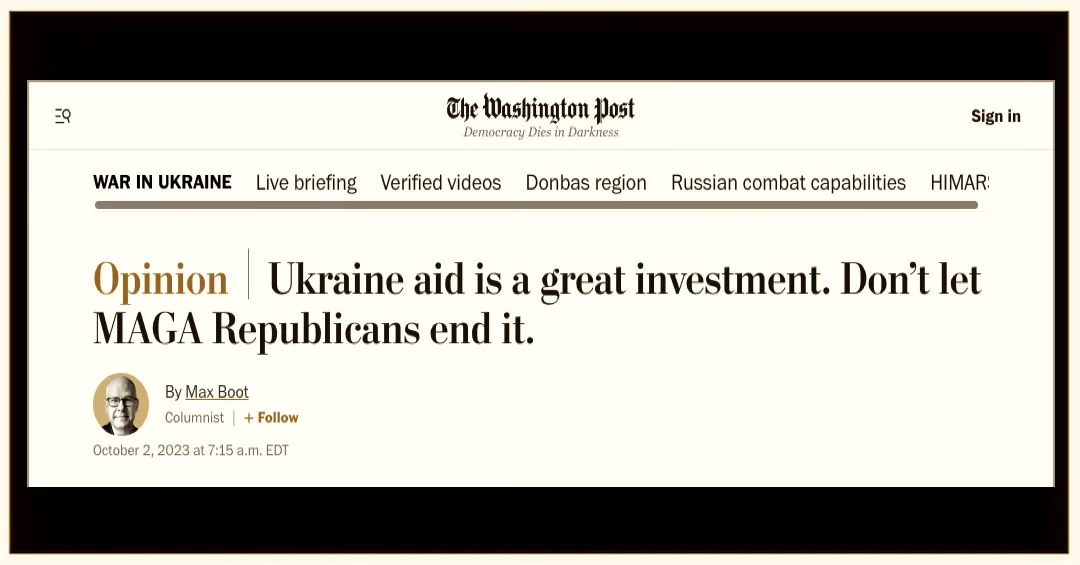
Even body counts and truck counts from the Vietnam War era are being brought back to show what a great “investment” the Ukraine War has been for the U.S. In her latest, Caitlin Johnstone cites war-lover Max Boot for his advocacy of the Russia-Ukraine War as a continuing investment opportunity for the U.S., including the use of body and truck counts as a measure of progress:
“Russia has lost an estimated 120,000 soldiers and 170,000 to 180,000 have been injured,” [Max] Boot writes [in a Washington Post op-ed]. “Russia has also lost an estimated 2,329 tanks, 2,817 infantry fighting vehicles, 2,868 trucks and jeeps, 354 armored personnel carriers, 538 self-propelled artillery vehicles, 310 towed artillery pieces, 92 fixed-wing aircraft and 106 helicopters.”
“The Russian armed forces have been devastated, thereby reducing the risk to front-line NATO states such as Poland and the Baltic republics that the United States is treaty-bound to protect,” Boot continues. “And all of that has been accomplished without having to put a single U.S. soldier at risk on the front lines.”
“That’s an incredible investment,” gloats Boot.
At no time in his masturbatory gushing about how many Russians this war has helped kill does Boot make any mention of the immense toll this deliberately provoked and completely unnecessary war has taken on Ukrainian lives. Their deaths and dismemberments and displacement are the largest price being paid into this “investment” by far, but Boot doesn’t deem them worthy of even a footnote.
We’ve been seeing this “investment” line being promoted with increasing frequency by US empire managers and their apologists. In an article published in the Connecticut Post last month, Senator Richard Blumenthal assured Americans that “we’re getting our money’s worth on our Ukraine investment.” A few days prior to that Senator Mitt Romney had described the proxy war as “the best national defense spending I think we’ve ever done,” because “We’re diminishing and devastating the Russian military for a very small amount of money… a weakened Russia is a good thing.” In December Senate Minority Leader Mitch McConnell said that funding the proxy war is “a direct investment in reducing Vladimir Putin’s future capabilities to menace America, threaten our allies and contest our core interests.” Last November the imperial war machine-funded think tank Center for European Policy Analysis published a report arguing that “US spending of 5.6% of its defense budget to destroy nearly half of Russia’s conventional military capability seems like an absolutely incredible investment.”
Imagine the vacuity, the bankruptcy, the venality, the sinfulness of writing about war and killing as “an absolutely incredible investment.” And what is our ROI, our return on investment? A lot of dead and wounded Russians and Ukrainians, a devastated and poisoned landscape, millions of war refugees, and an increasing likelihood of a wider war that could possibly go nuclear. ROI, indeed.
War is many things, but it is not an “investment.” People who talk and write like this have no moral center. They are soulless. They are automatons of war.
 Bracing Views