Taking On the Military-Industrial Complex

W.J. Astore

To Fight the Unbeatable Foe

To dream the impossible dream/To fight the unbeatable foe/To bear with unbearable sorrow/To run where the brave dare not go …

Whether you call it the military-industrial complex (MIC), the national security state, the MICIMATT,1 the blob, or something else entirely, taking on the MIC and trying to restrain its influence and power is akin to dreaming the impossible dream.

President Eisenhower warned us about the grave threat posed to liberty and democracy by the MIC in 1961. In the early 1980s, as a college student, I wrote against the growth of the MIC and massive Pentagon spending under President Ronald Reagan. After I retired from the military, I started writing articles, giving interviews, etc. against the MIC and militarism in America. I’ve been doing it for fifteen years, and it hasn’t made any discernible difference. Why should it?

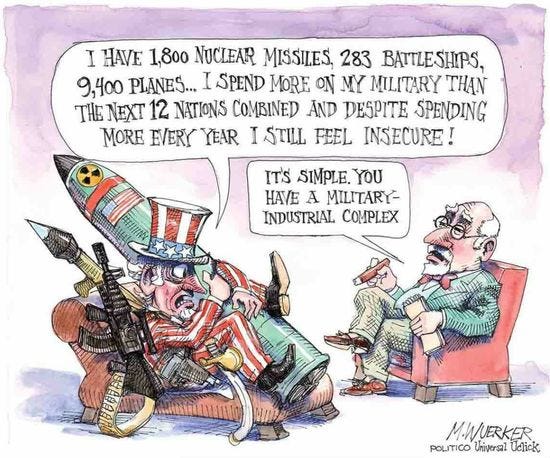
The MIC is massive and massively powerful. It consumes more than half of the federal discretionary budget. It employs millions of people. It is wildly profitable for major military contractors like Boeing, Lockheed Martin, and Raytheon. It is sold as essential to America’s national security and safety. Its uniformed members are lauded as heroes. We are all as Americans immersed in a matrix of militarism and imperialism since birth; to fight against it, then, is often seen as un-American.

Spoiler alert: I have no easy answers. There are no silver bullets. Ike called for an alert and knowledgable citizenry (that’s us) who would act as guards against the growing anti-democratic power of the MIC. The MIC responded by making sure we are kept largely docile and ignorant of its plans and actions.

When brave Americans do speak up, they are punished. Not people like me—I’m small fry. I mean people like Martin Luther King Jr., who called America the world’s greatest purveyor of violence during the Vietnam War. That speech made him unpopular even among many of his followers; exactly one year later, he was shot and killed.

People who truly pose a threat to the MIC are taught a lesson. Congresswoman Tulsi Gabbard, at the time also a major in the Hawaii Army National Guard, was smeared by NBC News as a Russian asset when she announced her candidacy for president in 2020. Gabbard was the only mainstream candidate criticizing the MIC and its disastrous regime-change wars. Dennis Kucinich, who bravely advocated for a Department of Peace, was sidelined and silenced by his own party (the Democrats). Jill Stein, who ran in 2016 as the Green Party candidate for the presidency, was also smeared as a “useful idiot” for Russia because she called for major reductions to war budgets.

There are many examples of brave Americans fighting the MIC. Edward Snowden told the truth about abuses of power by U.S. intelligence agencies; he’s in exile in Russia. Chelsea Manning went to prison for bravely exposing war crimes in Iraq. Daniel Hale is in prison for exposing the murderous results of America’s drone wars. Even foreign journalists like Julian Assange aren’t safe. Assange embarrassed the MIC and partially exposed the hideous face of war to Americans, and for that he’s being held in a maximum security prison under conditions meant to break him physically and mentally.

What is to be done? It’s flattering to me that a few readers think I might have answers. I have none. I’m not an organizer, I’m not an agitator or protester, I’m just a retired military schmuck looking for a new way forward for our country (and, by extension, for the planet). A new cold war is not a new way forward. Indeed, a new cold war will only ensure a hotter future for us all, if not an irradiated one.

McGovern, a bomber pilot and war hero, never bragged about his war experiences

I think George McGovern had the right approach in 1972. “Come home, America,” McGovern said. Stop trying to dominate the world. Stop claiming that democracy can be spread by bullets and bombs. Downsize the military and the whole MICIMATT and with the money saved send a check to every American. Call it a true peace dividend.

Support our troops—bring them home, is a commonsense message that holds appeal. Returning to Eisenhower, Ike once said that only Americans can truly hurt America. We hurt America when we exaggerate threats overseas, when we give blank checks to warmongers, indeed when we forget how hellish war truly is and how corrosive it is to our democracy (what’s left of it) and our way of life.

I’ve written so much about this that I know I’m repeating myself. And I’m probably preaching to the choir as well. But the choir must keep singing, even when the dogs of war howl to drown us out.

America needs a reformation or a revolution. A restoration of liberty where war and militarism are seen as the antithesis of liberty. Why can’t America be a shining city on a hill? Why do we instead choose to be a dark fortress bristling with cannons?

To dream the impossible dream/to fight the unbeatable foe …

1

Military-industrial-congressional-intelligence-media-academia-think tank complex. An awkward acronym that does help to capture the size and reach of the national security state. The MIC itself is supported by the mainstream media, many colleges and universities that are funded by the DoD, and all those think tanks in the DC area that are often funded by major weapons makers. Truly a Goliath awaiting a David with a slingshot.

Why Did Eisenhower Fail in 1961?

W.J. Astore

Perhaps America, Home of the Brave, Simply Fears Too Much

In 1961, in his famous farewell address, President Dwight D. Eisenhower warned America about the military-industrial complex. He said it potentially posed a grave threat to liberty and democracy, noting that only an alert and knowledgable citizenry could keep its “disastrous rise” in check. In an earlier draft of his speech, Ike had included Congress as part of the complex, but he removed it from the final draft in the interest of parting with Congress on good terms.

Ike, of course, knew the military and loved it and had worked with industry as well. He knew of what he spoke. Every year when he was president, the military wanted more. So did the weapons manufacturers. And Congress was willing to give them more in the name of jobs and for that nebulous cause of national security. Ike did a decent job as president containing the ambitions of the military and the greed of America’s merchants of death. His speech in 1961 was his parting shot across the bow of the complex and a warning that’s largely been forgotten by Americans then and now. 

Ike, I think, would be dismayed but not shocked at how the military-industrial complex or MIC has expanded its “misplaced” power over the last sixty years. The MIC is now the MICIMATT, or the military industrial congressional intelligence media academia think tank complex, employing millions of Americans in pursuit of full-spectrum dominance across the globe. In fact, America has proudly become a warrior nation (the citizen-soldier ideal is long dead) with 750 bases around the world and military budgets that routinely touch or exceed a trillion dollars. Permanent war is the new normal in America, justified as always in terms of making the world safe for democracy.

In the spirit of Ike, we should recognize the military or industry or Congress alone is not the enemy. It’s the conjunction of an immense military establishment with powerful industrial interests, and the enabling of the same by Congress, that needs to be addressed and reformed.  

Yet, given its enormity and its power, the complex is remarkably resistant to change, let alone to being shrunk and weakened. It will take enormous national will, working against powerful propaganda forces that will paint every Pentagon budget reduction, large or small, as unsafe if not un-American.

So why did Ike fail?  Or why did we fail Ike?  He warned us in 1961.  Why have we as “an alert and knowledgable citizenry” failed to guard against the acquisition of “disastrous” power by the MIC?

For the truth is America has become an Orwellian country where war is peace.  War (or preparations for war) has been continuous since Ike’s speech.  Our government wages war in the alleged cause of peace.  It acts imperially in the name of democracy, and we collectively accept or tolerate the tale that Big Brother tells us.

Short of a revolution, what America needs is radical honesty. An awakening.  If we truly want as a people to pursue peace, we can’t do that by constantly waging war.  If we truly favor democracy, we can’t pursue one through militarism and imperialism.

What kind of nation — what kind of people — do we want to be? Judging by our federal discretionary budget and by the general affection for all things military in our nation, perhaps we want to be a bellicose empire. I’m not saying all Americans want this; even those who do probably wouldn’t state it so baldly. But maybe this is just who we are, a nation and a people convinced that it’s always at risk, and thus one that’s forever fearful, hyper-vigilant, coiled to strike and ready to rumble.

“Quite an experience to live in fear, isn’t it? That’s what it is to be a slave.” So says Roy Batty, the doomed replicant in Blade Runner, played so brilliantly by Rutger Hauer. There’s a lesson here for all of us. The first step to heeding Ike’s warning, as well as his marching orders to us, is to control our collective fear. To stop listening to threat inflation about China or Russia or Iran or terrorism or whatever. Fear is the mind-killer, Frank Herbert noted in Dune, thus to think freely requires us to master that which kills thought. Fear, Master Po said in Kung Fu, is the only darkness.

We will only begin to downsize the military-industrial complex and end our pursuit of militarism when we acknowledge our fear, stop being slaves to it, and head away from the darkness.

America is the home of the brave, so we say. Isn’t it time we acted like it?

The Military-Industrial Complex Wins Again!

W.J. Astore

Election 2022 Truly Had a Clear Winner

With Veterans Day in mind, I was asked as a retired U.S. military officer for a comment on the 2022 election results, which produced this:

When both political parties pose as pro-military, when both are pro-war, when both are enablers of record-high Pentagon spending, when both act as if a new cold war with China and Russia is inevitable, do election results even matter?  No matter which party claims victory, the true victor remains the military-industrial-Congressional complex.

We have a winner, America!

To paraphrase Joe Biden, nothing fundamentally changed in the 2022 elections when it comes to colossal military spending, incessant wars and preparations for the same, and non-stop imperialism around the globe. There is no new vision for lower Pentagon spending, for fewer wars and weapons exports, and for a smaller, less domineering, imperial mission.

As General and President Dwight D. Eisenhower warned us in 1961, the military-industrial-Congressional complex represents a disastrous rise of misplaced power that is profoundly anti-democratic. Collectively, we’ve failed to heed Ike’s warning. The result has been one unnecessary and disastrous war after another, even as democracy in America withers. The Vietnam War—disaster. The Iraq War—disaster. The Afghan War—disaster. The War on Terror—disaster. Even the war America ostensibly won, the Cold War against the USSR, is now apparently about to be refought.

I suppose we need to refight the Cold War we “won” thirty years ago so we can lose that one too.

With the Democrats doing somewhat better than expected at the polls, war business should continue to grow in Washington, D.C. Most political commentators seem to think this is a good thing, when they think about it at all. Few seem to recall Ike’s warning that a military establishment of vast proportions is antithetical to democracy.

In this election cycle, I’ve heard nothing about peace. I’ve heard nothing about strengthening and preserving democracy by downsizing our military and imperial presence around the globe. Not from Democrats and Republicans.

So the winner in 2022 is the same winner as always: the military-industrial-Congressional complex. It’s a sad result to contemplate with Veterans Day looming.

Dammit, Where’s My Peace Dividend?

W.J. Astore

Just over 30 years ago, as a young captain in the Air Force, I was celebrating the collapse of the Soviet Union and the arrival of “the new world order.”  Those were the days!  We talked seriously about peace dividends, about America becoming a normal country in normal times, as in peaceful times.  Money on wars and weapons would be redirected to infrastructure improvements and repairs, to critical research in medicine, to improving health care, to renewable sources of energy.  America was ready to vault into the 21st century, no longer haunted by a cold war that could end the world in a heartbeat with nuclear war.

Leave it to America to snatch defeat from the jaws of victory.  For we truly have defeated ourselves since 1991 in our embrace of militarism, weaponry, and war.  And now we face renewed fears of nuclear war without any serious movement to end the proliferation of nuclear weapons.  Indeed, the U.S. military speaks of “investing” in more nuclear weapons as if they’re a growth stock, as if there are dividends awaiting us when we cash them in.  We’ll all cash in our chips, that’s for sure, if the missiles fly.

We seem possessed by a form of MADness, a certain fondness for mutually assured destruction (MAD).  Or, perhaps not fondness but resignation bordering on defeatism, which makes me think of those old posters we had as kids about nuclear war that reminded us there was little we could do once the missiles were launched, so we may as well kiss our ass goodbye.

But the world nevertheless remains full of surprises.  Color me amazed by America’s new love of Ukraine, formerly a Soviet republic that most Americans still can’t place on a map.  (I’ve seen Americans quizzed on the street who place Ukraine in Mexico or Australia.)  We love Ukraine so much that we’re willing to pledge $100 billion or more in aid, most of it in the form of military weapons and training.  America has never had a “special relationship” with Ukraine, so what gives?  My friends tell me we must defend democracy in Ukraine, but democracy doesn’t exist there (nor does it in America, but that’s another story).

The words of Darth Vader come to mind: “You don’t know the power of the Dark Side [of the Force].  I must obey my master.”  And in the case of Congress, that master is obviously the national security state, the MICIMATT of which Congress is a card-carrying member. (MICIMATT: Military-Industrial-Congressional-Intelligence-Media-Academia-Think-Tank Complex.) Think of it as the real “evil empire,” and good luck trying to resist its power and influence.    

Yet, how can America have turned to the “dark side”?  Isn’t America a collection of Jedi knights fighting for freedom?  It sure would be nice to think so!  But when you look at America’s wars in places like Vietnam, Iraq, and Afghanistan, what you see is an incredibly rich empire throwing almost everything at countries and peoples who had little if anything compared to the wealth and power of the U.S. and its ferocious military machine.  You also see enormous profiteering, especially by the “industrial” side of the America’s militarized complex, and incessant lying by the U.S. government about progress and “winning” in its various misbegotten wars.

Only when military defeat is nearly total do U.S. troops finally come home, after which the peace advocates, relatively few in number, are blamed for weakening fighting spirit at home.

Promises of peace dividends, whether after World War II or the Cold War, have simply withered away as wars of conspicuous destruction (Vietnam, Iraq, etc.) fed a society engaged in conspicuous consumption.  A militarized form of Keynesianism provided jobs and wealth for relatively few Americans at the expense of a great many.

Paradoxically, even as America’s wars went bad, no one was ever held accountable.  When the warmongers admitted they were wrong (a rarity), they argued they were wrong for the right reasons.  And those who were truly right, whether about Vietnam or Iraq or Afghanistan, were obviously right for the wrong reasons.  Those “wrong” reasons included preferring peace to war or daring to question the purity of U.S. motives and methods when it came to foreign wars.

And so we’ve come to the point when the so-called Progressives in Congress quickly cave to pressure and withdraw a milquetoast and mealymouthed letter that argued a tiny bit for diplomatic efforts by the Biden administration to end the Russia-Ukraine War.  It was as if they’d become quislings; as if calling for negotiation was equivalent to bowing and scraping before Vladimir Putin.

So, I return to my question: Dammit, where’s my peace dividend?  And the answer is nowhere because powerful forces in America simply love their war dividends — and they’re not about to surrender them.

Note to readers: If you’d like to comment, please go to Bracing Views on Substack. Thanks.

To Help the U.S. Military, Slash the Pentagon Budget

Isn’t it reassuring to know your taxpayer dollars are buying lots of “Ferraris” for the U.S. military?

W.J. Astore

If you truly want to help the U.S. military, slash its yearly budget.

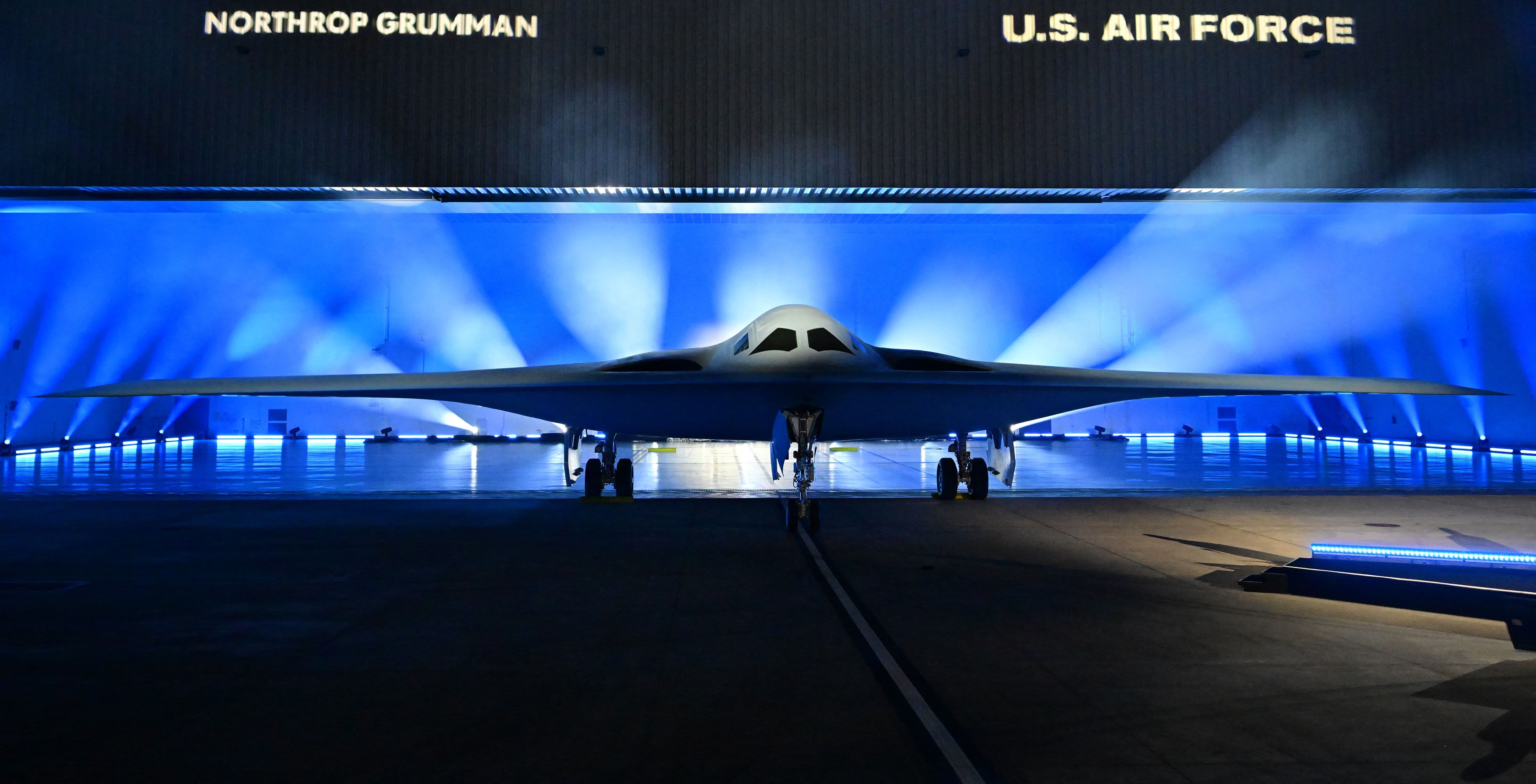
It’s counterintuitive, right? We think more money will help the Pentagon field effective forces and to be better prepared to defend America. But that hasn’t proven to be the case. The more money the Pentagon gets, the more money gets spent on unnecessary and often poorly performing weapons systems. Take my old service, the U.S. Air Force. It doesn’t need the B-21 bomber. It doesn’t need new ICBMs. The F-35 fighter is a major disappointment, a “Ferrari” according to the Air Force Chief of Staff, i.e. an exotic and temperamental plane you fly only on occasion, which isn’t what the Air Force wanted or needed. Similarly, the Navy is building aircraft carriers that can’t launch planes effectively and “little crappy ships” that have no role at all. And the Army has thousands of M-1 Abrams tanks parked in storage that it’ll probably never use.

Do you have a friend with too much money? Maybe he got an inheritance or some other windfall. And the money makes him stupid. It’s stipulated in the inheritance that he must spend all of it within a year or two (the way Pentagon appropriations work), and if he fails to spend it, he’ll get less in the future. So he spends wildly, without giving it much thought, because he’s got the money and because he has to. And spending money on expensive “Ferraris” is fun. He’s not encouraged to think about how to use the money wisely, rather the reverse. So he just buys big ticket items willy-nilly.

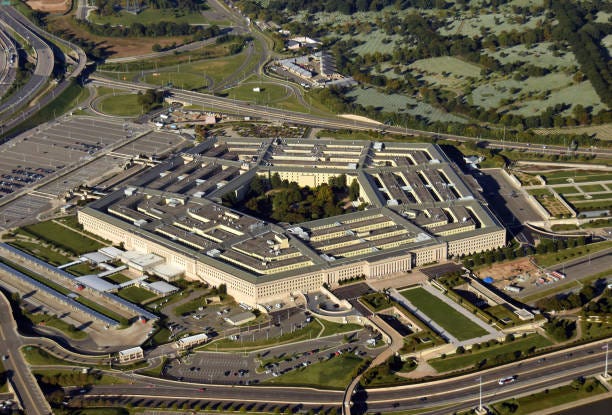
Congress, of course, is the Pentagon’s enabler. Whatever the military wants nowadays, Congress is determined to give the brass more, in the false name of supporting the troops. It’s not the troops that see the money, it’s the industrial side of Ike’s military-industrial complex that profits the most. There’s something truly unseemly about Congress throwing money at the Pentagon while camp-following weapons contractors siphon it up.

Technically, incredibly, the U.S. military is no longer at war, i.e. “large-scale combat operations,” according to Secretary of Defense Lloyd Austin. Perhaps you missed the announcement that new U.S. troops coming on active duty wouldn’t automatically receive the National Defense Service Medal, as they have since 9/11 and the subsequent global war on terror. With those “large-scale” wars finally ended, shouldn’t the Pentagon’s budget decrease in a big way? Wars in Iraq and Afghanistan were costing the U.S. over $100 billion a year, yet as they have ended, the Pentagon’s budget has increased by more than $100 billion. Talk about counterintuitive! Wars end as war budgets increase. Only in America.

There is no logic here. I’m reminded of a scene from the original Star Trek in which Spock is befuddled by an attack on Captain Kirk because there’s apparently no logic to it. As an alien patiently explains to Spock, “Perhaps you should forget logic and devote yourself to motivations of passion or gain.” It’s a telling lesson for anyone looking to explain the illogic of America’s defense budget.

Get rid of the passion and gain in the Pentagon’s budget, America. It’s time to use logic and make major cuts. Force the military to think rather than to spend. Who knows … we may end up with a leaner, even a smarter, military, one committed less to war and more to supporting and defending the U.S. Constitution.

The Betrayal of Dwight D. Eisenhower by His Own Memorial in Washington DC

Eisenhower knew war and hated it. He spoke of spending on wars and weapons as humanity crucifying itself on a cross of iron. He warned America in the strongest terms of the perils of the “military-industrial complex.” The Eisenhower Memorial in DC fails to capture his most powerful and memorable sentiments against war

W.J. Astore

Dwight D. Eisenhower’s most famous address was his last one to the nation in January of 1961, when he warned America of what he termed “the military-industrial complex.” It was a warning as powerful as it was prescient, and though Ike achieved much in life, surely this speech and the meaning of his warning deserve to be captured in the boldest terms in the memorial to Ike in Washington, DC.

Sadly, it isn’t. Though I haven’t yet seen the monument in person, images of it are available online with audio commentary. Let’s tackle the audio commentary first. In Part 5, “Leader of the Free World,” the narrator speaks of Ike’s “farewell address,” not his address on the military-industrial complex, and that it included a “caution” (not a “warning”) to the nation. Ike is allowed a few sentences on the military-industrial complex, but the narrator provides no additional context or commentary. The narrator then ends by saying this was Ike’s goodbye speech; again, no mention of how powerful Ike’s speech was in its criticism of a force that Ike declared threatened America’s democracy and our personal liberties. And then the kicker: at the end of the narration, we’re told the audio commentary was made possible by “a generous donation” by Boeing!

I burst out in rueful laughter. Of course Ike’s warning about the military-industrial complex was played down; the military-industrial complex funded the audio commentary! I felt like Ralphie in “A Christmas Story” when he discovers his secret magic decoder ring is only useful for decoding crummy commercials that urge him to drink his Ovaltine.

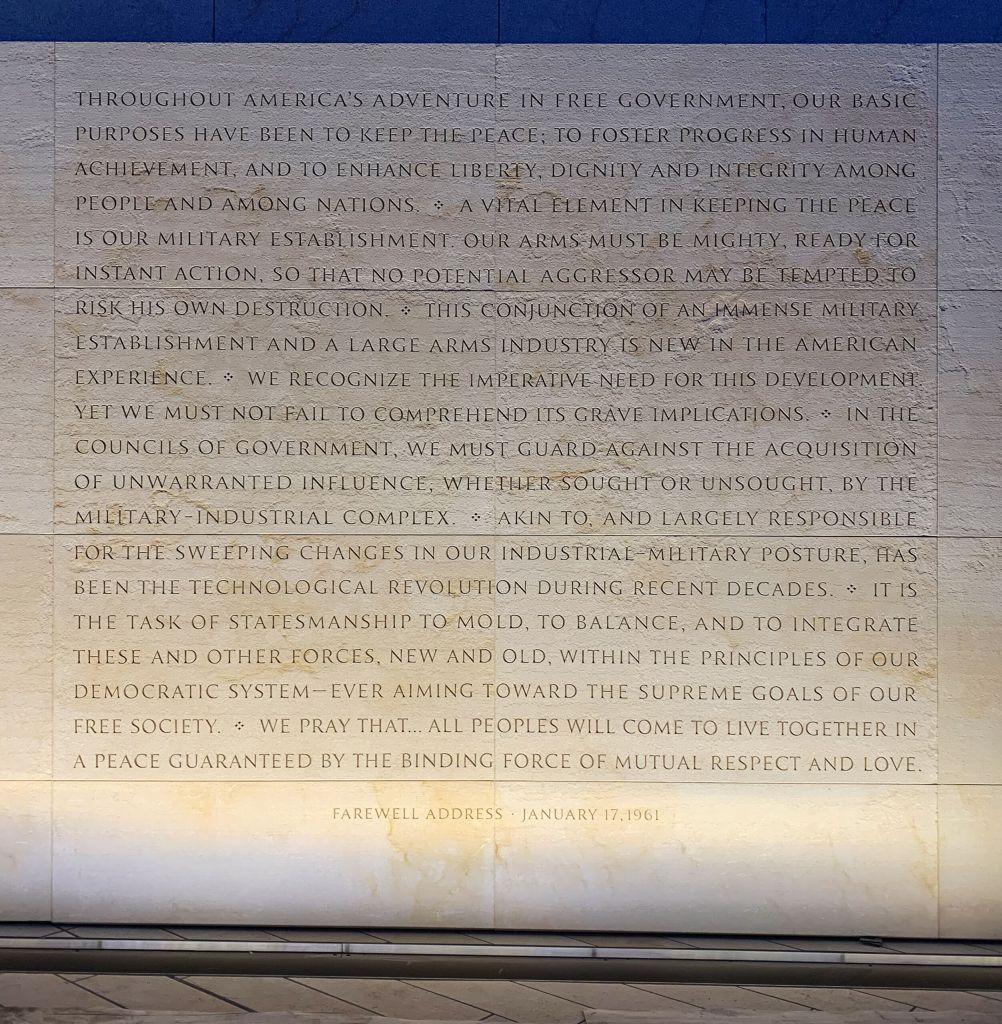
Turning to the memorial inscriptions themselves, here is the one for Ike’s “farewell address”:

Throughout America’s adventure in free government, our basic purposes have been to keep the peace; to foster progress in human achievement, and to enhance liberty, dignity and integrity among people and among nations. A vital element in keeping the peace is our military establishment. Our arms must be mighty, ready for instant action, so that no potential aggressor may be tempted to risk his own destruction. This conjunction of an immense military establishment and a large arms industry is new in the American experience. We recognize the imperative need for this development. Yet we must not fail to comprehend its grave implications. In the councils of government, we must guard against the acquisition of unwarranted influence, whether sought or unsought, by the military-industrial complex. Akin to and largely responsible for the sweeping changes in our industrial-military posture, has been the technological revolution during recent decades. It is the task of statesmanship to mold, to balance, and to integrate these and other forces, new and old, within the principles of our democratic system — ever aiming toward the supreme goals of our free society. We pray that…all peoples will come to live together in a peace guaranteed by the binding force of mutual respect and love.

Farewell Address
January 17, 1961

Notice how Ike’s warning (which I’ve bolded) about the military-industrial complex is buried in the text. Even more critically, the very heart of Ike’s warning is torn out. For here are Ike’s words that followed the warning about a military-industrial complex, and which are omitted on the memorial:

The potential for the disastrous rise of misplaced power exists and will persist.

We must never let the weight of this combination endanger our liberties or democratic processes. We should take nothing for granted. Only an alert and knowledgeable citizenry can compel the proper meshing of the huge industrial and military machinery of defense with our peaceful methods and goals, so that security and liberty may prosper together.

Why weren’t these powerful words of Ike also engraved in stone? Could it be because no one in the DC area, especially the military, its many corporations, and the Congress, wants the American people to come to grips with “the disastrous rise of misplaced power” in America?

Putting this memorial together required corporate funding. Congress was also heavily involved. So too was the military. Is it any wonder that Ike’s warning about the military-industrial-Congressional complex has been watered down to a “caution” and buried in the text of a fond “farewell”?

Remember, Ike implored us to be alert and knowledgeable citizens. How can we be when his speeches are bowdlerized at his own memorial and the audio commentary to the same is funded by Boeing?

It’s easy to lose the thrust of Ike’s powerful warning about the military-industrial complex when it’s buried in the middle of this monument, and when Ike’s strongest words weren’t even included

You truly need to sharpen your focus if you want to catch a glimpse of what truly worried Ike:

Something tells me that Ike, if he were alive today, would be none too happy about this. Ike’s memorial celebrates his boyhood, his service and great victory in World War II, and his presidency, but it fails to capture his finest speeches against war, against wasteful and immoral spending on deadly weaponry, and against a powerful alliance among the military, its weapons makers, and Congress that Ike saw as a fundamental threat to liberty and democracy.

Our monuments betray us, America, in more ways than one.

Why Did Nancy Pelosi Go to Taiwan?

W.J. Astore

House Speaker Nancy Pelosi’s trip to Taiwan was a disaster. It angered China, provoking a military response (missile firings and the like) that could escalate into something far worse. It interfered with cooperative efforts between China and the U.S. on vitally important fronts such as climate change. And it featured a startlingly incoherent speech by the Speaker in which she implied Benjamin Franklin was an early U.S. president as she proceeded to misquote and butcher his sentiment on liberty and security. Jimmy Dore does an excellent job here of allowing Pelosi to slay herself with her own words:

So, why did she go to Taiwan? Putting aside her own conceit and vainglory, she went for two reasons. The first was domestic politics. Just as the Democrats have (falsely) accused Trump and the Republicans of being soft on Russia, the Republicans have (falsely) accused Biden and the Democrats of being soft on China. Pelosi’s trip was meant to inoculate the Democrats against charges of “softness” vis-a-vis China. Meanwhile, as both major political parties accuse the other of being “soft” vis-a-vis regional powers (China, Russia), the military-industrial complex continues to cash in with record-setting “defense” budgets.

The second reason is connected to the first. Pelosi’s trip has generated the response the military-industrial complex was looking for from China. Thus on NBC News today, you see the following article that touts a resurgent Chinese military and how it constitutes a major threat to U.S. imperial dominance in the Pacific. The conclusion you’re supposed to draw from this is simple: China is a big-time threat to America, therefore we must spend even more money to “rebuild” America’s military to meet that threat.

There’s possibly a third reason, and that is the unreliability of Joe Biden and Kamala Harris as deliverers of a coherent message. Both Biden and Harris rely heavily on teleprompters; when they depart from the script, Biden is liable to blurt out inappropriate remarks that need to be “walked back” by aides, whereas Harris has a tendency to laugh inappropriately to cover her confusion. It’s doubly ironic that the Speaker of the House, sent to speak for America and the Democrats, spoke so poorly and confusingly.

This is no laughing matter, since diplomacy depends on clear communication. Certainly, the Chinese are speaking clearly with their military exercises and diplomatic warnings. That America’s leaders can’t speak clearly and exercise sound judgment is assuredly the clearest sign yet of U.S. decline, a decline that will not be arrested by throwing more money at the military.

Sound policy requires sound leaders. Whatever else one might say, the words of Biden, Harris, and Pelosi are unsound, marking them as not just ineffective leaders but dangerous ones.

I keep this globe in my office. It comes in handy to remind me of America’s “global reach” and “global power.” You can see how close Taiwan is to mainland China, and also how far Taiwan is from the U.S. But of course U.S. hegemony has no geographical limits, hence the presence of roughly 750 U.S. military bases globally. The world is not enough, since the U.S. must dominate space and cyberspace as well. Perhaps Nancy Pelosi should give her next muddled speech from low Earth orbit. Or the Moon?

American Exceptionalism

W.J. Astore

Two images of American exceptionalism to mull over today. The first shows how exceptional the U.S. is with its military spending:

Of course, U.S. military spending is projected to rise in FY 2023 to $840 billion or so. Note how most of the countries that spend significant sums on their military are U.S. allies, such as Germany, the U.K., Japan, and South Korea. Russia is weakening due to its war with Ukraine, yet U.S. military spending continues to soar because of alleged threats from Russia and China.

The second image is a spoof sent by a friend, but it wouldn’t entirely surprise me if it did become the official seal of the Department of Education:

Jesus riding a dinosaur: Why not? We have serious museums for creationists in the U.S., where dinosaurs wear saddles and Adam and Eve are depicted as cavorting with creatures dating to the Jurassic and Cretaceous eras. I’m not sure how they all fit on Noah’s ark, but the Lord does work in mysterious ways.

Given the emphasis on gun rights, babies, and Jesus in America, perhaps the bald eagle isn’t our best national symbol. Perhaps it should be the Baby Jesus holding an assault rifle. It certainly would give new meaning to “love God” and “love thy neighbor.”

The Giant War Robot that Rules America

Not exactly the “Great Society” envisioned by LBJ in the 1960s. How long before war becomes both programmed and automated into our society as an unstoppable force?

W.J. Astore

Readers, I admit to you I’m demoralized after seeing this news a couple of days ago:

The House on Thursday passed, 329-101, its version of the fiscal 2023 National Defense Authorization Act, which would authorize $840.2 billion in national defense spending.

I’ve been writing against massive and unnecessary spending on wars and weapons since the early 1980s, when I did a college project that was highly critical of the Reagan “Defense Buildup” under then-Secretary of Defense Caspar Weinberger. Those were the days when there was a real movement against Reagan’s pursuit of the MX “Peacekeeper” ICBM and the deployment of nuclear-tipped Pershing II and GLCMs (ground-launched cruise missiles, or “glick-ems”) to Europe. The Nuclear Freeze Movement helped to stimulate talks between Reagan and Gorbachev that led to the elimination of weapons like the Pershing II, the GLCMs, and Soviet SS-20s, introducing a small sliver of (temporary) sanity to U.S.-Soviet relations.

Then came the collapse of the Soviet Union in 1991 and America’s unipolar moment of triumph. Who knew that 30 years later, America would be vigorously advancing and inflating a new Russian threat that would then be used to “justify” renewed spending on all sorts of esoteric, exorbitant, and wildly unnecessary weaponry to feed the never-satiated military-industrial-congressional complex (MICC). I didn’t predict it, that’s for sure.

For the last 15 years, I’ve been writing for TomDispatch.com, averaging six articles a year whose main theme has been the often colossal failures of the MICC and the total lack of accountability for the same. Never has failure bred so much success for an institution. And the institution itself, I truly hesitate to write, is woefully lacking in integrity. Whether it was the Pentagon Papers in Vietnam, the Afghan War Papers, the lies about WMD in Iraq that precipitated the disastrous Iraq War in 2003, or that hoary chestnut about babies being ripped from incubators in Kuwait that helped to justify Desert Shield/Storm in 1991-92, the American people have been told so many lies about war by “their” MICC that it boggles the mind.

And don’t even get me started about how the military lied about Pat Tillman’s death, tarnishing the legacy of a brave soldier inspired by service and idealism.

People with integrity who try to tell us the truth about America’s wars, like Chelsea Manning and Daniel Hale, end up in jail. The liars and the ones who always get it wrong end up being richly rewarded and often promoted to the highest levels.

This has to end, or America itself will come to an end. And it’s so frustrating because, again, I’ve been writing about this, off and on, for forty years, and steadily over the last 15 years. But nothing I say or write, or other critics like Andrew Bacevich and William Hartung say or write, makes any difference, so it seems, as the MICC continues to become the giant war robot that rules America.

Military Spending Robs Workers and the Poor

Ike was unafraid of plain and cruel truths

W.J. Astore

Unless you’re working for Raytheon or some other weapons contractor, you’re being robbed whenever our government spends excessively on the military, which is always. $54 billion of your money was stolen from you and sent to Ukraine, with much of it going to Raytheon and similar merchants of death. More than $813 billion will be spent next year on the Pentagon, with roughly half of that being unnecessary for true national defense. Excessive military spending is a form of theft in which workers and the poor are the biggest victim.

My point here isn’t original. President Dwight D. Eisenhower said it nearly 70 years ago in 1953 in his brilliant “Cross of Iron” speech. In Ike’s words:

Every gun that is made, every warship launched, every rocket fired signifies, in the final sense, a theft from those who hunger and are not fed, those who are cold and are not clothed.

This world in arms is not spending money alone. It is spending the sweat of its laborers, the genius of its scientists, the hopes of its children. The cost of one modern heavy bomber is this: a modern brick school in more than 30 cities.  It is two electric power plants, each serving a town of 60,000 population. It is two fine, fully equipped hospitals. It is some fifty miles of concrete pavement. We pay for a single fighter plane with a half million bushels of wheat. We pay for a single destroyer with new homes that could have housed more than 8,000 people.

This is, I repeat, the best way of life to be found on the road the world has been taking. This is not a way of life at all, in any true sense. Under the cloud of threatening war, it is humanity hanging from a cross of iron. These plain and cruel truths define the peril and point the hope that come with this spring of 1953.

Ike, a Republican, a retired five-star general, told it like it was, is, and remains. Excessive military spending isn’t a left-right issue. It isn’t a Democrat-Republican issue. It’s a class issue. It’s a moral issue. Ike knew this and was unafraid to say it.

Ike said we are crucifying ourselves with this militarized way of life. He chose this image deliberately for its Christian meaning and moral power. He spoke openly of “plain and cruel truths.” Ike, a true public servant, wanted to make a better America. He had no fear of the military-industrial-Congressional complex because he knew it so well and could resist its old siren song of perpetual war as being somehow in our national interest. I salute him for his honesty and his wisdom.

What do we need to do? We need to reject militarism, we need to reinvest in America, we need to reanimate our democracy, and we need to restore peace. We need more Americans to run and work on these 4 Rs. America needs a thoroughgoing reformation now or, mark my words, as my dad used to say, we will soon experience something far more disruptive and unpleasant.