Peace Hero Martin Luther King Jr.

W.J. Astore

MLK recognized the evils of racism, extreme materialism, and militarism

Martin Luther King, Jr., hero for peace.

It’s sad that the word “hero” is so often modified by or married to “war” in history. He’s a war hero, we say, without giving it too much thought. As if wars are somehow ennobling and sublime.

Waging peace is far more noble than waging war. MLK Jr. recognized this in his famous speech against the Vietnam War on April 4, 1967. Back in 2015, I posted this article on MLK and his warning that America was close to suffering a spiritual death in its constant warmongering. Today, we see America enabling genocide by Israel in Gaza with nary a complaint from those in power. Spiritual death, indeed.

*****
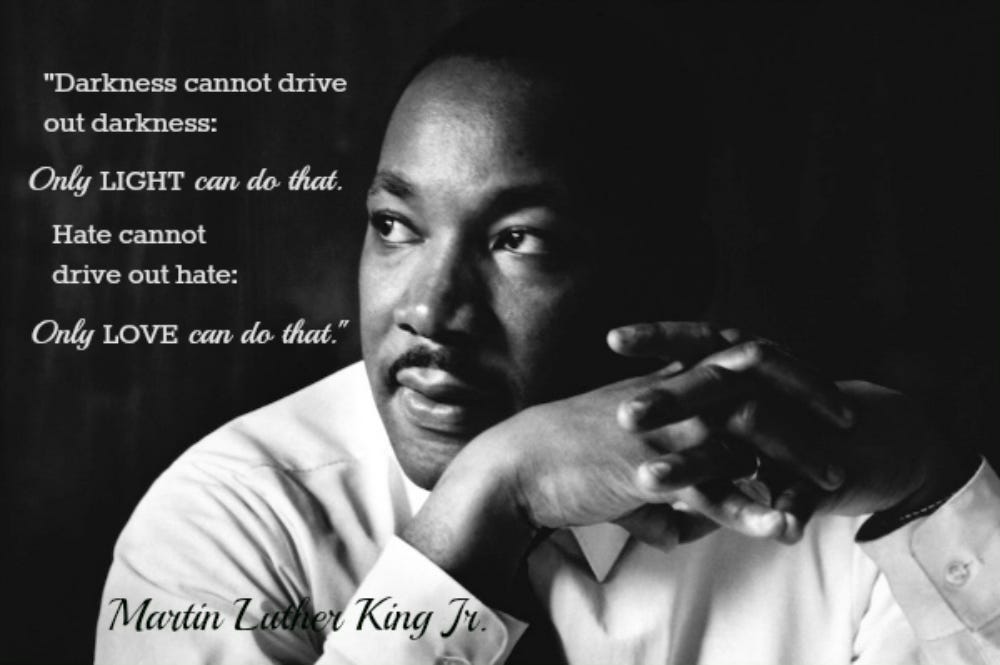
On April 4, 1967, Martin Luther King Jr. gave a powerful speech (“Beyond Vietnam – A Time to Break Silence”) that condemned America’s war in Vietnam. Exactly one year later, he was assassinated in Memphis.

What follows are excerpts from MLK’s speech. I urge you to read it in its entirety, but I’d like to highlight this line:

A nation that continues year after year to spend more money on military defense than on programs of social uplift is approaching spiritual death.

MLK called for a revolution of values in America. In his address, he noted that:

There is nothing except a tragic death wish to prevent us from reordering our priorities so that the pursuit of peace will take precedence over the pursuit of war.

MLK didn’t just have a dream of racial equality. He had a dream for justice around the world, a dream of a world committed to peace, a world in which America would lead a reordering of values in the direction of universal brotherhood.

Both of MLK’s dreams remain elusive. Racial inequalities and biases remain, though America is better now than it was in the 1960s in regards to racial equity. And what of a commitment to peace? Sadly, America remains dedicated to war, spending nearly a trillion dollars yearly on defense, Homeland Security, nuclear weapons, and “overseas contingency operations,” i.e. wars.

America has failed to dream the dreams of Martin Luther King, Jr., and we are the worse for it. (Bolded passages below are my emphasis.)

Excerpts from MLK’s Speech on Vietnam, April 4, 1967

At this point I should make it clear that while I have tried in these last few minutes to give a voice to the voiceless in Vietnam and to understand the arguments of those who are called “enemy,” I am as deeply concerned about our own troops there as anything else. For it occurs to me that what we are submitting them to in Vietnam is not simply the brutalizing process that goes on in any war where armies face each other and seek to destroy. We are adding cynicism to the process of death, for they must know after a short period there that none of the things we claim to be fighting for are really involved. Before long they must know that their government has sent them into a struggle among Vietnamese, and the more sophisticated surely realize that we are on the side of the wealthy, and the secure, while we create a hell for the poor.

Somehow this madness must cease. We must stop now. I speak as a child of God and brother to the suffering poor of Vietnam. I speak for those whose land is being laid waste, whose homes are being destroyed, whose culture is being subverted. I speak of the — for the poor of America who are paying the double price of smashed hopes at home, and death and corruption in Vietnam. I speak as a citizen of the world, for the world as it stands aghast at the path we have taken. I speak as one who loves America, to the leaders of our own nation: The great initiative in this war is ours; the initiative to stop it must be ours…

If we continue, there will be no doubt in my mind and in the mind of the world that we have no honorable intentions in Vietnam. If we do not stop our war against the people of Vietnam immediately, the world will be left with no other alternative than to see this as some horrible, clumsy, and deadly game we have decided to play. The world now demands a maturity of America that we may not be able to achieve. It demands that we admit that we have been wrong from the beginning of our adventure in Vietnam, that we have been detrimental to the life of the Vietnamese people. The situation is one in which we must be ready to turn sharply from our present ways. In order to atone for our sins and errors in Vietnam, we should take the initiative in bringing a halt to this tragic war…

It is with such activity in mind that the words of the late John F. Kennedy come back to haunt us. Five years ago he said, “Those who make peaceful revolution impossible will make violent revolution inevitable.” Increasingly, by choice or by accident, this is the role our nation has taken, the role of those who make peaceful revolution impossible by refusing to give up the privileges and the pleasures that come from the immense profits of overseas investments. I am convinced that if we are to get on the right side of the world revolution, we as a nation must undergo a radical revolution of values. We must rapidly begin…we must rapidly begin the shift from a thing-oriented society to a person-oriented society. When machines and computers, profit motives and property rights, are considered more important than people, the giant triplets of racism, extreme materialism, and militarism are incapable of being conquered.

A true revolution of values will soon cause us to question the fairness and justice of many of our past and present policies. On the one hand, we are called to play the Good Samaritan on life’s roadside, but that will be only an initial act. One day we must come to see that the whole Jericho Road must be transformed so that men and women will not be constantly beaten and robbed as they make their journey on life’s highway. True compassion is more than flinging a coin to a beggar. It comes to see that an edifice which produces beggars needs restructuring.

A true revolution of values will soon look uneasily on the glaring contrast of poverty and wealth. With righteous indignation, it will look across the seas and see individual capitalists of the West investing huge sums of money in Asia, Africa, and South America, only to take the profits out with no concern for the social betterment of the countries, and say, “This is not just.” It will look at our alliance with the landed gentry of South America and say, “This is not just.” The Western arrogance of feeling that it has everything to teach others and nothing to learn from them is not just.

A true revolution of values will lay hand on the world order and say of war, “This way of settling differences is not just.” This business of burning human beings with napalm, of filling our nation’s homes with orphans and widows, of injecting poisonous drugs of hate into the veins of peoples normally humane, of sending men home from dark and bloody battlefields physically handicapped and psychologically deranged, cannot be reconciled with wisdom, justice, and love. A nation that continues year after year to spend more money on military defense than on programs of social uplift is approaching spiritual death.

America, the richest and most powerful nation in the world, can well lead the way in this revolution of values. There is nothing except a tragic death wish to prevent us from reordering our priorities so that the pursuit of peace will take precedence over the pursuit of war. There is nothing to keep us from molding a recalcitrant status quo with bruised hands until we have fashioned it into a brotherhood.

Perhaps it seemed in 1967, even to MLK Jr., with all his experience to the contrary, that America could lead the world in a revolution of values, a pursuit of peace. MLK’s dream of such a revolution is dead, drowned in the vast profits of the merchants of death.

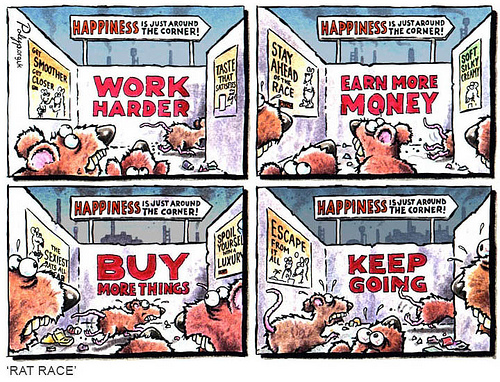
America, Land of Discontent

W.J. Astore

Binary logic is common in America. Us versus them. Republican versus Democrat. BLM versus BLM (that’s Black lives versus blue lives). Love it or leave it.

I remember as a teenager reading a coda to that saying: Or change it. If you don’t “love” America, you shouldn’t have to leave it. Indeed, if you truly “love” America, you’d want to change it to make it even better.

This idea was on my mind as a I watched a couple of videos on YouTube by Americans who’ve been living overseas for many years, only to return recently and reflect on how life in America seemed to them after being away for so long. Here are a few notes I jotted down:

Features of America: Consumerism. Materialism. Advertising everywhere, especially for prescription drugs. Fast pace of life and a stress on competition. A mainstream media that’s propagandistic — and that pushes fear and outrage. Only two major political parties that stifle debate and change. Constant divisiveness.

Features of Americans: Stress on individualism and ethnocentrism. Empathy and our common humanity is downplayed. Sense of entitlement. Lack of curiosity about the wider world. A lack of purpose in the sense of living a life of meaning. Lack of integrity, especially at the higher levels of government and the corporate world.

These observations reminded me of Michael Moore’s “Where to Invade Next” (2015). Moore goes to various countries (Germany, France, Italy, and so on), looking for ideas Americans can steal as they “invade.” I recall German workers who only had to work one job to make ends meet (roughly 37 hours a week, if memory serves), and also German workers who served by law on the board of major companies like Mercedes; I recall school lunches made for French kids by chefs using local ingredients (the contrast with American school lunches was stomach-turning); I recall Italian workers with six weeks of paid vacation per year, as opposed to American workers who are lucky to get two weeks. Why can’t America change to be more worker- and kid-and family-friendly?

The female leaders of Iceland, if memory serves, put it well near the end of Moore’s excursions. They said America is a me-me-me society, whereas Iceland prefers “we” to “me.”

I’ve written before about how Americans are kept divided, distracted, and downtrodden as a way of preventing meaningful, organized, societal change. Another “d” word related to this is discontent. Americans are often discontented in ways that inhibit change. It’s something Tana French touched on in her novel, “The Likeness,” from 2008. Here’s an excerpt:

Our entire society’s based on discontent: people wanting more and more and more, being constantly dissatisfied with their homes, their bodies, their décor, their clothes, everything.  Taking it for granted that that’s the whole point of life, never to be satisfied.  If you’re perfectly happy with what you’ve got—specially if what you’ve got isn’t even all that spectacular—then you’re dangerous.  You’re breaking all the rules, you’re undermining the sacred economy, you’re challenging every assumption that society’s built on. By being content, you become a subversive.  A traitor.

To which another character replies: “I think you’ve got something there.  Not jealousy, after all: fear… Throughout history—even a hundred years ago, even fifty—it was discontent that was considered the threat to society, the defiance of natural law, the danger that had to be exterminated at all costs.  Now it’s contentment.”

There’s a potential paradox here. Won’t the discontented favor positive change, whereas the contented will favor the status quo?

But French’s insight suggests otherwise. The discontented are so busy trying to become contented, most often through a me-first consumerism and materialism, that they can’t come together and mobilize for change. Fear drives them to pursue what their “betters” have, and to admire those people as well. It’s the contented who are dangerous, the ones who’ve left consumerism and materialism behind, the ones with the confidence, time, and independence of thought to contemplate a changed world, a better world. Perhaps even a better America.

Staying Sane in the Age of Trump

parallel-universe

Richard Sahn

As a social scientist living through horrific political, economic, and public health crises, I should be embracing with all my might philosophical materialism, the epistemological model behind science.  That I don’t could cost me personal and collegial respect, not to mention friendships. So, what exactly is philosophical materialism, and why do I find it ultimately non-collegial?

Philosophy precedes science.  It’s impossible to have science (or the sciences) without a presupposition about what is real, which is the arena of philosophy.  Philosophical materialism says that all that is real or factual is material or physical in nature.  And I find this too limiting.

I am more attuned to the Eastern philosophical model, intellectually supported these days by quantum physics, particularly the early 20th-century German physicist Werner Heisenberg.  It holds that non-material phenomena, such as dreams and hallucinations, are as real as physical phenomenon such as rocks and rivers, in one sense, even more real. (My dream is a reality sui generis. It is not electrochemical activity in my brain.) What’s more, all material and non-material phenomena come into existence from individual conscious intention and belief; there is no truly independent universe out there.

The good philosophical news here about the anti-materialist epistemological model is the plausibility of a multi-world or multi-dimensional universe.  If reality is a product of consciousness, rather than the other way around, it seems to me Franklin Delano Roosevelt’s claim that we have “nothing to fear but fear itself” is really possible. In fact, the psycho-therapeutic value of that statement is considerable.

But what do I do with my propensity toward progressive activism? And what do I do with those great discussions I have with my friends on how disgusting and horrible the Trump administration is? Can I have both perspectives at the same time? Emerson said that consistency is the hobgoblin of little minds. And it seems counterintuitive to be, following the Bible, “in the world but not of the world,” to see everyday life as play, as a sort of game created by me and only for me.

Don’t get me wrong.  I’m not arguing for “alternative facts,” as the supporters of Trump do.  I’m not denying science or the dangers of Covid-19.  When I go out, I social distance and wear a mask as needed.  But I also believe there is a reality outside of rocks and rivers, so to speak, a reality created by my consciousness, an immaterial realm that has its own existence, whether for me or for all of us.  Some might call this a “higher” realm; I prefer to see it as linked to the material, for I myself am both physical and mental, both material and immaterial.

Those epistemological paradigms, material and  immaterial, provide me with solace in these dark days.  Not everything is controlled by others, and especially not by the Cult of Trump.  I decide.  And for me that’s an empowering thought at a time when power is being actively denied to so many of us.

Richard Sahn is a retired sociology professor and a regular contributor to Bracing Views.

Divided, Distracted, Downtrodden: The Social and Political Reality in America Today

Consumerism1

W.J. Astore

The American people are being kept divided, distracted, and downtrodden.  Divisions are usually based on race and class. Racial tensions and discrimination exist, of course, but they are also exploited to divide people.  Just look at the current debate on the Confederate flag flying in Charleston, South Carolina, with Republican presidential candidates refusing to take a stand against it as a way of appeasing their (White) radical activist base.  Class divisions are constantly exploited to turn the middle class, or those who fancy themselves to be in the middle class, against the working poor.  The intent is to blame the “greedy” poor (especially those on welfare or food stamps), rather than the greedy rich, for America’s problems.  That American CEOs of top companies earn 300 times more than ordinary workers scarcely draws comment, since the rich supposedly “deserve” their money.  Indeed, in the prosperity Gospel favored by some Christians, lots of money is seen as a sign of God’s favor.

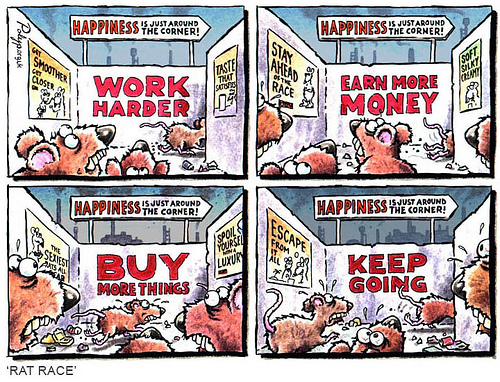
As people are kept divided by race, class, and other “hot button” issues (abortion and guns, for example), they are kept distracted by insatiable consumerism and incessant entertainment.  People are told they can have it all, that they “deserve it” (a new car, a bigger home, and so on), that they should indulge their wants.  On HGTV and similar channels, people go shopping for new homes, carrying a long list of “must haves” with them.  I “must have” a three-car garage, a pool, a media room, surround sound, and so on.  Just tell me what mortgage I can afford, even if it puts me deeply in debt.  As consumerism runs rampant, people are kept further distracted by a mainstream media that provides info-tainment rather than news. Ultimately, the media exists to sell product; indeed, it is product itself.  No news is aired that will disturb the financial bottom line, that will threaten the corporations that run the media networks, that will undermine the privileged and the powerful.

The people, kept divided and distracted, are further rendered powerless by being kept downtrodden.  Education is often of poor quality and focused on reciting rote answers to standardized tests.  Various forms of debt (student loan debt, credit card debt, debt from health care and prescription drugs costs, and so on) work to keep the people downtrodden.  Even workers with good jobs and decent benefits are worried.  Worried that if they lose their jobs, they lose their health care. So much of personal status and identity, as well as your ability to navigate American society, is based on your position.  For many it’s lose your job, lose your life, as you’re consumed by debt you can’t repay.

Divided, distracted, and downtrodden: It’s a recipe for the end of democracy in America.  But it also serves as a roadmap to recovery.  To reinvigorate our democracy, we must fight against divisiveness, we must put distractions behind us, and we must organize to fight for the rights of the people, rights like a better education for all, less debt (a college education that’s largely free, better health care for everyone, and far less emphasis on consumerism as a sign of personal and societal health and wealth), and improved benefits for the workers of America, who form the backbone of our nation.

We can’t wait for the politicians.  Most of them are already co-opted by the moneyed interests.  Meaningful change will have to come from us.  That is, after all, the way democracy is supposed to work.