W.J. Astore
In my new article for TomDispatch.com, I argue that words about war matter. A clear sign of America’s post-democratic military is the language our leaders use when they talk about war. Specifically, words, euphemisms, and expressions that muddle or obfuscate meaning while excluding most Americans from the debate. Acronyms like VUCA and 4GW and COIN, moreover, create a specialized language that suggests war is beyond the understanding of regular folk. Meanwhile, euphemisms and rhetoric hide the truth about war.
In a democracy, how are proper decisions to be made about war if the truth is deliberately cloaked or hidden?
The entire article is here at TomDispatch.com; what follows is the last section of my article, featuring a strong contribution from Mike Murry, a regular contributor here at Bracing Views.
The proliferation of euphemisms, acronyms, and neologisms has no end. You might start with “defense” instead of “war” department, followed by “homeland” security, the “PATRIOT” act, and on and on. I still recall Ronald Reagan’s christening of the MX nuclear missile, with its multiple warheads capable of unleashing city-wide genocides, as the “Peacekeeper.”
The United States may be losing our many “overseas contingency operations,” but when it comes to manipulating words, it’s truly “mission accomplished.”
The Truth About “Progress” in America’s Wars
These days, Secretary of Defense Ashton Carter often resorts to cancer imagery when describing the Islamic state. “Parent tumor” is an image he especially favors — that is, terrorism as a cancer that America’s militarized surgeons need to attack and destroy before it metastasizes and has “children.” (Think of the ISIS franchises in Libya, where the organization has recently doubled in size, Afghanistan, and Yemen.) Hence the proliferation of “surgical strikes” by drones and similarly “surgical” Special Ops raids, both of which you could think of as America’s equivalent of white blood cells in its war on the cancer of terrorism.
But is terrorism really a civilizational cancer that can be “cured” via the most aggressive “kinetic” treatments? Can the U.S. render the world cancer-free? For that’s what Carter’s language implies. And how does one measure “progress” in a “war” on the cancer of ISIS? Indeed, from an outsider’s perspective, the proliferation of U.S. military bases around the world (there are now roughly 800), as well as of drone strikes, Special Ops raids, and massive weapons exports might have a cancerous look to them. In other words, what constitutes a “cancer” depends on one’s perspective — and perhaps one’s definition of world “health,” too.
The very notion of progress in America’s recent wars is one that a colleague, Michael Murry, recently critiqued. A U.S. Navy Vietnam War Veteran, he wrote me that, for his favorite military euphemism, “I have to go with ‘progress’ as incessantly chanted by the American military brass in Iraq and Afghanistan…
“We go on hearing about 14 years of ‘progress’ which, to hear our generals tell it, would vanish in an instant should the United States withdraw its forces and let the locals and their neighbors sort things out. Since when do ‘fragile gains’ equate to ‘progress’? Who in their right mind would invest rivers of blood and trillions of dollars in ‘fragility’? Now that I think of it, we also have the euphemistic expression of ‘drawdown’ substituting for ‘withdrawal’ which in turn substitutes for ‘retreat.’ The U.S. military and the civilian government it has browbeaten into hapless acquiescence simply cannot face the truth of their monumental failures and so must continually bastardize our language in a losing — almost comical — attempt to stay one linguistic step ahead of the truth.”
Progress, as Murry notes, basically means nothing when such “gains,” in the words of David Petraeus during the surge months in Iraq in 2007, are both “fragile” and “reversible.” Indeed, Petraeus repeated the same two words in 2011 to describe similar U.S. “progress” in Afghanistan, and today it couldn’t be clearer just how much “progress” was truly made there. Isn’t it time for government officials to stop banging the drums of war talk in favor of “progress” when none exists?
Think, for instance, of the American-trained (and now re-trained) Iraqi security forces. Each year U.S. officials swear that the Iraqi military is getting ever closer to combat readiness, but much like one of Zeno’s paradoxes, the half-steps that military takes under American tutelage never seem to get it into fighting shape. Progress, eternally touted, seems always to lead to regress, eternally explained away, as that army regularly underperforms or its units simply collapse, often abandoning their American-supplied weaponry to the enemy. Here we are, 12 years after the U.S. began training the Iraqi military and once again it seems to be cratering, this time while supposedly on the road to retaking Iraq’s second largest city, Mosul, from its Islamic State occupiers. Progress, anyone?
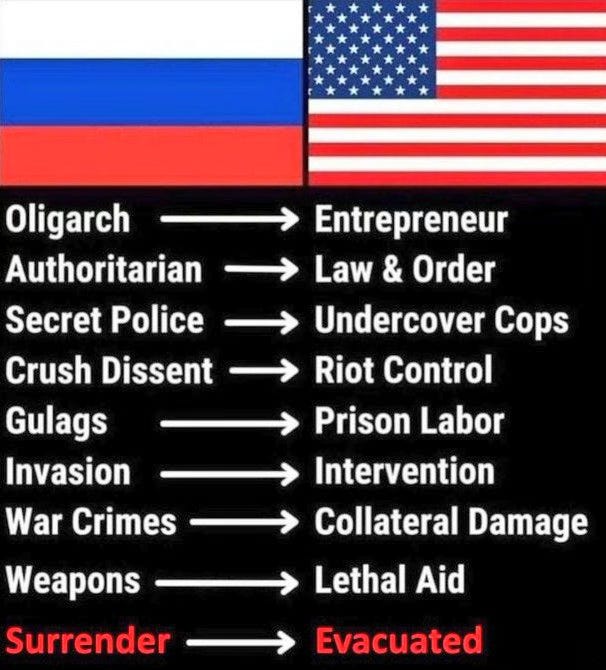
In short, the dishonesty of the words the U.S. military regularly wields illustrates the dishonesty of its never-ending wars. After so many years of failure and frustration, of wars that aren’t won and terrorist movements that only seem to spread as its leaders are knocked off, isn’t it past time for Americans to ditch phrases like “collateral damage,” “enemy noncombatant,” “no-fly zone” (or even worse, “safe zone”), and “surgical strike” and adopt a language, however grim, that accurately describes the military realities of this era?
Words matter, especially words about war. So as a change of pace, instead of the usual bloodless euphemisms and vapid acronyms, perhaps the U.S. government could tell the shocking and awful truth to the American people in plain language about the realities and dangers of never-ending war.
William Astore, a retired lieutenant colonel (USAF) and professor of history, is a TomDispatch regular. He blogs at Bracing Views.



 Bracing Views