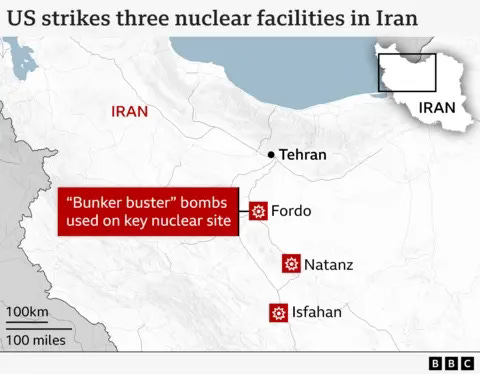
U.S. messaging to Iran, courtesy of President Trump, is quite simple: We slugged you (with our bombing attacks on three nuclear sites in your country), and if you don’t like it, we’ll slug you again, even harder, much, much harder.
Iran’s only real choice: “unconditional surrender,” according to the president.
Well, it’s a strategy, I suppose, the one of the abuser, the bully. Do what I want, else you’ll get slugged. Try to fight back, I’ll slug you much much harder. Oh, by the way, I believe in peace. And you can have peace by totally capitulating to me.
Another way of looking at or labeling this stategy: Bombing for Bibi. Yes, I know it’s not just Bibi Netanyahu behind it all. But he’s the chief flatterer, the skilled string-puller, the master manipulator of Trump. Not that it’s entirely hard to manipulate a narcissist who’s driven by money and consumed by his own ego.
So, we have to look to Iran to show a measure of restraint, since the U.S. and Israel won’t. If Iran chooses to fight, especially to hit back at U.S. targets in the region, all bets are off as our country stumbles into what could become World War III.
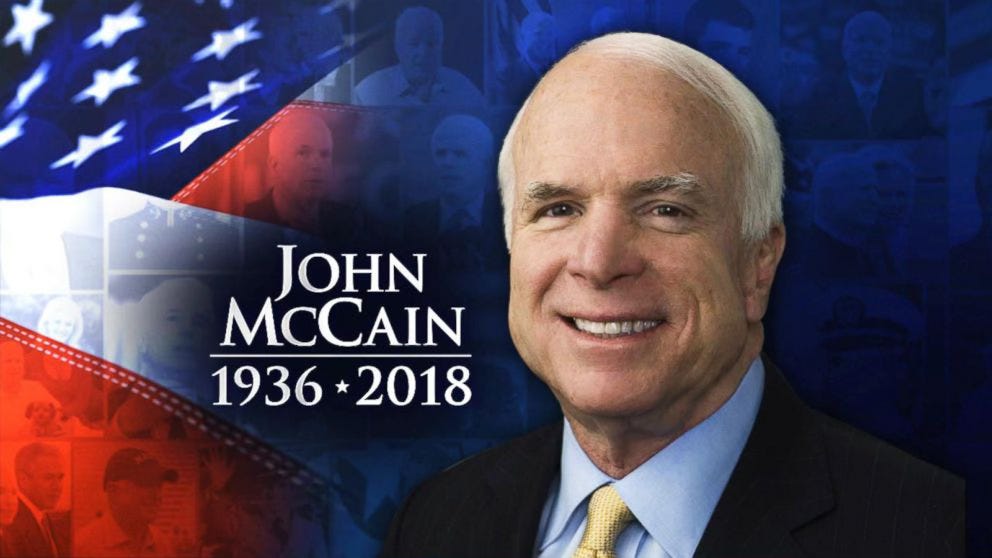
As Jimmy Dore put it today, No matter who you vote for, you get John McCain. A warmonger. Someone proud to joke about bombing Iran—and crazy enough to do it. Does it really matter if the warmonger is named Hillary Clinton, Joe Biden—or Donald Trump?
Congress, no surprise, is almost entirely behind Trump’s attack, despite some griping and sniping from the sidelines. Congress may complain, but it’s just posturing. That’s how you get reckless wars of choice that are unsupported by the American people.
Oh well. “We love you, God,” as Trump said last night as he announced the bombings. I never learned in CCD that God loves bombs and bombing; I must have been sleeping or absent for that one. Thou shalt kill, right?
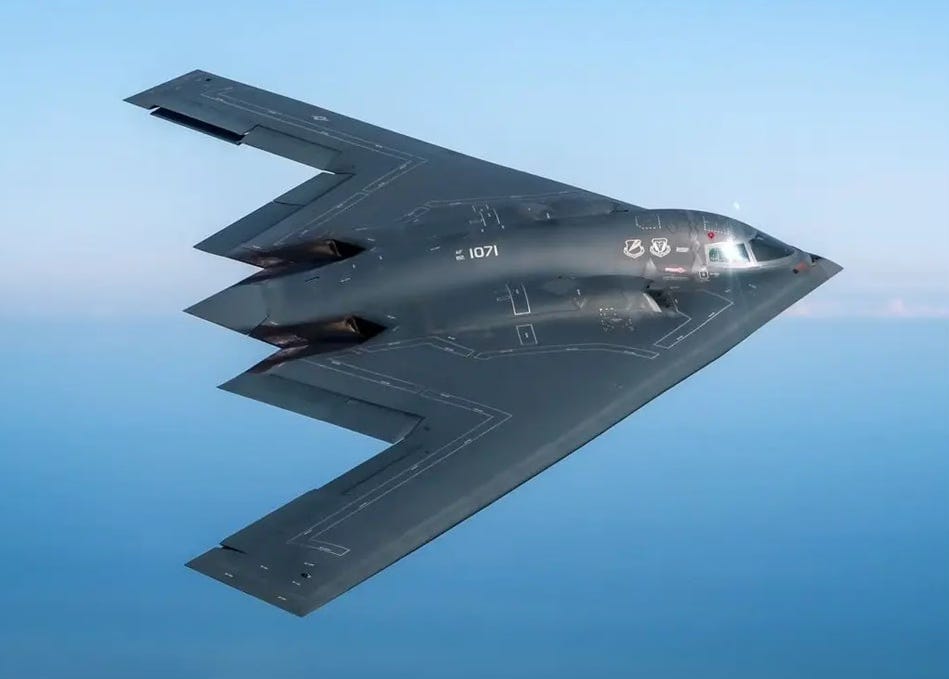
President Trump announced tonight that the U.S. has bombed three nuclear sites in Iran. After these attacks, he’s now asking for peace.
That the attacks were coming was obvious. Even Director of National Intelligence Tulsi Gabbard was brought firmly into line before the attacks. As the Downing Street Memo said about the Iraq War, the intelligence was fixed around the policy. In Iraq, the policy was a regime-change war; with Iran, the policy is to destroy nuclear sites and possibly to topple the Iranian government. A predetermined policy determines what is a “fact” and what isn’t.
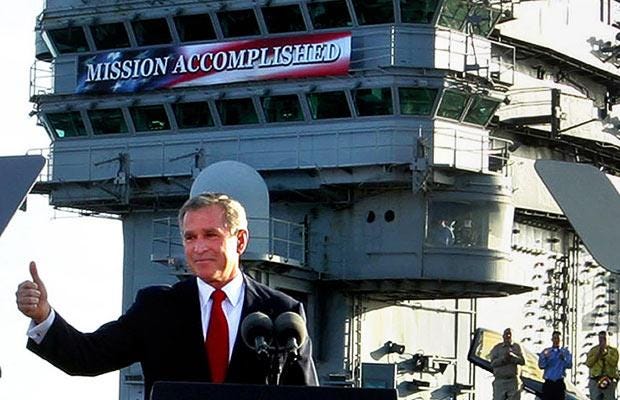
When you have an empire like the U.S. that devotes so much of its money and resources to the military, and when you have leaders desperate to be seen as “strong” and decisive, this is what happens. Military attacks followed by declarations that America seeks peace. War for peace. It makes no sense, but there you go.
Cui bono? Who benefits? Certainly, Israel in its ongoing efforts to dominate the region. Israel’s influence over U.S. foreign policy is remarkable. There was no way Trump was not going to bomb Iran, given the push from Israel to do so.
What happens next, I don’t know. But I did think that this was exactly what Trump would do—bomb Iran—because it’s always what the U.S. does.
Somewhere, in perhaps some hell, John McCain is singing a ditty about bombing Iran. People may have made fun of him, but the man predicted the future—and the future is now.
Then why is bombing the option that’s always chosen?
There they go again. The geniuses inside the DC Beltway are bombing the Middle East again, specifically 85+ targets in Iraq and Syria allegedly supported by Iran. It’s funny: I don’t recall a Congressional declaration of war against Iraq and Syria (or Iran, for that matter), but who needs to be limited by the U.S. Constitution, am I right?
After the recent attack that killed three U.S. soldiers, I heard again that hackneyed expression from DC that “all options are on the table” in response. Amazing how the option that’s always picked by U.S. presidents is the military one. If it’s not “bomb bomb bomb bomb bomb Iran,” as John McCain once jokingly sang, it’s bomb Iranian-backed units in Iraq and Syria, because that’s the best way toward greater stability and peace in the Middle East. Perfectly logical.
Yes, he died in 2018, but he’s America’s most likely presidential winner in 2024.
Speaking of John McCain, I like the joke that’s making the rounds that no matter who Americans vote for as president, they get John McCain, which is a shorthand way of saying that the National Security State is the unofficial fourth and most powerful branch of the U.S. government. Or, if you prefer, the MICIMATT, the military-industrial-congressional-intelligence-media-academe-think-tank complex.
Speaking of the media, you can always count on U.S. media talking heads issuing resounding hosannas to the highest whenever a U.S. president bombs a foreign country. Remember when reporters gushed that Donald Trump had finally become a real president in 2017 when he bombed Syria? Trump, who expressed his contempt for John McCain, finally became him—and earned the MICIMATT’s approval—when he started bombing and launching missiles to kill foreigners.
Finally, we often hear the expression from U.S. government-types that the only thing “they” understand is physical violence and war. It’s often far more accurate to say that the only thing “we” (the MICIMATT, that is) understand (and profit from) is physical violence and war.
What has America learned from the colossal failure of the Iraq War? Not what it should have learned, notes historian (and retired U.S. Army colonel) Greg Daddis at War on the Rocks. Daddis recently attended a 20-year retrospective symposium on the Iraq War, where he heard two distinctive narratives. As he put it:
Most, if not all, veterans of “Iraqi Freedom” told an inward-facing story focusing on tactical and operational “lessons” largely devoid of political context. Meanwhile, Iraqi scholars and civilians shared a vastly different tale of political and social upheaval that concentrated far more on the costs of war than on the supposed benefits of U.S. interventionism.
In short, the U.S. view of the Iraq War remains insular and narcissistic. The focus is on what U.S. troops may have gotten wrong, and how the military could perform better in the future. It’s about tactical and operational lessons. In this approach, Iraq and the Iraqi people remain a backdrop to American action on the grand stage. Put differently, the Iraqis are treated much like clay for Americans to mould or discard should they refuse to behave themselves under our hands.
So the “lessons” for America focus on how to become better, more skilled, manipulators of the “clay” at hand. Issues of right and wrong aren’t addressed. The morality or legality of war isn’t questioned. And Iraqis themselves, their suffering, their plight, even their say in determining their own futures within their country, is pretty much dismissed as irrelevant. And the same is largely true when considering the Vietnam War or the Afghan War; we matter, they don’t, even when we’re fighting in their country and spreading enormous destruction in undeclared and illegal wars.
As Mike Murry, a Vietnam veteran who comments frequently at this site, has said: you can’t do a wrong thing the right way. America’s Vietnam War was wrong; the Iraq War was wrong. There was no “right” way to do these wars. Yet, far too often, U.S. military officers and veterans, joined by far too many Americans who lack military experience, want to focus on how to wage a wrong war in a better, smarter, often more ruthless, way
Indeed, the narrative at times is reduced to “We lost because we weren’t ruthless enough, or we were about to win until the U.S. military was betrayed.” I wrote about this back in 2007 after I heard Senator John McCain speak on PBS. Basically, his point was that if America lost the Iraq War (which we already had), it wouldn’t be the U.S. military’s fault. It would be the fault of anyone who questioned the war. McCain, in other words, was spouting yet another exculpatory stab-in-the-back myth.
What can we learn from the Iraq War, then? Let’s start with these basic lessons: Don’t fight a war based on governmental lies and unfounded fears. Don’t fight illegal and immoral wars. Don’t fight undeclared wars. Don’t meddle in the societies of other people where you are seen as invaders and about which you are ignorant. Don’t wage war, period, unless the domestic security of the U.S. is truly threatened.
Those seem like the right lessons to me, not lessons about how to recognize insurgencies or how to respond more quickly to asymmetries like IEDs and ambushes.
In sum, learn this lesson: Vietnam, Iraq, Afghanistan, were and are countries with rich pasts and proud peoples who were not about to submit to American invaders and agendas, no matter how well-intentioned those invaders believed or advertised themselves to be.
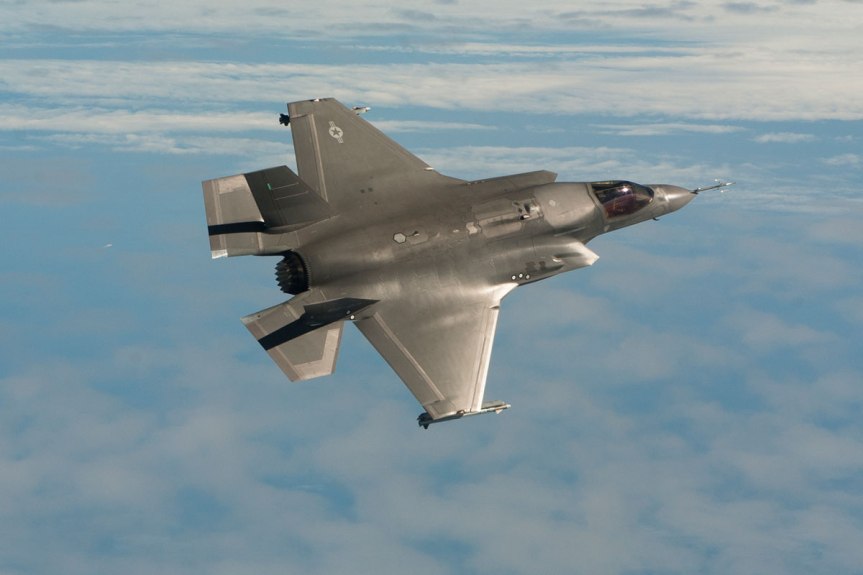
Imagine you’re President Joe Biden. You’re looking for nearly $2 trillion to fund vital repairs and improvements to America’s infrastructure. You learn of a warplane, the F-35 Lightning II, that may cost as much as $1.7 trillion to buy, field and maintain through the next half century. Also, you learn it’s roughly $200 billion over budget and more than a decade behind schedule. You learn it was supposed to be a low-cost, high-availability jet but that through time, it’s become a high-cost, low-availability one. Your senior Air Force general compares it to a Ferrari sports car and says we’ll “drive” it only on Sundays. What do you do?
Your first thought would probably be to cancel it, save more than a trillion dollars, and fund America’s infrastructure needs. Yet instead, the U.S. military is turning on the afterburners and going into full production. What gives?
When 60 Minutes reported on the F-35 in 2014, the plane was already seven years behind schedule and $163 billion over budget. Since then, it has weathered a series of setbacks and complications: Engines that are unreliable and in short supply. An ultra-expensive software system to maintain and repair the plane that doesn’t work. Higher operating costs — as much as 300% higher — compared to previous planes like the F-16 or the A-10. An overly loud engine that creates a noise nuisance to nearby population centers. The list goes on, yet so, too, does the F-35 program.
Why? Because of the power of the military-industrial-congressional complex. The F-35’s lead contractor, Lockheed Martin, used a tried-and-true formula to insulate the plane from political pressure, spreading jobs across 45 states and 307 congressional districts. In essence, the F-35 program has become “too big to fail.” At the Pentagon level, the plane is supposed to fulfill the needs of the Air Force, Navy and Marine Corps for a “fifth generation” stealthy fighter. There is no alternative, or so you’re told.
Yet, as America’s commander-in-chief, you must always remember there are alternatives. Think about it. Why buy a deeply troubled weapon system at inflated prices? Why reward a military contractor for woeful failures to deliver on time and within budget?
Congress rarely asks such questions because of the corrosive power of corporate lobbyists, the military’s insatiable demands for tech-heavy wonder weapons, and thinly-veiled threats that program cuts will cost jobs — meaning members of Congress might face electoral defeat if they fail to safeguard the F-35 pork apportioned to their districts.
But you’re the president — you should be above all that. You take a wider view like the one President Dwight D. Eisenhower took in 1953 in his “cross of iron” speech. Here Ike, a former five-star Army general, challenged Americans to prioritize instruments of peace over tools of war. Schools and hospitals, Ike wrote, were more vital to a democracy than destroyers and fighter jets. Ike was right then — and even more right today. He famously invested in an interstate highway system that served as an accelerant to the U.S. economy. He knew that warplanes, especially overly pricey and operationally dicey ones, were much less vital to the common good.
The Pentagon tells you it’s the F-35 or bust. But for you as president, it’s the F-35 and bust. You begin to realize that so many of the experts advising you to stay the course on the F-35 stand to profit if you do so.
And then you realize as America’s commander-in-chief that no weapon system should be too big to fail. You take heart from Sen. John McCain. In 2016, that ex-naval aviator declared the F-35 program was “both a scandal and a tragedy with respect to cost, schedule and performance.”
Why continue that scandal? Why not end that tragedy? You can decide to send the strongest and clearest message to the military-industrial-congressional complex by cancelling the F-35. You can vow to reform the flawed system that produced it. And you can fund your vital infrastructure programs with the savings.
William J. Astore is a retired Air Force lieutenant colonel and history professor. He is currently a senior fellow at the Eisenhower Media Network.
In my latest article for TomDispatch.com, I tackle America’s cult of bombing overseas, most recently in the Middle East, Central Asia, and portions of Africa, and the darker facets of air power in general. Air power may not be “unthinkable” like nuclear war, but most Americans nevertheless choose not to think about it since the bombing, the destruction, the killing are happening elsewhere to people other than us. Indeed, occasionally America’s politicians talk about bombing as if it’s a joke (consider John McCain’s little ditty about bombing Iran, or Ted Cruz’s reference to carpet bombing ISIS and making the sand “glow”).
Treating air power and bombing so cavalierly is a big mistake. Much like mass shootings in the “homeland,” it’s become the background noise to our lives. But it’s a deadly reality to others — and since violence often begets more violence, it may very well prove a prescription for permanent war.
Ten Cautionary Tenets About Air Power
1. Just because U.S. warplanes and drones can strike almost anywhere on the globe with relative impunity doesn’t mean that they should. Given the history of air power since World War II, ease of access should never be mistaken for efficacious results.
2. Bombing alone will never be the key to victory. If that were true, the U.S. would have easily won in Korea and Vietnam, as well as in Afghanistan and Iraq. American air power pulverized both North Korea and Vietnam (not to speak of neighboring Laos and Cambodia), yet the Korean War ended in a stalemate and the Vietnam War in defeat. (It tells you the world about such thinking that air power enthusiasts, reconsidering the Vietnam debacle, tend to argue the U.S. should have bombed even more — lots more.) Despite total air supremacy, the recent Iraq War was a disaster even as the Afghan War staggers on into its 18th catastrophic year.
3. No matter how much it’s advertised as “precise,” “discriminate,” and “measured,” bombing (or using missiles like the Tomahawk) rarely is. The deaths of innocents are guaranteed. Air power and those deaths are joined at the hip, while such killings only generate anger and blowback, thereby prolonging the wars they are meant to end.
Consider, for instance, the “decapitation” strikes launched against Iraqi autocrat Saddam Hussein and his top officials in the opening moments of the Bush administration’s invasion of 2003. Despite the hype about that being the beginning of the most precise air campaign in all of history, 50 of those attacks, supposedly based on the best intelligence around, failed to take out Saddam or a single one of his targeted officials. They did, however, cause “dozens” of civilian deaths. Think of it as a monstrous repeat of the precision air attacks launched on Belgrade in 1999 against Slobodan Milosevic and his regime that hit the Chinese embassy instead, killing three journalists.
Here, then, is the question of the day: Why is it that, despite all the “precision” talk about it, air power so regularly proves at best a blunt instrument of destruction? As a start, intelligence is often faulty. Then bombs and missiles, even “smart” ones, do go astray. And even when U.S. forces actually kill high-value targets (HVTs), there are always more HVTs out there. A paradox emerges from almost 18 years of the war on terror: the imprecision of air power only leads to repetitious cycles of violence and, even when air strikes prove precise, there always turn out to be fresh targets, fresh terrorists, fresh insurgents to strike.
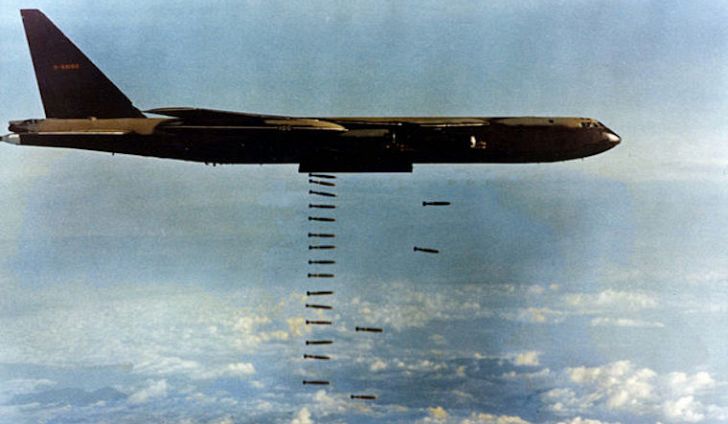
4. Using air power to send political messages about resolve or seriousness rarely works. If it did, the U.S. would have swept to victory in Vietnam. In Lyndon Johnson’s presidency, for instance, Operation Rolling Thunder (1965-1968), a graduated campaign of bombing, was meant to, but didn’t, convince the North Vietnamese to give up their goal of expelling the foreign invaders — us — from South Vietnam. Fast-forward to our era and consider recent signals sent to North Korea and Iran by the Trump administration via B-52 bomber deployments, among other military “messages.” There’s no evidence that either country modified its behavior significantly in the face of the menace of those baby-boomer-era airplanes.
5. Air power is enormously expensive. Spending on aircraft, helicopters, and their munitions accounted for roughly half the cost of the Vietnam War. Similarly, in the present moment, making operational and then maintaining Lockheed Martin’s boondoggle of a jet fighter, the F-35, is expected to cost at least $1.45 trillion over its lifetime. The new B-21 stealth bomber will cost more than $100 billion simply to buy. Naval air wings on aircraft carriers cost billions each year to maintain and operate. These days, when the sky’s the limit for the Pentagon budget, such costs may be (barely) tolerable. When the money finally begins to run out, however, the military will likely suffer a serious hangover from its wildly extravagant spending on air power.
6. Aerial surveillance (as with drones), while useful, can also be misleading. Command of the high ground is not synonymous with god-like “total situational awareness.” It can instead prove to be a kind of delusion, while war practiced in its spirit often becomes little more than an exercise in destruction. You simply can’t negotiate a truce or take prisoners or foster other options when you’re high above a potential battlefield and your main recourse is blowing up people and things.
7. Air power is inherently offensive. That means it’s more consistent with imperial power projection than with national defense. As such, it fuels imperial ventures, while fostering the kind of “global reach, global power” thinking that has in these years had Air Force generals in its grip.
8. Despite the fantasies of those sending out the planes, air power often lengthens wars rather than shortening them. Consider Vietnam again. In the early 1960s, the Air Force argued that it alone could resolve that conflict at the lowest cost (mainly in American bodies). With enough bombs, napalm, and defoliants, victory was a sure thing and U.S. ground troops a kind of afterthought. (Initially, they were sent in mainly to protect the airfields from which those planes took off.) But bombing solved nothing and then the Army and the Marines decided that, if the Air Force couldn’t win, they sure as hell could. The result was escalation and disaster that left in the dust the original vision of a war won quickly and on the cheap due to American air supremacy.
9. Air power, even of the shock-and-awe variety, loses its impact over time. The enemy, lacking it, nonetheless learns to adapt by developing countermeasures — both active (like missiles) and passive (like camouflage and dispersion), even as those being bombed become more resilient and resolute.
10. Pounding peasants from two miles up is not exactly an ideal way to occupy the moral high ground in war.
The Road to Perdition
If I had to reduce these tenets to a single maxim, it would be this: all the happy talk about the techno-wonders of modern air power obscures its darker facets, especially its ability to lock America into what are effectively one-way wars with dead-end results…
In reality, this country might do better to simply ground its many fighter planes, bombers, and drones. Paradoxically, instead of gaining the high ground, they are keeping us on a low road to perdition.
I’ve been seeing a lot of headlines, and reading quite a few tributes, about John McCain. A common word used to describe him is “warrior,” as in this op-ed at Al Jazeera of all places. If you do a quick Google search with “John McCain” and “warrior” you’ll see what I mean.
I’m a firm believer in the citizen-soldier tradition. Warrior-speak, I believe, is inappropriate to this tradition and to the ideals of a democracy. “Warrior” should not be used loosely as a substitute for “fighter,” nor should it replace citizen-sailor, which is what John McCain was (or should have been).
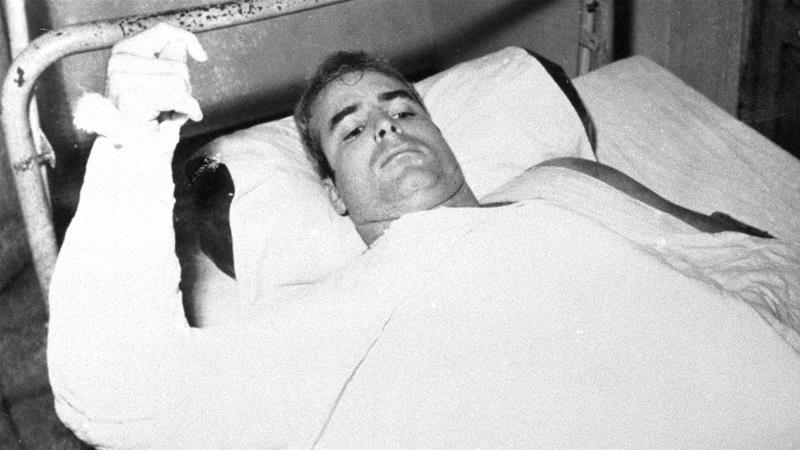
Yes, John McCain came from a family of admirals. He attended the U.S. Naval Academy. He became a naval aviator. He was shot down and became a prisoner of war. He showed toughness and fortitude and endurance as a POW under torture. But all this doesn’t (or shouldn’t) make him a “warrior.” Rather, he was a U.S. Navy officer, a product of a citizen-sailor tradition.
It’s corrosive to our democracy as well as to our military when we use “warrior” as a term of high praise. Many Americans apparently think “warrior” sounds cool and tough and manly, but there’s a thin line between “warrior” and “warmonger,” and both terms are corrosive to a country that claims it prefers peace to war.
In sum, it says something disturbing about our country and our culture when “warrior” has become the go-to term of ultimate praise. By anointing McCain as a “warrior,” we’re not praising him: we’re wounding our country.
News of the death of Senator John McCain from cancer has generated enormous sympathy and praise. When he ran for president in 2008, McCain was known as a “maverick” in the media, even though his views were rarely that far removed from traditional Republican orthodoxy. Maybe it was his style that won him that nickname. A former Navy fighter pilot and prisoner of war during the Vietnam war, McCain was less guarded than most politicians, and he courted the media with candor and humor (what a contrast to Donald Trump, who denounces the media as “the enemy of the people”).
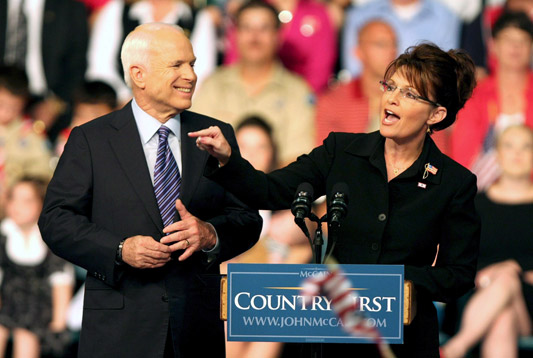
Rolling the dice in the 2008 campaign, McCain picked Sarah Palin as his running mate, a folksy governor from Alaska with virtually no experience in national or international politics. But what Palin had was strong populist instincts and a certain plain-speaking charisma. If McCain was the “maverick,” Palin was the “rogue” candidate. She helped to unleash a populist (anti-intellectual) fervor in the Republican party that culminated with Donald Trump.
I well remember the 2008 election. I was living in rural Pennsylvania and both vice-presidential candidates came for a visit. Joe Biden, the Democratic candidate, filled a high school gymnasium — roughly 600 people. Sarah Palin filled a minor league baseball stadium to overflowing — roughly 13,000 people.
Back then, Rebecca Traister wrote about Palin’s triumphal tour of rural Pennsylvania here. She also wrote about Palin’s rally at that minor league baseball stadium, Bowman Field. For some reason, the link to that article (which appeared originally at Salon.com) no longer works, but another blogger (“Lowell”) at Contextual Criticism cited portions of it back in early November 2008. Here’s how that blogger, quoting Traister, set the scene:
Palin is in Williamsport, Pennsylvania. It is a cold Thursday night. Thirteen thousand faithful, with “their Christian literature and thundersticks in tow,” have come to an outdoor baseball stadium to see the hockey mom from Alaska, the moose-slayer, the pit bull who ignites their basest instincts.
“Finally, about an hour before Palin’s scheduled arrival, Bowman Field kicked off its pre-party with the National Anthem sung under the giant flag suspended from a crane over the ‘Victory in Pennsylvania’ sign. A security sniper ogled the chilly crowd with his night-vision glasses, and a local minister took the stage to offer a benediction that hit the trifecta of guns, gays and abortion. The preacher asked forgiveness ‘for so many [who] have shed innocent blood through the course of abortions, and so many [who] would stop the sanctity of marriage between a man and a woman.’ With these abominations in mind, the preacher continued, ‘Thank you for raising up a woman like Gov. Sarah Palin at a time like this. Bless her for standing against those who would remove the guns from our cabinets, and those who would want to remove the baby from the womb of her mother. Bless her family as they adjust to changes in their lives that are going to be taking place on Tuesday.'”
Ms. Traister writes that “Palin was her down-home bestest, peppering her brief address with references to First Dude’s four snow-machine world championships, a lot of gratitude toward the veterans in the crowd, and a lot of folksy, g-droppin’ references to how ‘the time for choosin’s comin’ real soon,’ a golden-oldie reference to Ronald Reagan’s famous 1964 speech in support of Barry Goldwater. Combined with Palin’s repeated use of the phrases ‘You betcha!’ and ‘Drill, baby, drill!’ and her guess that the crowd was ‘so doggone proud’ of the Phillies, and her environmental justification that ‘God has so richly blessed this land with resources’ that [we] should probably strip-mine it, Palin seemed to be imitating Tina Fey’s imitation of her on ‘Saturday Night Live.'”
Toward the end, Palin invoked Reagan again, saying “In the end, what John McCain and I believe in is what Ronald Reagan believes in … we believe that America is still that shining City on a Hill that Ronald Reagan used to speak of.”
Now, lest you think Ms. Traister got out of that God-lovin’ bunch of folks without incident, think again. Here’s how she tells it:
“While I was interviewing some of the attendees, accompanied by another Salon staffer who was holding a video camera, a Palin fan in a newish silver sedan drove by and hit me hard in the back with the side mirror of the car, hard enough to bend the mirror back. Then the car drove off without anybody inside pausing to ask if I was all right. The middle-aged woman in the passenger seat, however, might have saluted me with an un-Christian hand gesture.”
Yes — that happened. Traister, a journalist, was hit “hard in the back” by a car, earning a middle-finger salute for her pains from one of the passengers. Talk about being anti-media! Small wonder that Trump’s diatribes resonate so well with “God-lovin'” people across the USA.
After the rallies in 2008, I asked my students (I was teaching college at the time) about them. They gushed about Palin. One of my students was especially taken by Palin’s husband, whom she considered to be a stud. None of my students had anything to say about the (much smaller and comparatively sedate) Biden rally.
Then and now, the mainstream media and the Democratic Party dismissed Palin as a joke, just as they initially dismissed Trump as a joke in 2015. Yet, as I wrote about Palin in 2010:
Much of what’s been said about Palin was also said of another backwoods American whose values were honed on the frontier: President Andrew Jackson. Palin may be no Jackson, but the liberal media’s sneering dismissal of her constitutes an indulgent, often self-congratulatory, narrative. It’s also a repudiation of our Jacksonian heritage of tough-minded, plain-speaking independence.
Like Jackson, Palin makes no pretense about being a cultivated American. Like it or not, she’s seen by her admirers as genuine precisely because she’s not a conflicted intellectual — precisely because she doesn’t confuse her followers by revealing a fourth side to every three-sided problem. Gosh darn it, she just loves God and loves America and loves our troops and loves her special baby and … well … that’s more than enough for her many admirers and followers.
Rural people in “fly-over” country are naturally suspicious of slick politicians who are both too smarmy and too clever for their own good. Palin is naturally “aw shucks” and seemingly content with her knowledge of the world. And, like Andrew Jackson before her, Palin is unapologetic, undeferential, and unabashedly proud to be an American. One simply can’t imagine her making a “patronizing apology tour” of European capitals, as President Obama was accused of doing by conservatives.
And which past president does Trump believe he’s most like? Andrew Jackson. Trump is, in a way, a male Palin with a lot more celebrity, lots more money, and scads of mendacity.
By selecting Palin as his running mate in 2008, McCain helped to open a door for future populists, a door Trump jumped through in 2015. It may not be McCain’s defining legacy, but it is, perhaps, his most negative.
Reference: See David Smith, “John McCain opened Pandora’s box – Sarah Palin came out, but Trump was right behind her. The senator regretted his choice of running mate. In 2008, no one could have imagined what it would mean,” at The Guardian, which got me thinking about this issue.
Reporter David Barstow (right) in 2014. He won a Pulitzer in 2009 for his reporting on retired generals serving as Pentagon hacks (referenced in the article below)
W.J. Astore
Note to reader: In May of 2008, I wrote this draft article, which became the basis of a shorter piece published at Nieman Watchdog later that year under the title, “Networks should replace Pentagon cheerleaders with independent military analysts.” Media coverage of the U.S. military and America’s wars is often lamentable as well as one-sided; if anything, media coverage as well as access under Obama has worsened. I’ve decided not to edit what I wrote in 2008, partly because the underlying dynamic remains the same. Rare it is for the curtain to be lifted on the messy realities of war; and those who choose to lift it, like Chelsea Manning, pay a high price indeed for honesty.
Obama’s recent decision to commute Manning’s prison sentence was a rare case of mercy, in this case extended to a truth-teller who did far more than the silver-haired generals cited below to educate Americans about war and its awful realities. 1/18/2017
The first thing that came to mind as I read David Barstow’s exposé [April 2008] in the New York Times, “Behind TV Analysts, Pentagon’s Hidden Hand,” was the classic scene in Casablanca where Claude Rains expresses his shock to Humphrey Bogart at the gambling going on, even as he collects his own winnings. Surely, Americans knew that the retired generals and colonels being paraded before them on network news were, in spite of their mufti, anything but unbiased, independent, “civilian” critics?
OK, maybe I’m more skeptical than some. But I was genuinely surprised, even shocked, at the brazenness of the Pentagon’s PR campaign, the fact that so many retired military men eagerly joined in “to carry [the Pentagon’s] water,” even at how eagerly they traded on their military expertise. Some even continued to advise top defense contractors as they offered supposedly disinterested testimony on TV. At times, however, their testimony merely echoed talking points fed to them during invitation-only briefings at the Pentagon. These briefings were designed not to support troops in harm’s way (a laudable goal) but to defend [Secretary of Defense] Don Rumsfeld and the Bush Administration’s strategy. (Those few officers who refused to parrot the Pentagon’s line found their access curtailed or even denied, Barstow shows.)
Not surprisingly, the mainstream media has either ignored Barstow’s exposé or effectively dismissed it as old news or business as usual. Fortunately, Glenn Greenwald at Salon has tenaciously pursued the story, revealing ever more clearly how the Pentagon’s propaganda campaign tried “to put the best possible face” (one retired officer’s words) on failing efforts in Iraq.
Clearly, the Pentagon courted these retired military men, identifying reliable “go to guys” and rewarding them with access to the Pentagon and the Secretary of Defense (access being pure gold within the Washington beltway). Such access included the aforementioned, invitation-only, PowerPoint briefings, which included “talking points” that these officers could then robotically repeat on TV, passing them off as their own informed and unbiased opinions. Such collusion indicates a well-oiled, influence-peddling, Pentagonal machine serviced by sycophantic cheerleaders, and it assuredly warrants investigation by Congress.
Seven Reasons to Dismiss the Sycophants
That said, the very idea of relying on retired military men as expert critics was fundamentally flawed from the beginning. The obvious reason why networks relied on these men (and they were all men) as expert commentators was because they lacked their own in-house experts. That, and the fact that they wanted to purchase the authority of these colonels and generals while being seen by viewers at home as patriotic and supportive of the troops.
I’d like to suggest seven reasons why this reliance on retired military “talking heads” was so wrongheaded, some obvious, some perhaps less so:
Despite their civilian coat-and-tie camouflage, these officers are not ex-generals and ex-colonels: they are retired colonels and generals–a distinction with a difference. They still carry their rank; they still wear the uniform at military functions; the rank-and-file still deferentially call them “sir”; their cars still have military stickers with eagles (for full colonels) and stars (for generals); they’re still saluted smartly when they drive on- and off-post. These men enjoy constant reminders and privileges of their high military status, and I’d wager nearly all of them think of themselves as military men first, “civilians” second. In short, these men identify with the U.S. military–indeed, they are the military–hardly a recipe for disinterested or dispassionate analysis of our military’s performance in Iraq, or anywhere else for that matter.
Along with identifying closely with the military, many of these media generals and colonels serve as advisors to defense contractors, who potentially stand to profit from continued fighting. This remarkable state of affairs persists despite the fact that, throughout their career, military officers are taught to avoid even the appearance of conflicts of interest, precisely because the potential for impropriety taints the integrity of the officer as well as the entire military-contractor process. It’s not enough to say, “I’m a man of integrity and I’d never compromise it for self-interest or personal gain.” You must strive to avoid even the appearance of a conflict of interest–a maxim that is so drilled into military training that it should be reflexive to these men, like coming to attention and saluting the flag as the National Anthem is played. Yet several of these men apparently saw no conflict in advising defense contractors while marching before the TV cameras to present “critical” and “independent” military analysis.
Within the military, there’s a strong bias against Monday-morning quarterbacks. There’s a natural tendency to defer to the commander-in-the-field, and to allow him or her to get on with the job without being micro-managed or second-guessed. As newly minted “civilian” advisors to the networks, these men don’t want to become what they themselves probably despised while they still wore the uniform–those cold, timid, milquetoast critics who’ll never know the triumphs and tribulations of Teddy Roosevelt’s mythical man in the arena.
Along with a strong bias against second-guessing, many military men see criticism as disloyal and destructive, not loyal and constructive. As a concept, loyalty within the military is simple to define but incredibly complex in its manifestations. Officers swear an oath to the Constitution of the United States, of course, and to that they must remain loyal. But there also exist strong personal and institutional loyalties; sometimes, these loyalties are so strong that they come to obscure the somewhat more abstract, if higher, loyalty to the Constitution. Sadly, some military men put loyalty to their service branch first, even before loyalty to the Constitution. Or they conflate the two: What’s good for the Army is ipso facto good for the country.
This is not to say these military men are somehow “bad”–only that they’re human. To understand this better, let’s look at a typical general’s background. In a very powerful way, this man probably lives for and loves the military. Military service may be in his family tree for generations. Perhaps he followed his father from post to post as a child (a military “brat,” it’s called, with affection). He then attends a service academy like Annapolis or West Point, where he’s told incessantly that he’s the best, and where he also learns that loyalty to one’s peers and service is paramount. As a commissioned officer, he then serves for thirty or more years in uniform, achieving flag rank and all the privileges as well as burdens that come with that rank. After this man retires, would we expect him to become a dynamic and even outspoken critic of an institution that defined his life? An institution that he loves?
It’s unlikely that senior military men will provide trenchant criticism, not only because they identify closely and personally with the military, but because they don’t want to run the risk of possibly undermining troop morale in the field. Related to this is the belief that “negative” and “biased” media criticism led to America’s defeat in Vietnam, the old “stab-in-the-back” myth that I’ve addressed elsewhere, and that Barstow’s exposé proves is still alive and well in today’s military.
Thus the testimony of these military men is not simply self-interested. They genuinely believe their boosterism is helping to redress the balance of otherwise negatively-biased, “liberal,” anti-military media coverage. Lending credence to this reading is a recent article in the Naval Institute’s Proceedings (January 2008). In “Stop Blaming the Press,” journalist David Danelo recalls a comment made by the current Commandant of the Marine Corps, General James Conway, back in September 2006. Lauding Marine reporters, Conway barked to rousing applause, “Maybe if we could get the rest of the media to do the job like you folks, we might have a chance of winning the war [in Iraq].”
In defending the evenhandedness of most media coverage, Danelo’s piece drew two strong dissents in the February issue of Proceedings. One Navy officer wrote to complain that Danelo failed “to level criticism at reporters for not doing their part to ensure victory.” Today’s press, this officer implied, neither supported the American soldier nor wanted to see America succeed in the war. Another officer, a retired Marine, wrote that “just one negative story” from an American journalist “bolsters our enemies’ confidence and resolve while equally destroying support from the public at home, thus eroding our servicemen’s and women’s resolve on the battlefield.” Refusing to suffer such journalistic “fools,” whose “stories could not have been more harmful than if al Qaeda had written them,” this officer demanded immediate military censorship of media working in-theater. Those journalists who refused to cooperate “would operate at their own risk and without military protection,” he concluded ominously.
Such opinions remain a commonplace in today’s military, especially among men of a certain age who began their service at the tail end or soon after the end of the Vietnam War. Indeed, evidence strongly suggests Senator John McCain shares this opinion.
Paradoxically, the fact that the war in Iraq has not gone well may be a reason why some of these military men believe we can’t afford criticism, especially if you believe this war can and must be won, as most of them do. Call this the “You can’t handle the truth” argument, combined with the “wars are always messy” argument. These arguments lead military men to suppress their own doubts, fearing that, if they air them fully, they’ll not only fatally wound an already faltering war effort, but that their peers may even see them as having given aid and comfort to the enemy.
The last, and perhaps most powerful, reason why networks should not lean heavily on retired military men as commentators is that it’s extremely difficult for anyone, let alone a diehard military man, to criticize our military because such criticism is taken so personally by so many Americans. When you criticize the military, people don’t necessarily recognize the patriotic subtlety of your exposé of the military-industrial complex. They hear you attacking Johnny and Suzy—the efforts of their son and daughter, or the boy and girl next door, who selflessly joined the military to defend America and make a positive difference in the world. Who really wants to hear that Johnny and Suzy may possibly be fighting (and dying) for a mistake? (Another way of putting this might be, “Why doesn’t that Cindy Sheehan shut up already?”) And, assuming he believed it, what retired military man wants to pass along that message to an audience of millions on TV?
What Is to be Done?
Relying on senior military officers, recently retired, to serve as disinterested critics is a bit like inviting Paul von Hindenburg, ex-Field Marshal of the German Army, to testify in 1919 on why his army lost World War I. You may get some interesting testimony–just don’t expect it to be critical or for that matter even true.
What the mainstream media must do now is act. Specifically, they must develop their own, independent, military experts, ones not beholden to the military-industrial complex, ones who don’t own stock in the defense industry, ones who don’t serve as advisors to defense contractors.
The mainstream media must also be willing to risk the ire of the American people by criticizing the military in stronger terms. The fact that major media outlets have come to rely on military talking heads for “critical” analysis reveals the inherent timidity of today’s media in taking on the Pentagon and the Bush Administration. Media outlets must get over their fear of being perceived as unpatriotic. They must air tough-minded criticism, even if some viewers tune out, turn off, and drop in to “patriotic” outlets like Fox News.
Obviously, it will take time for the media to develop its own, truly independent, military experts. In the meantime, they should consider using junior officers and NCOs, with recent combat experience, who have separated from the service. Why does an “expert” have to be a retired, white-haired colonel or general?
For that matter, why does an “expert” need to have worn an American military uniform? Some of the most creative analysis may come from “civilian” military historians or even from foreign military officers who are not emotionally connected to the U.S. military, and who thus don’t have to worry about having their patriotism questioned each time they hazard a criticism of U.S. strategy or tactics.
Until the mainstream media takes these steps, it will continue to be in thrall to the military, as is Congress itself, which also largely refuses to challenge the military before or during a war, in part because members of Congress fear being accused of defeatism and thus of losing elections.
The truth is that there’s a creeping militarism in our country–an excessive deference to military men, whether retired or still on active duty. Just look at the acclaim awarded to General Petraeus each time he comes to testify before Congress. Indeed, the presumptive Republican presidential nominee, John McCain, is already deferring to Petraeus, stating he would not make any decision regarding diverting troops to Afghanistan to search for Osama bin Laden without first receiving the blessing of the presumptive commanding general of CENTCOM.
If that’s where we’re headed, why don’t we just declare Petraeus to be our Caesar and appoint our “civilian” mainstream media military experts to command his Praetorian Guard? It sure would make matters clearer to the American people.
Send in the troops … there ought to be troops … don’t bother they’re here
W.J. Astore
I get a situation report (or SITREP) from FP: Foreign Policy. I’ve pasted it below. The gist of it is that Afghanistan is going poorly, therefore there’ll be no U.S. troop drawdown; and Iraq is going poorly, therefore the U.S. is sending more troops and money.
“Poorly” never seems to lead to the obvious conclusion: withdrawal. Rather it always leads to escalation: more troops and more money. So the U.S. always reinforces failure, exactly the opposite of sound military strategy.
The illogical nature of U.S. foreign policy would surely befuddle Mr. Spock. Put differently, U.S. foreign policy has a “logic” of its own. It goes something like this: Never admit mistakes. Domestic politics always come first, so never leave yourself open to charges of “cutting and running.” Never close an avenue to “influence” and future weapons sales, no matter if that avenue is a dead end.
No foreign policy update would be complete without a Republican charge of weakness or pusillanimity leveled against the Obama administration, hence the concluding comment by John McCain.
Here is the FP SITREP:
“The Institute for the Study of War recently released a map of Taliban strongholds throughout the country, showing the Taliban gains in the south.”
“A spokesman for the U.S. military command in Kabul tells SitRep that no U.S. servicemembers were caught up in the attack. In a statement, Gen. John Nicholson, head of U.S. and NATO troops in the country, said that the attack “shows the insurgents are unable to meet Afghan forces on the battlefield and must resort to these terrorist attacks.” Nicholson, who took command of America’s longest war last month, is still working to draw up a list of recommendations for what assets he’ll need. It’s expected he will ask that troop numbers remain at the current level of 9,800, and not drop to about 5,500 by the end of the year.”
“All eyes on Mosul. There are another 217 U.S. troops headed to Iraq to help security forces fight their way toward the ISIS-held city of Mosul, bringing the official number of American servicemembers there to just over 4,000. Hundreds more are in country but are not counted on the official rolls, meaning the real number is over 5,000, defense officials have said.”
“As part of the new aid package announced in Baghdad by Defense Secretary Ash Carteron Monday, the Pentagon will also start handing over $415 million to the Kurdish government to help pay their fighters, who have gone without pay amid a budget crunch due to falling oil prices.”
“The new troops will move out with Iraqi forces, advising local commanders at the battalion level, potentially putting them closer to the fight as the Iraqi army pushes north toward Mosul. Until this point, American advisors generally stayed at the division level or above. The new troops will also fly Apache helicopters that will strike ISIS fighters and man artillery systems, including the HIMARS (High Mobility Artillery Rocket System), which can fire multiple 200-lb. GPS-guided rockets over 40 miles. The HIMARS has already been used by U.S. forces to pound ISIS around Ramadi, and one U.S.-manned system has fired from Jordan into Syria in recent months. Sen. John McCain (R-Ariz.) called the new deployment the kind of ‘grudging incrementalism that rarely wins wars.'”




 Bracing Views