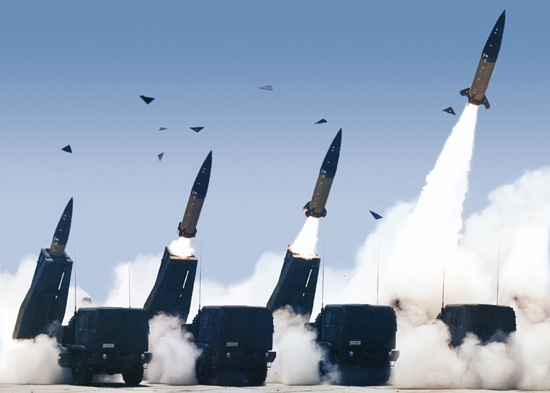
Today brings yet another announcement of more U.S. troops to Iraq. This time 600 are being sent as logistics support, advisers, and enablers (that term, “enabler,” is fuzzy indeed: enabler of what? More failure?). That brings the number of U.S. troops in Iraq to more than 5200, but of course this figure seriously under-represents the American presence in the region. Nowadays, most “troops” are provided by private contractors, and many of these are U.S. military veterans who discovered they could make a lot more money wearing mufti than in Uncle Sam’s uniforms. At the same time, the U.S. continues to provide heavy-duty weaponry to the Iraqi military, including Apache attack helicopters and the HIMARS rocket system. All of this is intended to help the Iraqi military retake the city of Mosul.
That the U.S. is yet again providing more troops as well as heavy weapons as “force multipliers” highlights the failure of U.S. military efforts to “stand up” an effective Iraqi military. The enemy, after all, has no Apache helicopters, no HIMARS system, and no U.S. advisers, although we certainly “enable” them with all the U.S. weaponry they’ve been able to capture or steal. Despite a lack of U.S. military training and aid, ISIS and crew have proven to be remarkably resilient. What gives?
Two years ago, I wrote an article at TomDispatch.com on “America’s Hollow Foreign Legions.” Back then, I said this:
Military training, no matter how intensive, and weaponry, no matter how sophisticated and powerful, is no substitute for belief in a cause. Such belief nurtures cohesion and feeds fighting spirit. ISIS has fought with conviction. The expensively trained and equipped Iraqi army hasn’t. The latter lacks a compelling cause held in common. This is not to suggest that ISIS has a cause that’s pure or just. Indeed, it appears to be a complex mélange of religious fundamentalism, sectarian revenge, political ambition, and old-fashioned opportunism (including loot, plain and simple). But so far the combination has proven compelling to its fighters, while Iraq’s security forces appear centered on little more than self-preservation.
Despite an ongoing record of failure, pulling out of Iraq is never an option that’s considered by the Pentagon. The only option our leaders know is more: more troops, more weapons, more money. As I wrote for TomDispatch back in October 2014:
pulling out is never an option, even though it would remove the “American Satan” card from the IS propaganda deck. To pull out means to leave behind much bloodshed and many grim acts. Harsh, I know, but is it any harsher than incessant American-led bombing, the commitment of more American “advisers” and money and weapons, and yet more American generals posturing as the conductors of Iraqi affairs? With, of course, the usual results.
Here we are, two years later, and nothing has changed. The war song remains the same, as discordant as ever, with a refrain as simple as it is harsh: putting out the fire with gasoline.
Hannah Arendt, cigarette in hand (Arendt Center, Bard College)
W.J. Astore
(This is part 2 of 2 of an essay dealing with lying, politics, and war, inspired by Hannah Arendt’s writings on The Pentagon Papers. For part 1, click here.)
After the Vietnam War, the U.S. government oversaw the creation of a post-democratic military, one that was less tied to the people, meaning that the government had even less cause to tell the truth about war. Unsurprisingly, then, the hubris witnessed in Vietnam was repeated with Iraq, together with an even more sweeping ability to deny or disregard facts, as showcased best in a statement by Karl Rove in 2004. The actions of the Bush/Cheney Administration, Rove suggested, bypassed the fact- or “reality-based” community of lesser humans precisely because their premises (the need to revolutionize the Middle East and to win the War on Terror through violence) were irrefutable and their motives unimpeachable. In Rove’s words:
We’re an empire now, and when we act, we create our own reality. And while you’re studying that reality—judiciously, as you will—we’ll act again, creating other new realities, which you can study too, and that’s how things will sort out. We’re history’s actors…and you, all of you, will be left to just study what we do.
So it was that the Bush/Cheney administration manufactured its own “facts” to create its own “reality,” as the Downing Street Memo revealed (according to a senior British official, U.S. intelligence was “fixed” in 2002 to justify a predetermined decision to invade Iraq in 2003). Dubious intelligence about yellowcake uranium from Africa and mobile biological weapons production facilities in Iraq (both later proved false) became “slam dunk” proof that Iraq had active programs of WMD development. These lies were then cited to justify a rapid invasion. That there were no active WMD programs in Iraq meant there could be no true “mission accomplished” moment to the war – a fact George W. Bush lampooned by pretending to “search” for WMD at the White House Correspondents’ Dinner in 2004. In this case, lies and self-deception coalesced in a wincing performance before chuckling Washington insiders that recalled the worst of vaudeville, except that Americans and Iraqis were dying for these lies.
Subsequent policy decisions in post-invasion Iraq didn’t fit the facts on the ground because those facts were simply denied. Then-Secretary of Defense Donald Rumsfeld said in July 2003 he didn’t do quagmires even as Iraq was becoming one for U.S. forces. Two years later, then-Vice President Cheney claimed the Iraq insurgency was “in the last throes” even as insurgent attacks began to accelerate. Lies and deception, to include self-deception, doomed the U.S. government to quagmire in Iraq, just as it had in Vietnam forty years earlier. Similar lies continue to bedevil U.S. efforts in Iraq today, as well as in Afghanistan and many other places.
Even as official lies and deception spread, whistleblowers who stepped forward were gagged and squashed. Chelsea Manning, Stephen Kim, and John Kiriakou were imprisoned; Edward Snowden was forced into permanent exile in Russia. Meanwhile, officials who toed the government line, who agreed to dissemble, were rewarded. Whether under Bush or Obama, government officials quickly learned that supporting the party line, no matter how fanciful, was and is rewarded – but that truth-telling would be punished severely.
Lying and Self-Deception Today
How are U.S. officials doing at truth-telling today? Consider the war in Afghanistan. Now in its 15th year, regress, not progress, is the reality on the ground. The Taliban controls more territory than ever, the drug trade is exploding, and Afghan forces remain unreliable. Yet the U.S. government continues to present the Afghan war as winnable and the situation as steadily improving.
Similarly, consider the war on terror, nowadays prosecuted mainly by drones and special ops. Even as the U.S. government boasts of terrorists killed and plots prevented, radical Islam as represented by ISIS and the like continues to spread. Indeed, as terrorism expert David Kilcullen recently admitted, ISIS didn’t exist until U.S. actions destabilized and radicalized Iraq after 2003. More than anything, U.S. intervention and blundering in Iraq created ISIS, just as ongoing drone strikes and special ops raids contribute to radicalization in the Islamic world.
Today’s generation of “best and brightest” problem-solvers believes U.S. forces cannot withdraw from Afghanistan without the Afghan government collapsing, hence the misleading statements about progress being made in that war. Radical Islamic terrorists, they believe, must be utterly destroyed by military means, hence deceptive statements about drone strikes and special ops raids as eliminating terrorism.
Accompanying lies and deception about progress being made in wars is image manipulation. Military action inoculates the Washington establishment, from President Obama on down, from (most) charges of being soft on terror (just as military action against North Vietnam inoculated John F. Kennedy and Lyndon B. Johnson against charges of being soft on communism). It also stokes the insatiable hunger of the military-industrial complex for bottomless resources and incessant action, a complex that the current crop of Republican and Democratic candidates for president (Bernie Sanders excepted) have vowed to feed and expand.
Whether in Vietnam, Iraq, or in the war on terror today, lying and self-deception have led to wrongheaded action and wrongful lessons. So, for example, rather than facing the quagmire of Afghanistan and extricating itself from it, Washington speaks of a generational war and staying the course until ultimate victory. Instead of seeing the often counterproductive nature of violent military strikes against radical Islam, Washington calls for more U.S. troops, more bombing, more “shock and awe,” the approach that bred the Islamic State in the first place.
One thing is certain: The U.S. desperately needs leaders whose judgment is informed by uncomfortable truths. Comfortable lies have been tried before, and look what they produced: lots of dead people, lost wars, and a crippling of America’s ability to govern itself as a democracy.
More than ever, hard facts are at a premium in U.S. politics. But the higher premium is the exorbitant costs we pay as a people, and the pain we inflict on others, when we allow leaders to make lies and deception the foundation of U.S. foreign policy.
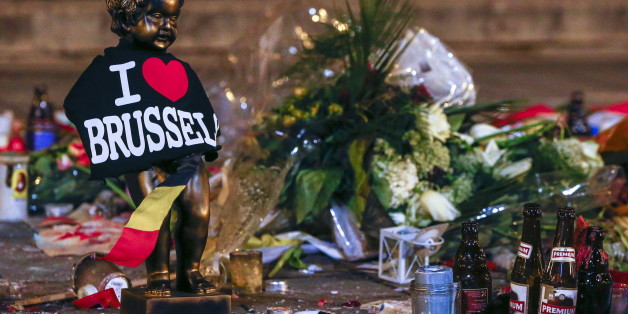
Replica of the Manneken-Pis statue, a major Brussels attraction, among flowers at a memorial for the victims of bomb attacks in Brussels. REUTERS/Yves Herman
W.J. Astore
I grew up during the Cold War when America’s rivalry with the Soviet Union posed a clear and present danger to our country’s very existence. Since the collapse of the USSR, or in other words the last 25 years, the U.S. has not faced an existential threat. Of course, the terrorist attacks on 9/11 were shocking and devastating, as were recent attacks in Paris and Brussels. But terrorism was and is nothing new. We faced it in the 1970s and 1980s, and indeed we will probably always face it. The question is how best to face it.
Stoking fear among the people is the wrong way to face it. Restricting liberty is the wrong way. An overly kinetic approach (i.e. lots of bombs and bullets) is the wrong way. Invading the Middle East (yet again) is the wrong way. Most of counter-terrorism, it seems to me, is an exercise in intelligence and policing (national and international). Yet we seem always to turn to our military to solve problems. The emphasis is relentlessly tactical/operational, stressing how many terrorists we kill in drone strikes and special ops raids (a version of the old “body count” from the Vietnam War era).
Military strikes and raids generate collateral damage and blowback, arguably creating more enemies than they kill. We’re helping to sustain a perpetual killing machine, a feedback loop. The more we “hit” various enemies while playing up the dangers of terrorism, especially in the media, the more they prosper in regards to attention (and recruits) they garner.
One of the first Rand primers I read as young Air Force lieutenant was “International Terrorism: The Other World War,” written by Brian M. Jenkins in 1985. Jenkins made many excellent points: that terrorists seek to instill fear, that their acts are mainly “aimed at the people watching,” that terrorism can’t be defeated like traditional (uniformed) enemies, that terrorists commit crimes for a larger political purpose (“causing widespread disorder, demoralizing society, and breaking down existing social and political order”), that terrorism is a form of political theater. As Jenkins notes:
“Terrorism attracts intense interest but produces little understanding. News coverage focuses on action not words. Terrorist incidents attract the media because they are genuine human dramas, different from ordinary murder and therefore newsworthy. “
Furthermore, “terrorists provide few lucrative targets for conventional military attack,” though this may be less true of state-sponsored terrorism.
What can we learn from Jenkins’s primer on terrorism? Three big lessons:
Deny the terrorists their victory by refusing to succumb to fear. In short, don’t panic. And don’t exaggerate the threat.
Don’t sensationalize the feats of terrorists in 24/7 media coverage of their attacks. That’s what the terrorists want. They want extensive media coverage, not only to shift public opinion and to spread fear, but also to recruit new members.
Finally, don’t change your way of life, your political system, your liberties, in response to terrorism. Abridging freedoms or marginalizing people (e.g. American Muslims) in the name of attacking terrorism is exactly what the terrorists want. They want to turn people against one another. To divide is to conquer.
The question is, when will Americans recognize the complexity of the terrorist threat while minimizing fear and over-reaction?
Terrorists need to be stopped, and that requires robust intelligence gathering, strong policing, and selective military action. But threat inflation, media hysteria, and militarized over-reaction simply play into the terrorists’ hands. Fear is the mind-killer, as Frank Herbert wrote. Let us always remember this as we face the terrorist threat with firmness and resolve.
I watched last night’s Republican debate from Florida (transcript here) and then checked this morning’s coverage from major networks such as NBC and CBS. The focus of media coverage was the “civility” of this debate compared to previous ones, combined with typical horse race speculations about which candidate won and which lost.
Well, I can’t tell you who won, but I can tell you who lost: the American people lost.
Several lowlights from the debate that stick in my mind:
1. Marco Rubio was asked about climate change and whether human action, such as the emission of greenhouse gases, contributed to it. Rubio essentially denied that human action had any significant impact on global warming. The essence of his answer: the climate is changing because the climate always changes. And the U.S. government can take no action to reduce it.
2. Donald Trump held to his position on torture. He believes waterboarding should be used, that laws should be changed to allow harsher means of torture, apparently because the enemy (ISIS) beheads its opponents or drowns them in cages. He was not challenged on how he would change international laws against torture, nor was he challenged on consistent evidence that torture does not work in efforts to gain accurate intelligence. Nor were any questions raised about the morality of torture and its proposed expansion if he wins the presidency.
3. All of the candidates expressed support for sending U.S. ground troops, perhaps 20,000 to 30,000, to combat ISIS in the Middle East. The situation was presented as a civil war within Islam between radical Sunni and Shia forces, but no candidate explained how U.S. combat forces could win someone else’s civil war, a war driven by fierce ideological differences. Somehow, magically, the reappearance of big battalions of U.S. troops and massive displays of air power would “shock and awe” radical jihadists into collapse and capitulation.
4. For the candidates, nothing Obama has done in the last seven years is worthy of the slightest praise. Obamacare must be repealed. The Iran nuclear deal is a disaster. His forthcoming trip to Cuba represents a capitulation to communism. His executive actions are illegal; all of them must be reversed.
5. Each candidate tried to best the other on who is more pro-Israel. According to Trump, “there’s nobody on this stage that’s more pro-Israel than I am.” Apparently Israel is the only U.S. ally that is worthy of total support and unconditional love by Republican candidates.
6. Trump refused to qualify his statement that there is “tremendous hate” in the Islamic world directed against the United States. However, there was no reason given for this hate, and no sense that U.S. military actions overseas, to include invasions, drone strikes, and special ops raids, contribute in any way to Islamic animosity. The candidates were simply not asked why some, most, or nearly all Muslims “hate” America.
7. Finally, topics that weren’t discussed at this debate but which are commonly discussed at Democratic debates: racism, shootings by police against Blacks, prison and justice reform, raising the minimum wage, the rising gap between the richest 1% and everyone else, reducing the cost of college education, and efforts to guarantee affordable health care for all. Nor were women’s issues, such as equal pay for equal work, mentioned. Indeed, with the exception of Trump’s comment about women being mistreated by the Muslim world, women’s issues simply didn’t exist, not in this debate and not in most of the others. Indeed, my wife turned to me during a previous Republican debate and said, “Not one of these guys cares one whit about women’s issues — they’re offering us nothing.”
Image showing Jihadi John. Apparently killed, then quickly replaced by a new “Jihadi John” — a visual metaphor of “progress” in the war on ISIS (AP photo)
W.J. Astore
An overarching strategy for defeating ISIS is simple enough to state: A concerted effort by regional power brokers to tamp down Islamic extremism while reducing the violent and chaotic conditions in which it thrives. Regional power brokers include the Israelis, the Saudis, the Iranians, and the Turks, joined by the United States and Russia. They should work, more or less cooperatively, to eliminate ISIS.
Why? Because you never know when a spark generated by extremists will ignite an inferno, especially in a tinderbox (a fair description of the Middle East). We know this from history. Consider the events of the summer of 1914. A Serbian “Black Hand” extremist assassinates an archduke of the Austro-Hungarian Empire in the Balkans (that era’s tinderbox of extremism). Most of Europe yawned, at least initially. A small brush fire between the Serbs and the Empire, easily containable, people said. Yet within weeks European troops were marching in the millions to their deaths in what became World War I.
In today’s Middle East, we’ve been lucky (so far) to avoid the kind of provocation and miscalculation that led to World War I. But consider the actions of a new president, say a Chris Christie. During a presidential debate, Christie promised to declare a no-fly zone over Syria and to shoot down any Russian plane that violated it. It’s the kind of ultimatum that very well could lead to another world war.
Provocations and ultimatums can rapidly spiral among nations that lack uniformity of purpose. For many of the power brokers engaged in the Middle East, defeating ISIS is either not the goal, or it’s not the primary one. Put differently, there are too many forces involved, working to discordant ends. Their actions, often at cross-purposes, ensure that entities like ISIS survive.
Let’s take the United States, for example. Every American politician says he (or she) wants to destroy ISIS. Yet in spite of this nation’s enormous military strength, we seem to be too weak, psychologically as well as culturally, to deal with Russia, Iran, et al. as diplomatic equals. The “exceptional” country thinks it must “lead,” and that means with bombing, drone strikes, troops on the ground, and similar “kinetic” actions. Rather than dousing the flames, such actions fuel the fire of Islamic extremism.
Consider America’s domestic political scene as well. ISIS is incessantly touted as a bogeyman to fear, most notably by Republican presidential candidates seeking to draw a contrast between themselves and Barack Obama, the “feckless weakling” in the words of Chris Christie. But the Republican “alternative” is simply more bombing and more U.S. troops. Making the sand glow is no strategy, Ted Cruz.
Strategy is a synthesis of means, ends, and will. Currently, the means is military force, with a choice of more (from Obama) or even more (from Republicans). Our leaders have no idea of the ends at all, other than vague talk of “destroying” ISIS. The will they exhibit is mostly bombast and fustian.
A nation lacking will, with no clear vision of means and ends, is a nation without a strategy. And a nation without a strategy is one that’s fated to fail.
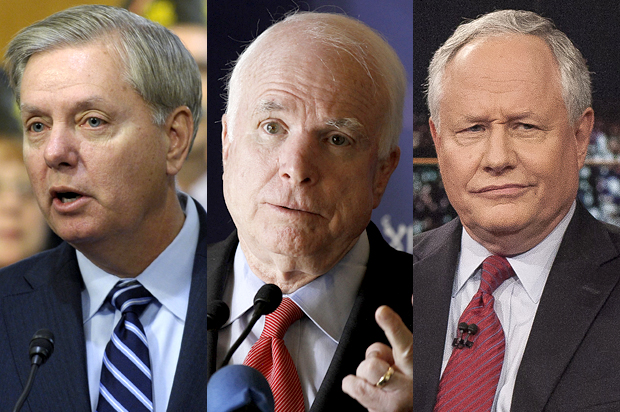
John McCain (middle) bookended by “warriors” Lindsey Graham (left) and Bill Kristol (right)
W.J. Astore
In his latest introduction at TomDispatch.com, Tom Engelhardt reveals a remarkable double standard — perhaps craziness is a better term — in the U.S. approach to terrorism in the wake of the Paris attacks. Prominent “conservative” leaders are calling for a major U.S. military invasion of territory controlled by ISIS, even though they know that ISIS has the “home field advantage.” They know, in short, that such an invasion will be both risky and costly, spreading chaos even further in the region, but they just can’t help themselves: they must “do something,” and the “something” in this case is sending other people’s sons and daughters into harm’s way.
But when it comes to incurring any risk, no matter how remote, to the American “homeland” from allowing refugees fleeing the chaos of the Middle East (chaos partly made by the USA and its previous military interventions, of course) to enter, these same conservative leaders cower. We can’t let “them” in. Too dangerous!
So, where the U.S. has an overwhelming “home field” advantage, these self-styled warriors retreat into paralyzing timidity. “Not in my backyard,” they say. But we sure as hell will send “our” troops into their backyards. See how brave we are in taking the fight to ISIS?
Here is Engelhardt’s introduction that so clearly highlights this tension:
In Washington, voices are rising fast and furiously. “Freedom fries” are a thing of the past and everyone agrees on the need to support France (and on more or less nothing else). Now, disagreements are sharpening over whether to only incrementally “intensify” the use of U.S. military power in Syria and Iraq or go to “war” big time and send in the troops. The editor of the right-wing Weekly Standard, Bill Kristol, is already calling for 50,000 American troops to take the Islamic State’s “capital,” Raqqa. Republican presidential candidate Senator Lindsey Graham, who has been urging that another 20,000 troops be dispatched to the region for months, offers this illuminating analogy to sports: “I’m looking for an away game when it comes to ISIL, not a home game. I want to fight them in their backyard.”
And don’t forget that increasingly angry sideline discussion about the Obama administration’s plan to let 10,000 Syrian refugees, carefully vetted for up to two years, trickle into the country. Alternatives proposed include setting up even harsher, more time-consuming vetting processes to insure that few of them can make it, allowing only certified, God-fearing Christian Syrians in while — give a rousing cheer for the “clash of civilizations” — leaving Muslims to rot in hell, or just blocking the whole damn lot of them.
I’m all for Bill Kristol and Lindsey Graham’s warrior fervor. I wish them every success as they deploy to Raqqa in their “away game” against ISIS.
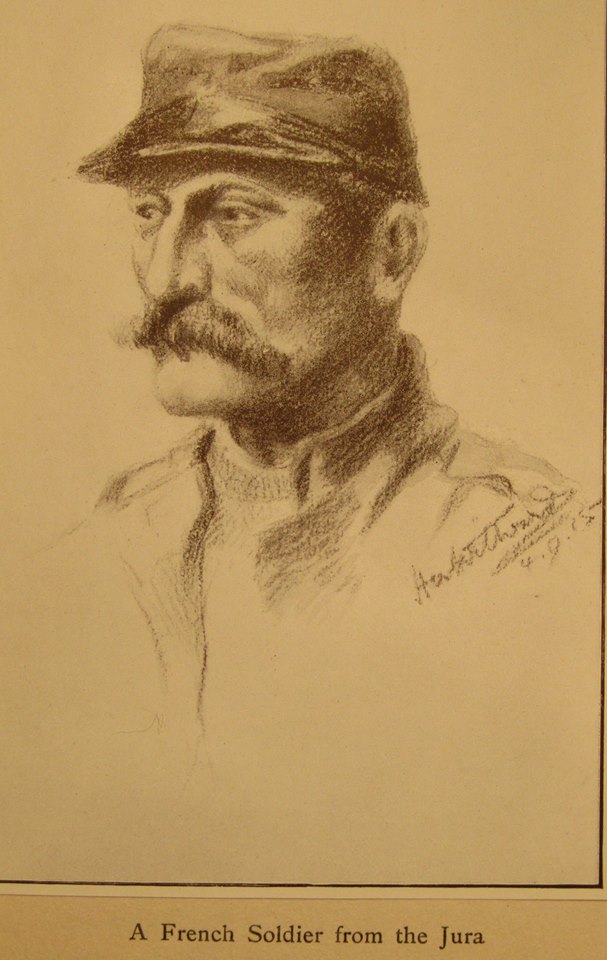
The French showed great resolve in 1915. A century later, that resolve yet lives
W.J. Astore
The world is still trying to digest the horrifying news from Paris of terrorist attacks by ISIS. We sympathize with all the victims of terrorism and other forms of violence, and we stand with France and its desire to bring the perpetrators and their accomplices to justice.
Yet we also must be careful not to overreact — not to play into the hands of ISIS and similar terrorist organizations.
French President François Hollande is already on the record as vowing, “We are going to lead a war [against ISIS] which will be pitiless.” But the answer to terrorism is not “pitiless” war. That’s exactly what terrorists want: they thrive on war and endless cycles of horrifying violence.
I understand Hollande’s rhetorical purpose. He’s saying: We’re united, we’re tough, we’ll avenge the murder of innocents. But pitiless war has been tried again and again in history — and it begets more atrocities and more war.
Terrorism is nothing new. What’s new is the way the West is elevating it into a generational war — another crusade. We must be very careful not to let the rhetoric of “generational” and “merciless” war become a self-fulfilling prophecy.
We must also be careful not to overreact to the threat of terrorism. In spite of the latest horrifying attacks in Paris, the threat of terrorism remains remote for the vast majority of us. The answer to the terrorist threat is not more state surveillance, not more military reprisals, not more curtailments of individual freedoms in the false name of security.
What is the answer? Resolve. Patience. Cooperation (e.g. international police work, intelligence sharing, and so forth). And action. Anger and cries for revenge in the form of “pitiless” war are natural after a profound shock, but they are not smart policy. Injustices committed in the name of “pitiless” war will not bring justice to the victims of the Paris attacks.
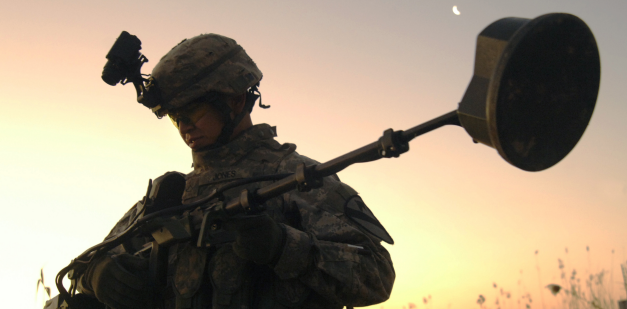
PFC Jones with Mine-Detector. Want to talk about fear?
W.J. Astore
Why, looky here, another article in the New York Times that examines the Republican “hawks” posturing for a presidential run in 2016. As the article blurb states, “Republicans are scrambling to outmuscle one another on national security issues.” It’s all about looking tough and calling for more boots on the ground in battles against ISIS and terror everywhere.
Here’s the money quote:
“There’s a lot of fear out there,” said Katon Dawson, a former chairman of the South Carolina Republican Party, noting that the Islamic State, also known as ISIS or ISIL, had become a regular topic of discussion at his regular breakfast spot in Columbia, the Lizard’s Thicket. “The waitresses and managers and everybody there has a notion about ISIL. People understand who this group is now.”
I should think the waitresses at “Lizard’s Thicket” would be more fearful of paying their weekly and monthly bills, given the low wages earned by wait staff in America. Or that they and their customers would be more fearful of their sons and daughters in uniform being deployed to Iraq to showcase those “muscles” that Republican politicians are always trying to flex. (Don’t worry: No politicians, Republican or Democrat, are eager to send their own sons and daughters overseas to fight.)
Once again, Republican politicians are banging the drums of fear – and as my dad always said, the empty barrel makes the most noise. The music is as tragic as it is predictable: endless war in the name of looking tough and defeating terror. And anyone who dares to suggest the folly of this risks being tarred as an appeaser to ISIS and its ilk.
What burns my butt is that none of these blowhard politicians has any skin in the game. They risk nothing in bleating for war. It’s not their sons and daughters who are being deployed to the front lines.
The other day, I was talking to a young woman at my eye doctor’s office. Her brother is in the Army. She told me he’s an EOD, an explosive ordnance disposal specialist. A risky job, I said, to which she replied, “He volunteered for the extra money,” money that the Army has yet to pay him. He’s got a four-year commitment and is due to be deployed after his training is completed.
So, as they seek to “outmuscle” their political rivals, how many politicians’ sons are in the Army right now, training for EOD duty and risking their lives for the extra money that comes with this hazardous duty? My educated guess: none. Absolutely none.
It’s easy to flex (and to risk) the muscles of others, America. Stop listening to politicians and their fear-mongering. No foreign terrorist is coming to get you as you enjoy your coffee and hash browns at “Lizard’s Thicket.” No – the biggest risk is blowhard politicians who are so, so, eager to send your sons and daughters off to yet more wars in the cause of outmuscling their rivals for political office.
Like so many bloated Hollywood movies nowadays, America’s wars may bomb, but they always produce their own sequels.
Look at the latest news from Iraq and Afghanistan. These wars have persisted for more than a decade, with several re-releases to include “surges” and repeats. The latest from Iraq is preparations to retake the city of Mosul from ISIS, which promises a repeat of the level of destruction visited upon Fallujah in 2004. In this there are echoes of Vietnam: in Mosul, we may have to destroy the city to save it. Five Iraqi brigades, most likely supported by American airpower and some American troops on the ground (air controllers and Special Forces), are poised to strike as early as April. Doubtless they’ll prevail, at least for the moment, as the city and its civilians pay a price so dear as to be indistinguishable from defeat. Mosul will be “liberated,” but just look what happened to Fallujah, which after the American “victory” in 2004 is now a devastated city retaken by elements of al-Qaeda in 2014.
(As an aside, it’s interesting that the New York Times uses the word “epic” to describe the Battle of Fallujah from 2004. Surely a better word is “catastrophic.” What is epic about a battle that destroys a city, a battle that is ultimately inconclusive? Check out Bing West’s book about Fallujah, whose title, “No True Glory,” captures the frustrations and contradictions of that battle, mainly from the American perspective.)
Moving to Afghanistan, the latest is that American troops may stay longer than expected (surprise!). Despite all the talk of “progress” in Afghanistan, the takeaway is the following section, from Secretary of Defense Ash Carter’s recent visit to Afghanistan:
“Despite the aid of American air power, 2014 was the deadliest year for Afghan forces since the start of the war in 2001, and many Afghan and Western officials in Kabul believe that 2015 will likely be worse, particularly with less support from Western allies. That has begun to change the conversation about the possibility of slowing down in the [American] withdrawal.”
In other words, expect more micro-surges of American troops and assets in the coming years, as well as more reports of “progress,” however temporary or illusory (at least America’s best and brightest learned from Vietnam not to talk of seeing light at the end of tunnels).
America’s wars are much like the “Transformers” franchise of movies: thrilling and seemingly conclusive at first, with much talk of missions being accomplished, followed by sequel after sequel of repetitive battles, increasingly loud and destructive, signifying vapidity and intellectual bankruptcy even as a few profit greatly from them.
And no one (certainly none of the producers at the Pentagon) seems to be able to pull the plug on green-lighting ever more sequels to these wars. Even when they bomb.
(For a different perspective on how recent Hollywood movies support American warmaking through myth-making, see Peter Van Buren’s insightful article “War Porn” at TomDispatch.com.)
Is the U.S. military doomed? I’d say yes. But it’s not because our troops are uncommitted, our weapons are bad, and our tactics are flawed. Rather it’s because of the conventional wisdom in Washington and the Pentagon that continues to commit our troops to unnecessary and unwinnable wars.
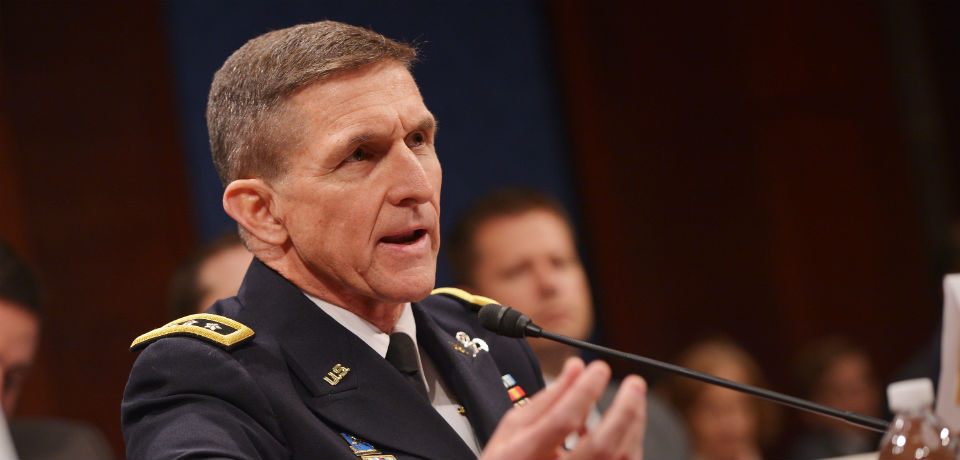
This conventional wisdom is perhaps best summed up in a speech by retired Lieutenant General Michael T. Flynn, the ex-chief of the Defense Intelligence Agency (DIA). It’s worth reading the speech in full, not because it’s especially original or insightful, but because it’s so unreflective and representative of Washington’s collective wisdom.
Here are General Flynn’s main points as I see them:
1. The American public must be committed to an open-ended ideological war “for decades.”
2. That war is against “grotesque” Islamic extremists who “hate our ideals” and who are “committed to the destruction of freedom and the American way of life.”
3. To win the war, America must be ready to use “overwhelming power” to defeat or deter the enemy, even if the U.S. must act alone.
4. Special Operations Forces (SOF) must be “well resourced” for this war, meaning they must be expanded even further and given even more money and latitude.
5. The model for this ideological war against extremist Islam is Ronald Reagan’s war against communism.
That is General Flynn’s strategic vision. It’s a vision widely shared within the Pentagon. And it’s a vision that dooms America to defeat.
Why? Mainly because radical Islam is a political/religious/social phenomenon. It is not amenable to military solutions. Indeed, the more America makes it into THE enemy, the more legitimacy organizations like ISIS gain within their communities and across the Muslim World.
Military force is a blunt instrument, even when it’s applied by the Special Ops community. Expanding the American SOF presence throughout the world is a recipe for more blowback, not more victories. Consider how well we’ve done so far in Afghanistan or Libya or Yemen. Or for that matter Iraq. Can anyone say that U.S. military intervention has produced stability in these countries? Has it contributed to the defeat of radical Islam? Indeed, in destabilizing Iraq and Libya and Yemen, has the U.S. not contributed to the spread of Islamic extremism?
Military professionals like General Flynn really know only one solution: “overwhelming power” applied “for decades.” And if you don’t accept their solution, they dismiss you as misguided (at best) or as arguing for “Retreat, retrenchment, and disarmament,” which “are historically a recipe for disaster,” according to General Flynn.
Well, I’m not aware of anyone seriously arguing for disarmament (fat chance of that happening in the USA!). I’m not aware of anyone arguing for “retreat,” as if this was the Chosin Reservoir in the Korean War. I’m not aware of anyone seriously working toward “retrenchment”; indeed, the SOF community keeps expanding, already mounting operations in 105 countries around the world in FY2015 (i.e., since October 2014). It’s easy to bayonet a straw man, general.
I have a few words for the general: Committing the American military to an ideological war “for decades” against radical Islam is pure folly. Chances are you won’t hammer it into non-existence: your blows will just spread it further, while wasting the energies of America and the lives of its troops.
Stop looking to Reagan and the collapse of communism for lessons and start looking at the actual results over the last 20-30 years of American meddling in Afghanistan, Iraq, Libya, and Yemen. And tell me: Is this what “victory” looks like? You want to double down on “overwhelming power” applied “for decades” as defending American “ideals” and “way of life”?
Which “ideals” are those, exactly? A permanent state of war in which military men are deferred to as the heroes and sages of the moment?






 Bracing Views