My fellow Americans, it’s nice to think we have a semblance of a constitutional republic, but that warship has sailed. This time, to Iran.
*****
This AM, I read an interesting story on the Supreme Court’s repeal of Trump’s tariffs. Justice Neil Gorsuch made the point that his fellow justices’ interpretation of the law often changes based on whether the president is a Republican or Democrat. This, to state the obvious, is not how the law is supposed to work.
*****
Years ago, I spied a bumper sticker that read: “I’m already against the next war.” It’s on my mind again.
******
I’ll support a war when Hollywood celebrities and sports stars willingly enlist. And when the sons and daughters of presidents and senators and CEOs happily join them in the ranks.
*****
Do you think it’s a coincidence that Bibi Netanyahu keeps visiting the White House even as the Trump administration prepares for yet another war in the Middle East?
*****
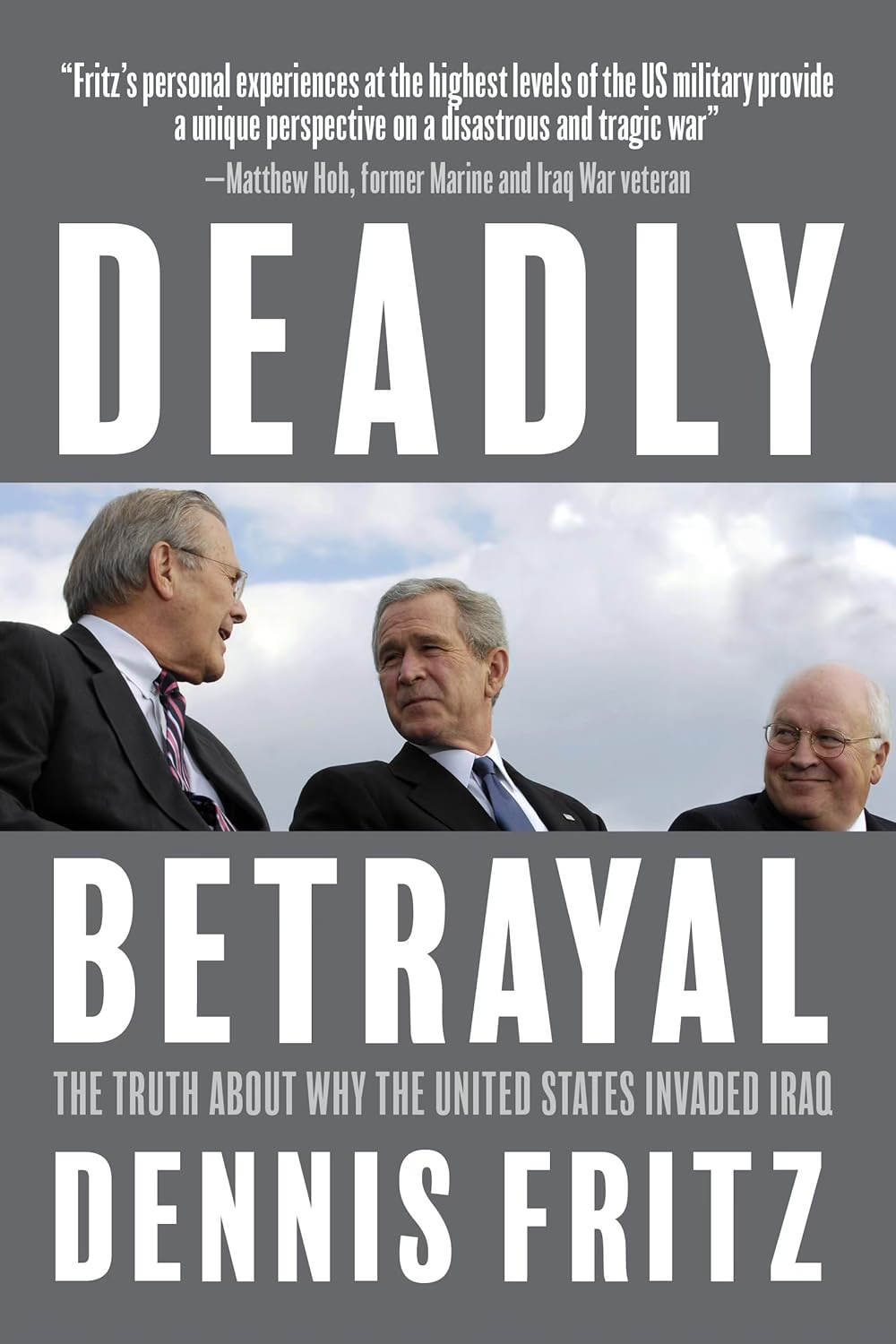
A great book for this moment is “Deadly Betrayal: The Truth About Why the United States Invaded Iraq” (2024) by Dennis Fritz. Fritz, a retired AF command chief master sergeant, was in the halls of power when the Bush/Cheney administration decided to invade Iraq in 2003. He identifies three main reasons for the Iraq War fiasco: U.S. leaders’ concerns about “credibility” and the perpetual fear of being perceived as “weak”; serving the security needs of Israel, especially by weakening Hamas and Hezbollah together with Iraq; and neocon fever dreams of imperial dominance in the Middle East connected to the control of oil.
In his conclusion, Fritz is scathingly blunt:
More than 4,500 [U.S. troops] made the ultimate sacrifice, and 100,000 have been wounded for life. There were no weapons of mass destruction in Iraq. Saddam Hussein posed no threat to our national security. The Iraq War wasn’t an honest mistake. It was a calculated lie—a deadly betrayal. Our service members were used as pawns by the government to fulfill an imperialist ideology. Their sacrifice had no basis in national defense. All Americans should be outraged, and we should never let this happen again. The troops didn’t even know why they were going to war.
It saddens me to think that Fritz may soon need to write “Deadly Betrayal II” about the forthcoming war with Iran.
President Trump announced tonight that the U.S. has bombed three nuclear sites in Iran. After these attacks, he’s now asking for peace.
That the attacks were coming was obvious. Even Director of National Intelligence Tulsi Gabbard was brought firmly into line before the attacks. As the Downing Street Memo said about the Iraq War, the intelligence was fixed around the policy. In Iraq, the policy was a regime-change war; with Iran, the policy is to destroy nuclear sites and possibly to topple the Iranian government. A predetermined policy determines what is a “fact” and what isn’t.
When you have an empire like the U.S. that devotes so much of its money and resources to the military, and when you have leaders desperate to be seen as “strong” and decisive, this is what happens. Military attacks followed by declarations that America seeks peace. War for peace. It makes no sense, but there you go.
Cui bono? Who benefits? Certainly, Israel in its ongoing efforts to dominate the region. Israel’s influence over U.S. foreign policy is remarkable. There was no way Trump was not going to bomb Iran, given the push from Israel to do so.
What happens next, I don’t know. But I did think that this was exactly what Trump would do—bomb Iran—because it’s always what the U.S. does.
Somewhere, in perhaps some hell, John McCain is singing a ditty about bombing Iran. People may have made fun of him, but the man predicted the future—and the future is now.
Yesterday, I talked to Dick Price, a Vietnam War veteran, at the LA Progressive about the U.S. military, the Vietnam War, the all-volunteer military, media coverage, and why America just can’t stop making war.
When no one is held accountable for failure, when lies are used as the basis for killing, when war produces colossal profits for a select few, when Congress refuses to take responsibility for oversight, when war budgets keep climbing to the trillion dollar mark, it isn’t all that surprising that wars prove essentially endless as democracy withers.
“Fighting a war to fix something works about as good as going to a whorehouse to get rid of a clap.” — Norman Mailer, The Naked and the Dead
I read Norman Mailer’s fine book about World War II, “The Naked and the Dead,” several years ago, though I’d forgotten the quote above until I ran across it again in an article by Andrew Bacevich at Harper’s in 2009.
Bacevich’s article was titled “The War We Can’t Win,” in which he critiqued and rejected President Barack Obama’s decision to “surge” in Afghanistan. As Bacevich wrote back in 2009:
What is it about Afghanistan, possessing next to nothing, that the United States requires, that justified such lavish attention? In Washington, this question goes not only unanswered but unasked. Among Democrats and Republicans alike, with few exceptions, Afghanistan’s importance is simply assumed—much the way fifty years ago otherwise intelligent people simply assumed that the United States had a vital interest in ensuring the survival of South Vietnam. Today, as then, the assumption does not stand up to even casual scrutiny.
Bacevich was right, of course. And once America pulled out of Afghanistan in 2021, we were encouraged to forget about it, just as we were encouraged to forget about Vietnam after the fall of Saigon in 1975.
If it doesn’t matter much to the U.S. when we lose wars, doesn’t that suggest the wars meant little to begin with? That there never truly were vital matters of national interest at stake?
The same was true of the Iraq War, as Bacevich describes it in the same article for Harper’s. This war, Bacevich writes, was “utterly needless” as “no Iraqi weapons of mass destruction [were] found, no ties between Saddam Hussein and the [9/11] jihadists established, no democratic transformation of the Islamic world set into motion, no road to peace in Jerusalem discovered in downtown Baghdad,” yet the U.S. was nevertheless hyping the success of the “surge” there from 2007 and how it should be applied to Afghanistan, an example of obtuseness and self-delusion that Bacevich said “is nothing short of obscene.”
He was right, of course, as both surges proved as fragile and reversible as weasel-worded General David Petraeus hinted they would be. Petraeus might be America’s best example of Grima Wormtongue from “The Lord of the Rings,” though of course there’s a lot of competition for that honor.
Bacevich, a retired Army colonel, political scientist, and Vietnam War veteran, criticizes U.S. leaders for their “failure of imagination,” for their crusading zeal, for their hubris, and for their tendency to substitute technique for sound strategy. He is right about all this, but someone always profits from war. Somebody always wins. And so perhaps the best way to understand these wars is to focus on the winners.
So, who won these wars? Certainly, the military-industrial complex won them. Every war, winning or losing, wise or unwise, strengthens the MIC by expanding its budgetary authority and scope of action. Military contractors, the merchants of death, especially profit from war, notably long “stalemated” ones like Vietnam, Iraq, and Afghanistan.
In a short video clip, Wikileaks Founder Julian Assange explained the purpose of the Afghan War which, as Bacevich mentions above, is inexplicable in terms of U.S. national interest:
A vast money-laundering operation that enriches oligarchs who profit from war, death, and mayhem: it makes a lot of sense, doesn’t it? Note too how Assange explains that the ultimate purpose here is to make war permanent, to make it normal, to make it unremarkable, even to make it the height of sanity.
This has happened and is happening. Today, Iraq and Afghanistan are largely forgotten in the U.S. and Europe. New fears are focused on bigger fish: Russia and/or China, even as the U.S. pummels Yemen. Few Western leaders are talking about peace; Europe is fixated on Russia even as America is more concerned with pivoting to Asia and doing the bidding of Israel in the Middle East.
And so the money-laundering continues.
A lesson here is to follow the money, especially when wars seem strategically stupid, because the people and forces in charge aren’t stupid—their priorities are just far different from our priorities.
And this is something Bacevich catches in a different context as he explains that the costs of war are not borne “by the people who inhabit the leafy neighborhoods of northwest Washington, who lunch at the Palm or the Metropolitan Club and school their kids at Sidwell Friends.” Indeed not. The costs are borne by the peoples of Iraq, Afghanistan, Yemen, and so on, as well as those U.S. troops who get caught waging these wars, and who likely come from small towns in Alabama and Texas and similar rural areas.
I’ve been reading John Ketwig’s memoir “…and a hard rain fell: A GI’s true story of the War in Vietnam,” and it’s reminding me just how plain dumb, destructive, and duplicitous America’s wars have been since World War II.
America’s wars are always dressed up with a necessary, even allegedly noble, cause. In Vietnam, we had to stop communism and all those dominoes from falling. In Iraq, it was about WMD and stopping Saddam Hussein, “the next Hitler.” In Afghanistan, it was about vengeance for 9/11, then creating democracy and even helping women. (How about helping women in America? Never mind.)
Vietnam is nominally communist today—and a big trading partner of the U.S. and an ally of sorts against China. No dominoes fell. Iraq didn’t have WMD and Saddam wasn’t the next Hitler; he was merely a regional strongman and a former U.S. ally who got a little too big for his britches, especially for Israel. Afghanistan was a war in search of a clear mission and attainable goals. After twenty years of effort and roughly $2 trillion in expenditures, the U.S. replaced the Taliban with—the Taliban. (I heard Norman Finkelstein say this first.)
We’re always told versions of the same lie: We need to fight them over there so that we don’t have to fight them here. Communism had to be rolled back in Vietnam else commies would be landing in Manhattan. Iraq had to be pummeled and Saddam overthrown before WMD landed in Boston. Afghanistan had to be pacified and modernized before the Taliban enforced conservative Sharia law in Biloxi.
None of this was true. The United States would have been perfectly safe without committing any troops to Vietnam, Iraq, and Afghanistan. In fact, the U.S. would have been far better off if those wars had never been fought. Certainly Vietnam, Iraq, and Afghanistan would have been far better off if they’d never become free-fire zones for American munitions (including the poisonous Agent Orange in Vietnam and, more recently, depleted uranium and other poisons in Iraq and Afghanistan).
Now we’re hearing about a possible U.S. war with Iran, allegedly to stop that country from acquiring an atomic bomb. It’s OK for the U.S. to have more than 5000 nuclear warheads and for Israel to have 200 or so, but it’s not OK for Iran to have even one, because reasons.
The U.S. military, vast as it is, with a vision of global dominance, always needs enemies. Of course, it’s not simply the military but the whole military-industrial complex, the MICIMATT,* which needs war and conflict to sustain itself.
I recently read “American War,” a powerful novel by Omar El Akkad. It imagines a second U.S. civil war starting roughly 50 years from now. It’s a fascinating book, well worth reading because it captures the horror of war, with all its atrocities, its massacres, its war crimes, and the deep wounds war leaves behind even among the most resolute survivors. John Ketwig’s book does the same as he recounts the fears and horrors of his year in Vietnam and the personal struggles he endured in coming to terms with what he’d seen and endured.
So, count me among those who are already against the next war, whether against Iran, China, or for that matter any other country. Sure, I think America needs to defend itself; I don’t think peace is going to break out spontaneously around the world; but I know for a fact that fighting constant wars is not a way toward greater peace and prosperity. Quite the opposite.
If you want to know what desperate and profoundly wounded war survivors are capable of, read “American War.” If you want to know what desperate and profoundly confused troops are capable of, read “…and a hard rain fell.” And ponder the continued propaganda here of the “good war,” the wonders of warriors and warfighters, and the repetition of slogans like “peace through strength,” a specific form of strength measured in kilotons and megatons of explosives, in massive body counts and military production figures.
Ask yourself: Is that “strength”? Are constant wars truly the path toward peace? How can we possibly be so dumb as to believe this?
MICIMATT: military-industrial-congressional-intelligence-media-academe-think-tank complex. It employs millions of people and spends more than a trillion dollars a year. It’s not easily confronted. Nor is it easily contained, let alone curtailed.
I remember watching The Phil Donahue Show with my dad. Informative and willing to tackle controversial issues, the show proved remarkably popular, a tribute to its host, Phil Donahue, who recently died at the age of 88. The show was briefly revived in 2002 on MSNBC, where it was the network’s highest-rated offering until it was cancelled.
Here’s what the Boston Globe had to say yesterday about Phil Donahue’s show in 2002 and why MSNBC cancelled it:
Donahue returned briefly to television in 2002, hosting another “Donahue” show on MSNBC. The station canceled it after six months, citing low ratings.
OK, the suits at MSNBC may have cited “low ratings,” but the real reason was that Phil Donahue was asking uncomfortable questions in the run up to the Iraq War. His show was perceived as anti-war and therefore unprofitable and “unpatriotic” to those suits. And so he was cancelled.
As Donahue says above, his show wasn’t “good for business,” and the business in America was (and is) war.
At Common Dreams, Jeff Cohen further explained why Donahue’s show was axed by MSNBC:
I was a senior producer on Phil’s short-lived MSNBCprimetime show in 2002 and 2003. It was frustrating for us to have to deal with the men Phil called “the suits”—NBCand MSNBC executives who were intimidated by the Bush administration, and resisted any efforts by NBC/MSNBC to practice journalism and ask tough questions of Washington before our young people were sent to Iraq to kill or be killed. Ultimately, Phil was fired because—as theleaked internal memo said—Donahue represented “a difficult public face for NBC at a time of war.”
But before we were terminated, we put guests on the screen who were not commonly on mainstream TV. We offered a full hour with Barbara Ehrenreich on Labor Day 2002, a full hour with Studs Terkel, congressmembers Bernie Sanders and Dennis Kucinich, columnist Molly Ivins, experts like Phyllis Bennis and Laura Flanders, Palestinian advocates including Hanan Ashrawi.
No one on US TV cross-examined Israeli leaders like Phil did when he interviewed then-Israeli Foreign Minister Shimon Peres, and later, former Prime Minister Ehud Barak. They seemed stunned—never having faced such questioning from a US journalist.
Phil Donahue (right) with Michael Moore—three right-wingers for balance not pictured.
But “the suits” ruined our show when they took control and actually mandated a quota system favoring the right wing: If we had booked one guest who was antiwar, we needed to book two that were pro-war. If we had two guests on the left, we needed three on the right. When a producer suggested booking Michael Moore—known to oppose the pending Iraq War—she was told she’d need to book three right-wingers for political balance.
Three weeks before the Iraq war started, and after some of the biggest antiwar mobilizations the world had ever seen (which were barely covered on mainstream TV), the suits at NBC/MSNBC terminated our show.
Keep this in mind if you watch MSNBC today, currently airing glowing coverage of the Democrats and the war machine. In fact, keep this in mind if you watch any corporate-owned news (CON) network.
Governor Tim Walz, the Democratic nominee for Vice President, has come under fire about his military record. Leading the charge has been another Vice President nominee, J.D. Vance of the Republican Party, who served in the Marines and deployed to Iraq.
A young Tim Walz. Little did that young man know how this photo and his military service would become yet another battleground in American politics, generating plenty of heat but very little light
Let’s use the Army acronym of BLUF (bottom line up front); in other words, let’s cut to the chase:
Tim Walz has said he retired as a command sergeant major (CSM) after 24 years of service in the Army National Guard. While he did serve as CSM for his battalion, he didn’t attend the Sergeants Major Academy and therefore he retired a step down as a master sergeant (MSG).
When Tim Walz retired in 2005, he was preparing to run for Congress. His unit was also preparing to deploy to Iraq, which it eventually did in March of 2006. Walz was well within his rights as a soldier to retire when he did. Whether he did so to avoid war service in Iraq is known only to Walz. He claims he’d made his decision to retire before his unit was notified of its overseas deployment to Iraq.
Tim Walz has talked loosely about using weapons of war “that he carried in war,” implying he’d seen combat service when he hadn’t. I don’t see this as a case of “stolen valor.” He wasn’t boasting about being some kind of badass hero in war. Obviously, in 24 years of service in the Army National Guard, he’d carried weapons of war and trained with them under simulated combat conditions “down range.” He should have simply said: “I’ve trained extensively with weapons of war.” Period.
Does any of this matter? Not to me. Tim Walz, by all accounts, served honorably, reaching the senior enlisted ranks. If the Army had wanted him to stay instead of retiring, he could have been stop-lossed or his retirement request could have been denied. He moved on to Congress, winning his election in 2006. He seems to be a person motivated by public service.
The issues that really matter here aren’t mentioned by the Republicans or the corporate-owned news (the CON). Here are those issues:
Tim Walz is a strong supporter of Israel and its ongoing genocide in Gaza.
Tim Walz is a strong supporter of massive military aid to Ukraine.
To my knowledge, Tim Walz has not criticized the military-industrial-congressional complex (MICC) in meaningful ways, though he has spoken out against the idea of China being an inevitable U.S. enemy.
Tim Walz, in short, is a typical pro-Israel, pro-Ukraine, generally pro-MICC, Democrat.
The most important issue of all is the whole idea that one must go to war—to serve in places like Afghanistan and Iraq and, more likely than not, to kill other human beings, to prove one’s “valor” in uniform. Why is carrying and using a gun in war such a great and glorious thing? Especially wars like those in Afghanistan and Iraq that were based on lies? Would we respect Tim Walz more if he’d gone to Iraq in 2006 and shot up some Iraqis in the cause of “freedom”?
As a candidate for the presidency in 2016, Donald Trump famously denounced the Iraq War, using words like “stupid,” “dumb,” a “total disaster.” and a “big fat mistake.” The war was based on a lie, Trump said, about weapons of mass destruction that didn’t exist. Even worse, the Bush/Cheney administration was behind the lie, leading to a war that destabilized the Middle East, costing the U.S. military thousands of lives and U.S. taxpayers $2 trillion, Trump concluded.
Under that bright blaze of honesty from Trump (yes, you read that right), we might question anyone who wants to trumpet service in Iraq as praiseworthy in the sense of “bringing freedom” or “spreading democracy.”
Perpetual War Abroad Is the Most Insidious Enemy to Liberty and Freedom at Home
I wrote my first article for TomDispatch in 2007, two years after I’d retired from the military. That article was highly critical of the U.S. military and its disastrous war in Iraq. I wrote that we, the citizens of America, had to save the military from itself and its worst excesses. Sadly, we the people have been demobilized; we have no say about “our” military and its wars.
In fact, while the Iraq and Afghan Wars are now officially over, both lost at enormous cost, we the people are still issuing blank checks to a Pentagon that is wildly if not fatally deluded and delusional.
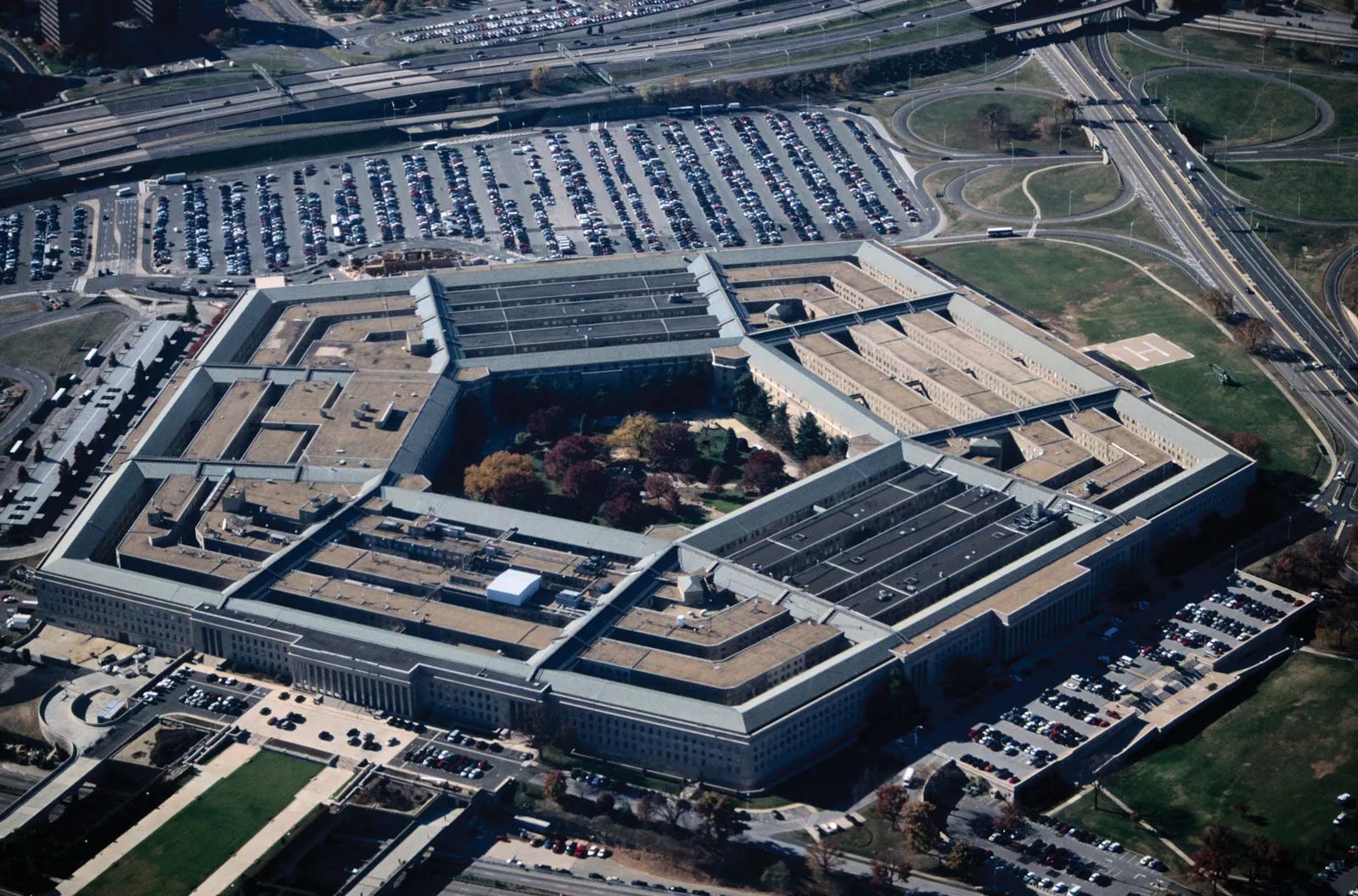
Much like a black hole, the Pentagon keeps sucking in everything around it, especially taxpayer dollars
Back in 2018, Tom Engelhardt, the creator, editor, and prime mover of TomDispatch, asked me to write a new introduction to my article from 2007. Here’s that intro as I wrote it back then:
Retiring from the U.S. military liberated my tongue, but I quickly learned few people were interested in what I had to say. In 2007, I was outraged by the way the Bush administration hid behind the richly bemedaled chest of General David Petraeus, using his testimony before a spineless Congress to evade responsibility for the catastrophic war in Iraq. I wrote an op-ed about how ‘my’ military was deluding itself not only into believing that it was the ‘greatest’ but that it could somehow find a formula to win an unwinnable war. I sent it to the usual suspects, newspapers like the New York Times and Boston Globe, with no response. A friend then mentioned a website I’d never heard of, TomDispatch.com, and I found a man there who would listen: today’s equivalent of I.F. Stone, Tom Engelhardt. What started as a one-off article led to 55 more ‘Tomgrams‘ over the last decade.
In that very first post, I asked, ‘How can you win someone else’s civil war?’ It’s a question the U.S. military still avoids asking, let alone answering. Indeed, a state of what I then called ‘ongoing self-delusion’ about war persists in that military and American society as a whole. More than a decade later, its commanders continue to mislead themselves and the rest of us by speaking about ‘new’ approaches that promise ‘progress’ in places like Afghanistan.
Who will teach the Pentagon that wars that never should have been fought cannot be won? Who will remind the American people that perpetual war abroad is the most insidious enemy to liberty and freedom at home? Members of the military, active duty and retired, need to speak up. Our oath to the Constitution was never about saluting smartly and following blindly, but about allegiance to the noble ideals expressed in that document. William J. Astore, May 2018
Since 2018, I’ve written another fifty or so articles for TomDispatch, nearly all of them focusing on U.S. military folly and fallacies. It hasn’t mattered. Both parties, Republicans and Democrats, profess their unconditional love of “our” troops, even as they’ve shoved and shoveled trillions of dollars to the military-industrial-congressional complex, the all-powerful MICIMATT* that increasingly infects our lives and infests our society and culture.
This November provides us another opportunity to go to the polls and allegedly vote for what we want. Most people want peace. The Republicans and Democrats offer us more war. Might I suggest that we vote for a person or party that actually seeks peace?
It’s highly unlikely we’re going to vote ourselves out of the mess we’re in. Look at the mainstream candidates! But at least we shouldn’t vote for yet more insanity.
*MICIMATT: military industrial congressional intelligence media academe think tank complex. To that you can now add Hollywood and the world of sports as well. Hercules had a much easier time vanquishing the hydra. It only had seven heads.
Learning from Ashleigh Banfield’s Landon Lecture of April 2003
Early in 2003, Ashleigh Banfield was a star in the making. A rising journalist at MSNBC, she covered the opening stages of the Iraq War. Before that, she’d made a name for herself covering the 9/11 attacks and their aftermath. Smart, pretty, highly skilled, she was heading nowhere but up. Until she gave an honest lecture on her experiences in Iraq and the Middle East on April 24, 2003.
I’ve written before about Banfield’s honest and heartfelt critique of Iraq war coverage in the U.S. mainstream media, which won her no friends at NBC News. In fact, the NBC brass sidelined and essentially exiled her. I recently reread her Landon Lecture at Kansas State University and realized NBC wasn’t just angry about her critique of mainstream media war coverage: they were likely even more incensed at how she humanized and empathized with Palestinians and other Middle Eastern peoples and groups, including organizations like Hezbollah.
Here’s some of what she had to say back then in 2003:
But it’s interesting to be able to cover this [Israel and Palestine]. There’s nothing in the world like being able to cross a green line whenever you want and speak to both sides of a conflict. I can’t tell you how horrible and wonderful it is at the same time in the West Bank and Gaza and Israel. There are very few people in this world who can march right across guarded check points, closed military zones, and talk to Palestinians in the same day that they almost embedded with Israeli troops, and that’s something that we get to do on a regular basis.
And I just wish that the leadership of all these different entities, ours included, could do the same thing, because they would have an eye opening experience, horrible and wonderful, all at the same time, and it would give a lot of insight as to how messages are heard and how you can negotiate. Because you cannot negotiate when someone can’t hear you or refuses to hear you or can’t even understand your language, and that’s clearly what’s happening in a lot of places in the world right now, the West Bank, Gaza and Israel, not the least of which there’s very little listening and understanding going on. Our language is entirely different than theirs, and I don’t just mean the words. When you hear the word Hezbollah you probably think evil, danger, terror right away. If I could just see a show of hands. Who thinks that Hezbollah is a bad word? Show of hands. Usually connotes fear, terror, some kind of suicide bombing. If you live in the Arab world, Hezbollah means Shriner. Hezbollah means charity, Hezbollah means hospitals, Hezbollah means welfare and jobs.
These are not the same organizations we’re dealing with. How can you negotiate when you’ re talking about two entirely different meanings? And until we understand — we don’t have to like Hizbullah, we don’t have to like their militancy, we don’t have to like what they do on the side, but we have to understand that they like it, that they like the good things about Hizbullah, and that you can’t just paint it with a blanket statement that it’s a terrorist organization, because even when it comes to the militancy these people believe that militancy is simply freedom fighting and resistance. You can’t argue with that. You can try to negotiate, but you can’t say it’s wrong flat out.
And that’s some of the problems we have in dealing in this war in terror. As a journalist I’m often ostracized just for saying these messages, just for going on television and saying, “Here’s what the leaders of Hezbullah are telling me and here’s what the Lebanese are telling me and here’s what the Syrians have said about Hezbullah. Here’s what they have to say about the Golan Heights.” Like it or lump it, don’t shoot the messenger, but invariably the messenger gets shot.
We hired somebody on MSNBC recently named Michael Savage. Some of you may know his name already from his radio program. He was so taken aback by my dare to speak with Al-Aqsa Martyrs Brigade about why they do what they do, why they’re prepared to sacrifice themselves for what they call a freedom fight and we call terrorism. He was so taken aback that he chose to label me as a slut on the air. And that’s not all, as a porn star. And that’s not all, as an accomplice to the murder of Jewish children. So these are the ramifications for simply being the messenger in the Arab world.
Emphasis added. Original spelling retained. You can watch her speech here.
Banfield tried to be a real journalist for MSNBC. She tried to understand and report the Israeli perspective but also the perspectives of groups like Hezbollah, and for that she was severely punished.
For Hezbollah, you could say something similar of Hamas today. As Banfield says, you don’t have to praise groups like Hamas (or, for that matter, Israel). But what you should try to do as a journalist is to understand them and to report on them as clearly and honestly as possible. As she says, her reward was to be defamed and dismissed as a slut by a fellow reporter, even called an accomplice to murder, after which her bosses at NBC punished and demoted her!
It’s no wonder that mainstream media coverage by most reporters today is so slavishly pro-Israel. Who wants to be slut-shamed and demoted? Who wants their career ruined just because they sought to understand more than one side (the Israeli/U.S. one) of complex situations in the Middle East?
My brother once quipped: “We learn, good.” MSM reporters in America “learned good” that being rabidly pro-Israel (and, of course, pro-U.S. government and pro-war) is always the safest bet to accolades and promotions from their corporate overlords.
With admirable honesty, Banfield spoke of the horrific face of war at Kansas State Univ. in 2003. Soon after her speech, she was demoted (Image courtesy of KSU)
And, as I wrote in my previous piece on Banfield: Any young journalist with smarts recognizes the way to get ahead is to be a cheerleader for U.S. military action, a stenographer to the powerful. Being a critic leads to getting fired (like Phil Donahue); demoted and exiled (like Banfield); and, in Jesse Ventura’s case, if you can’t be fired or demoted or otherwise punished, you can simply be denied air time.
Banfield tried to tell us there’s a difference between journalism and coverage; that far too many voices of dissent had been silenced in America before and during the opening stages of the Iraq War; that war coverage was (and is) far too often both one-sided and sanitized.
Again, it’s worth a few minutes of your time to listen to her lecture and reflect on her honesty and integrity—and how she was punished for it.
After watching this, you’ll understand why the reporters you see today on U.S. TV and cable networks are nothing like Ashleigh Banfield.
“War is ugly and it’s dangerous” and it fuels hatred. Yes it is and yes it does, Ms. Banfield. Thank you for your honesty, your integrity, and your courage.
The Most Fundamental Problem with the U.S. Military
“Integrity First” is the fundamental core value of the U.S. Air Force. Two other core values speak to “service before self” and “excellence in all we do.” But integrity remains the wellspring, and it’s the U.S. military’s stunning lack of integrity that has cost the American people and indeed the world so dearly over the last half-century.
Tonkin Gulf. My Lai. The Pentagon Papers. WMD in Iraq. Abu Ghraib. The Afghan War Papers. So many instances of “official” lies and distortions. So many lost wars where no senior officers were ever held accountable. Put up, shut up, fuck up, cover up, move up, seems to be the operating manual for success.
Last September, I wrote an article for TomDispatch: “Something is rotten in the U.S. military.” I suggested that integrity was now optional in that military, that lies and dishonor plagued America’s war machine. Evidently, those lies, that dishonor, is working just fine for the Pentagon as its budget continues to soar.
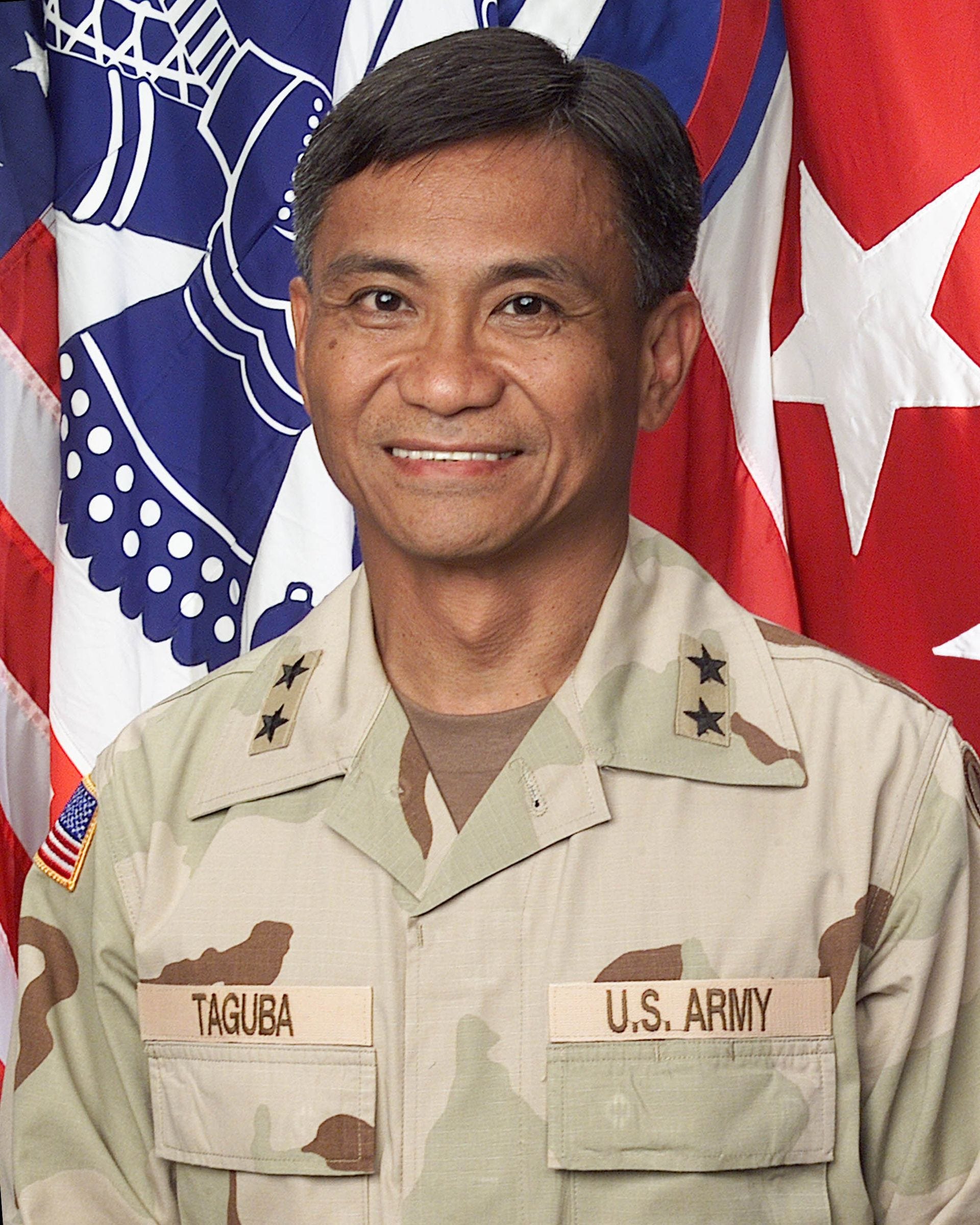
These thoughts occurred to me yet again as I read Seymour Hersh’s retrospective account of Major General Antonio (Tony) Taguba’s withering investigation of torture of prisoners at Abu Ghraib in Iraq. Taguba, a man of integrity, conducted an official—and honest—investigation of torture and mistreatment at Abu Ghraib; his reward for his honesty, his service, his excellence was not a commendation and promotion but threats, ostracism, and the death of his career as an Army officer.
General Antonio Taguba, man of integrity, service, and excellence
Sy Hersh’s article captures the rot at the core of the Pentagon and the U.S. government. Here Hersh speaks recently to Taguba:
[Taguba] “I was not a whistleblower. I knew I was in trouble when I was given the assignment [to investigate abuse at Abu Ghraib], but when you see those photos what can you do? I was a dead man walking.
“The kids were trained as traffic cops and then were told to transport [Iraqi] detainees. That’s how they got to Abu Ghraib. They weren’t trained for that but they had vehicles and rifles, just undisciplined kids with incompetent leadership and they were on the list to go home. They had all their equipment packed in Kuwait and ready to be shipped. And then they were told to stay behind.”
I [Hersh] asked: Would he do it again? “Sure,” Tony [Taguba] said, “I was hamstrung by the thirty days I had to investigate. I do not think I fulfilled my mission. [Secretary of Defense Donald] Rumsfeld was blaming the soldiers, but underneath they had no operational plan” for dealing with the prisoners.
“In hindsight, there was nothing I did to compromise my integrity. But integrity in the military and elsewhere is a bumper sticker. There is no reward for telling the truth.” [Emphasis added]
“There is no reward for telling the truth” in the U.S. military. That statement by retired General Taguba should move all Americans to take action against a military that has so clearly and tragically lost its way.
One suggestion: Cut the Pentagon budget in half and insist that it must pass a financial audit else forfeit all taxpayer funding. That might wake up a few generals and admirals.







 Bracing Views