Yet Another Smear Piece on Tulsi Gabbard

W.J. Astore

Where else but the New York Times

In my morning news feed from the New York Times came this article on Tulsi Gabbard:

How Tulsi Gabbard Became a Favorite of Russia’s State Media

President-elect Donald J. Trump’s pick to be the director of national intelligence has raised alarms among national security officials.

Here’s the key paragraph from the article, which, of course, is delayed until the sixth paragraph:

No evidence has emerged that she has ever collaborated in any way with Russia’s intelligence agencies. Instead, according to analysts and former officials, Ms. Gabbard seems to simply share the Kremlin’s geopolitical views, especially when it comes to the exercise of American military power. [Emphasis added]

Did you get that? NO EVIDENCE. Tulsi has never collaborated with Russia in any way. The problem is that she’s a critic of unnecessary and disastrous wars like Iraq and Afghanistan. She’s a critic of massive U.S. military aid to Ukraine. And since those criticisms are vaguely useful to Russia, she must therefore be a “Russian asset,” a dupe of Putin, according to Hillary Clinton and now the New York Times.

Within the so-called intelligence community (IC), you are allowed to be a cheerleader, a booster, even a selective critic in the sense that you may call for more money for the IC because of certain limitations or oversights, but you are not allowed to question America’s disastrously wasteful imperial foreign policy.

No matter how poorly the IC performs (consider the colossal failure of 9/11, or the total obliviousness about the impending collapse of the Soviet Union in the late 1980s, or recent disastrous wars in Afghanistan, Iraq, and Libya), no one is ever held accountable, even as the IC gets more money and authority.
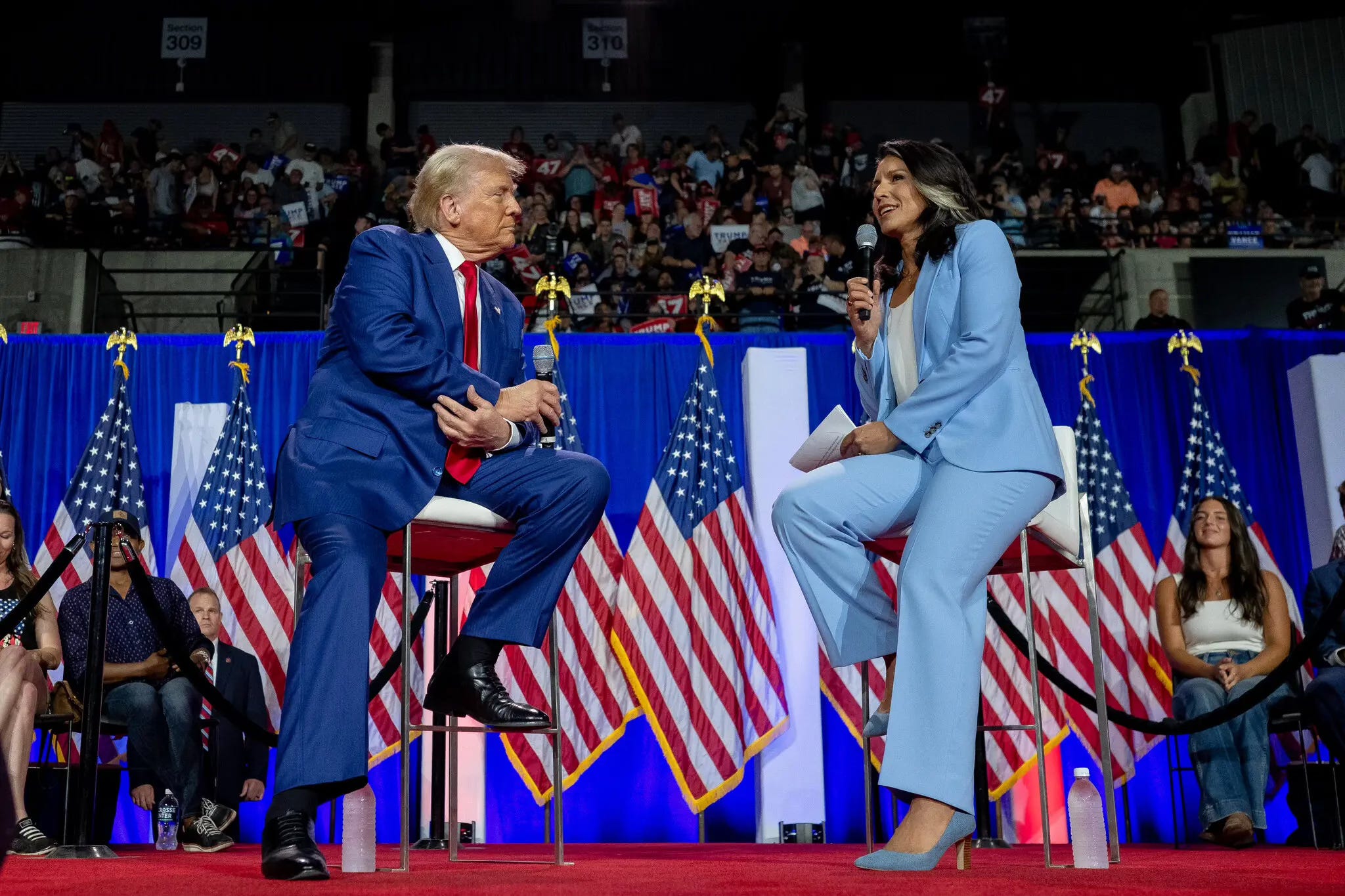
Tulsi Gabbard with President-elect Trump. (Jim Vondruska for the NYT)

Tulsi Gabbard promises to be a game-changer. Skeptical of the blatant misuse of American military power, she’s been an articulate critic of forever wars. She is especially sensitive to deploying U.S. troops in harm’s way for purposes other than the defense of the United States.

The “liberal” New York Times is having none of that. Consider this remarkable paragraph:

“Nominating Gabbard for director of national intelligence is the way to Putin’s heart, and it tells the world that America under Trump will be the Kremlin’s ally rather than an adversary,” Ruth Ben-Ghiat, a professor of history at New York University and the author of “Strongmen,” a 2020 book about authoritarian leaders, wrote on Friday. “And so we would have a national security official who would potentially compromise our national security.” [Emphasis added]

Who knew that “Putin’s heart” could be won so easily? And note the weasel wording that Tulsi could “potentially compromise” U.S. national security. Again, no evidence is presented. 

Well, we certainly don’t want the U.S. to have a rapprochement with Putin. He must always be our adversary, am I right? How dare that Trump and Gabbard might, just might, pursue a policy that is less antagonistic toward the Kremlin? Don’t you enjoy teetering on the brink of a world-ending nuclear exchange? I much prefer that to listening and negotiation.

In making enemies of Hillary Clinton and now the New York Times, Tulsi Gabbard has demonstrated she has what it takes to serve as director of national intelligence.

Tulsi Gabbard, A Smart Choice as Director of National Intelligence

W.J. Astore

And she surfs too

Former Democratic Congresswoman Tulsi Gabbard has been nominated as Director of National Intelligence by President-elect Donald Trump. The so-called intelligence community is up in arms about this. That is a very good thing.

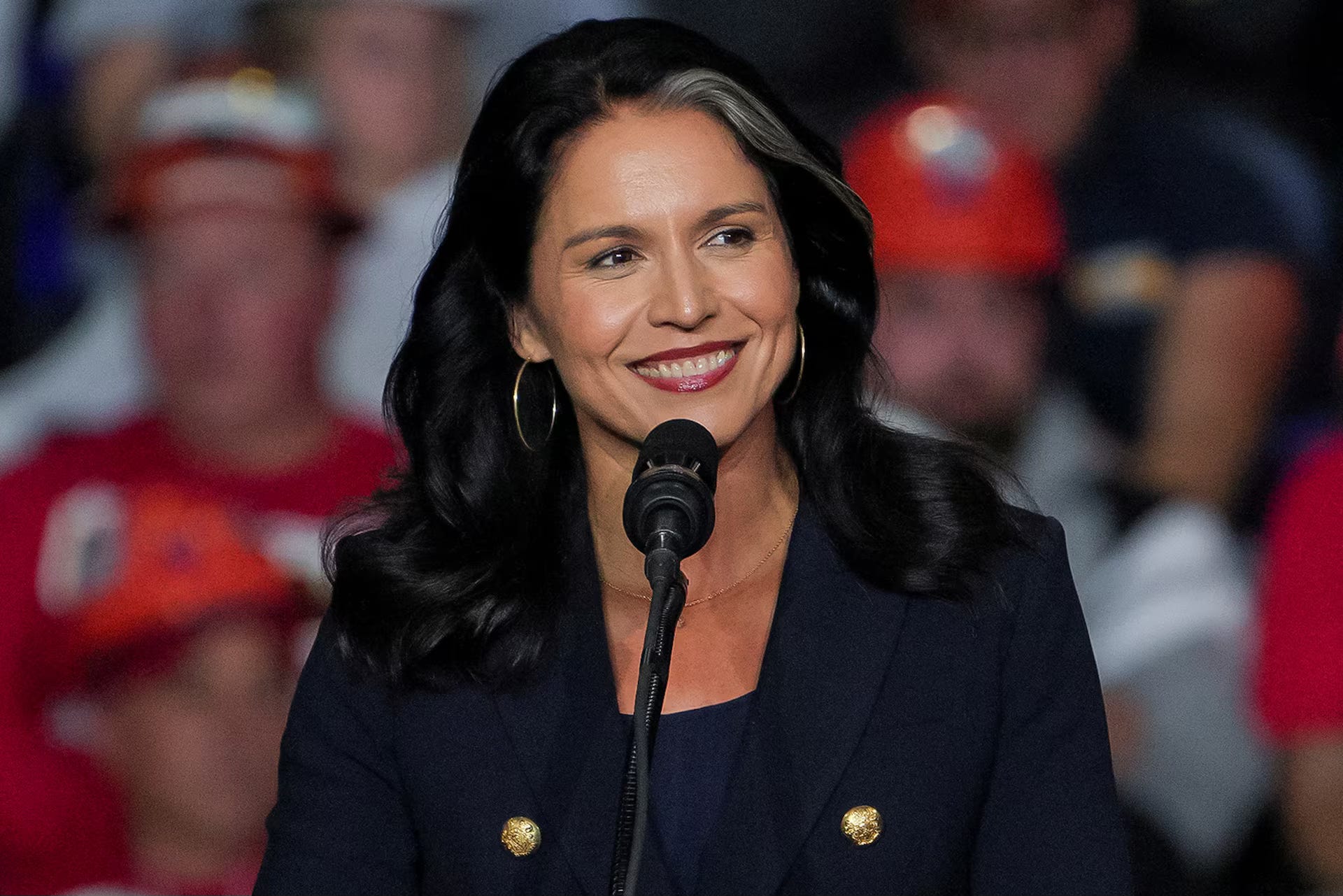
Tulsi Gabbard (Reuters, Jeenah Moon photo)

Here’s what Reuters has to say:

WASHINGTON, Nov 14 (Reuters) – President-elect Donald Trump’s choice of Tulsi Gabbard as U.S. intelligence chief has sent shockwaves through the national security establishment, adding to concerns that the sprawling intelligence community will become increasingly politicized.

Trump’s nomination of Gabbard, a former Democratic congresswoman who lacks deep intelligence experience and is seen as soft on Russia and Syria, is among several high-level picks that suggest he may be prioritizing personal allegiance over competence as he assembles his second-term team.

Among the risks, say current and former intelligence officials and independent experts, are that top advisers could feed the incoming Republican president a distorted view of global threats based on what they believe will please him and that foreign allies may be reluctant to share vital information.

Randal Phillips, a former CIA operations directorate official who worked as the agency’s top representative in China, said that with Trump loyalists in top government posts, “this could become the avenue of choice for some really questionable actions” by the leadership of the intelligence community. [Emphasis added.]

As if the intelligence “community” isn’t already politicized! And who sees Gabbard as allegedly “soft” on Russia and Syria? Hillary Clinton? The “queen of warmongers,” as Gabbard memorably described her?

Wow. We might get “some really questionable actions” by the IC (intelligence community). I’m glad we’ve never had any of those before.

Tulsi has a wealth of experience in the military (she remains a lieutenant colonel), she’s a former Congresswoman who’s served on important committees dealing with national security, and she’s tough as nails, having survived ruthless attacks on her character by the neocon Clinton wing of the Democratic Party. She is an excellent choice as Director.

What Tulsi has is integrity. Honesty. Poise. Perhaps even more importantly, she has Trump’s ear and his respect. As Director, she will oversee the preparation of Trump’s daily intelligence briefs. Trump was notorious in his first term in office for not paying much attention to those briefs. He should do better with Tulsi, somebody he trusts, preparing them.

Tulsi won my respect in 2016 when she supported Bernie Sanders and revealed how the Democratic presidential primary process was being fixed for Hillary Clinton. Tulsi has paid a high price for her principled stance, being smeared by Clinton and mainstream media outlets like NBC as a “Russian asset,” maybe even a stooge for Vladimir Putin. Politics is a rough game, but accusing a serving U.S. military officer and Congresswoman of being a “Putin puppet” is truly reckless and defamatory. Good for Tulsi for punching back.

The establishment Democratic party hates Tulsi because she refused to play their game. She refused to bow to the Clintons. Tulsi has also questioned America’s constant warmongering and knows a thing or two about the horrendous costs of war. She even has a normal life as a surfer. She has a connection to nature that I respect.

Her poise, her toughness, her integrity, makes her a superb choice as DNI. The more the intelligence “community” complains about her, the louder certain Democrats scream, the more certain I am that Trump has made a smart decision here.

Recall when Kamala Harris vowed to put a Republican in her cabinet? Well, Trump has made Gabbard his DNI and RFK Jr. will lead Health and Human Services. He’s picked two (former) Democrats for important posts and the Democrats can’t stand it.

On this occasion, with these appointments, I applaud Trump. You go, Tulsi. Ride the wave. Continue to serve our country as you always have.

Edward Snowden and Turnkey Tyranny

snowden
Edward Snowden

W.J. Astore

Edward Snowden recently talked to Joe Rogan for nearly three hours.  Snowden has a book out (“Permanent Record“) about his life and his decision to become a whistleblower who exposed lies and crimes by the U.S. national security state.  As I watched Snowden’s interview, I jotted down notes and thoughts I had.  (The interview itself has more than seven million views on YouTube and rising, which is great to see.)  The term in my title, “turnkey tyranny,” is taken from the interview.

My intent here is not to summarize Snowden’s entire interview.  I want to focus on some points he made that I found especially revealing, pertinent, and insightful.

Without further ado, here are 12 points I took from this interview:

1.  People who reach the highest levels of government do so by being risk-averse.  Their goal is never to screw-up in a major way.  This mentality breeds cautiousness, mediocrity, and buck-passing.  (I saw the same in my 20 years in the U.S. military.)

2.  The American people are no longer partners of government.  We are subjects.  Our rights are routinely violated even as we become accustomed (or largely oblivious) to a form of turnkey tyranny.

3.  Intelligence agencies in the U.S. used 9/11 to enlarge their power.  They argued that 9/11 happened because there were “too many restrictions” on them.  This led to the PATRIOT Act and unconstitutional global mass surveillance, disguised as the price of being kept “safe” from terrorism.  Simultaneously, America’s 17 intelligence agencies wanted most of all not to be blamed for 9/11.  They wanted to ensure the buck stopped nowhere.  This was a goal they achieved.

4.  Every persuasive lie has a kernel of truth.  Terrorism does exist — that’s the kernel of truth.  Illegal mass surveillance, facilitated by nearly unlimited government power, in the cause of “keeping us safe” is the persuasive lie.

5.  The government uses classification (“Top Secret” and so on) primarily to hide things from the American people, who have no “need to know” in the view of government officials.  Secrecy becomes a cloak for illegality.  Government becomes unaccountable; the people don’t know, therefore we are powerless to rein in government excesses or to prosecute for abuses of power.

6.  Fear is the mind-killer (my expression here, quoting Frank Herbert’s Dune).  Snowden spoke much about the use of fear by the government, using expressions like “they’ll be blood on your hands” and “think of the children.”  Fear is the way to cloud people’s minds.  As Snowden put it, you lose the ability to act because you are afraid.

7.  What is true patriotism?  For Snowden, it’s about a constant effort to do good for the people.  It’s not loyalty to government.  Loyalty, Snowden notes, is only good in the service of something good.

8.  National security and public safety are not synonymous.  In fact, in the name of national security, our rights are being violated.  We are “sweeping up the broken glass of our lost rights” in today’s world of global mass surveillance, Snowden noted.

9.    We live naked before power.  Companies like Facebook and Google, together with the U.S. government, know everything about us; we know little about them.  It’s supposed to be the reverse (at least in a democracy).

10.  “The system is built on lies.”  James Clapper, the director of national intelligence, lies under oath before Congress.  And there are no consequences.  He goes unpunished.

11.  We own less and less of our own data.  Data increasingly belongs to corporations and the government.  It’s become a commodity.  Which means we are the commodity.  We are being exploited and manipulated, we are being sold, and it’s all legal, because the powerful make the policies and the laws, and they are unaccountable to the people.

12.  Don’t wait for a hero to save you.  What matters is heroic decisions.  You are never more than one decision away from making the world a better place.

In 2013, Edward Snowden made a heroic decision to reveal illegal mass surveillance by the U.S. government, among other governmental crimes.  He has made the world a better place, but as he himself knows, the fight has only just begun against turnkey tyranny.

Collusion Takes Many Forms

W.J. Astore

Sometimes a picture is worth a thousand words:

180719-dan-coats-andrea-mitchell-se-445p_46a4b28bf9adc602cf30c81705e95778.focal-460x230

The supposed big news here is that Dan Coats, the Director of National Intelligence, didn’t know about President Trump’s invitation to Vladimir Putin to visit the White House this fall.

The real story is in plain sight: all the corporate sponsors of the Aspen Security Forum, including Lockheed Martin, the nation’s leading weapons maker.  I like the way the logo for Lockheed Martin hovers just above Dan Coats’s head.  Who works for whom here?

(Other military contractors with prominent logos included Symantec, which specializes in cybersecurity, and MITRE, which technically is a not-for-profit corporation that works mainly with the Department of Defense; I worked with MITRE engineers when I was in the Air Force.)

The other obvious story: the mainstream media’s cozy relationship to those in power.  Andrea Mitchell’s interview with Coats is downright chummy.  It’s all very polite and non-confrontational, with Mitchell hinting we all should be very concerned and nervous about Trump negotiating alone with Putin.

Perhaps so, perhaps not.  But I am concerned about all those cozy relationships within and across the national security state, and the way our media eagerly joins in on the fun.  Collusion takes many forms; let’s not focus so tightly on alleged collusion between the Trump campaign and Russia that we miss what’s in clear sight in photos and videos such as this.

Update (7/22/18): Is the mainstream media focusing on cozy relationships and possible collusion among the various players at Aspen?  You know, the military-industrial complex, the government and its seventeen intelligence agencies, universities and think tanks and the media, i.e. the usual suspects?  Of course not.  At ABC News, they’re focusing on whether Dan Coats’s chuckle and off-the-cuff remarks about Putin’s proposed visit to the White House were disrespectful to Trump.  And there you have it.

Knowledge is Power, but Power is no Substitute for Knowledge

020309_siers_462

W.J. Astore

Francis Bacon is famous for the aphorism, “Knowledge is power.”  Yet the reverse aphorism is not true.  The United States is the most powerful nation in the world, yet its knowledge base is notably weak in spite of all that power.  Of course, many factors contribute to this weakness.  Our public educational systems are underfunded and driven by meaningless standardized test results.  Our politicians pander to the lowest common denominator.  Our mainstream media is corporate-owned and in the business of providing info-tainment when they’re not stoking fear.  Our elites are in the business of keeping the American people divided, distracted, and downtrodden, conditions that do not favor critical thinking, which is precisely the point of their efforts.

All that is true.  But even when the U.S. actively seeks knowledge, we get little in return for our investment.  U.S. intelligence agencies (the CIA, NSA, DIA, and so on) aggregate an enormous amount of data, then try to convert this to knowledge, which is then used to inform action.  But these agencies end up drowning in minutiae.  Worse, competing agencies within a tangled bureaucracy (that truly deserves the label of “Byzantine”) end up spinning the data for their own benefit.  The result is not “knowledge” but disinformation and self-serving propaganda.

When our various intelligence agencies are not drowning in minutiae or choking on their own “spin,” they’re getting lost in the process of converting data to knowledge.  Indeed, so much attention is put on process, with so many agencies being involved in that process, that the end product – accurate and actionable knowledge – gets lost.  Yet, as long as the system keeps running, few involved seem to mind, even when the result is marginal — or disastrous.

Consider the Vietnam War.  Massive amounts of “intelligence” data took the place of knowledge.  Data like enemy body counts, truck counts, aircraft sorties, bomb tonnages, acres defoliated, number of villages pacified, and on and on.  Amassing this data took an enormous amount of time; attempting to interpret this data took more time; and reaching conclusions from the (often inaccurate and mostly irrelevant) data became an exercise in false optimism and self-delusion.  Somehow, all that data suggested to US officialdom that they were winning the war, a war in which US troops were allegedly making measurable and sustained progress.  But events proved such “knowledge” to be false.

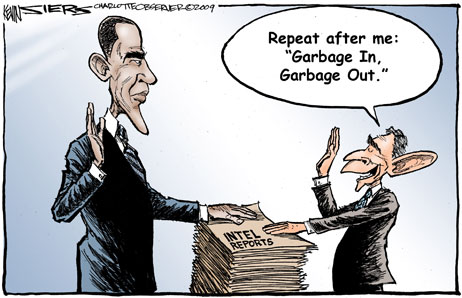
Of course, there’s an acronym for this: GIGO, or garbage (data) in, garbage (knowledge) out.

In this case, real knowledge was represented by the wisdom of Marine Corps General (and Medal of Honor recipient) David M. Shoup, who said in 1966 that:

I don’t think the whole of Southeast Asia, as related to the present and future safety and freedom of the people of this country, is worth the life or limb of a single American [and] I believe that if we had and would keep our dirty bloody dollar-crooked fingers out of the business of these nations so full of depressed, exploited people, they will arrive at a solution of their own design and want, that they fight and work for. And if, unfortunately, their revolution must be of the violent type…at least what they get will be their own and not the American style, which they don’t want…crammed down their throat.

But few wanted to hear Shoup and his brand of hard-won knowledge, even if he’d been handpicked by President Kennedy to serve as the Commandant of the Marine Corps exactly because Shoup had a reputation for sound and independent thinking.

Consider as well our rebuilding efforts in Iraq after 2003.  As documented by Peter Van Buren in his book “We Meant Well,” those efforts were often inept and counterproductive.  Yet the bureaucracy engaged in those efforts was determined to spin them as successes.  They may even have come to believe their own spin.  When Van Buren had the clarity and audacity to say, We’re fooling no one with our Kabuki dance in Iraq except the American people we’re sworn to serve, he was dismissed and punished by the State Department.

Why?  Because you’re not supposed to share knowledge, real knowledge, with the American people.  Instead, you’re supposed to baffle them with BS.  But Van Buren was having none of that.  His tell-all book (you can read an excerpt here) captured the Potemkin village-like atmosphere of US rebuilding efforts in Iraq.  His accurate knowledge had real power, and for sharing it with the American people he was slapped down.

Tell the truth – share real knowledge with the American people – and you get punished.  Massage the data to create false “knowledge,” in these cases narratives of success, and you get a pat on the back and a promotion.  Small wonder that so many recent wars have gone so poorly for America.

What the United States desperately needs is insight.  Honesty.  A level of knowledge that reflects mastery.  But what we’re getting is manufactured information, or disinformation, or BS.  Lies, in plainspeak, like the lie that Iraq had in 2002 a large and active program in developing WMD that could be used against the United States.  (Remember how we were told we had to invade Iraq quickly before the “smoking gun” became a “mushroom cloud”?)

If knowledge is power, what is false knowledge?  False knowledge is a form of power as well, but a twisted one.  For when you mistake the facade you’re constructing as the real deal, when you manufacture your own myths and then forget they’re myths as you consume them, you may find yourself hopelessly confused, even as the very myths you created consume you.

So, a corollary to Francis Bacon: Knowledge is power, but as the United States has discovered in Vietnam, Iraq, and elsewhere, power is no substitute for knowledge.

What Americans Value

There's no shortage of tanks in the USA
There’s no shortage of tanks in the USA

W.J. Astore

A sentiment attributed to Vice President Joe Biden is, Show me what’s in your budget, and I’ll tell you what you value.  These words resonate with me whenever I consider the yearly budget for the Department of Defense (DoD), Homeland Security, the Department of Energy (which handles nuclear weapons), and the various intelligence agencies (roughly 17; that’s why they form a community).

When you add up what we spend on defense, homeland security, “overseas contingency operations” (wars), nuclear weapons, and intelligence and surveillance operations, the sum approaches $750 billion dollars each and every year, consuming more than two-thirds of the federal government’s discretionary spending.

Here are some figures for Fiscal Year 2015 (FY15):

Defense: “Base” budget of $496 billion

Afghan War (not part of “defense”): $85 billion

VA: $65 billion

Homeland Security: $38 billion

Nuclear Weapons: $12 billion

FBI and Cyber Security (part of Justice Department budget): $18 billion

Total: $714 billion

Some of the budget of the State Department and for foreign aid supports weapons and training (“foreign military sales”), bringing us to roughly three-quarters of a trillion dollars, each and every year, on the military, intelligence, security, weapons, and wars.

How much do we spend at the federal level on education, interior, and transportation?  Roughly $95 billion.

When a government spends almost eight times as much on its military, security, wars, weapons, and the like as it does on educating its youth, fixing its roads and bridges and related infrastructure, and maintaining its national parks and land, is there any question what that country ultimately values?

Show me your budget and I’ll tell you what you value.  Sobering words. Sobering — and scary.