
In Praise of TomDispatch

W.J. Astore

Tom Engelhardt Is the Post-9/11 Generation’s I.F. Stone

Today’s post has a simple goal: to praise TomDispatch, a regular, reliable, and highly effective “antidote to the mainstream media.”

Its creator, editor, and chief author, Tom Engelhardt, founded the site soon after the 9/11 attacks in 2001. Its remarkable longevity and brilliant perspicacity testifies to his integrity, his character, indeed his patriotism and his humanity.

What I.F. Stone was to the Vietnam generation, Tom Engelhardt has been to the post-9/11 one. If more Americans had read his articles and truly listened to his words of wisdom, disastrous wars like the ones in Iraq and Afghanistan would never have happened, and America itself would be a far better place.

Tom began his site as a simple Listserv. Soon after 9/11, he started by putting together lists of articles he’d read, together with some commentary of his own, sharing those links and thoughts via email with friends and other interested parties. An early article that stuck in his mind (that he mentioned to me) concerned America’s bombing raids against Afghanistan in 2001, attacks that would serve mainly “to bounce the rubble” there. (Afghanistan had already been the site of a devastating war in the 1980s conducted by the Soviet Union.)

Quickly, Tom’s Listserv messages proved popular, focusing as they so often did on the folly and fallacies of American empire. A colleague suggested that he should create a website featuring his “tomgrams.” Though not a tech or computer wiz, Tom embraced the challenge, overseeing the founding of a dedicated site for original articles that would serve as “a regular antidote to the mainstream media.”

Tom has now been posting his tomgrams for 22 years, usually three original pieces each week, on Sunday, Tuesday, and Thursday. It’s the side job that took over his life, he ruefully admits. (Tom has been a longtime editor for several publishing houses, as well as writing several of his own books, notably “The End of Victory Culture,” which I highly recommend.)

I first started writing for TomDispatch in 2007. I recently posted my 106th article at the site. Tom has made me work! He features articles that are typically 2000 words or longer, articles that often include a dozen or more links that readers can follow to confirm facts and deepen their knowledge. Each article Tom posts goes through a rigorous process of editing, far more so, it seems, than many print magazines use nowadays. Typically, when I write for Tom, he edits my pieces, after which three proofreaders offer their own suggestions and corrections, all of which I review along with Tom. It’s a laborious process that produces consistently high-quality pieces at the site.

If you’re a regular reader of his site, you’ll have noticed that Tom writes introductions to nearly every piece he posts at TomDispatch. Some of his intros end up being essays in their own right. He is seemingly inexhaustible.

Tom Engelhardt, the creator of TomDispatch, with the author

Articles initially posted at TomDispatch usually go to many other sites. My most recent piece for Tom went to Common Dreams, Counterpunch, Information Clearing House, The Nation, ZNet, and LA Progressive, among other sites. Most of these are broadly liberal or progressive, but Lew Rockwell, a libertarian site, picked up my last piece as well. In the past, mainstream sites like CBS News have picked up and posted TomDispatch pieces, and three of my “tomgrams” earned a mention in the New York Times (here and here and here). Another one was posted (in shorter form) by the LA Times. All this is to say that TomDispatch’s reach far exceeds that of the site itself.

It’s amazing the network of readers and publishers Tom has built over the last 20+ years. I’m amazed as well at how some of my articles have been translated into foreign languages, including German, French, Italian, Spanish, Portuguese (in Brazil), Danish, Czech, and Arabic. Honestly, I never thought I’d be so widely read, and I owe that to Tom, who saw in 2001 the need for an alternative to the mainstream media soon after the events of 9/11 and all the mindless patriotic hoopla that followed. 

What makes TomDispatch unique? Certainly, the length and rigor of its pieces. Most sites nowadays post shorter works of 600 words or fewer. I’m also struck by the diversity of authors at the site. And, if I may, I wish to applaud Tom for seeking out military and government dissenters, military officers like Andrew Bacevich and Danny Sjursen and State Department dissenters like Peter Van Buren. And Tom has enlisted people like Noam Chomsky, Chalmers Johnson, Barbara Ehrenreich, Adam Hochschild, and so many other authors for whom he’s served as an editor.

(Check out Tom’s incredible list of authors since 2002 here.)

Later this year, Tom will celebrate his 80th birthday. He tells me TomDispatch is nearing its end, that soon, perhaps in the next year or two, it’ll post its last article. When it does, a bright light of stimulating discourse and informed dissent will be extinguished. America will be worse for it.

I urge you to dip into the TomDispatch archive. It begins in 2002 and comes forward to the present day. Read a few articles, especially on war, militarism, and empire. And tell me: Isn’t it amazing how much Tom saw that those in officialdom either didn’t see or refused to see?

America’s Foreign Policy and Cody Jarrett

W.J. Astore

Made it Ma, Top of the World!

A favorite movie of mine is “White Heat” (1949) with James Cagney playing Cody Jarrett, one-time gangster and all-time mama’s boy. In the famous ending to the movie, Cody finally makes it to the “top of the world,” in this case a refinery that explodes around him in a fireball that looks something like a nuclear mushroom cloud.

Top of the world, Ma! James Cagney at the end of “White Heat”

America’s foreign policy leaders remind me of Cody Jarrett. They want to dominate. They want to be top dog. They want to play king-of-the-hill, like so many bully-boys, and all that matters is making it to the top.

All this came to mind as I read Tom Engelhardt’s latest article at TomDispatch.com. His article reminded me that we as Americans simply don’t like dissent, no matter how well informed, no matter how well intended. In World War I, you weren’t supposed to question a war that President Woodrow Wilson had promised Americans we wouldn’t get involved in. In the 1950s, you weren’t supposed to question virulent anti-communism; you were supposed to salute smartly and demonize all communists everywhere. Today, you’re supposed to hate Putin, distrust the Chinese, and accept fully the idea that the Pentagon is wise to wage a new Cold War that may well end much like the ending of “White Heat.”

Engelhardt’s article salutes dissenters like I.F. “Izzy” Stone, people who are willing to challenge established narratives, to work against demonizing other peoples, to work toward mutual understanding and peace. Indeed, we need more Izzy Stones in America.

These are dangerous times. We’re supposed to go along with wars, with demonizing enemies, with high military spending. Bully-boy rhetoric and tactics are touted as the American way.  Our politics is retrograde, our attitude toward the world almost childish, again in a king-of-the-hill way. (America must be king, of course.)

So I fear we may well end up like Cagney at the end of “White Heat.”  Our gangster-leaders will shout: “Made it Ma, top of the world!” as the nuclear warheads explode around us.

Don’t Play the Sap for Any Government

W.J. Astore

In The Maltese Falcon, Humphrey Bogart famously tells Mary Astor that he won’t play the sap for her. It’s an immortal cinematic line:

https://www.youtube.com/watch?v=wPT49WXC0Zo

It’s election time in America, meaning there are plenty of candidates wishing we’d all play the sap for them. Don’t do it. Vote for those you believe in: candidates who are principled and have a record of taking bold stances and of telling the truth. People like Matt Hoh, who’s running for the Senate as a member of the Green Party in North Carolina.

Occasionally, I need to state the obvious, if only to remind myself of the realities of this world. All governments lie and all have their instruments of repression. The most dangerous government is most likely your own government, whatever country you live in, because that governing party has direct power over you, and also because you’re likely to have some allegiance to it, perhaps even some affection for it. As an American, for example, it’s far easier to play the patriot than to act as a dissident. The patriot gets applauded and rewarded; the dissident gets attacked and punished.

The U.S. government, like any other government, lies. Think of the Pentagon papers, the Afghan War papers, the “slam dunk” case of WMD in Iraq that were never found, and so on. All governments lie, as I.F. Stone said.

The message is simple: Always question authority, whether it’s Russian or Chinese or American. Be skeptical. Don’t play the sap. Make Humphrey Bogart proud.

America Needs a Stronger Anti-War Movement

W.J. Astore

Remember that saying from the Vietnam War era, “Suppose they gave a war and no one came?”  Considering present events, we need to modify that.  Suppose they kept giving us war after war and no one cared?

It’s remarkable that, even as President Trump expands our military involvement overseas, there is no significant anti-war protest movement in America.  Why is this?  Perhaps Americans don’t recognize the reality of today’s wars?

Tom Engelhardt has a great article today in which he reflects about World War II, the Vietnam War, and current conflicts around the world.  He ends his article with this powerful question:

In many ways, from its founding the United States has been a nation made by wars. The question in this century is: Will its citizenry and its form of government be unmade by them?

The answer to that is “yes,” if we continue largely to ignore them.

no-more-war
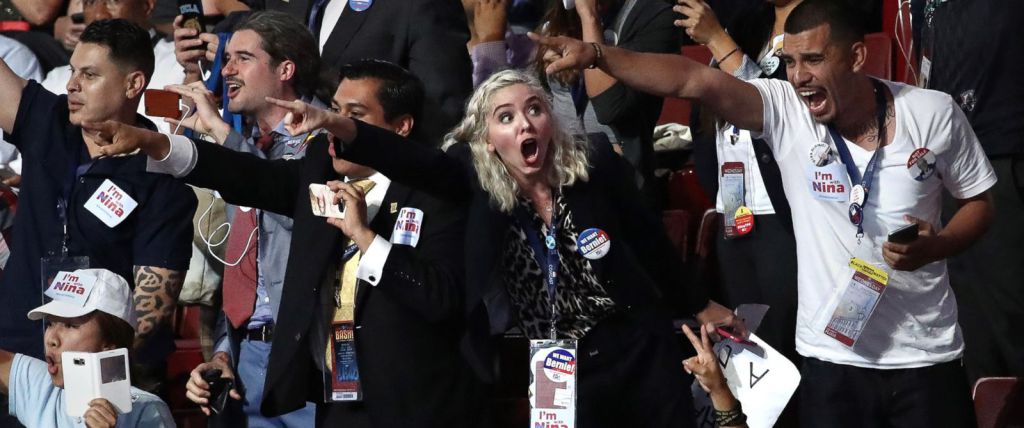
Protesters who shouted “No more war!” at the Democratic National Convention were silenced

Let me give you an example; it may sound trivial, but I think it’s indicative.  I just finished watching a seven-part series on HBO, “Big Little Lies.”  Set on the Monterey peninsula in California, the series revolved around several sets of mostly affluent, mostly White, parents and the travails of their privileged children.  The series did tackle serious issues, especially spousal abuse, and did feature fine acting.  What it did not feature was any sense that the U.S. has a military, let alone that America is at war around the world.

Wait a minute, you’re saying.  Why should a series featuring mostly affluent adults and their precocious children have said anything about the U.S. military and its wars?  Because of the setting.  I lived in Monterey for three years while serving as the military dean of students at the Defense Language Institute Foreign Language Center at the Presidio of Monterey.  I also taught at the Naval Postgraduate School in Monterey.  The U.S. military has a high profile there, but you’d never know it from watching “Big Little Lies.”  From that series, you’d think nearly everyone lived in sleek and expensive houses gazing out on the Pacific Ocean.  You’d never think that American adults had any concern whatsoever about what their military was up to around the world.  And perhaps that’s even true.

One teenager in “Big Little Lies” stirs family controversy by plotting to sell her virginity on the Internet to raise awareness of human trafficking.  (She eventually backs down.)  Perhaps she might have protested America’s wars instead?

So, why aren’t Americans protesting war?  Besides the unreality of these wars to the “Big Little Lies” crowd, here are some reasons that come to mind:

  • They’re couched as “necessary” wars against terrorism.
  • Unlike WWII or Vietnam, there’s no draft, hence the wars directly impact only American “volunteers” and their families/friends.
  • Recent U.S. casualties are much lower than they were from 2004-10 before, during, and after the “surges” in Iraq and Afghanistan, and much lower than in Vietnam. Americans care most when Americans die.  Witness the reaction to one Navy SEAL dying in a raid in Yemen.  If comparatively few American are dying, we don’t care much.
  • There is no major anti-war political party in the USA; the Democrats have embraced war as tightly as the Republicans. In short, there’s no strong rallying point against war.
  • The U.S. military has developed a form of war, based on technologies such as “smart” munitions and drones, that at least to us seems antiseptic and low cost.
  • American exceptionalism also plays a role, the government/mainstream media spin that Americans always enter wars reluctantly and only to do good.
  • Fear.  And nationalism (America First!) disguised as patriotism.

Another crucial reason: Many if not most Americans are remarkably disconnected from their government and its actions.  As Engelhardt wrote in another article (on the legendary journalist I. F. Stone):

What’s missing is any sense of connection to the government, any sense that it’s “ours” or that we the people matter. In its place—and you can thank successive administrations for this—is the deepest sort of pessimism and cynicism about a national security state and war-making machine beyond our control. And why protest what you can’t change?

Engelhardt wrote this in 2015, when Barack Obama was still commander-in-chief.  Now we have Trump and his unmerry crew, operating in their own bellicose reality.  In 2017 even more Americans are disconnected from the government, which they don’t see as “theirs.”  (Meanwhile, those who do see Trump and Crew as “theirs” probably embrace a bellicose approach to foreign policy.)

Disconnecting from government does not mean one should disconnect from its wars.  Those wars are being waged in our name; it’s up to us to work to end them.

Afterthoughts: Many Americans think that anti-war protest is somehow against “our” troops.  Yet, what could be better for our troops than fewer wars and less fighting?  Also, it’s foolhardy to give the U.S. military a blank check when it comes to war.  We the people are supposed to control our military, which is why America’s Founders gave Congress the power to declare war and to control the budget.  Finally, whether they know it or not, the Pentagon and its generals seriously need push-back from the American people.  When I watch Congressional hearings, most of our representatives are at pains to praise the military, instead of challenging it with tough questions.

Our military gets enough kudos!  What it needs is serious criticism, not unstinting praise along with buckets of money.