Hillary Clinton: A Deeply Compromised Candidate

hillary henry
Hillary and Henry

W.J. Astore

Hillary Clinton is a deeply compromised candidate.  She and her husband have made over $125 million in paid speeches since 2001, including $30 million in 16 months.  There’s nothing wrong with making lots of money: this is America, after all.  But there’s something wrong about accepting big checks from powerful banks and investment houses and then positioning yourself as the champion of “everyday people” in your run for the presidency.

Along with her close alliance with Wall Street, Hillary is essentially a neo-conservative on foreign policy who admires the Real Politik of men like Henry Kissinger.  She promises more interventionism overseas and doubtless more wars.  She is especially close to Israel and advertises herself as a loyal ally to Benjamin Netanyahu.

The person she most closely resembles in recent U.S. politics is Richard Nixon.  Like Nixon, she’s aggressive in foreign policy (recall her infamous quip about the fall of Qaddafi in Libya: “We came, we saw, he died”).  Like Nixon, she is secretive and economical with the truth, despite her truth-telling vows.  Like Nixon, she is a complex person, not without talent, but a person who often doesn’t appear fully comfortable, especially when pressed about her record.  Like Nixon, she leaves very little to chance; there’s calculation to nearly everything she does.

A Hillary Clinton administration promises to be even less transparent than Obama’s.  It would be more in service to the powers that be (big money donors such as the health care industry will come calling for their payback, and they’ll get it).  Despite protestations of being “progressive,” a Clinton administration promises to be regressive in terms of peace, social progress, and fairness for the working classes.

Despite this, her path to the presidency seems remarkably clear.  Bernie Sanders, an honest man of conviction, lacks establishment support.  Hillary’s Republican opponent of the moment, Donald Trump, is an opportunistic business tycoon who apparently says whatever pops into his head.  Trump may be the one candidate with more negative baggage than Hillary.

A Hillary/Trump matchup this fall promises lots of drama, but it’s a lose/lose scenario for anyone looking for real progressive change.
Bernie is More Generous to Workers than Hillary

Bernie

Last night’s town hall in Nevada revealed a crucial difference between Bernie Sanders and Hillary Clinton.  Bernie came out strongly for a $15 per hour minimum wage.  A living wage, as he called it.  Hillary demurred, suggesting that $12 per hour was sufficient, though she mentioned municipalities with higher minimums (places like San Francisco, which have a very high cost of living).

An extra $3.00 and hour, for 40 hours a week, for 50 weeks a year, is an extra $6000 in the pockets of workers (before taxes, of course).  For many working families, that’s the difference between struggling in poverty and making enough to live with a modicum of security.

Hillary went unchallenged on her $12 per hour figure.  But let’s remind ourselves that Hillary made $675,000 for three speeches to Goldman Sachs.  A person working for Hillary’s “generous” $12 wage would need 28 years to match what she made in three speeches that took her all of a few hours to make.

Indeed, Hillary’s “minimum wage” for her speeches to big banks and Wall Street is in the neighborhood of $100,000 to $200,000 per hour.  “Hey, that’s what they offered,” Hillary said.  And so Hillary is offering you, sales associate at Walmart, $12 per hour.  Are you not entertained?

When asked if she’d release transcripts of her speeches to the Wall Street banks and investment houses, Hillary essentially said no.  Of course, she didn’t say “no” because that would be honest.  Instead, she said she’d release her transcripts if all the other candidates did the same.  She knows that’s not happening, so her answer is no.

Perhaps Hillary could contact Goldman Sachs and ask them to start inviting workers to give speeches at her going rate.  A lot of American working families would deeply appreciate making $225,000 for a couple of hours of sharing their hard-won experiences with Wall Street bankers and investors.


Hillary Clinton’s “Low Blow”

joust
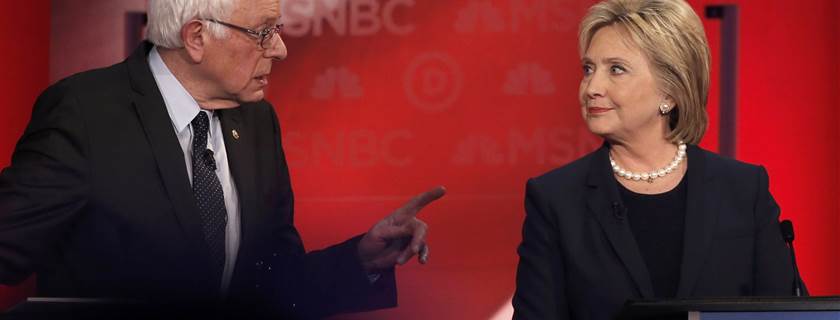
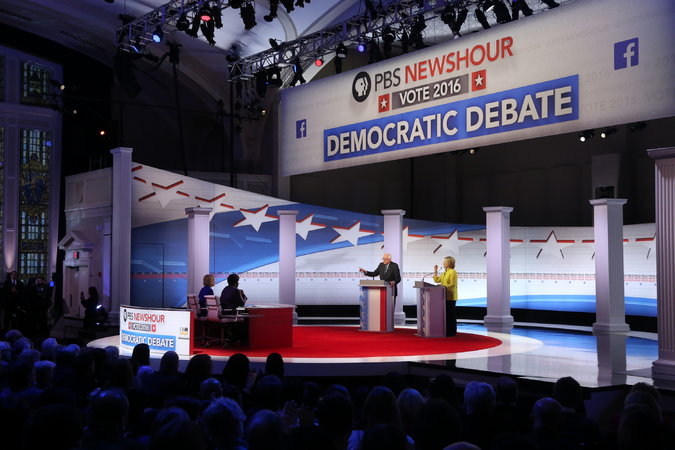
Bernie and Hillary at last night’s debate (Source: NYT)

W.J. Astore

Last night’s Democratic debate between Hillary Clinton and Bernie Sanders in Milwaukee hit the usual notes for these two candidates (the transcript is here). Clinton is all about competence and being ready on “day one” in the Oval office, whereas Bernie seeks a political revolution to galvanize the people. But a few telling items came up, mostly toward the end of the debate.

1.  Hillary accused Bernie of being too critical of President Obama, of not supporting him, of suggesting he was “weak,” and of not respecting Obama’s legacy of results, especially the Affordable Care Act.  This was a “low blow” for Bernie, who explained that he fully supported Obama, considered him to be a friend, and that he did indeed respect the president’s accomplishments.  Besides that, Bernie noted, “one of us ran against Barack Obama [in 2008]. I was not that candidate.”

2. Bernie actually dared to suggest the Defense Department’s budget had to be given careful scrutiny, noting that the DoD has yet to pass an audit.  In these days of issuing blank checks to the Pentagon, it was a significant moment.

3.  Bernie took Hillary to task, successfully I believe, for her cozy relationship with Henry Kissinger.  In my view, this was the most important moment of the night. With respect to U.S. foreign policy, Hillary promises continuity with neo-conservative principles of American interventionism and preemptive war.  Bernie, even as he promises to crush the Islamic State, is far less enamored with neo-con agendas and peace through aggression.

Here is what Bernie had to say about Kissinger:

“I happen to believe that Henry Kissinger was one of the most destructive secretaries of state in the modern history of this country.  I am proud to say that Henry Kissinger is not my friend. I will not take advice from Henry Kissinger. And in fact, Kissinger’s actions in Cambodia, when the United States bombed that country, overthrew Prince Sihanouk, created the instability for Pol Pot and the Khmer Rouge to come in, who then butchered some 3 million innocent people, one of the worst genocides in the history of the world. So count me in as somebody who will not be listening to Henry Kissinger…”

“Kissinger was one of those people during the Vietnam era who talked about the domino theory. Not everybody remembers that. You do. I do. The domino theory, you know, if Vietnam goes, China, da, da, da, da, da, da, da.  That’s what he talked about, the great threat of China.”

“And then, after the war, this is the guy who, in fact, yes, you’re right, he opened up relations with China, and now pushed various type of trade agreements, resulting in American workers losing their jobs as corporations moved to China.”

“The terrible, authoritarian, Communist dictatorship he warned us about, now he’s urging companies to shut down and move to China. Not my kind of guy.”

Hillary defended her relationship with Kissinger, just as she defended herself from suggestions she’d be influenced by big money donors. In both cases, she came across as the establishment candidate, one who is most comfortable in the corridors of power, schmoozing with other power brokers and players.

In sum, even as Hillary attempts to appropriate some of Bernie’s anti-establishment rhetoric, her actions demonstrate how much she’s ensconced within the establishment camp, especially when it comes to U.S. foreign policy.

For voters looking for change in November, Hillary promises only an amped up version of more of the same.


A Message of Uplift Won New Hampshire

SUB-TRUMP2-videoSixteenByNine1050
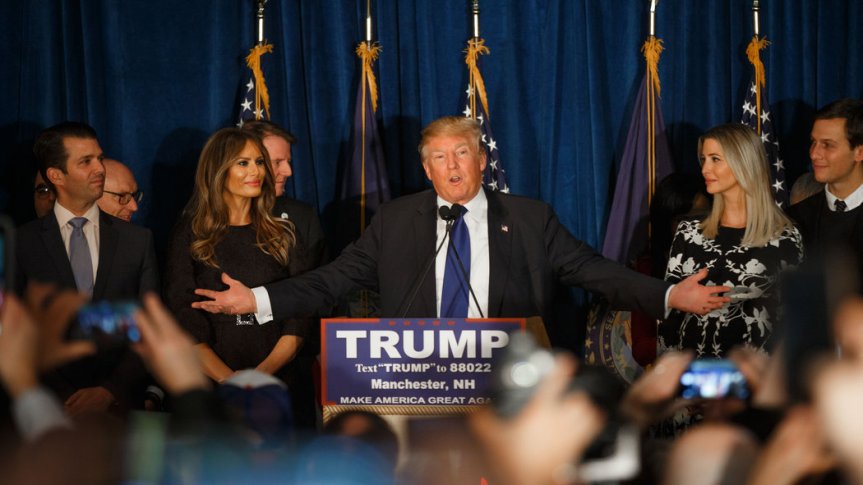
He’ll make America great again — it says so on his podium!

W.J. Astore

My wife and I watched the results come in last night on MSNBC and the four speeches by Hillary Clinton, Bernie Sanders, Donald Trump, and John Kasich.  Surprisingly, the best speech of the bunch was by Kasich, but more on that in a moment.

Hillary charged ahead with a concession speech that was basically a recycled stump speech.  It looked like she was using teleprompters.  She offered the obligatory thanks to her supporters, to New Hampshire, and so on, but you could tell she just wanted to move on from her crushing defeat.  She has real difficulty connecting with an audience, and her campaign’s message that she’s the most competent candidate, the one best able to step into the Oval Office on day one, simply isn’t resonating with voters who are fed up with establishment politics.

Bernie went next and also gave a modified version of his stump speech.  He spoke too long, but I’m guessing he was doing his best to exploit his “prime time” moment.  He offered kind words for Clinton but then proceeded to attack the politics as usual that she represents.  What got me most was the genuine excitement in the room for Bernie.  The people cheering behind him were an especially eclectic and vibrant mix (I know the “optics” are usually managed, but still).  There was a young black guy wearing a hat and a Bernie t-shirt who was simply a riot.  (He was standing behind and to Bernie’s left.)  My wife and I looked at each other and said: “He should be Bernie’s Vice President.”

Trump came on the heels of Bernie, and the shift in tone was immediate.  With Bernie, it’s all about the movement.  With Trump, it’s all about Trump.  Flanked by his photogenic family, Trump once again told Americans how he is going to make America “great” again, how America is going to win again — at negotiating treaties, with the economy, with wars — heck, I guess we’re going to win at EVERYTHING with Trump in command.  Again he boasted how he’s going to make the U.S. military so big and so strong that no one will dare attack us.  In a word, he bloviated.  But Trump should never be dismissed lightly, certainly not after his decisive victory in New Hampshire.

Kasich came next after Trump, and again the tone shifted.  Coming in a strong second in NH, Kasich talked about listening to the American people, and how the 100+ “town halls” he had done had changed him as a candidate and as a person.  He told personal stories and connected with the audience; he closed on a note of compassion, asking Americans to decompress, to take time to listen to one another, to find time for reflection.  His speech was the most personal and heartfelt of the four that I heard, and I found myself hoping that Kasich’s message would ultimately triumph over the bellicosity of Trump, Cruz, Rubio, and the rest of the Republicans.

Overall, last night was a night of surprises, with two unconventional candidates, Sanders and Trump, winning convincingly.  Their messages, of course, are polar opposites. Bernie wants a better future for all Americans, especially for the disadvantaged, whereas Trump is all about making America big and strong, a “winner.”  Put differently, Sanders sees a lot of ordinary Americans who are losing in today’s “rigged” economy, and he wants to lift them up.  Trump sees America writ large as losing, even some of the wealthiest, vis-a-vis foreign competitors like China, and he says he’ll lift all of America up.

It’s that message of uplift, expressed so differently by Sanders and Trump, that resonated so powerfully in New Hampshire.


Hillary to Bernie: You Smear Me When You Tell the Truth

bernie

W.J. Astore

I watched yet another Democratic debate last night, this one moderated by MSNBC in a more traditional format instead of the previous version’s “town hall.”  Much was repeated: Bernie Sanders wants a “revolution” to overthrow a rigged economy and to enact campaign finance reform, Hillary Clinton says she’s a progressive who can get things done and who will build on the legacy of President Obama.

For me, the big moment came when Hillary tried to change the narrative on her taking millions of dollars from banks, investment houses, and Wall Street in the form of speaking fees and money from Super PACs.  She accused Bernie of a “smear” campaign when he “insinuated” she might be influenced by all this money.  She said other progressives (she cited Obama, for example) took money from Wall Street yet still allegedly held the big money boys to account.

Another moment, not as big but also telling, was when Bernie painted Hillary as an “establishment” candidate.  Talk about stating the obvious!  But Hillary rejected this by playing the gender card.  How can I be an establishment candidate for president, Hillary asked, when if elected I’d be the first woman president?  This is total nonsense, of course. She is an establishment candidate who just happens to be a woman.  But I suppose she and her team had no other response to the truth Bernie was bringing.

Speaking of the establishment, after claiming she wasn’t part of it, Hillary cited Henry Kissinger’s praise of her, saying Kissinger had applauded her for running a tight ship at the State Department.  Praise from Caesar …

But back to the “smear” campaign.  Obviously, Hillary and her team are hoping the media will focus on the smoke and mirrors generated by that loaded term, while neglecting the reality of Bernie’s truth-telling.  Given the craven nature of the mainstream media, her cynical gambit may even work.

When the big money boys give millions to candidates, any candidate, they’re not usually so blatant (or stupid) as to be buying votes.  They’re not going to get caught telling a candidate, vote yes on this, no on that.  What they’re buying is access.  They’re gaining the candidate’s ear. They want to be the last “person” to whisper in the candidate’s ear before she or he makes a decision.

I’m sure Hillary believes she’s her own woman.  But she knows how the system works, and so does Bernie.  If you accept big money, you know it always comes with strings attached.  The more big money you accept, the more strings, until no matter how much you resist, you end up dancing like a puppet on those strings.  That’s basically Bernie’s point, and it’s not a smear. It’s the truth.

An interesting question came up about whether Hillary would be willing to share transcripts of all her speeches before the big money boys.  She said she’d look into it.  If she’s the “progressive” she claims to be, she should be willing to share those transcripts immediately as a matter of public record.  Something tells me we either won’t see these transcripts, or they’ll be released months from now, after the primary race is decided.


Bernie Sanders Won Last Night’s Democratic Debate

bernie
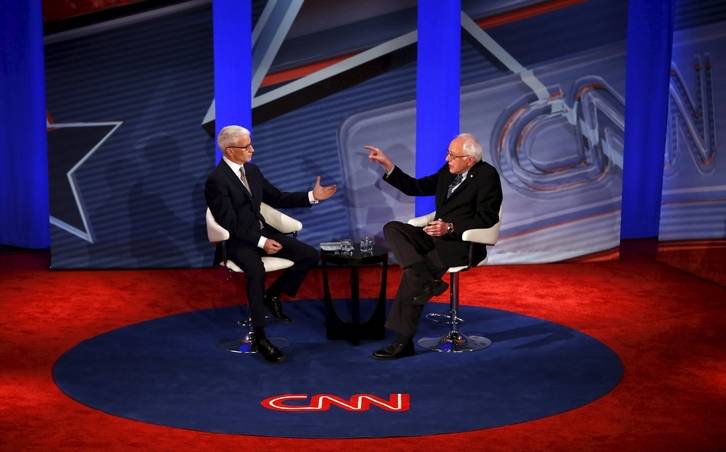
Bernie Sanders makes a point to Anderson Cooper during last night’s debate

W.J. Astore

Last night, Bernie Sanders and Hillary Clinton separately took questions from a “town hall” in Derry, New Hampshire with Anderson Cooper moderating.  Overall, both candidates did well, though I give the edge to Sanders (more on why in a moment).

Sanders came across as passionate on the issues and concerned for ordinary Americans.  He continues to speak of a political revolution, which to him doesn’t mean tumbrels to the guillotine.  It means getting more people involved in the political process, especially youth and the disadvantaged.  He spoke eloquently of helping others.  Memorable to me was his work to desegregate housing owned by the University of Chicago when Sanders was a student.  When asked why he fought against racist policies, Sanders said he’s always hated a bully – and always fought for fairness and equality.  He came across, in short, as an honest and decent man, a man of integrity, which is the word his wife used to describe him (she was sitting in the audience, and was asked to describe her husband with a single word).

Hillary came across as determined and competent and informed.  She tended to meander during her answers, coming across as somewhat of a policy wonk or a technocrat.  She rejected Sanders’ talk of a revolution, preferring to build on President Obama’s (and her own) legacy.  For example, she wants to put the finishing touches to Obamacare, rather than going for Sanders’ idea of a single-payer, “Medicare for all” system.  She spoke briefly of breaking the ultimate glass ceiling for women – her gaining the office of the presidency – and how that would inspire women of all ages.  She took her usual hardline on U.S. foreign policy, making no promises that she would reduce wars or for that matter spending on defense.

In sum, if you’re happy with the status quo, you’ll get plenty of that with Clinton.  If you want change, if you’re tired of a “rigged” economy and a corrupt political process, Sanders is far more likely to act in your favor.

Where I thought Hillary fell down was in her posturing as a progressive.  The millions of dollars she has accepted in speaking fees from banks and investment houses, she suggested, would have no impact on her policy decisions, which is simply implausible.  Powerful organizations don’t give political candidates big money without strings attached to it, and of course Clinton knows this.  It also seemed implausible when Clinton suggested she had not decided to run for president when she accepted those speaking fees.  As if her “doubts” about running absolved her of responsibility for taking big money from Wall Street.  It was all frankly unconvincing.

Hillary Clinton is a fighter.  She came across best when she spoke of the Republican right-wing attacks she’d had to endure over the last 25 years, and what they’d taught her about the political process.  Her footing was less secure when she had to relate to other people.  For example, a man suffering from advanced-stage cancer asked her about dying with dignity.  Bill Clinton, the “natural” as Hillary called him, would have turned this into an empathetic “I feel your pain” moment.  But Hillary got lost in the details, saying she would have to study up on the ethics of terminal care, the laws, the role of medical professionals, what other countries are doing (she mentioned The Netherlands), and so on.  As she tackled the problem in a wonkish way, she seemed to forget the person standing in front her.

In sum, Bernie Sanders is driving the narrative, not Hillary Clinton.  It’s Bernie who’s been talking about a rigged system, about economic fairness, about working for unions, about justice and prison reform, and it’s Hillary who’s been put on the defensive.  So lately Hillary’s been borrowing liberally from Bernie’s script.  She’s now talking about “the deck being stacked” against ordinary people, and how she’s going to fight for workers, and how much Wall Street is supposedly against her candidacy.

As Bernie has gained in the polls, as his message has begun to resonate, Hillary has responded by trying to be more like Bernie.  And it just doesn’t ring true, at least for me.  Advantage, Bernie.


The Republican Alternate Universe of Paranoia

repubdebate-162-master675
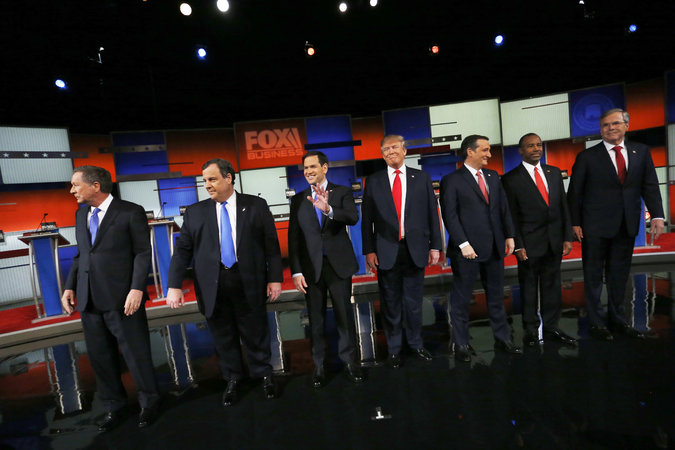
Paranoia will destroy ya

W.J. Astore

I watched last night’s Republican debate so you wouldn’t have to.  Leaving aside the usual mugging by Donald Trump, the usual jousting over side issues like whether Ted Cruz is a natural born citizen, I thought I’d take an impressionistic approach to the debate.  You can read the debate transcript here (if you dare), but here is my admittedly personal take on the main messages of the debate.

  1. Barack Obama and Hillary Clinton are coming to take your guns. So you need to elect a Republican who will allow you to keep your guns and to buy many, many more guns while carrying them openly in public.
  2. Related to (1), ISIS is coming to these shores. In fact, they’re already here.  That’s one big reason why everyone needs guns – to protect ourselves from ISIS and other terrorists out to kill Americans on Main Street USA.
  3. America is weak. Obama has gutted our military.  The Iranians and Russians laugh at us.  To stop them from laughing, America needs to rebuild its military, buy more weapons, and use them freely.  In fact, all the next commander-in-chief needs to do is ask military leaders what they need to win, give them exactly that, then stand back as our military (especially Special Ops troops) kicks ass.  Victory!
  4. America is weak (again), this time economically. The Chinese are kicking our ass.  They’re tougher than us and smarter than us.  We need to teach them who’s boss, perhaps with a big tariff on Chinese imports, combined with intense pressure on them to revalue their currency.
  5. The American tax system is unfair to corporations. We need to lower corporate tax rates so that American companies won’t relocate, and also so that American businesses will be more competitive vis-à-vis foreign competitors.
  6. The most oppressed “minority” in the U.S. are not Blacks or Hispanics or the poor: it’s the police. Yes, the police.  They are mistreated and disrespected.  Americans need to recognize the police are there to protect them and to defer to them accordingly.
  7. The only amendment worth citing in the U.S. Constitution is the Second Amendment.
  8. The National Security Agency, along with all the other intelligence agencies in America, need to be given more power, not less. They need broad and sweeping surveillance powers to keep America safe.  Privacy issues and the Fourth Amendment can be ignored.  People like Edward Snowden are traitors. “Safety” is everything.
  9. Bernie Sanders is a joke. Hillary Clinton just might be the anti-Christ.
  10. Immigrants are a threat, especially if they’re Muslim. They must be kept out of America so that they don’t steal American jobs and/or kill us all.

What I didn’t hear: Anything about the poor, or true minorities, or gender inequities, or the dangers of more war, and so on.

My main takeaway from this debate: Republican candidates live in the United States of Paranoia, a hostile land in which fear rules.  Think “Mad Max, Fury Road,” but without any tough females about.  (I have to admit I missed Carly Fiorina/Imperator Furiosa on the main stage.)

Only one candidate struck a few tentative notes of accord through bipartisan collaboration and compromise: Ohio governor John Kasich.  In his closing statement, he spoke eloquently of his parents’ working-class background.  He’s also the only candidate with the guts not to wear the by-now obligatory flag lapel pin.  I’m not a Republican, but if I had to vote for one, it would be him.  Why?  Because he’s the least batshit crazy of the bunch.

Yes, it was a depressing night, one spent in an alternate universe detached from reality.  In the end, old song lyrics popped into my head: “paranoia will destroy ya.”  Yes, yes it will, America.

Hillary Clinton to Edward Snowden: Face the Music

Edward Snowden: Face the music -- or perhaps a firing squad
Edward Snowden: Face the music — or perhaps a firing squad

W.J. Astore

A revealing question and answer came in this week’s presidential debate among the Democratic candidates.  They were asked if Edward Snowden, the whistleblower who revealed illegal spying by the NSA and the U.S. government, should be considered a hero or traitor.

Hillary Clinton’s answer was revealing of who she is and what she stands for; here it is in full:

CLINTON: He broke the laws of the United States. He could have been a whistleblower. He could have gotten all of the protections of being a whistleblower. He could have raised all the issues that he has raised. And I think there would have been a positive response to that.

COOPER: Should he do jail time?

ClINTON: In addition — in addition, he stole very important information that has unfortunately fallen into a lot of the wrong hands. So I don’t think he should be brought home without facing the music.

According to Hillary, Snowden is not officially a whistleblower, since he failed to apply for such status within the government. If he had, she suggests he would have been given a fair hearing.  (Right!  Just like the “positive response” Hillary Clinton’s State Department gave Peter Van Buren, who for his honesty about Iraq reconstruction was outcast and hounded into retirement.) She also suggests that Snowden’s revelations have “fallen into a lot of the wrong hands,” by which I think she means not foreign terrorists but the American people — what she terms “everyday” people to distinguish them from people like her.

But, finally, this sentence is the killer: I don’t think he should be brought home without facing the music.

Facing the music: Do you know what that potentially means for Edward Snowden?  Accused of treason (his information having fallen into all those “wrong hands“), he would face the possibility of execution by the U.S. government.  Facing the music in this case may mean facing a firing squad.  At the very least, we’re talking about a LONG jail sentence, doubtless in a maximum security federal penitentiary.

By comparison to Hillary, the other candidates showed measures of compassion.  Lincoln Chaffee said he wanted to bring Snowden home: that he deserved praise for revealing illegal activities by the U.S. government.  Martin O’Malley essentially agreed with Clinton but without the ominous warning about the need to face the music.  Bernie Sanders applauded Snowden for his role in educating the people about their dishonest and abusive government; he said that important service should be taken into account if and when Snowden returns for trial.  Jim Webb punted the question to “the legal system” but he also highlighted the dangers of uncontrolled surveillance and how such power can be used for undemocratic purposes: “We’ve got a vast data bank of information that is ripe for people with bad intentions to be able to use,” Webb said.  Of course, we truly wouldn’t know the full extent of this without the revelations provided by Snowden.

Following on from what Webb said, the conclusion is obvious: Edward Snowden is a hero.  He should be brought back to the United States and praised for his courage in revealing how our government has spied illegally, not only on the American people but on much of the world.  Untrammeled spying is not making us safer; it’s people like Snowden, those who still have integrity and who believe in the ideals of democracy, who are making us safer.

On the question of Snowden, hero or traitor, all the candidates disappointed. But in calling for Snowden to face the music, Hillary Clinton’s answer represented the deepest bow to the National Security State.

If I were Snowden, I wouldn’t plan on returning to the USA if Clinton is elected president.

Two Points About the Hillary Clinton Email Fiasco

Hillary in 2013
Hillary in 2013

W.J. Astore

Much is being made of Hillary Clinton’s private email server, which she used when she was Secretary of State.  To me, the real issue is not that Hillary endangered national security by sending classified information in the clear.  No — the real issue is that the Clintons act as if they are above the rules and laws that apply to “the little people.”  They are superior and smug, totally devoted to themselves and their pursuit of power and the privileges that come with it.  It’s a matter of character, in other words.  Hillary’s evasiveness, her lack of transparency, her self-righteousness, her strong sense of her own rectitude, make her a dangerous candidate for the presidency.

My second point is this: The issue of classification should be turned on its head.  The real issue is not that Hillary potentially revealed secrets.  No — the real issue is that our government keeps far too much from us.  Our government uses security classification not so much to keep us safe, but to keep the national security state safe — safe from the eyes of the American people.

As The Guardian reported in 2013:

“A committee established by Congress, the Public Interest Declassification Board, warned in December that rampant over-classification is ‘imped[ing] informed government decisions and an informed public’ and, worse, ‘enabl[ing] corruption and malfeasance’. In one instance it documented, a government agency was found to be classifying one petabyte of new data every 18 months, the equivalent of 20m filing cabinets filled with text.”

Nowadays, seemingly everything is classified.  And if it’s classified, if it’s secret, we can’t know about it.  Because we can’t be trusted with it.  That’s a fine idea for an autocracy or dictatorship, but not so fine for a democracy.

Government of the people, by the people, for the people?  Impossible when nearly everything of any importance is classified.

Too bad Hillary didn’t send everything in the clear — what a service she would have done for the American people and for democracy!

Hillary Shillary: A Deeply Compromised Presidential Candidate

Hillary Clinton (NY Times)

W.J. Astore

Hillary Clinton will soon be announcing her candidacy for the presidency.  She has learned from 2008, or so reports say, and will be reaching out to voters in “intimate” settings like pseudo-town halls, rather than the mass rallies of her previous candidacy, which were supposed to anoint her as the “inevitable” Democratic candidate in 2008.

Yes, Hillary is searching for the common touch, the touch that came so naturally (in more ways than one) to her husband Bill.  It’s an act, of course, for there’s no candidate more calculating and controlling and imperious than Hillary.  This is not necessarily a bad thing in a leader; nice gals finish last, especially in the man’s world of U.S. presidential politics.  Hillary knows it’s not enough for women to “lean-in”; you have to be willing to get down and dirty to beat the old boys at their own game.

No, the main problem is not Hillary’s imperiousness.  It’s her shilling for major corporate donations, and her willingness to accept major “donations” from foreign governments (via the Clinton Foundation) while claiming that her hands remain untied and unsullied.

An interesting graphic from LittleSis illustrates the point, which explains that: “Of the 425 large corporate donors to the Clinton Foundation, the Wall Street Journal found 60 of those donors lobbied the State Department during Hillary Clinton’s tenure.”

http://littlesis.org/maps/534-hrc-complex-corporate-ties/raw?embed=true&zoom=0.617

As Peter Van Buren notes, the Clintons have already broken their promises of transparency with respect to donors and their donations.  It’s say one thing and do another: business as usual for the Clintons.

When she was in high school, Hillary was an enthusiastic supporter of Barry Goldwater in the 1964 presidential election, whose campaign slogan, “In your heart, you know he’s right,” was appositely funny.  Yes — far right, people said. Hillary’s slogan for 2016 should be, “In my heart, I know I’m right,” so vote for me, peasants.  Never mind where and how Bill and I got our money, and to whom we owe favors.

Shilling for money is a large part of the American “democratic” process, and Bill and Hillary are masters at it.  This shouldn’t necessarily disqualify Hillary.  But the broken promises, the dubious ethics, the constant evasiveness: well, those qualities are far more worrying.  And deeply compromising.