Are you feeling “Kamalove” for Kamala Harris? Are you gaga for MAGA and Donald Trump? Or maybe you’re angry J.D. Vance once made a comment about “childless cat ladies.” This is the preferred narrative being pushed by the great CON, the corporate-owned news.*
It wasn’t that long ago that, thanks to Bernie Sanders, among others, Americans were talking about real issues. Affordable health care for all. A $15 federal minimum wage. Sweeping student loan debt relief. Tax reforms that would favor the working classes rather than the richest among us. Campaign finance reform that would get “big money” out of politics.
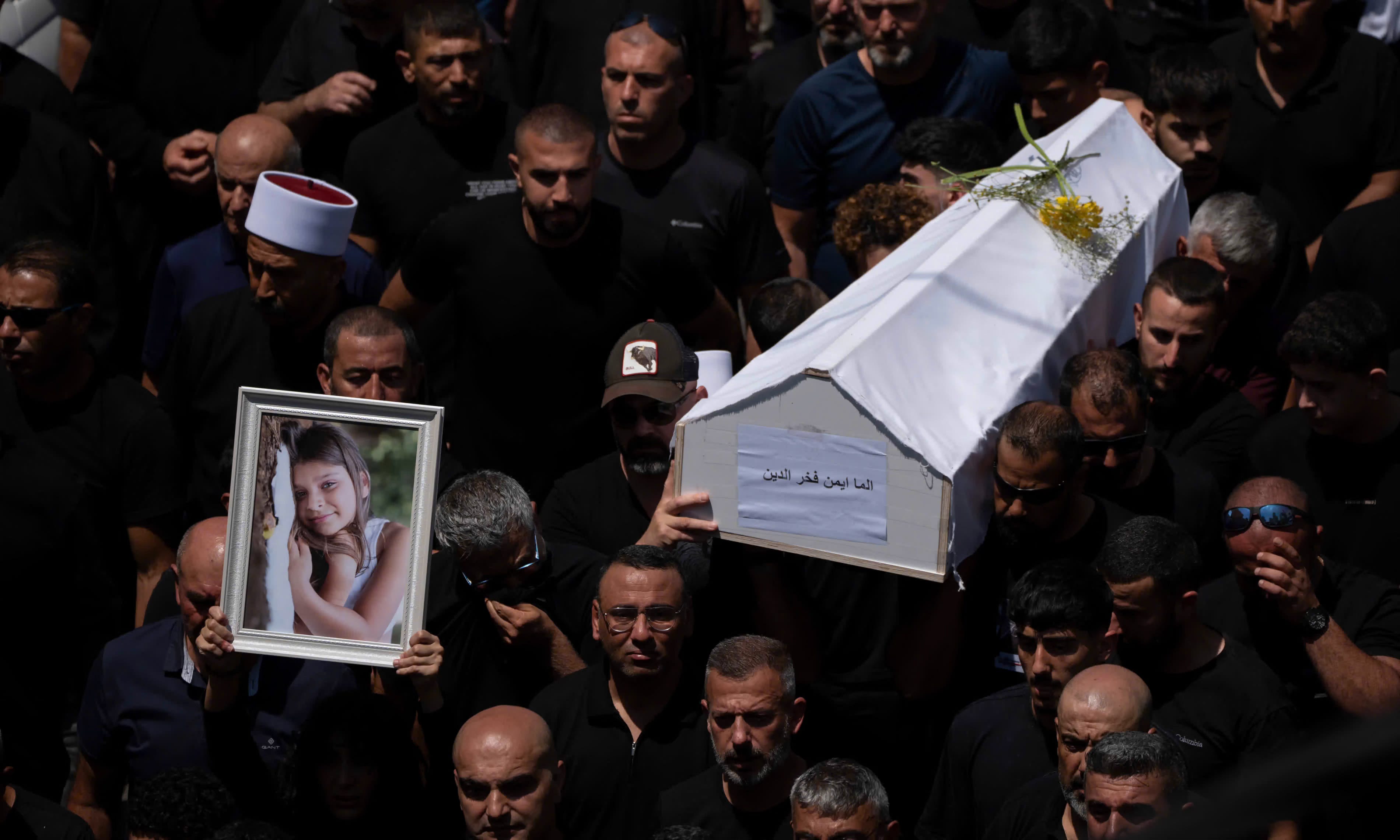
This is the madness of war. (Mourners from the Druze minority carry the coffins of some of the 12 children and teenagers killed in the rocket strike in the village of Majdal Shams. Photograph: Léo Corrêa/AP)
Another vital issue, of course, is America’s seemingly permanent state of war and its slavish support of Israel in its ongoing demolition of Gaza. As expected, that genocidal act is beginning to spin out of control as it appears Israel is preparing to strike Hezbollah in Lebanon in the aftermath of a deadly missile strike on the Israeli-occupied Golan Heights.
When will the madness of war in the Middle East end? And is it the intent of the U.S. government to continue to provide all the weapons Israel needs to continue its campaign of mass killing? (Always done in the name of “defense” and “security,” naturally.)
In his recent address to America, President Biden declared that under him U.S. troops weren’t at war for the first time this century. His exact words were: “I’m the first president in this century to report to the American people that the United States is not at war anywhere in the world.” This boast came as U.S. forces were bombing Yemen in support of Israel’s operations in Gaza. Meanwhile, America leads the world in selling weapons and spends more on its military than the next ten countries combined, most of those being U.S. allies.
When does the U.S. get to become a normal country in normal times, rather than a nation permanently at war and forever preparing for it, even for nuclear Armageddon? Why are we spending possibly as much as $2 trillion on “modernizing” a nuclear triad that, if used, could easily destroy life on earth as well as several other earth-sized planets? When are we going to end this insanity?
We need to challenge Democrats and Republicans as well as the media to cover real issues, issues of life and death, rather than writing puff pieces about Kamalove and MAGA.
Learning from Ashleigh Banfield’s Landon Lecture of April 2003
Early in 2003, Ashleigh Banfield was a star in the making. A rising journalist at MSNBC, she covered the opening stages of the Iraq War. Before that, she’d made a name for herself covering the 9/11 attacks and their aftermath. Smart, pretty, highly skilled, she was heading nowhere but up. Until she gave an honest lecture on her experiences in Iraq and the Middle East on April 24, 2003.
I’ve written before about Banfield’s honest and heartfelt critique of Iraq war coverage in the U.S. mainstream media, which won her no friends at NBC News. In fact, the NBC brass sidelined and essentially exiled her. I recently reread her Landon Lecture at Kansas State University and realized NBC wasn’t just angry about her critique of mainstream media war coverage: they were likely even more incensed at how she humanized and empathized with Palestinians and other Middle Eastern peoples and groups, including organizations like Hezbollah.
Here’s some of what she had to say back then in 2003:
But it’s interesting to be able to cover this [Israel and Palestine]. There’s nothing in the world like being able to cross a green line whenever you want and speak to both sides of a conflict. I can’t tell you how horrible and wonderful it is at the same time in the West Bank and Gaza and Israel. There are very few people in this world who can march right across guarded check points, closed military zones, and talk to Palestinians in the same day that they almost embedded with Israeli troops, and that’s something that we get to do on a regular basis.
And I just wish that the leadership of all these different entities, ours included, could do the same thing, because they would have an eye opening experience, horrible and wonderful, all at the same time, and it would give a lot of insight as to how messages are heard and how you can negotiate. Because you cannot negotiate when someone can’t hear you or refuses to hear you or can’t even understand your language, and that’s clearly what’s happening in a lot of places in the world right now, the West Bank, Gaza and Israel, not the least of which there’s very little listening and understanding going on. Our language is entirely different than theirs, and I don’t just mean the words. When you hear the word Hezbollah you probably think evil, danger, terror right away. If I could just see a show of hands. Who thinks that Hezbollah is a bad word? Show of hands. Usually connotes fear, terror, some kind of suicide bombing. If you live in the Arab world, Hezbollah means Shriner. Hezbollah means charity, Hezbollah means hospitals, Hezbollah means welfare and jobs.
These are not the same organizations we’re dealing with. How can you negotiate when you’ re talking about two entirely different meanings? And until we understand — we don’t have to like Hizbullah, we don’t have to like their militancy, we don’t have to like what they do on the side, but we have to understand that they like it, that they like the good things about Hizbullah, and that you can’t just paint it with a blanket statement that it’s a terrorist organization, because even when it comes to the militancy these people believe that militancy is simply freedom fighting and resistance. You can’t argue with that. You can try to negotiate, but you can’t say it’s wrong flat out.
And that’s some of the problems we have in dealing in this war in terror. As a journalist I’m often ostracized just for saying these messages, just for going on television and saying, “Here’s what the leaders of Hezbullah are telling me and here’s what the Lebanese are telling me and here’s what the Syrians have said about Hezbullah. Here’s what they have to say about the Golan Heights.” Like it or lump it, don’t shoot the messenger, but invariably the messenger gets shot.
We hired somebody on MSNBC recently named Michael Savage. Some of you may know his name already from his radio program. He was so taken aback by my dare to speak with Al-Aqsa Martyrs Brigade about why they do what they do, why they’re prepared to sacrifice themselves for what they call a freedom fight and we call terrorism. He was so taken aback that he chose to label me as a slut on the air. And that’s not all, as a porn star. And that’s not all, as an accomplice to the murder of Jewish children. So these are the ramifications for simply being the messenger in the Arab world.
Emphasis added. Original spelling retained. You can watch her speech here.
Banfield tried to be a real journalist for MSNBC. She tried to understand and report the Israeli perspective but also the perspectives of groups like Hezbollah, and for that she was severely punished.
For Hezbollah, you could say something similar of Hamas today. As Banfield says, you don’t have to praise groups like Hamas (or, for that matter, Israel). But what you should try to do as a journalist is to understand them and to report on them as clearly and honestly as possible. As she says, her reward was to be defamed and dismissed as a slut by a fellow reporter, even called an accomplice to murder, after which her bosses at NBC punished and demoted her!
It’s no wonder that mainstream media coverage by most reporters today is so slavishly pro-Israel. Who wants to be slut-shamed and demoted? Who wants their career ruined just because they sought to understand more than one side (the Israeli/U.S. one) of complex situations in the Middle East?
My brother once quipped: “We learn, good.” MSM reporters in America “learned good” that being rabidly pro-Israel (and, of course, pro-U.S. government and pro-war) is always the safest bet to accolades and promotions from their corporate overlords.
With admirable honesty, Banfield spoke of the horrific face of war at Kansas State Univ. in 2003. Soon after her speech, she was demoted (Image courtesy of KSU)
And, as I wrote in my previous piece on Banfield: Any young journalist with smarts recognizes the way to get ahead is to be a cheerleader for U.S. military action, a stenographer to the powerful. Being a critic leads to getting fired (like Phil Donahue); demoted and exiled (like Banfield); and, in Jesse Ventura’s case, if you can’t be fired or demoted or otherwise punished, you can simply be denied air time.
Banfield tried to tell us there’s a difference between journalism and coverage; that far too many voices of dissent had been silenced in America before and during the opening stages of the Iraq War; that war coverage was (and is) far too often both one-sided and sanitized.
Again, it’s worth a few minutes of your time to listen to her lecture and reflect on her honesty and integrity—and how she was punished for it.
After watching this, you’ll understand why the reporters you see today on U.S. TV and cable networks are nothing like Ashleigh Banfield.
“War is ugly and it’s dangerous” and it fuels hatred. Yes it is and yes it does, Ms. Banfield. Thank you for your honesty, your integrity, and your courage.



 Bracing Views