
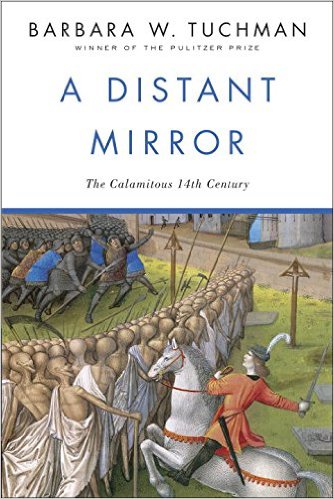
The Calamitous 21st Century

tuchman

W.J. Astore

We’re only sixteen years into the 21st century, but it seems like a “best of times, worst of times” kind of epoch.  It’s the best of times for the aristocracy of the rich, and the worst of times for the poor and disadvantaged, especially when they live close to or in war zones.

Perhaps that’s a statement of the obvious, except the gap between the richest and poorest continues to grow.  Their worlds, their realities, are so different as to be virtually disconnected.  This is a theme of several recent science fiction films, including the “Hunger Games” series (the Capitol versus the Districts) and “Elysium,” in which the privileged rich literally live above the sordid earth with its teeming masses.

Some of the big fears of our present century include the emergence of a “super bug,” a contagion that is highly resistant to traditional drugs.  We’ve overused antibiotics and are slowly breeding new strains of bacteria that modern medicine can no longer defeat.  Meanwhile, many people in the U.S. still lack health care, or they’re reluctant to use it because it’s too expensive for them.  And then there are the workers who lack sick leave.  They force themselves to go to work, even when sick, because they need the money.  How long before inadequate health care and sick workers facilitate the conditions for the spread of a plague?

And then there’s the contagion of violence and war.  America’s wars in places like Iraq, Afghanistan, and Africa are basically open-ended.  They are today’s version of the “Hundred Years’ War” between England and France, an on-again, off-again struggle for dominance that sprawled across two centuries.  In fact, America’s “war on terror,” with its “surgical strikes” and reliance on technology as a quasi-panacea, seems to be breeding new types of “super-bug” terrorists who are highly resistant to traditional techniques of policing and war.

In this effort, one thing is certain: No U.S. president will be declaring “peace” or even “normal” times for the next decade or two (or three).

Finally, let’s not forget global warming.  The Pentagon and the CIA haven’t.  Republicans may have their share of climate change deniers, but when it comes to the U.S. national security state, contingency plans are already in place for the disasters awaiting us from global warming.  Competition for scarce resources (potable water especially, but food and fuel as well) combined with more intense storms, widespread flooding, and much warmer temperatures, will generate or aggravate wars, famines, and plagues.

Are we living in a failed or failing world?

In “A Distant Mirror,” the historian Barbara Tuchman wrote about the calamitous 14th century of plagues and wars and a mini-ice age in the northern hemisphere. We seem to be facing a calamitous 21st century of plagues and wars and a mini-hothouse age.  It’s a grim prospect.

The question is: Can we act collectively to avert or avoid the worst of these calamities?  Or are we fated to dance our very own 21st-century danse macabre?
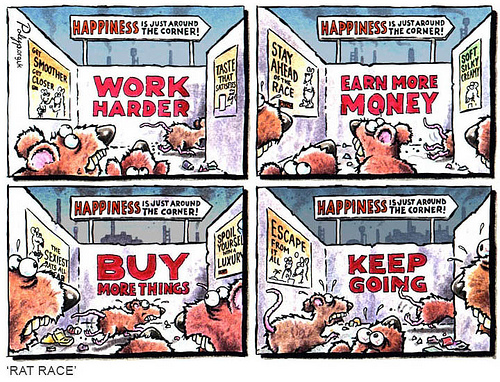
Divided, Distracted, Downtrodden: The Social and Political Reality in America Today

Consumerism1

W.J. Astore

The American people are being kept divided, distracted, and downtrodden.  Divisions are usually based on race and class. Racial tensions and discrimination exist, of course, but they are also exploited to divide people.  Just look at the current debate on the Confederate flag flying in Charleston, South Carolina, with Republican presidential candidates refusing to take a stand against it as a way of appeasing their (White) radical activist base.  Class divisions are constantly exploited to turn the middle class, or those who fancy themselves to be in the middle class, against the working poor.  The intent is to blame the “greedy” poor (especially those on welfare or food stamps), rather than the greedy rich, for America’s problems.  That American CEOs of top companies earn 300 times more than ordinary workers scarcely draws comment, since the rich supposedly “deserve” their money.  Indeed, in the prosperity Gospel favored by some Christians, lots of money is seen as a sign of God’s favor.

As people are kept divided by race, class, and other “hot button” issues (abortion and guns, for example), they are kept distracted by insatiable consumerism and incessant entertainment.  People are told they can have it all, that they “deserve it” (a new car, a bigger home, and so on), that they should indulge their wants.  On HGTV and similar channels, people go shopping for new homes, carrying a long list of “must haves” with them.  I “must have” a three-car garage, a pool, a media room, surround sound, and so on.  Just tell me what mortgage I can afford, even if it puts me deeply in debt.  As consumerism runs rampant, people are kept further distracted by a mainstream media that provides info-tainment rather than news. Ultimately, the media exists to sell product; indeed, it is product itself.  No news is aired that will disturb the financial bottom line, that will threaten the corporations that run the media networks, that will undermine the privileged and the powerful.

The people, kept divided and distracted, are further rendered powerless by being kept downtrodden.  Education is often of poor quality and focused on reciting rote answers to standardized tests.  Various forms of debt (student loan debt, credit card debt, debt from health care and prescription drugs costs, and so on) work to keep the people downtrodden.  Even workers with good jobs and decent benefits are worried.  Worried that if they lose their jobs, they lose their health care. So much of personal status and identity, as well as your ability to navigate American society, is based on your position.  For many it’s lose your job, lose your life, as you’re consumed by debt you can’t repay.

Divided, distracted, and downtrodden: It’s a recipe for the end of democracy in America.  But it also serves as a roadmap to recovery.  To reinvigorate our democracy, we must fight against divisiveness, we must put distractions behind us, and we must organize to fight for the rights of the people, rights like a better education for all, less debt (a college education that’s largely free, better health care for everyone, and far less emphasis on consumerism as a sign of personal and societal health and wealth), and improved benefits for the workers of America, who form the backbone of our nation.

We can’t wait for the politicians.  Most of them are already co-opted by the moneyed interests.  Meaningful change will have to come from us.  That is, after all, the way democracy is supposed to work.

America Is the Greatest Country? Look At Our Health Care — And Weep

Image

This is also featured at Huffington Post

Americans generally, and politicians in particular, proudly proclaim that we live in “the greatest” country. But how should we measure the greatness of a country? I’d suggest that quality of life should be a vitally important measure.

And what is more fundamental to quality of life than ready access to health care? When you’re sick or suffering, you should be able to see a medical specialist. And those costs should be — wait for it — free to you. Because health care is a fundamental human right that transcends money. Put succinctly, the common health is the commonwealth. And we should use the common wealth to pay for the common health.

Here’s the truth: We all face the reality of confiscatory taxation. If you’re like me, you pay all sorts of taxes. Federal, state, and local income taxes. Property taxes. School taxes. Social security. State lotteries are a regressive tax aimed at the poor and the gullible. We pay these taxes, and of course some for health care as well (Medicare/Medicaid), amounting to roughly 30 percent of our income (or higher, depending on your tax bracket, unless you’re super-rich and your money comes from dividends and capital gains, then you pay 15 percent or lower: see Romney, Mitt).

Yet despite this tax burden, medical care for most of us remains costly and is usually connected somehow to employment (assuming you have a good job that provides health care benefits). Even if you have health care through your job, there’s usually a substantial deductible or percentage that you have to pay out-of-pocket.

America, land of the free! But not free health care. Pay up, you moocher! And if you should lose your job or if you’re one of the millions of so-called underinsured … bankruptcy.

Health care is a moral issue, but our leaders see it through a business/free market lens. And this lens leads to enormous moral blind spots. One example: Our colleges and universities are supposed to be enlightened centers of learning. They educate our youth and help to create our future. Higher Ed suggests a higher purpose, one that has a moral center — somewhere.

But can you guess the response of colleges and universities to Obamacare? They’re doing their level best to limit adjunct professors’ hours to fewer than thirty per week. Why? So they won’t be obligated by law to provide health care benefits to these adjuncts.

Adjuncts are already underpaid; some are lucky to make $3000 for each course they teach. Now colleges and universities are basically telling them, “Tough luck, Adjunct John Galt. If you want medical benefits, pay for health insurance yourself. And we’re limiting your hours to ensure that you have to.” 

So, if Adjunct John Galt teaches 10 courses a year (probably at two or three institutions of “higher” learning) and makes $30,000, he then faces the sobering reality of dedicating one-third of this sum to purchasing private health insurance. If that isn’t a sign of American greatness, I don’t know what is.

I groan as much as the next guy when I pay my taxes. But I’d groan a lot less if I knew my money was funding free health care for all (including me and mine). Commonwealth for the common health. With no death panels in sight.

As “Dirty Harry” said in a different context, “I know what you’re thinking.” Free health care for all is simply too expensive. We say this even as we spend a trillion dollars a year on national defense and homeland security, to include the funding of 16 intelligence agencies to watch over us.

A healthy republic that prides itself on “greatness” should place the health of its citizens first. That we don’t is a cause for weeping — and it should be a cause for national soul-searching.

Astore writes regularly for TomDispatch.com and can be reached at wjastore@gmail.com.