“Peace” is a word rarely heard in American discourse. No matter the year, there are wars and rumors of war for America. This is obviously unhealthy for society, for the environment, for everything, an idea caught by a Vietnam War-era slogan, “War is not healthy for children and other living things.”
About all that war is “healthy” for is the continued growth of the military-industrial-congressional complex, the MICIMATT that truly runs much of America. As America’s war budget soars to $900 billion and as America dominates the world’s market in weaponry, accounting for 40% of that deadly trade, acts of violence and extremism continue to rise. The U.S., for example, has provided roughly $200 billion over the last three years to support Ukraine and Israel, most of it in the form of deadly weaponry. This is sold to the American people as a job-creator.
Back in 2021, I wrote about endless war feeding extremism in America for the Eisenhower Media Network. You can read the entire report here; what follows in an excerpt of what I wrote.
Endless War Fosters and Favors Extremism
Written in 2021
Since the attacks of 9/11/2001, America has been at war. A U.S. military vision of global reach and global power morphed into a global war on terror (GWOT). The GWOT led to invasions of Afghanistan and Iraq—wars that were based on lies and which promoted atrocity. Iraq had no weapons of mass destruction, the leading issue publicly in America’s decision to invade in 2003. Afghanistan had no direct role in the 9/11 attacks; indeed, 15 of the 19 Al Qaeda terrorists were Saudi nationals. Yet the Afghan War was waged both in the false name of avenging 9/11 and of preventing such attacks in the future.
Both wars cost thousands of American lives killed, tens of thousands grievously wounded, and both failed. Temporary gains secured by U.S. troops at high cost in “surges” in Iraq and Afghanistan proved fragile and reversible, two words used by General David Petraeus himself, and at the time, to qualify them.
Nevertheless, whether these wars were led by Petraeus or a series of otherwise forgettable generals, progress proved elusive even as real money was being squandered (the two wars are estimated to have cost America more than $6.4 trillion by May of 2021). Yet as Army Lieutenant Colonel Paul Yingling wrote in 2007, a private losing a rifle suffers quicker and more adverse punishment than generals who continually lose wars.
America’s wars have proven to be losers, shamefully so, yet no senior leaders have been punished or even demoted. Bewildered troops returning home from these meaningless wars often discovered grim prospects despite slogans of “support our troops” and “20%-off mattress sales” ostensibly held in honor of veterans and their service.
Donald Trump, a reality TV star and failed casino owner, gained popularity and eventually the presidency in part by promising to end America’s wasteful and winless wars overseas. It was a promise he failed to keep. Nevertheless, Trump’s message about wasteful and fruitless wars was noteworthy, demonstrating the domestic impact and blowback of open-ended and disastrous foreign military interventions.
Winless, seemingly endless, and often brutal wars have had a brutalizing impact on the troops who served. A state of constant war, James Madison warned, is corrosive to democracy. Wars without progress, wars without purpose, wars unsupported by the people (Congress has not issued a formal declaration of war since World War II), breed alienation, bitterness, and dismay. They also foster extremism.
Nearly one in five of the Capitol rioters charged for their actions on January 6, 2021 were military veterans. White supremacy is a known and increasing problem in the U.S. military. In response to riots and extremism, Secretary of Defense Lloyd Austin in February 2021 ordered military units to observe a one-day stand-down to address extremism. Remarkably, troops had to be reminded that attempts to seize seats of power in the U.S. government, as during the Capitol riot, were contrary to their oaths to the Constitution and against the law.
And it’s not just rank-and-file service members who apparently require lessons in civilian primacy. A letter signed by 124 retired generals and admirals warned of Marxism and socialism within the U.S. military and questioned President Joe Biden’s mental and physical fitness to serve as commander-in-chief. The civil-military divide manifested by this letter echoed a similar one in France where right-wing military officers warned of a civilizational struggle within France allegedly being aggravated by Muslim immigration and Islamism.
Extremism within the U.S. military undeniably exists; manipulation by senior leaders spouting big lies remains a serious concern, as do groups such as QAnon and the Oath Keepers that specialize in radicalization via misinformation. Yet the ultimate source of radicalization within the U.S. military, and possibly within wider U.S. society, is war itself.
Wars that are waged without the people’s support, under false pretenses, and with no profit to society other than to America’s military-industrial-congressional complex are conducive to rampant corruption and societal decay.
Endless wars and the deep wounds that come from them have served as an ideal incubator of extremism in America. The first and most vital step in ending extremism, therefore, is to end these undeclared wars and the resentments, violence, and hatred they breed.
When the Soviet Union fell in 1991, America heard something about “peace dividends” and “a new world order.” With the Soviet Union gone, the Cold War over, America could take all the hundreds of billions it had been spending on weapons and wars and spend it instead on America. We could, in theory, embrace peace, reinvest in America, and save our children from a world of incessant wars and preparations for the same.
It was not to be.
The collapse of the Soviet Union coincided with Desert Shield/Storm, when America allegedly kicked its “Vietnam Syndrome” once and for all, according to then-President George H.W. Bush. This “syndrome” was allegedly inhibiting America’s pursuit of righteous victory through military means, and the expulsion of Iraqi forces from Kuwait was allegedly proof that America was back and that military force had powerful efficacy for good.
Out went the idea of peace dividends. This was America’s moment to dominate, a Pax Americana achieved through military force or threats of the same. U.S. dominance of the Middle East contributed to the decision by Al Qaeda to launch attacks against the USA, but any U.S. culpability for 9/11 was swept away by another President Bush, George W., who explained that Al Qaeda had no rationale for 9/11 other than their hatred of American freedoms.
The aftermath of 9/11 was an orgy of American violence directed against “evildoers” everywhere. It was a two-decade global war on terror, GWOT as jihad, leading to wars in Afghanistan, Iraq, Libya, and elsewhere. Even as these wars proved disastrous, those who advocated for them saluted themselves as being right but (perhaps) for the wrong reason, the “wrong” reason being some version of having loved America too much, whereas those who’d opposed these wars were “wrong” even though events had proven them to be right (they were wrong apparently because they didn’t love America enough, especially its domineering government).
It’s been a long time, more than three decades, since I’ve heard anyone mention peace dividends. Even when President Biden ended the Afghan War in 2021, military spending soared upwards, and this was before the Russia-Ukraine War. With the Hamas attacks on Israel and the impending invasion and destruction of Gaza by the IDF, America will likely embrace war and increase military spending with even more fervor.
War is America’s growth stock. Our politicians brag that military aid to countries like Ukraine and Israel serves to create jobs in America. Rarely is any mention made of Russian dead, of Palestinian dead, or for that matter of any dead, as America dominates the global trade in weaponry. The idea of “the merchants of death,” the opposition by the U.S. Senate in the 1930s to making profits by killing people, seems like ancient history, seems absurd, given America’s tight embrace of militarism. If we’re not fighting wars we’re arming others to fight wars. And we console ourselves that we’re only providing “good guys” with guns, for, as the NRA taught us, the only way to stop bad guys with guns is to give good guys even more guns.
Perhaps that’s the essence of U.S. foreign policy today. We give “good guys” like Ukrainians and Israelis all the guns they want to go kill “bad guys” like Russians and Palestinians while congratulating ourselves for “investing” in America’s arms manufactures. Indeed, members of Congress have said that providing older weapons from U.S. stockpiles of the same to countries like Ukraine is positively wonderful, since it forces the U.S. military to buy new weapons for itself, helping to create more jobs among the makers of guns, ammo, and bombs. What a win-win!
Lately I’ve been reading a lot about President Lyndon Johnson and how his “Great Society” and fight against poverty was done in by the calamitous Vietnam War in the 1960s. What’s tragic today in America is that we no longer have a vision of a great society, a better society, a fairer, more just, and more equitable society. Endless war and wildly excessive military expenditures is our only vision.
We put it on our stamps. And that’s where it remains.
The result is that “peace” has become a word rarely heard in America, a Pollyanna-like concept, easily dismissed as pie-in-the-sky. In fact, the last U.S. president to speak sincerely and powerfully for peace was John F. Kennedy, and that was sixty years ago. No president since JFK has stood before us to advance a vision of eventual world peace rather than of endless war and expensive preparations for the same.
We are told and taught today that peace is impossible and war is inevitable. Those who promote peace are dismissed as dreamers and weaklings as the “warriors” and hawks are promoted for their alleged realism and toughness.
Constant wars and preparations for the same destroy democracy and lead to spiritual death, to cite the words of James Madison and Martin Luther King Jr. Those are the true dividends of war, not jobs in American factories producing bullets and bombs. The true dividends of peace are a restoration of democracy and spiritual renewal in America.
There’s an important point about America’s Global War on Terrorism (GWOT) that people often miss.
When the Bush/Cheney administration announced the GWOT after 9/11, I think nearly all Americans assumed that “global” meant everywhere but the “good” countries. That global meant the axis of evil (Iraq, Iran, North Korea) and similar so-called bad actors, but that it didn’t mean countries like Canada — and certainly not the U.S. homeland.
But global really did mean everywhere on earth as we’ve watched the war on terror escalate domestically. The U.S. government/security state has built the foundation and superstructure for a permanent war on terror, and it simply isn’t going to go away. The Iraq and Afghan wars are essentially over (both lost), and fears of North Korea have subsided as the military-industrial-congressional complex focuses on Ukraine, Russia, and China, but the GWOT continues. It’s now turned inwards, within and along our own borders, and those techniques that were practiced (if not perfected) in Iraq, Afghanistan, and elsewhere are now being used and inflicted upon ordinary Americans who are attempting to resist state-corporate authoritarianism.
The GWOT has come home — but perhaps it’s always been here. What’s changed is how state-corporate entities can define almost any form of determined protest—even civil and nonviolent ones—as “terror.” Labeling someone a “domestic terrorist” gives state-corporate actors a whole host of powerful ways to punish activists, notes by Michael Gould-Wartofsky at TomDispatch.com.
At the same time, America has witnessed the “rise of the warrior-cop,” as Radley Balko noted in his book by that title.
Three years ago, I wrote about the militarization of police forces at TomDispatch. This is what I wrote then:
America’s violent overseas wars, thriving for almost two decades despite their emptiness, their lack of meaning, have finally and truly come home. An impoverished empire, in which violence and disease are endemic, is collapsing before our eyes. “When the looting starts, the shooting starts,” America’s self-styled wartime president [Donald Trump] promised, channeling a racist Miami police chief from 1967. It was a declaration meant to turn any American who happened to be near a protest into a potential victim
As such demonstrations proliferate, Americans now face a grim prospect: the chance to be wounded or killed, then dismissed as “collateral damage.” In these years, that tried-and-false military euphemism has been applied so thoughtlessly to innumerable innocents who have suffered grievously from our unending foreign wars and now it’s coming home.
A few days ago, The Onion, a satirical news site, compared America’s obedience and passivity to power to the current situation in France. Here’s how they put it:
In an ongoing struggle against ruling-class oppression, the people of France again protested in a way that Americans are welcome to at any time, sources confirmed Thursday. According to reports, French citizens across the country were spotted hitting the streets en masse as a unified front against the institutional bondage that seeks to subjugate them while never failing to apply forceful pressure every time injustice strikes, which Americans can and should feel free to do whenever they so choose.
Yes, but are Americans truly “welcome” to protest “whenever they so choose”? We’d like to think so, especially as July 4th approaches (America! Land of the Free!), but who wants to be detained and thrown in jail for domestic terrorism? Anyone in America hankering to be labeled as a terrorist by the state, whether on the right or left of the political spectrum, even if the charge is eventually dismissed?
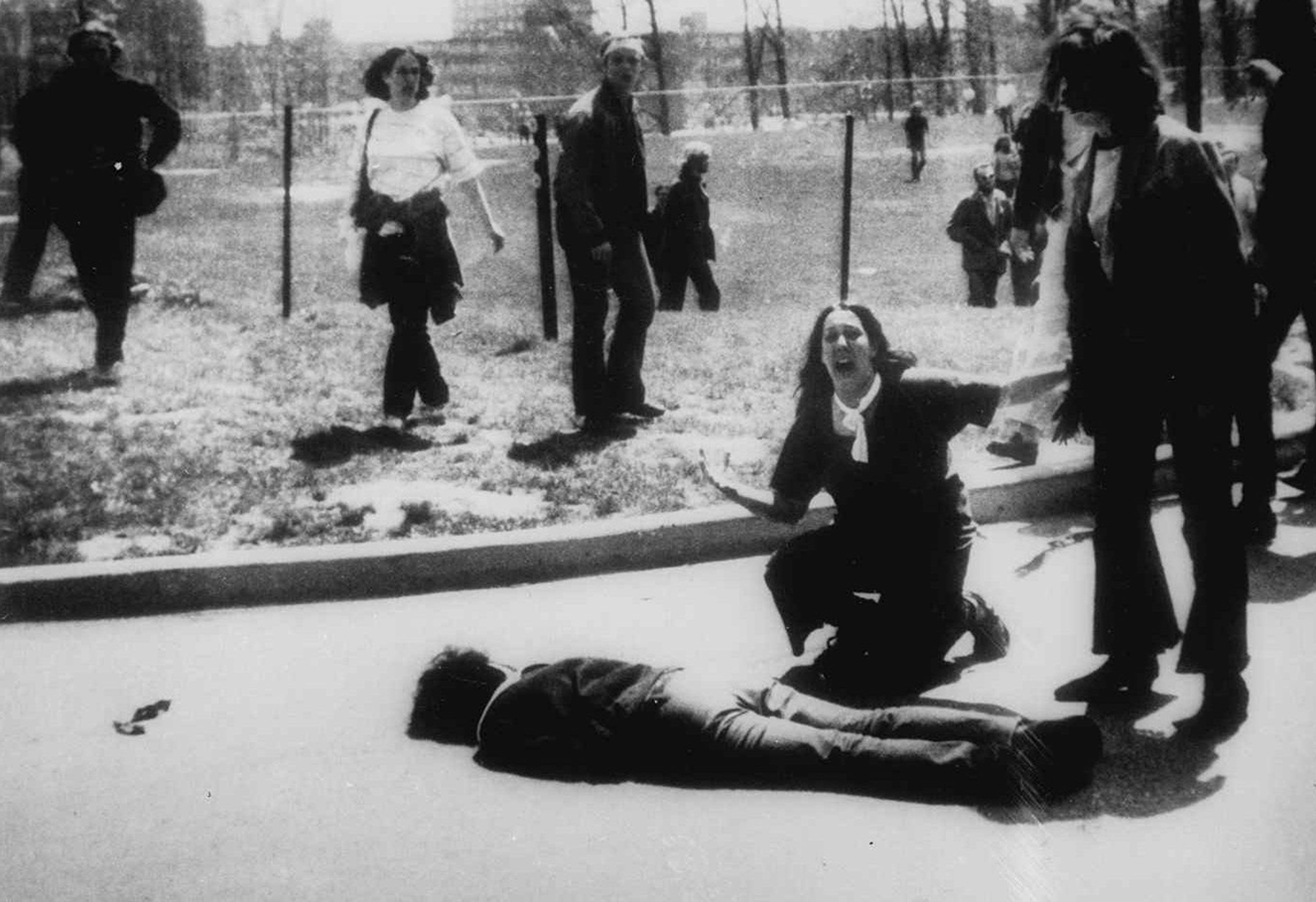
Searing photo of state violence at Kent State in 1970. The dead student’s name was Jeffrey Miller. The young woman crouched in shock and horror was Mary Ann Vecchio. Richard Nixon called the protesters “bums.” What would the state call them today—domestic terrorists?
Remember those innocent days of the 1960s when for some the police were “pigs” and the protesters were “bums” (Richard Nixon’s word for the students killed at Kent State)? Now those protesters could be charged with domestic terrorism even as various heavily armed enforcers of the law would likely be celebrated (consider all those “blue lives matter” flags, for example).
Remember when “defund the police” was briefly a thing? By which people meant less funding for militarized police forces and more for mental health services and the like. President Joe Biden and the Democrats realized any serious effort to restrain police power would leave them open to charges of being soft on crime, so Biden and the party simply declared: Fund the police. (Republicans concur, of course, even as they still accuse Biden and the Dems of being soft on crime.)
And there you have it. Fund the police at all levels, local, state, and federal, and grant them the kind of powers given to America’s “warriors” in the GWOT. Set them loose on all of America’s domestic “terrorists.” After all, the GWOT went so well in Iraq, Afghanistan, Libya, Yemen, and elsewhere. Surely it will go equally well in the Homeland. Right?
Addendum: In writing this, I came across a superb article by Patricia McCormick at the Washington Post on Mary Ann Vecchio, “the girl in the Kent State photo.” She was just 14 when the above photo was taken. She paid a high price, as the article recounts. Letters to her family accused her of being a “drug addict,” a “tramp,” or a “communist.” The then-governor of Florida suggested she was a “professional agitator” and therefore responsible for the students’ deaths. A Gallup poll back then, cited by McCormick, said that 58% of Americans blamed the students at Kent State and only 11% blamed the National Guardsmen who opened fire and killed the four students.
“Professional agitator” sounds much like today’s domestic terrorist. And let’s reflect on those 58% of Americans who believed the students at Kent State were responsible for their own deaths. How dare they block the free flight of “Made in USA” bullets with their young bodies? The “bums”! (“Domestic terrorists.”)
When the first hijacked plane hit the World Trade Center on 9/11/2001, I was at the Air Force Academy in Colorado Springs. I was in my car, listening to the radio, just outside the North Gate, where a B-52 sits on static display as a symbol of American power. The first reports suggested it was an accident, but it soon became apparent it was a deliberate act. As a second and then a third plane hit the WTC and the Pentagon, I remember hearing speculation that 9/11 could have a higher death toll than the Battle of Antietam, the single bloodiest day of the U.S. Civil War. It was bad enough, if not that bad.
I remember confusion and chaos in the government, and the use of the word “folks” by President George W. Bush to describe the hijackers. Very quickly, his rhetoric changed, and soon America would be launched on a global crusade against terrorists and other evildoers.
The flags came out and America came together, but that team spirit, so to speak, was quickly seized upon and exploited by Bush/Cheney to justify war anywhere and everywhere. Good will was squandered and wise counsel was rejected in a calculated plot for power-projection disguised as righteous vengeance. Sweep everything up, related and unrelated, go big: those were the sentiments of Donald Rumsfeld, Dick Cheney, and crew. They had failed so badly at protecting America on 9/11; they were not going to fail to use 9/11 for their own nefarious purposes.
And now, 20 years later, we’re witnessing how badly their hubris and dishonesty have damaged democracy in America, as well as damaging or destroying millions of lives around the globe.
After finishing my tour at the AF Academy in 2002, I became the Dean of Students at the Defense Language Institute at the Presidio of Monterey. I wonder how many of “my” young troops who so proudly crossed the stage with newly acquired language skills in Pashto and Dari and Arabic never made it home from Bush and Cheney’s GWOT, their “global war on terror.”
9/11 remains a traumatic day for America. It’s a day we remember where we were and what we were doing when we first learned of this horrific attack on our country. However briefly, 9/11 brought America together, but militarism and constant warfare along with prejudice and ignorance have served only to weaken our democracy while impoverishing our country.
This madness was on my mind as I recently re-watched “The City on the Edge of Forever,” a classic Star Trek episode in which history’s changed when Dr. McCoy travels back in time to 1930s America. Here he saves the life of Edith Keeler, a social activist who, in an alternate timeline, delays U.S. entry into World War II, which allows the Nazis to develop the atomic bomb first, thereby winning the war. Captain Kirk and Mr. Spock learn they must prevent McCoy from saving Keeler, which is complicated by the fact that Kirk falls hard for her. She’s a visionary who speaks of space travel and a better world. As Kirk courts her, Keeler says she dreams of a future in which all the money currently spent on war and death … and Kirk completes her thought by saying that that money will be spent instead on life. Kindred spirits they are, Kirk and Keeler, yet to restore history to its proper place, he must let her die.
Joan Collins as Edith Keeler and William Shatner as Captain Kirk: Reaching for the stars
Keeler’s dream of peace – of all the trillions of dollars spent on weapons and war and death being instead spent on life – is the proper one, the right one, even as it was tragically premature. For this she must die, forgotten to history, a bit player remembered only for running a small neighborhood mission for those with nowhere else to go.
I’ve always been attracted to science fiction and to plots both utopian, or at least hopeful, and dystopian. But in the dystopia in which we increasingly find ourselves today, we need hopeful visions. We need Edith Keelers. But to use Star Trek-speak again, what I see issuing from the U.S. government is far more consistent with a Klingon Empire driven by war than a peaceful and life-affirming “federation” of planets. The U.S. empire is not about to go quietly, nor will it go peacefully.
It’s time for a new course, a far less bellicose one, but a no less determined one, where Americans look within rather than without. Echoing Edith Keeler, let’s spend our money and resources on life, not death, love, not war. Let’s try that for the next 20 years. If we do, I bet we’ll be a lot better off in 2041 than we are today.
FDR’s Four Freedoms brought meaning to World War II
W.J. Astore
At TomDispatch.com, Andrew Bacevich asks a pregnant question: What should we call America’s no-name wars? (Afghanistan, Iraq, Libya, Syria, and so on.) It used to be the GWOT (global war on terror), sometimes shortened to War on Terror and favored by the Bush/Cheney administration. The Obama administration punted, preferring the anodyne label of “overseas contingency operations.” Other names and concepts have been floated, such as “generational war” and “long war,” and the U.S. military itself, which is quite expert at creating acronyms, has used terms like MOOTW (military operations other than war). Indeed, the fact that America’s wars lack a commonly accepted name points to the lack of a common theme or strategy. Put differently, when you can’t name something accurately, how can you understand it, let alone fight it smartly and win it?
Forgive me for being flippant, but I can think of a few less than reverent names that serve to highlight the folly of America’s nameless wars. How about these?
“Perpetual Preemptive War”: Preemptive war was the great idea of the Bush/Cheney administration. Remember how we couldn’t allow the smoking gun of Iraqi WMD to become a mushroom cloud? We had to preempt the non-existent WMD, hence the disastrous Iraq war(s).
“Generational War for Generals”: General David Petraeus has spoken of a generational war against terror in countries like Afghanistan, comparing it to America’s 60+ year commitment to South Korea. Waging that war should keep a lot of U.S. generals busy over the next few decades.
“Bankrupt Strategy to Bankrupt America”: America’s total national debt just reached $21 trillion (you read that right), with perhaps $6 trillion of that due to America’s wars since 9/11. If we keep up this pace of spending, we will soon conquer ourselves to bankruptcy. Mission accomplished!
“The Wars to End All Peace”: Woodrow Wilson had “the war to end all wars” with World War I. Bush/Obama/Trump can say that they have the wars to end all peace, since there simply is no prospect of these wars ever ending in the foreseeable future.
“Endless War to End Democracy”: FDR had the Four Freedoms and a real war to end Nazi Germany and Imperial Japan as threats to world peace. We now have endless war to end democracy in America. As James Madison wrote,
Of all the enemies of true liberty, war is, perhaps, the most to be dreaded, because it comprises and develops the germ of every other. War is the parent of armies; from these proceed debt and taxes; and armies, and debts, and taxes are the known instruments for bringing the many under the domination of the few. In war, too, the discretionary power of the Executive is extended; its influence in dealing out offices, honors and emoluments is multiplied; and all the means of seducing the minds, are added to those of subduing the force, of the people. The same malignant aspect in republicanism may be traced in the inequality of fortunes, and the opportunities of fraud, growing out of a state of war, and in the degeneracy of manner and of morals, engendered in both. No nation can preserve its freedom in the midst of continual warfare …
In short, instead of fighting for Four Freedoms, we’re now waging a permanent war that will end freedom.
Small wonder we avoid naming our wars – their theme and meaning are too frightening to nail down with precision.
In America’s war on terror, the groundhog always sees its own shadow, meaning six (or more) years of additional war. War is indeed the new normal in America, as I argue in this article today for TomDispatch.com.
War Is the New Normal Seven Deadly Reasons Why America’s Wars Persist
By William J. Astore
It was launched immediately after the 9/11 attacks, when I was still in the military, and almost immediately became known as the Global War on Terror, or GWOT. Pentagon insiders called it “the long war,” an open-ended, perhaps unending, conflict against nations and terror networks mainly of a radical Islamist bent. It saw the revival of counterinsurgency doctrine, buried in the aftermath of defeat in Vietnam, and a reinterpretation of that disaster as well. Over the years, its chief characteristic became ever clearer: a “Groundhog Day” kind of repetition. Just when you thought it was over (Iraq, Afghanistan), just after victory (of a sort) was declared, it began again.
Now, as we find ourselves enmeshed in Iraq War 3.0, what better way to memorialize the post-9/11 American way of war than through repetition. Back in July 2010, I wrote an article for TomDispatch on the seven reasonswhy America can’t stop making war. More than four years later, with the war on terror still ongoing, with the mission eternally unaccomplished, here’s a fresh take on the top seven reasons why never-ending war is the new normal in America. In this sequel, I make only one promise: no declarations of victory (and mark it on your calendars, I’m planning to be back with seven new reasons in 2019).
1. The privatization of war: The U.S. military’s recourse to private contractors has strengthened the profit motive for war-making and prolonged wars as well. Unlike the citizen-soldiers of past eras, the mobilized warrior corporations of America’s new mercenary moment — the Halliburton/KBRs (nearly $40 billion in contracts for the Iraq War alone), the DynCorps ($4.1 billion to train 150,000 Iraqi police), and the Blackwater/Xe/Academis ($1.3 billion in Iraq, along with boatloads of controversy) — have no incentive to demobilize. Like most corporations, their business model is based on profit through growth, and growth is most rapid when wars and preparations for more of them are the favored options in Washington.
“Freedom isn’t free,” as a popular conservative bumper sticker puts it, and neither is war. My father liked the saying, “He who pays the piper calls the tune,” and today’s mercenary corporations have been calling for a lot of military marches piping in $138 billion in contracts for Iraq alone, according to the Financial Times. And if you think that the privatization of war must at least reduce government waste, think again: the Commission on Wartime Contracting in Iraq and Afghanistan estimated in 2011 that fraud, waste, and abuse accounted for up to $60 billion of the money spent in Iraq alone.
To corral American-style war, the mercenaries must be defanged or deflated. European rulers learned this the hard way during the Thirty Years’ War of the seventeenth century. At that time, powerful mercenary captains like Albrecht von Wallenstein ran amok. Only Wallenstein’s assassination and the assertion of near absolutist powers by monarchs bent on curbing war before they went bankrupt finally brought the mercenaries to heel, a victory as hard won as it was essential to Europe’s survival and eventual expansion. (Europeans then exported their wars to foreign shores, but that’s another story.)
2. The embrace of the national security state by both major parties:Jimmy Carter was the last president to attempt to exercise any kind of control over the national security state. A former Navy nuclear engineer who had served under the demanding Admiral Hyman Rickover, Carter cancelled the B-1 bomber and fought for a U.S. foreign policy based on human rights. Widely pilloried for talking about nuclear war with his young daughter Amy, Carter was further attacked for being “weak” on defense. His defeat by Ronald Reagan in 1980 inaugurated 12 years of dominance by Republican presidents that opened the financial floodgates for the Department of Defense. That taught Bill Clinton and the Democratic Leadership Council a lesson when it came to the wisdom of wrapping the national security state in a welcoming embrace, which they did, however uncomfortably. This expedient turn to the right by the Democrats in the Clinton years served as a temporary booster shot when it came to charges of being “soft” on defense — until Republicans upped the ante by going “all-in” on military crusades in the aftermath of 9/11.
Since his election in 2008, Barack Obama has done little to alter the course set by his predecessors. He, too, has chosen not to challenge Washington’s prevailing catechism of war. Republicans have responded, however, not by muting their criticism, but by upping the ante yet again. How else to explain House Speaker John Boehner’s invitation to Israeli Prime Minister Benjamin Netanyahu to address a joint session of Congress in March? That address promises to be a pep talk for the Republicans, as well as a smack down of the Obama administration and its “appeasenik” policies toward Iran and Islamic radicalism.
Serious oversight, let alone opposition to the national security state by Congress or a mainstream political party, has been missing in action for years and must now, in the wake of the Senate Torture Report fiasco (from which the CIAemerged stronger, not weaker), be presumed dead. The recent midterm election triumph of Republican war hawks and the prospective lineup of candidates for president in 2016 does not bode well when it comes to reining in the national security state in any foreseeable future.
3. “Support Our Troops” as a substitute for thought. You’ve seen them everywhere: “Support Our Troops” stickers. In fact, the “support” in that slogan generally means acquiescence when it comes to American-style war. The truth is that we’ve turned the all-volunteer military into something like aforeign legion, deploying it again and again to our distant battle zones and driving it into the ground in wars that amount to strategic folly. Instead of admitting their mistakes, America’s leaders have worked to obscure them by endlessly overpraising our “warriors” as so many universal heroes. This may salve our collective national conscience, but it’s a form of cheap grace that saves no lives — and wins no wars.
Instead, this country needs to listen more carefully to its troops, especially the war critics who have risked their lives while fighting overseas. Organizations like Iraq Veterans Against the War and Veterans for Peace are good places to start.
4. Fighting a redacted war. War, like the recent Senate torture report, is redacted in America. Its horrors and mistakes are suppressed, its patriotic whistleblowers punished, even as the American people are kept in a demobilized state. The act of going to war no longer represents the will of the people, as represented by formal Congressional declarations of war as the U.S. Constitution demands. Instead, in these years, Americans were told togo to Disney World (as George W. Bush suggested in the wake of 9/11) and keep shopping. They’re encouraged not to pay too much attention to war’s casualties and costs, especially when those costs involve foreigners with funny-sounding names (after all, they are, as American sniper Chris Kyle so indelicately put it in his book, just “savages”).
Redacted war hides the true cost of a permanent state of killing from the American people, if not from foreign observers. Ignorance and apathy reign, even as a national security state that is essentially a shadow governmentequates its growth with your safety.
5. Threat inflation: There’s nothing new about threat inflation. We saw plenty of it during the Cold War (nonexistent missile and bomber gaps, for example). Fear sells and we’ve had quite a dose of it in the twenty-first century, from ISIS to Ebola. But a more important truth is that fear is a mind-killer, a debate-stifler.
Back in September, for example, Senator Lindsey Graham warned that ISIS and its radical Islamic army was coming to America to kill us all. ISIS, of course, is a regional power with no ability to mount significant operations against the United States. But fear is so commonplace, so effectively stoked in this country that Americans routinely and wildly exaggerate the threat posed by al-Qaeda or ISIS or the bogeyman du jour.
Decades ago, as a young lieutenant in the Air Force, I was hunkered down inCheyenne Mountain during the Cold War. It was the ultimate citadel-cum-bomb-shelter, and those in it were believed to have a 70% likelihood of surviving a five-megaton nuclear blast. There, not surprisingly, I found myself contemplating the very real possibility of a thermonuclear exchange with the Soviet Union, a war that would have annihilated life as we knew it, indeed much of life on our planet thanks to the phenomenon of nuclear winter. You’ll excuse me for not shaking in my boots at the threat of ISIS coming to get me. Or of Sharia Law coming to my local town hall. With respect to such fears, America needs, as Hillary Clinton said in an admittedly different context, to “grow a pair.”
6. Defining the world as a global battlefield: In fortress America, all realms have by now become battle spheres. Not only much of the planet, the seas, air, and space, as well as the country’s borders and its increasingly up-armored police forces, but the world of thought, the insides of our minds. Think of the 17 intertwined intelligence outfits in “the U.S. Intelligence Community” and their ongoing “surge” for information dominance across every mode of human communication, as well as the surveillance of everything. And don’t forget the national security state’s leading role in making cyberwar a reality. (Indeed, Washington launched the first cyberwar in history by deploying the Stuxnet computer worm against Iran.)
Think of all this as a global matrix that rests on war, empowering disaster capitalism and the corporate complexes that have formed around the Pentagon, the Department of Homeland Security, and that intelligence community. A militarized matrix doesn’t blink at $1.45 trillion dollars devoted to the F-35, a single under-performing jet fighter, nor at projections of $355 billion over the next decade for “modernizing” the U.S. nuclear arsenal, weapons that Barack Obama vowed to abolish in 2009.
7. The new “normal” in America is war: The 9/11 attacks happened more than 13 years ago, which means that no teenagers in America can truly remember a time when the country was at peace. “War time” is their normal; peace, a fairy tale.
What’s truly “exceptional” in twenty-first-century America is any articulated vision of what a land at peace with itself and other nations might be like. Instead, war, backed by a diet of fear, is the backdrop against which the young have grown to adulthood. It’s the background noise of their world, so much a part of their lives that they hardly recognize it for what it is. And that’s the most insidious danger of them all.
How do we inoculate our children against such a permanent state of war and the war state itself? I have one simple suggestion: just stop it. All of it. Stop making war a never-ending part of our lives and stop celebrating it, too. War should be the realm of the extreme, of the abnormal. It should be the death of normalcy, not the dreary norm.
It’s never too soon, America, to enlist in that good fight!
William J. Astore, a retired lieutenant colonel (USAF), is a TomDispatch regular. His D.Phil. is in Modern History from the University of Oxford. He’s just plain tired of war and would like to see the next politician braying for it be deployed with a rifle to the front lines of battle. He edits the blog The Contrary Perspective.








 Bracing Views