The scary part is that the official death toll of 76,134 is an undercount. So many bodies remain under rubble or just plain obliterated by bombs.
Of course, the so-called cease fire in Gaza is anything but as Israel continues its policy of not-so-selective killing and slow strangulation. If you suggest genocide is wrong, the predictable response from the Israeli-U.S. government is that you’re a Hamas terrorist sympathizer and probably an anti-Semite as well (the latter is true even if you’re Jewish).
Coincidentally, I just took a drink after typing that and started choking. OK, maybe that wasn’t a coincidence.
I remember during Catholic service we’d sing the hymn: “Whatsoever you do to the least my brothers, that you do unto me.” I guess they’re just empty words to all those avowed Christians in the government.
Back in June of 2023, I wrote a letter to my archdiocese in response to a request for money. (I am a lapsed Catholic who has in the past given money to the Church.) Here is the letter I wrote, with some follow-on thoughts:
*****
June 2023
Most Reverend ***
Archdiocese of Boston
Dear Reverend ***
I received your Catholic Appeal funding letter dated June 1st. I won’t be contributing…
[Well into the 1990s,] I took my Catholic faith seriously; in fact, my master’s thesis at Johns Hopkins, which examined Catholic responses to science in the mid-19th century, especially Darwinism, geology, and polygenism, was published in the Catholic Historical Review. But scandals involving the Church drove me to question my commitment to Catholicism and especially its patriarchal hierarchy, which was so intimately involved in the coverups of crimes committed against innocents.
I grew up in Brockton, Mass., where the archdiocese assigned a predatory priest to our church of St. Patrick’s. His name was Robert F. Daly. He abused minors and was eventually defrocked by the Church, but far too late. (See the Boston Globe, 6/14/11.)
When I attended St. Patrick’s in the 1970s, Father Daly was teaching CCD. A sexual predator was attempting to teach young people the meaning of Christian love. He had a decent definition for love, something like “giving, without expecting anything in return.” Selfless love, I suppose. Tragically, he obviously failed catastrophically to practice what he preached.
Fortunately, I was never abused. I was supposed to have one meeting with him, alone, that was cancelled at the last minute. I’d like to imagine God was looking out for me on that day, but that’s absurd. Why wasn’t God looking out for all those children abused by Catholic clergy like Father Daly?
To be blunt, I am thoroughly disgusted by the moral cowardice of the archdiocese in confronting fully its painful legacy of failing to protect vulnerable children against predatory priests like Father Daly. Shame on the Church.
The Bible says that all sins may be forgiven except those against the Holy Spirit. This is supposed to refer to a stubborn form of blasphemy. Yet I truly can’t think of a worse sin committed by the Church than to allow innocent children to suffer at the hands of predators disguised as “fathers.”
I sincerely hope you are doing something to change the Church, to reform it, to save it. I fear the Church has not fully confessed its sins, and in that sense it truly does not deserve absolution from the laity. Far too often, the Church has placed its own survival ahead of Truth, ahead of Christ as the Way and the Truth, and thus the Church has washed its hands of its crimes, as Pontius Pilate did.
I am staggered by this betrayal.
Perhaps you have truly fought to reform the Church. If you have not yet done so, perhaps you will soon find the moral courage. I pass no judgment on you. Judge not, lest you be judged. But I do find the Church to be wanting.
Recalling scripture, if the Church does not abide in Christ, should it not be cast into the fire and be consumed?
I am sorry to share such a bleak message with you. I find the Church’s decline to be truly tragic because we need high moral standards now more than ever. Yet the Church is adrift, consumed by petty concerns and obedience to power. Just one example: The U.S. Church cannot even clearly condemn the moral depravity of genocidal nuclear weapons!
I realize I am seriously out of step with today’s Catholic church. I believe priests should be able to marry if they so choose. I believe women who have a calling should be ordained as priests. I believe the Church’s position on abortion is absolutist and wrong. More than anything, I believe the Church is too concerned with itself and its own survival and therefore is alienated from the true spirit of Christ, a spirit of compassion and love.
Unlike you, I cannot in good conscience claim to be “devotedly yours in Christ.” But I am sincere in wishing you the moral courage you will need to manifest your devotion in directions that will help the least of those among us the most. For I well recall the song we sang in our youth: Whatsoever you do for the least of my brothers, that you do unto Me.
Sincerely yours
*****
I’m happy to say I get a thoughtful response from a local bishop, who assured me the Church was serious about reform, was doing all that it could to eliminate pedophilia and to punish those who were guilty of it, and that therefore the Church no longer needed outside policing.
It was the last statement that puzzled me. The Church disgraced itself precisely because it had swept decades of crimes under the rug. Hadn’t the Church learned that earnest attempts at reform by insiders were necessary but not sufficient?
So I wrote back these comments to the bishop:
I will say this as well: I don’t think the Church can police itself from within. That’s what produced the scandals to begin with. It’s like asking the Pentagon to police itself, or police forces with their “internal affairs” departments.
The Church has to open itself to being accountable to the laity, not just to reformers like yourself. Thus the Church has to cede power and a certain measure of autonomy, and institutions are loath to do this, for obvious reasons. Meanwhile, the Church is being weakened by lawsuits, as people seek compensation (and perhaps a measure of vengeance) for sins of the past.
Skeptics would reply that it took a huge scandal with major financial implications to force the Church to do the right thing.
For too long, the Church tolerated these crimes. The Church is hardly unique here. Think of sexual assaults within the military (notably during basic training), or think of the Sandusky scandal at Penn State, where Joe Paterno clearly knew of (some) of Sandusky’s abuse, yet chose not to take adequate action. (I was at Penn College when that scandal broke.)
The challenge, as you know, is that the Church is supposed to be a role model, an exemplar of virtue. Priests hold a special place of trust within communities and are therefore held in especially high regard.
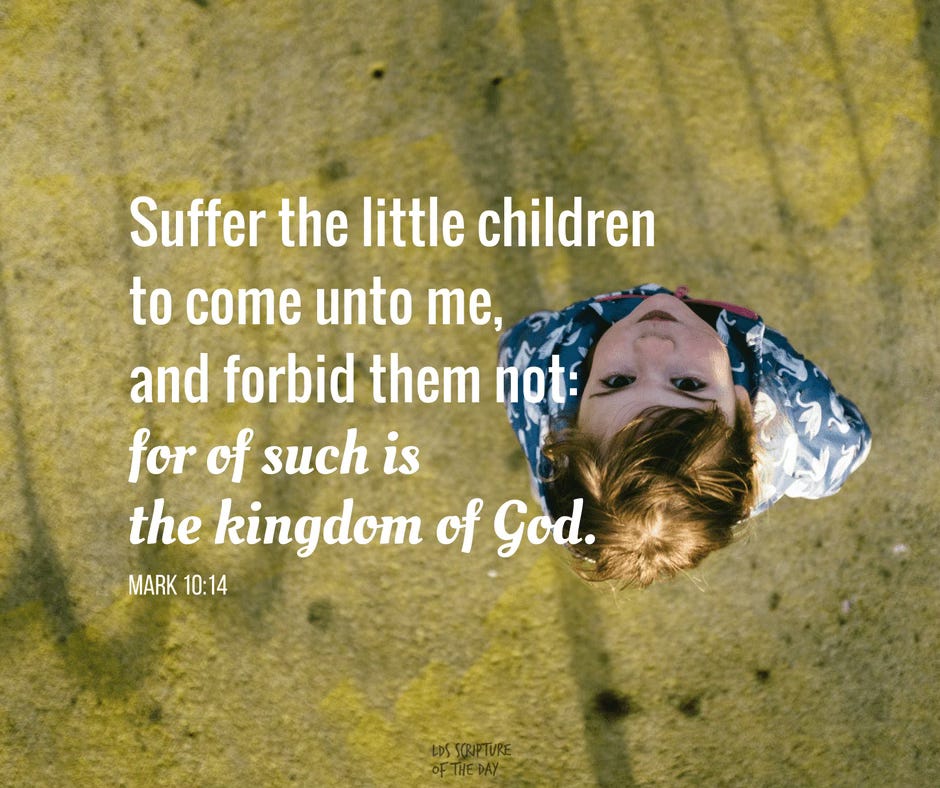
Image courtesy of the Mormon (LDS) Church
As my older brother-in-law explained to me, if a young boy or girl accused a priest of assault in the 1950s or 1960s, few if any people would have believed them. Indeed, the youngster was likely to be slapped by a parent for defaming a priest. That moral authority, that respect, was earned by so many priests who had done the right thing, set the right example. It was ruined by a minority of priests who became predators and a Church hierarchy that largely looked the other way, swept it under the rug, or otherwise failed to act quickly and decisively.
As you say, the Church has learned. It is now better at policing itself. The shame of it all is that it took so much suffering by innocents, and the revelations of the same and the moral outrage that followed, to get the Church to change.
*****
Friends of mine who are still firm believers tell me, correctly, that the Church is much more than the hierarchy. It certainly shouldn’t be defined by the grievous sins of a few. Still, I can’t bring myself to rejoin a Church that so grievously failed the most innocent among us.
There’s a passage in the New Testament where Christ says: “Suffer little children to come unto me.” As in, let the children come, I will bless them, for they in their innocence and humility are examples to us all. He didn’t teach, let the children suffer, molest them and exploit them, then cover it all up.
I still have respect for priests who exhibit the true fruits of their calling. I still find the teachings of Christ to be foundational to my moral outlook. But I find the Church itself to be unnecessary to the practice of my faith, such as it is. I do hope the Church truly embraces transparency and service; I hope it recalls as well its need to preach life and love and peace, as we need these now more than ever.
“A Ministry of Risk” is a new book on Philip Berrigan that gathers his “writings on peace and nonviolence.” It’s edited by Brad Wolf, who has helped to lead the ongoing “Merchants of Death” war crimes tribunal against the vast profiteering of America’s military-industrial complex. (Full disclosure: I participated in the tribunal and blurbed the book.)
The Berrigan brothers, Phil and Dan, fought courageously against war and for peace, coming from a deeply felt Catholicism centered in Christ’s teachings, e.g. blessed are the peacemakers, for they shall be called the children of God. I previously wrote about Dan Berrigan and his spirited protest against the Vietnam War as part of the Catonsville Nine. Phil was equally devoted to peace, being a Christian witness against America’s deep-seated culture of war and other forms of violence.
Phil wrote with great eloquence about the need to change America, and his short entry on “Liberation from Fear” in 1969 from New Politics vividly shows the brilliance of his insights. I’ve written before about the salience of fear in America and the need to counter it. Given my own peculiar interests, I’ve cited a powerful saying from “Dune” that “fear is the mind-killer” as well as the words of Master Po from “Kung Fu” that “fear is the only darkness.”
This is what Phil Berrigan had to say about fear, love, and the need for a revolution in America, not, hopefully, a violent revolution, but a complete change in values:
As for myself [wrote Berrigan], I fail to see how a society can be thrown into revolution except through massive civil disobedience, which in the case of America means that domestic and foreign business is rendered unprofitable, and hence inoperable. And I fail to see how extensive civil disobedience can be an effective factor unless the movement is built of people who are less concerned about power and more about justice; who are fearless but not rash; who are disciplined but not bureaucratic; who are patient but not dilatory; who are moral but not moralistic—in private and in public.
But above all, a movement must be built of those who would risk the jaws of the Beast, not in the prospect of being torn alive but rather in trust of their own weapons—truth, justice, freedom, love. Revolution is a time of personal and public purification if it is truly revolution, and the liberation principally sought after is a liberation from fear. Doesn’t Scripture say something about perfect love casting out fear? Which may suggest that the chief obstacle to revolution is fear, or the fear to love. And revolution without vast resources of love will be a bloodbath and, at best, a mere shift in power.
These words pulse with meaning and insight. America needs a revolution, and one based on love is the one least likely to end in a violent bloodbath. Marianne Williamson, to her credit, campaigned on a message of love four years ago to counter the fear she saw being stoked by candidates like Donald Trump. She wasn’t wrong about this.
Too many Church positions trouble me, as does the awful legacy of sexual abuse
I was raised Catholic and attended church well into my twenties until I began to lose interest in the ritual and repetition. Still, I did my master’s thesis on American Catholic responses to evolution, polygenism, and geology in the 19th century, a version of which was published when I was in my early thirties. To this day, I continue to read the New Testament and am still inspired by the teachings of Jesus Christ. As a popular ad campaign puts it, He (Jesus Christ) gets us. Or at least he gets me, or I get him.
Yet I am seriously out of step with today’s Catholic church. I believe priests should be able to marry if they so choose. I believe women who have a calling should be ordained as priests. I believe the Church’s position on abortion is absolutist and wrong. More than anything, I believe the Church is too concerned with itself and its own survival and therefore is alienated from the true spirit of Christ, a spirit of compassion and love.
Yes, I still have a rosary
Scandals involving the Church contributed to my loss of commitment to the Church and especially its patriarchal hierarchy, which was so intimately involved in the coverups of crimes committed against innocents. The betrayal struck close to home. In my hometown, the Church assigned a known predatory priest. His name was Robert F. Daly. He abused minors and was eventually defrocked by the Church, but far too late and more than thirty years after his abusive behavior.
Fortunately, I was never abused. I had a scheduled meeting with him, alone, when I was about fifteen, but fortunately it was cancelled at the last minute. So many other children and teens were not so fortunate. To be blunt, I remain thoroughly disgusted by the moral cowardice exhibited by the Church in confronting fully its painful legacy of failing to protect vulnerable children against predatory priests. Shame on the Church.
The Bible says that all sins may be forgiven except those against the Holy Spirit. This is supposed to refer to a stubborn form of blasphemy. Yet I truly can’t think of a worse sin committed by the Church than to allow innocent children to suffer at the hands of predators disguised as “fathers.”
I have written to the Church and have heard from prominent leaders that the Church takes these crimes seriously and can now police itself in the matter of predatory priests. I’m sure these officials are sincere, but the idea of a self-policing church is a self-serving one.
As I wrote to one Catholic bishop, who assured me the Church now “gets it”:
Skeptics would reply that it took a huge scandal with major financial implications to force the Church to do the right thing.
For too long, the Church tolerated these crimes. The Church is hardly unique here. Think of sexual assaults within the military (notably during basic training), or think of the Sandusky scandal at Penn State, where Joe Paterno clearly knew of (some) of Sandusky’s abuse yet chose not to take adequate action. (I was at Penn College when that scandal broke.)
The challenge, as you know, is that the Church is supposed to be a role model, an exemplar of virtue. Priests hold a special place of trust within communities and are therefore held in especially high regard.
As my brother-in-law, who’s now 76, explained to me, if a young boy or girl accused a priest of assault in the 1950s or 1960s, few if any people would have believed them. Indeed, the youngster was likely to be slapped by a parent for defaming a priest. That moral authority, that respect, was earned by so many priests who had done the right thing, set the right example. It was ruined by a minority of priests who became predators and a Church hierarchy that largely looked the other way, swept it under the rug, or otherwise failed to act quickly and decisively.
As you say, the Church has learned. It is now better at policing itself. The shame of it all is that it took so much suffering by innocents, and the revelations of the same and the moral outrage that followed, to get the Church to change.
I’m encouraged by the example set by Pope Francis and especially his commitment to peace, but I don’t believe I will ever be a practicing Catholic again. Too many church policies still trouble me, as does the awful legacy of the sexual abuse scandal.
I grew up in the Catholic Church, where I professed my faith weekly at every mass I attended. I also grew up a fan of the U.S. military, even as I read many books critical of its performance in the Vietnam War. Thankfully, I didn’t have to profess my faith in that military, but if I had, what would such a “profession” have looked like? This is the subject of my latest article at TomDispatch.com, which you can read about here.
Here’s what I believe America’s profession of faith would look like at this moment in our militarized history:
* We believe in wars. We may no longer believe in formal declarations of war (not since December 1941 has Congress made one in our name), but that sure hasn’t stopped us from waging them. From Korea to Vietnam, Afghanistan to Iraq, the Cold War to the War on Terror, and so many military interventions in between, including Grenada, Panama, and Somalia, Americans are always fighting somewhere as if we saw great utility in thumbing our noses at the Prince of Peace. (That’s Jesus Christ, if I remember my Catholic catechism correctly.)
* We believe in weaponry, the more expensive the better. The underperforming F-35 stealth fighter may cost $1.45 trillion over its lifetime. An updated nuclear triad (land-based missiles, nuclear submarines, and strategic bombers) may cost that already mentioned $1.7 trillion. New (and malfunctioning) aircraft carriers cost us more than $10 billion each. And all such weaponry requests get funded, with few questions asked, despite a history of their redundancy, ridiculously high price, regular cost overruns, and mediocre performance. Meanwhile, Americans squabble bitterly over a few hundred million dollars for the arts and humanities.
* We believe in weapons of mass destruction. We believe in them so strongly that we’re jealous of anyone nibbling at our near monopoly. As a result, we work overtime to ensure that infidels and atheists (that is, the Iranians and North Koreans, among others) don’t get them. In historical terms, no country has devoted more research or money to deadly nuclear, biological, and chemical weaponry than the United States. In that sense, we’ve truly put our money where our mouths are (and where a devastating future might be).
* We believe with missionary zeal in our military and seek to establish our “faith” everywhere. Hence, our global network of perhaps 800 overseas military bases. We don’t hesitate to deploy our elite missionaries, our equivalent to the Jesuits, the Special Operations forces to more than 130 countries annually. Similarly, the foundation for what we like to call foreign assistance is often military training and foreign military sales. Our present supreme leader, Pope Trump I, boasts of military sales across the globe, most notably to the infidel Saudis. Even when Congress makes what, until recently, was the rarest of attempts to rein in this deadly trade in arms, Pope Trump vetoes it. His rationale: weapons and profits should rule all.
* We believe in our college of cardinals, otherwise known as America’s generals and admirals. We sometimes appoint them (or anoint them?) to the highest positions in the land. While Trump’s generals — Michael Flynn, James Mattis, H.R. McMaster, and John Kelly — have fallen from grace at the White House, America’s generals and admirals continue to rule globally. They inhabit proconsul-like positions in sweeping geographical commands that (at least theoretically) cover the planet and similarly lead commands aimed at dominating the digital-computer realm and special operations. One of them will head a new force meant to dominate space through time eternal. A “strategic” command (the successor to the Strategic Air Command, or SAC, so memorably satirized in Stanley Kubrick’s Dr. Strangelove) continues to ensure that, at some future moment, the U.S. will be able to commit mass genocide by quite literally destroying the world with nuclear weapons. Indeed, Pope Trump recently boasted that he could end America’s Afghan War in a week, apparently through the mass nuclear genocide of (his figure) 10 million Afghans. Even as he then blandly dismissed the idea of wiping that country “off the face of the earth,” he openly reflected the more private megalomania of those military professionals funded by the rest of us to think about “the unthinkable.” In sum, everything is — theoretically at least — under the thumbs of our unelected college of cardinals. Their overblown term for it is “full-spectrum dominance,” which, in translation, means they grant themselves god-like powers over our lives and that of our planet (though the largely undefeated enemies in their various wars don’t seem to have acknowledged this reality).
* We believe that freedom comes through obedience. Those who break ranks from our militarized church and protest, like Chelsea Manning, are treated as heretics and literally tortured.
* We believe military spending brings wealth and jobs galore, even when it measurably doesn’t. Military production is both increasingly automated and increasingly outsourced, leading to far fewer good-paying American jobs compared to spending on education, infrastructure repairs of and improvements in roads, bridges, levees, and the like, or just about anything else for that matter.
* We believe, and our most senior leaders profess to believe, that our military represents the very best of us, that we have the “finest” one in human history.
* We believe in planning for a future marked by endless wars, whether against terrorism or “godless” states like China and Russia, which means our military church must be forever strengthened in the cause of winning ultimate victory.
* Finally, we believe our religion is the one true faith. (Just as I used to be taught that the Catholic Church was the one true church and that salvation outside it was unattainable.) More pacific “religions” are dismissed as weak, misguided, and exploitative. Consider, for example, the denunciation of NATO countries that refuse to spend more money on their militaries. Such a path to the future is heretical; therefore, they must be punished.
Please read the rest of my article here at TomDispatch.com. And please comment. Did I miss anything in my version of America’s militarized profession of faith?





 Bracing Views