I remember making collages in grade school; they were always good fun. I came across this collage of bumper stickers yesterday at the Gypsy Joint Cafe in Great Barrington, Mass. (They make scrumptious sandwiches and salads, by the way.)
It’s a representative sample of sentiments that are common to progressive places. (But note the “Don’t mess with Texas,” which is representative of, well, Texans.)
It’s hard to argue with “Teach Peace” or “Peace Is Patriotic.” “Folk the War” is pretty straightforward. And I do like the idea of living the life that I love. And I hope that the more I know, the less I need.
Now I need to find a similar collage of conservative stickers. Will those stickers be as idealistic, as upbeat, as focused on sustainable food and education and music and peace?
Education in my sense of liberating and strengthening (making articulate and uncompromising) the intellect is of course antithetical to much of what is going on in our schools and universities, which I would rather refer to by such terms as training, molding, socialization, mystification, memorizing of facts, obfuscation of meaning–all processes designed to produce intelligent citizens who are ready to execute jobs faithfully and not ask any questions about their meaning or purpose or value to fellow human beings.
(Christian Bay, Strategies of Political Emancipation, 1981)
Corporate society takes care of everything. And all it asks of anyone, all it’s ever asked of anyone ever, is not to interfere with management decisions.
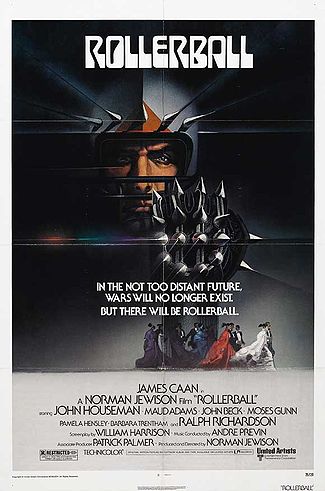
Mr. Bartholomew (played by John Houseman) in Rollerball, 1975
As a professor and lifelong learner, I see education as equal parts empowering and enlightening. Knowledge is power, as Francis Bacon said, and the lamp of learning helps to illuminate our lives.
But is education also about social control? Sadly, the answer is “yes.” Education that is simplified and standardized is often little more than indoctrination. Education that is too regimented, too centralized, too much like a factory, prepares students for a life of unquestioning obedience and unreflective conformity.
Authorities have often been keen to restrict or outlaw forms of knowledge that they see as undermining their privileges and power. Writing from Australia, Dr Teri Merlyn reminded me that:
There have been very direct, coordinated battles [against knowledge and reformers] – witness the censorship battles over Tom Paine’s ‘The Rights of Man’, when you could go to gaol for simply owning a copy, and the 19th Century ‘Church and King’ mobs sent to punish radical writers and publishers by burning down their houses … There are powerful social forces at work that have their self-interest at heart and see what they do in that context. Witness the great educator of the working class, Hannah Moore, writing to her Bishop at the turn of the 18th Century, assuring him whilst she was teaching these working class girls to read, sufficient for their service duties, they would never learn to write, for that would encourage them to aspire beyond their station.
Education today still largely teaches students to stay within their station. Today’s focus on vocational education is both salutary and one-dimensional. Students are told to get degrees as passports to a job. They’re not told to aspire to be skeptical citizens who dare to question (or even to supplant) authority.
And there’s the rub. We face difficult, seemingly intractable, problems in the world today. Global warming. Fossil fuel dependence. A widening gap between rich and poor. A military-industrial-intelligence complex that dominates our foreign policy as well as much of our domestic policy. Worrisome budget deficits. Unaffordable health care. The list goes on.
But our students are not being educated to address these challenges, at least not in any radical way, in the sense of getting to the roots of the problem.
Education, in essence, has largely become training, just another form of careerism. And the high student debt that many students incur in obtaining their “passport to success” ensures they are essentially indentured servants, forced to keep working to pay off their debt (and often to keep their health care benefits as well).
Even as students incur debt in the process of training for a career, higher education brags most loudly about its close ties to business and industry. Yet business and industry, as Teri Merlyn notes, “has effectively [outsourced] its responsibility to train its workforce, diverting that cost onto the public purse. In order to do that, it has infested educational language with its own terminology. The dominance of the Business Paradigm is now absolute.”
Just as college football is a feeder to the NFL, higher education is increasingly a feeder to business and industry. It’s a Rollerball world dominated by violent sports and corporate conglomerates.
Education, in short, has lost any sense of higher purpose. “Adapt to the world as you find it” is both the implicit and explicit message. And whatever you do, don’t rock the boat.
Part of the method is to destroy any sense of class identity among students. Today, virtually all my students self-identify as being members of the “middle class,” even though many are working class (just as I am a son of factory workers). In American society, we’ve lumped blue-collar with white-collar jobs, so that now janitors and fast-food workers (for example) think of themselves as middle class.
This is not to denigrate janitors or fast-food workers. Rather, it’s to highlight the calculated decline of class identity and solidarity in the U.S. If we’re all middle class, if we’re all bourgeois, why bother uniting in unions to fight for our rights? If we allegedly inhabit a post-class society of social mobility, education can then ignore ethical and societal questions of fairness to focus on workforce training and professional development.
As my Aussie correspondent, Dr Teri Merlyn, astutely noticed:
“That phenomenon of working class identity is a most unwilling one, so the strategy to co-opt the working class as nominal members of the owning class through the share and property markets was very successful. One might even suspect this recent ‘economic crisis’ [of 2008] as the ‘owners’ simply taking back what they see as rightfully theirs.”
Put differently, you can’t see you’re being screwed as a worker when you view yourself as an “owner” in your own right. And when you’re educated to conform, to produce the standard answer, to aspire to a respectable job (with your identity confined to that job), your consciousness will never be raised to challenge the system in any radical way.
In fact, your goal is to become the system, to reap its rewards for yourself, just as those that you now work for have done and are doing.
As we witness uprisings around the world, from Egypt to Greece to Brazil and elsewhere, we should ponder why there are not similar uprisings in the U.S. Is it because the U.S. really is, pardoning Voltaire, the best of all possible worlds? Or is it because our educational system immunizes us against any form of “socialism” (a curse word in American politics) or class consciousness?
Education, when it’s about getting the right answer that leads to the right job without ever questioning prevailing authority, becomes a status quo operation in social control.
To recognize that is not to surrender to it. Rather, it’s to begin to fight it.
As a history professor with a B.S. degree in mechanical engineering teaching at a technical college after 20 years’ service in the US Air Force, I’m sympathetic to education that connects to the world of doing, of making, of providing goods and services to consumers. Yet we must not allow education itself to become a consumable. When education becomes a commodity and students become consumers, the result is zombie education. Often characterized in practice by the mindless munching of digestible bits of disconnected PowerPoint factoids, zombie education leads to more mindless consumption of commodities after graduation, a result consistent with greed-driven capitalism, but not with ideal-driven democracy.
Mindless consumption is bad enough. But zombies are also mindless in political contexts, which is why totalitarian systems work so hard to create them as a preliminary to taking power. Think here of Hannah Arendt’s critique of Adolf Eichmann as a man devoured by the demands of his job (the extermination of the Jews in Europe), a cliché-ridden careerist who was unable to think outside the constraints of Nazi party ideology.
But let’s return to the economic bottom line. In his signature role as Gordon Gekko, Michael Douglas in Wall Street: Money Never Sleeps (2010) describes the latest generation of college graduates as NINJAs (no income, no jobs, no assets). Basically, they’re screwed, he says. This may even be true if you view a college diploma strictly as a passport to a vocation that pays well.
But true education is much more than that. True education is transformative. It’s soul-enriching and soul-engaging. It opens alternative paths to living that don’t begin and end at the workplace. It measures personal fulfillment in ways that aren’t restricted to take-home pay.
Higher education is (or should be) about enriching your life in terms that are not exclusively financial. It’s about the betterment of character and the development of taste. It’s about becoming a savvier citizen whose appreciation of, and dedication to, democracy is keener and more heartfelt.
And that’s precisely why it’s worthy of greater public funding. State and federal funding of higher education must be restored to previous levels precisely because an informed and empowered citizenry is the best guarantor of individual freedoms as well as communal well-being.
Education, in short, is not a commodity – it’s the commonwealth.
But today’s view of education is often narrowly focused on individual profit or vocational training or STEM (science, technology, engineering, mathematics), a bias that carries with it class-based strictures. Students are told it’s OK to be selfish but also that their role is to be consumers, not creators; conformists, not dreamers.
Powerful institutions at local, state, and federal levels share this bias. Educators currying favors from business and industry spout bromides about “competitiveness.” Business leaders address graduates and tell them the secrets to success in life are a positive attitude, punctuality and smart clothes.
If we view education as an ephemeral commodity in a world of goods, so too will our students. They’ll lump it together with all the other trivial, product-based, corporate-funded information with which they’re constantly bombarded. Critical thinking? Informed citizenship? Boring. And could you shut up a minute? I need to take this call/send this tweet/update my Facebook.
Staring vacantly into electronic gizmos as they shuffle to and from class, students are already halfway to joining the zombie ranks. Let’s not infect them further with commodity-based zombie education.
What is to be done? History is a guide. Consider the words of John Tyndall, eminent rationalist and promoter of science. In “An Address to Students” in 1868, or 145 years ago, Tyndall opined that:
“The object of [a student’s] education is, or ought to be, to provide wise exercise for his capacities, wise direction for his tendencies, and through this exercise and this direction to furnish his mind with such knowledge as may contribute to the usefulness, the beauty, and the nobleness of his life.”
Of course, back then such an education was reserved for young men. We congratulate ourselves today for including the “her” with the “his,” of promoting “diversity,” usually defined in racial or gender or ethnic terms.
But what about the diversity of a college education that embraces, not just hardheaded utility or the politics of identity, but ideals about the beauty and nobility of life? What about the fostering of judgment, the ability to go beyond prefabricated, binary thought processes of ideology to a form of thinking that can assess the value and significance of events, situations, and choices on their own terms?
But zombies don’t care about beauty or nobility. They’re not worried about making judgments, especially moral ones. All they want is to consume. Defined by their appetite, they are hollow people, easily led – and easily misled.
As long as we market education as a consumable, the zombies will come. They may even find ways to pay their tuition. Just don’t expect them to de-zombify upon graduation. Just don’t expect them to become noble citizens inspired by, and willing to stand up for, the beauty of true democracy.
A good friend of mine wrote to me the other day about an increasingly rare privilege he enjoyed, courtesy of a visitor from Europe. In my friend’s words,
Yesterday we had a friend visit from Europe. We sat from about 7 PM to midnight just talking about anything from personal or work problems to politics and the time just flew by… The contrast with the limited ability of the well-educated Americans we have met here to really discourse was astounding. Free discourse and examination of competing ideas is fundamental to democracy yet most Americans today consider it either “impolite” or “bad manners” to reveal themselves in even random conversations. Most Americans have decided to live in a black or white world, not the grey that is the reality.
Imagine that! My friend’s European guest demonstrated both the ability to reason, distinguishing facts from theories and conjecture, as well as tolerance, the ability to entertain other points of view, even when they disagree with your own.
Remember when Americans enjoyed the cut and fray of conversation, the pleasure of minds working hard to shed light on difficult matters? Just as our bodies prosper from demanding physical chores, so too do our minds.
Sadly, discourse in the USA today, such as it is, is mostly polarized. It’s I’m right and you’re wrong, and the way I prove it is to outshout you. This is one reason why otherwise thoughtful people tend to avoid protracted or revealing conversations. What’s the point, when all the other person wants to do is to cow you, condemn you, or convert you?
That said, Americans are slowly losing the ability to converse, for lots of different reasons. Young people are educated indoctrinated to get a job, with “success” measured by their pay and benefits. They place little value on becoming educated, informed, critical thinkers. They’re constantly distracted by various electronic devices and video games, and constantly bombarded with trivial information masquerading as meaningful news.
Immersion in the trivial stifles creative discourse and is an ever-present threat, as Alexandr Solzhenitsyn warned us 35 years ago:
People also have the right not to know, and it is a much more valuable one. The right not to have their divine souls stuffed with gossip, nonsense, vain talk. A person who works and leads a meaningful life does not need this excessive burdening flow of information.
Solzhenitsyn
A large part of leading a meaningful life is healthy communal discourse. But our society no longer sees discourse — the true exchange of ideas — as valuable. You can’t put a dollar figure on it, you can’t sell advertising for it, you can’t assign a metric to it, so just abandon it.
Writing skills are also degenerating. My students have difficulty sustaining an argument in print. They have difficulty in conversing intelligently on a range of subjects. They can’t distinguish facts from propaganda, or they prefer to deny facts that disagree with their received opinions. And they are tainted by me-first American exceptionalism.
And it’s only gotten worse since 9/11. As my friend noted, “On top of the social attitudes of feeling that conversation on serious topics is outré, the post 9/11 suppression of free speech has had a devastating effect on private discussion of national politics.”
In these times of conformity and confusion and complicity with power, we need thoughtful and contrarian discourse more than ever.
Come, let us reason together. And let’s not be afraid of heated discussion. A controlled burn can stop the most raging wildfire in the mind. We all need to burn more brightly to shed the light that is the essence of an active mind and a thriving democracy.





 Bracing Views