
Remember When the Balanced Budget Amendment Was A Thing?

$37 Trillion in Debt and Counting

BILL ASTORE

JUN 30, 2025

With the U.S. national debt sitting at $37 trillion, it’s hard to imagine a time when Congress argued for a balanced budget amendment to the Constitution. Remember when Republicans had a reputation for fiscal conservatism?

According to the non-partisan CBO, President Trump’s big beautiful bill will add another $3.3 trillion in debt over the next decade. At the same time, the bill cuts health care to poor people. This from the New York Times:

G.O.P. Bill Has $1.1 Trillion in Health Cuts and 11.8 Million Losing Care, C.B.O. Says

Analysis from the nonpartisan Congressional Budget Office found that Republicans’ new version of the legislation would make far deeper cuts and lead to more people becoming uninsured than previous proposals.

Who needs health insurance, am I right?

Yearly interest on the national debt is now higher than the Pentagon budget, which is truly saying (and spending) a lot.
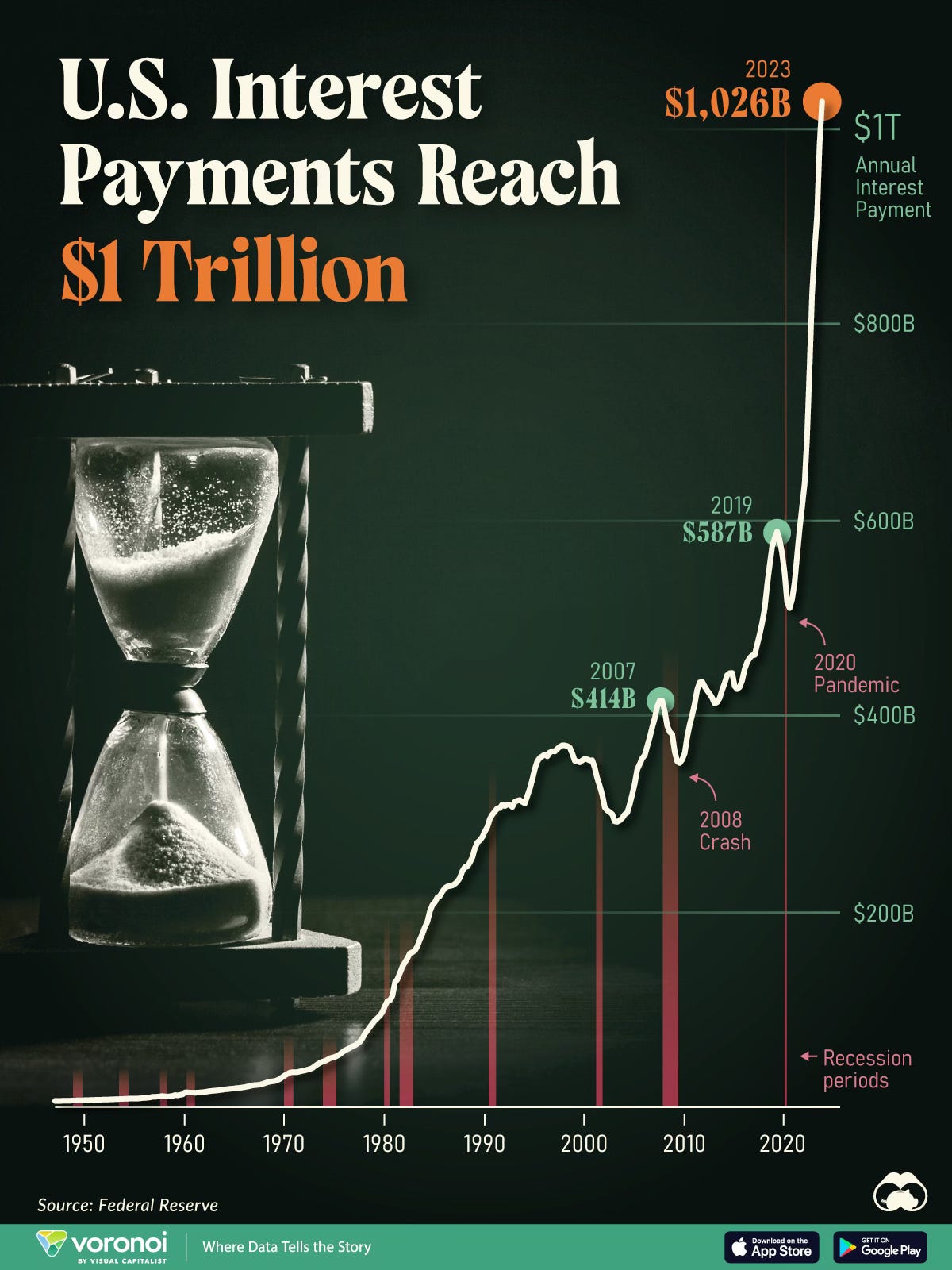
Where is all the money going? Leaving aside the cost of servicing the national debt, most of discretionary spending goes to the Pentagon, Homeland Security, and similar forces of aggression and repression. New nuclear weapons, for example, may cost $2 trillion over the next 30 years. A misnamed “golden dome” (leaky sieve is more accurate) allegedly to protect America against nuclear missile attacks may cost $500 billion or more over the next decade or two. And nothing costs as much as foreign wars, as we learned from the disastrous Iraq and Afghan Wars, which may end up adding $8 trillion to the national debt when all the bills come due.

While achieving a balanced budget isn’t easy, there are two easy ways to come closer:

  1. Tax the rich.
  2. Stop making war, downsize the empire, and focus the U.S. military on national defense and defense alone.

Option (1) is out since the rich own the government. (Welcome to Plutocracy USA.) Option (2) is also out since the military-industrial-congressional complex is the fourth branch of government and arguably the most powerful. All presidents appease it, whether their names are Bush or Biden, Obama or Trump.

So, Congress and the President do what they always do: Serve the rich and kowtow to the MICC, the National (In)Security State. Any “balancing” to be done with the federal budget will be done on the tired backs of the poor and disadvantaged. They have no lobbies, no money, no say.

Can the working classes pull America up by their collective bootstraps? America’s workers have achieved miracles before, but this is too big of an ask even for them.
Divided, Distracted, Downtrodden: The Social and Political Reality in America Today

Consumerism1

W.J. Astore

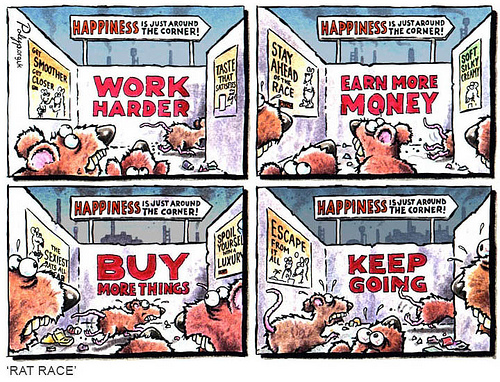
The American people are being kept divided, distracted, and downtrodden.  Divisions are usually based on race and class. Racial tensions and discrimination exist, of course, but they are also exploited to divide people.  Just look at the current debate on the Confederate flag flying in Charleston, South Carolina, with Republican presidential candidates refusing to take a stand against it as a way of appeasing their (White) radical activist base.  Class divisions are constantly exploited to turn the middle class, or those who fancy themselves to be in the middle class, against the working poor.  The intent is to blame the “greedy” poor (especially those on welfare or food stamps), rather than the greedy rich, for America’s problems.  That American CEOs of top companies earn 300 times more than ordinary workers scarcely draws comment, since the rich supposedly “deserve” their money.  Indeed, in the prosperity Gospel favored by some Christians, lots of money is seen as a sign of God’s favor.

As people are kept divided by race, class, and other “hot button” issues (abortion and guns, for example), they are kept distracted by insatiable consumerism and incessant entertainment.  People are told they can have it all, that they “deserve it” (a new car, a bigger home, and so on), that they should indulge their wants.  On HGTV and similar channels, people go shopping for new homes, carrying a long list of “must haves” with them.  I “must have” a three-car garage, a pool, a media room, surround sound, and so on.  Just tell me what mortgage I can afford, even if it puts me deeply in debt.  As consumerism runs rampant, people are kept further distracted by a mainstream media that provides info-tainment rather than news. Ultimately, the media exists to sell product; indeed, it is product itself.  No news is aired that will disturb the financial bottom line, that will threaten the corporations that run the media networks, that will undermine the privileged and the powerful.

The people, kept divided and distracted, are further rendered powerless by being kept downtrodden.  Education is often of poor quality and focused on reciting rote answers to standardized tests.  Various forms of debt (student loan debt, credit card debt, debt from health care and prescription drugs costs, and so on) work to keep the people downtrodden.  Even workers with good jobs and decent benefits are worried.  Worried that if they lose their jobs, they lose their health care. So much of personal status and identity, as well as your ability to navigate American society, is based on your position.  For many it’s lose your job, lose your life, as you’re consumed by debt you can’t repay.

Divided, distracted, and downtrodden: It’s a recipe for the end of democracy in America.  But it also serves as a roadmap to recovery.  To reinvigorate our democracy, we must fight against divisiveness, we must put distractions behind us, and we must organize to fight for the rights of the people, rights like a better education for all, less debt (a college education that’s largely free, better health care for everyone, and far less emphasis on consumerism as a sign of personal and societal health and wealth), and improved benefits for the workers of America, who form the backbone of our nation.

We can’t wait for the politicians.  Most of them are already co-opted by the moneyed interests.  Meaningful change will have to come from us.  That is, after all, the way democracy is supposed to work.