The USA No Longer Sees Freedom and Liberty as Core Strengths

liberty-tree1
Why are we so intent on chopping it down?

W.J. Astore

In the crusade against Communism, otherwise known as the Cold War, the U.S. saw “freedom” as its core strength.  Our liberties were contrasted with the repression of our chief rival, the USSR.  We drew strength from the idea that our system of government, which empowered people whose individualism was guided by ethics based on shared values, would ultimately prevail over godless centralism and state-enforced conformity.  An important sign of this was our belief in citizen-soldiers rather than warriors, and a military controlled by democratically-elected civilians rather than by dictators and strong men.

Of course, U.S. foreign policy during the Cold War could be amoral or immoral, and ethics were often shunted aside in the name of Realpolitik.  Even so, morality was nevertheless treated as important, and so too were ethics.  They weren’t dismissed out of hand.

Fast forward to today.  We no longer see “freedom” as a core U.S. strength.  Instead, too many of us see freedom as a weakness.  In the name of defeating radical Islamic terrorism, we’ve become more repressive, even within the USA itself.  Obedience and conformity are embraced instead of individualism and liberty.  In place of citizen-soldiers, professional warriors are now celebrated and the military is given the lion’s share of federal resources without debate.  Trump, a CEO rather than a statesman, exacerbates this trend as he surrounds himself with generals while promising to obliterate enemies and to revive torture.

In short, we’ve increasingly come to see a core national strength (liberty, individualism, openness to others) as a weakness.  Thus, America’s new crusades no longer have the ethical underpinnings (however fragile they often proved) of the Cold War.  Yes, the Cold War was often unethical, but as Tom Engelhardt notes at TomDispatch.com today, the dirty work was largely covert, i.e. we were in some sense embarrassed by it.  Contrast this to today, where the new ethos is that America needs to go hard, to embrace the dark side, to torture and kill, all done more or less openly and proudly.

Along with this open and proud embrace of the dark side, America has come increasingly to reject science.  During the Cold War, science and democracy advanced together.  Indeed, the superior record of American science vis-à-vis that of the Soviet Union was considered proof of the strength and value of democracy.  Today, that is no longer the case in America.  Science is increasingly questioned; evidence is dismissed as if it’s irrelevant.  “Inconvenient truths” are no longer recognized as inconvenient — they’re simply rejected as untrue.  Consider the astonishing fact that we have a president-elect who’s suggested climate change is a hoax perpetrated by China.

Yesterday, I saw the following comment online, a comment that summed up the new American ethos: “Evidence and facts are for losers.”  After all, President-elect Trump promised America we’d win again.  Let’s not let facts get in the way of “victory.”

That’s what a close-minded crusader says.  That the truth doesn’t matter.  All that matters is belief and faith.  Obey or suffer the consequences.

Where liberty is eroded and scientific evidence is denied, you don’t have democracy.  You have something meaner.  And dumber.  Something like autocracy, kleptocracy, idiocracy.  And tyranny.
The Calamitous 21st Century

tuchman

W.J. Astore

We’re only sixteen years into the 21st century, but it seems like a “best of times, worst of times” kind of epoch.  It’s the best of times for the aristocracy of the rich, and the worst of times for the poor and disadvantaged, especially when they live close to or in war zones.

Perhaps that’s a statement of the obvious, except the gap between the richest and poorest continues to grow.  Their worlds, their realities, are so different as to be virtually disconnected.  This is a theme of several recent science fiction films, including the “Hunger Games” series (the Capitol versus the Districts) and “Elysium,” in which the privileged rich literally live above the sordid earth with its teeming masses.

Some of the big fears of our present century include the emergence of a “super bug,” a contagion that is highly resistant to traditional drugs.  We’ve overused antibiotics and are slowly breeding new strains of bacteria that modern medicine can no longer defeat.  Meanwhile, many people in the U.S. still lack health care, or they’re reluctant to use it because it’s too expensive for them.  And then there are the workers who lack sick leave.  They force themselves to go to work, even when sick, because they need the money.  How long before inadequate health care and sick workers facilitate the conditions for the spread of a plague?

And then there’s the contagion of violence and war.  America’s wars in places like Iraq, Afghanistan, and Africa are basically open-ended.  They are today’s version of the “Hundred Years’ War” between England and France, an on-again, off-again struggle for dominance that sprawled across two centuries.  In fact, America’s “war on terror,” with its “surgical strikes” and reliance on technology as a quasi-panacea, seems to be breeding new types of “super-bug” terrorists who are highly resistant to traditional techniques of policing and war.

In this effort, one thing is certain: No U.S. president will be declaring “peace” or even “normal” times for the next decade or two (or three).

Finally, let’s not forget global warming.  The Pentagon and the CIA haven’t.  Republicans may have their share of climate change deniers, but when it comes to the U.S. national security state, contingency plans are already in place for the disasters awaiting us from global warming.  Competition for scarce resources (potable water especially, but food and fuel as well) combined with more intense storms, widespread flooding, and much warmer temperatures, will generate or aggravate wars, famines, and plagues.

Are we living in a failed or failing world?

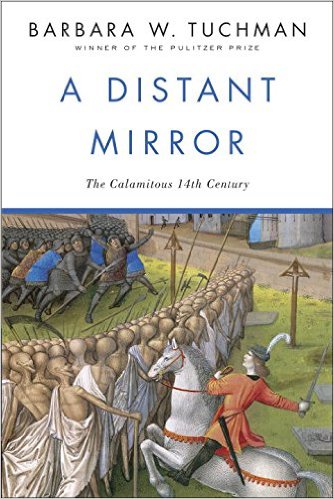
In “A Distant Mirror,” the historian Barbara Tuchman wrote about the calamitous 14th century of plagues and wars and a mini-ice age in the northern hemisphere. We seem to be facing a calamitous 21st century of plagues and wars and a mini-hothouse age.  It’s a grim prospect.

The question is: Can we act collectively to avert or avoid the worst of these calamities?  Or are we fated to dance our very own 21st-century danse macabre?

Two Big Reasons Not to Vote for Trump

May 29, 2016
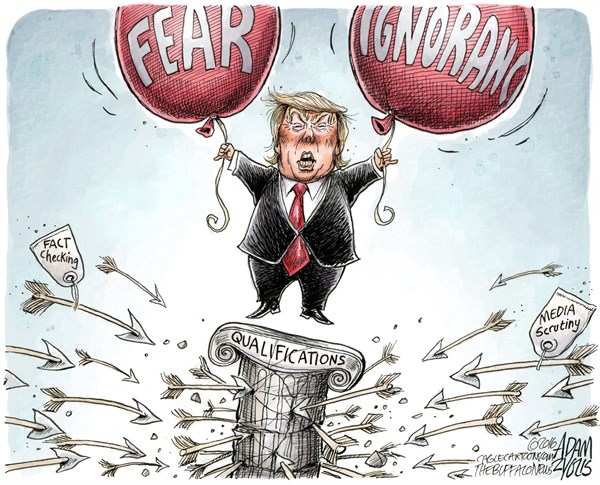
Fear his ignorance

W.J. Astore

Nuclear proliferation and global warming are two big issues that Donald Trump is wrong about.  They’re also the two biggest threats to our planet.  Nuclear war followed by nuclear winter could end most life on earth within a matter of weeks or months.  Global warming/climate change, though not as immediate a threat as nuclear war and its fallout, is inexorably leading to a more dangerous and less hospitable planet for our children and their children.

What does “The Donald” believe?  On nuclear proliferation, which only makes nuclear war more likely, Trump is essentially agnostic and even in favor of other nations joining the nuclear club, nations like Japan, South Korea, even Saudi Arabia.  When all countries should be earnestly working to reduce and then eliminate nuclear stockpiles, Trump is advocating their expansion.  (An aside: recall in a previous debate that Trump had no idea what America’s nuclear triad is; add intellectual sloth to his many sins.)

On global warming, Trump is essentially a skeptic on whether it exists (“hoax” and “con job” are expressions of choice), even as he seeks to protect his resorts from its effects. Along with this rank hypocrisy, Trump is advocating an energy plan that is vintage 1980, calling for more burning of fossil fuels, more drilling and digging, more pipelines, as if fossil fuel consumption was totally benign to the environment and to human health.

Along with his tyrannical and fascist tendencies, Trump is wrong on two of the biggest issues facing our planet today.  His ignorance and recklessness render him totally unfit to be president.