The scary part is that the official death toll of 76,134 is an undercount. So many bodies remain under rubble or just plain obliterated by bombs.
Of course, the so-called cease fire in Gaza is anything but as Israel continues its policy of not-so-selective killing and slow strangulation. If you suggest genocide is wrong, the predictable response from the Israeli-U.S. government is that you’re a Hamas terrorist sympathizer and probably an anti-Semite as well (the latter is true even if you’re Jewish).
Coincidentally, I just took a drink after typing that and started choking. OK, maybe that wasn’t a coincidence.
I remember during Catholic service we’d sing the hymn: “Whatsoever you do to the least my brothers, that you do unto me.” I guess they’re just empty words to all those avowed Christians in the government.
Back in June of 2023, I wrote a letter to my archdiocese in response to a request for money. (I am a lapsed Catholic who has in the past given money to the Church.) Here is the letter I wrote, with some follow-on thoughts:
*****
June 2023
Most Reverend ***
Archdiocese of Boston
Dear Reverend ***
I received your Catholic Appeal funding letter dated June 1st. I won’t be contributing…
[Well into the 1990s,] I took my Catholic faith seriously; in fact, my master’s thesis at Johns Hopkins, which examined Catholic responses to science in the mid-19th century, especially Darwinism, geology, and polygenism, was published in the Catholic Historical Review. But scandals involving the Church drove me to question my commitment to Catholicism and especially its patriarchal hierarchy, which was so intimately involved in the coverups of crimes committed against innocents.
I grew up in Brockton, Mass., where the archdiocese assigned a predatory priest to our church of St. Patrick’s. His name was Robert F. Daly. He abused minors and was eventually defrocked by the Church, but far too late. (See the Boston Globe, 6/14/11.)
When I attended St. Patrick’s in the 1970s, Father Daly was teaching CCD. A sexual predator was attempting to teach young people the meaning of Christian love. He had a decent definition for love, something like “giving, without expecting anything in return.” Selfless love, I suppose. Tragically, he obviously failed catastrophically to practice what he preached.
Fortunately, I was never abused. I was supposed to have one meeting with him, alone, that was cancelled at the last minute. I’d like to imagine God was looking out for me on that day, but that’s absurd. Why wasn’t God looking out for all those children abused by Catholic clergy like Father Daly?
To be blunt, I am thoroughly disgusted by the moral cowardice of the archdiocese in confronting fully its painful legacy of failing to protect vulnerable children against predatory priests like Father Daly. Shame on the Church.
The Bible says that all sins may be forgiven except those against the Holy Spirit. This is supposed to refer to a stubborn form of blasphemy. Yet I truly can’t think of a worse sin committed by the Church than to allow innocent children to suffer at the hands of predators disguised as “fathers.”
I sincerely hope you are doing something to change the Church, to reform it, to save it. I fear the Church has not fully confessed its sins, and in that sense it truly does not deserve absolution from the laity. Far too often, the Church has placed its own survival ahead of Truth, ahead of Christ as the Way and the Truth, and thus the Church has washed its hands of its crimes, as Pontius Pilate did.
I am staggered by this betrayal.
Perhaps you have truly fought to reform the Church. If you have not yet done so, perhaps you will soon find the moral courage. I pass no judgment on you. Judge not, lest you be judged. But I do find the Church to be wanting.
Recalling scripture, if the Church does not abide in Christ, should it not be cast into the fire and be consumed?
I am sorry to share such a bleak message with you. I find the Church’s decline to be truly tragic because we need high moral standards now more than ever. Yet the Church is adrift, consumed by petty concerns and obedience to power. Just one example: The U.S. Church cannot even clearly condemn the moral depravity of genocidal nuclear weapons!
I realize I am seriously out of step with today’s Catholic church. I believe priests should be able to marry if they so choose. I believe women who have a calling should be ordained as priests. I believe the Church’s position on abortion is absolutist and wrong. More than anything, I believe the Church is too concerned with itself and its own survival and therefore is alienated from the true spirit of Christ, a spirit of compassion and love.
Unlike you, I cannot in good conscience claim to be “devotedly yours in Christ.” But I am sincere in wishing you the moral courage you will need to manifest your devotion in directions that will help the least of those among us the most. For I well recall the song we sang in our youth: Whatsoever you do for the least of my brothers, that you do unto Me.
Sincerely yours
*****
I’m happy to say I get a thoughtful response from a local bishop, who assured me the Church was serious about reform, was doing all that it could to eliminate pedophilia and to punish those who were guilty of it, and that therefore the Church no longer needed outside policing.
It was the last statement that puzzled me. The Church disgraced itself precisely because it had swept decades of crimes under the rug. Hadn’t the Church learned that earnest attempts at reform by insiders were necessary but not sufficient?
So I wrote back these comments to the bishop:
I will say this as well: I don’t think the Church can police itself from within. That’s what produced the scandals to begin with. It’s like asking the Pentagon to police itself, or police forces with their “internal affairs” departments.
The Church has to open itself to being accountable to the laity, not just to reformers like yourself. Thus the Church has to cede power and a certain measure of autonomy, and institutions are loath to do this, for obvious reasons. Meanwhile, the Church is being weakened by lawsuits, as people seek compensation (and perhaps a measure of vengeance) for sins of the past.
Skeptics would reply that it took a huge scandal with major financial implications to force the Church to do the right thing.
For too long, the Church tolerated these crimes. The Church is hardly unique here. Think of sexual assaults within the military (notably during basic training), or think of the Sandusky scandal at Penn State, where Joe Paterno clearly knew of (some) of Sandusky’s abuse, yet chose not to take adequate action. (I was at Penn College when that scandal broke.)
The challenge, as you know, is that the Church is supposed to be a role model, an exemplar of virtue. Priests hold a special place of trust within communities and are therefore held in especially high regard.
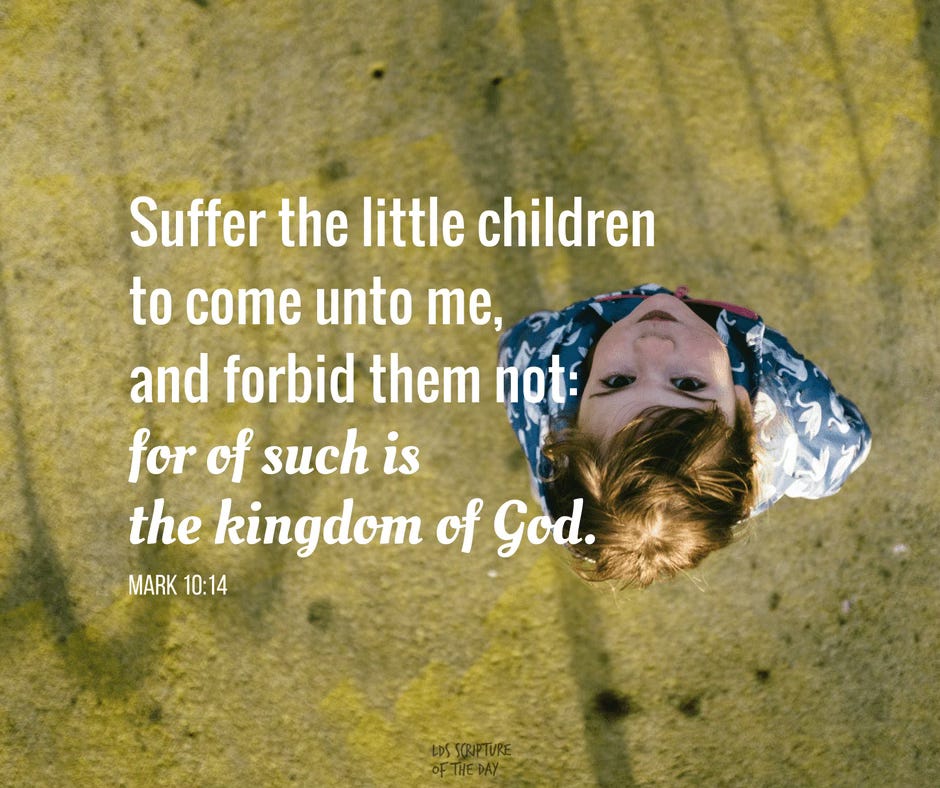
Image courtesy of the Mormon (LDS) Church
As my older brother-in-law explained to me, if a young boy or girl accused a priest of assault in the 1950s or 1960s, few if any people would have believed them. Indeed, the youngster was likely to be slapped by a parent for defaming a priest. That moral authority, that respect, was earned by so many priests who had done the right thing, set the right example. It was ruined by a minority of priests who became predators and a Church hierarchy that largely looked the other way, swept it under the rug, or otherwise failed to act quickly and decisively.
As you say, the Church has learned. It is now better at policing itself. The shame of it all is that it took so much suffering by innocents, and the revelations of the same and the moral outrage that followed, to get the Church to change.
*****
Friends of mine who are still firm believers tell me, correctly, that the Church is much more than the hierarchy. It certainly shouldn’t be defined by the grievous sins of a few. Still, I can’t bring myself to rejoin a Church that so grievously failed the most innocent among us.
There’s a passage in the New Testament where Christ says: “Suffer little children to come unto me.” As in, let the children come, I will bless them, for they in their innocence and humility are examples to us all. He didn’t teach, let the children suffer, molest them and exploit them, then cover it all up.
I still have respect for priests who exhibit the true fruits of their calling. I still find the teachings of Christ to be foundational to my moral outlook. But I find the Church itself to be unnecessary to the practice of my faith, such as it is. I do hope the Church truly embraces transparency and service; I hope it recalls as well its need to preach life and love and peace, as we need these now more than ever.
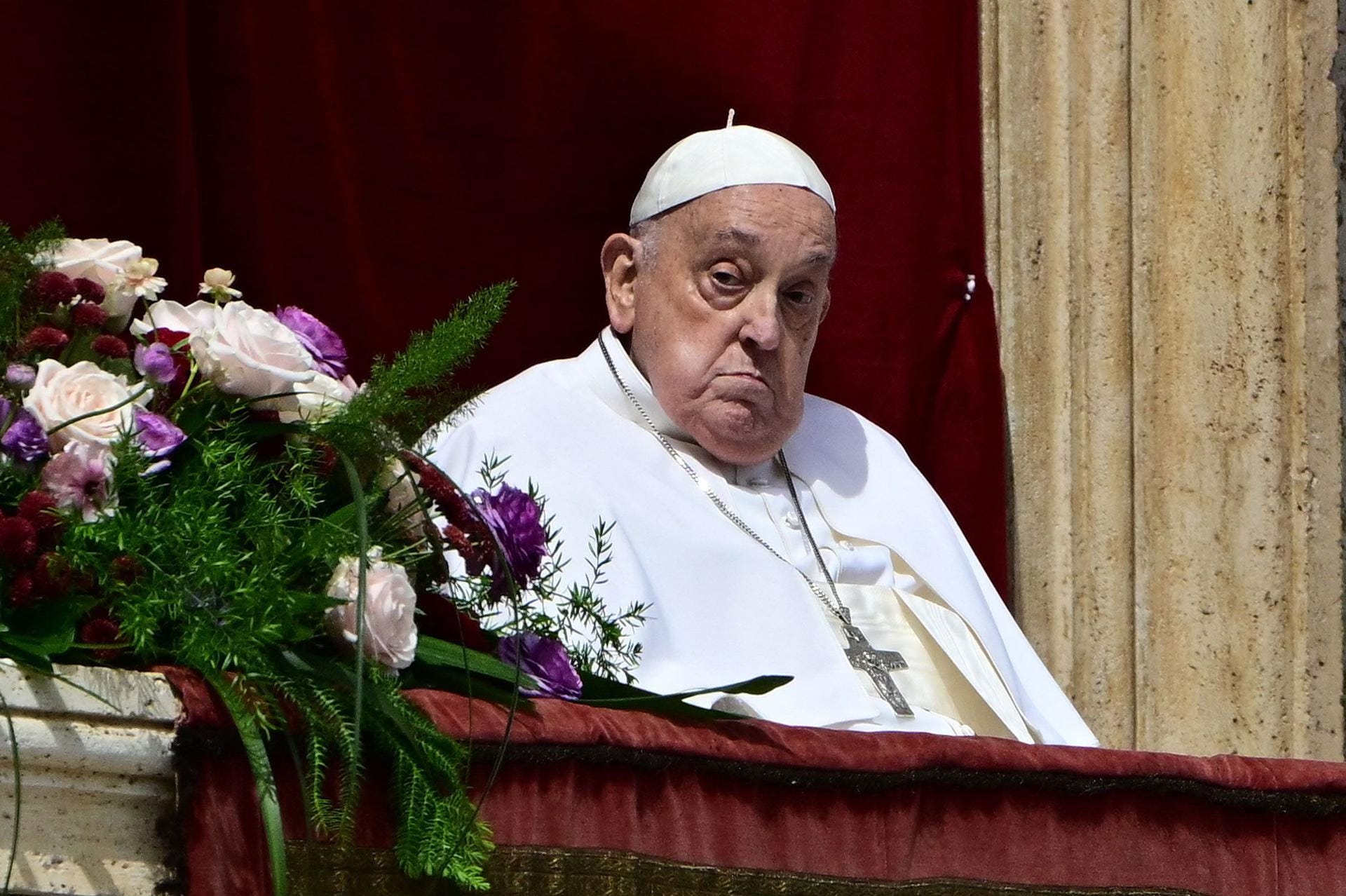
I woke to the news that Pope Francis had died at the age of 88. Francis had qualities that I admired, including his lack of pomp and his support of the disadvantaged. As Caitlin Johnstone notes, Francis was an advocate for the Palestinians. He was known as a “liberal” pope, so my guess is that we’ll soon see an old-school conservative elected as the new pope.
Pope Francis (Tiziana Fabi/AFP/Getty Images)
I was raised Catholic, getting confirmed back in 1979, but I’m very much a lapsed one today. I think the Church should allow female priests and should not persist in upholding chastity for the hierarchy. I think the Church should speak out far more strongly against genocidal nuclear weapons and warfare in general. I think the Church should use its great wealth and power to ease the suffering of people around the world. And I know all this is not going to happen in an institution dedicated to its own survival.
There are, of course, many “good” priests, “good” sisters, committed to charity and guided by the teachings of Christ, but those who are bumped upstairs, who become the bishops and cardinals of the Church, are often those who are most committed to the trappings of power. They are the most political, the most worldly, the most vulnerable to vainglory and sin, especially the sin of pride and the lust for power.
Perhaps a new pope will carry on the legacy of Francis, but something tells me that the College of Cardinals is going to coalesce behind a traditionalist, a symbol of orthodoxy. There will be no Vatican III, no fresh opening of the Church, no revolutionary spirit.
After Francis I see regression, not reformation, and it makes me sad to type that.
Too many Church positions trouble me, as does the awful legacy of sexual abuse
I was raised Catholic and attended church well into my twenties until I began to lose interest in the ritual and repetition. Still, I did my master’s thesis on American Catholic responses to evolution, polygenism, and geology in the 19th century, a version of which was published when I was in my early thirties. To this day, I continue to read the New Testament and am still inspired by the teachings of Jesus Christ. As a popular ad campaign puts it, He (Jesus Christ) gets us. Or at least he gets me, or I get him.
Yet I am seriously out of step with today’s Catholic church. I believe priests should be able to marry if they so choose. I believe women who have a calling should be ordained as priests. I believe the Church’s position on abortion is absolutist and wrong. More than anything, I believe the Church is too concerned with itself and its own survival and therefore is alienated from the true spirit of Christ, a spirit of compassion and love.
Yes, I still have a rosary
Scandals involving the Church contributed to my loss of commitment to the Church and especially its patriarchal hierarchy, which was so intimately involved in the coverups of crimes committed against innocents. The betrayal struck close to home. In my hometown, the Church assigned a known predatory priest. His name was Robert F. Daly. He abused minors and was eventually defrocked by the Church, but far too late and more than thirty years after his abusive behavior.
Fortunately, I was never abused. I had a scheduled meeting with him, alone, when I was about fifteen, but fortunately it was cancelled at the last minute. So many other children and teens were not so fortunate. To be blunt, I remain thoroughly disgusted by the moral cowardice exhibited by the Church in confronting fully its painful legacy of failing to protect vulnerable children against predatory priests. Shame on the Church.
The Bible says that all sins may be forgiven except those against the Holy Spirit. This is supposed to refer to a stubborn form of blasphemy. Yet I truly can’t think of a worse sin committed by the Church than to allow innocent children to suffer at the hands of predators disguised as “fathers.”
I have written to the Church and have heard from prominent leaders that the Church takes these crimes seriously and can now police itself in the matter of predatory priests. I’m sure these officials are sincere, but the idea of a self-policing church is a self-serving one.
As I wrote to one Catholic bishop, who assured me the Church now “gets it”:
Skeptics would reply that it took a huge scandal with major financial implications to force the Church to do the right thing.
For too long, the Church tolerated these crimes. The Church is hardly unique here. Think of sexual assaults within the military (notably during basic training), or think of the Sandusky scandal at Penn State, where Joe Paterno clearly knew of (some) of Sandusky’s abuse yet chose not to take adequate action. (I was at Penn College when that scandal broke.)
The challenge, as you know, is that the Church is supposed to be a role model, an exemplar of virtue. Priests hold a special place of trust within communities and are therefore held in especially high regard.
As my brother-in-law, who’s now 76, explained to me, if a young boy or girl accused a priest of assault in the 1950s or 1960s, few if any people would have believed them. Indeed, the youngster was likely to be slapped by a parent for defaming a priest. That moral authority, that respect, was earned by so many priests who had done the right thing, set the right example. It was ruined by a minority of priests who became predators and a Church hierarchy that largely looked the other way, swept it under the rug, or otherwise failed to act quickly and decisively.
As you say, the Church has learned. It is now better at policing itself. The shame of it all is that it took so much suffering by innocents, and the revelations of the same and the moral outrage that followed, to get the Church to change.
I’m encouraged by the example set by Pope Francis and especially his commitment to peace, but I don’t believe I will ever be a practicing Catholic again. Too many church policies still trouble me, as does the awful legacy of the sexual abuse scandal.
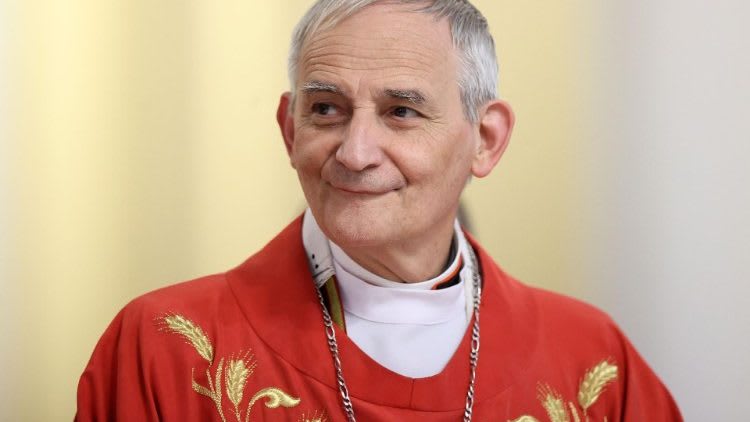
There is a famine of peace in the world today. I came across that phrase, “famine of peace,” in an article in the New Yorker that reported on a papal envoy sent to advocate for a truce and diplomacy to President Joe Biden. Biden, a practicing Catholic, gave the envoy a hearing, but as yet I’ve heard no change from the White House with respect to sending more weapons to Ukraine and maximum support for the war effort.
Pope Francis, working for peace, is exactly what I’d expect from Christ’s representative here on earth. Indeed, it is what I’d expect from all Christians everywhere. Yet we continue to have a glut of war in the world, with plenty of war pigs feeding at the trough.
Cardinal Matteo Maria Zuppi brought a message of peace to President Biden.
I’m a lapsed Catholic, but I have nothing but respect when the Church does its best to embody, obey, and manifest Christ’s two commandments: love God, love thy neighbor. Being faithful to these commandments is everything for Christians.
War is a terrible sin that enables and empowers so many other sins. Meanwhile, a famine of peace and a glut of war means terrible suffering for the world’s most vulnerable. War is thus to be avoided or averted under nearly all circumstances; indeed, Christ implored us to turn the other cheek when we are struck.
I’ve read enough “just war” theory to see how almost any war can be twisted as “defensive” and “necessary.” And I believe in rare circumstances the evil of war may be necessary to stop or prevent even worse evils, e.g. World War II put a stop to Nazi domination and the enslavement and massacre of millions of people, most especially Jews and gypsies, among other “undesirables” and “lesser humans” according to Nazi ideology.
The Pope in those days, Pius XII, did not speak forcibly enough to condemn the crimes of the Nazis. In Francis it is good to have a pope who’s willing to speak of today’s famine of peace. All Christians everywhere should look within to consider why peace is dying and war is thriving. Under these conditions, if we fail to act, do we dare even call ourselves “Christian”?
Despite the possibility that what a deranged Vladimir Putin planned as a small war against Ukraine could morph into a nuclear catastrophe capable of engulfing us all, the United States is still the most warlike nation on earth.
Wars don’t come cheap these days, so it shouldn’t come as a surprise that the only truly non-partisan issue in Congress is the Pentagon budget. Democrats and Republicans alike, neither of whom expect to get shot at, vie with one another to show how resolute they are in keeping America strong no matter what the cost, even in human lives, though preferably those of foreigners.
The Pentagon budget, now creeping toward $800 billion, is more than three times that of China, our closest rival, a country that had the effrontery to build an aircraft carrier of its very own to challenge our eleven. The generosity of Congress enriches people who in the 1930s were stigmatized as “merchants of death,” but the latter have since learned the value of public relations. America’s military-industrial complex, as might be expected, led the way in recruiting the very best PR talent. The war to liberate Kuwait (Desert Storm) came to us thanks in part to the creativity of Hill & Knowlton (known in the trade as the Torture Lobby). Wars have persisted even as critical domestic problems continue to go unaddressed, such as American school children suffering brain damage due to lead-contaminated drinking water.
There is something immoral about all this. To be fair, the Catholic Church in the United States, for which morality is presumed to be a major concern despite some very public failings, does take notice of war now and then. Or rather it used to. It hasn’t done so lately.
The United States Council of Catholic Bishops meets twice a year, which you’d think would give a troubled bishop the opportunity to call into question the morality of much of what our armed forces have been up to. But you’d think wrong. Successive cliques of ill-educated, narrow-focused reactionaries—Burke, Gomez, Lori, Cordileone, Kurtz, and Dolan the most prominent among the current crop—have succeeded in keeping the topic of war off the agenda for more than thirty years. Nor have they seemed to have had much trouble doing so.
Recently, however, two bishops have spoken up in their own dioceses. Bishop Stowe of Lexington and Archbishop Wester of Santa Fe have pleasantly surprised Catholics like me by issuing pastoral letters calling for the abolition of nuclear weapons. Unfortunately, my pleasure is diminished by the realization that such efforts, however welcome, will do little to stave off a nuclear Armageddon after which, in the words of Nikita Khrushchev, the living will envy the dead.
The Vatican—even during the imperious reign of John Paul II, whose attention was fixed upon restoring freedom to his native land (which is now on the road to dictatorship)—has been forever calling for nuclear disarmament. But how has it called? In what tone of voice? That’s the key question.
Forty years ago, and far too long after the nuclear massacres of Hiroshima and Nagasaki—atrocities that the Catholic Church in America, like its government, has yet to condemn—the bishops of the United States, prodded, I’m sure, by Ronald Reagan’s missile-rattling rhetoric, surprised everybody by announcing that they were going to prepare a pastoral letter on war.
The deliberations of the committee, headed by Cardinal Bernardin of Chicago, got off on the wrong foot when Bernardin was forced to announce at the first meeting that they were by no means to condemn the possession of nuclear weapons, an edict from Rome that slammed the door in the face of the Holy Spirit, whose guidance they presumably would be imploring.
But the bishops labored on and brought forth “The Challenge of Peace.” It was a good but compromised document. Not compromised enough, however, for John Paul II and Cardinal Joseph Ratzinger. After the first draft was scrutinized in Rome, Bernardin and Archbishop John Roach, chairman of the U.S. Council of Bishops, were called on the carpet in Rome to defend it to the “NATO bishops” (a Vatican dicastery previously unknown to me), who were more concerned about a Soviet armor thrust through the Fulda Gap than anything that Jesus might have said.
Bernardin and Roach duly met with their critics, and the NATO bishops came away content. The concessions were major. One, for example, was purging a declaration of “no first use” of nuclear weapons in response to an attack with conventional weapons. The first draft had not done anything quite so bold. It merely proposed that any circumstances in which a first use would be morally acceptable would be difficult to imagine. Well: Ratzinger and the NATO bishops had no problem imagining one.
When the final version of The Challenge of Peace came out in May of 1983, the Pentagon, which had been a bit worried, and hawks everywhere—especially devout Catholic hawks like William F. Buckley Jr—breathed a sigh of relief. It was obvious to all who cared to read it that the bishops had waffled. With all due modesty—well, some anyway—the title of a subsequent article of mine in Commonweal, “Sidestepping The Challenge of Peace,” summed it up. (Commonweal disagreed with me, and still does, but that’s another story.)
Whatever the case, the Peace Pastoral is gone and forgotten, a failure that casts a pall to this day over subsequent (and toothless) Vatican statements on how nice peace is and how bad war is.
What do I want the Church to do? Let me quote somebody else, somebody who answered that question far better than I ever could.
In 1948 the Dominicans of Paris invited Albert Camus to address them about what he and other non-believers wanted to hear from the Catholic Church in the wake of the horrors of World War II, their hope being that they could unite to confront the horrors that yet impended.
Camus, who described himself and others like him as “isolated individuals,” was quite willing to challenge the Church. He did not share the beliefs of the Dominicans, he said, but neither did he dismiss them. He recounted how during the war he, even as a non-believer, had looked to Rome. He wanted to hear a “great voice” raised to condemn the monstrous evil of the war, but he failed to hear it. There were those who said that they had heard it, but what little the world heard from Rome was the Church speaking in what he dismissed, not without cause, as its “encyclical voice,” a form of speech that was prolix, abstract, and devoid of inspiration for all those not attuned to it. (The word “Jew,” incidentally, did not make the cut.)
The Dominicans wanted to know what the world expects of Christians. He gave them his answer:
What the world expects of Christians is that Christians should speak out loud and clear and proclaim their condemnation in such a way that never a doubt, never the slightest doubt, could rise in the heart of the simplest man. Christians must get away from abstraction and confront the bloodstained face that history has taken on today.
And what happens, Camus went on to ask, if Christianity doesn’t rise to the challenge? And here Camus shows a prescience that eludes the U.S. Council of Catholic Bishops. For it was a question quite pertinent to our own era, marked as it is by empty churches and tepid bishops.
If Christianity does turn away from the challenge, Camus told the Dominicans,
Christianity will lose once and for all the virtue of revolt and indignation that belonged to it long ago. In that case self-proclaimed Christians may still be among us, but Christianity itself will die, and world will suffer greatly for its loss.
In the spirit of Camus, here’s my recommendations. However reluctant our bishops might be to confront the blood-stained face of history, they could make a start by talking to people who know more than they do and have experienced more than they have.
In his book The Doomsday Machine, Daniel Ellsberg, working for RAND, tells how he was shocked to see an unguarded fighter plane on the tarmac armed with a nuclear bomb. (This was more than 60 years ago, but even today nuclear surety remains less than sure.). A drunken pilot could jump into the cockpit and be off to Beijing to set off World War III just like that. In any case, Ellsberg took the opportunity to place his hand on the bomb and feel the heat of radiation. I’m sure he would be happy to share his feelings at the next USCCB conference if invited.
Then there’s Bishop Botean, who leads the Romanian eastern rite Church in the United States. He’s the only Catholic bishop who issued a letter condemning the Iraq invasion, calling it an unjust war in which Catholics may in nowise participate. If the USCCB was willing to hear what he had to say, it would give some of the disgruntled brethren an opportunity to ask what prompted him to be such a spoilsport.
There’s also Andrew Bacevich, a retired colonel and veteran of the Vietnam war, who is the head of the Quincy Institute for Responsible Statecraft. He’s a conservative Catholic who is a severe critic of American foreign policy, especially in the Middle East.
Finally, Archbishop Wester had the grace to praise the late Sr. Megan Rice who appeared on the front page of the New York Times after, at age 82, invading the Holy of Holies of nuclear weaponry in Oakridge, Tennessee. The USCCB could follow up on the incredible feat that she and her two companions carried off by recognizing and commending the Plowshares Movement, founded by the Berrigans, a group of heroic men and women who have borne witness against nuclear weapons and suffered greatly for it. They have heeded Jesus’ command to shout what he taught them from the rooftops, instead of keeping their mouths shut about anything that might disturb major donors. (Those big churches and episcopal palaces aren’t going to maintain themselves!)
The bishops have much to learn from talking to people like the ones I’ve listed here. They might even learn to denounce the abomination of genocidal nuclear weapons—and especially any idea that a “first use” policy of the same is in any way morally defensible.
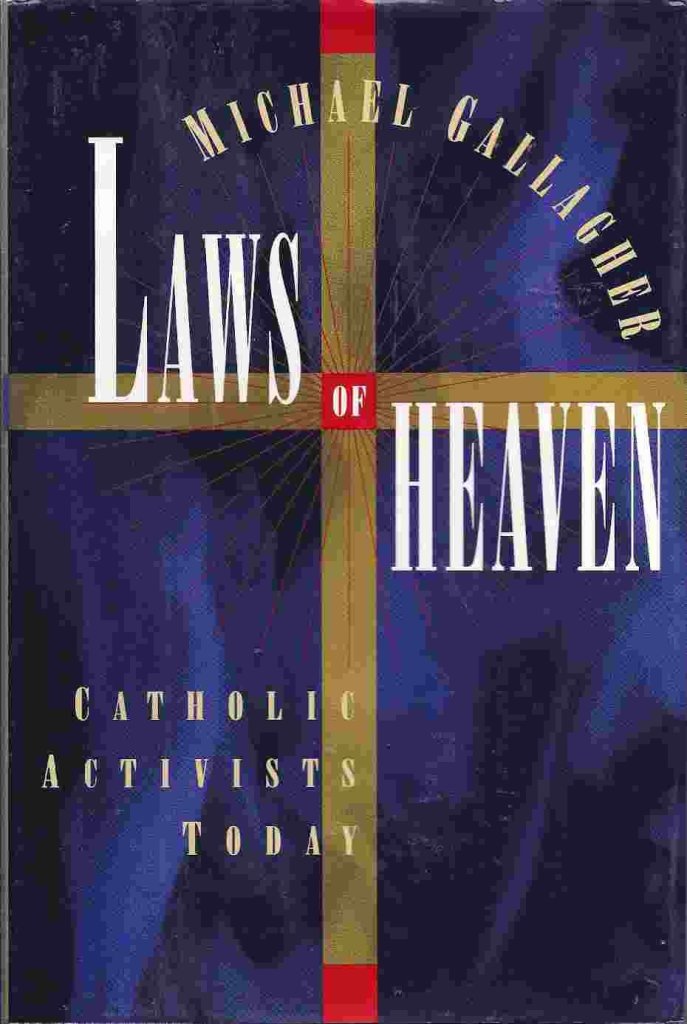
Michael Gallagher served as a paratrooper during the Korean War. His book on Catholic activists, Laws of Heaven, won the National Jesuit Book Award in theology, and his translation of Yukio Mishima’s Spring Snow was a finalist for a National Book Award.
As Christmas approaches, peace is on my mind. Christ, after all, was known as the Prince of Peace. I say “was” because we hear so infrequently of peace in the United States today. In fact, peace in the U.S. seems to be contingent on enormous military budgets dedicated to weapons and warfare. It reminds me of Strategic Air Command (SAC) in the Air Force, which was prepared utterly to destroy the Soviet Union and China in the 1960s but whose motto was “peace is our profession.” Paraphrasing Tacitus, one might say that SAC was prepared to make the world an irradiated hellscape and call it “peace.”
If Christmas is to have any religious meaning, one would think it would be centered on the arrival of the Prince of Peace in the world. As a Catholic, I can’t count the number of times I recited the prayer that begins, Glory to God in the highest/and peace to His people on earth, the Gloria in adoration of Christ as a bringer of peace. By way of contrast, Easter is about the fulfillment of Christ’s mission; His death and resurrection “takes away the sins of the world,” even as we continue to implore Him to “grant us peace.”
Now that I reflect upon it, the Christian mass must be one of the few places in American culture today where we routinely hear about peace, where the idea is not mocked as fallacious or faulty or insane.
To be honest, I’m not in close contact with Christian culture today. What little I know of it confuses me and disappoints me. I can’t square the so-called Prosperity Gospel with Christ’s teachings against the corruption of earthly riches. I can’t square the evangelical emphasis on personal salvation by being born again with Christ’s command to focus on helping others in place of celebrating oneself. (OK, you’re saved; now get over yourself.) It’s so terribly easy to lose sight of the great commandments of Christianity, which boil down to loving God and loving thy neighbor.
So many Americans seem to believe they live in an exceptional nation, literally holier than other nations because of shared Judeo-Christian traditions as well as God’s special favor allegedly showered upon this “city on a hill.”
Is it OK if I say that current events (and past ones too) suggest otherwise? Garrisons across the globe bristling with weapons are not the same as a shining city on a hill. There is nothing angelic about a Predator or Reaper drone, nor is salvation to be found at any end of a Hellfire missile.
What part of “love thy neighbor” is reflected in a gargantuan war and weapons budget that officially sits just under $800 billion, and which in its total cost routinely exceeds a trillion dollars annually? Not to be presumptuous, but something tells me the Prince of Peace isn’t too happy about this.
Yes, I am stunned that there isn’t more Christian opposition to America’s war machine. I am stunned that America’s churches and ministers have made their peace, so to speak, with nuclear weapons that can destroy all of God’s creation. I am stunned that on Christmas Day, when Christians are supposed to adore Christ and to recall the miracle of His birth, that we collectively give so little thought to making peace happen, to dedicating ourselves to it in His name.
Still, I must say this about my Catholic Church and my memories of it: At least we reached out to each other to offer a sign of peace. We reached across the pews to shake hands, to share smiles, to make human contact.
Let us offer each other the sign of peace: Should this not be our gift to each other, not just this Christmas but on each and every day? What better way to adore the Prince of Peace than to spread peace?
Is it possible the U.S. hit a peak of sorts in 1969? I know – 1969 was a Nixon year, another year of destruction in Vietnam, though the music in those days was far better than today. But I’m thinking of Apollo, as in our landing on the moon in July of 1969. Having recently celebrated the 50th anniversary of the moon landing, that momentous event is still on my mind, especially when I think of the old poster I had on my bedroom wall that showed the Apollo journey from earth to the moon, its various stages and maneuvers. It was all bewildering to a young boy caught up in the space program, but at least I knew my country was at the forefront of science.
In 1969 America reached the moon! We respected science. Many Americans were trying to end a disastrous war in Vietnam. People marched for civil rights, they fought for equal rights, there was a sense America’s potential was nearly limitless.
WTF in 2020? Many Americans, including our president, don’t respect science. We fire doctors for calling out quack medical cures. We put a breeder of labradoodles in charge of our Covid-19 pandemic response. Wars just go on forever with little resistance. We’re sliding backwards in rights for minorities, for women, for workers. And the space program? Moribund in the USA. We’re very much stuck on earth, an earth that is less hospitable to life than it was fifty years ago.
The years 1970-2020 has defined a half-century of American decline. Perhaps we might speak of five bad “emperors”: Nixon, Reagan, Clinton, Shrub Bush, and Obama, now joined by Trump, our very own blend of Nero and Caligula. He fiddles and diddles while America burns.
Joe Biden and the establishment Democrats are hardly the answer. Even Jesus isn’t the answer unless we start taking His words about the rich (and so much else) seriously. The Jesus of my youth had no use for greed and money and material goods – He taught us our treasure was in heaven, gained by righteous living through faith while manifesting love. That sacrificial message is drowned out today by the so-called prosperity gospel, preached by ministers who are cashing in even as they tell their followers that wealth is the most legitimate form of God’s grace. Back in the Catholic church of my youth, such ideas would have been blasphemous. At my church I recall the example set by Sister Emily and Sister Jane Elizabeth – they sure weren’t living in luxury. Forgive them, sisters, they know not what they do.
Here we are, in 2020, in a land of un-truth, in a universe of alternative facts, in belief systems where money matters more than anything, where even ministers stoke conflict, and we wonder why we can’t come together and develop a clear, coherent, and coordinated response to the coronavirus crisis.
How to change this? How about letting experts lead us? You know the saying: it ain’t rocket science. But Apollo was rocket science, and so we deferred to experts, and they got us to the moon and back six times and patched together an amazing rescue of Apollo 13 when it went wrong. To beat Covid-19, we can’t listen to Trump and his band of grifters and losers. We must listen to the scientists, the doctors, and act collectively based on sound medical science. The “rocket scientists” will get us through this, together with the humanists and the selfless efforts of so many medical workers and (mostly) nameless others.
Longer term, we need to re-create our government, because it has, quite simply, betrayed most of us. Simultaneously, we need to move beyond nationalism and think and act on a global scale to save our earth. If Apollo taught us one thing, it’s the wondrous value of our own planet. The moon may be a place of magnificent desolation, but who wants to live permanently in desolation? We need global vision and action, not only to help prevent future pandemics, but also to preserve our planet as a viable biosphere for a global population projected to top ten billion people in the coming decades.
Nobody said it would be easy; yet if we stay on our current course, just about anybody can guess humanity’s fate. But if we can put a man on the moon, surely we can come together to create a better future for ourselves and our children.
The year was 1969, and this song by the Youngbloods went gold: “Come on people now, smile on your brother, everybody get together, try to love one another right now. Right now. Right now.” It wasn’t – or shouldn’t be — just hippie dreaming. Indeed, it’s the essence of true Christianity.
Today, I want to share a bracing view, courtesy of my mother. She converted to Catholicism (from Protestantism) when she married my dad, but she wasn’t much of a church-goer. When my dad suggested she should accompany him to mass on Sundays, she had a telling rejoinder:
You worry about your soul — I’ll worry about mine.
Excellent advice. Mom had a way of speaking that cut to the chase.
When it comes to religion, too many Americans seek to push their beliefs on others. And often there’s some guilt or a veiled threat in the push. “A good person goes to church.” “These are holy days of obligation.” “You should go to set a good example for the kids.” “Don’t forget judgment day — God is looking down on you right now.”
My mom was having none of that. She also didn’t need church to do the right thing. She was kind and generous and, in my opinion, followed the example of the Gospel without making airs about it.
When it comes to religion, few people want to be pushed into attending “mandatory” practices. Indeed, I’ve always liked Christ’s teachings on praying to God in private, rather than standing on a street corner and shouting your beliefs to the masses. Speaking of which, I once witnessed a man doing exactly that in Oxford, England, shouting on the street, proclaiming the good news. When someone complained, he cited a Biblical passage that enjoined him to proclaim his faith in a loud voice so that others might follow in his footsteps.
That’s a problem with the Bible: So many passages, so many messages, so many interpretations.
Still, I persist in believing in my mother’s aphorism: Focus on the health of your own soul and its relationship to whatever higher power or higher ideals you believe in. Don’t focus on the souls and the beliefs and practices of others.
Or, as Christ put it, “Judge not — lest you be judged.”
An older symbol of the Chaplain Corps that includes Christian and Jewish symbols. There are now Buddhist, Hindu, and Muslim symbols as well
W.J. Astore
Disturbing, upsetting, baffling: these words often apply when young troops face religious pressure or discrimination for the first time.
And it disturbs, upsets, and baffles me that a nation founded on religious freedom produces people that want to abridge or eliminate that freedom in the (false) name of following Christ.
It also disturbs, upsets, and baffles me that a military that is supposed to defend our Constitutional freedoms, to include freedom of religion, occasionally works in ways that undermine that very freedom.
I was born and raised within the Catholic church, but I would never push my religious beliefs on someone else. Certainly not in a military context, in which supervisory authority is nearly absolute.
I believe there is a place for God (or gods, or no god) in the military, and a place for chaplains. Troops should be able to worship freely in the military, as is their right as American citizens. But there’s no place for proselytizing, pressure, “mandatory” Bible studies, and all the rest of that.
I remember how much Colorado Springs and the Air Force Academy changed between my first tour there (1990-92) and my second (1998-2002). Lots of evangelical organizations (like Focus on the Family) built headquarters just to the east of the AF Academy. I started to see that evangelical influence permeate the Academy. I suppose I was lucky I left in 2002, just before the scandals involving religious discrimination broke.
The military attracts many young people looking for certitude as well as a mission, a calling. Some of these young people come to espouse a narrow form of “Christianity,” one that sees itself as uniquely American and uniquely suited to a military context.
Yet how can troops take an oath to support and defend the Constitution, which enshrines freedom of religion, and then work to curtail or offend the religious freedoms of others?
Here’s what people need to remember about military settings: the authority of your direct supervisor is nearly absolute. If your drill sergeant, your platoon commander, your company commander, makes it obvious that he or she favors Christianity, it puts enormous pressure on subordinates to conform, or at least to fake it.
If your boss in a civilian setting is an assertive Christian evangelist, at least you have the option of quitting (however painful that might prove). There is no option in the military of “quitting” your platoon, your company, your unit. Furthermore, in a war zone, refusing to conform to an evangelical zealot as a leader could literally become a matter of life and death. Hey, Private Jones, you’re an atheist: go ahead and walk point again, i.e. take the lead as the unit walks through dangerous enemy territory infested with IEDs and snipers. Maybe that’ll give you some faith in God. Ha ha.
Again, the U.S. military must remember its purpose: to support and defend the Constitution. In fulfilling that purpose, there is simply no place for evangelism of any religion, Christian or otherwise.
Note: Since 2005, the Military Religious Freedom Foundation (MRFF) has fought to ensure religious freedom within military settings. The foundation represents nearly 45,000 service members, 96% of whom identify as Christian. Find out more about the MRFF at http://www.militaryreligiousfreedom.org.







 Bracing Views