The AI hype train is here and is speeding ahead like the fastest Japanese bullet train. It’s a “revolution,” and AI is going to change everything and/or doom us all. Or maybe it’ll usher in a glorious utopia? New technologies always seem to mobilize both the doomsayers and the utopian dreamers.
Amazingly, ChatGPT is already recording 800 million weekly active users. Meanwhile, investment in AI races ahead—not without serious implications. Today, I noted these two stories at the New York Times:
So, the demand for chips may inflate the price of your next computer even as investors in AI continue to throw money at its promise.
Given the nature of the corporations and governments making decisions about AI and its future, I’m not optimistic for an AI-driven utopia. Count me among the (guarded) pessimists.
Why? Here’s one snippet I gleaned from the New York Times the other day:
28,000,000,000
— That’s how many liters of water Microsoft said it would use for its data centers in 2030, according a report obtained by The Times.The company had promised to cut its water use, but big tech companies are guzzling water during the A.I. frenzy.
That’s an enormous quantity of water when water scarcity is a major issue for our climate change-driven future.
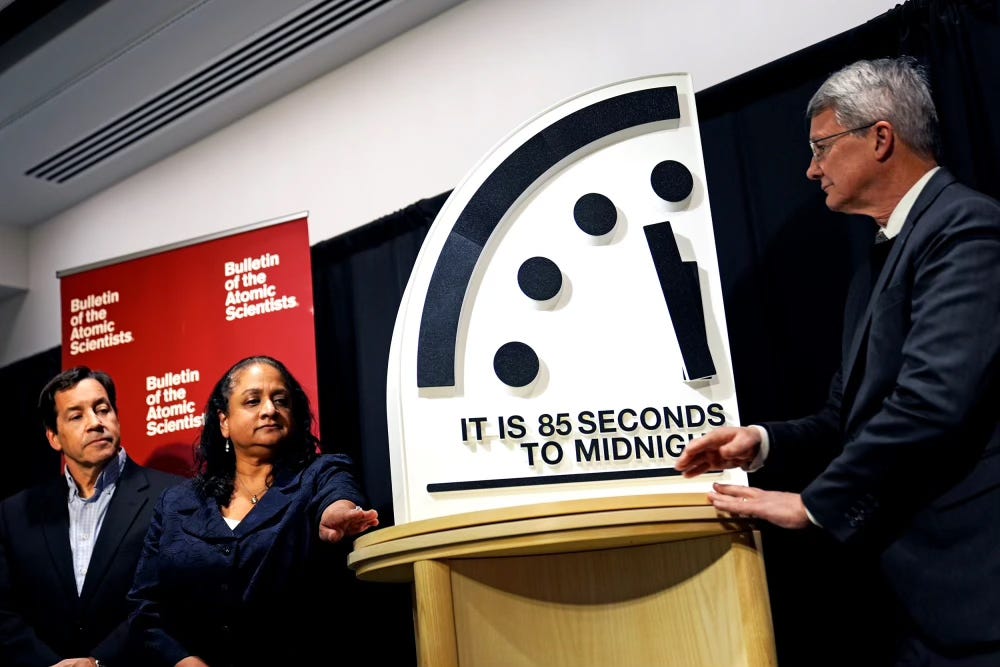
Along with that, I saw where the Bulletin of the Atomic Scientists moved the Doomsday Clock to 85 seconds to midnight, the closest it’s ever been to nuclear Armageddon. In their statement, the scientists cited the rise of AI and its application to weapons and war as one reason for the clock’s creep toward midnight.
So, what gives with this “AI frenzy”? My guess is that AI is being harnessed by the powerful for their purposes. They’re not investing big money to help the little people. This is not to say that every AI application is nefarious and evil. But I think the general trend will be AI-driven “efficiency,” meaning lots of people losing their jobs, along with AI-driven surveillance and control, in the name of greater “safety and security,” naturally.
One thing is certain: we shouldn’t blame the technology. Whatever AI is or becomes, it will be a manifestation of us—but, more worryingly, a manifestation of the agendas of the capitalists, the corporatists, and the warmongers among us, those who are always seeking dominance, even “full-spectrum” dominance, including AI and everything it’s capable of, “guardrails” be damned.
AI, of course, stands for artificial intelligence, and I’ve played with it here at Bracing Views. I’ve used ChatGPT and DeepSeek to write critical essays on the military-industrial complex, critiquing the results in my posts. Overall, I was impressed—and glad that I no longer have to wade through student essays completed outside of class.
I stopped teaching eleven years ago, before AI was available. Of course, the Internet was, and I did have students who cut and paste from sources online. Usually, I could tell; I would do a search using a “student” passage that just sounded a bit too good, and often whole paragraphs would come up that the student lazily cut and pasted into an assignment as their own work. Those were easy papers to grade. F!
Today’s AI programs make this more difficult. If I were teaching today, I’d assign fewer essays outside of class, and I’d probably bow to reality and allow students to use AI to help clarify their arguments.
The challenge remains: In this new world of AI, how do you evaluate student performance in a humanities course where research and writing skills are important, along with some command of the facts and an ability to think critically about them?
I’d likely employ a mix of the old and new. Standard exams—the usual multiple choice, short answer, written essay, all completed in the classroom—still have a role. But I’d incorporate AI too, especially for class discussion.
Consider, for example, debating the merits (and demerits) of the military-industrial complex. AI can easily write short essays both in favor and against (or even an essay that examines the pros and cons of the MIC). Those essays could then be used in class to tease out the complexities of the MIC, and how evidence can be used (manipulated?) to tell vastly different stories.
Another example: Should atomic bombs have been used at Hiroshima and Nagasaki? Again, AI can easily write essays in favor, or against, or “neutral” (pros and cons again). Those short essays could then form the basis for class discussion and further debate.
In a way, AI is a selective manifestation of evidence that is already out there. And there’s the rub. Who’s doing the selecting? Who’s writing the algorithms? Which evidence is being favored and which is being suppressed or disregarded?
AI, as I understand it, uses algorithms that favor certain kinds of evidence over other kinds. Generally speaking, AI favors “official” sources, e.g. government documents, mainstream media reporting, scholarly think tanks with credentials, and so on.
Alternatively, it’s possible AI could gather information from less than reputable sources. Again, what algorithms are being used? What are the agendas of those behind the AI in question?
To students, AI is something of a black box. It spits out answers without a lot of sourcing (unless you specifically ask for it). Students in a hurry may not care—they just want answers. But as Tom Cruise demands In A Few Good Men: “I want the truth.” What happens when AI Colonel Jessup decides, “You can’t handle the truth” and feeds us convenient half-truths and propaganda. Will students even care? Will they have the skills to recognize they’re being misled? Or that they’re not getting the full story?
That’s what I worry about. Students who simply accept what AI has to say. Not that they learned nothing—but that they learned exactly what they were programmed to learn. Strangely, in this scenario, the students themselves are reduced to automatons. And I don’t think most students want to be unthinking robots for the Man.
Or do they?
Postscript: Over at his new Substack site, Mike Neiberg is tackling AI and the humanities. Check it out at michaelneiberg.substack.com.
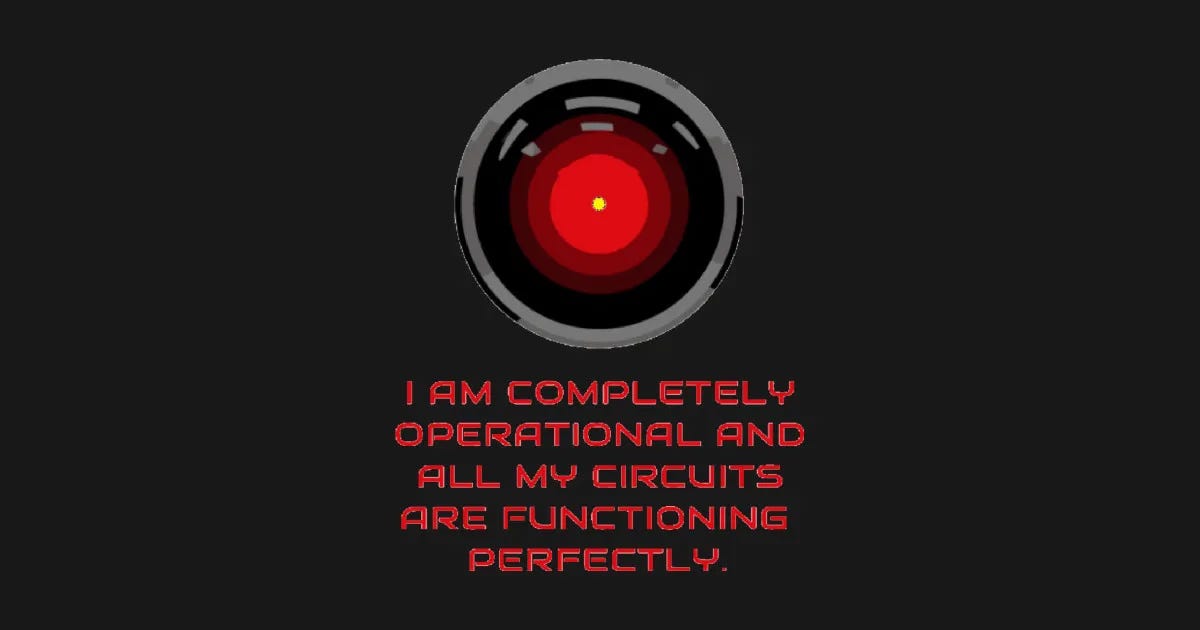
I recently checked in with HAL 9000, actually ChatGPT and DeepSeek, to see what AI says about my writing on military policy. I’ll let ChatGPT go first:
William Astore, a retired U.S. Air Force lieutenant colonel and historian, has emerged as a prominent voice critiquing America’s militaristic culture and its pervasive influence on domestic and foreign policy. Through his essays on platforms like TomDispatch and Truthdig, Astore offers a candid examination of how militarism has become deeply embedded in American society, often to its detriment.
The Militarization of American Society
Astore argues that the United States has transitioned from a nation with a military to a militarized nation. He contends that this shift is not marked by overt displays of military power but by a subtle, pervasive presence of militaristic values in everyday life. This includes the normalization of war, the glorification of military service, and the integration of military imagery into civilian spaces. He warns that such normalization desensitizes the public to the realities of war and erodes democratic values.
The Business of War
In his critique of the military-industrial complex, Astore highlights how war has become a profitable enterprise for a select few. He references General Smedley Butler’s assertion that “war is a racket,” emphasizing that the true beneficiaries of war are often corporations and political elites, rather than the general populace. Astore suggests that this profit-driven approach to war leads to prolonged conflicts with little regard for their human or financial costs.
The Disconnect Between Military and Society
Astore points out the growing divide between the military and civilian sectors. He notes that the all-volunteer force, while composed of individuals who choose to serve, often does so out of limited economic opportunities rather than a deep-seated desire to fight. This creates a situation where the broader public remains detached from the consequences of war, leading to a lack of accountability and understanding.
A Call for Reflection and Change
Throughout his writings, Astore advocates for a return to a more restrained and reflective approach to military engagement. He urges Americans to critically assess the true costs of war and to reconsider the glorification of militarism in public life. By fostering a more informed and engaged citizenry, Astore believes the U.S. can move towards a foreign policy that prioritizes diplomacy and peace over conflict.
Astore’s insights challenge readers to confront the complexities of American militarism and its implications for both domestic society and international relations. His work serves as a reminder of the importance of maintaining a vigilant and informed public to ensure that the nation’s military endeavors align with its democratic ideals.
*****
That’s a fair assessment, I’d say. I do believe America is too war- and profit-driven, too adulatory toward the military, and also too disconnected from the grim realities of war. And I have called for a recommitment to and renewal of diplomacy. A “vigilant and informed public” is exactly what Ike called for in 1961 when he said that only an alert and knowledgeable citizenry could keep the military-industrial-congressional complex in check. I suppose that’s why the MICC works to keep Americans isolated from and ignorant about war. The last thing the MICC wants is alert and knowledgeable citizens who challenge it.
HAL 9000 (from the movie “2001”)
Let’s turn to DeepSeek and its summary, which isn’t quite as comprehensive as ChatGPT:
William Astore, a retired U.S. Air Force lieutenant colonel and historian, is a vocal critic of U.S. military policy and militarism. His key arguments include:
Excessive Militarization. Astore argues that the U.S. has become overly reliant on military solutions to geopolitical problems, leading to endless wars and bloated defense budgets. He critiques the “military-industrial complex” (a term popularized by Eisenhower) for perpetuating this cycle.
Militarism in Society. He highlights how militarism has seeped into American culture, with the glorification of the military. pervasive defense contracting, and the influence of retired generals in media and politics.
Failed Wars & Lack of Accountability. Astore condemns U.S. interventions (e.g. Iraq, Afghanistan) as costly failures, driven by hubris and flawed assumptions, with little accountability for policymakers.
Erosion of Democracy. He warns that unchecked militarism undermines democratic values, as vast resources are diverted to the military while domestic needs (education, healthcare, infrastructure) are neglected.
Need for Reform. Astore advocates for a more restrained foreign policy, reduced defense spending, and greater public skepticism toward military leaders and war propaganda.
*****
Again, I think that’s a fair summary. I like the emphasis on lack of accountability. So-called experts are never called to account for advocating for disastrous wars; indeed, they’re usually promoted to higher positions. You can never go wrong by going “strong,” at least rhetorically. The worst thing in America is to argue for diplomacy and peace and being proven right, for you were right “for the wrong reasons,” i.e. sure, Iraq and Afghanistan were disastrous wars that killed, wounded, and displaced millions, but it would have been pusillanimous and “weak” of America not to slap around a few countries in the aftermath of 9/11. So put on your “big boy” warrior fatigues and start kicking ass, because that’s what real Americans do.
It’s interesting that AI programs probably wouldn’t write that last sentence but they can “write” sober and rational prose rather effectively.
ChatGPT and DeepSeek can be useful tools, I think, if used judiciously. I worry, however, about AI programs being used for decision-making, especially decisions related to life and death in war. So, for example, I’ve read about AI programs being used for target selection in places like Gaza. Just what we need—ever-more automated death.
You may recall that, late in 2022, I asked the AI platform ChatGPT to write a short critical essay on the military-industrial complex. That essay is here.
Recently, news out of China came of a new AI platform known as DeepSeek that reportedly is both cheaper and better than U.S. efforts. I asked DeepSeek for a 600-word critical essay on the MIC, and it complied with its human master (at least for now). Here’s the essay, which, you may agree, is quite good:
The Military-Industrial Complex: A Critical Examination [Written by DeepSeek]
The military-industrial complex (MIC) in the United States, a term popularized by President Dwight D. Eisenhower in his 1961 farewell address, refers to the symbiotic relationship between the nation’s armed forces, defense contractors, and the political institutions that support them. While Eisenhower warned of its potential dangers, the MIC has since grown into a colossal entity that wields significant influence over American society, economy, and foreign policy. This essay argues that the military-industrial complex is detrimental to the United States, perpetuating endless wars, distorting national priorities, and undermining democratic principles.
One of the most glaring consequences of the MIC is its role in perpetuating a state of perpetual war. The United States has been involved in military conflicts for the majority of its history, with the 21st century being no exception. The wars in Afghanistan, Iraq, and elsewhere have been justified under the guise of national security, but they have often served the interests of defense contractors more than the American people. Companies like Lockheed Martin, Boeing, and Raytheon profit immensely from the production of weapons and military technology, creating a perverse incentive to maintain and escalate conflicts. This cycle of war and profit not only drains national resources but also results in the loss of countless lives, both American and foreign. The human cost of these wars is immeasurable, and the moral implications of prioritizing profit over peace are deeply troubling.
Moreover, the MIC distorts national priorities by diverting vast sums of money away from critical domestic needs. The United States spends more on its military than the next ten countries combined, with the defense budget often exceeding $700 billion annually. This staggering expenditure comes at the expense of underfunded sectors such as education, healthcare, infrastructure, and climate change mitigation. While the country boasts an unparalleled military capability, it lags behind other developed nations in key areas of social and economic well-being. For instance, the U.S. faces a crumbling infrastructure, a lack of universal healthcare, and a growing wealth gap. The prioritization of military spending over these pressing issues reflects a skewed set of values that favors corporate interests over the welfare of citizens.
The influence of the MIC also undermines democratic principles by eroding the separation of power and fostering corruption. Defense contractors spend millions of dollars annually on lobbying and campaign contributions, ensuring that politicians support policies favorable to the industry. This creates a feedback loop where elected officials are incentivized to approve bloated defense budgets and authorize military interventions, regardless of their necessity or public support. The result is a government that is increasingly beholden to corporate interests rather than the will of the people. Furthermore, the revolving door between the Pentagon, Congress, and defense contractors exacerbates this issue, as individuals move seamlessly between public service and lucrative private sector positions. This blurring of lines between public and private interests erodes trust in government and undermines the democratic process.
Critics of the MIC often face significant backlash, as questioning the necessity of military spending or the morality of war is frequently framed as unpatriotic or naive. This stifling of dissent is another way in which the MIC exerts its influence, creating a culture where alternative perspectives are marginalized. The media, too, plays a role in perpetuating this status quo, often uncritically echoing government narratives and failing to hold policymakers accountable. This lack of critical scrutiny allows the MIC to operate with minimal oversight, further entrenching its power.
In conclusion, the military-industrial complex represents a profound threat to the United States, perpetuating endless wars, distorting national priorities, and undermining democratic principles. Eisenhower’s warning about the dangers of the MIC remains as relevant today as it was in 1961. To address these issues, the United States must reevaluate its priorities, reduce its reliance on military solutions, and invest in the well-being of its citizens. Only by challenging the entrenched power of the MIC can the nation hope to achieve a more just, peaceful, and equitable future. The stakes are high, and the time for action is now. [End of essay.]
*****
Amen to that, DeepSeek! There are a few edits I’d make here. Raytheon is now RTX. The defense war budget is now $900 billion and rising, not $700 billion. I wouldn’t use the word “symbiotic” to describe relations among the Pentagon, the weapons makers, and Congress; more like “toxic,” corrupted as it is by greed, money and self-interest. I do very much like this line: “the moral implications of prioritizing profit over peace are deeply troubling.” Deeply troubling indeed!
Anyhow, if you’re interested, go to DeepSeek.com, create an account, and ask our future AI overlord a question. Perhaps you’ll be surprised by the result.
In my eclectic reading, I came across a couple of references to ChatGPT, an experiment in artificial intelligence (AI). You ask the AI bot a question, or give it a task, and it spits out an answer, and I must say a pretty good one judging from the task I gave it.
My task to the AI bot: “Write a critical essay on the military-industrial complex.” Here’s what it generated:
The military-industrial complex refers to the relationship between a country’s military and the defense industry that supplies it, seen together as a vested interest which influences public policy. This relationship has been a source of concern for many people, who argue that it can lead to an unnecessary expansion of military budgets and an over-reliance on military solutions to problems.
One of the main criticisms of the military-industrial complex is that it can result in the waste of taxpayer money. Military contracts are often given to a select group of companies, which can result in overcharging for goods and services. Additionally, the military often purchases weapons and equipment that are unnecessary or not well-suited for the tasks at hand. This can lead to a tremendous amount of waste and inefficiency, as resources are poured into projects that do not provide much value.
Another concern is that the military-industrial complex can distort foreign policy decision-making. Countries with a strong military-industrial complex may be more likely to engage in military action, even when diplomatic solutions would be more appropriate. This can lead to an escalation of conflicts and an increased risk of war.
The military-industrial complex can also have negative impacts on domestic policy. It can divert resources away from other important priorities, such as education and healthcare. Additionally, the influence of the defense industry on policy decisions can lead to the prioritization of the needs of military contractors over the needs of the general public.
Some have argued that the military-industrial complex represents a threat to democracy, as it can give undue influence to a small group of powerful interests. This can lead to a lack of transparency and accountability in decision-making, as well as a distorted political process.
In conclusion, the military-industrial complex is a complex and multifaceted issue that has the potential to have negative impacts on both domestic and foreign policy. It is important for citizens to be aware of the potential dangers of this relationship and to hold their elected officials accountable for ensuring that military spending is responsible and transparent.
Not bad! Firstly, I’m glad I’m no longer a professor actively teaching and grading papers. Something tells me more than a few students might be reaching for help from the AI bot on their assignments. Often, I was able to catch plagiarism (the giveaway was an essay written too well with too many “big words” used correctly) by searching for certain phrases or sentences that struck me as more than odd or much too advanced, but now with these AI programs I’m guessing it’s going to be a lot harder to ensure students do their own work.
Anyhow, the AI bot essay on the military-industrial complex makes some good points, don’t you think? Though there’s still room for a human here (at least I hope so).
So what does this human intelligence (that’s me) have to say?
“Unnecessary expansion of military budgets”: that’s for sure! The latest Pentagon budget is $858 billion, and that doesn’t count roughly $45 billion in aid (mostly military) to Ukraine. It also leaves out much spending related to homeland security, policing, and the like. By some estimates, 2/3rds of the federal discretionary budget is devoted to military, security, and policing.
“Over-reliance on military solutions”: bingo! Afghanistan, Iraq, Libya, Syria, Somalia, Yemen, the whole “war on terror” was and is driven by the idea that America’s singular military strength can solve everything.
A “vested interest” that “influences public policy”: I think the AI bot has read Eisenhower’s warning about the undue influence of the MIC and the danger it poses to freedom and democracy.
A “tremendous amount of waste and inefficiency”: Looks like the AI bot has heard that the Pentagon is missing trillions of dollars and has failed five audits in a row. It’s probably heard about wasteful weapons like the F-35 and B-21 as well. (Coincidence: as I was typing “wasteful,” the computer corrected my initial misspelling to “hateful.” Yes, I suppose a nuclear bomber that can kill millions could be described as “hateful”).
“Escalation of conflicts” and “an increased risk of war”: Well, I’m glad our leaders have the Ukraine situation firmly in hand and are seeking a well-considered diplomatic solution. (Yes, that’s sarcasm. Match that, AI bot!)
“Negative impacts on domestic policy”: Well, I’m glad Americans have excellent and affordable health care, virtually no debt due to educational costs, and that John Q. Public is heard as much as Boeing and Raytheon in the halls of power. (More sarcasm from the human!)
“Lack of transparency and accountability”: Boy, this AI bot is smart! When’s the last time you heard of a U.S. general or admiral being cashiered for losing a war?
“Important for citizens to be aware of the potential dangers” of the MIC: Hooray for the AI bot! If only we still had citizens in America who were kept informed about the dangers of the MIC. We’ve all been reduced to passive consumers and occasional voters who are told by the mainstream media to cheer for war and to revel in the beauty of our missiles.
I think you’ll agree, dear reader, that the AI bot is less sarcastic and more dispassionate than I am. It also speaks with much greater probity of the dangers of the MIC than people like Biden or Trump or Pelosi or DeSantis. So I say “three cheers!” for our new robot master. ChatGPT for President in 2024!





 Bracing Views