Would a better prepared U.S. have used torture?

tmw2014-08-13colorlarge

The so-called Senate CIA Torture Report is supposed to be released today.  Five years ago, I wrote an article for Nieman Watchdog on the Bush Administration’s decision to resort to “enhanced interrogation techniques,” or torture in plain speak.  Torture, I wrote back then, was the refuge of the impatient and incompetent, an approach that abrogated America’s fidelity to international treaties even as it became habit-forming.  In other words, the resort to torture simply begat more torture, irrespective of results.  As President Obama said, “We tortured some folks.”  And so on.  W.J. Astore

COMMENTARY | May 18, 2009

Did a lack of trained interrogators with appropriate language proficiency lead Bush administration officials to embrace torture as a ‘short cut’? A former dean at the Defense Language Institute writes that America was unprepared to wage a patient and savvy war of counterintelligence against Al Qaeda – which may have made less humane and less effective methods seem like an attractive option. Seventh in a series of articles calling attention to the things we still need to know about torture and other abuses committed by the Bush administration after 9/11.

By William J. Astore

In a letter dated May 10, 2007, General David H. Petraeus wrote to American troops serving in the Multi-National Force in Iraq:

Some may argue that we would be more effective if we sanctioned torture or other expedient methods to obtain information from the enemy.  They would be wrong.  Beyond the basic fact that such actions are illegal, history shows that they also are frequently neither useful nor necessary.  Certainly, extreme physical action can make someone “talk;” however, what the individual says may be of questionable value.

Petraeus’s directive to the troops was unequivocal: Besides being illegal, torture is counterproductive, unnecessary, and generates “intelligence” of dubious reliability.

Evidence suggests the U.S. military was telling the Bush Administration these cold, hard facts all along.  Why then did George Bush and Dick Cheney approve torture under the guise of “enhanced interrogation techniques”?

To answer this question, I think we need to remember not only the immense pressure the Bush Administration was under in 2002 (the events of 9/11, after all, occurred on their watch), not only their idée fixe for a settling of accounts with Saddam Hussein and Iraq, but also America’s lack of preparedness to wage a patient and savvy war of counterintelligence against Al Qaeda.

I witnessed this indirectly at the Defense Language Institute Foreign Language Center (DLIFLC), where I served as the Associate Provost/Dean of Students from 2002 to 2005.  Clearly, the U.S. lacked translators, interpreters, and especially trained military interrogators.  I recall interrogators being pulled from assignments at DLIFLC and reassigned to operational tours in the Middle East and Central Asia; the problem was that their language proficiency was often in Chinese or Korean or a Romance language – not, as one might expect, in Arabic, Pashto or Dari.

Few people understand how long it takes to produce a skilled military interrogator.  Attaining basic language proficiency in Arabic takes nearly 18 months of constant training at DLIFLC.  But attaining mastery of the language and the culture – the acuity and sensitivity to interrogate a suspect who’s deliberately trying to mislead you – takes years and even decades of study and practice.  From 2002 to 2005, it may be that our country simply didn’t have enough skilled and disciplined interrogators to take the indirect approach.

Torture, I’m suggesting, wasn’t used because of a simple Machiavellian calculus of “the ends justify the means.”  Rather, we lacked the most humane and most effective means to attain the ends that the Bush Administration so desperately wanted – “actionable intelligence” that could prevent yet another 9/11 from occurring on their watch.  So they deployed “enhanced interrogation techniques,” which carried with them not merely the risk but the certainty of excesses and mistakes.

As investigators look more closely at America’s resort to torture, they should ask if we decided to go rough because we couldn’t go smooth.  Because we lacked the language and cultural skills to play good cop, we played bad cop as a short cut.  The problem, of course, is that short cuts are habit-forming.  And in the name of results, they often sacrifice the essential for the expedient.  In the case of the Bush Administration, not only did torture apparently provide unreliable intelligence: It also abrogated America’s fidelity to international treaties that forbade torture, and compromised our own ethos of truth, justice, and the American way.

Here, the lessons of the French in Algiers continue to resonate.  Think back to the revelations of General Paul Aussaresses in 2001, which scandalized France.  Aussaresses unrepentantly confessed that, in attempting to suppress terrorism in Algeria in the 1950s, detainee abuse, torture, even murder became routine, first-choice, approaches.  The resort to torture simply begat more torture.

Investigators should look at whether this dynamic also applied to America in Afghanistan and Iraq.  How many of our counterterrorist experts became like General Aussaresses: Self-perceived patriots who believed torture and even murder were justified in the name of protecting the state?  After all, if the state’s essential purpose is to protect its citizens, and you’re dealing with an enemy that’s malevolently contumacious, as Al Qaeda appeared to be, what’s to stop avowed “patriots” from torturing suspects, especially when the state’s leaders have authorized harsh techniques and are pressing you for results?

Patriotism, it’s been said, is the last refuge of the scoundrel.  Is torture the last refuge of the impatient and the incompetent?  If so, how do we instill patience and competence?  Of the hundreds of billions we spend on national defense each year, surely we should dedicate more funding to training and retaining skilled and disciplined military interrogators.  Counterterrorism succeeds or fails based on human intelligence (HUMINT).  But to get the most reliable HUMINT, we have to be able to outsmart our foes.  And the best way to do this is to treat them as humans, not as vessels to be beaten until they voice the echoes of our worst fears.

Updated (12/9/2014, 11:50AM EST): The Executive Summary to the “Torture Report” has been released.  I’ve scanned the first 40 pages.  One remarkable data point is that supposedly the CIA did not brief the President on the full extent of the “enhanced interrogation techniques” until April 8, 2006.  In short, the CIA and its hired contractors used certain torture techniques on their own authority for four years.  Here’s an excerpt from the report:

On August 1, 2002, based on comments from White House Counsel Alberto Gonzales, the talking points were revised to eliminate references to the waterboard.  CIA records indicate, however, that the talking points were not used to brief the president. On August 2, 2002, the National Security Council legal advisor informed the DCI’s chief of staff that “Dr. Rice had been informed that there would be no briefing of the President on this matter, but that the DCI had policy approval to employ the CIA’s enhanced interrogation techniques.”

Records state that prior to the use of the CIA’s enhanced interrogation techniques on Abu Zubaydah in 2002, the CIA did not brief Secretary of State Colin Powell or Secretary of Defense Donald Rumsfeld, two members of the National Security Council, on the techniques. The Committee, including the chairman and vice chairman, was also not briefed on the CIA’s enhanced interrogation techniques prior to their use.

It seems like the CIA is shouldering all of the blame here.  The failure (if it was that) to brief the president, the secretary of state, the secretary of defense, as well as the Senate Intelligence Committee, constitutes a fundamental breakdown in Constitutional safeguards.  (Unless, of course, the “failure” to brief senior civilian leaders was all about protecting them and maintaining “plausible deniability.”)

Whatever else the report reveals, this violation of the Constitution is especially egregious.  If true, it would suggest that the CIA should be severely disciplined or even disbanded.

But I truly doubt whether the buck stops with rogue elements in the CIA …

Update (12/10/14): Eric Fair was a contract interrogator for the Army in 2004.  In an Op-Ed for the New York Times today, he writes:

I was an interrogator at Abu Ghraib. I tortured.

Today, the Senate released its torture report. Many people were surprised by what it contained: accounts of waterboardings far more frequent than what had previously been reported, weeklong sleep deprivation, a horrific and humiliating procedure called “rectal rehydration.” I’m not surprised. I assure you there is more; much remains redacted.

Most Americans haven’t read the report. Most never will. But it stands as a permanent reminder of the country we once were.

Obama’s Speech on ISIS: More of the Same, As in Military Action (Updated)

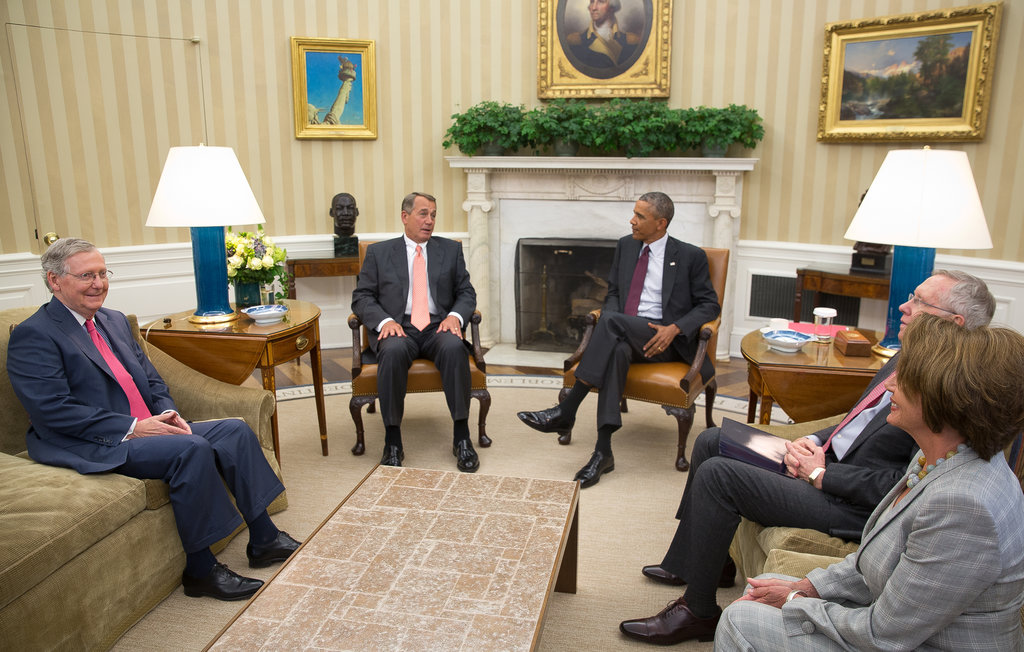
Obama "consults" with Congress before ordering more bombing.  Note the irony of George Washington's portrait, the man who warned us to avoid foreign entanglements
Obama “consults” with Congress before ordering more bombing. Note the irony of George Washington’s portrait, the man who warned us to avoid foreign entanglements (Source: NYT)

W.J. Astore

President Obama’s speech tonight on the Islamic State (or ISIS) promises more military action.  More airstrikes, more boots on the ground (mainly Special Forces), more training for the Iraqi military (who have endured more than a decade’s worth of U.S. military training, with indifferent results), and more weapons sales (which often end up in the hands of ISIS, thereby necessitating more U.S. airstrikes to destroy them).

All of this is sadly predictable.  Call it the TINA militarized strategy, as in “There is no alternative” (TINA) but to call in the military.

There are three reasons for the TINA strategy.  One is domestic politics.  Facing elections in November, the Obama Administration and the Democrats must appear to be strong.  They must take military action, at least in their eyes, else risk being painted by Republicans as terrorist-appeasers.

The second reason is also obvious: The military option is the only one the U.S. is heavily invested in; the only option we’re prepared, mentally as well as physically, to embrace.  The U.S. is militarized; we see the military as offering quick results; indeed, the military promises such results; we’re impatient people; so we embrace the military.

Never mind the talk of another long war, perhaps of three years or longer.  When they bother to pay attention, what most Americans see on their TV and computer screens is quick results, like the video released by Central Command showing the U.S. military blowing up ISIS equipment (often, U.S. military equipment provided to Iraq but appropriated by ISIS).  And unlike those ISIS “medieval” beheadings, decapitation by laser-guided bomb is both unoffensive and justified.

And if we’re blowing things up with our 21st-century decapitation bombs, we must be winning — or, at least we’re doing something to avenge ISIS barbarism.  Better to do something than nothing.  Right?

The third reason is more subtle and it comes down to our embrace of “dominance” as our de facto military strategy.  Allow me to explain.  After World War II, the U.S. military embraced “containment” as the approach to the Soviet Union.  “Parity” was the buzzword, at least in the nuclear realm, and “deterrence” was the goal.  With the collapse of the Soviet Union, the U.S. did not become “a normal country in normal times,” nor did we cash in our peace dividends.  Instead, the U.S. military saw a chance for “global reach, global power,” global dominance in other words.  And that’s precisely the word the U.S. military uses: dominance (expanded sometimes to full spectrum dominance, as in land, sea, air, space, cyberspace, and who knows what else).

You can explain a lot of what’s happened since 9/11 with that single word: dominance.  The attacks of 9/11 put the lie to U.S. efforts to dominate global security, which drove the Bush/Cheney Administration to double down on the military option as the one and only way of showing the world who’s boss.  Clear failures of the military option in Iraq, Afghanistan, and elsewhere did not encourage soul-searching; rather, it simply drove Obama and his generals to promise that “this time, we’ll do it (bombing and raids and interventions) better and smarter” than the previous administration.

There’s simply no learning curve when your overall goal is to exercise dominance each and every time you’re challenged. Ask John McCain.

So as you listen to the president’s speech tonight, keep those three elements in mind: domestic politics, our enormous investment (cultural as well as financial) in the military and our preference for quick results at any price, and finally our desire to exercise dominance across the globe.  It may help you to parse the president’s words more effectively.  Perhaps it will also explain why our leaders never seem to learn.  It’s not because they’re stupid: it’s because their careers and commitments require them not to learn.

Bombs away.

Update: There’s another aspect of our dominance that is fascinating to consider.  The US sees its dominance as benevolent or benign, never as bellicose or baneful.  This is reflected brilliantly in the US Navy’s current motto, “A global force for good.”  Not to deny that the Navy does good work, but I’m not sure we’d applaud if F-18s were dropping laser-guided bombs on our troops.  The point is that as a society we have a willed blindness to how our “dominance” plays out in the rest of the world.  We only seem to care when that “dominance” comes to Main Street USA, as it did recently in Ferguson, Mo.  (The ongoing militarization of police forces, and their aggressiveness toward ordinary people, are surely signs of “dominance,” but who wants to argue this is benevolent or benign in intent?)

If another country sought global reach/global power through military dominance, that country would be instantly denounced by US leaders as inherently hostile and treated as a major threat to world peace.

Update 2 (9/12/14):  Dan Froomkin at The Intercept has a stimulating round-up of criticism about Obama’s latest plans for war (courtesy of Tom Engelhardt at TomDispatch.com).  A summary:

Yesterday, Dan Froomkin of the Intercept offered a fairly devastating round-up of news reports from the mainstream (finally coming in, after much deferential and semi-hysterical reportage!) suggesting just what a fool’s errand the latest expansion of the U.S. intervention in Iraq/Syria could be. (And today’s NY Times has more of the same.) Here are just some selections from his post. Tom Engelhardt

“President Obama’s plan to “degrade and destroy” the Islamic State counts on pretty much everything going right in a region of the world where pretty much anything the U.S. does always goes wrong. Our newspapers of record today finally remembered it’s their job to point stuff like that out.

“The New York Times, in particular, calls bullshit this morning — albeit without breaking from the classic detached Timesian tonelessness. Mark Mazzetti, Eric Schmitt and Mark Landler (with contributions from Matt Apuzzo and James Risen) start by pointing out the essential but often overlooked fact that ‘American intelligence agencies have concluded that [the Islamic State] poses no immediate threat to the United States.’

“And then, with the cover of ‘some officials and terrorism experts,’ they share a devastating analysis of all the coverage that has come before: ‘Some officials and terrorism experts believe that the actual danger posed by ISIS has been distorted in hours of television punditry and alarmist statements by politicians, and that there has been little substantive public debate about the unintended consequences of expanding American military action in the Middle East….’

“In the Washington Post this morning, Rajiv Chandrasekaran focuses on all the implausible things that have to go right beyond ‘U.S. bombs and missiles hitting their intended targets’: ‘In Iraq, dissolved elements of the army will have to regroup and fight with conviction. Political leaders will have to reach compromises on the allocation of power and money in ways that have eluded them for years. Disenfranchised Sunni tribesmen will have to muster the will to join the government’s battle. European and Arab allies will have to hang together, Washington will have to tolerate the resurgence of Iranian-backed Shiite militias it once fought, and U.S. commanders will have to orchestrate an air war without ground-level guidance from American combat forces…’

“The McClatchy Newspapers Washington bureau , finally no longer alone in expressing skepticism about Obama’s plans, goes all Buzzfeed with a Hannah Allam story: ‘5 potential pitfalls in Obama’s plan to combat the Islamic State’. Allam notes that Yemen and Somalia are hardly examples of success; that the new Iraqi government is hardly “inclusive”; that training of Iraqi soldiers hasn’t worked in the past; that in Syria it’s unclear which “opposition” Obama intends to support; and that it may be too late to cut off the flow of fighters and funds.”

https://firstlook.org/theintercept/2014/09/11/news-organizations-finally-realize-obamas-war-plan-messed/

Update 3 (9/12/14): US Army Colonel (ret.) Andrew Bacevich has a sound critique of the bankruptcy of Obama’s strategy.  Here’s an excerpt:

Destroying what Obama calls the Islamic State of Iraq and the Levant won’t create an effective and legitimate Iraqi state. It won’t restore the possibility of a democratic Egypt. It won’t dissuade Saudi Arabia from funding jihadists. It won’t pull Libya back from the brink of anarchy. It won’t end the Syrian civil war.  It won’t bring peace and harmony to Somalia and Yemen. It won’t persuade the Taliban to lay down their arms in Afghanistan. It won’t end the perpetual crisis of Pakistan. It certainly won’t resolve the Israeli-Palestinian conflict.

All the military power in the world won’t solve those problems. Obama knows that. Yet he is allowing himself to be drawn back into the very war that he once correctly denounced as stupid and unnecessary — mostly because he and his advisers don’t know what else to do. Bombing has become his administration’s default option.

Rudderless and without a compass, the American ship of state continues to drift, guns blazing.