
Blame

W.J. Astore

When candidates lose an election, they are primarily responsible 

If Kamala Harris loses this election, can we please not blame Jill Stein, Susan Sarandon, Vladimir Putin, the usual suspects?

If Donald Trump loses this election, can we please not blame immigrants, voting machines, and various alleged forms of ballot- and ballot box tampering? And god knows what else Team Trump comes up with?

When candidates lose elections, they and their campaigns are primarily responsible. Sure, there’s always the possibility of bad breaks, bad luck, even occasional attempts at cheating. (Find me some votes in Georgia!) But usually one candidate and one campaign simply ran a better, smarter, more dynamic race.

For all you Kamala Harris and Donald Trump supporters out there, you should be prepared for your candidate to lose, and, if so, you should want them to lose with grace. No one likes a sore loser.

So, for example, Harris may win the popular vote but lose the election in the electoral college. If that happens, it will be likely due to her tepid campaign messaging and her total support of Israel, which is costing her votes in critical swing states.

If Trump loses, a critical factor will be Republican messaging on “women’s issues,” the biggest one being abortion. Trump’s own inconsistencies and inconstancy will also be a factor. Sure, MAGA loves Trump, but many other Americans see Trump as divisive, bombastic, and unreliable. Trump’s rallies, where he’ll say virtually anything, convinces more than a few Americans that he’s the very opposite of a “very stable genius.”

An excerpt from the New York Times (see below) yesterday explains why Harris may yet lose. Again, it’s not because Stein will steal “her” votes or Putin will brainwash his American comrades; rather, Harris has run a careful, often shallow campaign that simply may not generate enough voter enthusiasm on Nov. 5th.

Hopefully, we’ll know by Wednesday who won, and we’ll also witness the loser bow out with some grace and dignity. A man can dream …

The famous Rudyard Kipling quote featured at Wimbledon

The New York Times on the Harris campaign and its weakness:

Harris has run a strikingly cautious campaign. Game theorists would describe it as a low-variance strategy. She and her aides avoided moves that might have gone very well — and might have gone very poorly.

Can you name her campaign’s central theme, for example? Many of her main messages are vague (“when we fight, we win”), Trump-focused (“in it for himself”) or both (“turn the page”). Asked on television how her presidency would differ from Biden’s, Harris said, “There is not a thing that comes to mind.”

She could have taken a different approach. She could have run on the populist, anti-corporate message that is helping Democratic Senate candidates — or gone in the opposite direction and portrayed herself as a business-friendly centrist. She could have picked an issue, like housing, and signaled that it would be her No. 1 priority, much as health care was for Barack Obama. Instead of offering a bold, thematic message, Harris has announced a series of modest policies.

Her low-variance strategy is also evident in her decision not to explain why she reversed her stances on immigration and fracking. Many voters say they want to know more about Harris — who became a candidate only three months ago — and she hasn’t always filled in the blanks.

The strategy is evident with the Middle East, too. She didn’t pick as her running mate the popular Jewish governor of Pennsylvania partly because many Israel critics opposed him. Her campaign also didn’t invite any Palestinians to speak at the Democratic convention, which may hurt her in Michigan. When possible, Harris has avoided conflict.

All these decisions have benefits, to be clear. Making the Middle East more salient is rarely smart in American politics. Explaining why she changed her mind about the border could have made her look weak. Doing more town halls and interviews to explain her views could have exposed one of Harris’s weaknesses: Although she is an excellent debater, she can struggle in less structured settings.

But if Harris loses, her caution will look problematic. 

According to the Times, the basic weakness (and strength) of the Trump campaign is Trump himself. Are enough Americans ready for another four years of MAGA? We’ll know soon enough …
If We Lose Afghanistan, You’re to Blame

W.J. Astore

In my CNN news feed for today, I came across a warning from Army General Austin Scott Miller about Taliban advances in Afghanistan as U.S. troop withdrawals proceed. Conditions are deteriorating (not for the Taliban, obviously) and CNN cautioned that the Biden administration has yet to put together a plan to pursue terrorists in Afghanistan after the troop pullout is completed.

And I thought to myself: yet more evidence of the U.S. military covering its collective ass, for when the Taliban does take over, which it has been doing over the last decade, America’s generals can say, See, we told you so. We told you not to pullout too quickly. We told you this would happen, despite all those hard-fought gains we’d secured (always “fragile” and “reversible,” though, in the words of General David Petraeus). So when the “loss” does come (Afghanistan was never ours to “win” to begin with), it’ll be Biden’s fault, not ours.

In short, if we lose Afghanistan, we in the military are not to blame. You’re to blame.

Of course, this is patently ridiculous for so many reasons. I’ve written a lot about the Afghan war, and read more, so in a nutshell here’s why General Miller and Company are full of it:

  1. The U.S. military had nearly 20 years and billions and billions in resources to train, equip, and field an Afghan military, yet all those efforts gained little.
  2. The U.S. military had nearly 20 years and a trillion dollars in resources yet failed to defeat the Taliban.
  3. Before Biden ordered the troop pullout, the Taliban had already secured most of the country. This was also true when Trump as president considered withdrawing but was talked out of it by his generals.

As the saying goes in Afghanistan, the Americans have the fancy watches but the Afghan people have the time. Afghanistan never was America’s to win. And with respect to terrorism, the presence of U.S. and allied troops there only served to exacerbate the conflict. More and more military hammer blows only shattered the country further, causing more devastation, more desperation, and more extremism. The U.S. military seemed to specialize in killing the second- or third-ranked “terrorist” leader, over and over again, only to see a generally younger, more extreme leader rise to take his place. It was a terrific tactic for perpetual war, but it was hardly one suited to producing victory, whatever that might look like.

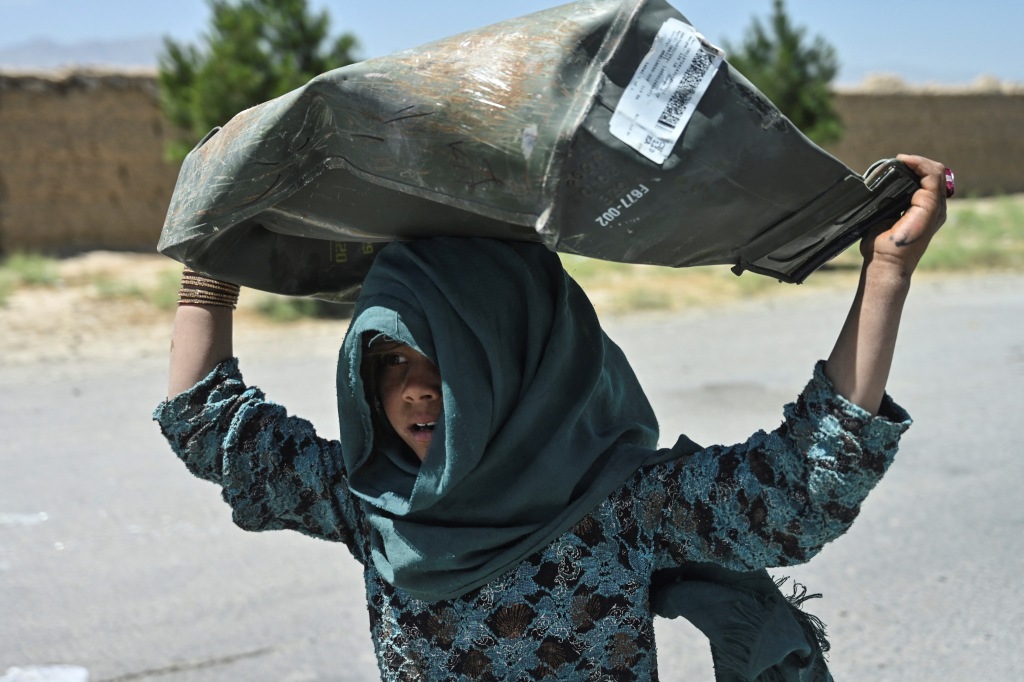
So American troops are leaving places like Bagram like thieves in the night, leaving behind lots of junk and a legacy of violence and destruction. If one photo can serve to sum up our withdrawal, consider this one of an Afghan girl at work carrying scrap metal (Made in USA!) for money:

In this picture taken on June 17, 2021, a girl carries a metal box she collected from a junkyard near the Bagram Air Base in Bagram. – The Pentagon is evacuating Bagram airbase as part of its plan to withdraw all forces by this year’s 20th anniversary of the September 11 attacks on the US, taking military gear home or given to Afghan security forces, but tons of civilian equipment must be left behind. (Photo by Adek BERRY / AFP) / TO GO WITH ‘Afghanistan-USA-conflict-Bagram’ FOCUS by Anne CHAON and Mushtaq MOJADDIDI

Well, that makes me proud to be an American.

Update (7/9/21):

Biden’s speech yesterday on Afghanistan was the usual claptrap. He claimed the U.S. didn’t go to Afghanistan to nation-build, even though the Afghan surge was all about defeating the Taliban while installing a “government in a box” for the Afghan people. All that effort by so many agencies to create an Afghan justice system, security forces, and so on so as to create the fundamentals of a government — all forgotten now because they failed. Meanwhile, the Afghan forces the U.S. military “trained” are folding quickly, flooding Afghanistan with even more weaponry.

I got this in my news feed from the New York Times: 

In Forceful Defense of Afghan Withdrawal, Biden Says U.S. Achieved Its Objectives

By Michael D. Shear, David E. Sanger and Thomas Gibbons-Neff
The president insisted that the United States had done more than enough to empower the Afghan police and military to secure the future of their people.

Look at the way this is structured. First the lie that we achieved our objectives. Then the idea that the way to “secure the future” is to create strong police and military forces. That is surely an idea that’s made in militarist America — that you secure the future through strong police and military forces. It’s the very opposite of what a democratic society would argue. But it is the approach of an authoritarian empire.

The GM Ignition Switch Crime

A grieving Laura Christian (far right) appeals to GM and America for justice (J. Scott Applewhite/AP)

W.J. Astore

Truthout has a powerful story on the GM ignition switch design flaw, the one that killed at least thirteen people, and possibly as many as 29 (or more).  If many are so eager to support capital punishment for mass murderers, why not the death penalty for GM?  GM knew about the problem with their switch, but apparently decided it was more cost effective not to engage in a recall that would cost the company roughly $1.5 million, or 57 cents per car.

As Truthout suggests, the big problem is no one is held responsible for corporate murder.  Some money washes hands in various lawsuits, perhaps a big fine will be levied by the government, but no one goes to jail, no specific person is punished.

This sad and tragic fact put me to mind (once again) of Don Henley’s song, “If Dirt Were Dollars,” in which he sings:

“These days the buck stops nowhere/no one takes the blame/but evil is still evil/in anybody’s name.”

If corporations are people, as the U.S. Supreme Court decided, and as Mitt Romney reminded us while he campaigned for president, can’t we punish them as people?

The death penalty is popular in many places in America — it allegedly deters the worst crimes, its supporters claim.  Isn’t it time for an ignition kill switch to be activated against GM?  That would certainly deter future companies from valuing their bottom lines more than the lives of their customers.

But I’m dreaming, of course.  Corporations are citizens, my friends, except they are much more equal as citizens than you and me.  How can we measure their value?  Look again to their financial bottom lines, and how much “free” speech that allows them to exercise in the halls of power.

And so it goes in the land that equates speech and honor with money and power.