Understanding Donald Trump’s Appeal

Trump runs over GOP

W.J. Astore

I lived and taught in a rural and conservative area in Pennsylvania for nine years, an area that’s “flyover country” for Beltway elites.  Back in 2008, I remember how the locals went gaga over Sarah Palin’s visit to the area, and how crestfallen so many people were when Barack Obama was elected president.  I remember how people sported Bush/Cheney stickers on their cars and trucks (even the faculty at the largely vocational college at which I taught), long after these men had left office.  Sadly, I also recall a lot of Confederate flag license plates, especially on trucks, but there were also people who flew them at home from their flagpoles.  This was not about “heritage,” since Pennsylvania was Union country in the Civil War.  No – it was about being a White “redneck” and taking the country back from, well, the “other” – Blacks, Muslims, immigrants, anyone considered to be an outsider, anyone part of the “influx,” a racially-loaded word that referred to outsiders (where I lived, mainly Blacks from Philadelphia and its environs).

Rural PA, previously Sarah Palin country, is now Trump country.  In the recent presidential primary, fifty thousand Democrats in PA changed party affiliation so they could vote Republican.  An educated guess: they weren’t switching parties to vote for Kasich or Cruz.  They were caught up in Trump hype about making America great again!

download
It says so on his hat!

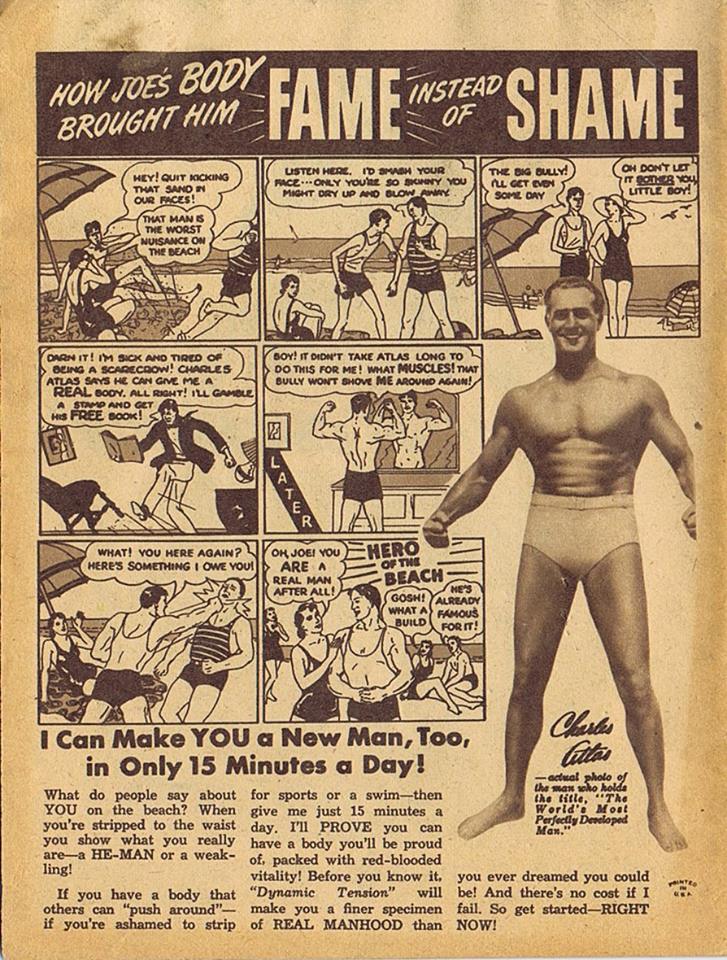
That’s a slogan to be reckoned with.  Some say it’s a racist dog whistle.  Those with ears attuned to the frequency hear the message as “making America great again by making it White again.”  There’s truth to this, but the message is also one of nostalgia.  Trump, like many of his followers, has recognized that the USA is no longer NUMBER ONE in all things, and he’s got the balls (as his followers might say) to say it plainly.  No BS about America being the exceptional nation, the bestest, the kind of nonsense that flows freely from the mouths of most U.S. politicians.  America is acting like a 99-pound weakling, Trump says, and he’s the Charles Atlas to whip us back into shape.
atlas

Trump’s vulgarity, his elaborate comb over, his tackiness, the shallowness of his knowledge (especially on foreign affairs), have contributed to the establishment’s ongoing dismissal of him.  A recent article by Glenn Greenwald and Zaid Jilani documented the many dead certain (yet dead wrong) predictions of Trump’s imminent demise, even as he was winning primary after primary and gaining in the polls.  The establishment elites just couldn’t believe that a man not vetted by them – a man best known for bloated casinos and lowbrow reality TV – could be a viable candidate for the presidency.  And indeed they continue to predict his imminent demise at the hands of one of their own (Hillary Clinton) in the fall.  Yet as I wrote back in July 2015, Trump is not to be underestimated.

What exactly is the appeal of Trump?  Speaking his mind is one.  Yes, he’s vulgar, he’s boorish, he’s ignorant, he’s sexist.  Just like many of his followers.  In a way, Trump revels in his flaws.  He has the confidence to own them.  Many people are attracted to him simply because (like Sarah Palin) he’s not a typical mealy-mouthed politician.

Another obvious appeal: He’s a rich celebrity who acts like a rube.  Indeed, he acts like many regular folks would if they’d just won a Powerball jackpot.  He’s got the trophy wife.  He’s got a lot of pricey toys (How about that Trump jet?).  He doesn’t have much class, but so what?  Trump is Archie Bunker with money, a blowhard, an American classic.  What you see is pretty much what you get.  And that’s a refreshing feature for many of his followers, who have little use for complexity or nuance.

trump jet
Not presidential?  He already has his own “Trump Force One”

For all that, let’s not ignore Trump’s positions (such as they are) on the issues.  He’s against a lot of things that many Americans are also against.  He’s critical of immigration.  He’s more than wary of Muslims.  He despises “political correctness.”  He’s against trade deals (so he says).  The Chinese and Japanese come in for special opprobrium as trade cheaters.  “And China!  And China!” Trump declaims as he launches another round of attacks on the Chinese for stealing American jobs.  Trump’s followers believe they’ve finally found their man, someone who will stand up to the Chinese, the Mexicans, the Muslims, and all those other foreigners who are taking their jobs and hurting America.

Trump is a master of scapegoating.  But more than this, he takes positions that show a willingness to depart from Republican orthodoxy.  He’s expressed support for Planned Parenthood (except for its abortion services) because of the health care it provides to women.  He’s outspokenly critical of U.S. wars and nation-building (as well as Bush/Cheney and company).  He wants to rebuild America’s infrastructure.  He wants to force America’s allies to pay a greater share of their own defense costs.  He’s not slavishly pro-Israel.  He’s not enamored with neo-conservative principles and the status quo in U.S. foreign policy.  He wants to put “America first.”  As far as they go, these are respectable positions.

Yet I’ve not come to praise Trump but to explain, at least partially, his appeal and its persistence.  Trump’s negatives are well known, and indeed I’ve written articles that are highly critical of him (see here and here and here).  Most of Trump’s supporters are aware of the negatives yet plan to vote for him regardless.  Why?

Desperation, to start.  Americans are drowning in debt.  They’re scared.  Not just the lower classes but the middle classes as well.  Just consider the title of a recent article at The Atlantic: The Secret Shame of Middle-Class Americans: Nearly half of Americans would have trouble finding $400 to pay for an emergency.  Times are far tighter for ordinary Americans than Beltway elites know or are willing to admit.

large

In tough times an unconventional candidate like Trump (or Bernie Sanders) offers hope – the promise of significant change.  What does Hillary Clinton offer?  So far, more of the same.  But scared or desperate people don’t want the same, with perhaps a few more crumbs thrown their way by establishment-types.  They want a political revolution, to quote Bernie Sanders.  They want freshness.  Authenticity.

Strangely, despite all his flaws and insults and bigotry, or rather in part because of them, Trump seems more genuine, more of a candidate of the people, than does Hillary.  Bernie Sanders, another genuine candidate with big ideas, beats him handily in the fall, I believe.  But Bernie is being elbowed out by the establishment powerbrokers in the Democratic Party.  The big money (of both parties) is pegging its hopes on Hillary.  It’s already predicted her sobriety and “experience” will triumph over Trump’s wildness and inexperience.

Given the record of “expert” predictions so far in this election, as well as Trump’s own track record, I wouldn’t be too confident in betting against The Donald.

Hillary Clinton: The MOTS Candidate

image
More of the same (MOTS) versus Feeling the Bern

W.J. Astore

With Trump now the presumptive nominee after his victory in Indiana and Ted Cruz’s withdrawal from the race, the Republican narrative seems clear.  Trump’s appeal is summed up nicely here by NBC:

Trump won by discovering a primal desire among GOP voters for a swaggering populist who would buck orthodoxy on trade, protect entitlements, build a border wall, deport all undocumented immigrants, and implement an “America First” foreign policy that demanded allies pay for U.S. protection or go it alone.

Millions of supporters, distrustful of their party’s leaders, rallied behind him as a unique figure whose personal fortune enabled him to spurn donors and say what he wanted with impunity.

His presumptive opponent: Hillary Clinton.  But not so fast!  Playing the spoiler, Bernie Sanders won in Indiana and has an outside chance of denying the nomination to Hillary. As Bernie pointed out in Indiana, he’s winning the vote of those 45 years of age and younger, and his appeal is strong among liberals and independents.

A large part of Bernie’s appeal is that he’s a man of principle with a clear message.  I can easily tell you what Bernie is for.  He’s for a political revolution.  He wants a single-payer health care system.  He wants free college tuition for students at state colleges.  He wants campaign finance reform.  He wants a $15 minimum wage.  He wants to break up big banks.  He was against the Iraq War and wants a less bellicose foreign policy.  The man knows how to take a stand and stick with it.

Now: What does Hillary Clinton want, besides the presidency of course?  It’s hard to say. For the last few months, she’s essentially been responding to Bernie.  As his progressive and idealistic message resonates with voters, Hillary cautiously adopts aspects of it.  For example, she was against a $15 minimum wage until she was for it.  She’s made noises about getting big money out of politics even as she’s siphoned up as many Benjamins as she could.  Lately, she’s pivoted and begun to run against Trump, as if Bernie has no chance at all to deny her the nomination.

Here’s the problem for Hillary: She’s a MOTS candidate, or more of the same.  She’s promised a continuation of President Obama’s policies, at least domestically, while in foreign policy she’s promised to take a harder line than Obama.  But I’m hard-pressed to name a single major policy initiative that’s uniquely hers, and I’ve watched virtually all of the Democratic debates and town halls.  She’s running as a technocrat, as an insider, as Obama in a pantsuit but with iron fists.

Assuming it’s Hillary versus Trump in the fall, it’ll be Trump who has the ideas, crazy or divisive or unsustainable as they may be.  And it’ll be Hillary who’ll be running as the “safe” candidate, the anti-Trump, the one whose motto might be, “the audacity of establishment incrementalism.”

Is that what American voters are looking for?  Establishment incrementalism?  More of the same?

Stay in the race, Bernie Sanders, and give us a real choice this fall.

Above the people, beside the people, against the people

abe

W.J. Astore

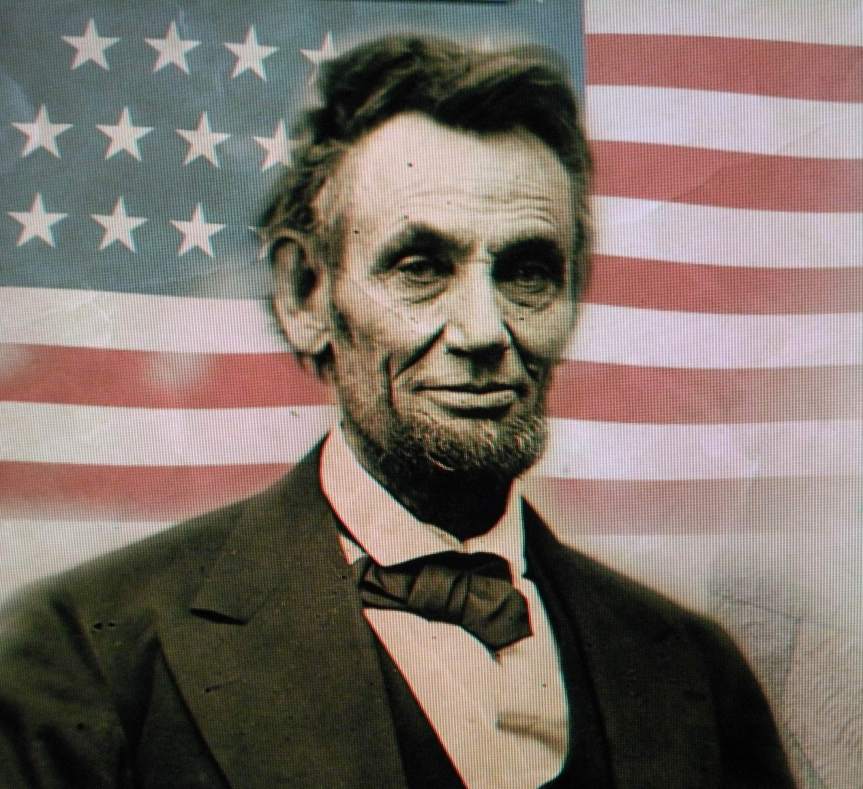
Remember when Abraham Lincoln wrote about our government as being “of the people, by the people, for the people”?  Even after 150 years, those words still resonate, but they are increasingly less true.  Today, our government places itself above the people, and when the government is not working against the interests of (most of) the people, it acts as if the people’s interests are beside the point.

We’ve entered a new historical moment in America, which is precisely the point of Tom Engelhardt’s latest essay at TomDispatch.com.  As Engelhardt notes, our electoral process is “part bread-and-circuses spectacle, part celebrity obsession, and part media money machine.” Our foreign policy, and increasingly our domestic policy as well, is dominated by the national security state, the one leviathan in our government that is never paralyzed.  The political process itself is ever more divisive, polarized, and disconnected from the hardships faced by the working and middle classes.  Even planetary dangers such as climate change are either denied or ignored, as if denial or ignorance will keep seas and temperatures from rising.

The very disconnection of our government from painful realities explains in part the appeal of “maverick” candidates like Donald Trump and Bernie Sanders.  Yes, they are two very different men, but what they have in common is their willingness to take the side of ordinary Americans, who have seen their standard of living stagnate or drop over the last thirty years.  Trump says he wants to make America great again: the implicit message is that we pretty much suck now, that we are a nation in decline, and that the sooner we admit it, the sooner we can take action to restore America to greatness.  Sanders says he wants a future we can believe in, which is at its core much like Trump’s message.  America has serious problems, both men are saying, but greatness is still within our grasp if only we act together as a people.

Again, much separates Trump and Sanders, yet both are willing to admit the times are bad for many hardworking Americans.  What they’re saying is this: the American dream is increasingly a nightmare.  And part of the nightmare is a government that doesn’t act in the people’s interests because it’s been co-opted by special interests.  A government that can’t even do its job, such as to declare war or to advise on a Supreme Court nominee, in accordance with its Constitutional duties.

The promise and potential of our country remains.  But that promise, that potential, is being squandered by an alliance of various interests that are no longer responsive to the people.  If not dead, representative democracy in America is on life support.  Unless we can reinvigorate it, as Engelhardt notes in his article, we will continue to suffer a decline analogous to the declines of other great empires (think Rome, for example).  The difference today is the possibility of planetary-wide destruction, whether quickly from nuclear weapons or slowly from climate change.

Never was a revival in American democracy more urgently needed, not only for ourselves, but for the world.

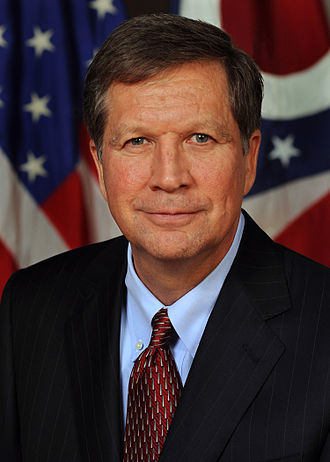
The Next Commander-in-Chief

Governor_John_Kasich
John Kasich

W.J. Astore

A reader wrote to ask my opinion on which presidential candidate would make the best commander-in-chief.  This is a speculative exercise, of course, but why not speculate? I’ve watched most of the debates and have a sense of the candidates, though of course I’ve never met them and have no direct experience with them.  (I once shook President Bill Clinton’s hand, and saw Hillary in the background, but that’s a story for another day.)  So let’s take the five remaining candidates in alphabetical order:

Hillary Clinton: Often wrong and too hawkish, which is a bad combination. She was wrong on the Iraq War, wrong on Libya, and unapologetic in her fondness for Henry Kissinger. Under Clinton, I see more wasteful military interventions.

Ted Cruz: Far too eager to use military force.  You’ll recall his posturing about “carpet bombing” and making the sand “glow” in the Middle East, apparently by using nuclear weapons.  The recent terrorist attacks in Belgium have him calling for a police state in U.S. neighborhoods where Muslim-Americans live.

John Kasich: Has experience working military matters while in Congress (18 years on the House Armed Services Committee).  Has executive experience as a governor.  Has had the temerity to criticize the Saudis for supporting radical elements in Islam.  Has opposed wasteful weapons systems (the B-2 and A-12, for example).  Speaks carefully and appears to be temperamentally suited to the job.

Bernie Sanders: He was right to oppose the Iraq War.  Thinks for himself.  Not a slave to neoconservative interventionism.  Yet he lacks experience dealing with the military and with foreign policy.  Has the capacity for growth.

Donald Trump: Lacks an understanding of the U.S. Constitution and his role and responsibilities as commander-in-chief.  Though he has shown a willingness to depart from orthodoxies, e.g. by criticizing the Iraq War and the idea of nation-building, Trump’s temperament is highly suspect.  His bombast amplified by his ignorance could make for a deadly combination.  Hysterical calls for medieval-like torture practices are especially disturbing.

Of the five major candidates, and with Sanders somewhat of a blank slate, I think John Kasich has the best potential — in the short-term — to be an effective commander-in-chief.  This does not mean that I support Kasich for president, for I object to several of his domestic policies.

Not exactly a “bracing view,” perhaps, but it’s my honest attempt to answer a reader’s question.  I do think Sanders has considerable potential to be an excellent commander-in-chief because he possesses moral courage.

Sadly, the odds of either Kasich or Sanders winning in November seem very long indeed.

Hillary Clinton: A Deeply Compromised Candidate

hillary henry
Hillary and Henry

W.J. Astore

Hillary Clinton is a deeply compromised candidate.  She and her husband have made over $125 million in paid speeches since 2001, including $30 million in 16 months.  There’s nothing wrong with making lots of money: this is America, after all.  But there’s something wrong about accepting big checks from powerful banks and investment houses and then positioning yourself as the champion of “everyday people” in your run for the presidency.

Along with her close alliance with Wall Street, Hillary is essentially a neo-conservative on foreign policy who admires the Real Politik of men like Henry Kissinger.  She promises more interventionism overseas and doubtless more wars.  She is especially close to Israel and advertises herself as a loyal ally to Benjamin Netanyahu.

The person she most closely resembles in recent U.S. politics is Richard Nixon.  Like Nixon, she’s aggressive in foreign policy (recall her infamous quip about the fall of Qaddafi in Libya: “We came, we saw, he died”).  Like Nixon, she is secretive and economical with the truth, despite her truth-telling vows.  Like Nixon, she is a complex person, not without talent, but a person who often doesn’t appear fully comfortable, especially when pressed about her record.  Like Nixon, she leaves very little to chance; there’s calculation to nearly everything she does.

A Hillary Clinton administration promises to be even less transparent than Obama’s.  It would be more in service to the powers that be (big money donors such as the health care industry will come calling for their payback, and they’ll get it).  Despite protestations of being “progressive,” a Clinton administration promises to be regressive in terms of peace, social progress, and fairness for the working classes.

Despite this, her path to the presidency seems remarkably clear.  Bernie Sanders, an honest man of conviction, lacks establishment support.  Hillary’s Republican opponent of the moment, Donald Trump, is an opportunistic business tycoon who apparently says whatever pops into his head.  Trump may be the one candidate with more negative baggage than Hillary.

A Hillary/Trump matchup this fall promises lots of drama, but it’s a lose/lose scenario for anyone looking for real progressive change.

Bernie is More Generous to Workers than Hillary

Bernie

Last night’s town hall in Nevada revealed a crucial difference between Bernie Sanders and Hillary Clinton.  Bernie came out strongly for a $15 per hour minimum wage.  A living wage, as he called it.  Hillary demurred, suggesting that $12 per hour was sufficient, though she mentioned municipalities with higher minimums (places like San Francisco, which have a very high cost of living).

An extra $3.00 and hour, for 40 hours a week, for 50 weeks a year, is an extra $6000 in the pockets of workers (before taxes, of course).  For many working families, that’s the difference between struggling in poverty and making enough to live with a modicum of security.

Hillary went unchallenged on her $12 per hour figure.  But let’s remind ourselves that Hillary made $675,000 for three speeches to Goldman Sachs.  A person working for Hillary’s “generous” $12 wage would need 28 years to match what she made in three speeches that took her all of a few hours to make.

Indeed, Hillary’s “minimum wage” for her speeches to big banks and Wall Street is in the neighborhood of $100,000 to $200,000 per hour.  “Hey, that’s what they offered,” Hillary said.  And so Hillary is offering you, sales associate at Walmart, $12 per hour.  Are you not entertained?

When asked if she’d release transcripts of her speeches to the Wall Street banks and investment houses, Hillary essentially said no.  Of course, she didn’t say “no” because that would be honest.  Instead, she said she’d release her transcripts if all the other candidates did the same.  She knows that’s not happening, so her answer is no.

Perhaps Hillary could contact Goldman Sachs and ask them to start inviting workers to give speeches at her going rate.  A lot of American working families would deeply appreciate making $225,000 for a couple of hours of sharing their hard-won experiences with Wall Street bankers and investors.


Hillary Clinton’s “Low Blow”

joust
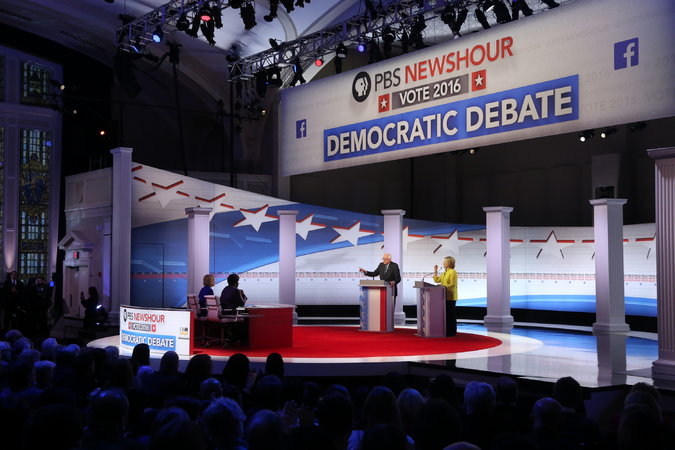
Bernie and Hillary at last night’s debate (Source: NYT)

W.J. Astore

Last night’s Democratic debate between Hillary Clinton and Bernie Sanders in Milwaukee hit the usual notes for these two candidates (the transcript is here). Clinton is all about competence and being ready on “day one” in the Oval office, whereas Bernie seeks a political revolution to galvanize the people. But a few telling items came up, mostly toward the end of the debate.

1.  Hillary accused Bernie of being too critical of President Obama, of not supporting him, of suggesting he was “weak,” and of not respecting Obama’s legacy of results, especially the Affordable Care Act.  This was a “low blow” for Bernie, who explained that he fully supported Obama, considered him to be a friend, and that he did indeed respect the president’s accomplishments.  Besides that, Bernie noted, “one of us ran against Barack Obama [in 2008]. I was not that candidate.”

2. Bernie actually dared to suggest the Defense Department’s budget had to be given careful scrutiny, noting that the DoD has yet to pass an audit.  In these days of issuing blank checks to the Pentagon, it was a significant moment.

3.  Bernie took Hillary to task, successfully I believe, for her cozy relationship with Henry Kissinger.  In my view, this was the most important moment of the night. With respect to U.S. foreign policy, Hillary promises continuity with neo-conservative principles of American interventionism and preemptive war.  Bernie, even as he promises to crush the Islamic State, is far less enamored with neo-con agendas and peace through aggression.

Here is what Bernie had to say about Kissinger:

“I happen to believe that Henry Kissinger was one of the most destructive secretaries of state in the modern history of this country.  I am proud to say that Henry Kissinger is not my friend. I will not take advice from Henry Kissinger. And in fact, Kissinger’s actions in Cambodia, when the United States bombed that country, overthrew Prince Sihanouk, created the instability for Pol Pot and the Khmer Rouge to come in, who then butchered some 3 million innocent people, one of the worst genocides in the history of the world. So count me in as somebody who will not be listening to Henry Kissinger…”

“Kissinger was one of those people during the Vietnam era who talked about the domino theory. Not everybody remembers that. You do. I do. The domino theory, you know, if Vietnam goes, China, da, da, da, da, da, da, da.  That’s what he talked about, the great threat of China.”

“And then, after the war, this is the guy who, in fact, yes, you’re right, he opened up relations with China, and now pushed various type of trade agreements, resulting in American workers losing their jobs as corporations moved to China.”

“The terrible, authoritarian, Communist dictatorship he warned us about, now he’s urging companies to shut down and move to China. Not my kind of guy.”

Hillary defended her relationship with Kissinger, just as she defended herself from suggestions she’d be influenced by big money donors. In both cases, she came across as the establishment candidate, one who is most comfortable in the corridors of power, schmoozing with other power brokers and players.

In sum, even as Hillary attempts to appropriate some of Bernie’s anti-establishment rhetoric, her actions demonstrate how much she’s ensconced within the establishment camp, especially when it comes to U.S. foreign policy.

For voters looking for change in November, Hillary promises only an amped up version of more of the same.


A Message of Uplift Won New Hampshire

SUB-TRUMP2-videoSixteenByNine1050
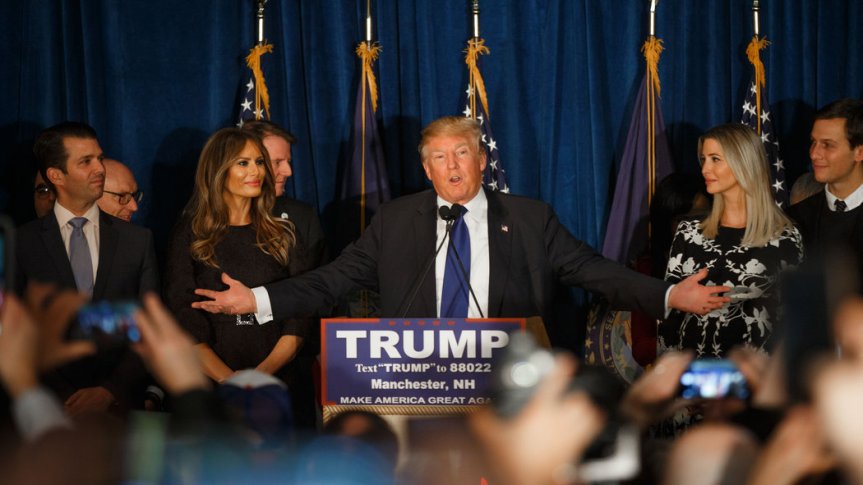
He’ll make America great again — it says so on his podium!

W.J. Astore

My wife and I watched the results come in last night on MSNBC and the four speeches by Hillary Clinton, Bernie Sanders, Donald Trump, and John Kasich.  Surprisingly, the best speech of the bunch was by Kasich, but more on that in a moment.

Hillary charged ahead with a concession speech that was basically a recycled stump speech.  It looked like she was using teleprompters.  She offered the obligatory thanks to her supporters, to New Hampshire, and so on, but you could tell she just wanted to move on from her crushing defeat.  She has real difficulty connecting with an audience, and her campaign’s message that she’s the most competent candidate, the one best able to step into the Oval Office on day one, simply isn’t resonating with voters who are fed up with establishment politics.

Bernie went next and also gave a modified version of his stump speech.  He spoke too long, but I’m guessing he was doing his best to exploit his “prime time” moment.  He offered kind words for Clinton but then proceeded to attack the politics as usual that she represents.  What got me most was the genuine excitement in the room for Bernie.  The people cheering behind him were an especially eclectic and vibrant mix (I know the “optics” are usually managed, but still).  There was a young black guy wearing a hat and a Bernie t-shirt who was simply a riot.  (He was standing behind and to Bernie’s left.)  My wife and I looked at each other and said: “He should be Bernie’s Vice President.”

Trump came on the heels of Bernie, and the shift in tone was immediate.  With Bernie, it’s all about the movement.  With Trump, it’s all about Trump.  Flanked by his photogenic family, Trump once again told Americans how he is going to make America “great” again, how America is going to win again — at negotiating treaties, with the economy, with wars — heck, I guess we’re going to win at EVERYTHING with Trump in command.  Again he boasted how he’s going to make the U.S. military so big and so strong that no one will dare attack us.  In a word, he bloviated.  But Trump should never be dismissed lightly, certainly not after his decisive victory in New Hampshire.

Kasich came next after Trump, and again the tone shifted.  Coming in a strong second in NH, Kasich talked about listening to the American people, and how the 100+ “town halls” he had done had changed him as a candidate and as a person.  He told personal stories and connected with the audience; he closed on a note of compassion, asking Americans to decompress, to take time to listen to one another, to find time for reflection.  His speech was the most personal and heartfelt of the four that I heard, and I found myself hoping that Kasich’s message would ultimately triumph over the bellicosity of Trump, Cruz, Rubio, and the rest of the Republicans.

Overall, last night was a night of surprises, with two unconventional candidates, Sanders and Trump, winning convincingly.  Their messages, of course, are polar opposites. Bernie wants a better future for all Americans, especially for the disadvantaged, whereas Trump is all about making America big and strong, a “winner.”  Put differently, Sanders sees a lot of ordinary Americans who are losing in today’s “rigged” economy, and he wants to lift them up.  Trump sees America writ large as losing, even some of the wealthiest, vis-a-vis foreign competitors like China, and he says he’ll lift all of America up.

It’s that message of uplift, expressed so differently by Sanders and Trump, that resonated so powerfully in New Hampshire.


Hillary to Bernie: You Smear Me When You Tell the Truth

bernie

W.J. Astore

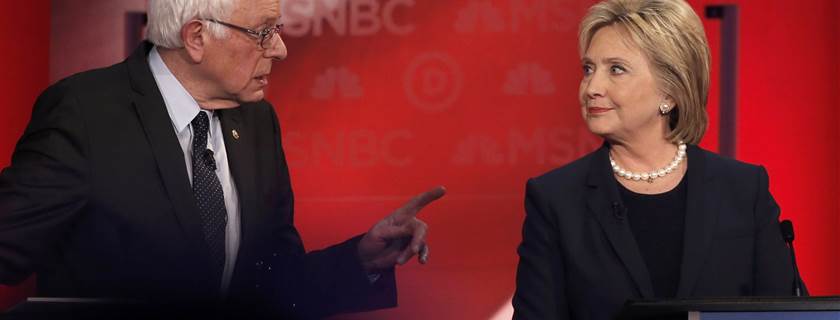
I watched yet another Democratic debate last night, this one moderated by MSNBC in a more traditional format instead of the previous version’s “town hall.”  Much was repeated: Bernie Sanders wants a “revolution” to overthrow a rigged economy and to enact campaign finance reform, Hillary Clinton says she’s a progressive who can get things done and who will build on the legacy of President Obama.

For me, the big moment came when Hillary tried to change the narrative on her taking millions of dollars from banks, investment houses, and Wall Street in the form of speaking fees and money from Super PACs.  She accused Bernie of a “smear” campaign when he “insinuated” she might be influenced by all this money.  She said other progressives (she cited Obama, for example) took money from Wall Street yet still allegedly held the big money boys to account.

Another moment, not as big but also telling, was when Bernie painted Hillary as an “establishment” candidate.  Talk about stating the obvious!  But Hillary rejected this by playing the gender card.  How can I be an establishment candidate for president, Hillary asked, when if elected I’d be the first woman president?  This is total nonsense, of course. She is an establishment candidate who just happens to be a woman.  But I suppose she and her team had no other response to the truth Bernie was bringing.

Speaking of the establishment, after claiming she wasn’t part of it, Hillary cited Henry Kissinger’s praise of her, saying Kissinger had applauded her for running a tight ship at the State Department.  Praise from Caesar …

But back to the “smear” campaign.  Obviously, Hillary and her team are hoping the media will focus on the smoke and mirrors generated by that loaded term, while neglecting the reality of Bernie’s truth-telling.  Given the craven nature of the mainstream media, her cynical gambit may even work.

When the big money boys give millions to candidates, any candidate, they’re not usually so blatant (or stupid) as to be buying votes.  They’re not going to get caught telling a candidate, vote yes on this, no on that.  What they’re buying is access.  They’re gaining the candidate’s ear. They want to be the last “person” to whisper in the candidate’s ear before she or he makes a decision.

I’m sure Hillary believes she’s her own woman.  But she knows how the system works, and so does Bernie.  If you accept big money, you know it always comes with strings attached.  The more big money you accept, the more strings, until no matter how much you resist, you end up dancing like a puppet on those strings.  That’s basically Bernie’s point, and it’s not a smear. It’s the truth.

An interesting question came up about whether Hillary would be willing to share transcripts of all her speeches before the big money boys.  She said she’d look into it.  If she’s the “progressive” she claims to be, she should be willing to share those transcripts immediately as a matter of public record.  Something tells me we either won’t see these transcripts, or they’ll be released months from now, after the primary race is decided.


Bernie Sanders Won Last Night’s Democratic Debate

bernie
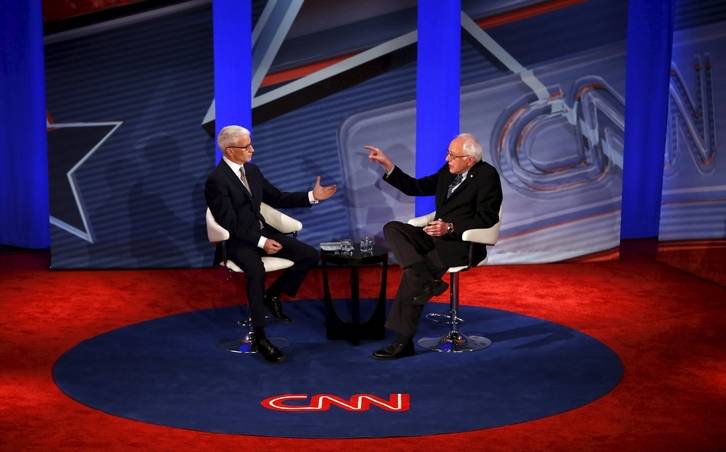
Bernie Sanders makes a point to Anderson Cooper during last night’s debate

W.J. Astore

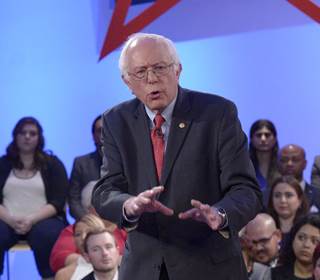
Last night, Bernie Sanders and Hillary Clinton separately took questions from a “town hall” in Derry, New Hampshire with Anderson Cooper moderating.  Overall, both candidates did well, though I give the edge to Sanders (more on why in a moment).

Sanders came across as passionate on the issues and concerned for ordinary Americans.  He continues to speak of a political revolution, which to him doesn’t mean tumbrels to the guillotine.  It means getting more people involved in the political process, especially youth and the disadvantaged.  He spoke eloquently of helping others.  Memorable to me was his work to desegregate housing owned by the University of Chicago when Sanders was a student.  When asked why he fought against racist policies, Sanders said he’s always hated a bully – and always fought for fairness and equality.  He came across, in short, as an honest and decent man, a man of integrity, which is the word his wife used to describe him (she was sitting in the audience, and was asked to describe her husband with a single word).

Hillary came across as determined and competent and informed.  She tended to meander during her answers, coming across as somewhat of a policy wonk or a technocrat.  She rejected Sanders’ talk of a revolution, preferring to build on President Obama’s (and her own) legacy.  For example, she wants to put the finishing touches to Obamacare, rather than going for Sanders’ idea of a single-payer, “Medicare for all” system.  She spoke briefly of breaking the ultimate glass ceiling for women – her gaining the office of the presidency – and how that would inspire women of all ages.  She took her usual hardline on U.S. foreign policy, making no promises that she would reduce wars or for that matter spending on defense.

In sum, if you’re happy with the status quo, you’ll get plenty of that with Clinton.  If you want change, if you’re tired of a “rigged” economy and a corrupt political process, Sanders is far more likely to act in your favor.

Where I thought Hillary fell down was in her posturing as a progressive.  The millions of dollars she has accepted in speaking fees from banks and investment houses, she suggested, would have no impact on her policy decisions, which is simply implausible.  Powerful organizations don’t give political candidates big money without strings attached to it, and of course Clinton knows this.  It also seemed implausible when Clinton suggested she had not decided to run for president when she accepted those speaking fees.  As if her “doubts” about running absolved her of responsibility for taking big money from Wall Street.  It was all frankly unconvincing.

Hillary Clinton is a fighter.  She came across best when she spoke of the Republican right-wing attacks she’d had to endure over the last 25 years, and what they’d taught her about the political process.  Her footing was less secure when she had to relate to other people.  For example, a man suffering from advanced-stage cancer asked her about dying with dignity.  Bill Clinton, the “natural” as Hillary called him, would have turned this into an empathetic “I feel your pain” moment.  But Hillary got lost in the details, saying she would have to study up on the ethics of terminal care, the laws, the role of medical professionals, what other countries are doing (she mentioned The Netherlands), and so on.  As she tackled the problem in a wonkish way, she seemed to forget the person standing in front her.

In sum, Bernie Sanders is driving the narrative, not Hillary Clinton.  It’s Bernie who’s been talking about a rigged system, about economic fairness, about working for unions, about justice and prison reform, and it’s Hillary who’s been put on the defensive.  So lately Hillary’s been borrowing liberally from Bernie’s script.  She’s now talking about “the deck being stacked” against ordinary people, and how she’s going to fight for workers, and how much Wall Street is supposedly against her candidacy.

As Bernie has gained in the polls, as his message has begun to resonate, Hillary has responded by trying to be more like Bernie.  And it just doesn’t ring true, at least for me.  Advantage, Bernie.