W.J. Astore
About seven years ago, I had an impassioned debate with a conservative friend about whether the U.S. had engaged in torture and, if we had, whether it had been effective. My position was clear: we had engaged in torture, and it was both wrong and counterproductive. My friend was unconvinced. His arguments, which I detail below, provide a contrary perspective on the issue of torture as well as insight into the rationale of those who supported Dick Cheney’s unapologetic stance on torture.
(My friend is now deceased. I don’t believe he would object to having his views outlined here, but I do believe he would wish to remain anonymous. I have edited his comments for clarity, putting them in the form of a list.)
1. Torture. The very word makes us feel a bit uncomfortable. Yet we have yet to come to anywhere near an agreement on exactly what the word means. To some it is hot irons, the rack, and beatings. At the other end are those who maintain the act of keeping prisoners at a facility like Gitmo, or indeed at any facility, is in of itself a form of torture.
I am not in favor of categorically using physical means to obtain intelligence from captives. From the tone of the [White House] memos [on torture], and from what I have read of the views of those in both the White House and the Pentagon, no one there was in favor of that approach either. That is clearly not in the best interests of anyone. At the same time, it is folly to advertise [to the enemy] exactly what we will and will not do.
Clearly, from the very fact that the memos exist at all, and that questions were asked requiring legal answers, this subject was not approached in a cavalier fashion by anyone [in the Bush Administration].
It was St. Augustine who first offered the admonition that you may not do evil that good might come of it. But he also said that it is at time permissible to tolerate a lesser evil to prevent a great evil.
2. Waterboarding did yield results that stopped an attack on US soil. I believe that Cheney is correct in asking that further memos be released that either prove or disprove that point. I also believe that these episodes of waterboarding are being presented [by the media] out of context and without perspective. In sum, if waterboarding resulted in obtaining info that did indeed foil an operation against the U.S., then I see no problem with having used it.
3. The Geneva Conventions [on the treatment of prisoners of war] do not apply here. Terrorists are not soldiers of any state. They do not wear uniforms. We have a new paradigm to which we must adjust, both in the pure military sense, as well as the way we deal with those we capture.
Are such men to be treated as soldiers? Are they to be treated as criminals? Are we to extend such niceties as the Geneva conventions to those who would offer the exact opposite to those who would come under their control?
If we treat all captives as if they were soldiers, under Geneva Convention rules, that would create some problems, and would also effectively end the conversation. There would be no interrogations. On the other hand, if we treat this as a war, and all captives as POWs, then we are well within our rights to keep those same persons under confinement until the war ends.
If we treat these captives as criminals, we have other problems. First, and this may sound silly, but I doubt that they were read their Miranda rights as they were taken prisoner. But if they are to be treated as criminals, then other rules apply as well, and one of those rules is the right for authorities to question them.
As it stands now, how you treat terrorists is open to debate. They are clearly not soldiers. They are also not actually criminals either.
4. The nature of the enemy: What we have now is a very different paradigm. These are not State actors. There is no fear on their part of betraying their “State,” or of facing consequences relating to betraying the State. There is no “State” in the first place. These are Islamo-fascist terrorists, who have no state, only a religious conviction from which they draw their motivation.
We also know that they view cooperation and diplomacy and forbearance as weakness.
We know how totalitarian thugs act and react. We know what drives them, and we know what stops them. We have had ample experience over the centuries.
5. Abu Ghraib in Iraq, while deplorable, also did not represent an attempt to garner intelligence. And its commander was sacked. I take exception to any comparisons with such places as the Hanoi Hilton [in North Vietnam]. The objective there was not information, but rather confession.
And what do we do to detainees who, after being treated as “guests,” respond by throwing feces and attempting to assault US guards? Is no physical response to be permitted at all?
6. This media focus, some would say obsession, with torture is more about attacking the Bush Administration than it is about protecting the rights of prisoners.
7. While I have concerns about the prisoners who are the recipients of torture and abuse, I also worry about those on the other side. The act of abusing another human being is not healthy, and leads to many psychological problems. I worry about the effect any of this activity will have on our own people.
8. The validity of information obtained under torture is always suspect. But we come back then to the very definition of torture. Is the stress of being questioned in of itself a form of torture? And again, we are not talking about soliciting confessions; we are talking about obtaining and confirming information, from various persons and from different sources. If we decide that we cannot in any way, shape, or form question captives, then we might as well just treat them as we would soldiers. And that would mean keeping them locked up for a very long time.”
If I were to summarize my friend’s views, I’d say he believed that torture was regrettable but necessary to keep America safe, that those who were making a big deal about it were motivated by animus against the Bush Administration, and that those who objected to torture in principle didn’t realize the nature of the enemy, i.e. “Islamo-fascist thugs” who had to be “stopped,” even at the cost of committing lesser evils (torture) to prevent greater evils (attacks on innocent Americans).
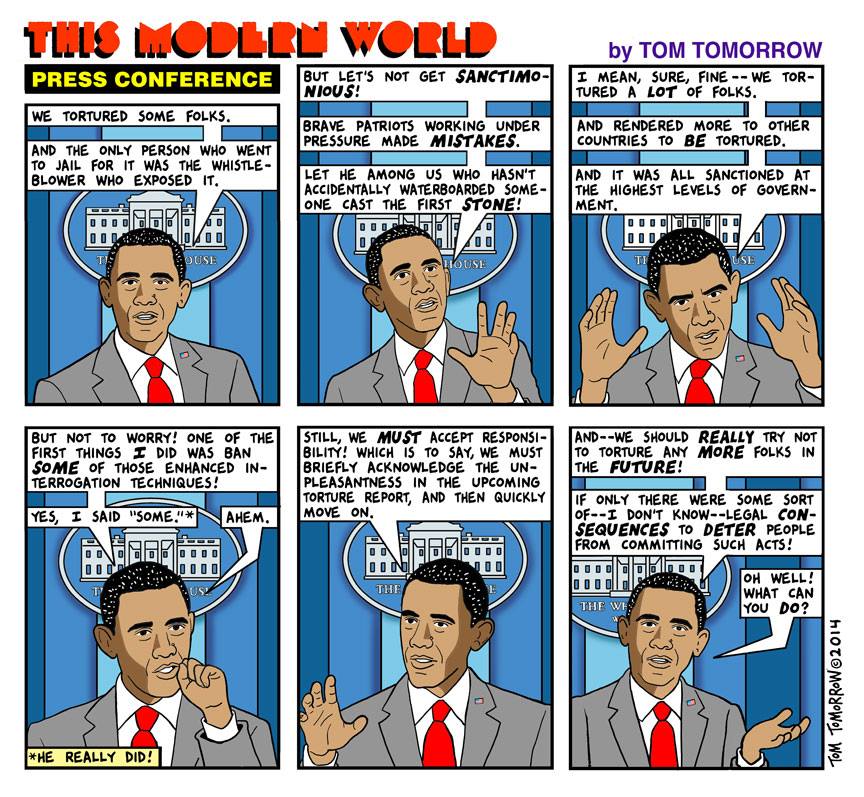
And I’d say his views, politicized and biased as they were, were and are widely held in America, which is exactly why the Obama Administration chose not to prosecute anyone for the crime of torture. “We tortured some folks,” as Obama memorably said, but let’s look forward, not backward. So, in essence, Obama pretty much agrees with my conservative friend.
Update: Another thought: this debate over torture is much like the current debate over the renewal of The Patriot Act. The Obama Administration is trotting out the usual suspects to argue that, to defend ourselves from Islamo-fascist thugs, we must reauthorize the Patriot Act and consent to unlimited surveillance.
It’s yet another version of “we had to destroy the village to save it.” In this case, it’s “we must empower authoritarian and secretive governmental agencies to preserve democracy and freedom in America.” Good luck with that!


 Bracing Views