Would you buy a new car if its longevity was 40% of your old one?
When I was still in the Air Force, the F-35 was on the drawing boards as a fairly low cost, multi-role, fighter-bomber somewhat akin to an F-150 pickup truck. Being designed and built by Lockheed Martin and also having to meet the varying requirements of the U.S. Air Force, the Navy, and the Marine Corps, cost and complexity quickly escalated, so much so that an AF Chief of Staff recently compared it to a Ferrari rather than to a trusty and capable pickup truck.
That Ferrari comparison is apt with respect to cost, though even Ferraris may be more durable and reliable than the F-35.
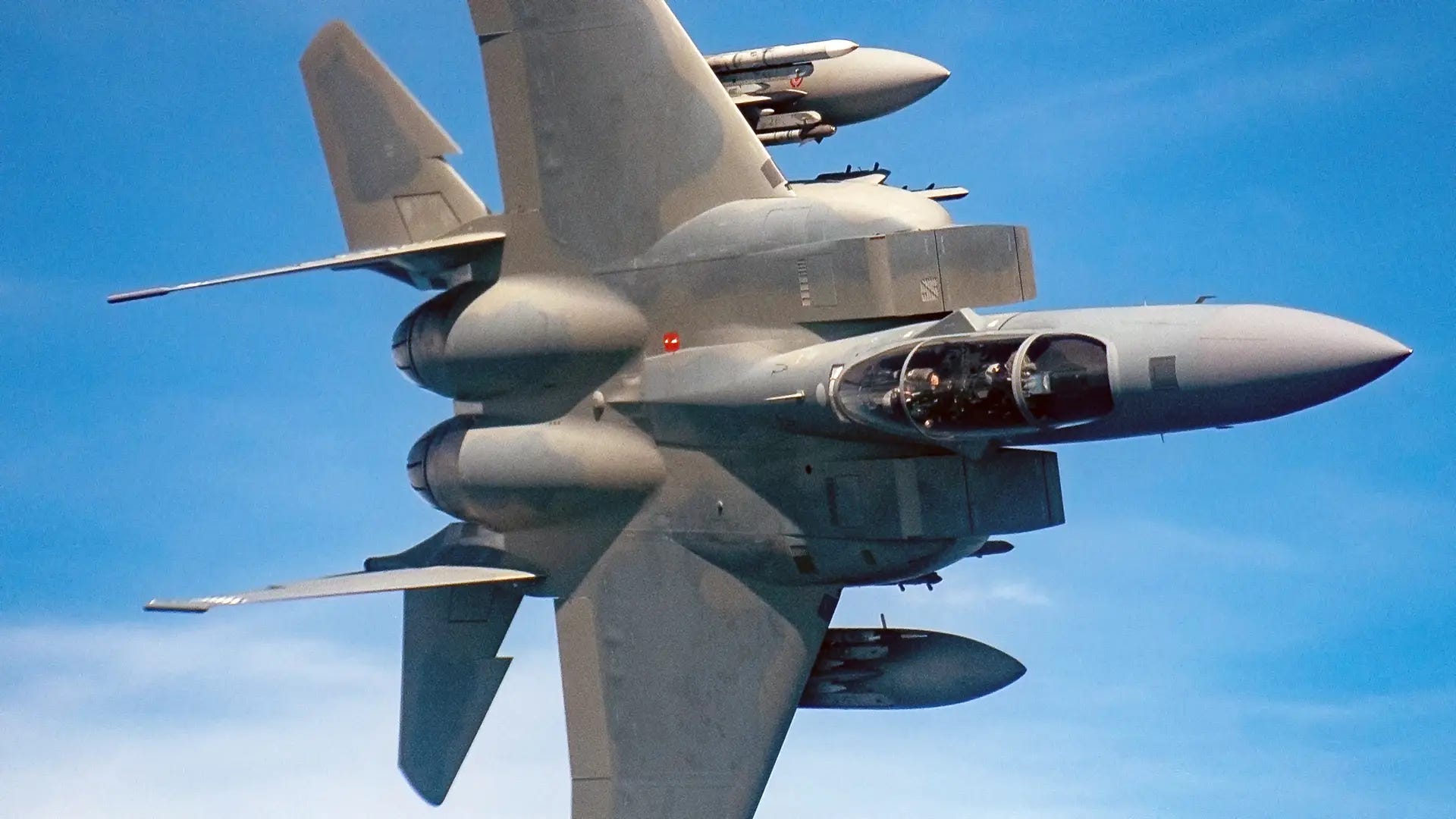
How so? A friend sent along an article on the F-15EX Eagle II fighter.
F-15EX Eagle II. Not stealthy, but its lasts 2.5 times as long as the F-35
Now, I’ve been reading about the F-15 since I was a teenager in the 1970s. It’s a proven fighter jet but it lacks the stealthy characteristics of the F-35. But here’s the section that got my attention from the article:
Remember, the F-15EX has a 20,000-hour airframe life. The F-35A has an 8,000-hour airframe life. This is one way the F-15EX gets done dirty when people make comparisons between it and the F-35, often based on unit cost alone, which is about equal. We are talking about two-and-a-half times the airframe hours out of the box with the F-15EX. That is not a knock against the F-35A at all. The F-15EX is just a very mature aircraft that has been optimized for longevity over a much younger one.
I like the way the author tries to explain away the short airframe life of the F-35. Hey, it’s a young aircraft! What can you expect except a 60% drop in longevity?
How many of us would buy a car, a truck, or any other technology if we were told the new tech would last only 40% as long as roughly comparable older tech? Would Apple advertise a new iPhone battery as lasting only four hours when the previous version lasted ten hours? How many people would rush out to buy the “new and improved” iPhone in this case?
The F-35 has many issues, which I’ve written about here and here. Add a much quicker expiration date to the mix.
I’m assuming Ferrari is none too happy with its cars being compared to the F-35!
What has America learned from the colossal failure of the Iraq War? Not what it should have learned, notes historian (and retired U.S. Army colonel) Greg Daddis at War on the Rocks. Daddis recently attended a 20-year retrospective symposium on the Iraq War, where he heard two distinctive narratives. As he put it:
Most, if not all, veterans of “Iraqi Freedom” told an inward-facing story focusing on tactical and operational “lessons” largely devoid of political context. Meanwhile, Iraqi scholars and civilians shared a vastly different tale of political and social upheaval that concentrated far more on the costs of war than on the supposed benefits of U.S. interventionism.
In short, the U.S. view of the Iraq War remains insular and narcissistic. The focus is on what U.S. troops may have gotten wrong, and how the military could perform better in the future. It’s about tactical and operational lessons. In this approach, Iraq and the Iraqi people remain a backdrop to American action on the grand stage. Put differently, the Iraqis are treated much like clay for Americans to mould or discard should they refuse to behave themselves under our hands.
So the “lessons” for America focus on how to become better, more skilled, manipulators of the “clay” at hand. Issues of right and wrong aren’t addressed. The morality or legality of war isn’t questioned. And Iraqis themselves, their suffering, their plight, even their say in determining their own futures within their country, is pretty much dismissed as irrelevant. And the same is largely true when considering the Vietnam War or the Afghan War; we matter, they don’t, even when we’re fighting in their country and spreading enormous destruction in undeclared and illegal wars.
As Mike Murry, a Vietnam veteran who comments frequently at this site, has said: you can’t do a wrong thing the right way. America’s Vietnam War was wrong; the Iraq War was wrong. There was no “right” way to do these wars. Yet, far too often, U.S. military officers and veterans, joined by far too many Americans who lack military experience, want to focus on how to wage a wrong war in a better, smarter, often more ruthless, way
Indeed, the narrative at times is reduced to “We lost because we weren’t ruthless enough, or we were about to win until the U.S. military was betrayed.” I wrote about this back in 2007 after I heard Senator John McCain speak on PBS. Basically, his point was that if America lost the Iraq War (which we already had), it wouldn’t be the U.S. military’s fault. It would be the fault of anyone who questioned the war. McCain, in other words, was spouting yet another exculpatory stab-in-the-back myth.
What can we learn from the Iraq War, then? Let’s start with these basic lessons: Don’t fight a war based on governmental lies and unfounded fears. Don’t fight illegal and immoral wars. Don’t fight undeclared wars. Don’t meddle in the societies of other people where you are seen as invaders and about which you are ignorant. Don’t wage war, period, unless the domestic security of the U.S. is truly threatened.
Those seem like the right lessons to me, not lessons about how to recognize insurgencies or how to respond more quickly to asymmetries like IEDs and ambushes.
In sum, learn this lesson: Vietnam, Iraq, Afghanistan, were and are countries with rich pasts and proud peoples who were not about to submit to American invaders and agendas, no matter how well-intentioned those invaders believed or advertised themselves to be.
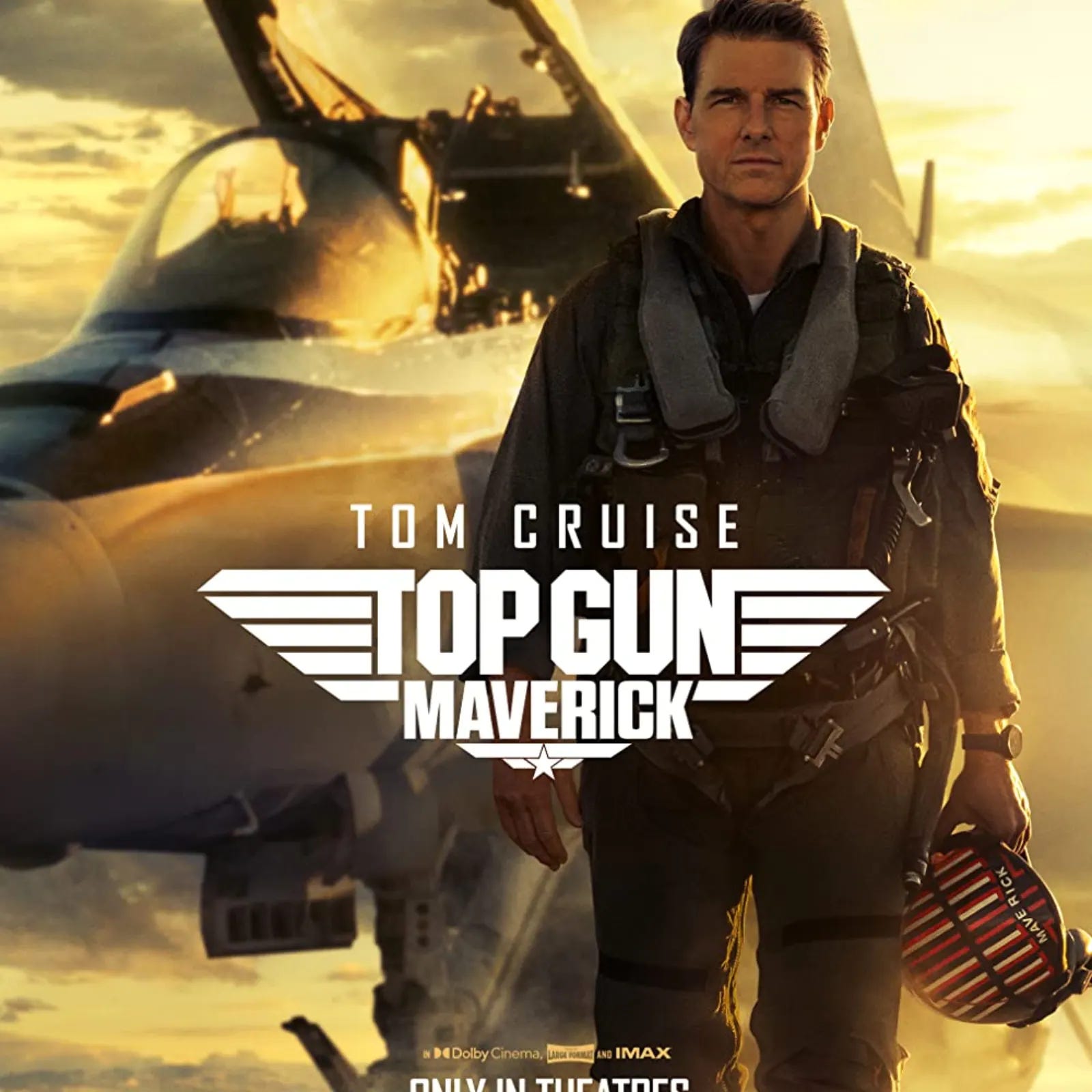
The U.S. military is having a major problem recruiting new troops, notes Nan Levinson in an informative piece at TomDispatch.com. As usual, the military has tried most everything. Lowering standards, especially on the ASVAB test. Boosting bonuses and benefits. Infiltrating high school (even grade schools!) with military programs tied to recruitment like Junior ROTC. More money for ad campaigns, using celebrities and catchy slogans. Hoopla at sports stadiums. Nothing’s worked.
Even extended Hollywood commercials for the military aren’t enough to get young Mavericks to join
But, being an out-of-the-Pentagon-box thinker, I have the solution: Downsize the military!
Why does America need a large standing Army given all the force-multipliers we’re buying for hundreds of billions of dollars each year? What large-scale war is America currently fighting? We pulled out of Afghanistan, out of Iraq (mostly), and should be downsizing our imperial footprint (or bootprint, if you prefer).
I know: Russia! China! We must be prepared!
Those seeking a conventional war with either of those two land powers in their spheres of influence should surely have their sanity checked. Land war in Asia? With nuclear powers? No thank you!
Come on, America. If fewer young Americans want to join the U.S. military, take this as a sign of the wisdom of youth. Wisdom of youth — a phrase not commonly seen, but possibly of great relevance to us all, as Levinson notes in her conclusion.
Want a better military with higher-quality recruits? Simply recruit fewer of them by being more selective and by downsizing inflated recruitment numbers. In other words, change the metrics to show a recruiting victory. The U.S. military, after all, has plenty of experience doctoring metrics (Vietnam, Iraq, Afghanistan, etc.).
Lower the quotas* and declare victory! Hooah!
*Warning: lowering the quotas may result in decreased funding from Congress and increased chances of avoiding wasteful wars. May also result in fewer command billets for generals. Warrior discretion is advised.*
Yet another mass shooting, this one in Louisville, Kentucky, and once again I marvel at the language used to describe such occurrences. The shooting that left five dead at a bank was described as a “tragic event,” akin to a tornado, something that simply can’t be prevented. The “heroes” were the responding police officers, and they certainly deserve credit for their bravery in confronting the shooter and killing him (one officer remains in critical condition).
What is to be said that hasn’t been already said? We live in a violent society with roughly 400 million guns, and we’ve already seen 146 mass shootings in 2023, according to the Gun Violence Archive. Democrats, of course, advocate for an assault rifle ban or other half-measures, knowing that they won’t have to follow through since Republicans control the House and will block gun control measures.
Perhaps the folly of all this is captured by the Onion headline that they repeat for nearly every mass shooting: ‘No Way To Prevent This,’ Says Only Nation Where This Regularly Happens. That about covers it.
Turning to the Pentagon, leaked papers are on the Internet that reveal Ukraine’s position is tenuous in its war with Russia. To summarize quickly, Ukrainian air defenses are short on missiles, Ukrainian forces are short on ammo, and offensive prospects look grim for this year. Senior American officials expect continued stalemate in the war, even as “happy talk” of a smashing Ukrainian spring offensive toward Crimea is spouted in some circles of the mainstream media. The leaked papers also reveal apparent U.S. spying on allies such as South Korea, not exactly a good look for America.
What’s revealing is how the mainstream media takes the Pentagon’s side, basically deploring the leak of this classified information and calling for more censorship on the Internet. I take the opposite tack. In a democracy, government actions are supposed to be transparent to us. I want to know what my government is up to; we all should. Certainly, the media should want to know. Instead, we’re encouraged to side with the Pentagon, perhaps the most powerful and secretive agency of the government.
And so we learned that our government continues to spy on allies even as it continues to provide massive amounts of military aid to Ukraine in a war that is currently a grinding stalemate and about which senior officials are far more pessimistic in private than they are in public. Valuable information, I’d say, that shouldn’t be kept secret from us.
The juxtaposition of these two stories suggests a possible solution to both. America has far too many guns and far too much ammo in private hands. Ukraine needs guns and ammo. Is it time for a “guns and ammo” drive for Ukraine across America? “Save Ukraine—donate your assault rifles and bullets!” Yes, I’m joking. I guess the violent reality of America is making me more than a bit crazy.
A friend sent along an article on Philip K. Dick, the science fiction author whose works have been turned into Hollywood films like “Blade Runner” and “Minority Report.” Dick had this to say about societal trends toward narrative construction and information control:
“We live in a society in which spurious realities are manufactured by the media, by governments, by big corporations. We are bombarded with pseudo-realities manufactured by very sophisticated people using very sophisticated electronic mechanisms. I do not distrust their motives. I distrust their power. They have a lot of it. And it is an astonishing power: that of creating whole universes, universes of the mind. I ought to know. I do the same thing.”
Dick wrote this in the 1970s. If he were writing today, I’m guessing he’d add that he distrusted their motives as well as their power.
Philip K. Dick
False narratives and pseudo-realities are everywhere. Today at TomDispatch, Noam Chomsky highlights the false narrative that global warming simply doesn’t exist, or that it does exist but that it’s a completely natural process that humans can do nothing about. This is perhaps the most dangerous false narrative we face today. That we can simply ignore humanity’s impact on nature—which is convenient for those profiting from the exploitation of the earth’s resources, such as fossil fuels.
Another pseudo-reality we face is that America’s national security is constantly threatened by “near-peer” rivals bent on our destruction. This “reality” drives colossal military spending as next year’s Pentagon budget soars toward $900 billion. A related “reality” is that the world is made safer by more thermonuclear warheads and weapons, a false narrative that the Pentagon is betting on to the tune of $2 trillion over the next thirty years.
Why generate this pseudo-reality? Because the Pentagon gains power and corporations profit greatly. Meanwhile, regular working folk, whose lives could be improved and empowered by a $2 trillion investment in their health and well-being, are left to struggle and suffer. They are, in a word, disempowered.
I remain at a loss how Joe Sixpack’s life is made better by B-21 stealth bombers, Sentinel ICBMs, and Columbia-class nuclear-missile-firing submarines.
With Donald Trump’s peccadilloes once again dominating the news cycle, essential stories about climate change and Armageddon-enabling nuclear weapons are mostly ignored. We are encouraged to take sides, for or against, an aging con man and his payola to a porn star and a Playboy bunny; we are told this is a matter of grave national concern requiring wall-to-wall media coverage, even as natural disasters exacerbated by climate change surge around us and even as nuclear war grows ever more possible.
Time to face reality, America. As Dick also wrote, “Reality is that which, when you stop believing in it, doesn’t go away.” Those nuclear weapons aren’t going away, nor is the threat of climate change.
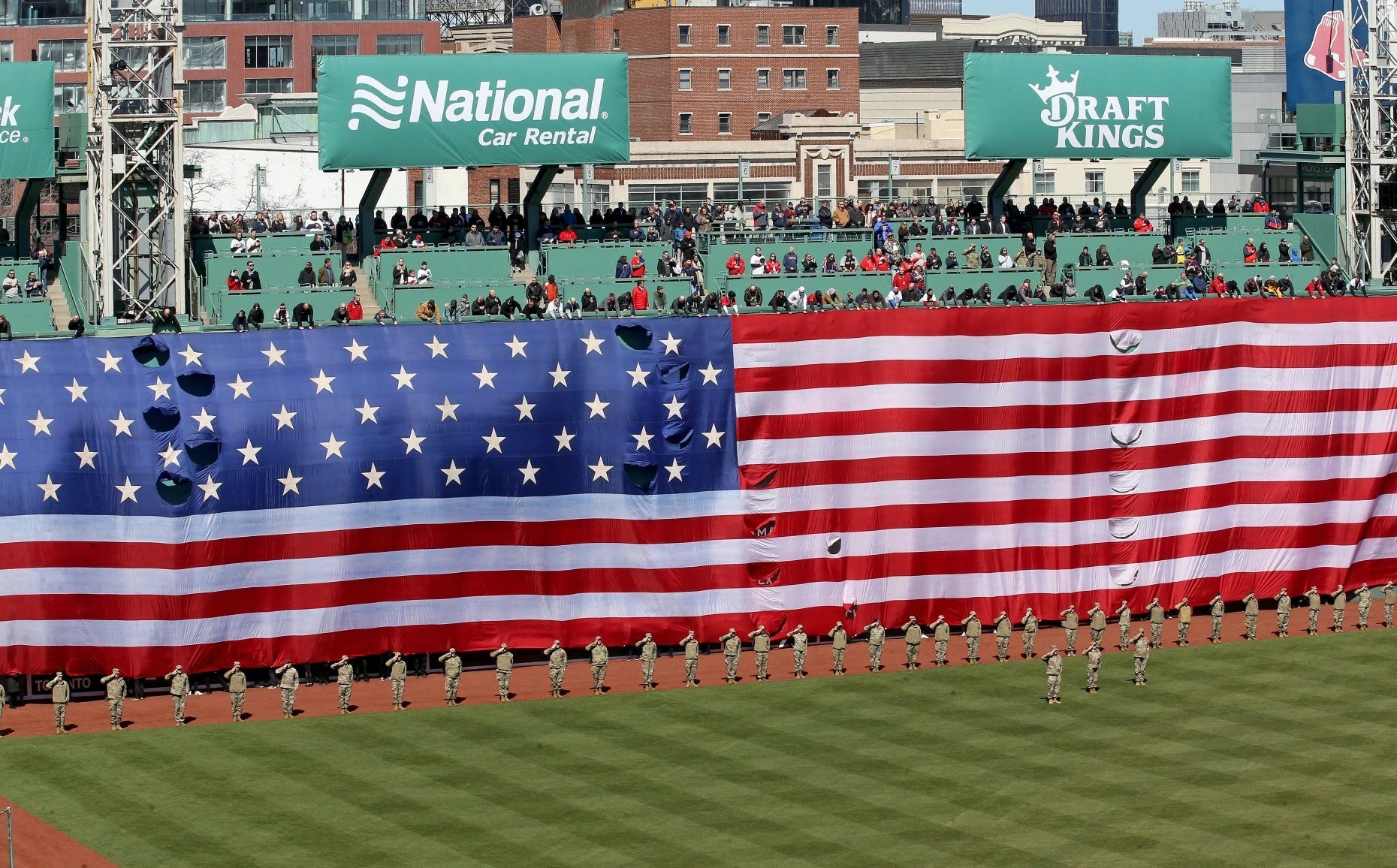
Yesterday was opening day at Fenway Park, where “my” team, the Boston Red Sox, began their 123rd season. I turned on the TV just as a humongous American flag fell across the Green Monster (the wall in left field). Standing before that wall were troops in camouflage uniforms saluting smartly as the National Anthem began. As that anthem reached its conclusion, four combat jets flew over as the crowd cheered.
And I thought to myself: When did opening day in baseball become an excuse for a military parade?
It’s a salute the troops celebration! (Matt Stone, Boston Herald, photo)
Not to be a killjoy, but I thought we were celebrating a new season of baseball. I can see an over-the-top celebration of all things military on July 4th, perhaps, but on March 30th?
Heaven knows the cost of all this military hoopla. The military doesn’t care, of course, since it has plenty of money to burn. Plus, it’s basically a huge recruitment commercial for a military that is under increasing strain to meet recruitment quotas, so it’s a win-win for the Pentagon.
As I’ve written before, we can’t seem to play ball anymore in America without the military involved in the game. But war is not a game, nor is military service.
Even as the Pentagon and the Red Sox team up to celebrate the military, giving viewers a warm patriotic fuzzy, veterans continue to suffer from the aftereffects of a generational war on terror, notes Andrea Mazzarino at TomDispatch.com. Many of these vets suffer from multiple traumas, yet as Mazzarino succinctly puts it: “America’s veterans need all the help they can get and, as yet, there’s no evidence it’s coming their way.”
As usual, the VA is underfunded even as weapons procurement is awash in funding. There are plenty of people in the VA who care, but they are swamped by the number of veterans in need of care. A good book on this is “Our Veterans: Winners, Losers, Friends, and Enemies on the New Terrain of Veterans Affairs,” by Suzanne Gordon, Steve Early, and Jasper Craven, published last year.
What we need in America are far fewer military celebrations and far more attention paid to the plight of our veterans. Meanwhile, let’s forgo the military trappings in our baseball parks and sports stadiums and let the players do what they do best: play ball.
I don’t get bogged down in the operational and tactical details of the Russia-Ukraine War. I don’t know which side is winning or allegedly winning, or which side is best prepared to launch a spring offensive, or which weapons will allegedly turn the tide (likely answer: none). In my view, both sides are losing, especially Ukraine since the war is being fought on their turf. Each side has suffered well over 100,000 killed. Russia has captured territory; whether they can keep it remains to be seen.
War—it sucks. But let’s keep fighting so someone can “win.” (Natali Sevriukova mourns the loss of her home in Kyiv; Sky News)
My focus is on larger questions and points. Here they are, in no special order:
1. Does Ukraine truly seek to retake Crimea from Russia? If so, how much are the U.S. and NATO prepared to assist in this? Assuming Ukraine can launch such an offensive, how might Russia respond? Is the nuclear option on the table for Putin if Crimea is invaded? Could war in Crimea escalate to World War III?
2. If the U.S. doesn’t like China’s peace plan to end the war, where is the U.S. peace plan? Does the U.S. even have one?
3. If peace talks can’t proceed until Russia withdraws all its forces from Ukraine, doesn’t that mean they’ll be no peace talks without a total military victory by Ukraine? Aren’t we talking about a prolonged and even more murderous war for both sides?
4. Why is it that the West sees peace talks as weakness? Ukraine has done better than expected in battle; can’t Ukrainians negotiate from a position of strength?
5. Diplomats like to say that no one wants war, but that simply isn’t true. Plenty of people make lots of money from war. The longer the war lasts, the more money they’ll make.
6. The U.S. has benefited geopolitically from the weakening of Russia. Economically too with the destruction of the Nord Stream pipelines. That doesn’t delegitimize efforts to aid Ukraine in this war, but it does make you seriously question U.S. motives and intent.
7. Observers have noted inept tactics by Russian forces; at the same time, they call for higher U.S. and NATO spending due to Russia’s dangerous military. Doesn’t Russia’s mediocre performance suggest deliberate threat inflation here? Couldn’t U.S. and NATO military spending be sinking instead of surging?
8. Observers suggest Ukraine is an “aspiring” democracy. Restrictions to free press, high rates of corruption, and similar issues suggest Ukraine’s democratic aspirations are already victims of this war. Since war is the enemy of democracy, it’s unlikely Ukraine’s “aspirations” will survive if this war continues without end.
9. Putin’s invasion of Ukraine was illegal, immoral, and wrong. But that doesn’t mean it was “unprovoked.”
10. Are wars best ended by sending expensive and advanced weaponry to the battlefront?
11. To the claim that reducing U.S. and NATO weapons shipments while promoting negotiation would “embolden” Putin and Russia: If it did and does, just resume the shipments while denouncing Putin for reneging on peace talks.
12. Putin doesn’t want peace; he’s “worse than Hitler.” That claim is more than misleading. If the war is going poorly for Russia, Putin may calculate that a negotiated peace would be better for him in the long run than more killing, especially if the Ukraine boosters are correct about the formidable nature of Ukraine’s planned spring offensive.
13. A U.S. policy decision to work for a negotiated truce and peace could conceivably lead to an end to fighting. That truce/peace could be couched in terms of avoiding a wider war that could escalate to nuclear weapons, while still upholding Ukraine’s right to exist and to pursue its own form of government. Of course, the devil would be in the details with respect to the terms of the truce/treaty. Why isn’t the U.S. working to advance this?
14. Strictly for Americans: What vital national interest does the U.S. have in providing more than $110 billion in aid, and counting, to Ukraine? How are we supporting and defending the U.S. Constitution in Ukraine? Ukraine is not a NATO member. The U.S. has no formal alliance with Ukraine. Ukrainian democracy is (at best) imperfect. Continued support of Ukraine runs the risk of a wider, more calamitous, war. Certainly, Americans can legitimately ask why Ukraine has received $110 billion in one year while U.S. states continue to be starved of funds for the homeless, the mentally ill, education, and other worthy social causes within the U.S. itself.
15. Strictly for Americans: In 2023, is the U.S. to send another $110 billion to Ukraine? How about in 2024? Until Ukraine “wins”? What if the war lasts for five years? Ten years?
In raising these questions and making these points, I seek to promote an approach that lessens the danger of a wider war while saving lives on both sides. Sadly, challenging official U.S. policy often leads to accusations of spouting Kremlin talking points. Which makes me wonder: Is democracy even more tenuous and illusory in the U.S. than it is in Ukraine and Russia? We know Russia is a corrupt dictatorship controlled by Putin. Are we willing to see clearly how corrupt the U.S. government is and how little say the American people have in matters of state?
Humanity wins when wars end. I’m for humanity. I sincerely hope Russians and Ukrainians stop killing each other, and I believe my country should be doing everything in its power to put a stop to this war. That doesn’t mean freezing it so that Putin can allegedly “win.” It means helping to broker a settlement amenable to both sides.
Or should I prefer yet more killing with yet greater chances of dangerous escalation?
It began in August 1914, a war in Europe that was supposed to be over by Christmas of that year. But it exploded out of control, becoming the “Great War” or “The World War” or even “The War to End All Wars.” And when it finally ended on 11/11 in 1918, something like ten million troops were dead.
We know it as World War I or the First World War because we know what came after it: yet another calamitous world war, a sequel, one that was far worse than the original. And after that war finally ended in 1945, something like 75-80 million people were dead around the world, including 25 million in the Soviet Union, six million Jews in the Holocaust, and 250,000 at Hiroshima and Nagasaki.
Hiroshima, 1945, after a “small” atomic bomb. Nuclear attacks in a “new” Cold War will be inconceivably worse
Of course, World War II also wasn’t the end of the killing. The so-called Iron Curtain descended in Europe, leading to the Cold War between the U.S. and the Soviet Union that almost ended with Armageddon in 1962 during the Cuban Missile Crisis. That Cold War came to an end in 1991 with the collapse of the Soviet Union. The U.S. celebrated its apparent victory, even calling briefly for “peace dividends” in the 1990s. It was not to be.
Thirty years after the (First) Cold War, we now hear of a “new Cold War.” We hear again that China and Russia are America’s enemies, a new “Axis of Evil,” notes Caitlin Johnstone. America is already engaged in a proxy war with Russia in Ukraine. Now America’s leaders are posturing over Taiwan and threatening war with China if the Chinese military makes aggressive moves against that country. (Of course, the Chinese consider Taiwan to be China, a “One China” policy the U.S. used to support.)
It does seem as if “my” Cold War, when I served in the U.S. military, may be remembered to history as the First Cold War, and that America has already begun a Second Cold War. And, just as World War II was far worse than World War I in casualties and destruction, Cold War II could conceivably be a LOT worse than Cold War I if we choose to continue to wage it.
Sequels, as a general rule, are usually worse, sometimes far worse, than the originals. We had better stop this nonsense of a new Cold War before we relearn this in the hardest way possible.
Names Like Minuteman, Peacekeeper, and Sentinel Are Diabolically Dishonest
Ever think about names of U.S. weapons of war? Rarely are those names honest. I do applaud the relative honesty of Predator and Reaper drones, because those names capture the often predatory nature of U.S. foreign policy and the grim reaperish means that are often employed in its execution. Most names are not so suggestive. For example, U.S. fighter planes carry noble names like Eagle, Fighting Falcon, or Raptor. Nuclear bombers are an interesting case since they can carry thermonuclear bombs and missiles to kill hundreds of thousands, possibly millions, of people. So we have the B-52 Stratofortress (a great 1950s-era name), the B-1 Lancer, the B-2 Spirit, and the new B-21 Raider (the name has historical echoes to the Doolittle Raid on Tokyo in 1942).
Reaping what we sow? Just reaping? Whatever the case, the U.S. way of war is grim
Shouldn’t these bombers carry names like Megadeath or Mass Murder?
Think too of nuclear missiles. The Air Force’s Intercontinental Ballistic Missiles (ICBMs) have had names like Titan, Minuteman, Peacekeeper, and now the new Sentinel. But since these missiles carry warheads that could easily kill millions, wouldn’t a more honest name be The Holocaust ICBM? For that’s what these missiles promise: a nuclear holocaust.
Consider too the Navy’s Ohio-class nuclear missile-firing submarines (SSBN) with their Trident missiles. (Trident—gotta hand it to the Navy.) Just one submarine can carry 20 Trident II missiles, each with up to eight warheads, each warhead being roughly equivalent to six Hiroshima bombs. Again, roughly speaking, each of these submarines carries an arsenal equivalent to one thousand Hiroshima bombs. And the U.S. has fourteen of these submarines.
Instead of the Ohio-class of submarines, shouldn’t they be called the Armageddon-class? Or the Apocalypse-class? The Genocide-class?
With a bit more honesty, perhaps it wouldn’t be so easy to sell these horrific weapons to Congress and the American people. Then again, when the bottom line is higher budgets for the Pentagon and more jobs for Congressional districts, I guess America will buy most anything. Even Holocaust missiles and Armageddon submarines. And for upwards of $2 trillion over the next 30 years as well.
If they don’t bust the budget, perhaps they’ll destroy the world.






 Bracing Views