War Destroys History

W.J. Astore

The God of War Consumes All

The ancients were wise to make war a god. Violent, unpredictable, destructive, seductive, brutal, and capricious. And of course very, very powerful in its hold on the human mind.

Ares, the Greek god of war

I trained as a historian, where an understanding of facts, context, and other forms of evidence is all-important. War destroys history. War creates its own “facts.” Who needs context when you hear the cry: “We’re at war!”

Consider the Russia-Ukraine War. Americans are encouraged to believe the war began with Putin’s invasion in February 2022. All you need to know is that Putin is evil and that he wants to conquer and subjugate Ukraine. A bit of history is introduced by equating Putin with Hitler; sometimes you see claims that Putin is “worse than Hitler.” But that’s about all the “history” you’re encouraged to know.

To follow the war, you might go to the Guardian, which tells me this is Day 596 of Putin’s invasion. Again, it’s implied that what came before Putin’s decision to invade simply doesn’t matter.  NATO expansion to Russia’s borders, for example, is dismissed as irrelevant. Russia shouldn’t have felt threatened by benevolent, peace-loving NATO. Nor do you need to know anything about U.S. meddling in Ukrainian politics. Focus on the war, cheer on the Ukrainians, and see all Russians as guilty, more or less, even Russian opera singers and tennis players.

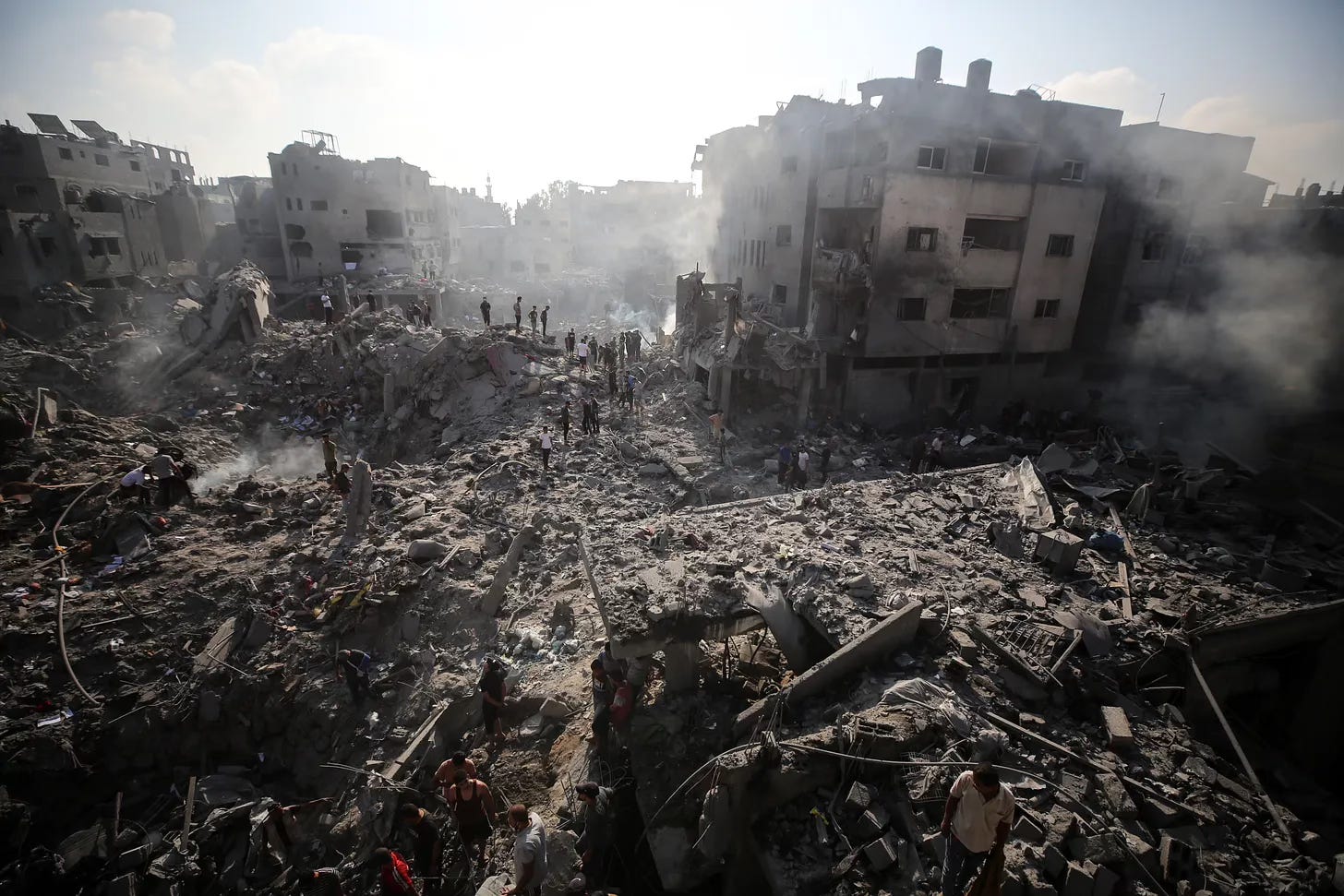
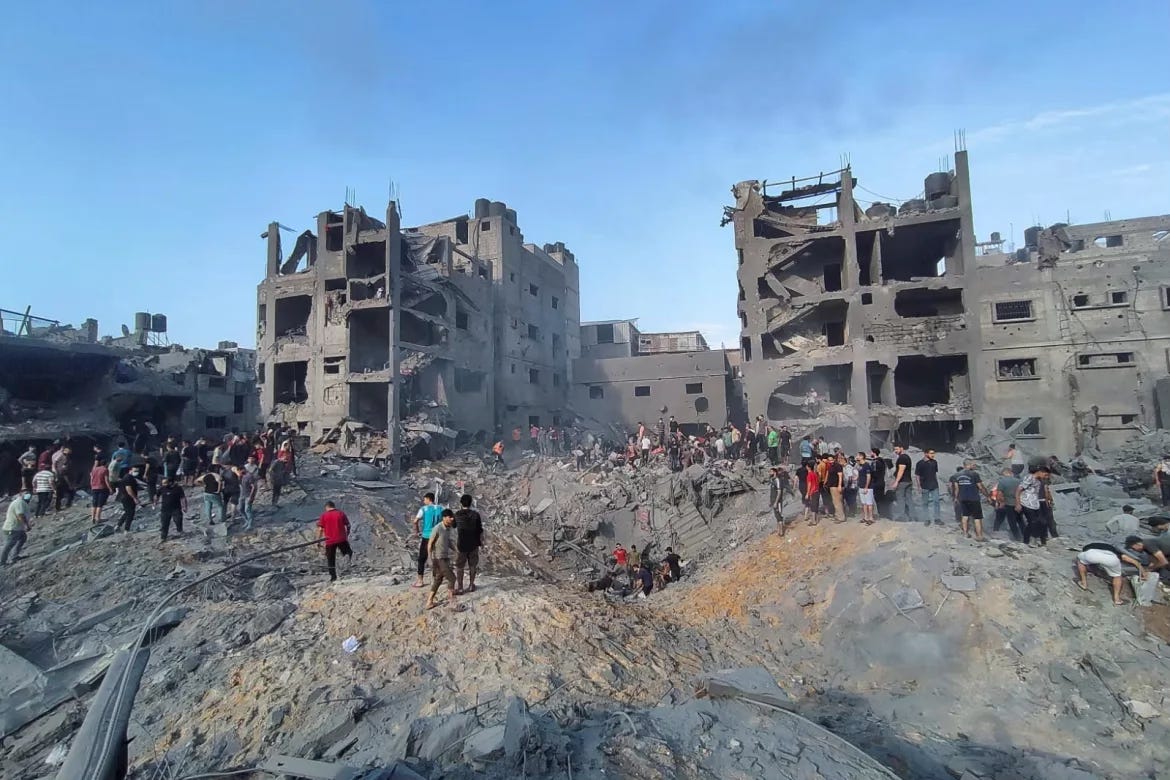
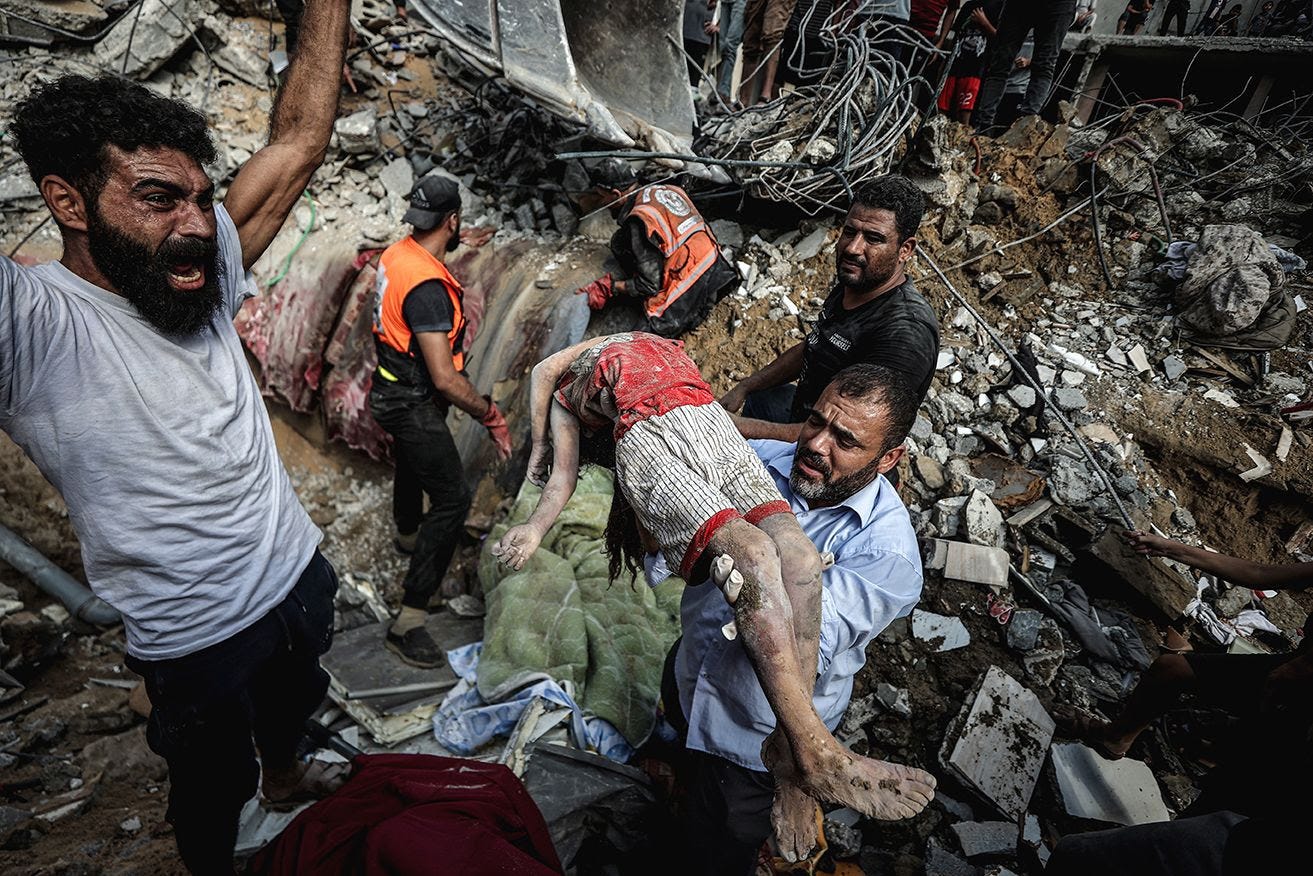
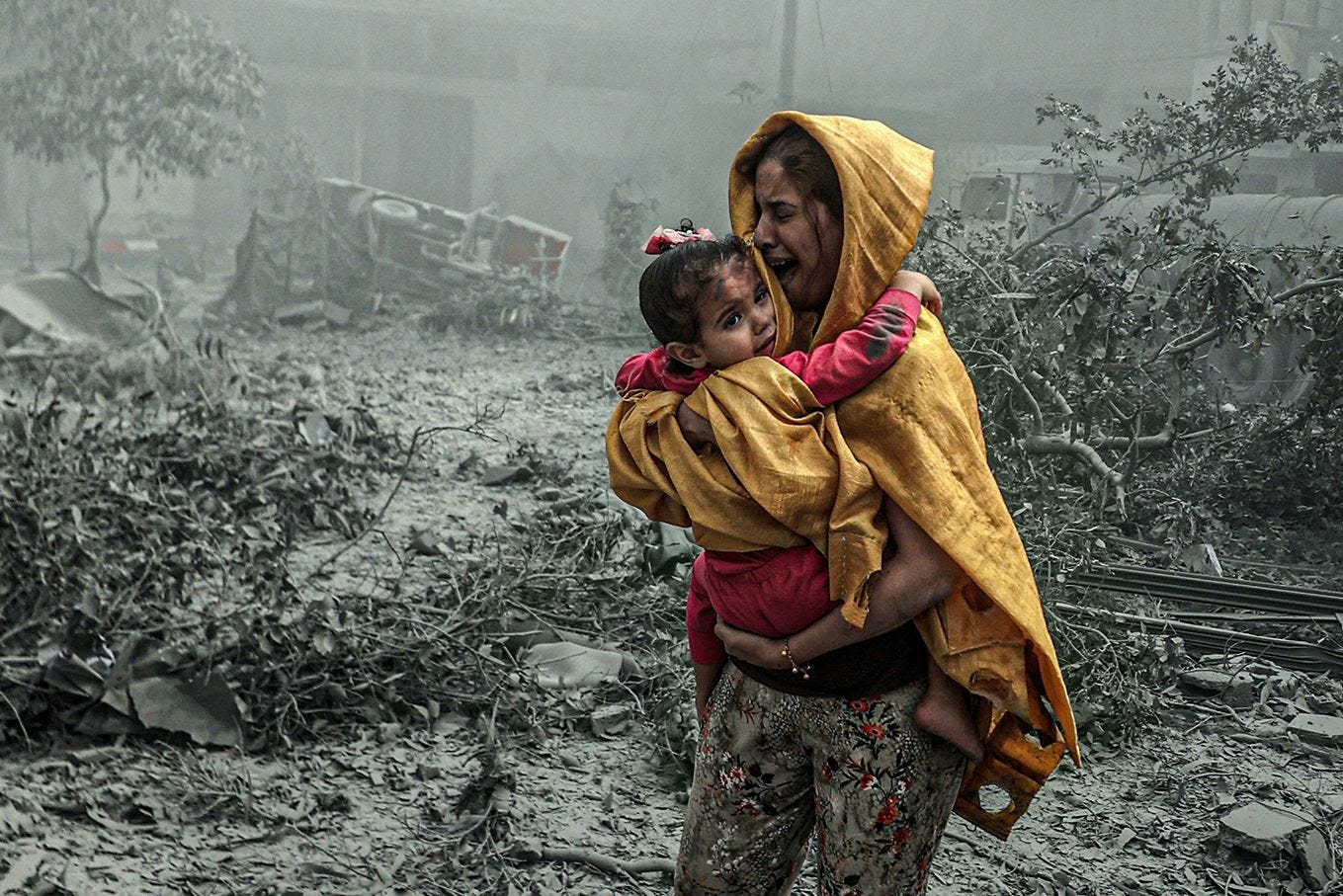
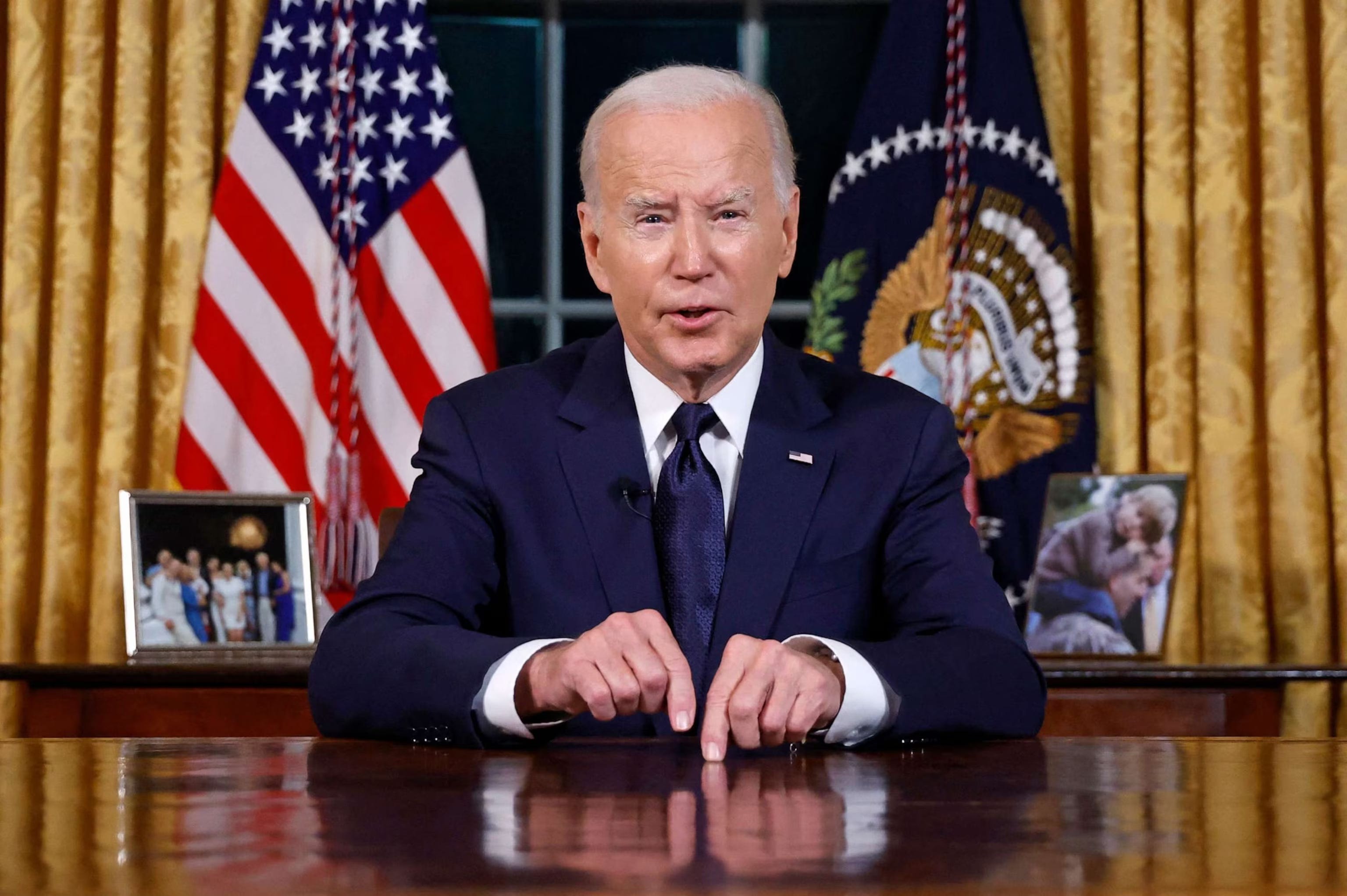
Consider as well the war between Israel and Hamas in the Gaza Strip. Again, Americans are encouraged to believe the war began with terrorist attacks by Hamas. All you need to know is that Hamas is engaged in “pure, unadulterated evil” (President Biden) and that Israel must defend itself however it deems fit. Hamas is evil, Israel is good, end of story.

Americans saw this with 9/11 and the Bush/Cheney response to it. President Bush encouraged us to believe that Al Qaeda attacked the U.S. because they hated us for our freedoms. They hate us because they ain’t us, simple as that. Meanwhile, Bush told the world you’re either for us or you’re for the terrorists.

War is the great and terrifying simplifier. We go to war shouting “Remember the Alamo!” or “Remember the Maine; to hell with Spain!” or “Remember Pearl Harbor!” with vengeance on our minds. There’s no need to think. There no need to seek any understanding. Who cares about history and context? It’s time to kill-kill-kill. That’s the only language *they* understand, because they’re pure evil even as we represent pure goodness. Our wrath is righteous and measured; their wrath is unbounded and insane, evil, the work of “human animals.”

Recall what Congresswoman Barbara Lee said when she cast the lone vote of dissentafter 9/11. Instead of authorizing a blank check of support for Bush/Cheney and U.S. military action everywhere, Lee advised restraint and asked a nation in mourning to pause. Citing a clergy member, she memorably cautioned that “as we act, let us not become the evil that we deplore.” Her speech was a profile in courage for which she was widely attacked and condemned.

What followed 9/11 was an orgy of violence by the U.S., a global war on terror akin to a jihad, producing the Afghan War, the Iraq War, Libya’s collapse into chaos, Gitmo, Abu Ghraib, the collateral murder video, torture, and so many other deplorable acts. Yet we as Americans are told by our leaders and the mainstream media to forget these “excesses,” these “mistakes,” because we meant well and we had no choice but to respond to evil terrorists with massive military might.

And so now Israel, aided by the U.S., faces the same choice: how best to respond to a terrorist attack. And it appears their response will be an exercise in massive military might. Because history doesn’t matter. The god of war has taken over. And that god demands vengeance. Violence. Blood sacrifice.

Yet there is wisdom in the Bible when it says (Romans 12:19-21):

Dearly beloved, avenge not yourselves, but rather give place unto wrath: for it is written, Vengeance is mine; I will repay, saith the Lord.
Therefore if thine enemy hunger, feed him; if he thirst, give him drink: for in so doing thou shalt heap coals of fire on his head.
Be not overcome of evil, but overcome evil with good.

What War Does to Us

W.J. Astore

It Makes Us Hate; It Leads Us to Slaughter

From the Gaza Strip, the Hamas offensive against Israel has been murderously effective. The vaunted and much-celebrated Israeli military was caught by surprise and is responding to the Hamas attacks with its own version of murder, as captured in this announcement:

Israel Defense Minister: “I have ordered a complete siege on the Gaza Strip. There will be no electricity, no food, no fuel, everything is closed. We are fighting human animals and we act accordingly.” [emphasis added]

Actually, we have laws against allowing animals to starve. Think of the SPCA, the society for the prevention of cruelty to animals. Furthermore, comparing humans to animals is most often an insult to animals. Animals’ thirst for blood is sated quickly compared to humans and our thirst.

Let’s be clear: Hamas and the Palestinian people are not “human animals.” They are not lesser humans or beasts. Are the Jewish people forgetting the way that the Nazis reduced them to lesser humans or beasts to be exterminated during the Holocaust?

The Gaza Strip has been described as the world’s largest open-air prison.

Announcing a siege against all Palestinians in the Gaza Strip (no food, no power, mostly unsafe water) is the equivalent of launching a holocaust in slow motion. How is this in any way a proportionate and defensible response to the attacks by Hamas?

Meanwhile, as usual the U.S. government, showing its inherent unity and conformity, is 100% behind Israel, sending an aircraft carrier and issuing blank checks of unequivocal support. The mainstream media once again is telling Americans which side to hate. Think of the Palestinians as a gaggle of little Putins and you’ll be applauded for your right-think.

This is why I hate war. It turns us into killers. It leads us to hate those we kill. And hate kills our minds and makes us even more willing killers.

I applaud and support neither Hamas nor Israel. I applaud and support those who fight for a peaceful future in which we don’t see each other as “human animals” to be slaughtered with impunity.

The War Party Rules Washington

W.J. Astore

Guess What’s a High Priority for Democrats in Congress?

Here’s a reminder of a stark reality: When President Joe Biden finally ended the disastrous Afghan War in 2021, the Pentagon war budget went up by roughly $50 billion.

The Afghan War was costing America almost $50 billion a year until the war party in DC (both Democrats and Republicans) decided enough was enough. So how could ending a war result in a substantial increase in military spending?

That’s easily answered. The bipartisan war party pivoted from the lucrative but frustrating war on terror to the much more lucrative “new cold war” with Russia and China. And of course Vladimir Putin’s provoked invasion of Ukraine early in 2022 sealed the deal. Putin’s illegal invasion, provoked as it was, as NATO itself admits, was a massive boon to the military-industrial-congressional complex. Pentagon war budgets have continued to soar since 2021 (and indeed since 2001 and the original launch of the war on terror), with no end in sight other than perhaps nuclear Armageddon. (Not an end I’m looking forward to, but there’s no fate but that which we make.)

A few in Congress, mostly Republicans, are finally growing tired of massive military aid to Ukraine, though these same Republicans are generally in favor of even more massive military budgets to “deter” China. Yet Democrats are fighting against reductions in military weaponry to Ukraine with the kind of energy you’d think would be devoted to helping Americans deal with poverty and inflation.

House Minority Leader Hakeem Jeffries (left) carrying water for Zelensky of Ukraine. More war, please! 

So, for example, House Minority leader Hakeem Jeffries has stated that a high priority for Democrats in the ongoing struggle over electing a new House Speaker is that the new Speaker must support higher funding—for Ukraine! (Jeffries also wants the impeachment inquiry into Joe Biden to end.)

Higher military spending for Ukraine is a top priority for Democrats, even as Americans struggle with higher bills for food, housing, health care, and other essentials of life. Think about that for a moment.

Of course, Congress was prepared to continue paying for Ukraine’s war effort even if the federal government had shut down, so Jeffries is nothing but consistent here. Waging a wildly expensive and dangerous proxy war against Russia is more important to Congress than helping Americans who are struggling across our land with food and gas bills.

Small wonder that the largest political party in America is composed of “independents.”

Whether it’s RFK Jr., Cornel West, or someone else, we need to get behind independent candidates and reject the Democratic-Republican war party. Vote the war pigs out!

War as an “Investment”

W.J. Astore

The Bizarre Business-Speak of Mass Killing

Did you know the Russia-Ukraine War is a great “investment” for the United States? A terrific opportunity to kill lots of Russians and to destroy lots of their military equipment at a relatively cheap cost to us? (Just don’t mention the price paid by Ukraine.) It gives new meaning to the expression “making a killing” on the “market.”

To Gordon Gekko’s infamous “greed is good” speech we must now add “war is good.” That war is “right.” That it “works”—at least for America, allegedly. 

War as an “investment” truly symbolizes the moral bankruptcy of conventional discourse in the U.S. political mainstream. Instead of war being a calamity, a catastrophe, a realm of death and destruction, dare I say even a mortal sin of grievous evil, we’re told that instead it’s an investment that’s paying dividends, especially in that growth stock known as Ukraine.

We can’t let MAGA Republicans stop the Ukraine “investment,” can we? Not when it’s paying such great dividends

Even body counts and truck counts from the Vietnam War era are being brought back to show what a great “investment” the Ukraine War has been for the U.S. In her latest, Caitlin Johnstone cites war-lover Max Boot for his advocacy of the Russia-Ukraine War as a continuing investment opportunity for the U.S., including the use of body and truck counts as a measure of progress:

“Russia has lost an estimated 120,000 soldiers and 170,000 to 180,000 have been injured,” [Max] Boot writes [in a Washington Post op-ed]. “Russia has also lost an estimated 2,329 tanks, 2,817 infantry fighting vehicles, 2,868 trucks and jeeps, 354 armored personnel carriers, 538 self-propelled artillery vehicles, 310 towed artillery pieces, 92 fixed-wing aircraft and 106 helicopters.”

“The Russian armed forces have been devastated, thereby reducing the risk to front-line NATO states such as Poland and the Baltic republics that the United States is treaty-bound to protect,” Boot continues. “And all of that has been accomplished without having to put a single U.S. soldier at risk on the front lines.”

“That’s an incredible investment,” gloats Boot.

At no time in his masturbatory gushing about how many Russians this war has helped kill does Boot make any mention of the immense toll this deliberately provoked and completely unnecessary war has taken on Ukrainian lives. Their deaths and dismemberments and displacement are the largest price being paid into this “investment” by far, but Boot doesn’t deem them worthy of even a footnote.

We’ve been seeing this “investment” line being promoted with increasing frequency by US empire managers and their apologists. In an article published in the Connecticut Post last month, Senator Richard Blumenthal assured Americans that “we’re getting our money’s worth on our Ukraine investment.” A few days prior to that Senator Mitt Romney had described the proxy war as “the best national defense spending I think we’ve ever done,” because “We’re diminishing and devastating the Russian military for a very small amount of money… a weakened Russia is a good thing.” In December Senate Minority Leader Mitch McConnell said that funding the proxy war is “a direct investment in reducing Vladimir Putin’s future capabilities to menace America, threaten our allies and contest our core interests.” Last November the imperial war machine-funded think tank Center for European Policy Analysis published a report arguing that “US spending of 5.6% of its defense budget to destroy nearly half of Russia’s conventional military capability seems like an absolutely incredible investment.”

Imagine the vacuity, the bankruptcy, the venality, the sinfulness of writing about war and killing as “an absolutely incredible investment.” And what is our ROI, our return on investment? A lot of dead and wounded Russians and Ukrainians, a devastated and poisoned landscape, millions of war refugees, and an increasing likelihood of a wider war that could possibly go nuclear. ROI, indeed.

War is many things, but it is not an “investment.” People who talk and write like this have no moral center. They are soulless. They are automatons of war.

Canada Applauds a Waffen-SS Soldier

W.J. Astore

The Good Nazi?

In 1985, President Ronald Reagan was attacked for visiting a German military cemetery in Bitburg, West Germany, because that cemetery included forty graves of members of the Waffen-SS, the combat branch of the Schutzstaffel led by the infamous Heinrich Himmler. Reagan’s intent was to commemorate the 40th anniversary of the ending of World War II in Europe, not to celebrate those forty graves among the 2000 in that cemetery. Nevertheless, he was deeply criticized for laying a memorial wreath at Bitburg, as the photo below shows.

By Elke Wetzig – Own work, CC BY-SA 4.0, https://commons.wikimedia.org/w/index.php?curid=49406384

Fast forward nearly 40 years to 2023 and we recently witnessed the spectacle of the Canadian Parliament giving two sustained standing ovations to a living (former) member of the Waffen-SS, a Ukrainian (Yaroslav Hunka) who’d joined the Nazis to fight against the Soviet Union in World War II.

No one it seems in the Canadian Parliament thought it odd to applaud a soldier who’d fought on the side of the Nazis during World War II against an ally of Canada. And, yes, the Soviet Union was an ally of Canada and the U.S., and more than any other country was responsible for defeating Hitler and his murderously racist regime, whose most fanatical followers were members of the SS.

Prime Minister Justin Trudeau’s apology, meanwhile, was done in two parts. He blamed the House Speaker (who resigned) for this colossal blunder even as he attacked Russia for seeking to exploit the mistake for political advantage. Meanwhile, Poland is seeking to extradite the former member of the Waffen-SS for possible war crimes committed during World War II.

How could such a colossal blunder have occurred, and just before Yom Kippur, the holiest day in the Jewish calendar?

Knowledge of history was simply cast aside, I think, because the Canadian political “elite” were so eager to showcase a Ukrainian who’d killed Russians, even if he’d done so as a member of the murderous SS. Of course, President Zelensky was present at this debacle, applauding along. It was all about showing support for Ukraine in its allegedly righteous war against Russia, with Canada naturally being on the side of the righteous. 

In a recent podcast featuring Matt Taibbi and Walter Kirn, Kirn noted astutely that the Canadian Parliament, apparently to a person ignorant of World War II and Nazi history, was more than anything applauding itself, celebrating their own rectitude, in saluting an old soldier who’d killed Russians. What did it matter that he’d served Heinrich Himmler, who oversaw the “Final Solution” and the Holocaust? What mattered was showing you stood in solidarity today with Zelensky against Putin.

Heinrich Himmler (center), head of the SS, visits the unit of the Waffen-SS under question, the so-called Galicia Division formed in 1943 (Getty image; BBC News)

If America was “ashamed” of Ronald Reagan in 1985 merely for visiting a cemetery to commemorate war dead where two percent of the graves were Waffen-SS members, how should Canadians feel about their political elite standing as one to stormily applaud a living, breathing, former member of Waffen-SS and saluting him as a hero for killing Russians?

“Ashamed” doesn’t begin to capture the depth of this crime against history.

The Rambo Mystique

W.J. Astore

Forgotten Lessons from “First Blood”

I remember seeing the first Rambo flick (“First Blood”) in a movie theater in 1982 when I was nineteen and rooting for Sly Stallone’s character against the police and national guardsmen who are sent to kill him.  The police think it’ll be easy to subdue one man, but we the viewers know better.  As Colonel Trautman, Rambo’s former commanding officer, says in the movie: In war, it’s wise to have “a good supply of body bags” on hand, a telling reminder about the harsh reality of combat.

In “First Blood,” military clothing and the flag offer no protection to John Rambo, who’s treated as a lowlife by the local sheriff 

Yet, there’s a deeper meaning to “First Blood” captured near the end of the movie, when John Rambo, having improbably acted as a one-man invincible army (a true “Army of One”), bitterly reflects on his own post-Vietnam experiences.  Rambo, breaking down, admits he can’t adapt to regular civilian life.  A loner, he feels himself to be a loser, even though he was decorated for heroism in war with the Medal of Honor.  Wounded and haunted by war, his soul seared by violence, he surrenders to Colonel Trautman.

The original Rambo movie wasn’t necessarily deep, but it did remind us that soldiers like Rambo carried hidden wounds of war; it also highlighted a societal suspicion, whether just or unjust, of military veterans.  The sheriff in “First Blood” has no respect for Rambo as a military “hero”; he sees him as a disreputable and dangerous outsider and just wants to be rid of him, one way or another.

Subsequent Rambo films would portray him as a virtually unstoppable killing machine. In the first sequel, Rambo is sent back to Vietnam to rescue American POWs betrayed and abandoned by the U.S. government.  Perhaps the most famous line from that movie is when Rambo asks Colonel Trautman whether, in returning to Vietnam, the government will finally allow U.S. soldiers to win this time.  It was a concise statement of the stab-in-the-back myth, the idea the U.S. military would have won the war in Vietnam if only it hadn’t been betrayed by a duplicitous and spineless government.

“Do we get to win this time?”  That’s a question that should haunt all Americans, since we haven’t won a war since 1945.  But who is to blame for not winning?  And have the wars America has fought since World War II really been worth fighting to begin with?

Update (9/2923): A lot has changed in forty years, as a couple of my friends pointed out in response to this article. We could imagine at least two scenarios for a revised Rambo made in 2023:

Version 1: In 2023, the sheriff wouldn’t have to call in the National Guard.  All his deputies would gear up with assault rifles, sniper rifles, body armor, and MRAPs donated by the Pentagon as excess gear and the local SWAT team would be mobilized and deployed to find and kill Rambo.

Version 2: Perhaps the most likely one: Rambo would be wearing a “blue lives matter” flag, the sheriff’s patrol car would be festooned with “support our troops” stickers, and they’d call a town meeting to give Rambo the keys to the town as a Medal of Honor winner.

Imagining a Progressive Pentagon

W.J. Astore

13 Tasks and 3 Maxims for a Very Different Pentagon

Also at TomDispatch.com.

A progressive Pentagon? Talk about an oxymoron! The Pentagon continues to grow and surge with ever larger budgets, ever more expansive missions (for example, a Space Force to dominate the heavens and yet more bases in the Pacific to encircle China), and ever greater ambitions to dominate everywhere, including if necessary through global thermonuclear warfare. No wonder it’s so hard, to the point of absurdity, to imagine a Pentagon that would humbly and faithfully serve only the interests of “national defense.”

Yet, as a thought experiment, why not imagine it? What would a progressive Pentagon look like? I’m not talking about a “woke” Pentagon that touts and celebrates its “diversity,” including its belated acceptance of LGBTQ+ members. I’m glad the Pentagon is arguably more diverse and tolerant now than when I served in the Air Force beginning in the early 1980s. Yet, as a popular meme has it, painting “Black Lives Matter” and rainbow flags on B-52 bombers doesn’t make the bombs dropped any less destructive. To be specific: Was it really a progressive milestone that the combat aircraft in last year’s Super Bowl flyover were operated and maintained entirely by female crews? Put differently, are the bullets and bombs of trans Black G.I. Jane somehow more tolerant and less deadly than cis White G.I. Joe’s?

A progressive military shouldn’t stop with “more Black faces in high places,” more female generals “leaning in” around conference tables, and similar so-called triumphs for diversity. Consider Lloyd Austin, the first Black secretary of defense, whose views and actions have been little different from those of former Defense Secretaries James Mattis or Donald Rumsfeld, and whose background as a retired Army four-star general and well-paid former board member of Raytheon makes him the very stereotype of Dwight D. Eisenhower’s military-industrial complex.

No, all-female air crews aren’t nearly enough. Indeed, they are, I’d argue, a form of “woke” camouflage for a predatory military leopard that refuses to change its spots — or curb its appetite.

A truly progressive military should start with the fundamentals. All service members swear an oath to support and defend the Constitution, the system of laws that defines and enshrines our vital rights and freedoms (speech, a free press, the right to assemble, privacy, and so on); in short, the right to live untrammeled by domineering forces. Yet, almost by definition, that right is threatened, if not violated, by a massive military-industrial-congressional complex that penetrates nearly every domain of American life. That complex, after all, is anti-democratic, shrouded in secrecy, and jealous of its power, as well as fundamentally and profoundly anti-progressive. Indeed, it’s fundamentally and profoundly anti-truth.

Consider these hard facts. All too many Americans didn’t know how badly they’d been lied to about the Vietnam War until the Pentagon Papers emerged near the end of that disastrous conflict. All too many Americans didn’t know how badly they’d been lied to about the Afghan War until the Afghan War Papers emerged near the end of that disastrous conflict. All too many Americans didn’t know how badly they’d been lied to about the Iraq War until the myth of Saddam Hussein’s weapons of mass destruction (which had been part of the bogus rationale for invading that country) crumbled; nor did they know how badly they continued to be lied to until the myth of the American “surge” there collapsed when the Islamic State forces triumphed all too easily over an American-built Iraqi security structure that collapsed like a rotten house of cards. Perhaps some of them didn’t truly know until a loudmouthed Republican candidate for president, Donald J. Trump, dared to say that the Iraq War had been an unmitigated disaster, or, in Trump-speak, “a big fat mistake.” That burst of honesty helped him win the presidency in 2016. (His rival in that election, Hillary Clinton, remained essentially the chief spokesperson for the Pentagon.)

Yet despite the horrendous failures (and war crimes) of Vietnam, Afghanistan, Iraq, and other U.S. military ventures of this century, no one is ever punished! Sure, you could point to Donald Rumsfeld being cashiered as secretary of defense amid the rubble of “the Global War on Terror,” a belated admission by the administration of President George W. Bush and Vice President Dick Cheney that the Iraq War was going poorly indeed. Still, all those cracks were later papered over with the myth of “the surge” and when Rumsfeld died in 2021, he would receive remarkably glowing tributes in obituaries, as well as bipartisan salutes for his “service” to America rather than condemnation for his numerous crimes and blunders.

The Pentagon’s rampant culture of dishonesty, a cancer that above all infects the brass, led one serving Army officer, Lieutenant Colonel Paul Yingling, to write a now-renowned (or, if you’re part of the Pentagon, infamous) paper for Armed Forces Journal in 2007 on America’s failure of generalship. As he memorably noted, a U.S. Army private suffered far more dearly for losing a rifle than America’s generals did for losing a war. The Army’s response was — no surprise — to change nothing, leading Yingling to retire early.

13 Tasks for a Progressive Pentagon

Venturing into the Pentagon’s innermost corridors of power, one might be excused for recalling Obi-Wan Kenobi’s warning to Luke Skywalker in Star Wars as they approached the spaceport of Mos Eisley: “You will never find a more wretched hive of scum and villainy. We must be cautious.”

How does one possibly reform such a top-heavy, self-serving, and dishonest institution along progressive lines? A moment in Greek mythology comes to mind: Hercules and the Augean Stables. Let me nevertheless press ahead with this all too herculean task.

Dreaming is free, as Blondie once sang, so why not dream a little dream with me? Here’s a list — a baker’s dozen, in fact — of ways a progressive Pentagon would both exist and act far differently from America’s current regressive (and very, very aggressive) version of the same.

A progressive Pentagon would:

* Take the lead in working to eliminate all nuclear weapons everywhere — that is, total nuclear disarmament — rather than investing vast sums in the coming decades in the U.S. nuclear arsenal. It would disavow using nuclear weapons first (“no first use”) in any conflict. It would cancel all plans to “modernize” the current nuclear triad of missiles, planes, and submarines at an estimated cost of $2 trillion. It would also immediately eliminate obsolete and vulnerable land-based Intercontinental Ballistic Missiles, or ICBMs, and cancel as redundant the Air Force’s new B-21 stealth bomber.

* Oppose sending any more of those devastating cluster munitions or depleted uranium tank shells to Ukraine; indeed, it would take the lead in eliminating such awful weaponry.

* Stop inflating threats and end all talk of a “new Cold War” with China and Russia.

* Celebrate the insights of Generals Smedley Butler and Dwight D. Eisenhower that war is fundamentally a racket (Butler) and that the military-industrial-congressional complex poses the severest of threats to freedom and democracy in America (President Eisenhower).

* Reject the language of militarism, including describing its troops as “warriors” and “warfighters,” as profoundly undemocratic and un-American.

* Recognize the costs of wars already fought to those troops and ensure full funding of the Department of Veterans Affairs, including for post-traumatic stress disorder (PTSD), traumatic brain injury (TBI), and moral injuries, among the other wounds of war.

* End the war on terror, launched just after the attacks of September 11, 2001, and urge Congress to repeal the open-ended war authorization it passed then with but a single dissenting vote, because war itself is terror.

* Refuse to go to war unless there’s a formal congressional declaration of the same as the Constitution demands. If the United States had followed that rule, the last war we would have fought was World War II.

* Reject its present culture of secrecy as profoundly counterproductive to success not just in war but in general. That doesn’t mean, of course, sharing specific battle plans (of which there should be far fewer) or detailed information about weaponry with potential enemies. It does mean a willingness to speak truth to the American people, whose support would be needed to prosecute any genuinely necessary war, assuming there even is such a thing.

* Embrace honor and integrity including a willingness of the U.S. military to fall on its own sword — that is, take genuine responsibility for both its deeds and its misdeeds.

* Recognize that one cannot serve both a republic and an empire, that a choice must be made, and that a Pentagon of the present kind in a genuine republic would voluntarily downsize itself, while largely dismantling its imperial infrastructure of perhaps 800 overseas bases.

* Lead the way in demilitarizing space, including eliminating America’s fledgling Space Force and its “guardians.”

* Clearly acknowledge that large, standing militaries and constant wars, as well as preparations for more of the same, are corrosive to democracy, liberty, and the Constitution, as America’s founders recognized.

Imagine that! A progressive Pentagon of peace rather than a regressive one of power and unending warfare. You may say I’m a dreamer, but I’m not the only one.

What was $550 billion down the crapper in 2014 is approaching $900 billion a decade later

Three Maxims for a Progressive Pentagon

Careful readers won’t be surprised to learn that I was an early Star Wars fan. Naturally, I rooted for the underdog rebels against the evil empire and its henchman, Darth Vader. I saw myself as a potential Jedi Knight, wielding an elegant weapon, a protector of freedom and the republic. (In my defense, I was 14 years old in 1977 when I first saw Star Wars.)

Then, in 1980, I watched The Empire Strikes Back, just as I was pursuing an Air Force ROTC scholarship for college. I heard Yoda, the Jedi master, declare to Luke that “wars not make one great.” That pearl of wisdom floored me then and continues to inform my life.

I’ve read my share of “heavy” philosophy and have the academic credentials to pose as a “serious” enough thinker. Yet I come back to the homespun wisdom captured in certain movies and TV shows that still carries weight for me. Let me share bits of such wisdom with you.

The first is from Kung Fu, the 1970s TV series starring David Carradine. As a young Kwai Chang Caine meets Master Po for the first time, he is astonished to discover that his master is blind. He takes pity on Po, suggesting that his life must be one of endless darkness. Master Po instantly corrects him. “Fear,” he says, “is the only darkness.”

The second is from The Outlaw Josey Wales, a classic western starring Clint Eastwood, also from the 1970s. Josey Wales is a renegade, a wanted man who leaves dead bodies in his wake wherever he travels. Yet he’s also tired of killing, a man in search of peace. In a moving scene, he negotiates just such a peace with Ten Bears, a Comanche chief, saying that there must be a way for people to live together without butchering one another, without constant bloodletting, without race-based hatreds.

A progressive Pentagon would recognize the deep truth of those three maxims: that wars not make one great, that fear is the only darkness, and that there’s a better way for people to live together than constantly butchering one another.

As a Catholic youth, I was taught that the beginning of wisdom is the fear of God. Today, I’d put that differently. The beginning of wisdom is the quest to master one’s fear, the urge to turn away from fear-driven hatreds, to find better, more pacific, more loving ways.

At the core of the original Star Wars trilogy, George Lucas implanted a message that anger, fear, aggression, and violence — the “dark side” of the Force, as he put it — should be resisted. As Darth Vader confesses to Luke, the power of that dark side is nearly irresistible. Fear and related negative emotions, eerily seductive as they are, can consume our minds (and, as it turns out, given the Pentagon budget, our taxpayer dollars as well).

Too many Americans are prey to the dark side, allowing fear to be the mind-killer. It’s not entirely our fault. From the end of World War II until this very moment, we’ve been told time and again to fear — and fear some more. Fear the communists in Korea and Vietnam. Fear Saddam Hussein and his weapons of mass destruction in Iraq. Fear Russia and its Hitleresque leader, Vladimir Putin. Fear China and its growing authoritarian power. Closer to home, we’re even now regularly told to fear our neighbors, MAGA or “woke,” depending on your “blue” or “red” team allegiance.

In truth, though, fear is the true darkness. You shouldn’t have to be a Jedi master to know that wars not make one great, that the darkness of fear (and arming ourselves against it) is a path to hell, and that people could indeed live together without eternally slaughtering one another. Those, then, would be my three maxims for a newly progressive Pentagon.

To echo the words of Steven Tyler of Aerosmith: Dream until your dreams come true.

Everything that’s wrong with America in one sentence

W.J. Astore

Guess who’s exempt from a potential government shutdown?

I saw this today at CNN.

The Pentagon has also determined that the training and support of Ukrainian forces is exempt from a potential government shutdown, and will continue even in the increasingly likely event that Congress fails to pass a spending bill in the coming days.

Isn’t it nice to know that even if the U.S. federal government shuts down, Ukraine will still get all the weapons and related military aid they need to continue to fight and kill Russians? Americans may be furloughed from their jobs or have to work for no pay, but Ukraine will get paid.

That one sentence shows you the priorities for “your” government. Guess what? You’re not a priority, but war overseas is. You’re not exempt from a government shutdown, but Ukrainian military forces are.

So, if you want to get paid, America, or enter a federal facility that may be closed due to a shutdown, just wave a blue-and-yellow flag and tell the government it’s all for the war effort in Ukraine.

Bring this flag with you and tell the government you’re exempt from the looming government shutdown

RFK Faces the Nation and Questions Its Conscience

W.J. Astore

The Moral Question of America’s Wars

It was November 1967. The Vietnam War was at its height. His brother, the President, had been shot and killed in Dallas four years earlier. He himself would die of an assassin’s bullet within the next year. It was time for Robert F. Kennedy Sr. to “Face the Nation.”

TV was more serious back then, and very few politicians today, certainly not Donald Trump and Joe Biden, could speak with RFK’s clarity and eloquence.

It’s worth listening to Bobby Kennedy’s interview from 1967, but especially the last six minutes (beginning at the 18-minute mark) as he attempts to explicate his moral reservations and objections to America’s war against Vietnam. Such moral objections to war are rarely if ever heard today from Democrats and Republicans in DC. Bobby Kennedy wasn’t just saying the Vietnam War was dumb, that the U.S. military was employing bad strategy, that the war was too expensive, that it was a distraction from pressing domestic concerns, and so on.

Near the end of this interview, Bobby Kennedy called for serious and deep moral reflection on the use of U.S. military power overseas.  He asked Americans to examine their consciences and cited the tens of thousands of civilians killed and wounded (not just U.S. troops).  He said America was losing its moral position in the world due to the war. He was right.  

RFK wasn’t anti-war. He recognized war was occasionally unavoidable. Yet he was willing to articulate war’s horrors. The deaths of tens of thousands of innocent women and children from wanton American firepower and especially napalm. The creation of millions of war refugees. The harsh realities of war should trouble Americans, Kennedy said, especially when its awful costs are justified on dubious grounds. Was it truly the case, Kennedy asked, that America had to fight communism over there so that we didn’t have to fight it over here? Did the U.S. have the moral right to wage a ghastly war against North Vietnam on the off-chance that a communist victory there might eventually pose a threat to America?

What I heard here from Bobby Kennedy was a dramatic appeal to conscience.  An appeal to Americans to look within themselves and to stop needless violence, not only in Vietnam but also here at home in America’s streets.

In November 1967, Bobby Kennedy said something truly vital. Appealing to moral conscience, he recognized we are all human.  That all lives matter, not only those of U.S. troops in Vietnam. And that far too often the decision makers in Washington had forgotten this most basic of moral facts.

I can’t say what Bobby would have achieved, killed as he was by an assassin’s bullet.  But I think he was a healer, a man who had matured much since the death of his brother, a man of compassion and conscience, a man willing to reject the notion that might makes right and that million of “others” can and should be killed, wounded, or made refugees simply because it could be justified in terms of “protecting America.”

Do we have that right? Bobby asks. Plainly, he believed we didn’t.

What a shame he didn’t live to become president.

The Dogs of War Are Winning

W.J. Astore

Like a herd of cats, antiwar activists lack unity 

Clearly, on this 22nd anniversary of 9/11, the dogs of war have won and continue to win.

It hasn’t mattered that, over the last 16 years, after a 20-year military career, I’ve written hundreds of articles critical of the military-industrial-congressional complex (MICC) and in support of peacemaking and diplomacy rather than war making and gargantuan military expenditures. My writing hasn’t slowed America’s collective march toward nationalism, militarism, and war.

Lately, I’ve been working more closely with antiwar groups. They mean well. America needs them. But they are losing.

There are many reasons for this, the main one being the sheer size, reach, and power of the MICC. But there’s another reason that’s become apparent to me that’s perhaps best described in metaphorical terms.

The dogs of war run in packs obedient to the alphas. They know exactly what they want: power, profit, dominance. They are usually cocksure in their confidence and think of themselves as realists and patriots. They are rewarded with loads of money.

My cat. She does not back down to the dogs of war. But she’s territorial and doesn’t play well with others. She’s been known to show me who’s boss. 

Critics of war are more like cats. They tend to be territorial, prickly, and disobedient. They may be against war, but they are often at cross purposes on how best to resist it. They may be quick to take offense at perceived slights and don’t always play well together.  They also have a lot less money. They are likely to see themselves as idealists and to reject patriotism as “combustible rubbish” and “the last refuge of the scoundrel.”

America is a dog country. Cats are suspect, especially antiwar ones. Especially brave cats (Daniel Hale, Chelsea Manning) are locked away in cages. Meanwhile, the alpha dogs make billions barking and growling and howling for war and yet more war.

Until we change this dynamic, the alpha dogs will continue to spread havoc in America and indeed across the globe.