A 52-Year-Old Letter Says Much About America’s Failed Wars
A friend sent along an old Time magazine from May 8th, 1972, which I’ve thoroughly enjoyed perusing. Back in the 1970s, I had a subscription to Time, but my old copies were long ago consigned to the trash. Anyhow, in reading the “Letters” section, I came across a stunning missive written by Oriana Fallaci, an Italian war correspondent who wrote for Europeo Magazine.
Fallaci in 1960, showing some serious attitude (Wiki)
Here’s what Ms. Fallaci had to say about the U.S. war effort in Vietnam:
As an Italian, as a longtime war correspondent in Viet Nam, as the author of a book on the Viet Nam War, I have to answer the sort of judgment made by the unnamed Rand Corp. analyst who said that the South could hold out against the North Vietnamese “unless the North Vietnamese are all Prussians and the South Vietnamese are all Italians.”
I assume that he refers to the fact that the Italian soldiers fought with total lack of enthusiasm during the second World War and particularly in its last phase. Yes, indeed they did. They showed the same lack of enthusiasm that the American soldiers have shown in Viet Nam. Many times, while following your GIs in combat, I have had the impression that I was seeing Italians and not Americans. Do you know why? Because both those Italians and those Americans were fighting a war they did not believe in, a war they were ashamed of.
She nails it. When you realize the war you’re fighting is a dishonest one, an unnecessary one, even one that is shameful, you generally don’t fight well. It doesn’t matter what nationality you are.
Ms. Fallaci’s book on the Vietnam War
When and what was the last war U.S. troops truly believed in, one that they weren’t entirely ashamed of? I think you’d have to go back to World War II, and of course even then more than a few U.S. troops had their doubts, as citizen-soldiers of a democracy are wont to have, because there’s no such thing as a “good” war.
Anyhow, note as well how the prediction of that Rand Corporation “expert” proved wrong. Instead of South Vietnam holding out against the north, it folded fairly quickly three years later in 1975. I guess its soldiers all fought like Italians and those of North Vietnam all fought like Prussians.
Waging war is a horrible thing—especially when the war one is called on to wage is false and shameful. Ms. Fallaci knew that.
Finally a bit of truth from the New York Times, but for what reason, and why now?
Remember when Barack Obama claimed in 2007-09 the Afghan War was the right war, the good one, as opposed to the wrong and bad Iraq War prosecuted by Bush/Cheney? Of course, they were both disastrous wars, but until the Biden administration finally pulled out, chaotically so, in 2021, the mainstream media was still supporting the idea that America was doing good in Afghanistan.
I suppose enough time has passed for the New York Times to allow for a measure of honesty, if only to support Joe Biden’s reelection this year. See, Biden made the rightdecision to withdraw because now we finally can admit the war was a disaster. Naturally, it wasn’t entirely or even mainly the U.S. government’s fault …
Of course, plenty of people knew the Afghan War was a disaster; my colleague Matthew Hoh resigned from the State Department in 2009 in protest against Obama’s “surge” there and counterproductive U.S. policy decisions. Democrats in Congress listened to Hoh and a few wanted to change course, but they were brought to heel by Nancy Pelosi, who said no dissent on the Afghan War was permissible when Obama was fighting so hard for health care reform in America. Hoh heard those words straight from Pelosi’s mouth. So we got twelve more years of disastrous war and Obamacare.
Abdul Aziq in 2015 (Bryan Denton for the New York Times)
Anyhow, in my NYT news feed this AM, the “hidden history” of America’s “savage campaign” is finally being covered, though the savageness is largely ascribed to an Afghan ally of the U.S., General Abdul Aziq. As usual, American “advisers” tried to curb his worst instincts, apparently without success. Well, what can you do with such “savages”?
Here’s how the NYT puts it:
But his [Aziq’s] success, until his 2018 assassination, was built on torture, extrajudicial killing and abduction. In the name of security, he transformed the Kandahar police into a combat force without constraints. His officers, who were trained, armed and paid by the United States, took no note of human rights or due process, according to a New York Times investigation into thousands of cases that published this morning. Most of his victims were never seen again.
Washington’s strategy in Afghanistan aimed to beat the Taliban by winning the hearts and minds of the people it was supposedly fighting for. But Raziq embodied a flaw in that plan. The Americans empowered warlords, corrupt politicians and outright criminals in the name of military expediency. It picked proxies for whom the ends often justified the means.
The NYT is shocked, shocked!, that there was a “flaw” in the U.S. plan that “empowered warlords, corrupt politicians and outright criminals” in the cause of military “progress.” Hmm…sounds more like a feature of U.S. policy than a flaw.
What about all those U.S. generals testifying to Congress under oath about the progress we were allegedly making in Afghanistan? Are any of them going to be called to account? You can bet your sweet combat boots that they’re not.
After Aziq, matters grew even worse in Afghanistan, as the NYT puts it here: “What they [new warlords and supposed U.S. allies] brought under the name of democracy was a system in the hands of a few mafia groups,” said one resident of Kandahar who initially supported the government. “The people came to hate democracy.”
So, instead of Operation Enduring Freedom, America brought Operation Endemic Corruption to Afghanistan. That latter operation most definitely succeeded.
Here’s how the NYT summarizes its new study of the Afghan War:
Historians and scholars will spend years arguing whether the United States could have ever succeeded. The world’s wealthiest nation had invaded one of its poorest and attempted to remake it by installing a new government. Such efforts elsewhere have failed.
But U.S. mistakes — empowering ruthless killers, turning allies into enemies, enabling rampant corruption — made the loss of its longest war at least partly self-inflicted. This is a story Matthieu [Aikins] and I [Azam Ahmed] will spend the coming months telling, from across Afghanistan.
Echoes of the Vietnam War here. The world’s wealthiest nation invading a much poorer one in the name of “democracy,” then spreading corruption and devastation ending in a chaotic withdrawal. And now grudging admission that maybe, just maybe, the U.S. loss in Afghanistan was “at least partly self-inflicted.”
Ya think? Or maybe we can just blame the Afghan people, just as we blamed our “allies” in South Vietnam.
Nothing against Aikins and Ahmed here. I’m sure their “hidden history” of America’s war in Afghanistan will be revelatory. Yet why was it “hidden” for so long? And why are the “hiders” never called to account?
And was it really “hidden”? Matthew Hoh wasn’t the only truth-teller willing to blow a whistle. Why was his honest voice suppressed while worm-tongued generals like David Petraeus and Stanley McChrystal were celebrated?
I wonder when we’ll get the “hidden history” of America’s “savage” involvement in Gaza and Ukraine? Perhaps in 2030?
When Barack Obama took over as president in 2009, the global war on terror, or GWOT, just didn’t seem to fit the tenor of his “hope” and “change” message. So wars in Iraq and Afghanistan were rebranded as “overseas contingency operations.” Talk about the banality of evil! Even Orwell’s Big Brother might be impressed by OCOs as a substitute for invasion and war.
A euphemistic word Obama didn’t banish was “surge.” The “surge” in Iraq allegedly had worked under General David Petraeus, even though its gains proved as “fragile” and “reversible” as Petraeus hinted they would be. So Obama conducted his own surge in Afghanistan, the so-called good or smart war after the Bush/Cheney disaster in Iraq. And of course the “gains” in Afghanistan also proved both fragile and reversible, though no one was held to account for the miserable failure of the Afghan War. Whoops. I mean the Afghan contingency operation for democracy and enduring freedom.
Showing that he too could learn from America’s folly, Vladimir Putin termed his invasion of Ukraine a “special military operation.” U.S. leaders laughed at this, criticizing Putin for his propagandistic euphemism, even as they persisted in using terms like “overseas contingency operation” for America’s “kinetic” military actions. The eye of the beholder, I guess.
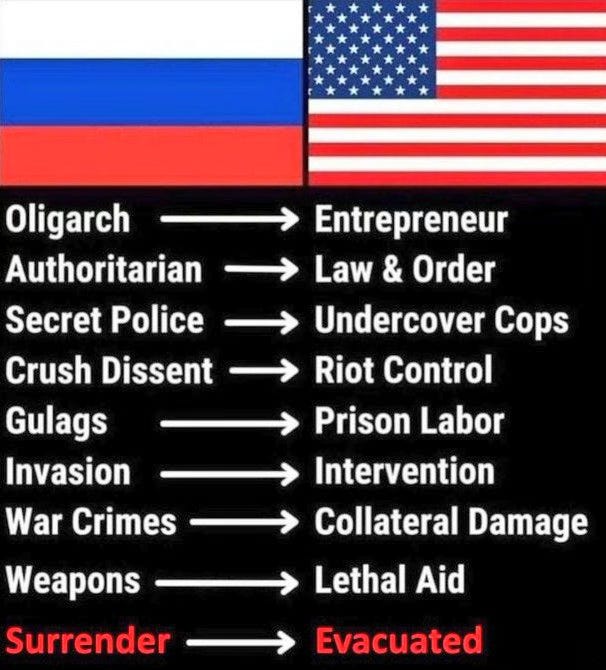
These thoughts came to mind as I perused my Twitter/X feed yesterday and spied this illustration posted by Chay Bowes:
Though the Russian flag is on the left, it could be the flag of China, Iran, North Korea, or any other alleged evildoer. The Russians invade, we intervene (for the sake of democracy, naturally). The Russians commit war crimes, we have unfortunate instances of collateral damage. In the war of the words, the U.S. military is clearly rather clever in a self-aggrandizing and self-exculpatory way.
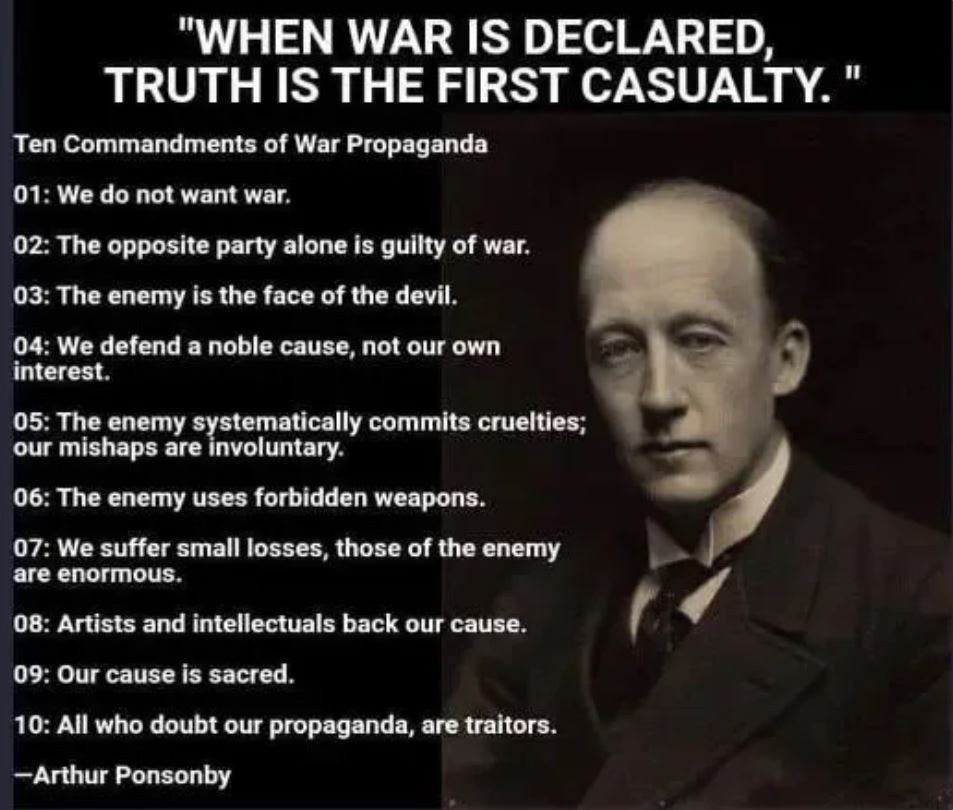
Looking at comments from this Twitter feed, I came across another useful illustration of manipulating language and information in the cause of war. Take a gander:
I confess I’d never heard of Arthur Ponsonby and his book, Falsehood in War-Time. I need to check it out.
This may prove a handy list to keep around as America’s national (in)security state acts to gin up the next war.
Student Protest and the White Rose Movement in Nazi Germany
Apologists for the Israeli government and its genocidal policies are now warning us about “radicalized” college and university students. Apparently, it’s “radical” to protest genocide, famine, and ceaseless bombing. Contrariwise, it’s apparently “normal” to support mass murder, total destruction, and widespread starvation. Talk about a world turned upside down …
Of course, it’s only “radical” to oppose genocide if you live in a totalitarian state that’s prosecuting that genocide or aiding others in prosecuting it. Anyone with a working conscience and a smidgen of humanity would think it’s normal and sane to oppose mass murder and to protest against it.
Sophie Scholl flanked by her brother, Hans (L) and friend Christoph Probst (R) in 1942
Consider a university student who famously protested against genocide: Sophie Scholl. She, her brother Hans, and the rest of the White Rose movement in Nazi Germany are celebrated as heroes today in Germany because they spoke out at great risk against mass murder, and indeed the Nazis executed them in 1943 after holding show trials.
Again, we don’t dismiss Sophie Scholl as a campus “radical” for standing up for Jews and protesting against the murderous policies of the Third Reich. We see her as a paradigmatic individual, an example of the very best of us, a young woman of great moral courage. Of course, the Nazis thought otherwise, arresting her then executing her, her brother, and other White Rose members as traitors to their “race.”
Perhaps the Scholls were radical after all: radical in their courage and their commitment to human rights and values for all.
If you want to watch a powerful movie about young campus “radicals,” check out “Sophie Scholl: The Final Days,” from 2005. I highly recommend it. Back in 2013, I put together a list of 13 movies about the Holocaust and genocide for a college course I taught. In that course, I used well-known movies and documentaries like “Schindler’s List,” “The Sorrow and the Pity,” and “Night and Fog.” The list below was my attempt to expand on that and to point my students to some movies and documentaries that they may not have seen.
Here’s the original article I posted back in 2013:
Thirteen Movies About the Holocaust
I’ve seen a lot of movies and documentaries about the Holocaust or with themes related to the Holocaust and totalitarianism. Of the films I’ve seen, these are the thirteen that stayed with me. Please note that these movies have adult themes; they may not be suitable for children or teens.
American History X (1998): Searing movie about neo-Nazis and the power of hate. Violent scenes for mature audiences only.
Anne Frank: The Whole Story (2001): Excellent dramatization of Anne Frank’s life, to include the tragic end at Bergen-Belsen.
For My Father (2008): A movie about Palestinians, Israelis, and suicide bombers, but also a movie about the difficulties of confronting and overcoming prejudice.
Hotel Rwanda (2004): The genocide in Rwanda, and how one brave man made a difference.
Judgment at Nuremberg (1961): Powerful indictment of Nazi war criminals after World War II.
Katyn (2007): A reminder that the Nazis weren’t the only mass murderers in World War II.
The Last Days (1998): Incredibly moving documentary that explores the fate of Hungarian Jews. Highly recommended.
Life Is Beautiful (1997): It’s hard to believe that a comedy could be made about the Holocaust. But I think this movie works precisely because the main character is so resourceful and full of life.
The Lives of Others (2006): Astonishing movie about life under a totalitarian regime (East Germany). A “must see” to understand how people can be controlled and cowed and coerced, but also how some find ways to resist.
Lore (2012): Movie about a German teenager who has to survive in the chaos of 1945 as the Third Reich comes crashing down. Various small scenes show the hold that Hitler had over the German people, and the reluctance of many Germans to believe that the Holocaust occurred and that Hitler had ordered it.
Sarah’s Key (2010): Heart-wrenching movie about the roundup of Jews in France, which reminds us that the Nazis had plenty of helpers and collaborators.
Sophie Scholl: The Final Days (2005): Inspiring movie about Hans and Sophie Scholl and the White Rose movement in Nazi Germany. The Scholls were college students who took a courageous stand against the Nazis. Executed as traitors in 1943, they are now celebrated as heroes in Germany.
The Wave (2008): Compelling movie about the allure of fascism and “the Fuhrer (leader) principle.” Highly recommended, especially if you want to know how Hitler got so many young people to follow him.
$95 Billion “Supplemental” for More Weapons and War
Who knew mass death was such a growth industry? And by “death” I mean not only of humans but of any organism in a war zone.
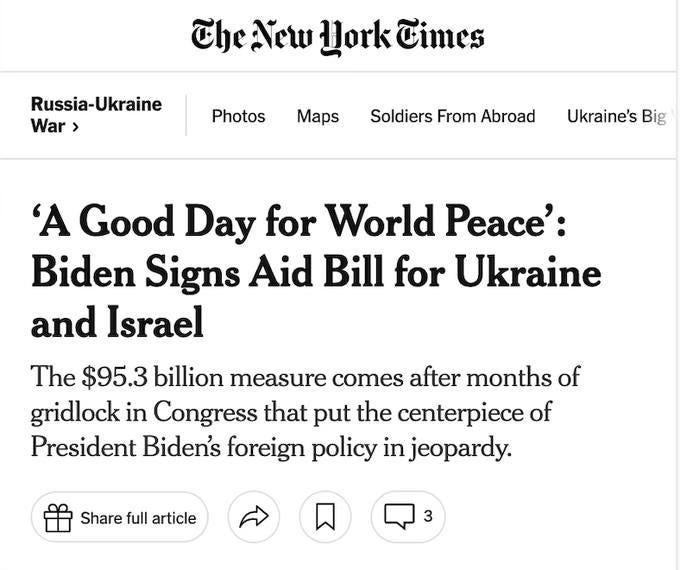
We humans are a self-absorbed lot. We blast the earth and obliterate life without a thought to the ravages we commit against nature. Indeed, we pass and sign bills for $95 billion for more weapons and war and we dare call it “peace”!
Yes, President Biden thinks “peace” is advanced through weapons and war. It’s a sentiment that recalls Tacitus and his condemnation of the Roman Empire: “They create a desert and call it ‘peace.’”
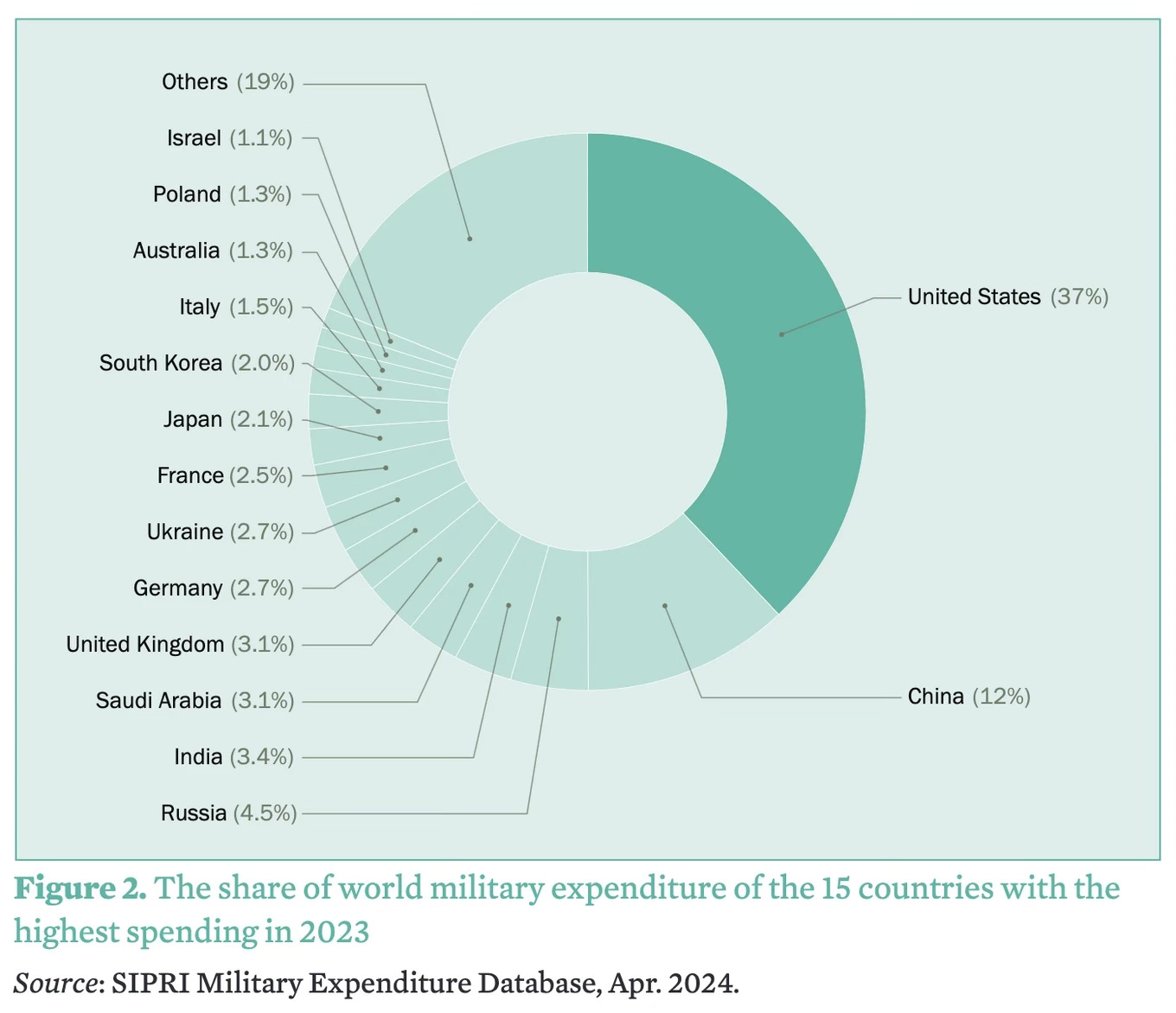
So, even though the USA spends triple what China does and eight times what Russia does, we’re the nation allegedly most committed to advancing peace. Call it a logic bomb, and we’re the best at producing them.
Finally, here’s a quick summary about what real high explosive bombs are doing in Gaza:
No worries: the president says it’s a “good day” for world peace. In Gaza, call it the peace of the grave, as so many innocent Palestinians are buried in mass graves or under rubble.
Today is Earth Day: a good day to commit ourselves to saving the earth from the ravages of nuclear war. Global warming may get us in the long term, but nothing will kill the planet quicker than a nuclear war.
I’ve written a lot about the folly, the greed, the absurdity, of yet another round of “investment” in nuclear weapons. There’s no need for an updated nuclear triad when the present triad is more than enough to destroy the earth and probably several other planets as well.
America’s nuclear triad currently consists of land-based ICBMs (Minuteman III), bombers like the B-1 and B-2, and submarines that carry nuclear-tipped missiles. The Pentagon plans to “modernize” all these “legs” of the triad at a possible total cost of $2 trillion over the next 30 years.
First off, land-based ICBMs and nuclear bombers are no longer needed. The ICBMs are especially vulnerable to attack, putting pressure on DC decisionmakers to launch them quickly in case of a warning (perhaps false) of a nuclear attack against their silos.
All the U.S. truly needs for deterrence is the current Ohio-class sub force with its Trident II missiles. That force can be modernized without an entirely new class of sub being built, which is perhaps why we’re seeing ads about building new submarines as “job-creators.”
In the USA, more nukes are “justified” most often by threat inflation (or even threat creation) and military Keynesianism—morally dubious claims that jobs are created by building genocidal weapons and doomsday machines.
Speaking of America’s submarines and their missiles: Each Trident II D5 missile has up to 8 warheads, with up to 20 missiles per submarine. One submarine could conceivably destroy 160 targets, with each of those warheads having a “yield” of somewhere between 5 and 25 Hiroshima bombs. That arsenal, if launched, could very well tip the world into nuclear winter while killing tens of millions of people outright. A nuclear winter would kill billions. From one sub! And the Navy has 14 of them!
Senator George McGovern in 1963 complained about the absurd nuclear “overkill” the U.S. possesses. Just over 60 years ago, some members of Congress vowed to do something to stop the madness. And then came Vietnam … and so many other wars and rumors of war.
We Americans are so easily distracted by war and propagandized into believing that safety comes from swinging the biggest nuclear club.
Anyone who thinks about nuclear weapons and war games in the abstract should watch this scene from “Terminator II.” It’s perhaps the best, most visceral, image of what one nuclear bomb would produce.
“There’s no fate but what we make for ourselves.” The more nuclear weapons we build, the darker our fate becomes, and the closer we come to terminating ourselves and our planet.
On this Earth Day, the U.S. should commit itself to a “no first use” policy with respect to using nuclear weapons and to total nuclear disarmament, to be achieved over the next 20-30 years.
Something like a JFK-like vow is needed here: Before the decade is out, America should commit itself to halving its nuclear forces, working with other countries on the goal of nuclear disarmament.
Only the future of humanity, as well as that of the earth and all living things, is at stake here.
Surprise! The House has approved $95 billion in more weapons and war for Ukraine and Israel, along with a few billion tossed in for Taiwan. Ukraine gets the lion’s share of the aid, roughly $61 billion, while Israel gets roughly $26 billion, which is $12 billion more than the Biden administration initially asked for.
Imagine that! $26 billion for Israel as it slaughters Palestinians in Gaza. America is led by moral monsters and mental midgets.
Speaker Mike Johnson confuses the Baltics with the Balkans and says the Bible tells us America must support Israel no matter what that country does. Does he “speak” for you?
I predicted months ago (not a tough prediction) that Republicans would eventually cave and support Ukraine. In this election year, they don’t want to be blamed for “losing” the Russia-Ukraine War. Even though the war is going poorly for Ukraine, the answer is never to negotiate or deescalate, it’s always to escalate with even more destructive weaponry. Of course, this is justified by America’s moral monsters and mental midgets (M4 for short) by saying Putin is evil and that jobs will be created in America among the arsenal-producing merchants of death.
There was a time, World War II to be exact, when it made a smidgen of sense to call America the “Arsenal of Democracy.” Those days are long gone. America is now simply an arsenal.
Of course, this is yet another triumph for the MICIMATT: the military-industrial-congressional-intelligence-media-academe-think-tank complex. Its power and greed are almost irresistible. Add that to AIPAC, threat inflation, and fear-mongering and perhaps it is irresistible until the U.S. empire final collapses under the weight of its own folly.
But let me give the last word to my smarter wife, who upon hearing of yet another $95 billion for war put it succinctly: “All that money to kill people.” Then she added: they are the planet-wreckers.
When I was in the U.S. military, I learned a saying (often wrongly attributed to the Greek philosopher Plato) that only the dead have seen the end of war. Its persistence through history to this very moment should indeed be sobering. What would it take for us humans to stop killing each other with such vigor and in such numbers?
Song lyrics tell me to be proud to be an American, yet war and profligate preparations for more of the same are omnipresent here. My government spends more on its military than the next 10 countries combined (and most of them are allies). In this century, our leaders have twice warned of an “axis of evil” intent on harming us, whether the fantasy troika of Iraq, Iran, and North Korea cited by President George W. Bush early in 2002 or a new one — China, Russia, and North Korea — in the Indo-Pacific today. Predictably given that sort of threat inflation, this country is now closing in on a trillion dollars a year in “defense spending,” or close to two-thirds of federal discretionary spending, in the name of having a military machine capable of defeating “evil” troikas (as well as combatting global terrorism). A significant part of that huge sum is reserved for producing a new generation of nuclear weapons that will be quite capable of destroying this planet with missiles and warheads to spare.
My country, to be blunt, has long been addicted to war, killing, violence, and massive preparations for more of the same. We need an intervention. We need to confront our addiction. Yet when it comes to war and preparations for future conflicts, our leaders aren’t even close to hitting rock bottom. They remain in remarkable denial and see no reason to change their ways.
To cite two recent examples: Just before Easter weekend this year, President Biden swore he was personally devastated by Palestinian suffering in Gaza. At the same time, his administration insisted that a United Nations Security Council resolution for a ceasefire in Gaza that it allowed to pass was “non-binding” and, perhaps to make that very point, reportedly shipped 1,800 MK84 2,000-pound bombs and 500 MK82 500-pound bombs off to Israel, assumedly to be used in — yes! — Gaza.
The Biden administration refuses to see the slightest contradiction in such a stance. Men like Joe Biden and his chief diplomat Antony Blinken confess to being disturbed, even shocked, by the devastation our bombs deliver. Who knew Israel would use them to kill or wound more than 100,000 Palestinians? Who knew that they’d reduce significant parts of Gaza to rubble? Who knew that a blank check of support for Israel would enable that country to — it’s hard not to use the phrase — offer a final solution to the Gaza question?
Not to be outdone by the Democrats, Republican Congressman Tim Walberg of Michigan recently cited the examples of Hiroshima and Nagasaki in seeking a “quick” end to the conflict in Gaza (before walking his comments back somewhat). For him, Israel remains America’s greatest ally, whatever its actions, even as he argues that Palestinians in Gaza merit no humanitarian aid from the United States whatsoever.
With that horrifying spectacle — and given the TV news and social media, it truly has been a spectacle! — of genocide in Gaza, America’s leaders have embraced the very worst of Machiavelli, preferring to be feared rather than loved, while putting power first and principle last. Former National Security Adviser and Secretary of State Henry Kissinger, recently deceased, rightly vilified for pursuing a Bismarckian Realpolitik, and deeply involved in the devastation of Vietnam, Cambodia, and Laos, might even have blanched at the full-throttled support for war (and weapons sales) now being pursued by this country’s leaders. Dividing the world into armed camps based on fear seems basic to our foreign policy, a reality now echoed in domestic politics as well, as the Democratic blue team and the MAGA Republican red team attack each other as “fascistic” or worse. In this all-American world of ours, all is conflict, all is war.
When asked about such an addiction to war, your average government official will likely claim it’s not our fault. “Freedom isn’t free,” so the bumper sticker says, meaning in practice that this country stands prepared to kill others without mercy to ensure its “way of life,” which also in practice means unbridled consumption by an ever-shrinking portion of Americans and unapologetic profiteering by the richest and greediest of us. Call it the “moderate” bipartisan consensus within the Washington Beltway. Only an “extremist” would dare call for restraint, tolerance, diplomacy, and peace.
A Common Cause to Unify Humanity
Short of an attack on Earth by aliens, it’s hard to imagine the U.S. today making common cause with “enemies” like China, Iran, North Korea, or Russia. What gives? Isn’t there a better way and, if so, how would we get there?
In fact, there is a common foe — or perhaps a common cause — that should unite us all as humans. That cause is Earth, the health of our planet and all the life forms on it. And that foe, to state the obvious (even if it regularly goes unsaid), is war, which is unhealthy in the extreme not just for us but for our planet, too.
War turns people into killers — of our fellow humans, of course, but also of all forms of life within our (often very large) blast radii. In addition, war is a mass distraction from what should truly matter to us: the sacredness of life and the continued viability of our planet and its ecology. Call it a cliché but there’s no way to deny it: there is indeed only one Spaceship Earth. As far as we know now, our planet is the sole body in the universe teeming with life. Of course, the universe is incomprehensibly vast and there could well be other forms of life out there, but we don’t know that, not with certainty anyway.
Imagine, in a dystopic future, America’s “best and brightest” (or the “best and brightest” of another country) acting in a nuclear fury, employing the very weaponry that continues to proliferate but hasn’t been used since the destruction of two Japanese cities on August 6 and 9, 1945, and so crippling Spaceship Earth. Imagine also that our planet is truly the universe’s one magnificent and magical spot of life. Wouldn’t it be hard then to imagine a worse crime, not just against humanity, but life itself cosmically? There would be no recompense, no forgiveness, no redemption — and possibly no recovery either.
Of course, I don’t know if God (or gods) exists. Though I was raised a Catholic, I find myself essentially an agnostic today. Yet I do believe in the sacredness of life in all its diversity. And as tenacious as life may be, given our constant pursuit of war, I fear the worst.
Earthrise from the Apollo 8 mission
If you’re of a certain age, you may recall when the astronauts on Apollo 8 witnessed earthrise as their spaceship orbited the moon in 1968. The crew read from Genesis, though in truth it could have been from any creation story we humans have ever imagined to account for how we and our world came to be. Specific religions or creeds didn’t truly matter at that moment, nor should they now. What mattered was the sense of awe we felt as we first viewed the Earth from space in its full glory but also all its fragility.
For make no mistake, this planet is fragile. Its ecosystems can be destroyed. Not for nothing did the inventor of the atomic bomb, J. Robert Oppenheimer, turn to the Hindu scriptures to intone, “Now I am become death, the destroyer of worlds,” when he saw the first atomic device explode and expand into a mushroom cloud during the Trinity test in New Mexico in July 1945.
In the febrile postwar climate of anti-communism that would all too soon follow, America’s leaders would decide that atomic bombs weren’t faintly destructive enough. What they needed were thermonuclear bombs, 1,000 times more destructive, to fight World War III against the “big fat commie rat.” Now nine (9!) nations have nuclear weapons, with more undoubtedly hankering to join the club. So how long before mushroom clouds soar toward the stratosphere again? How long before we experience some version of planetary ecocide via a nuclear exchange and the nuclear winter that could follow it?
Genocide and Ecocide on a Planetary Scale
The genocide happening in Gaza today may foreshadow one possible future for this planet. The world’s lone superpower, its self-styled beacon of freedom, now dismisses U.N. Security Council resolutions to stop the killing as “non-binding.” Meanwhile, Israel, whose founding was a response to a Holocaust inflicted during World War II and whose people collectively said Never Again, is now killing, starving, and displacing hundreds of thousands of Palestinians in the name of righteous vengeance for Hamas’s October 7th attack.
If the U.S. and Israel can spin mass murder in Palestine as not just defensible, but even positive (“defeating Hamas terrorists”), what hope do we have as a species? Is this the future we have to look forward to, an endless echoing of our murderous past?
I refuse to believe it. It truly should be possible to imagine and work toward something better. Yet, in all honesty, it’s hard to imagine new paths being blazed by such fossilized thinkers as Joe Biden and Donald Trump.
“Don’t trust anyone over thirty” was a telling catchphrase of the 1960s. Now, we’re being told as Americans that we’ll have to place our trust in one of two men almost at or exceeding 80 years of age. Entrusting and empowering political dinosaurs, however, represents an almost surefire path toward future extinction-level events.
Let me turn instead to a 25-year-old who did imagine a better future, even as he protested in the most extreme way imaginable the genocide in Gaza. This February, fellow airman Aaron Bushnell lit himself on fire outside the Israeli embassy in Washington, D.C. He sacrificed his life in a most public way to challenge us to do something, anything, to stop genocide. America’s “leaders” answered him by ignoring his sacrifice and sending more bombs, thousands of them, to Israel.
Aaron Bushnell did, however, imagine a better world. As he explained last year in a private post:
“I’ve realized that a lot of the difference between me and my less radical friends is that they are less capable of imagining a better world than I am. I follow YouTubers like Andrewism that fill my head with concrete images of free, post-scarcity communities and it makes me so much more prepared to reject things about the current world, because I’ve imagined how things could be and that helps me see how extremely bullshit things are right now.
“What I’m trying to say is, it’s so important to imagine a better world. Let your thoughts run wild with idealistic dreams of what the world should look like and let the pain and anger at how it’s not that way flow through you. Let it free your mind and fuel your rage against the machine.
“It’s not too late for you or anyone. We can have the world of our dreams tomorrow, but we have to be willing to fight today.”
His all-too-public suicide was a fiery cry of despair, but also a plea for a better future, one free of mass murder.
Earlier this week, millions of people across America witnessed a total eclipse of the sun. It’s awe-inspiring, even a bit alarming, to see the sun disappear in the middle of the day. Those watching took comfort in knowing that it would reappear from behind the moon in a matter of seconds or minutes and so gloried in that fleeting moment of preternatural darkness.
But imagine if the moon and sun were somehow to become permanently stuck in place. Imagine that darkness was our future — our only future. Sadly enough, however, it’s not the moon but we humans who can potentially cast the Earth into lasting darkness. Via the nuclear winter that could result from a nuclear conflict on this planet, we could indeed cast a shadow between the sun and life itself, a power of destruction that, tragically, may far exceed our current level of wisdom.
We know from history that it’s far easier to destroy than to create, far easier to kill than to preserve. Yet when countries make genocide or ecocide (from nuclear winter) possible and defensible (as a sign of uncompromising “toughness” and perhaps the defense of “freedom”), you know that their leaders are, in some sense, morally obtuse monsters. And who or what are we if we choose to follow such monsters?
As human populations rise, as vital resources like water, food, and fuel shrink, as this planet grows ever hotter thanks to our intervention and our excesses, we’ll need to cooperate more than ever to ensure our mutual survival. Far too often, however, America’s strategic thinkers dismiss cooperation through diplomacy or otherwise as naïve, unreliable, and impractical. “Competition” through zero-sum games, war, or other hyperviolent urges seems so much more “reasonable,” so much more “human.”
To the victor goes the spoils, so it’s said. But a planet despoiled by thermonuclear war, cast into darkness, ravaged by radiation, disease, and death, would, of course, offer no victory to anyone. Unless we put our efforts into ending war, rather than continuing to war on one another, such conflicts will, sooner or later, undoubtedly put an end to us.
In reality, our worst enemy isn’t some “axis” or other combination of imagined foes from without, it’s within. We remain the world’s most dangerous species, the one capable of wiping out most or all of the rest, not to speak of ourselves, with our folly. So, as Aaron Bushnell wrote, free your mind. Collectively, there must be a better way for all creatures, great and small, on this fragile spaceship of ours.
Out of control, indeed. The Biden administration claims it’s frustrated with the Netanyahu government, so how does it show its frustration? By approving the sale of more F-35 jets to Israel, together with more bombs to turn what’s left of Gaza into rubble. Just what Israel needs: 1,800 MK84 2,000-pound bombs. That’s 1.8 kilotons of bombs right there, added to a bomb tonnage against Gaza that has already reached Hiroshima and Nagasaki levels. But I guess it’s OK if you drop thousands of bombs rather than just two atomic bombs.
It’s OK: Israel used a lot of “Made in USA” bombs to do this, not just a couple of atomic bombs.
Meanwhile, I saw this morning that the Biden administration is pressing to sell up to 50 newly built F-15 jets to Israel, a sale that will require Congressional approval. Not to worry—that sale will be approved.
Way to punish Israel, Joe Biden!
Even Trump, who’s professed his love of Israel, is not as slavishly obedient to Netanyahu as Biden is.
And the Palestinians in Gaza? They simply don’t matter, else the Biden administration wouldn’t be providing all those bombs and warplanes to Israel.
We need regime change in Washington, D.C.
MAGA, however, isn’t the answer. We don’t need to make America great again. We need to make America moral, ethical, compassionate, and humane. MAMECH?
Courtesy of Stephen Semler, let’s take a look at the federal budget recently signed into law by President Biden:
The biggest boost in spending from 2023 to 2024 went to the Pentagon. Of course! Even though the Pentagon has yet to pass an audit. Throw money at it as a reward!
Let’s do some basic math. Add the Pentagon budget, Homeland Security, Military Construction and the VA, and State/Foreign Ops and you get $1.118 trillion. (Basically, the State Department is a tiny branch of the Pentagon.) But even that figure is low, since some Energy spending goes to nuclear weapons, and I can’t imagine that spending on science doesn’t have military applications.
Let’s go with the $1.118 trillion figure as a rough estimate of military spending. Adding up all the numbers of money spent produces a total of $1.627 trillion. That means the percentage of money spent on the Pentagon and related military matters amounts to 68.7% of federal discretionary spending.
Yes, the Pentagon ate our government.
Of course, not included in the figures above is mandatory federal spending on the rapidly escalating national debt, Medicare and Medicaid, and Social Security. Nevertheless, the rough figures here are a telling indicator of the dominance of militarism and military spending in our lives. When nearly seventy cents on the dollar goes to empire, internal security, wars, foreign military sales, and the like, there’s little money left for other concerns like better education and transportation or safer water and a cleaner environment.
Well, America gets what it pays for. More military bases, more wars, more weapons, and more bloodshed globally. Add in some apocalyptic nuclear weapons and now I’m really having a bad Monday.
Update: Courtesy of Stephen Semler once again, my guesstimates above were close to being spot on, as shown in his new post, which I’ll attach here:
Sixty-eight percent of the FY2024 discretionary budget is for military and law enforcement-related programs.
This $1.1 trillion total includes the Pentagon and Military Construction/VA spending bills and parts of four others:
Homeland Security: Title II — CBP, ICE, TSA, Coast Guard, Secret Service ($55 billion); Title III — State Homeland Security Grant Program, Urban Area Security Initiative, Nonprofit Security Grant Program, Public Transportation Security Assistance, Port Security Grants ($1.5 billion)
Commerce, Justice, Science: Title II — Marshals Service, National Security Division, Interagency Law Enforcement, FBI, DEA, ATF, Federal Prison System, State and Local Law Enforcement Activities ($32.3 billion)
Energy and Water: Atomic energy military activities ($32.8 billion)












 Bracing Views