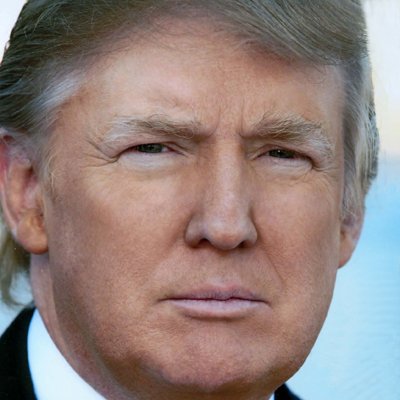
Give the hobgoblin with the bad comb-over his due: He knows how to divide and distract, to divert attention by casting aspersions on others.
The latest Trump tweet that showcased this tactic came today at the G-20 Summit when Trump tweeted the following:
“Everyone here is talking about why John Podesta refused to give the DNC server to the FBI and the CIA. Disgraceful!”
The Washington Post analyzes why this tweet is so wrongheaded and misleading, but a factual analysis won’t matter to Trump’s legion of followers.
There’s a method to Trump’s madness. By continuing to vilify Hillary Clinton, Barack Obama, and smaller fish like John Podesta, he’s distracting Americans from his own problems with the FBI. He’s saying the real crooks, the true inept leaders, are Democrats. Somehow, he thinks this “look over there!” misdirection ploy will work. And he may well be right. Trump learned a lot from “reality” TV and wrestling shows, including how to entertain people even as he exploits them.
When I think about Trump, I come back to one of my father’s favorite sayings: the empty barrel makes the most noise. Trump always makes a lot of noise, but there’s nothing there. There’s no substance. The noise, because it’s so loud and annoying, briefly grabs your attention, then it’s gone.
Yet the damage it does isn’t gone. Even as we become accustomed to the thunder of Trump’s tweet storms, we’re slowly losing our hearing. By hearing, I mean our ability to discern truth, or at least to block out the thunderous distraction of big lies.
When the president is a walking (or golf cart-riding), tweeting, fabricating, drum-beating clown, democracy can’t help but suffer.
More and more under Trump, discourse in America is being degraded. But the bigger problem may be that so few Americans seem to care.
I live in a fairly posh area of America. A place where people have vacation “cottages” with pools, a “destination” place for some, especially in July and August. July 4th is hopping in these parts, with parties and parades and fireworks and trips to the beach and barbecues. It’s summer, it’s warm and sunny, it’s time to relax with family and friends and enjoy life.
And then I read headlines like this today (from FP: Foreign Policy): “U.S. Troops in the Thick of it in Mosul and Raqqa.” And this story about U.S. Marines deploying yet again to Helmand Province in Afghanistan:
Helmand. The commander of 300 Marines newly deployed to Helmand province recently told FP’s Paul McLeary he already has the full authority to get his troops out and about with Afghan troops in the fight. “So far we really haven’t seen much of a need to do it,” said U.S. Marine Corps Brig. Gen. Roger Turner, “but if there’s a need to be somewhere we have the authority and capability and capacity to be where we need to be.”
He also advocated for a larger American footprint, in keeping with reported Pentagon plans to add 3,000 to 5,000 more troops in the coming months. “With a little bit larger force over here we would be in a position to have more flexibility” to do some of the advising he believes would help the Afghan forces push back against two years of Taliban offensives.
And I think of that “Groundhog Day” movie with Bill Murray in which he repeats the same day, again and again, with only minor changes. If you’ve seen the movie, Murray finally breaks out of what appears to be an infinite loop only when he changes his ways, his approach to life, his mentality. He becomes a better person and even gets the girl.
When is the USA going to break out of its infinite loop of war? Only when we change our culture, our mentality.
A “war on terror” is a forever war, an infinite loop, in which the same place names and similar actions crop up again and again. Names like Mosul and Helmand province. Actions like reprisals and war crimes and the deaths of innocents, because that is the face of war.
Speaking of war crimes, another report today from FP: Foreign Policy:
[A] new Human Rights Watch report signals trouble ahead: witnesses in Mosul say that “Iraqi forces beat unarmed men and boys fleeing the fighting within the last seven days, and said they also obtained information about Iraqi forces executing unarmed men during this time period.”
When will it end? Freedom includes freedom from forever war. Yet Americans continue to be told that the price of freedom is having U.S. troops deployed everywhere — the projection of power in 100+ countries. And some consider it patriotic to support those commitments without question, since to question it is seen as not supporting the troops. Which is nonsense, since our troops fight, at least in theory, to support and defend the U.S. Constitution, which, among other rights, enshrines freedom of speech and the right to dissent.
Can we contemplate a future Fourth of July in which American troops are no longer stuck in an infinite loop, fighting yet again in the blasted streets of Mosul or on the dusty plains of Helmand province? A day of independence from war?
That would truly be a day to celebrate with parades, parties, and fireworks.
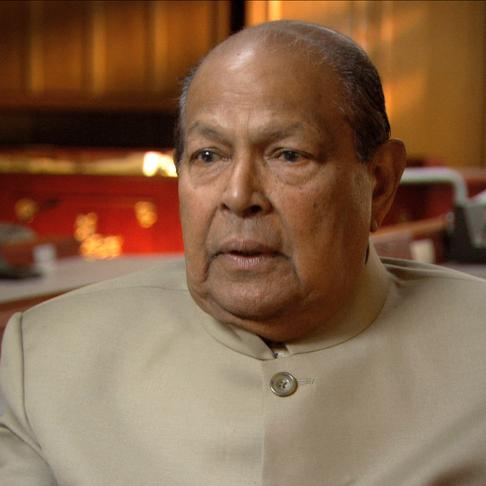
Readers of Bracing Views are familiar with Michael Murry’s frequent contributions to our site. One of Mike’s more penetrating comments originated from a discussion he had with the late Sri Lankan Ambassador Ananda W. P. Guruge. As Mike recently recounted, Guruge “certainly had it right when he told me once why his government had refused America’s offer of military aid against the Tamil insurgency in that little island country: If the Americans come, they will just draw an arbitrary line through a temporary problem and make it permanent.”
Dr. Ananda W. P. Guruge. From closertotruth.com
Not many people have noticed how America’s wars, which used to have clear ending dates, like VE and VJ days in 1945 at the end of World War II, presently never seem to end. In his introduction to Bill Hartung’s new article at TomDispatch.com, “Destabilizing the Middle East (Yet More),” Tom Engelhardt reminds us of how U.S. military interventions in Afghanistan, Iraq, Somalia, Yemen, and elsewhere simply never end. Instead, they fester, they surge and shrink, they metastasize, they become, as Dr. Guruge noted, permanent.
That reality of permanent war is arguably the most insidious problem facing American democracy today. I didn’t say it; James Madison did:
Of all the enemies of true liberty, war is, perhaps, the most to be dreaded, because it comprises and develops the germ of every other. War is the parent of armies; from these proceed debt and taxes; and armies, and debts, and taxes are the known instruments for bringing the many under the domination of the few. In war, too, the discretionary power of the Executive is extended; its influence in dealing out offices, honors and emoluments is multiplied; and all the means of seducing the minds, are added to those of subduing the force, of the people. The same malignant aspect in republicanism may be traced in the inequality of fortunes, and the opportunities of fraud, growing out of a state of war, and in the degeneracy of manner and of morals, engendered in both. No nation can preserve its freedom in the midst of continual warfare …
Why do so many Americans fail to see this? Because believing is seeing. I heard that line on “American Gods” recently, a compelling reversal of “seeing is believing.” It applies here because America’s leaders believe in war, and Americans in general believe in their military, and believing is seeing. A belief in the efficacy of war and the trustworthiness of the military drives America’s “kinetic” actions around the world, and that belief, that faith, serves to make wars permanent.
Believing is seeing. It explains why our wars, despite catastrophic results that are so plainly in sight, persist without end. W.J. Astore
America’s Endless Wars
Tom Engelhardt
Not that anyone in a position of power seems to notice, but there’s a simple rule for American military involvement in the Greater Middle East: once the U.S. gets in, no matter the country, it never truly gets out again. Let’s start with Afghanistan. The U.S. first entered the fray there in 1979 via a massive CIA-led proxy war against the Soviets that lasted until the Red Army limped home in 1989. Washington then took more than a decade off until some of the extremists it had once supported launched the 9/11 attacks, after which the U.S. military took on the role abandoned by the Red Army and we all know where that’s ended — or rather not ended almost 16 years later. In the “longest war” in American history, the Pentagon, recently given a free hand by President Trump, is reportedly planning a new mini-surge of nearly 4,000 U.S. military personnel into that country to “break the stalemate” there. Ever more air strikes and money will be part of the package. All told, we’re talking about a quarter-century of American war in Afghanistan that shows no sign of letting up (or of success). It may not yet be a “hundred-years’ war,” but the years are certainly piling up.
Then, of course, there’s Iraq where you could start counting the years as early as 1982, when President Ronald Reagan’s administration began giving autocrat Saddam Hussein’s military support in his war against Iran. You could also start with the first Gulf War of 1990-1991 when, on the orders of President George H.W. Bush, the U.S. military triumphantly drove Saddam’s army out of Kuwait. Years of desultory air strikes, sanctions, and other war-like acts ended in George W. Bush’s sweeping invasion and occupation of Iraq in the spring of 2003, a disaster of the first order. It punched a hole in the oil heartlands of the Middle East and started us down the path to, among other things, ISIS and so to Iraq War 3.0 (or perhaps 4.0), which began as an air campaign in August 2014 and has yet to end. In the process, Syria was pulled into the mix and U.S. efforts there are still ratcheting up almost two years later. In the case of Iraq, we’re minimally talking about almost three decades of intermittent warfare, still ongoing.
And then, of course, there’s Somalia. You remember the Blackhawk Down incident in 1993, don’t you? That was a lesson for the ages, right? Well, in 2017, the Trump administration is sending more advisers and trainers to that land (and the U.S. military has recently suffered its first combat death there since 1993). U.S. military activities, including drone strikes, are visibly revving up at the moment. And don’t forget Libya, where the Obama administration (along with NATO) intervened in 2011 to overthrow autocrat Muammar Gaddafi and where the U.S. military is still involved more than six years later.
Last but hardly least is Yemen. The first U.S. special ops and CIA personnel moved into a “counter-terrorism camp” there in late 2001, part of a $400 million deal with the government of then-strongman Ali Abdullah Saleh, and the CIA conducted its very first drone assassination in that country in November 2002. Almost 16 years later, as TomDispatch regular Bill Hartung reports, the U.S. is supporting a grim Saudi air and ground war of terror there, while its own drone strikes have risen to new highs.
It’s a remarkable record and one to keep in mind as you consider Hartung’s account of President Trump’s fervent decision to back the Saudis in a big league way not just in their disastrous Yemeni war, but in their increasingly bitter campaign against regional rival Iran. After so many decades of nearly unending conflict leading only to more of the same and greater chaos, you might wonder whether an alarm bell will ever go off in Washington when it comes to the U.S. military and war in the Greater Middle East — or is Iran next? Tom
To continue reading Bill Hartung’s article at TomDispatch.com, click here.
If you want to know just what kind of mental space Washington’s still-growing cult of “national security” would like to take us into, consider a recent comment by retired general and Department of Homeland Security Secretary John Kelly. In late May on Fox and Friends, he claimed that “the American public would ‘never leave the house’ if they knew what he knew about terrorist threats.”
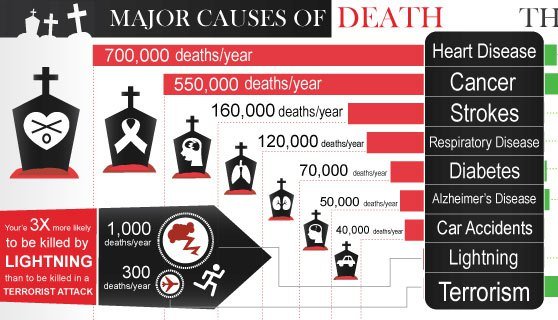
That seems like a reasonable summary of the national security state’s goal in the post-9/11 era: keep Americans in a fear-filled psychic-lockdown mode when it comes to supposed threats to our safety. Or put another way, the U.S. is a country in which the growing power of that shadow state and its staggering funding over the last decade and a half has been based largely on the promotion of the dangers of a single relatively small peril to Americans: “terrorism.” And as commonly used, that term doesn’t even encompass all the acts of political harm, hatred, and intimidation on the landscape, just those caused by a disparate group of Islamic extremists, who employ the tactics by which such terrorism is now defined. Let’s start with the irony that, despite the trillions of dollars that have poured into the country’s 17 intelligence agencies, its post-9/11 Department of Homeland Security, and the Pentagon in these years, the damage such terrorists have been able to inflict from Boston to San Bernardino to Orlando, while modest in a cumulative sense, has obviously by no means been stopped. That, in turn, makes the never-ending flow of American taxpayer dollars into what we like to call “national security” seem a poor investment indeed.
To deal with so many of the other perils in American life, it would occur to no one to build a massive and secretive government machinery of prevention. I’m thinking, for instance, of tots who pick up guns left lying around and kill others or themselves, or of men who pick up guns or other weapons and kill their wives or girlfriends. Both those phenomena have been deadlier to citizens of the United States in these years than the danger against which the national security state supposedly defends us. And I’m not even mentioning here the neo-Nazi and other white terrorists who seem to have been given a kind of green light in the Trump era (or even the disturbed Bernie Sanders supporter who just went after congressional Republicans on a ball field in Virginia). Despite their rising acts of mayhem, there is no suggestion that you need to shelter in place from them. And I’m certainly not going to dwell on the obvious: if you really wanted to protect yourself from one of the most devastating killers this society faces, you might leave your house with alacrity, but you’d never get into your car or any other vehicle. (In 2015, 38,300 people died on American roads and yet constant fear about cars is not a characteristic of this country.)
It’s true that when Islamic terrorists strike, as in two grim incidents in England recently, the media and the security state ramp up our fears to remarkable heights, making Americans increasingly anxious about something that’s unlikely to harm them. Looked at from a different angle, the version of national security on which that shadow state funds itself has some of the obvious hallmarks of both an elaborate sham and scam and yet it is seldom challenged here. It’s become so much a part of the landscape that few even think to question it.
In his latest post, Ira Chernus, TomDispatch regular and professor of religious studies, reminds us that it hasn’t always been so, that there was a moment just a half-century ago when the very idea of American national security was confronted at such a basic level that, ironically, the challenge wasn’t even understood as such. In this particular lockdown moment, however, perhaps it’s worth staying in your house and following Chernus, who’s visited the 1960s before for this website, on a long, strange trip back to 1967 and the famed Summer of Love. Tom
Be sure to read the entire post, “A Psychedelic Spin on National Security,” by Ira Chernus, at TomDispatch.com. Ah, to have a “summer of love” again!
Donald Trump, as Tom Engelhardt reminds us today at TomDispatch.com, was a declinist candidate for the presidency. He saw America in decline, in peril, and said so. He deplored America’s trade policies, its immigration policies, its position in the world. He was a unique blend of pessimism, realism, and optimism — but, as recent events have shown, it has all ended in opportunism for Trump. And that opportunism — combined with his ego-driven need for adulation — is only exacerbating the very real decline of America.
As a candidate, Trump was rightly pessimistic about America and its wars, outspokenly realistic about our “third-world” infrastructure, and cagily optimistic that America could be great “again.” But if his first five months as president have shown anything, it’s that his approach to governance is in the service of his own brand and interests. His motto: What’s good for Trump is good for America. And that motto defines as well as restricts his vision.
As a candidate, Trump had valid insights into some of the aspects of American decline. If only he would act on these insights! If only he’d get us out of debilitating forever wars; if only he’d invest a trillion dollars in U.S. infrastructure; if only he’d commit truly to helping the working classes with better jobs (support for higher wages and health care for all would be a start). Yet Trump, who talked of draining the swamp of Washington, has only become the latest and scariest creature of that swamp.
Despite all his failings, Trump has managed to secure a base of support that is resilient (so far). Why is this? As undisciplined as Trump can be and often is (all those damaging tweets!), there’s a reality to him. He may be boorish, bullying, boastful, and belligerent, but he’s real in the sense that he’s not trying to hide his flaws (because he sees them as strengths).
Contrast Trump with the Democratic establishment. Yes, Bernie Sanders is real; he resonated (and resonates still) with America. But the Democratic Party? It’s still caught in the past, re-fighting the election of 2016, re-fighting the Cold War with Russia, re-fighting its old dispute between its “activists” and its “pragmatists.” It appears the pragmatists are still winning, despite the fact that its posing pragmatist of progressivism (yes, it’s an oxymoron), Hillary Clinton, crashed and burned so spectacularly last November.
“It says so on his hat.”
But to return to Tom Engelhardt’s article. The grim irony of Trump is that the man who campaigned on the slogan “MAGA: Make America Great Again,” is doing his best as president to lead America deeper into a ditch.
In a different context, the Gospel speaks of a day when the first shall be last, and the last shall be first. Trump, posing as an American Firster, may well lead Americans to a new and shocking position as Lasters.
An astute Bracing Views reader described the Trump-Comey-Russia hearings as “the audio version of a glittering disco ball,” which captures the moment. Sure, there’s lots of flash there, but the real problems of the USA are being very much ignored. Put differently, it’s hard to hear any real news when the thump-thump-thump of Trump-Comey-Russia drowns out all other voices.
I’ve already said my piece (at TomDispatch.com) about some of the big problems that face our country, so indulge me for a moment as I consider the disco inferno of Trump-Comey.
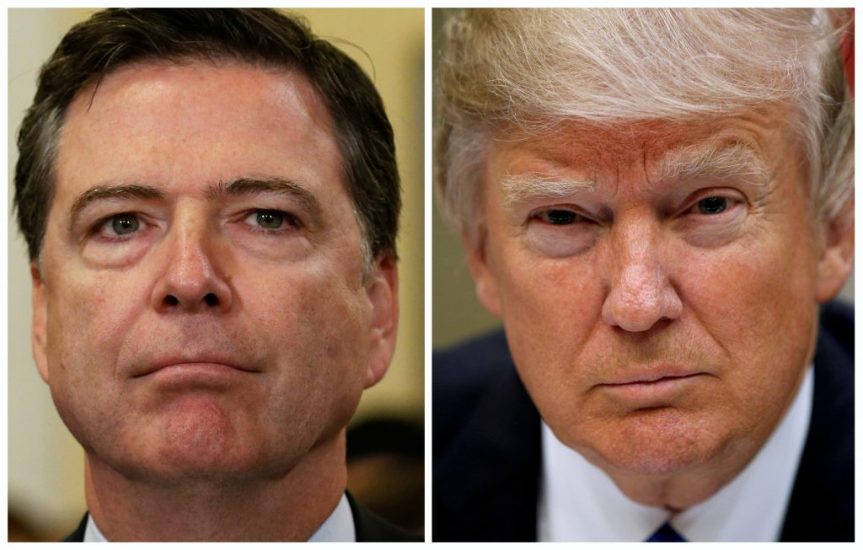
My take: Trump wanted loyalty, Comey didn’t promise that, nor should he have. Trump, it seems, also felt upstaged by Comey (not only because the former FBI Director is taller than Trump and more vigorous). Comey, in short, was uncooperative, not one of Trump’s guys, so he fired him. As president, Trump has that power.
Was it a smart move? No. Does it look bad? Yes, especially the timing. Is it obstruction of justice? Apparently not, since the various Russia-Trump investigations are progressing. (To my knowledge, there are at least three of them ongoing.)
More than anything, Comey’s testimony makes Trump look like a dick (to use a technical term). But we already knew that. Trump’s been posing (it didn’t require acting) as a dick for years on TV, taking great relish in saying, “You’re fired!” to a range of has-been celebrities. Should we really be surprised that Trump is acting like a dick as president? Even his followers knew he was a dick; they just thought he was their dick.
Did Trump collude with Russia? Of course he did! He admitted it himself. Remember when Trump called for the Russians to hack Hillary Clinton — to find her “thirty thousand” missing emails, ha ha! That may not be the legal definition of collusion, but if you heard that and refused to consider that Candidate Trump’s encouragement of hacking by a foreign power in an election for his benefit was wrongful, well, so be it. Those Americans who voted for Trump were apparently untroubled by it.
I’m not defending Trump. The man is a menace to the world, with his denial of global warming/climate change, his embrace of nuclear weapons, his cocksureness fed by his ignorance, the list goes on. But, based on the evidence that’s been presented so far, he’s done nothing that reaches an impeachable offense. Major league dick status, yes. Impeachment? Not yet. Or Nyet.
The biggest problem with Trump is not that he’s a Russian stooge. It’s that he’s not presidential. He doesn’t understand public service. It’s utterly foreign to him, not just because he has no experience of it but because it’s contrary to his egocentric personality.
Look at his priorities as president. (They are the same as they were when he was a real estate developer.) #1 for Trump is Trump. #2 for Trump is his immediate family, joined by a few trusted lackeys, toadies, and sycophants. #3 for Trump is his money, his position in society, and his reputation among his peers and fellow billionaires, those “masters of the universe,” to use Tom Wolfe’s phrase.
Make America great again? That’s never been Trump’s priority. Make Trump greater and greater? That’s more like it.
Trump is fulfilling his version of the American dream. Too bad it’s a nightmare for America.
A common depiction of Russia as a hyper-aggressive bear. But what is the United States?
W.J. Astore
In a recent article at TomDispatch.com, I argued that the United States, after defeating the former Soviet Union in the Cold War, seized upon its moment of “victory” and, in a fit of hubris, embraced an increasingly imperial and authoritarian destiny that echoed in many ways the worst attributes of the USSR. You can read the entire article here. What follows is an excerpt that details some of the ways the U.S. has come to echo or mirror certain features associated with the USSR, the “Evil Empire” of the Reagan years.
Also, for a podcast in which I discuss my article with Burt Cohen, follow this link or this address: http://keepingdemocracyalive.com/just-hacking-weve-become-like-soviets/
When I was a young lieutenant in the Air Force, in 1986 if memory serves, I attended a secret briefing on the Soviet Union. Ronald Reagan was president, and we had no clue that we were living through the waning years of the Cold War. Back then, believing that I should know my enemy, I was reading a lot about the Soviets in “open sources,” you know, books, magazines and newspapers.
The “secret” briefing I attended revealed little that was new to me. (Classified information is often overhyped.) I certainly heard no audacious predictions of a Soviet collapse in five years, though the Soviet Union would indeed implode in 1991. Like nearly everyone at the time, the briefers assumed the USSR would be our arch enemy for decades to come and it went without saying that the Berlin Wall was a permanent fixture in a divided Europe, a forever symbol of ruthless communist oppression.
Little did we know that, three years later, the Soviet military would stand aside as East Germans tore down that wall. And who then would have believed that a man might be elected president of the United States a generation later on the promise of building a “big, fat, beautiful wall” on our shared border with Mexico?
I wasn’t allowed to take notes during that briefing, but I remember the impression I was left with—that the USSR was deeply authoritarian, a grim surveillance state with an economy dependent on global weapons sales; that it was intent on nuclear domination; that it was imperialist and expansionist; that it persecuted its critics and dissidents; and that it had serious internal problems carefully suppressed in the cause of world mastery, including rampant alcohol and drug abuse, bad health care and declining longevity (notably for men), a poisoned environment, and an extensive prison system featuring gulags.
All of this was exacerbated by festering sores overseas, especially a costly and stalemated war in Afghanistan and client-states that absorbed its resources (think: Cuba) while offering little in return.
This list of Soviet problems, vintage 1986, should have a familiar ring to it, since it sounds uncannily like a description of what’s wrong with the United States today.
In case you think that’s an over-the-top statement, let’s take that list from the briefing—eight points in all—one item at a time.
1. An authoritarian, surveillance state. The last time the U.S. Congress formally declared war was in 1941. Since then, American presidents have embarked on foreign wars and interventions ever more often with ever less oversight from Congress. Power continues to grow and coalesce in the executive branch, strengthening an imperial presidency enhanced by staggering technologies of surveillance, greatly expanded in the aftermath of the 9/11 terrorist attacks.
Indeed, America now has 17 intelligence agencies with a combined yearly budget of $80 billion. Unsurprisingly, Americans are surveilled more than ever, allegedly for our safety even if such a system breeds meekness and stifles dissent.
2. An economy dependent on global weapons sales. The United States continues to dominate the global arms trade in a striking fashion. It was no mistake that a centerpiece of Pres. Trump’s recent trip was a $110 billion arms deal with Saudi Arabia. On the same trip, he told the Emir of Qatar that he was in the Middle East to facilitate “the purchase of lots of beautiful military equipment.” Now more than ever, beautiful weaponry made in the U.S.A. is a significant driver of domestic economic growth as well as of the country’s foreign policy.
3. Bent on nuclear domination. Continuing the policies of Pres. Barack Obama, the Trump administration envisions a massive modernization of America’s nuclear arsenal, to the tune of at least a trillion dollars over the next generation. Much like an old-guard Soviet premier, Trump has boasted that America will always remain at “the top of the pack” when it comes to nuclear weapons.
4. Imperialist and expansionist. Historians speak of America’s “informal” empire, by which they mean the U.S. is less hands-on than past imperial powers like the Romans and the British. But there’s nothing informal or hands-off about America’s 800 overseas military bases or the fact that its Special Operations forces are being deployed in 130 or more countries yearly.
When the U.S. military speaks of global reach, global power, and full-spectrum dominance, this is traditional imperialism cloaked in banal catchphrases. Put differently, Soviet imperialism, which American leaders always professed to fear, never had a reach of this sort.
5. Persecutes critics and dissidents. Whether it’s been the use of the Patriot Act under George W. Bush’s presidency, the persecution of whistleblowers using the World War I-era Espionage Act under the Obama administration, or the vilification of the media by the new Trump administration, the United States is far less tolerant of dissent today than it was prior to the Soviet collapse.
As Homeland Security Secretary and retired four-star Marine Gen. John Kelly recently put it, speaking of news stories about the Trump administration based on anonymous intelligence sources, such leaks are “darn close to treason.” Add to such an atmosphere Trump’s attacks on the media as the “enemy” of the people and on critical news stories as “fake” and you have an environment ripe for the future suppression of dissent.
In the Soviet Union, political opponents were often threatened with jail or worse, and those threats were regularly enforced by men wearing military or secret police uniforms. In that context, let’s not forget the “lock her up!” chants led by retired Lt. Gen. Michael Flynn at the Republican National Convention and aimed at Donald Trump’s political opponent of that moment, Hillary Clinton.
6. Internal problems like drug abuse, inadequate health care and a poisoned environment. Alcoholism is still rife in Russia and environmental damage widespread, but consider the United States today. An opioid crisis is killing more than 30,000 people a year. Lead poisoning in places like Flint, Michigan, and New Orleans is causing irreparable harm to the young. The disposal of wastewater from fracking operations is generating earthquakes in Ohio and Oklahoma.
Even as environmental hazards proliferate, the Trump administration is gutting the Environmental Protection Agency. As health crises grow more serious, the Trump administration, abetted by a Republican-led Congress, is attempting to cut health-care coverage and benefits, as well as the funding that might protect Americans from deadly pathogens. Disturbingly, as with the Soviet Union in the era of its collapse, life expectancy among white men is declining, mainly due to drug abuse, suicide and other despair-driven problems.
7. Extensive prison systems. As a percentage of its population, no country imprisons more of its own people than the United States. While more than two million of their fellow citizens languish in prisons, Americans continue to see their nation as a beacon of freedom, ignoring Guantánamo Bay, Cuba. In addition, the country now has a president who believes in torture, who has called for the murder of terrorists’ families, and who wants to refill Guantánamo with prisoners. It also has an attorney general who wants to make prison terms for low-level drug offenders ever more draconian.
8. Stalemated wars. You have to hand it to the Soviets. They did at least exhibit a learning curve in their disastrous war in Afghanistan and so the Red Army finally left that country in 1989 after a decade of high casualties and frustration, even if its troops returned to a land on the verge of implosion. U.S. forces, on the other hand, have been in Afghanistan for 16 years, with the Taliban growing ever stronger, yet its military’s response has once again been to call for investing more money and sending in more troops to reverse the “stalemate” there.
Meanwhile, after 14 years, Iraq War 3.0 festers, bringing devastation to places like Mosul, even as its destabilizing results continue to manifest themselves in Syria and indeed throughout the greater Middle East. Despite or rather because of these disastrous results, U.S. leaders continue to over-deploy U.S. Special Operations forces, contributing to exhaustion and higher suicide rates in the ranks.
In light of these eight points, that lighthearted Beatles tune and relic of the Cold War, “Back in the USSR,” takes on a new, and far harsher, meaning.
To read the rest of this article, go to TomDispatch.com. Thank you.
Let the 6-year-old rule, unless you prefer the cornfield (Twilight Zone)
W.J. Astore
Let’s state the obvious: Donald Trump is a climate change denier. And this is for political as well as petty reasons. When it comes to his investments, his resorts, he is not stupid enough to deny the evidence of his own eyes. As I wrote a year ago:
On global warming, Trump is essentially a skeptic on whether it exists (“hoax” and “con job” are expressions of choice), even as he seeks to protect his resorts from its effects. Along with this rank hypocrisy, Trump is advocating an energy plan that is vintage 1980, calling for more burning of fossil fuels, more drilling and digging, more pipelines, as if fossil fuel consumption was totally benign to the environment and to human health.
His climate change skepticism is politically motivated and calculated to appeal to his base. No surprise there. But Trump also revels in anti-intellectualism, which has a strong tradition in the U.S.
Sure, intellectuals mess up, and more than a few can find a fourth side to every three-sided problem. But Trump only sees one side to every three-sided problem. His side. Like a temperamental child, he thinks he can create his own reality, regardless of facts. And the rest of us now have to put up with the spoiled brat until 2020 (or impeachment, which is unlikely before 2018, at the earliest).
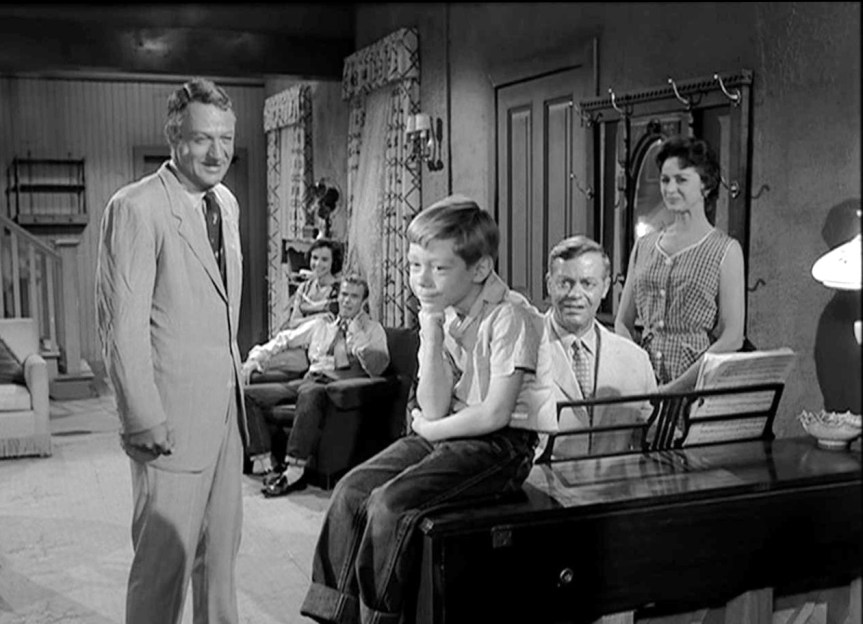
Trump reminds me of the spoiled kid in the famous “Twilight Zone” episode, “It’s A Good Life.” In that episode, a six-year-old kid prone to temper tantrums and getting his own way rules with absolute power over his parents and the townfolk of “Peaksville.”
Don’t offend this kid (Bill Mumy, the child-tyrant in “It’s A Good Life”)
Anyone who offends the petty tyrant (played memorably by Billy Mumy) is punished, often in gruesome ways. A more merciful result is to be “sent to the cornfield,” a euphemism for death.
Welcome to Peaksville, America. And think only good thoughts of our six-year-old leader. Unless, of course, you prefer the cornfield.
The historian Jill Lepore has an interesting article at The New Yorker on dystopic novels and their popularity today. Dystopias are all the rage, which is not surprising given the politics of fear that rules us.
Consider the stark contrast between the Republican Party of today versus that of the 1980s. Remember the sunny optimism projected by Ronald Reagan? The idea it’s “morning again” in America? Now we have the dystopia of Trump. Mexicans are rapists! Muslims are terrorists! They’re coming to get us! Build a wall! Torture and kill them!
I’m not suggesting Reagan was a saint. Reagan was, however, a gifted communicator and an inspiring symbol for many. There was substance there as well. As a young man, he served as a lifeguard and helped to save lives. I find it intriguing that he was somewhat of an introvert, somewhat of a dreamer. He worked with the Soviets and Mikhail Gorbachev on the elimination of nuclear weapons, a dream that did not come to pass. For all his flaws, there was a fundamental decency about him.
Contrast Reagan to Trump. With Trump, it’s all about him. Trump’s favorite way of communicating is with insults, bluster, threats, and tweets. Reagan dreamt of eliminating nuclear weapons; Trump insists America will remain “at the top of the [nuclear] pack,” at a cost of a trillion dollars over the next generation.
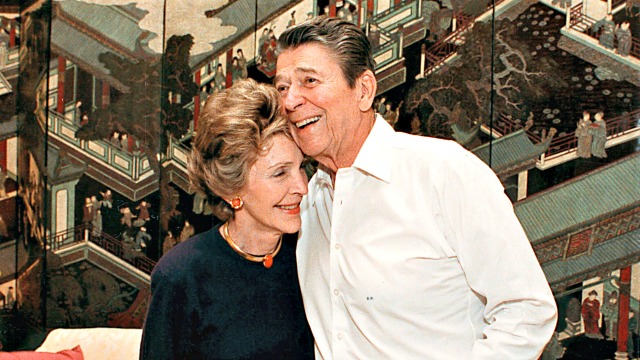
Reagan and his wife Nancy were quirky as well (astrology, anyone?), but seeing how they looked at each other and treated one another, no one could doubt their love. Trump and Melania? In public, at least, they come across as ill at ease, uncomfortable with each other. Small potatoes, perhaps, but part of being the “First Family” is projecting harmony, or so it has been in the past. Nowadays, such symbolism seems unimportant as Trump himself dominates the scene, his wife seemingly a bit player in his life.
There’s a toxicity to Trump that’s consistent with the emergence of all these dystopic novels. The Victorian author Samuel Smiles once wrote that a man should be what he seems or purposes to be. By this Smiles meant that a man must demonstrate, by his behavior, uprightness of character. A quaint expression, that. When people think of Trump today, “uprightness of character” doesn’t exactly spring to mind. Rather the reverse.
Though I wrote early on that Donald Trump had a serious chance at the presidency, by early November of last year I thought the negativity of his message – his bundle of hate – would not prove compelling enough to carry him to victory. I was wrong, of course. Trump, with his dystopic rhetoric as well as his actions, captured as well as amplified a prevailing mood.
It’s not morning again in America. Under Trump, darkness and dystopia prevail.
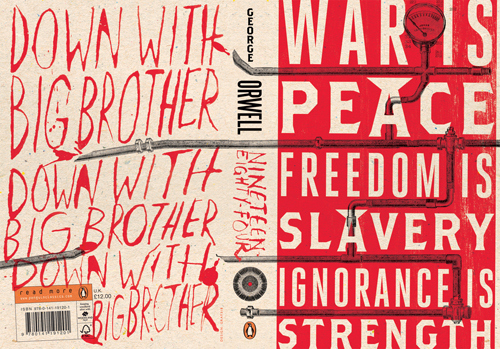
George Orwell’s 1984 is filled with wisdom. Perhaps my favorite saying from that book is Orwell’s statement about history and its importance. He said, he who controls the past controls the future. He who controls the present controls the past.
If you have the power, in the present, to rewrite history, to redefine the past, enshrining your version of history as fact while consigning all the bits you don’t like to oblivion (“down the memory hole”), you can define people’s sense of reality as well as what they believe is possible. You can limit what they see, their horizons. You can limit how and what they think. You can, in a major way, control the future. Add the control of language to the restriction and re-definition of history and you have a powerful means to dominate meaning, discourse, and politics in society.
Donald Trump and Company are brazen in their rewriting of history, notes Rebecca Gordon in her latest post at TomDispatch.com. They make no apologies and take no prisoners. They simply claim lies to be true, repeating them over and over until some people come to accept them as truth. The examples she cites include the size of Trump’s inauguration crowd (“Bigly!”), the reality of global warming (“Chinese lie!”), and why Trump fired FBI Director James Comey (“He hurt Hillary!”).
Another example of the big lie is the whole concept of “Trumpcare,” the recent revision to Obamacare as passed by the House. They sell this as a health care plan instead of what it really is: a health coverage denial plan and tax cut for the rich.
The GOP health care bill would insure 23 million fewer people than current law after a decade, while potentially impacting many with pre-existing conditions, according to the nonpartisan Congressional Budget Office.
The bill would spend $1.1 trillion less on health care and use the savings primarily to finance large tax cuts for high-income earners and medical companies. Overall, it would reduce deficits by $119 billion over ten years.
I know one thing: that’s not a health care plan.
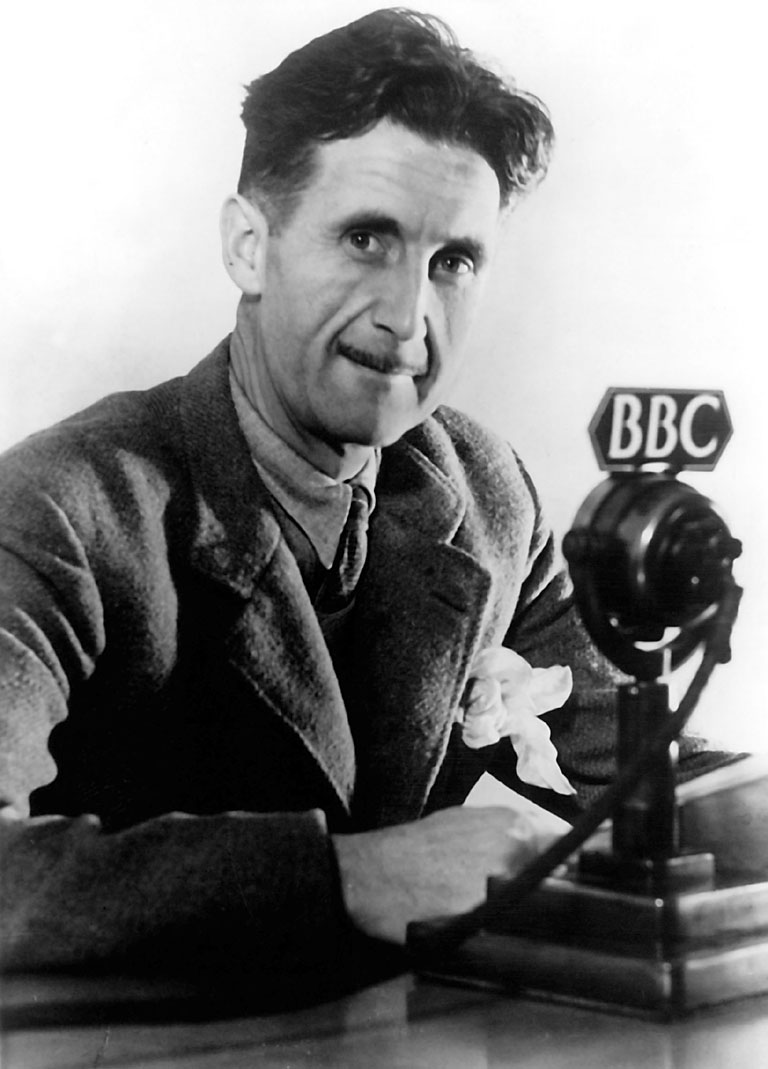
George Orwell
Returning to language, a big theme of Orwell’s 1984 is how language will be simplified, or dumbed down, stripping away meaning and subtlety and substituting unreflective obedience and coarseness in their place. Think here about how Donald Trump speaks. Orwellian expressions like “doubleplusgood” are not foreign to a man who speaks in glittering generalities to sell his ideas and hyperbolic superlatives to extol his own virtues.
In his introduction today to Rebecca Gordon’s article, Tom Engelhardt quotes Trump’s recent graduation speech at the Coast Guard Academy, during which Trump did what he does best — sell himself with lies (“alternative facts!”):
I’ve accomplished a tremendous amount in a very short time as president. Jobs pouring back into our country… We’ve saved the Second Amendment, expanded service for our veterans… I’ve loosened up the strangling environmental chains wrapped around our country and our economy, chains so tight that you couldn’t do anything — that jobs were going down… We’ve begun plans and preparations for the border wall, which is going along very, very well. We’re working on major tax cuts for all… And we’re also getting closer and closer, day by day, to great healthcare for our citizens.
One thing Trump does know is how to manipulate language — in short, to lie — to his own benefit.
In this age of Trump, a sense of history has rarely been more important. We have to fight for the richness, the complexity, as well as the accuracy of our history and our language. The very existence of the American republic depends on it.







 Bracing Views