It’s been a depressing election season but the end is finally near (hopefully not THE END). The Democrats tell me I must vote blue no matter who because democracy is at stake and only they can save it from the fascist Republicans. The Republicans tell me to vote for them because Biden the radical socialist/liberal is out to groom our kids, take away our guns, and disrespect our religion (it’s assumed here that your religion is Christianity). Both parties are hyping fear of the other as a motivating force. It’s not a shooting civil war; we don’t have a Bleeding Florida (yet) like we had in the 1850s in Bleeding Kansas; but the stoking of divisions in this country for electoral gains is truly dispiriting.
After reviewing my state’s ballot online and looking over the choices, I expect I’ll be voting mostly for Democrats, not because I want to but because the third-party choices are either uninspiring or non-existent. I live in a solidly blue state, so I don’t really have to worry about a red tide of Republicans surging across my little corner of this earth. Elsewhere in America, I expect Republicans will do quite well.
The reason is simple: The Democrats’ message, like Biden himself, is old, corporate-centered, and uninspiring. I can’t name one policy the Democrats are truly embracing to help ordinary Americans. A $15 federal minimum wage? Nope. Single-payer health care? Nope. A firm commitment to getting big/corporate money out of politics? Nope. Reductions to Pentagon spending and a peace dividend to those in need? Nope. I could go on and on. Just about the only clear Democratic message is “vote for us because the Republicans are going to destroy democracy.”
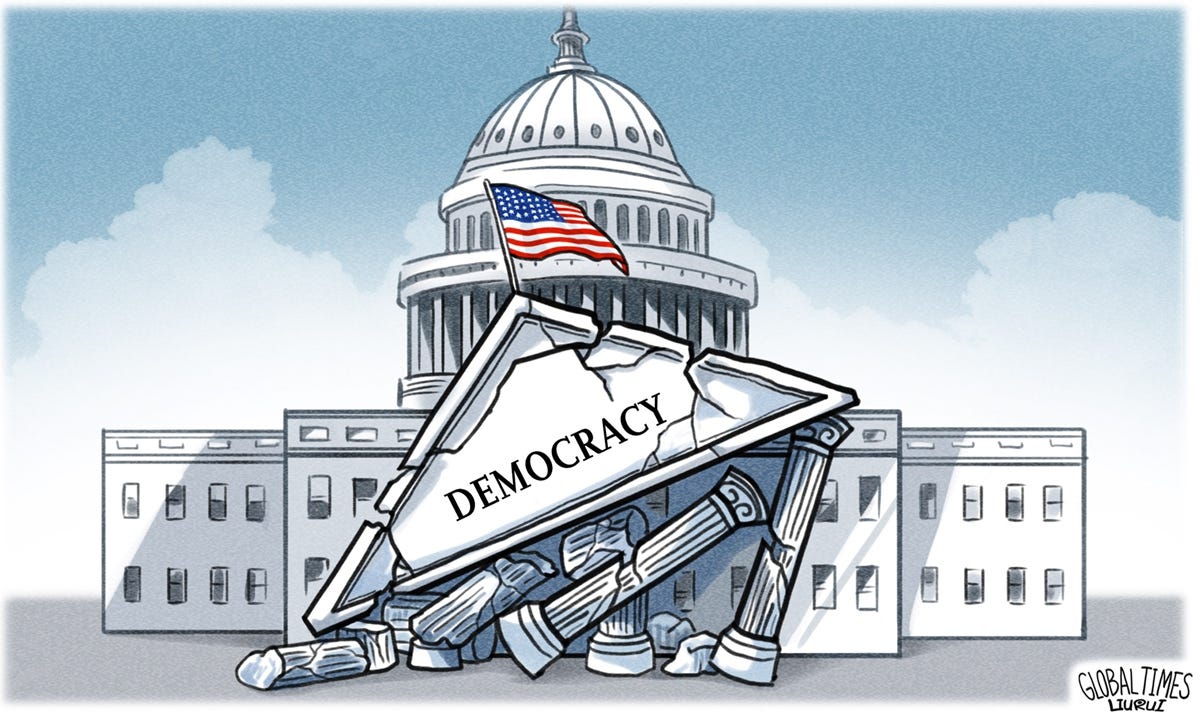
Of course, Democracy is already destroyed in America. Both parties are corporate-dominated. They obey the owners and donors and ignore us. The people who need the most help in America are those with the weakest voices; those who are dominant keep scheming successfully to get more and more even while loudly crying “foul.” It’s socialism for the corporate rich, dog-eat-dog capitalism for everyone else, and both parties are firmly committed to keeping it that way.
So why do I vote? I truly believe it’s one of my civic duties. Besides, there are issues/questions on the ballot that do matter in my state, and I want to have my say.
So, my fellow Americans, don’t despair at tomorrow’s results. Don’t become fearful about one party or the other winning followed by democracy’s destruction. For that happened decades ago, and we’re still chugging along, even though I’m seeing more black smoke billowing from the engine compartment.
My dad knew the score, and his words haunt me. He survived poverty, the Great Depression, World War II, and low-paying factory work before securing a decent civil service job that kept us solidly in the middle class. In the 1990s, he told me he’d had it tough in the beginning of his life but easy at the end; but he predicted the reverse would be true for me: relatively easy at the beginning but tough at the end. I hope he’s wrong, but I fear he’s right. The proof is evident at every election. Sigh.
Don’t tell me I voted for the very bad guy when I voted for a very good one
Let’s look at a political ballot with three candidates. (I use “guy” without a specific gender in mind.)
Candidate (R): Very Bad Guy
Candidate (D): Bad Guy
Candidate (G): Very Good Guy
I only have one vote. I choose Candidate (G).
But wait, the critics scream. (G) doesn’t have a chance. Only (D) can win against (R). You must vote for (D) or children and democracy will die!
As Mr. Spock would say, this is highly illogical.
If (R) wins the election, the voters who cast their ballots for the Very Bad Guy are responsible. Not me.
If (D) loses, i.e. failed to win enough votes, then Party (D) should have nominated a better, more attractive, candidate, instead of a Bad Guy.
If (D) does win, and remember he’s a Bad Guy, his party will feel vindicated and will likely keep nominating bad guys. Why change a winning formula?
Logically, if I want a Very Good Guy to win, I have to vote for him. And if I want to drive Party (D) to nominate better candidates, I can’t do that by giving their bad guys my vote. I have to incentivize Party (D) to change, and they won’t change if I just roll over and vote for them because Party (R) is allegedly even worse.
So, if lots of Very Bad Guys win on Tuesday, blame those who voted for them. Prod those voters who stayed home and didn’t vote (perhaps by fielding better candidates in the future). Ponder why the big “choice” was between Very Bad Guy and Bad Guy. Just don’t blame me for voting for the Very Good Guy.
Tuesday’s elections won’t be kind to the aimless Democrats
President Joe Biden is not a message guy. Nor is Nancy Pelosi. Nor is Chuck Schumer. The senior leaders of the Democratic Party lack charisma, lack communication skills, and seemingly have no compelling core principles except the usual ones for politicians (raise money, stay in power). I’ve seen plenty of political ads, heard plenty of speeches, read plenty of articles, and what I’ve gathered is that I should vote Democrat because the Republicans are dangerous to democracy and beholden to Trump. And that’s about it for a “message.”
My guess is that this magnet is selling well
Oh, there is one thing. Biden promised he’d attempt to codify Roe v Wade into law if the Democrats can somehow keep control of the House and Senate, which at this point is unlikely for the House and dodgy as well for the Senate. Here’s the problem with that “promise.” In 2007, Barack Obama promised to codify Roe v Wade if he won the presidency, saying it would be his top priority. After he was elected, he changed his mind and did nothing. In 2020, Joe Biden made a similar promise; he has also done nothing in the last two years. Yet now we’re supposed to believe Biden’s new “promise,” even though it’s an obvious and desperate ploy to rally pro-choice forces to vote blue no matter who on Tuesday.
That Democrats are not Republicans is enough for more than a few voters, and I get that. What’s truly shocking is that’s pretty much the Democrats’ message. And it simply isn’t persuasive enough to appeal to undecided voters. More and more voters, fed up with both parties, are “independents” or otherwise unaffiliated, and you have to give them a reason to vote for you other than “the other guy (or gal) is worse.”
Consider, for example, the Democrats and war. Democrats fully support massive budgets for the Pentagon; Democrats fully support $100 billion or more for Ukraine in its war against Russia; Democrats fully embrace the “new Cold War” and aggressive support of Taiwan. Recall that Biden suggested “Putin must go” as a goal of the Ukraine war, and that Nancy Pelosi, that skilled and deft diplomat, traveled to Taiwan to stir up anti-American sentiment in China. If you’re at all interested in slightly downsizing the Pentagon budget, of ratcheting down tensions with Russia and China, of pursuing diplomacy with words instead of weapons, of occasionally fostering the idea of “peace,” today’s Democratic Party is not for you.
As inflation continues to rise, hollowing out the working and middle classes even more, the Democrats have no solutions except higher interest rates and a bit more government aid here and there so that you can keep making (barely) your rent or mortgage payments while putting food on the table and paying for heat. Forget about a higher federal minimum wage. Forget about single-payer health care. Even student loan debt relief is very limited (it may go away completely if the courts rule Biden exceeded his executive authority).
As Democrats lecture people about saving democracy, Americans wonder where democracy went. Obviously, both political parties are beholden to big money, the owners and the donors, and ordinary people have no say, except on Tuesday when we’re each allowed to cast one vote.
I will be voting, of course. As the saying goes, my vote must have some value or the powers that be wouldn’t be spending so much money to buy it. Where possible, I’ll be voting for candidates whose values most closely align with mine. That often means I’ll be voting third party, which my critics tell me is a vote for Trump and his evil minions. Sure, keep on scolding me for wanting honest and principled candidates like Matt Hoh, who’s running for the Senate in North Carolina for the Green Party. It’s all my fault for wanting candidates who truly offer hope and change, instead of more of the same.
Blame the voters, Democrats! It’s a surefire way to victory, if “victory” means another shellacking at the midterms by the Party of Trump. Sigh.
Whatever else is true, it’s not morning again in America.
Shooting for total victory for Ukraine may only lead to total war for the world
Recently, I’ve been discussing the Russia-Ukraine War with a friend. He sees it as a “war of national liberation” for Ukraine and fully supports extensive U.S. military aid in weaponry, intelligence, and logistics. Supporters of Ukraine, he said, are much like those who supported republican Spain against the fascist forces of Franco in the 1930s. Vladimir Putin is a dangerous dictator bent on Ukraine’s total subjugation. He must be stopped, and the best way to ensure that is total military victory for Ukraine. He also opined that Ukraine is winning the war and that the $100 billion or so that the U.S. government has pledged is money well spent.
Once Ukraine wins the war, he concluded, it should be fully integrated into NATO, still a vitally important alliance against Russian imperial expansion and exploitation. Ukraine only seeks to protect its own sovereignty and to join European democracies and the EU, a goal the U.S. should actively seek to facilitate.
I wish I could be as confident and certain as my friend of the nobility of both Ukraine’s cause and U.S. participation in Ukrainian politics and the war. Why am I more skeptical than my friend? For several reasons:
The U.S. government has done nothing to facilitate diplomacy and negotiation between Ukraine and Russia. Indeed, the Biden administration has worked to discourage diplomacy.
Ukraine may see itself as engaged in a “war of national liberation,” but for U.S. officials it’s more of a proxy war to weaken Russia. Various sanctions and the destruction of the Nord Stream pipelines suggest powerful economic and financial motives that have nothing to do with safeguarding Ukrainian territory or its “democracy.”
Undeniably, U.S. aid to Ukraine, commitments of which have already exceeded $100 billion, are a major boon to the military-industrial complex in America. When people profit massively from war and death, it’s reasonable to question their motives.
The U.S. military/government exists to safeguard national security and the U.S. Constitution. In that context, the territorial integrity of Ukraine is not a vital concern.
The danger of military escalation in Europe is real. A longer war means more dead and wounded soldiers on both sides; more destruction and collateral damage; and more inflammatory rhetoric about nuclear red lines, dirty bombs, and the like. The longer the war lasts, the more inflamed passions will become, and the more likely efforts “to end Russian occupation” of Ukraine will escalate into something far more ambitious — and likely far deadlier.
To me, neither side appears to be clearly winning and neither is on the verge of victory. If the war lasts another year, or two, or three, any kind of Ukrainian “victory” may be pyrrhic indeed if the country is a blasted husk as a result.
War is ugly. Long wars are uglier still.
As I explained to my friend, I deplore Putin’s decision back in February to invade. I hope Ukraine prevails. But I believe Russia, Ukraine, and indeed the world would be better off if the war ends via negotiated settlement, the sooner the better. History teaches us that wars often spin out of control when estranged sides insist on total victory.
I added that I’d be careful indeed in placing faith in the wisdom of U.S. leaders or in appeals to ideals of the Lincoln Brigade of the Spanish Civil War of the 1930s. Recent wars (Vietnam, Iraq, Afghanistan, etc.) should teach us how frequently U.S. leaders lie, and how willing they are to wage long and disastrous wars that compromise U.S. security.
Also, talk of “facilitating Ukraine’s liberation” is both open-ended and ill-defined. For the U.S., is that limited to weaponry and training and the like? Or does “facilitating” mean much more than that, including combat by U.S. troops and the risk of dying or being grievously wounded in the cause of Ukraine’s liberation? If the latter, would you send your sons and daughters to fight in such a war?
Talking about Ukrainian national liberation and protecting democracy seems unproblematic, but, as I asked my friend, are you and yours willing to fight and die for it? When did Ukrainian “liberation” become so vitally important to U.S. national defense? So much so that $100 billion or more of your money is sent there, so much so that the 101st Airborne Division is deployed to Romania as a form of tripwire or deterrent, so much so that plans to deploy upgraded U.S. tactical nuclear weapons to Europe are being accelerated even as recent exercises featured dry runs of nuclear weapons attacks.
Already the Russia-Ukraine War has lasted far longer than experts predicted. Already it has cost far more than anyone expected. Shooting for total victory for Ukraine may only lead to total war for the world.
(Please go to Bracing Views on Substack if you’d like to comment.)
On learning the value of negotiation from the Outlaw Josey Wales
We’re in a strange moment when advocating for negotiations toward peace in Ukraine is dismissed as not only wrongheaded but morally wrong. We’re told that only Ukraine can determine its future, and that one must not appease a dictator (Putin), but in the same breath we’re told that peace will only come when Russia is totally defeated by force of arms, with the main arms supplier being the United States. Methinks various actors in the U.S. are evincing a conflict of interest here. When war is profitable and you keep arguing for it, it doesn’t take a detective to see motives that are suspect.
Even when it’s necessary, war is bloody awful and murderously atrocious. Not surprisingly, Jesus Christ preferred to bless the peacemakers instead of the warmongers. Yet peacemakers today in the U.S. are rare indeed in the government and in mainstream media. In God we (don’t) trust.
Being anti-war strikes me as a sane position for any human being. War, in rare cases, may be unavoidable and even necessary (I’d point to World War II as a necessary war to defeat Nazi Germany and Imperial Japan), but being anti-war should be reflexive. As I once read on a bumper sticker: “I’m already against the next war.” I laughed at that one. Peace is joyful.
I’d go further and argue that peace is pro-life and pro-choice. Everyone should be for it, unless, that is, you make your fortune from war. It’s hard to be pro-life, after all, when you’re shouting “kill” at some enemy. And you really have no choices when you’re dead. If you want more choices in life, turn away from war. There’s nothing like war to deny you choices — and perhaps life as well.
The Russia-Ukraine War may soon enter its second year. No one in their right mind should be cheering for this. I don’t want to see more dead Russians and Ukrainians. I don’t want escalating tensions between the U.S. and Russia, the world’s most powerful nuclear-armed nations. Only a fool or a war profiteer should want another cold war, considering that the previous one wasted trillions of dollars, cost millions their lives, and almost ended in nuclear Armageddon sixty years ago off the coast of Cuba.
For some reason an old Clint Eastwood film comes to mind: “The Outlaw Josey Wales.” As Josey Wales says to Ten Bears, a Native American chief, in a grim life-or-death faceoff, “Men can live together without butchering one another.” Wales, unafraid to be seen as “weak” by negotiating with a Comanche chief, brought his word of death even as he sought an understanding that would preserve life. And life it was.
Negotiation is not weakness. Peace and life, as Josey Wales knew, is far preferable to war and death. If the will exists, even bitter opponents can find common ground and a path forward away from death. Words of peace have iron of their own, as Ten Bears says. They ring true when they resonate from people of honor.
Josey Wales, a man who’d lost his family to war and its butchery, a man who’d had to kill to survive, wanted nothing more than peace and a chance for a better life. So should we all.
(If you’d like to comment, please go to Bracing Views on Substack. Thanks.)
Just over 30 years ago, as a young captain in the Air Force, I was celebrating the collapse of the Soviet Union and the arrival of “the new world order.” Those were the days! We talked seriously about peace dividends, about America becoming a normal country in normal times, as in peaceful times. Money on wars and weapons would be redirected to infrastructure improvements and repairs, to critical research in medicine, to improving health care, to renewable sources of energy. America was ready to vault into the 21st century, no longer haunted by a cold war that could end the world in a heartbeat with nuclear war.
Leave it to America to snatch defeat from the jaws of victory. For we truly have defeated ourselves since 1991 in our embrace of militarism, weaponry, and war. And now we face renewed fears of nuclear war without any serious movement to end the proliferation of nuclear weapons. Indeed, the U.S. military speaks of “investing” in more nuclear weapons as if they’re a growth stock, as if there are dividends awaiting us when we cash them in. We’ll all cash in our chips, that’s for sure, if the missiles fly.
We seem possessed by a form of MADness, a certain fondness for mutually assured destruction (MAD). Or, perhaps not fondness but resignation bordering on defeatism, which makes me think of those old posters we had as kids about nuclear war that reminded us there was little we could do once the missiles were launched, so we may as well kiss our ass goodbye.
But the world nevertheless remains full of surprises. Color me amazed by America’s new love of Ukraine, formerly a Soviet republic that most Americans still can’t place on a map. (I’ve seen Americans quizzed on the street who place Ukraine in Mexico or Australia.) We love Ukraine so much that we’re willing to pledge $100 billion or more in aid, most of it in the form of military weapons and training. America has never had a “special relationship” with Ukraine, so what gives? My friends tell me we must defend democracy in Ukraine, but democracy doesn’t exist there (nor does it in America, but that’s another story).
The words of Darth Vader come to mind: “You don’t know the power of the Dark Side [of the Force]. I must obey my master.” And in the case of Congress, that master is obviously the national security state, the MICIMATT of which Congress is a card-carrying member. (MICIMATT: Military-Industrial-Congressional-Intelligence-Media-Academia-Think-Tank Complex.) Think of it as the real “evil empire,” and good luck trying to resist its power and influence.
Yet, how can America have turned to the “dark side”? Isn’t America a collection of Jedi knights fighting for freedom? It sure would be nice to think so! But when you look at America’s wars in places like Vietnam, Iraq, and Afghanistan, what you see is an incredibly rich empire throwing almost everything at countries and peoples who had little if anything compared to the wealth and power of the U.S. and its ferocious military machine. You also see enormous profiteering, especially by the “industrial” side of the America’s militarized complex, and incessant lying by the U.S. government about progress and “winning” in its various misbegotten wars.
Only when military defeat is nearly total do U.S. troops finally come home, after which the peace advocates, relatively few in number, are blamed for weakening fighting spirit at home.
Promises of peace dividends, whether after World War II or the Cold War, have simply withered away as wars of conspicuous destruction (Vietnam, Iraq, etc.) fed a society engaged in conspicuous consumption. A militarized form of Keynesianism provided jobs and wealth for relatively few Americans at the expense of a great many.
Paradoxically, even as America’s wars went bad, no one was ever held accountable. When the warmongers admitted they were wrong (a rarity), they argued they were wrong for the right reasons. And those who were truly right, whether about Vietnam or Iraq or Afghanistan, were obviously right for the wrong reasons. Those “wrong” reasons included preferring peace to war or daring to question the purity of U.S. motives and methods when it came to foreign wars.
And so we’ve come to the point when the so-called Progressives in Congress quickly cave to pressure and withdraw a milquetoast and mealymouthed letter that argued a tiny bit for diplomatic efforts by the Biden administration to end the Russia-Ukraine War. It was as if they’d become quislings; as if calling for negotiation was equivalent to bowing and scraping before Vladimir Putin.
So, I return to my question: Dammit, where’s my peace dividend? And the answer is nowhere because powerful forces in America simply love their war dividends — and they’re not about to surrender them.
Note to readers: If you’d like to comment, please go to Bracing Views on Substack. Thanks.
The U.S. and NATO have apparently decided that the world is better (for them) if Russia is weak and chaotic instead of being comparatively strong and orderly.
Something tells me a strong and orderly Russia might be better. A weak and chaotic Russia, with nuclear weapons, is likely to be far less predictable. For example, who or what comes after Vladimir Putin if he’s overthrown? Is the West sure that a divided or disorganized Russia is a “better” one?
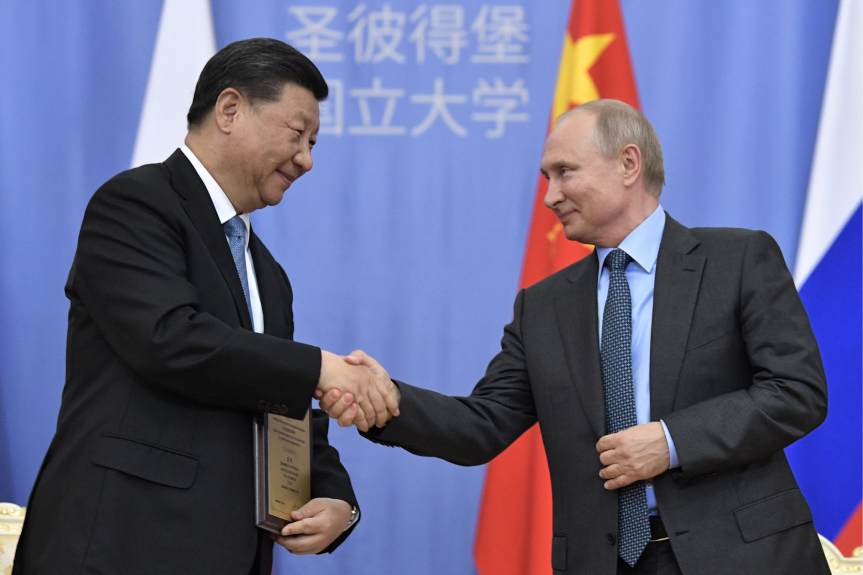
As Margaret Thatcher said of Mikhail Gorbachev, we can do business with him. Putin is a rational actor. Who or what follows him in Russia may be much more vengeful than rational — and vengeance and nukes are a potent, perhaps genocidal, mix.
Recently, I was thinking about the difference between the end stages of the Cold War, when I entered the Air Force in the 1980s, and the current crisis with Russia. To me, one big thing stands out. In the 1980s, the U.S. was willing to negotiate on equal terms with the USSR. Reagan and Gorbachev, despite their differences, talked to each other with respect. Today, Joe Biden refers to Putin and the Russians with disdain. Biden seems to see Putin as little more than a thug, someone not worth talking to. As Biden himself said, “For God’s sake, this man cannot remain in power.”
The U.S. has been a dominant superpower for so long that its leaders simply take it for granted and have little (if any) empathy for others. Weakening Russia is not a sign of American cleverness or strength but rather of shortsightedness.
In the 1980s, Reagan and Gorbachev talked sincerely of nuclear arms reductions, even of their eventual elimination. Nothing like this exists today. Indeed, the U.S. now speaks of “investing” in a new generation of nuclear weapons at a cost of a trillion dollars (or more). Basically, the U.S. is in a nuclear arms race with itself, even as Russia and China are trotted out as the looming nuclear threats.
In demonizing Putin and Russia, the U.S. is closing doors to negotiation and potentially opening missile silo doors to obliteration. By not bargaining at all, Biden and company are not being resolute, they’re being pigheaded.
As Winston Churchill famously said, “Meeting jaw to jaw is better than war.” Politics and war are not and should not be antithetical to each other. A negotiated settlement is better than more dead Ukrainians, more dead Russians, more blasted terrain, and even higher risks of nuclear escalation.
Haven’t we heard enough already about nuclear red lines and dirty bombs? Stability is what’s needed today based on some measure of respect, however grudgingly given. If avowed Cold War warriors like Reagan and Thatcher in the 1980s could do business with Gorbachev and the Soviet Union, America’s leaders today, from a much stronger position, should be able and willing to do business with Putin.
This is not about appeasing or rewarding Putin for his invasion. It’s about stopping a war before it potentially grows wider — and far more deadly.
Note for readers: If you care to comment on this post, please go to Bracing Views on Substack. Thanks.
It seems strange to me how America’s leadership is spoiling for a new world war. Most Americans wanted revenge against Japan after Pearl Harbor in 1941 and understood the dangers of Nazism and Germany’s quest for world dominance, but why is risking a world war necessary in defense of Ukraine or Taiwan?
Here’s my take: Let Ukraine and Russia settle their differences. Let China and Taiwan settle their differences. The fate of Ukraine or Taiwan has almost nothing to do with U.S. national security.
No other nation on the planet defines the entire world as its sphere of influence. Only in America is the fate of faraway countries like Ukraine or Taiwan tied directly to our fate. It’s like Russia being worried about the U.S./Mexican border or China taking a direct hand in defending Cuba against America.
Maybe what we need is a new Monroe Doctrine. Instead of warning others to stay out of “our” hemisphere, Americans need to vow that we remain in “our” hemisphere, because what happens in Taiwan largely stays in Taiwan, and what happens in Ukraine largely stays in Ukraine. Neither fundamentally compromises our national security and neither directly threatens our Constitution and way of life.
But we must stand up to Putin! We must stand up to Xi! If we don’t stop them over there, we’ll have to stop them here! To that I say, let’s wait and see. Any country foolish enough to invade America will face a heavily armed and inflamed people who are ready to rumble.
It’s time to stop spoiling for a new world war. Sadly, at least three big problems constrain Americans in plotting a saner course:
Wars and preparations for war are immensely profitable for weapons makers.
Domestic politics, as both parties accuse the other of being weak on China or Russia or both, driving both parties into the arms of hawks.
The mainstream media, which never met a war it didn’t like, as long as ratings are high.
How do we fix this? Levy a war tax on the richest Americans for all the weaponry and other aid being sent to Ukraine and Taiwan and elsewhere. Stop voting for candidates who always vote for more and more war. Stop listening to the mainstream media and their warmongering.
One thing is certain: war is too important to be left to the generals, the Beltway bandits, and the usual neocon suspects who posture about putting on big boy pants while sitting safely in corner offices.
So many people vote for a Democrat or Republican without having a clue what their candidate stands for. Politicians are adept at refusing to take positions; profiles in courage they are not. This is one big reason why I respect Matthew Hoh, candidate for the U.S. Senate in North Carolina. He takes firm stances based on his personal convictions and principles. Here, courtesy of INDY Week in North Carolina, is an article that details these. Not surprisingly, the Democratic and Republican candidates chose not to answer these questions.
My suggestion: Find a candidate in your district who’s willing to go on the record with strong stances that you believe in. If you can’t find such a candidate, write someone in, or don’t vote for that office, or (big ask) consider running for office yourself in the future, or consider joining new parties that seek to break the corrupt hold on our politics that the Democrats and Republicans have enjoyed for far too long.
1) What are your primary concerns for the State of North Carolina?
I have been to all parts of North Carolina throughout the campaign, and the three things I hear everywhere are healthcare, housing, and drugs.
Millions of people in NC live without healthcare due to being uninsured or underinsured, while more than 20% of NC adults are in collections for medical debt. Housing is unaffordable across the state. Home prices are out of reach for most working families, while rents have increased at a criminally staggering rate of 25-50%. Individuals, families and communities, particularly Black, Latino, and Native American communities, have been devastated by the War on Drugs. Every day 12 North Carolinian lives are lost from fatal overdoses. At the same time, the mass incarceration and prohibition policies of Republicans and Democrats have ruined lives and wrecked families, destroyed neighborhoods, and sustained cycles of crime.
These are the same issues I see in my life. My family, friends and neighbors suffer and are hurt by these deliberate bipartisan policies. I’m running to make sure there is a voice in this race for Medicare for All and not for for-profit healthcare; that there are meaningful, affordable housing policies that are not simply tax breaks and subsidies for developers and banks; and that we end the War on Drugs and treat substance abuse and addiction as public health matters rather than as crimes.
2) What in your background qualifies you to represent the people of this state effectively? What would you cite as your biggest career accomplishments?
I’m a disabled Marine Corps combat veteran. I live paycheck to paycheck, often solely on my veteran disability payments. Due to my disability, I went five years unable to earn an income. This, more than anything else, has prepared me to represent working families in Washington, DC.
In 2009, I resigned my position with the State Department in Afghanistan in protest over the escalation of that war. I’ve worked in Washington, DC with members of Congress and their staff for over a decade on war and peace, veterans issues and foreign policy. I’m very familiar with how Congress and the DC establishment operate, and this, perhaps, is the best explanation as to why I am running with the Green Party and not as a Democrat or Republican.
Locally, I have done peer support in the veterans and homeless communities.
If elected, what three policies would you prioritize and how would you work across the aisle to enact those initiatives?
I believe there are Democrats who are willing to break with their party and support meaningful climate and healthcare legislation (not giveaways to the fossil fuel industry and healthcare insurance companies such as the Inflation Reduction Act and the Affordable Care Act.) At the same time, some Democrats and Republicans are willing to reduce the bloated military-industrial complex, rein in the gross violations of constitutional rights and liberties by law enforcement and intelligence agencies, and end corporate subsidies. I look forward to working with progressives and libertarians on ending the War on Drugs, protecting and expanding civil liberties, particularly LGTBQIA+ rights, and ending our militarized foreign policy.
To accomplish this, I will work in a manner similar to how Senators Joe Manchin and Kyrsten Sinema have operated these past two years. However, rather than my efforts being for the benefit of fossil fuel companies and hedge fund managers, as with Senators Manchin and Sinema, my efforts will be for the working and middle classes. I have said repeatedly: no one will get $15 billion aircraft carriers unless our people get healthcare.
3) More than 1 million Americans have died due to COVID-19 and millions more are struggling with astronomical medical bills. Do you believe the American health system is working? What is your plan for making sure health care is affordable and accessible to all American citizens? Are you in favor of a single-payer option?
I’m running because I have many people in my life, people I love, that must check their bank account before calling their doctor. Around a third of all COVID deaths occurred due to people’s inability to afford medical care. That is a consequence of our for-profit healthcare system and a legacy of the Affordable Care Act. Before the pandemic, tens of thousands of Americans were dying each year as a result of not being able to pay for healthcare. I support Medicare for All, which would provide people with affordable and quality healthcare under a single-payer system. This would save our society hundreds of billions of dollars annually while ensuring everyone can get the healthcare they need. I’m also in favor of canceling all medical debt.
4) What factors are fueling the country’s growing political polarization and how will you work to mend it?
Politicians in both parties have increasingly relied on culture war rhetoric to maintain voter loyalty, despite taking millions of dollars from corporations who couldn’t care less about issues like LGBTQ rights or religious freedom. Additionally, partisan gerrymandering has increasingly resulted in noncompetitive districts, denying voters the chance to support candidates from other parties. I support reforms like ranked-choice voting, proportional representation for legislatures, and public campaign financing. These improvements would take the pressure off voters not to “split the vote” and allow them to vote for candidates based on issues and policies and not party identity.
Rent, property taxes, and home sale prices have generally been rising over the past several years. What, if anything, should the federal government do to address this growing affordability crisis?
The federal government plays a dominant role in housing as it backs loans and mortgages, subsidizes development and construction, and provides grants to developers. This allows the federal government to institute rent control, which should be done. Public banking would allow working families to qualify for home loans based on their rental histories. Corporations, banks, and investment firms should be banned from purchasing single-family homes. Housing policy, like other areas of the economy, needs a reversal of the decades of bi-partisan support for corporations, banks and the wealthy at the expense of the working and middle classes. Our homeless epidemic, a massive moral failing, is the direct consequence of this choice to prioritize profit over people.
5) Do you believe the federal minimum wage should be increased? If, by how much? If not, why?
I support a federal living wage that annually increases to match inflation and the rising cost of living, particularly housing costs. That would currently equal around $22 an hour. I fully support the right of workers to organize through unions for higher wages, better benefits, and safer working conditions. Additionally, we need to incentivize employee ownership, cooperatives and workplace democracy.
6) What specific policies or programs do you endorse or would pursue to combat inflation? Do you foresee the US heading into a larger economic recession and if so, what is the best way for Congress to address it?
Food and energy price increases are a result of climate change and war. Droughts, floods, and wildfires will continue to impact our economy, as will foreign wars, while our dependence on fossil fuels will keep us at the mercy of US and foreign oil companies. We need a Real Green New Deal to address these causes.
Supply chain shortages, resulting from decades of infrastructure neglect, are another reason for inflation. Most significantly, however, the current inflation rate is driven by corporate greed and price gouging, not labor costs or productivity issues. Fed interest rate hikes, meant to cause unemployment and which will fully push us into a recession, are not the answer.
Economic inequality has devastated the working and middle classes. This has resulted from deliberate policies over decades meant to ensure those at the top not only remain at the top but see their wealth grow. Working families have been squeezed to the point that 60% of us now live paycheck to paycheck while a third of families can’t make ends meet, with that number rising to more than half of Black and Latino families. I’m the only candidate in the race for US Senate calling for Medicare for All, rent control, public banking, universal public education from pre-K through university, including vocational and trade schools, and living wages adjusted annually for cost of living increases. These measures will substantially and fundamentally address economic inequality and establish healthcare, housing, education and jobs as human rights.
7) The US Supreme Court issued a ruling this summer overturning Roe v. Wade. Do you believe abortion should be a fundamental human right? If elected, would you support a federal ban on abortion? What role, if any, should Congress play in restricting or expanding access to abortion?
Abortion, like other reproductive rights, is healthcare, and healthcare is a human right. Abortion is ultimately the sole decision of a woman. Like all other forms of healthcare, abortion should be available through a universal single-payer healthcare system available to all people without cost at the point of service. Abortion should be available without conditions and judgment. We must ensure women and their families have all the resources they need for healthy and productive lives, and we must protect abortion seekers and providers from violence.
8) Please state three specific policies you support to address climate change.
Ban fossil fuel extraction techniques and infrastructure, such as fracking, offshore drilling, and oil and gas pipelines. Invest in green energy tech, industry, transportation, agriculture and infrastructure to decrease and end our dependence on fossil fuels. Support training programs to help workers in fields like mining and farming transition to high-paying jobs in sustainable energy and agriculture. These and other actions to mitigate the climate collapse and to assimilate to our changing world, particularly transforming and strengthening our economic and societal infrastructure, are key elements of the Green Party’s Green New Deal.
9) What more, if anything, should Congress do to regulate firearms?
I carried rifles and pistols in combat. The American people have the right to use firearms for self-defense and hunting. Still, measures like background checks, proper training standards, and mandatory waiting periods need to be implemented so that these weapons don’t end up in the hands of people who plan to harm others. A thorough in-person licensing and training program should be a requirement for possessing a firearm, especially outside the home. These measures must be consistent across states. We must also work to dismantle the gun lobby, whose continued obstruction of common sense gun regulations puts us all in danger.
Prohibition and poverty are and have long been, the primary root causes of crime. End the decades-long, failed, counterproductive and shameful War on Drugs. We must address the deep state of poverty by ensuring all people are paid a living wage and have healthcare and access to free public education from pre-K through college (including trade/vocational programs.)
10) Are there any issues this questionnaire has not addressed that you would like to address?
Environment: I’ve lost track of the number of NC communities that can’t drink their water. The poisoning of our air, land and water by corporations backed and protected by Democrat and Republican politicians is a mass environmental catastrophe that has caused immense environmental harm, devastated wildlife and sickened and killed North Carolinians.
Immigration: My grandparents were immigrants. If any other nation were treating people at its border the way the US treats people at its southern border, we would decry it as a crime against humanity. The bipartisan Democrat and Republican border policies have not only been failures but are massive human rights violations. We must treat all people with dignity and address the systemic reasons why people leave their home countries.
This nation needs immigrants to grow and develop our economy. There is no reason we cannot achieve an immigration policy that treats people humanely, allows for a pathway to citizenship, and provides economic benefits to our society. It’s simply a question of choosing to do so rather than continuing decades of racist fearmongering for political gain.
Democracy: Voting should be expanded, strengthened and made more inclusive. We need to make voting more accessible and easier for individual voters and we must update and modernize our political process.
A Pew poll found that 70% of Americans support the need for more political parties. Voters should have more options. I support ranked choice voting, proportional representation, abolishing the electoral college, ending gerrymandering, establishing term limits and fighting continuously to get money out of politics.
This past summer, the North Carolina Green Party and my campaign had to go to federal court to participate in this election. This was necessary because of a well-funded legal campaign by the Democratic Party to keep the Green Party off the ballot. At all levels, the Green Party prevailed (multiple county boards of elections, NC State Boards of Elections, Wake County Superior Court, US District Court and US Federal Appeals Court); however, the effect on our ability to participate in elections and to represent voters who otherwise would not be represented was dramatically impacted. Voter suppression occurs in multiple forms by both of the major parties.
Reparations: I support Black and Indigenous-led efforts to provide reparations.
It’s election time in America, meaning there are plenty of candidates wishing we’d all play the sap for them. Don’t do it. Vote for those you believe in: candidates who are principled and have a record of taking bold stances and of telling the truth. People like Matt Hoh, who’s running for the Senate as a member of the Green Party in North Carolina.
Occasionally, I need to state the obvious, if only to remind myself of the realities of this world. All governments lie and all have their instruments of repression. The most dangerous government is most likely your own government, whatever country you live in, because that governing party has direct power over you, and also because you’re likely to have some allegiance to it, perhaps even some affection for it. As an American, for example, it’s far easier to play the patriot than to act as a dissident. The patriot gets applauded and rewarded; the dissident gets attacked and punished.
The U.S. government, like any other government, lies. Think of the Pentagon papers, the Afghan War papers, the “slam dunk” case of WMD in Iraq that were never found, and so on. All governments lie, as I.F. Stone said.
The message is simple: Always question authority, whether it’s Russian or Chinese or American. Be skeptical. Don’t play the sap. Make Humphrey Bogart proud.








 Bracing Views