Militarism Run Mad

W.J. Astore

Remember President Biden’s request for $33 billion in “aid” to Ukraine? That $33 billion package has become $40 billion and has already been approved by the House. More than half of this “aid” is in the form of weapons or in support of deploying more U.S. troops and equipment to Europe. And even that $40 billion isn’t high enough for some members of the Senate, who are calling for even more “aid,” i.e. more spending at the expense of the American taxpayer that will likely serve to prolong the Russia-Ukraine War.

More and more money for war recalls a famous quip by Winston Churchill in the age of navalism, when industrial interests in the UK pushed for more and more battleships to be built so that Britain could continue to rule the waves and not be slaves.

As Churchill famously said: The Admiralty had demanded six ships; the economists offered four; and we finally compromised on eight.

America has embraced a militarized Keynesianism that is very good indeed for weapons makers like Raytheon and Lockheed Martin. It’s also very good for the Pentagon, whose budget projections keep rising when they should be falling.

Think about it. Overall, the Russian military hasn’t yet distinguished itself in Ukraine, and the longer the war lasts, the weaker that military becomes. If the U.S. military budget was actually based on an honest assessment of threats, the budget should be decreasing as Russia becomes less of a threat.

Another interesting aspect of this is that it’s mainly been Republicans voting against the $40 billion package in “aid.” Democrats, no matter how “progressive,” are eagerly voting for it, even as inflation soars in America and people struggle to make ends meet.

Perhaps it’s time to build more battleships to help the poor and struggling? We can house the unhoused in ships!

Housing for the unhoused! The HMS Dreadnought battleship

Dominating the World Stage

W.J. Astore

“Make love, not war!” on the helmet of Marine Corporal Billy Winn, Vietnam, 1967 (Photo by William Eggleston)

In the 1960s, in response to the Vietnam War, young Americans vowed to “make love, not war.” Ever since 9/11, if not before, America has a new vow: Make War, Not Love.

The American empire believes it must dominate the world stage. Partly this is due to hubris unleashed by the fall of the Soviet Union in 1991. As Colin Powell put it that year:

“We no longer have the luxury of having a threat to plan for. What we plan for is that we’re a superpower. We are the major player on the world stage with responsibilities around the world, with interests around the world.”

When you define the world as your “stage” and define yourself as a military and economic “superpower,” as the major player, a hubristic and militaristic foreign policy almost naturally follows. And so it has.

In my latest article for TomDispatch.com, I detail five reasons why America remains addicted to hubristic war; what follows is an excerpt that focuses on America’s vision of itself as the best and purest actor on the world stage. Please read the entire article at TomDispatch.com.

***

About 15 years ago, I got involved in a heartfelt argument with a conservative friend about whether it was wise for this country to shrink its global presence, especially militarily. He saw us as a benevolent actor on the world stage.  I saw us as overly ambitious, though not necessarily malevolent, as well as often misguided and in denial when it came to our flaws. I think of his rejoinder to me as the “empty stage” argument.  Basically, he suggested that all the world’s a stage and, should this country become too timid and abandon it, other far more dangerous actors could take our place, with everyone suffering. My response was that we should, at least, try to leave that stage in some fashion and see if we were missed.  Wasn’t our own American stage ever big enough for us?  And if this country were truly missed, it could always return, perhaps even triumphantly. 

Of course, officials in Washington and the Pentagon do like to imagine themselves as leading “the indispensable nation” and are generally unwilling to test any other possibilities.  Instead, like so many ham actors, all they want is to eternally mug and try to dominate every stage in sight. 

In truth, the U.S. doesn’t really have to be involved in every war around and undoubtedly wouldn’t be if certain actors (corporate as well as individual) didn’t feel it was just so profitable. If my five answers above were ever taken seriously here, there might indeed be a wiser and more peaceful path forward for this country. But that can’t happen if the forces that profit from the status quo — where bellum (war) is never ante- or post- but simply ongoing — remain so powerful. The question is, of course, how to take the profits of every sort out of war and radically downsize our military (especially its overseas “footprint”), so that it truly becomes a force for “national security,” rather than national insecurity. 

Most of all, Americans need to resist the seductiveness of war, because endless war and preparations for more of the same have been a leading cause of national decline.  One thing I know: Waving blue-and-yellow flags in solidarity with Ukraine and supporting “our” troops may feel good but it won’t make us good.  In fact, it will only contribute to ever more gruesome versions of war. 

A striking feature of the Russian invasion of Ukraine is that, after so many increasingly dim years, it’s finally allowed America’s war party to pose as the “good guys” again. After two decades of a calamitous “war on terror” and unmitigated disasters in Afghanistan, Iraq, Libya, Somalia, and so many other places, Americans find themselves on the side of the underdog Ukrainians against that “genocidal” “war criminal” Vladimir Putin.  That such a reading of the present situation might be uncritical and reductively one-sided should (but doesn’t) go without saying. That it’s seductive because it feeds both American nationalism and narcissism, while furthering a mythology of redemptive violence, should be scary indeed.

Yes, it’s high time to call a halt to the Pentagon’s unending ham-fisted version of a world tour.  If only it were also time to try dreaming a different dream, a more pacific one of being perhaps a first among equals. In the America of this moment, even that is undoubtedly asking too much. An Air Force buddy of mine once said to me that when you wage war long, you wage it wrong. Unfortunately, when you choose the dark path of global dominance, you also choose a path of constant warfare and troubled times marked by the cruel risk of violent blowback (a phenomenon of which historian and critic Chalmers Johnson so presciently warned us in the years before 9/11).

Washington certainly feels it’s on the right side of history in this Ukraine moment. However, persistent warfare should never be confused with strength and certainly not with righteousness, especially on a planet haunted by a growing sense of impending doom.

Pimps of War

W.J. Astore

You would think that a U.S. president would have better things to do than to tour and tout a missile-production facility in Alabama, but then you’d be forgetting the power of the military-industrial complex and the profitability of war. Yesterday, President Biden toured a Lockheed plant that makes the Javelin missile, which I’m sure is working overtime given the number of missiles (about 5500) this country has shipped to Ukraine in its war against Russia. I was asked for a quick comment before Biden’s visit, and here’s what I came up with:

You don’t defuse a war by sending more and more weapons to the war zone.  You don’t send a message of peace by visiting a missile-making facility.  President Biden spoke of inspiring other nations with the power of our example, but he’s opting instead for examples of our power.  In so doing, he’s betraying his own promise to America and to the world.  Statesmanship, not brinksmanship, is what’s required to end the disastrous war in Ukraine.  Negotiation, not militarism, is the correct path forward.  But it’s hard indeed to play the statesman and to foster negotiation when you pimp yourself out to the weapons makers.

Incredibly, or perhaps not so incredibly, Noam Chomsky has praised Donald Trump for his willingness to call for a negotiated settlement to the war. By contrast, the Biden administration appears content to let the war drag on in the cause of weakening Russia. In short, Ukraine is the administration’s proxy, and Biden & Company are willing to fight and die to the last Ukrainian while supplying plenty of arms to the same. Indeed, the latest aid package for $33 billion for Ukraine includes $20 billion in weaponry.

Should weapons really be identified as “aid”? No matter. The U.S. media is pimping for war, the president is visiting missile plants and praising the wonders of our weapons and how many Russian tanks they’ve destroyed, and we’re all supposed to accept this as business as usual in America. Which it is.

Abortion in America

Today’s big news: a “leaked” memo from the Supreme Court suggests that the court will overturn Roe v. Wade. My first thought is that the leak was deliberate, a way to get people used to the idea that a decision that has stood for 50 years is being negated by a packed and biased court. Let people yell and tweet and fulminate, but that’s all you get to do.

My second thought: the main victims of this law will be women without financial means. Women of means will always have access to abortion; they can travel to another state, pay a private doctor, etc. It’s poorer women, often of color, who will suffer the most.

But who cares about them, right? Justice is blind to them, never for them.

What a partisan joke the Supreme Court is in the U.S. And they have the gall to argue that the court is apolitical!

wjastore's avatarBracing Views

W.J. Astore

I truly believe that if men got pregnant, abortion would be free, legal, and readily available across the United States.

But men don’t get pregnant, so the idea of carrying an unwanted baby to term is mainly theoretical for them. How easy it is, then, to outlaw abortion while claiming to be pro-life.

Having been raised Catholic, I was taught abortion is murder. It’s that blunt. As the Church was teaching me that, it was allowing predatory priests to molest children. There was even a predatory priest assigned to my parish when I was young. So I’m not too keen on the moral authority and teachings of the Church here. Again, if priests got pregnant, I truly believe abortion would be accepted within the Church. Perhaps it would be justified by arguing that priests, first and foremost, have to serve God and the Church and therefore shouldn’t be…

View original post 738 more words

Prediction for 2014: War Will Continue to Find A Way

War has much been on my mind lately, with a scene from “Gone with the Wind” flashing through my brain. It’s when Ashley Wilkes, the paragon of honor and decency, reflects on war: “Most of the miseries of the world were caused by wars,” Wilkes says. “And when the wars were over, no one ever knew what they were about.”

Powerful words coming from a Southern cavalier who went off to do his duty in the “War Between the States.” Interestingly, the South often called it “the war of northern aggression,” whereas the North used “the war of southern rebellion.” War is a remarkably protean thing, and often completely unpredictable in its duration and effects. We often can’t even agree how to name it.

Here’s a repost from the end of 2013, nine distant years ago. Who could have predicted America’s Afghan War would finally be over, only to be replaced by a new Cold War and massive weapons shipments to Ukraine in a war with Russia that could also last for years, spreading miseries for reasons that are already disputed and which may yet prove unfathomable.

wjastore's avatarBracing Views

“War is like love; it always finds a way.”  So wrote Bertolt Brecht, and when it comes to American politics and foreign policy in 2014, you can bet on Brecht being right.  There is no major anti-war party in the USA today.  Despite claims to fiscal austerity, Democrats and Republicans fall over themselves to fully fund the Pentagon and its ongoing wars across the globe.  Our misguided involvement in Afghanistan lurches into its thirteenth year with promises that it won’t end until 2024 at the earliest.  The only certainty for 2014 is more dead bodies, more casualties of war, more money wasted.

Barbara Tuchman, a historian who knew how to write for the educated public, was right in pointing out the persistence of folly in history.  A heavily militarized U.S. foreign policy is an illustration of that.  Our country continues to seek global dominance through militarized measures, perhaps…

View original post 266 more words

Edward Snowden and Turnkey Tyranny

The truth is out there, America. Sometimes, the truth has even been forced to go into exile in Russia. How ironic is that? I remember the days when Soviet truth-seekers like Solzhenitsyn sought asylum in the U.S. Edward Snowden, of course, had to find asylum in Russia. Our country is not big enough to welcome him back. When did we become so small?

wjastore's avatarBracing Views

snowden Edward Snowden

W.J. Astore

Edward Snowden recently talked to Joe Rogan for nearly three hours.  Snowden has a book out (“Permanent Record“) about his life and his decision to become a whistleblower who exposed lies and crimes by the U.S. national security state.  As I watched Snowden’s interview, I jotted down notes and thoughts I had.  (The interview itself has more than seven million views on YouTube and rising, which is great to see.)  The term in my title, “turnkey tyranny,” is taken from the interview.

My intent here is not to summarize Snowden’s entire interview.  I want to focus on some points he made that I found especially revealing, pertinent, and insightful.

Without further ado, here are 12 points I took from this interview:

1.  People who reach the highest levels of government do so by being risk-averse.  Their goal is never to screw-up in a major…

View original post 555 more words

The Language of War

Suddenly, the U.S. media has become blunt in its rhetoric about war. So too have U.S. leaders. We hear constantly of war crimes and war criminals, even of genocide and mass graves. The criminals, of course, are exclusively Russian, or so the media says.

Yet when U.S. leaders are talking about their actions, the language of war is very different, and words like “crime” and “genocide” are never heard. Perhaps this post from six years ago may serve as a reminder of the pliability of America’s language of war.

wjastore's avatarBracing Views

languageW.J. Astore

The language of war fascinates me.  I was reading President Obama’s response to Donald Trump on whether Obama “gets it” when it comes to the threat of terrorism and came across this passage:

“Someone [Donald Trump] seriously thinks that we don’t know who we are fighting? If there is anyone out there who thinks we are confused about who our enemies are — that would come as a surprise to the thousands of terrorists who we have taken off the battlefield.”

That’s such a curious phrase: “terrorists who we have taken off the battlefield.”  As if the United States has simply evacuated them or relocated them instead of killing them.

I think the distancing effect of air power has something to do with this euphemistic language.  The U.S. military “takes people off the battlefield” rather than killing them, blowing them up, and so on.  Obama’s personality may…

View original post 552 more words

War and Weapons Are Strictly Business

W.J. Astore

“Strictly Business”

In “The Godfather,” Michael Corleone, played brilliantly by Al Pacino, says that killing a rival mobster and crooked police captain who conspired to kill his father is nothing personal — it’s strictly business. Something similar can be said of America’s wars and weapons trade today. As retired General Smedley Butler said in the 1930s, U.S. military actions often take the form of gangster capitalism. Want to know what’s really going on? Follow the muscle and the money!

America has “invested” itself in the Russia-Ukraine war, and I use that word deliberately. U.S. weapons makers like Raytheon and Lockheed Martin are making a killing, literally and figuratively, on the ongoing war, whether by sending arms to Ukraine or in the major boost forthcoming to Pentagon spending supported by Democrats and Republicans in Congress. (Who said bipartisanship is dead?) For all the blue-and-yellow flags that America is flying in symbolic solidarity with Ukraine, the true colors of this war, as with most wars, is red for blood and green for money.

Economic sanctions against Russia, meanwhile, are meant to damage the financial wellbeing of that country, possibly leading to instability and even collapse. And who would profit from such a collapse? And who is profiting now from restricting fossil fuel exports from Russia? As war drags on in Ukraine, disaster piles on disaster, and capitalism has a way of profiting from war-driven disasters. Why do you think America’s disastrous Afghan War lasted for two decades?

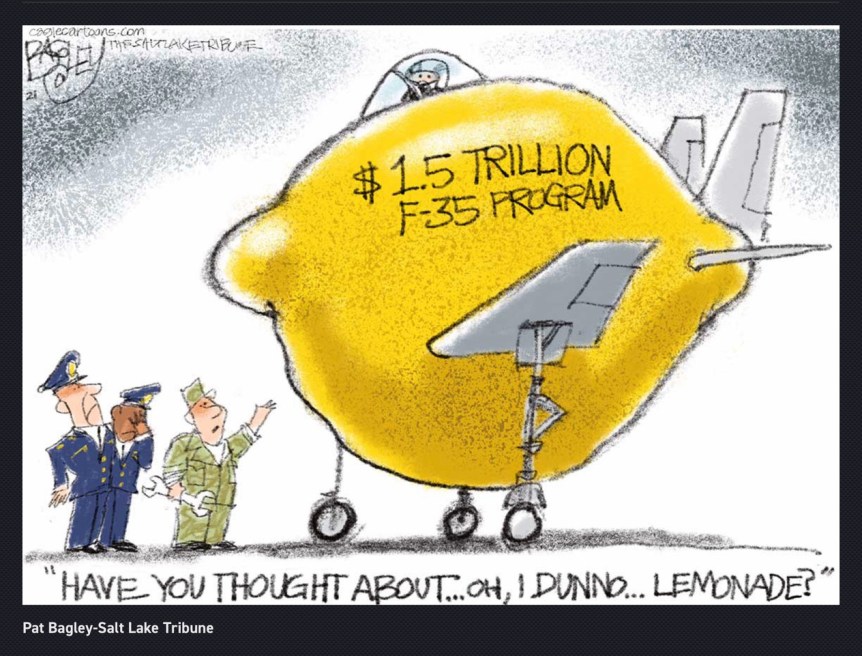
Curiously, investment-speak in the U.S. military is quite common. Generals and admirals talk of “investing” in new nuclear missiles and immense ships. They further talk of “divesting” in certain weapons that have proven to be disasters in their own way, like the F-22 fighter. What’s with all this “investing” and “divesting” in the U.S. military? One thing is certain: Generals won’t have to change their language as they retire and move through the revolving door to join corporate boards at major weapons contractors.

Today’s generals and politicians never display the honesty of President Dwight Eisenhower, who explained nearly seventy years ago that weapons represent a theft from the people and their needs, not an “investment.” Those who say there’s no business like show business may be right, but Hollywood’s a piker compared to the Pentagon, where there’s truly no business like war business.

Higher Military Spending Leads to Less Security

W.J. Astore

What does “security” mean to you?  My dad had a utilitarian definition.  Born in 1917, he found himself in a fatherless immigrant family with four siblings during the height of the Great Depression.  To help his family survive, he enlisted in the Civilian Conservation Corps in 1935 and served for two years, earning a dollar a day, most of it sent home to his mother.  For my dad, security meant a roof over one’s head, three square meals a day, and warm clothes on one’s back.  Food, shelter, clothing: it really was that simple.

Of course, you needed to pay for those bare necessities, meaning you needed a job with decent pay and benefits.  Personal security, therefore, hinges on good pay and affordable health care, which many U.S. workers today – in the richest country in the world – continue to scratch and claw for.  Another aspect of personal security is education because pay and career advancement within U.S. society often depend on one’s educational level.  A college education is proven to lead to higher pay and better career prospects throughout one’s life.

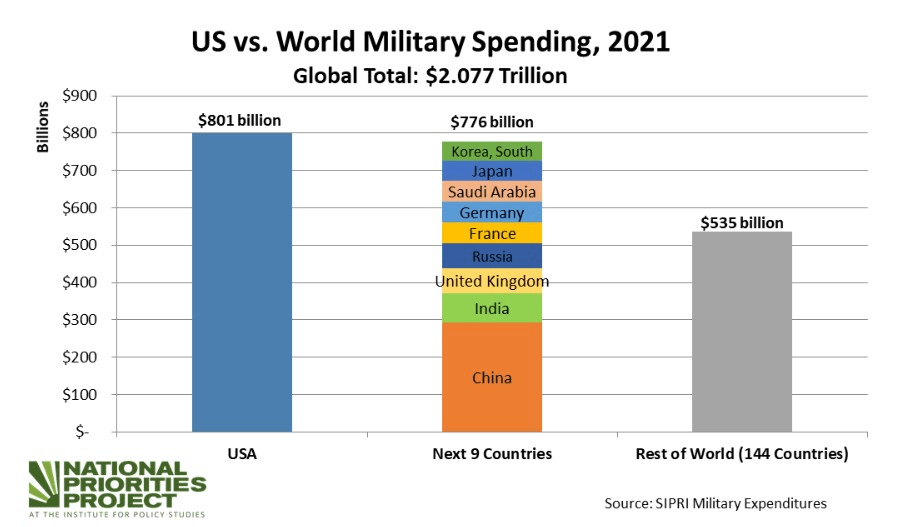
Personal security is in many ways related to national security.  Certainly, a nation as large as the U.S. needs a coast guard, border controls, an air force, a national guard, and similar structures for defensive purposes.  What it doesn’t need is a colossal, power-projecting juggernaut of a military at $800+ billion a year that focuses on imperial domination facilitated by 750 overseas bases that annually cost more than $100 billion just to maintain.  True security, whether personal or national, shouldn’t be about domination.  It should be focused on providing a collective standard of living that ensures all Americans can afford nutritious food, a decent place to live, adequate clothing, a life-enriching education, and health care.

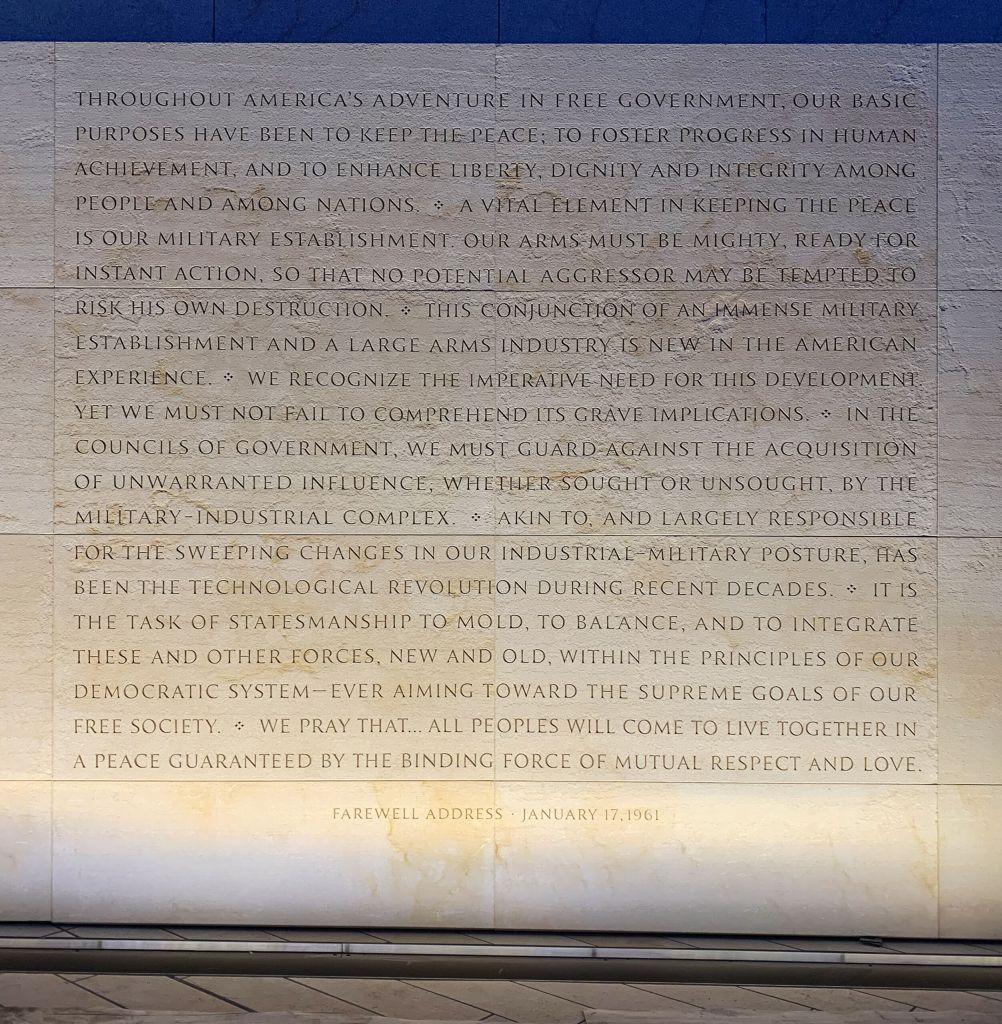
President Dwight D. Eisenhower understood this.  In his farewell address as president in 1961, he warned us about the military-industrial complex and its anti-democratic nature.  Even more importantly, he called for military disarmament as a “continuing imperative,” and he talked of peace, which he tied to human betterment, and which he said could be “guaranteed by the binding force of mutual respect and love.”  Ike knew that huge, offensive-minded military budgets constituted a theft from the people; even worse, he knew they constituted a betrayal of our national ideals.  A hugely powerful military establishment had “grave implications” to the “very structure of our society,” Ike presciently warned.  We have failed to heed his warning.

Ike, a former five-star U.S. general who led the D-Day invasion in 1944, knew the dangers of funding an immense military establishment

For Ike, true national security was about fostering human betterment and working toward world peace.  It was about securing the necessities of life for everyone.  It entailed the pursuit of military disarmament, a pursuit far preferable to allowing the world to be crucified on a cross of iron erected by wars and weapons manufacturers.

Tragically, America’s “councils of government” no longer guard against militarism; rather, they have been captured, often willingly, by the military-industrial complex.  The “alert and knowledgeable citizenry” that Ike was counting on to hold the line against incessant warfare and wasteful weaponry is largely uninterested, or uninformed, or uneducated in matters of civics and public policy.  Meanwhile, military spending keeps soaring, and the result is greater national insecurity.

In a paradox Ike warned us about, the more money the government devotes to its military, the less secure the nation becomes.  Because security isn’t measured in guns and bullets and warheads.  It’s measured in a healthy life, a life of meaning, a life of liberty. The pursuit of happiness, not eternal belligerence, should be the goal.

Consider the following fable.  A man lives in a castle.  He says he seeks security.  So he digs moats and erects walls and piles cannon ball upon cannon ball.  He posts armed guards and launches raids into the surrounding countryside to intimidate “near-peer” rivals.  He builds outlying fortifications and garrisons them, thinking these will secure his castle from attack.  Meanwhile, his family and relations in the castle are starving; the roof leaks and internal walls are covered in mold; the people, shivering and in rags, are uneducated and in poor health.  Has this man truly provided security for his people?  Would we call this man wise?

Grossly overspending on the military and weaponry — on castles and cannons everywhere — produces insecurity. It’s the very opposite of wisdom. Let’s end this folly, America, and seek human betterment and world peace as Ike advised us to do.

Addendum: these are the words Ike spoke in 1953

Every gun that is made, every warship launched, every rocket fired signifies, in the final sense, a theft from those who hunger and are not fed, those who are cold and are not clothed.

This world in arms is not spending money alone. It is spending the sweat of its laborers, the genius of its scientists, the hopes of its children. The cost of one modern heavy bomber is this: a modern brick school in more than 30 cities.  It is two electric power plants, each serving a town of 60,000 population. It is two fine, fully equipped hospitals. It is some fifty miles of concrete pavement. We pay for a single fighter plane with a half million bushels of wheat. We pay for a single destroyer with new homes that could have housed more than 8,000 people.

This is, I repeat, the best way of life to be found on the road the world has been taking. This is not a way of life at all, in any true sense. Under the cloud of threatening war, it is humanity hanging from a cross of iron.

Deplorable Leaders

W.J. Astore

America’s “leaders” believe they are in-the-know, and the rest of us are know-nothings who can be pushed around or ignored.

Perhaps the most honest thing Hillary Clinton ever did was to speak of her “basket of deplorables” after which she dismissed them as “irredeemable.” This is exactly how Hillary and most of our “leaders” think. Anyone who’s skeptical of them, anyone who asks for proof, anyone who’s willing to resist, is thrown into a “deplorable” basket and dismissed.

It will work until it doesn’t; indeed, it’s already not working. But the system is not about to give in. At the presidential level, America’s likely candidates for “leader of the free world” in 2024 are Joe Biden and Donald Trump, or, as my wife likes to joke, ODR versus ODR. Old Demented Rotter versus Old Divisive Rotter.

Let’s take the “old” part first, since ageism is an instant rejoinder. It used to be said that being President of the U.S. was the toughest, most demanding, job in the world, making enormous demands on physical stamina and mental acuity. Eisenhower was considered old when he left the presidency at the age of 70, replaced by John F. Kennedy at the age of 43. If Biden is reelected in 2024, he will be 82 that November, and Trump will be 78. Both men are well past their prime. Are they truly ready for the rigors of the office? Do we trust either man to be able to complete another four-year term in office?

Now, let’s take the “D” part. Many observers have noted Biden’s mental decline; it was readily noticeable in 2020 when he ran as a candidate in the primaries. Sadly, mental decline often accelerates with age, sometimes unpredictably. Reelecting Joe Biden in 2024, assuming he runs again, will likely lead to his vice president taking over for him during his second term of office. Trump, meanwhile, is a divisive leader whose personal motto might be “divide and rule.” A leader should bring people together for their mutual advantage, not tear them apart for his own advantage.

And now the “R” part, the “rotter.” Neither Trump nor Biden is a champion of workers, of the poor, of the vulnerable. Neither has much empathy. Both are deeply compromised. It’s a common failing of “big fish” politicians to have so little regard for the commoners that they rule, but surely we can find candidates that are, dare I say, less rotten?

“Leaders” like Hillary Clinton are fond of denouncing large swaths of the American public as “deplorable.” Is this not a classic case both of projection and of profound narcissism? How do we move beyond ODR versus ODR in 2024?

What a country! (Azeen Ghorayshi / BuzzFeed News)