The Grim Death Toll in Gaza

W.J. Astore

Nearly 120K Palestinians May Already Be Dead

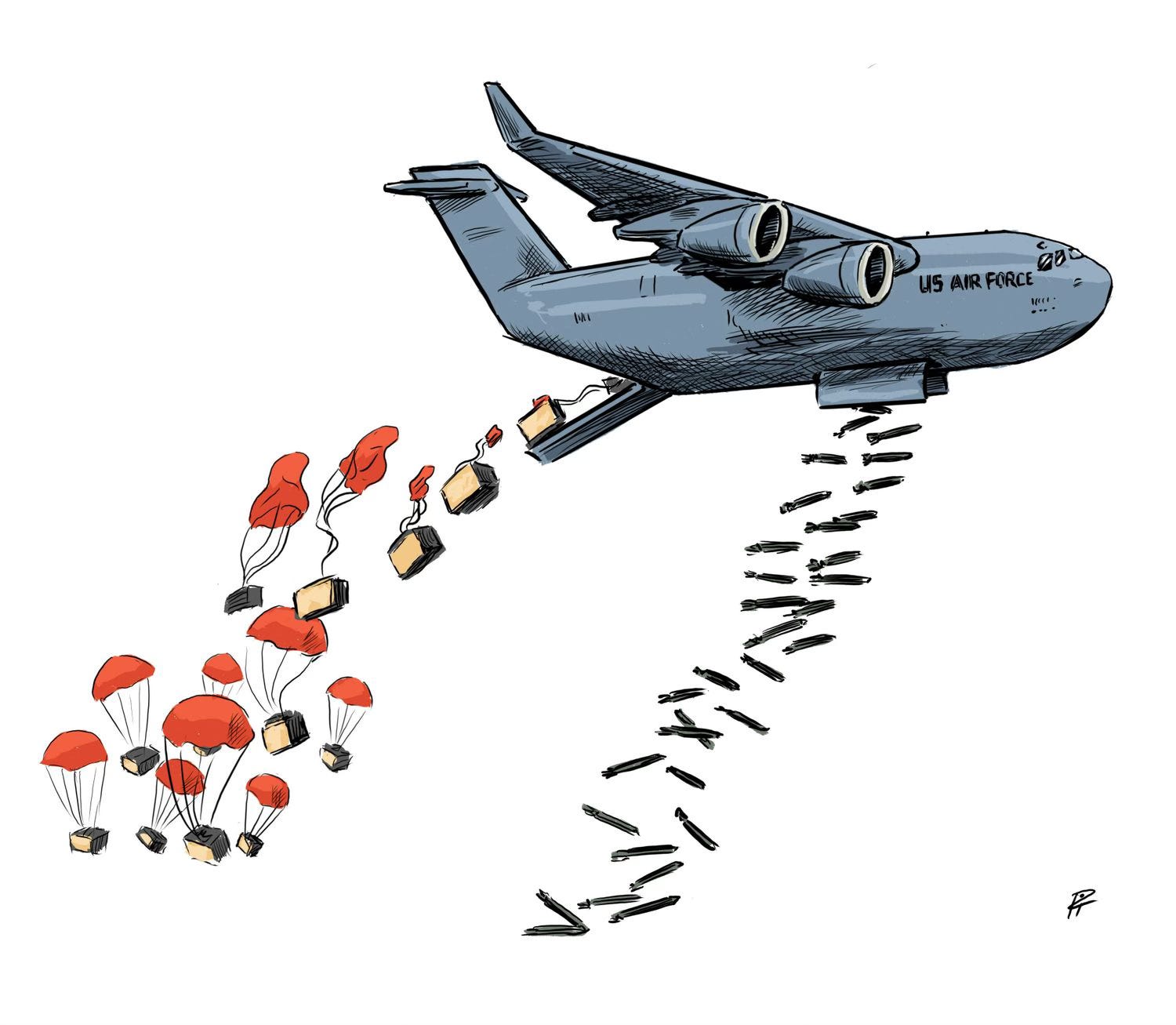
Ninety-nine American healthcare workers who volunteered to work in Gaza and who’ve witnessed the effects of the Israeli onslaught there suggest that nearly 120,000 Palestinians are already dead.

That huge number doesn’t surprise me. When you look at the photos from Gaza and the Stalingrad-like devastation, I’d guessed that the “official” death toll of roughly 42,000 was a serious undercount. That number comes from morgue and hospital statistics; it doesn’t account for people buried under the rubble, for missing people, and of course for people who’ve died of “natural” causes due to the disruption of hospital care, of potable water supplies, and so on.

More details are provided in this article at Antiwar.com. Also, you can read the letter written by these 99 healthcare workers, imploring the Biden/Harris administration to stop providing the bombs, missiles, shells, bullets, and other munitions Israel has been using to shred the bodies of so many innocent people in Gaza.

“Never again” was supposed to be the message we learned from the horrific Holocaust against the Jews perpetrated by the Nazis and their fellow travelers. “Never again” applies to the people of Gaza. It applies to people everywhere who are slaughtered simply because of who they are and because another people wants to be rid of them.

This is the leading reason why I can’t support Biden/Harris, now Harris/Walz. I can’t support Trump/Vance. The U.S. political establishment is completely spineless and immoral in its total support of Israel as it applies its own final solution to the Palestinian question. Whether it’s Harris or Trump, the message is “Support Israel” no matter what. And I refuse to sanction that. I refuse to vote for that.

Gaza, much like Stalingrad in World War II, is a desolate and increasingly unlivable moonscape of craters and destruction

More Money for Ukraine, More Weapons for Israel

W.J. Astore

And More War Under a Harris/Walz Administration

Whether they like it or not (and they seem very much to like it), the Democratic Party has become America’s war party.

The U.S./Ukrainian Flag on Biden’s lapel says it all. Zelenskyy, as a former actor, has his role down pat

This is especially true with respect to Ukraine. Zelenskyy has won another $7.9 billion in its war with Russia, prompting this “thank you” from him:

I am grateful to Joe Biden, US Congress and its both parties, Republicans and Democrats, as well as the entire American people for today’s announcement of major US defence assistance for Ukraine totalling $7.9bn and sanctions against Russia.

On behalf of the Ukrainian people and our brave warriors on the frontlines, I thank our closest ally, the United States, for finding a way to allocate the remaining security assistance to Ukraine and ensure that the Presidential authority is not expired by the end of the US financial year.

We will use this assistance in the most efficient and transparent manner to achieve our major common goal: victory for Ukraine, just and lasting peace, and transatlantic security.

I am grateful to the United States for providing the items that are most critical to protecting our people. An additional Patriot air defence battery, other air defence capabilities and interceptors, drones, long-range missiles, and air-to-ground munitions, as well as funds to strengthen Ukraine’s defence industrial base.

I also appreciate the decision to expand programs to train more of our pilots to fly F-16s, as well as the strong sanctions measures imposed to further limit Russia’s ability to fund its aggression against Ukraine.

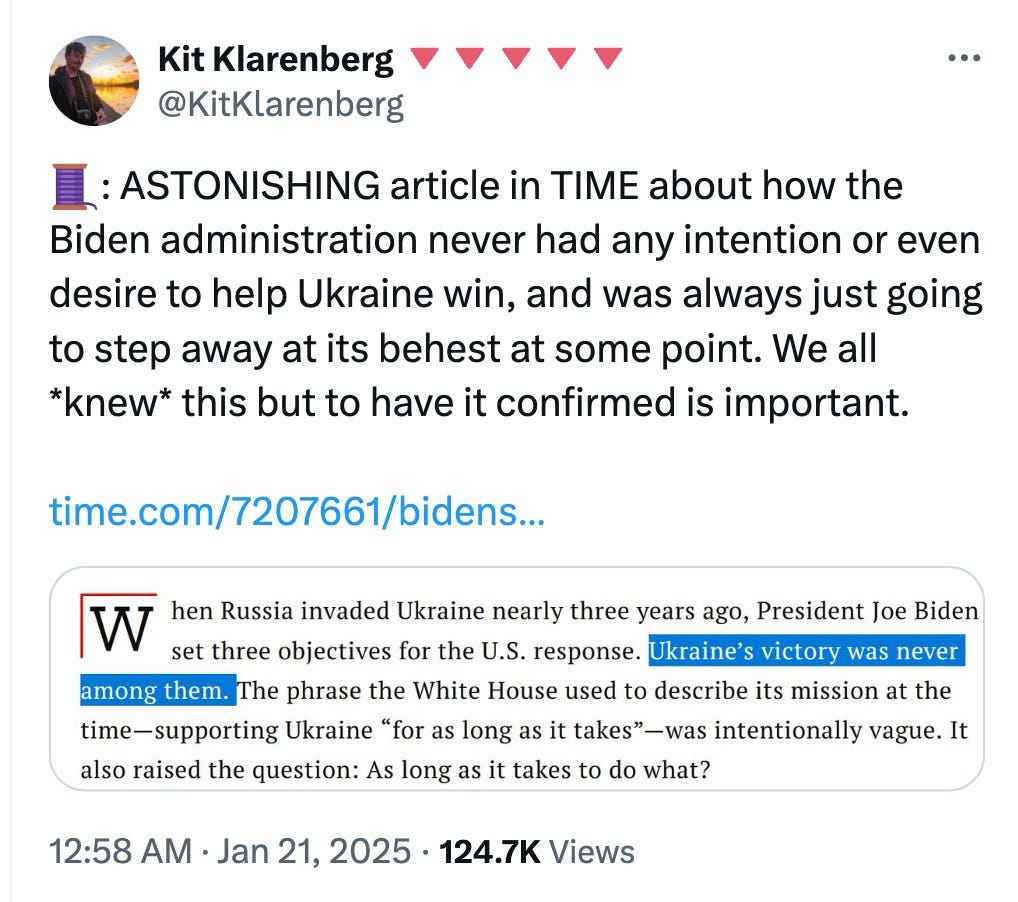
Kamala Harris is committed to supporting Ukraine “for as long as it takes,” meaning, I guess, some sort of “victory” over Russia, however unlikely that is. So look for a lot more dead and wounded Ukrainians and Russians and a world still hovering on the brink of nuclear war.

Over to Israel. Kamala Harris has pledged her undying and eternal support for Israel’s right to defend itself, meaning any action Israel is prepared to take, including genocide in Gaza. She has ruled out any curtailment of weapons shipments to Israel. According to the BBC, stemming the flow of weapons to Israel is a “left” position. Any sensible moderate and conservative is totally for genocide, I gather.

None of this is surprising, of course. When it comes to war, America is a uniparty of Dick Cheney, Hillary Clinton, and Kamala Harris. There is no difference among them, which is why Cheney endorsed Harris, and why more than 700 senior national security officials gushed about her.

Donald Trump, meanwhile, seeks to end the Russia-Ukraine War. Does that make him a “leftist”?

Of course not. Trump, like Harris, is totally behind Israel, and totally in bed with the military-industrial complex. Yet he’s skeptical of NATO and has an aversion to war and death in Russia and Ukraine, which for me is his strongest suit.

If you’re truly antiwar and seek a candidate who’s against massive military spending and imperial dominance, your best bet is Jill Stein and the Green Party. You know—the “crazy” or “fringe” people, according to the mainstream media.

Pandering for the Pennsylvania Vote

W.J. Astore

Zelenskyy Signs Artillery Shells in Scranton, PA

BILL ASTORE

SEP 25, 2024

In what passes for Democracy in America, the electoral vote determines the president, not the popular vote, meaning there are certain “battleground states” that are far more important than those that are reliably “blue” or “red.” Pennsylvania is one of them. It may all come down to the PA vote, according to The Nation, so both parties are doing their best to pander to PA voters.

That’s the main reason Kamala Harris flip-flopped on fracking: to win more votes in Pennsylvania. She was bluntly against fracking; now she says she’s all for it; rank opportunism is all it is, which makes her typical of most politicians.

The suits sign artillery shells—the closest they’ll get to war

Even worse than the flip-flop on fracking was Ukrainian President Zelenskyy’s recent visit to Scranton, PA, where he signed artillery shells intended to kill Russians in Ukraine. Zelenskyy also gave an interview in which he criticized the Trump/Vance ticket and its understanding of and approach to the Russia-Ukraine War. Doesn’t this count as foreign interference in America’s elections?

There’s something incredibly unseemly about this. A foreign leader comes to America and signs artillery shells meant to kill other human beings, with our taxpayer funds paying for the shells as well as his trip (he flew on a U.S. Air Force plane). And he tacitly endorses Kamala Harris over her opponent.

I don’t want my taxpayer funds going to shells that kill Russians. I certainly don’t want to celebrate it. Of course, I don’t want my taxpayer funds going to kill Palestinians in Gaza either, but my voice doesn’t matter.

We’re likely to hear more about alleged foreign interference in U.S. elections, but which leader/country has more influence on U.S. politics: Putin/Russia, Zelenskyy/Ukraine, or Netanyahu/Israel?

Hint: Who came to Congress and had its members jumping out of their seats to applaud him rapturously as if his appearance constituted the Second Coming?

America Is Weak!

W.J. Astore

Spend More on the Military! Says the New York Times

As the U.S. deploys more troops to the Middle East (now nearing 50,000 and rising), as Israel expands its war into Lebanon by killing nearly 500 people there, as Palestinians continue to die in Gaza and the West Bank as Israel steals their land, the “liberal” New York Times is running features on how “weak” the U.S. military is.

This is from yesterday’s New York Times send-out, citing a recent (and typical) bipartisan study:

*******

American weaknesses

The report cited several major U.S. weaknesses, including:

A failure to remain ahead of China in some aspects of military power. “China is outpacing the United States and has largely negated the U.S. military advantage in the Western Pacific through two decades of focused military investment,” the report concluded.

One reason is the decline in the share of U.S. resources devoted to the military. This Times chart, which may surprise some readers, tells the story:

Three lines track federal spending on health care, social security and defense. Total budget allocated to defense has fallen since 1950, while money spent on health care and income security has risen.

Source: Congressional Budget Office | By The New York Times

The report recommended increasing military spending, partly by making changes to Medicare and Social Security (which is sure to upset many liberals) and partly by increasing taxes, including on corporations (which is sure to upset many conservatives). The report also called for more spending on diplomacy and praised the Biden administration for strengthening alliances in Europe and Asia.

A Pentagon bureaucracy that’s too deferential to military suppliers. The report criticized consolidation among defense contractors, which has raised costs and hampered innovation. The future increasingly lies with drones and A.I., not the decades-old equipment that the Pentagon now uses.

A U.S. manufacturing sector that isn’t strong enough to produce what the military needs. A lack of production capacity has already hurt the country’s efforts to aid Ukraine, as The Times has documented. “Putin’s invasion has demonstrated how weak our industrial base is,” David Grannis, the commission’s executive director, said. If the Pentagon and the innovative U.S. technology sector collaborated more, they could address this problem, Grannis added.

A polarized political atmosphere that undermines national unity. A lack of patriotism is one reason that the military has failed to meet its recent recruitment goals. Perhaps more worrisome, many Americans are angry at one another rather than paying attention to external threats.

*******

Where to begin with such nonsense?

  1. So-called “defense” spending currently sits at or above $1 trillion, representing roughly 60% of federal discretionary spending. It continues to rise. Showing it as declining vis-a-vis the GDP is lying through statistics.
  2. Even if military spending was truly declining, which it isn’t, that would be a “good news” story. As President Eisenhower explained in 1953, military spending represents a theft from those who hunger, those who need shelter, those who need better schools and hospitals.
  3. Social Security: Yes, the government is going to keep trying to cut benefits while handing the savings to military contractors. Ditto for Medicare.
  4. Notice who’s mainly to blame for the alleged need for higher military spending: Putin and China.
  5. The Pentagon has misspent funds and misunderstands war. The solution: give the Pentagon more money as a reward.
  6. Americans are allegedly so angry with each other we’re not sufficiently hating Russians, Chinese, Iranians, and other alleged “external threats.”
  7. America lacks patriotism!

All this is reported with a straight face and the utmost seriousness by your “liberal” friends at the New York Times

So, when your Social Security benefits are reduced, when your Medicare bills go up, as you struggle even more mightily to make ends meet, just know your money is going to the Pentagon and the weapons makers.

Got a problem with that? The real problem just might be your lack of patriotism.

Escalation in the Russia-Ukraine War

W.J. Astore

More Missiles Are Not the Answer, Unless You Want World War III

It’s Friday the 13th, and though I’m not superstitious about the date, I’m not liking this headline in today’s New York Times:

Top News

Biden Poised to Approve Ukraine’s Use of Long-Range Western Weapons in Russia

The topic will be on the agenda Friday with the first official visit to Washington by Britain’s new prime minister, Keir Starmer.

*****

That’s a headline that proves once again that America is led by the best and brightest. (Sarcasm alert.)

Vladimir Putin has already said that long-range weapons striking targets in Russia means war between Russia and NATO. I don’t think he’s bluffing. And, lest we forget, Russia has nearly 6000 nuclear warheads in its inventory.

Why is the U.S. and NATO allowing Ukraine to use missiles that can strike targets deep into Russian territory? The short answer is that Ukraine is losing the war. But any escalation by Ukraine can be matched (and over-matched) by Russia. The most likely scenario is an even more devastated Ukraine. The worst-case scenario is World War III.

Wars are made by fools with stars on their shoulders and produce more fools, especially in government circles. Ukraine isn’t going to win the war by launching Storm Shadow missiles 150 miles into Russia. More attacks on Russia are likely to reinforce Putin’s rule than to weaken it. 

Meanwhile, Ukraine continues to lose more territory to Russian forces in the east, as this map (courtesy of the NYT) shows.

In a war that’s now lasted more than two and a half years, we’ve been told repeatedly that new “magical” weapons will make all the difference for Ukraine, whether Leopard and Challenger and Abrams tanks or F-16 fighter jets or ATACMS or what-have-you. Yet the Russia-Ukraine War is largely an old-fashioned infantry and artillery war, a land war, an attritional war, in which Ukraine is slowly being worn down.

Long-range missiles launched into Russia aren’t going to turn the tide in Ukraine’s favor. But they may provoke a devastating response from Russia that could provoke a far wider conflict. And for what, exactly?

From the Arsenal of Democracy to an Arsenal of Genocide

W.J. Astore

Time to Make America Sane–Again?

I started blogging in 2007 for TomDispatch.com. Tom Engelhardt, the mastermind of that indispensable site, saw something in an article I sent him on saving the U.S. military from itself. That is, from its own vainglory, its own global ambitions for power and dominance, its own illusions of being number one, both the world’s toughest military and also the world’s freedom-bringers. Certainly, the megalomania and Messiah-like fantasies weren’t a military mindset alone; it was even more pronounced among the neocons who orbited the Bush/Cheney administration and who still largely define U.S. foreign policy in the Biden/Harris administration. Things are so bad that some (wrongly) believe Trump/Vance offer a more moderate, far less warlike, alternative, when Trump’s record suggests little of the sort.

Anyhow, this is my 108th article for TomDispatch in the 17 years I’ve been writing for the site, a mark of persistence that suggests a certain folly on my part, and considerable patience on Tom’s part. 

During World War II, American leaders proudly proclaimed this country the “arsenal of democracy,” supplying weapons and related materiel to allies like Great Britain and the Soviet Union. To cite just one example, I recall reading about Soviet armored units equipped with U.S. Sherman tanks, though the Soviets had an even better tank of their own in the T-34 and its many variants. However, recent news that the United States is providing yet more massive arms deliveries to Israel (worth $20 billion) for 2026 and thereafter caught me off guard.  Israel quite plainly is engaged in the near-total destruction of Gaza and the massacre of Palestinians there.  So, tell me, how over all these years did the self-styled arsenal of democracy become an arsenal of genocide?

Israel, after all, couldn’t demolish Gaza, killing at least 40,000 Palestinians in a population of only 2.1 million, including thousands of babies and infants, without massive infusions of U.S. weaponry. Often, the U.S. doesn’t even sell the weaponry to Israel, a rich country that can pay its own bills. Congress just freely gifts body- and baby-shredding bombs in the name of defending Israel from Hamas. Obviously, by hook or crook, or rather by shells, bombs, and missiles, Israel is intent on rendering Gaza Palestinian-free and granting Israelis more living space there (and on the West Bank). That’s not “defense” — it’s the 2024 equivalent of Old Testament-style vengeance by annihilation.

As Tacitus said of the rampaging Romans two millennia ago, so it can now be said of Israel: they create a desert — a black hole of death in Gaza — and call it “peace.” And the U.S. government enables it or, in the case of Congress, cheers on its ringleader, Israeli Prime Minister Bibi Netanyahu.

Of course, anyone who knows a little American history should have some knowledge of genocide. In the seventeenth century, Native Americans were often “satanized” by early colonial settlers. (In 1994, a friend of mine, the historian David Lovejoy, wrote a superband all-too-aptly titled article on exactly that topic: “Satanizing the American Indian.”) Associating Indians with the devil made it all the easier for the white man to mistreat them, push them off their lands, and subjugate or eradicate them. When you satanize an enemy, turning them into something irredeemably evil, all crimes become defensible, rational, even justifiable. For how can you even consider negotiating or compromising with the minions of Satan?

Growing up, I was a strong supporter of Israel, seeing that state as an embattled David fighting against a Goliath, most notably during the Yom Kippur War of 1973. Forty years later, I wrote an article suggesting that Israel was now the Goliath in the region with Palestinians in Gaza playing the role of a very much outgunned and persecuted David. An American-Jewish friend told me I just didn’t get it. The Palestinians in Gaza were all terrorists, latent or incipient ones in the case of the infants and babies there. At the time, I found this attitude uncommon and extreme, but events have proven it to be far too common (though it certainly remains extreme). Obviously, on some level, the U.S. government agrees that extremism in the pursuit of Israeli hegemony is no vice and so has provided Israel with the weaponry and military cover it needs to “exterminate all the brutes.” Thus, in 2024, the U.S. “cradle of democracy” reveals its very own heart of darkness.

Looking Again at the World Wars That Made America “Great”

When considering World Wars I and II, we tend to see them as discrete events rather than intimately connected. One was fought from 1914 to 1918, the other from 1939 to 1945. Americans are far more familiar with the Second World War than the First. From both wars this country emerged remarkably unscathed compared to places like France, Germany, Russia, the United Kingdom, China, and Japan. Add to that the comforting myth that America’s “greatest generation” pretty much won World War II, thereby saving democracy (and “Saving Private Ryan” as well).

Perhaps, however, we should imagine those years of conflict, 1914-1945, as a European civil war (with an Asian wing thrown in the second time around), a new Thirty Years’ War played out on a world stage that led to the demise of Europe’s imperial powers and their Asian equivalent and the rise of the American empire as their replacement. Germanic militarism and nationalism were defeated but at an enormous cost, especially to Russia in World War I and the Soviet Union in World War II. Meanwhile, the American empire, unlike Germany’s Second and Third Reichs or Japan’s imperial power, truly became for a time an untrammeled world militarist hegemon with the inevitable corruption inherent in the urge for near-absolute power.

Vast levels of destruction visited upon this planet by two world wars left an opening for Washington to attempt to dominate everywhere. Hence, the roughly 750 overseas bases its military set up to ensure its ultimate global reach, not to speak of the powerful navy it created, centered on aircraft carriers for power projection and nuclear submarines for possible global Armageddon, and an air force that saw open skies as an excuse for its own exercises in naked power projection. To this you could add, for a time, U.S. global economic and financial power, enhanced by a cultural dominance achieved through Hollywood, sports, music, and the like.

Not, of course, that the United States emerged utterly unchallenged from World War II. Communism was the specter that haunted its leaders, whether in the Soviet Union, China, or Southeast Asia (where, in the 1960s and early 1970s, it would fight a disastrous losing war, the first of many to come, in Vietnam, Laos, and Cambodia). Here, there, and everywhere, even under the very beds of Americans, there was a fear of the “commie rat.” And for a while, communism, in its Soviet form, did indeed threaten capitalism’s unbridled pursuit of profits, helping American officials to create a permanent domestic war state in the name of containing and rolling back that threat. The collapse of the Soviet Union in 1991 erased that fear, but not the permanent war state that went with it, as Washington sought new enemies to justify a Pentagon budget that today is still rising toward the trillion-dollar mark. Naturally (and remarkably disastrously), it found them, whether in Afghanistan, Iraq, or so many other places in the case of the costly and ultimately futile Global War on Terror in the aftermath of the 9/11 attacks.

And eternally losing (or at least not winning) its wars raised the question: What will replace it? What will happen as imperial America continues to decline, burdened by colossal debt and strategic overreach, and crippled from within by a rapacious class of oligarchs who fancy themselves as a new all-American aristocracy. Will that decline lead to collapse or can its officials orchestrate a soft landing? In World Wars I and II, Europeans fought bitterly for world dominance, powered by militarism, nationalism, racism, and greed. They suffered accordingly and yet did recover even if as far less powerful nations. Can the U.S. manage to curb its own militarism, nationalism, racism, and greed in time and so recover similarly? And by “racism,” I mean, for example, reviving the idea (however put) of China as a “yellow peril,” or the tendency to see the darker-skinned peoples of the Middle East as violent “terrorists” and the latest minions of Satan.

And then, of course, there’s always the fear that, in the future, a world war could once again break out, raising the possibility of the use of nuclear weapons from global arsenals that are always being “modernized” and the possible end of most life on Earth. It’s an issue worth highlighting, since the U.S. continues to “invest” significant sums in producing yet more nuclear weapons, even as it ratchets up tensions with nuclear powers like Russia and China. Though a winnable nuclear war among the great powers on this planet is inconceivable, that hasn’t stopped my country from pushing for a version of nuclear superiority (disguised, of course, as “deterrence”).

Making America Sane Again

The world wars of the previous century facilitated America’s global dominance in virtually all its dimensions. That, in fact, was their legacy. No other nation in history had, without irony or humility, divided the globe into military combatant commandslike AFRICOM for Africa, CENTCOM for the Middle East, and NORTHCOM here at home. There are also “global” commands for strategic nuclear weapons, cyber dominance, and even the dominance of space. It seemed that the only way America could be “safe” was by dominating everything everywhere all at once. That insane ambition, that vainglory, was truly what made the U.S. the “exceptional” nation on the world stage.

Such a boundless pursuit of dominance, absurdly disguised as benefiting democracy, is now visibly fraying at the seams and may soon come apart entirely. In 2024, it’s beyond obvious that the United States no longer dominates the world, even if its military-industrial-congressional complex (MICC) does indeed dominate its national (in)security state and so increasingly the country. What an irony, in fact, that defeating European militarism in two world wars only accelerated the growth of American militarism and nationalism, making the world’s lone superpower for so many decades the scariest country for all too many peoples outside its borders.

Think, in fact, of the U.S. emerging from World War II with what might be thought of as victory disease. The last nearly 80 years of its foreign policy witnessed the remarkable progression of that “disease,” despite a lack of actual victories (unless you count minor escapades like the invasion of Grenada). Put differently, the U.S. emerged from World War II so singularly an economic, financial, and cultural juggernaut that subsequent military defeats almost didn’t seem to matter.

Even as America’s economic, financial, and cultural power has waned in this century, along with its moral position (consider President Obama’s curt “We tortured some folks” admission, along with support for Israel’s ongoing genocide), the government does continue to double-down on military spending. Pentagon budgets and related “national security” costs now significantly exceed $1 trillion annually even as arms shipments and sales continue to surge. War, in other words, has become big business in America or, as General Smedley Butler so memorably put it 90 years ago, a first-class “racket.”

Worse yet, war, however prolonged and even celebrated, may be the very definition of insanity, a deadly poison to democracy. Don’t tell that to the MICC and all its straphangers and camp followers, though.

Ironically, the two countries, Germany and Japan, that the U.S. took credit for utterly defeating in World War II, forcing their unconditional surrender, have over time emerged in far better shape. Neither of them is perfect, mind you, but they largely have been able to avoid the militarism, nationalism, and constant warmongering that so infects and weakens American-style democracy today. Whatever else you can say about Germany and Japan in 2024, neither of them is bent in any fashion on either regional or global domination, nor are their leaders bragging of having the finest military in all human history. American presidents from George W. Bush to Barack Obama have indeed bragged about having a matchless, peerless, “finest” military. The Germans and Japanese, having known the bitter price of such boasts, have kept their mouths shut.

My brother Stevie once memorably said: “No brag, just facts.”

My brother has a saying: no brag, just facts. And when we look at facts, the pursuit of global dominance has been driving the American empire toward an early grave. The “finest” military lost disastrously, of course, in Vietnam in the last century, and in Afghanistan and Iraq in this one. It functionally lost its self-proclaimed Global War on Terror and it keeps losing in its febrile quest for superiority everywhere.

If we met a person dressed in a military uniform who insisted he was Napoleon, boasted that his Imperial Guard was the world’s best, and that he could rule the world, we would, of course, question his sanity. Why are we not questioning the collective sanity of America’s military and foreign-policy elites?

This country doesn’t need to be made great again, it needs to be made sane again by the rejection of wars and the weaponry that goes with them. For if we continue to follow our present pathway, MADness could truly lie in wait for us, as in the classic nuclear weapons phrase, mutually assured destruction (MAD).

Another form of madness is having a president routinely implore God — yes, no one else! — to protect our troops. This is not a knock on Joe Biden alone. He’s just professing a nationalist piety that’s designed to win applause and votes. Assuming Biden has the Christian God in mind, consider the irony, not to say heresy, of functionally begging Christ, the Prince of Peace, to protect those who are already armed to the teeth. It’s also an abdication of the commander-in-chief’s responsibility to support and defend the U.S. Constitution while protecting those troops himself. Who has the biggest impact, God or the president, when it comes to ensuring that troops aren’t sent into harm’s way without a justifiable cause supported by the American people through a Congressional declaration of war?

Consider the repeated act of looking skyward to God to support military actions as a major league cop-out. But that’s what U.S. presidents routinely do now. Such is the pernicious price of pursuing a vision that insists on global reach, global power, and global dominance. America’s leaders have, in essence, elevated themselves to a god-like position, a distinctly angry, jealous, and capricious one, far more like Zeus or Ares than Jesus. Speaking of Jesus, he is alleged to have said, “Suffer the children to come unto me.” The militarized American god, however, says: suffer the children of Gaza to die courtesy of bombs and shells made here in the U.S.A. and shipped off to Israel at a remarkably modest price (given the destruction they cause).

To echo a popular ad campaign, Jesus may “get” us, but our leaders (self-avowed Christians, all) sure as hell don’t get him. I may be a lapsed Catholic, not a practicing one like Joe Biden, but even I remember my catechism and a certain commandment that Thou shalt not kill.

Governor Tim Walz’s Military Record

W.J. Astore

Questionable Assertions, but Not “Stolen Valor”

Governor Tim Walz, the Democratic nominee for Vice President, has come under fire about his military record. Leading the charge has been another Vice President nominee, J.D. Vance of the Republican Party, who served in the Marines and deployed to Iraq.

A young Tim Walz. Little did that young man know how this photo and his military service would become yet another battleground in American politics, generating plenty of heat but very little light

Let’s use the Army acronym of BLUF (bottom line up front); in other words, let’s cut to the chase:

  1. Tim Walz has said he retired as a command sergeant major (CSM) after 24 years of service in the Army National Guard. While he did serve as CSM for his battalion, he didn’t attend the Sergeants Major Academy and therefore he retired a step down as a master sergeant (MSG).
  2. When Tim Walz retired in 2005, he was preparing to run for Congress. His unit was also preparing to deploy to Iraq, which it eventually did in March of 2006. Walz was well within his rights as a soldier to retire when he did. Whether he did so to avoid war service in Iraq is known only to Walz. He claims he’d made his decision to retire before his unit was notified of its overseas deployment to Iraq.
  3. Tim Walz has talked loosely about using weapons of war “that he carried in war,” implying he’d seen combat service when he hadn’t. I don’t see this as a case of “stolen valor.” He wasn’t boasting about being some kind of badass hero in war. Obviously, in 24 years of service in the Army National Guard, he’d carried weapons of war and trained with them under simulated combat conditions “down range.” He should have simply said: “I’ve trained extensively with weapons of war.” Period.

Does any of this matter? Not to me. Tim Walz, by all accounts, served honorably, reaching the senior enlisted ranks. If the Army had wanted him to stay instead of retiring, he could have been stop-lossed or his retirement request could have been denied. He moved on to Congress, winning his election in 2006. He seems to be a person motivated by public service.

The issues that really matter here aren’t mentioned by the Republicans or the corporate-owned news (the CON). Here are those issues:

  1. Tim Walz is a strong supporter of Israel and its ongoing genocide in Gaza.
  2. Tim Walz is a strong supporter of massive military aid to Ukraine.
  3. To my knowledge, Tim Walz has not criticized the military-industrial-congressional complex (MICC) in meaningful ways, though he has spoken out against the idea of China being an inevitable U.S. enemy.

Tim Walz, in short, is a typical pro-Israel, pro-Ukraine, generally pro-MICC, Democrat.

The most important issue of all is the whole idea that one must go to war—to serve in places like Afghanistan and Iraq and, more likely than not, to kill other human beings, to prove one’s “valor” in uniform. Why is carrying and using a gun in war such a great and glorious thing? Especially wars like those in Afghanistan and Iraq that were based on lies? Would we respect Tim Walz more if he’d gone to Iraq in 2006 and shot up some Iraqis in the cause of “freedom”?

As a candidate for the presidency in 2016, Donald Trump famously denounced the Iraq War, using words like “stupid,” “dumb,” a “total disaster.” and a “big fat mistake.” The war was based on a lie, Trump said, about weapons of mass destruction that didn’t exist. Even worse, the Bush/Cheney administration was behind the lie, leading to a war that destabilized the Middle East, costing the U.S. military thousands of lives and U.S. taxpayers $2 trillion, Trump concluded.

Under that bright blaze of honesty from Trump (yes, you read that right), we might question anyone who wants to trumpet service in Iraq as praiseworthy in the sense of “bringing freedom” or “spreading democracy.”

Selling the Russia-Ukraine War to Trump

W.J. Astore

This Week in U.S. Militarism

During his one debate with Joe Biden, Donald Trump made the audacious claim that if reelected in November he would end the Russia-Ukraine War before his inauguration in January. While it’s doubtful he could do that, the boast certainly disturbed self-styled supporters of Ukraine like Senator Lindsey Graham.

Graham recently made an appearance to highlight strategic minerals in Ukraine. He said Ukraine is sitting on $10-$12 trillion in various “critical” minerals and metals and that Putin must not be allowed to seize, mine, sell, or otherwise share them with China.

Mr. President, we cannot allow a strategic minerals gap!

Trump, in general, has been skeptical of providing an almost open-ended commitment to Ukraine, to the tune of roughly $200 billion in aid since Russia launched its “special military operation.” This new emphasis on Ukraine as a business partner sitting on a “gold mine,” a mine that could be stolen by Putin, seems tailor-made to convince Trump, a businessman with an affinity for gold, to keep funneling weapons and money to Ukraine if he does indeed win reelection in November.

A trillion here, a trillion there, pretty soon you’re talking real money.

*****

This week in U.S. militarism: I was scrolling through my CNN email feed this morning and noticed this headline:

Army officer wins Miss USA
Michigan’s Alma Cooper was crowned the new Miss USA on Sunday, capping a tumultuous year of pageant controversy.

A U.S. Army officer is Miss USA. At least she’s used to obeying orders. 

Back in January at CNN, I noted this headline: US Air Force officer crowned as 2024 Miss America.

Miss America, 2Lt Madison Marsh (from the AF Website). Taken at the Daytona 500 Speedway, where she was engaged in recruitment and PR

This truly must be a first. Both Miss USA and Miss America are serving U.S. military officers. My only question is this: What’s wrong with the Navy? How come the Army and the Air Force are dominating the beauty pageants?

In all seriousness, public relations teams for the U.S. military must think this is a major coup, but it seems so strange to me to mix beauty pageants with military service. I recently caught Miss America on NESN (New England Sports Network) doing an on-air interview wearing mufti and a tiara. She attended the Air Force Academy, where I taught for six years. She’s smart, ambitious, accomplished, and obviously pretty.

She may yet fulfill her dream of becoming an Air Force pilot. Will she then launch missiles and drop bombs, perhaps on whatever country is threatening Israel in the Middle East? At least those on the receiving end of those missiles and bombs can say they were killed by a former Miss America.

There’s something very strange going on here.

“Generation Warfighter” Needs to End

W.J. Astore

Empty Boasts of Having the “World’s Best” Military Hide Rot, Waste, and Stupidity

Sixteen years ago, I made a plea to my fellow citizens to banish the word “warfighter” from our vocabulary. I asked that we stop referring to the U.S. military as the “world’s best,” an empty boast then and, after twin disasters in Iraq and Afghanistan, an emptier one today. (If something can indeed be “emptier,” it’s certainly bellicose boasts of alleged military brilliance.) Today’s military is overstretched, busy guaranteeing Israel’s security as the Israeli Defense Forces demolish and depopulate Gaza. Facing recruiting shortfalls, open-ended imperial commitments across the globe, and fears of hostilities with Russia, China, Iran, or an almost unimaginable and certainly unbeatable combination of the three, the U.S. military faces grim times.  If leaders like President Biden truly want to protect “our” troops, they should look not to God but in the mirror. They should pursue peace through diplomacy while downsizing an unsustainable empire. Isn’t it finally time for “Generation Warfighter” to come to an end before the U.S. military is utterly hollowed out — and America with it?

Having the “Best Military” Is Not Always a Good Thing 
Reclaiming Our Citizen-Soldier Heritage 

By William J. Astore

[Originally posted at TomDispatch in July of 2008]

When did American troops become “warfighters” — members of “Generation Kill” — instead of citizen-soldiers? And when did we become so proud of declaring our military to be “the world’s best”? These are neither frivolous nor rhetorical questions. Open up any national defense publication today and you can’t miss the ads from defense contractors, all eagerly touting the ways they “serve” America’s “warfighters.” Listen to the politicians, and you’ll hear the obligatory incantation about our military being “the world’s best.”

All this is, by now, so often repeated — so eagerly accepted — that few of us seem to recall how against the American grain it really is. If anything — and I saw this in studying German military history — it’s far more in keeping with the bellicose traditions and bumptious rhetoric of Imperial Germany under Kaiser Wilhelm II than of an American republic that began its march to independence with patriotic Minutemen in revolt against King George.

So consider this a modest proposal from a retired citizen-airman: A small but meaningful act against the creeping militarism of the Bush years would be to collectively repudiate our “world’s best warfighter” rhetoric and re-embrace instead a tradition of reluctant but resolute citizen-soldiers.

Becoming Warfighters

I first noticed the term “warfighter” in 2002. Like many a field-grade staff officer, I spent a lot of time crafting PowerPoint briefings, trying to sell senior officers and the Pentagon on my particular unit’s importance to the President’s new Global War on Terrorism. The more briefings I saw, the more often I came across references to “serving the warfighter.” It was, I suppose, an obvious selling point, once we were at war in Afghanistan and gearing up for “regime-change” in Iraq. And I was probably typical in that I, too, grabbed the term for my briefings. After all, who wants to be left behind when it comes to supporting the troops “at the pointy end of the spear” (to borrow another military trope)?

But I wasn’t comfortable with the term then, and today it tastes bitter in my mouth. Until recent times, the American military was justly proud of being a force of citizen-soldiers. It didn’t matter whether you were talking about those famed Revolutionary War Minutemen, courageous Civil War volunteers, or the “Greatest Generation” conscripts of World War II. After all, Americans had a long tradition of being distrustful of the very idea of a large, permanent army, as well as of giving potentially disruptive authority to generals.

Our tradition of citizen-soldiery was (and could still be) one of the great strengths of this country. Let me give you two examples of such citizen-soldiers, well known within military circles because they wrote especially powerful memoirs. Eugene B. Sledge served in the U.S. Marines during World War II, surviving two unimaginably brutal campaigns on the islands of Peleliu and Okinawa. His memoir With the Old Breed is arguably the best account of ground warfare in the Pacific. After three years of selfless, heroic service to his country, Sledge gladly returned to civilian life, eventually becoming a professor of biology. His conclusion — that “war is brutish, inglorious, and a terrible waste” — is one seconded by many a combat veteran.

Richard (Dick) Winters is better known because his exploits were captured in the HBO series Band of Brothers. He rose from platoon commander to battalion commander, serving in the elite 101st Airborne Division during World War II. A hero beloved by his men, Winters wanted nothing more than to quit the military and return to the civilian world. After the war, he lived a quiet life as a businessman in Pennsylvania, rarely mentioning his service and refusing to use his military rank for personal gratification. In Beyond Band of Brothers, he recounts both his service and his ideas on leadership. It’s a book to put in the hands of any young American who wishes to understand the noble ideas of service and sacrifice.

Sledge and Winters were regular guys who answered their country’s call. What comes across in their memoirs, as well as in the many letters I’ve read from World War II soldiers, was the desire of the average dogface to win the war, return home, hang up the uniform, and never again fire a shot in anger. These men were war-enders, not warfighters. Indeed, they would’ve been sickened by the very idea of being “warfighters.”

The term “warfighter” — a combination, I suppose, of “warrior” and “war fighting” — suggests a person who lives for war, who spoils for a fight. Certainly, the United States has fought its share of ruthless wars. But traditionally our soldiers have thought of themselves as civilians first, soldiers second. Equally as important, the American people thought of their troops that way.

Why are we now, with so little debate, casting aside an ethos that served us well for two centuries for one that straightforwardly embraces war and killing? Possibly because we’ve invented a distinctly American product: sanitized militarism. I bumped into it last week at a most unlikely place.

Visiting Gettysburg

Last week, I finally made it to Gettysburg, site of the great three-day battle between Union and Confederate forces in July 1863 that ended with the defeat of General Robert E. Lee’s army. Walking the battlefield was a sobering experience. I found myself on Little Round Top at 5:00 PM, just about the time of day that Union generals rushed men to reinforce the hill against a determined Confederate assault at the close of the battle’s second day. Earlier, I was at the Angle, just when, almost a century and a half ago, Pickett’s Charge failed to pierce the Union center, sealing Lee’s fate on the third day.

The Devil’s Den at Gettysburg

As these events played through my mind, I marveled that I had the battlefield largely to myself. Not that I was alone, mind you. Tour buses circled; cars, trucks, and SUVs whizzed about, but many, perhaps most, Americans who visit Gettysburg get surprisingly little tactile or sensory experience of its difficult topography. Yes, a few kids (and fewer adults) joined me in clambering about the huge, claustrophobically placed boulders of Devil’s Den, and I did spy a couple of guided tour groups on foot. But at the site of a bloodcurdling, distinctly septic nineteenth century battle, most visitors were clearly having a distinctly bloodless, even antiseptic, twenty-first century experience.

That day, I learned a lot about Gettysburg the battle — and maybe a little about us as well. As surely as my fellow tourists were staying in their cars and buses, we, as a people, are distancing ourselves from the realities of war. As we seal ourselves away from war’s horrors, we’re correspondingly finding it easier to speak of “warfighters” and to boast of having the world’s best military.

As we catch a glimpse, from the comfort of our living rooms, of a suicide bombing in Iraq or an American outpost attacked, then abandoned, in Afghanistan, are we not like those tourists in buses at Gettysburg, listening to sanitized recordings telling us what to see and think about the (expurgated) reality in front of us? And who dares challenge the “expert” commentary? Who dares turn off the canned talking heads and stare into the face of war?

But if we are to end our militaristic, yet curiously sanitized, “warfighter” moment, if we are ever to return to our citizen-soldier ethos and heritage, this is just what we must do.

After all, it’s later than you think. Our military now relies not only on a volunteer (if, at times, “stop-lossed”) Army, but increasingly on tens of thousands of hired guns, consultants, interrogators, interpreters, and other paramilitary camp followers. Private, for-profit “security contractors” — companies like Blackwater and Triple Canopy — give a disturbing new meaning to our “warfighter” terminology and the rhetoric that marches in step with it. As even casual students of history will recall, a clear sign of the Roman Empire’s decline was its shift from citizen-soldiers motivated by duty to mercenaries motivated by profit.

Replacing “warfighters” with true citizen-soldiers in the mold of Sledge and Winters would hardly be a solve-all solution at this late date, but it might be a step in the right direction — however unlikely it is to happen. For when we look at our troops, if we don’t see ourselves, then we see aliens or, worse yet, superiors (“warfighters”) in need of “support.” And that’s a clear sign of trouble for the republic.

Want to Be in the “World’s Best Military”? Ask German Veterans

It may come as a shock to some, but the American army wasn’t the best in the field in World War I, or World War II either. And thank heavens for that.

The distinction falls to the Kaiser Wilhelm’s army in 1914, and to Hitler’s Wehrmacht in 1941. Even toward the end of World War II, the American army was still often outmaneuvered and outclassed by its German foe. Because victory has a way of papering over faults and altering memories, few but professional historians today recall the many shortcomings of our military in both world wars.

But that’s precisely the point: The American military made mistakes because it was often ill-trained, rushed into combat too quickly, and handled by officers lacking in experience. Put simply, in both World Wars it lacked the tactical virtuosity of its German counterpart.

But here’s the question to ponder: At what price virtuosity? In World War I and World War II, the Germans were the best soldiers because they had trained and fought the most, because their societies were geared, mentally and in most other ways, for war, because they celebrated and valued feats of arms above all other contributions one could make to society and culture.

Being “the best soldiers” meant that senior German leaders — whether the Kaiser, Field Marshal Paul von Hindenburg, that Teutonic titan of World War I, or Hitler — always expected them to prevail. The mentality was: “We’re number one. How can we possibly lose unless we quit — or those [fill in your civilian quislings of choice] stab us in the back?”

If this mentality sounds increasingly familiar, it’s because it’s the one we ourselves have internalized in these last years. German warfighters and their leaders knew no limitations until it was too late for them to recover from ceaseless combat, imperial overstretch, and economic collapse.

Today, the U.S. military, and by extension American culture, is caught in a similar bind. After all, if we truly believe ours to be “the world’s best military” (and, judging by how often the claim is repeated in the echo chamber of our media, we evidently do), how can we possibly be losing in Iraq or Afghanistan? And, if the “impossible” somehow happens, how can our military be to blame? If our “warfighters” are indeed “the best,” someone else must have betrayed them — appeasing politicians, lily-livered liberals, duplicitous and weak-willed allies like the increasingly recalcitrant Iraqis, you name it.

Today, our military is arguably the world’s best. Certainly, it’s the world’s most powerful in its advanced armaments and its ability to destroy. But what does it say about our leaders that they are so taken with this form of power? And why exactly is it so good to be the “best” at this? Just ask a German military veteran — among the few who survived, that is — in a warrior-state that went berserk in a febrile quest for “full spectrum dominance.”

Fighting to End Wars

Words matter. Let’s start by banishing the word “warfighter,” and, while we’re at it, let’s toss out that “world’s best” boast as well. Boasting about military prowess is more Spartan than Athenian, more Second and Third Reich Germany than republican and democratic America.

Indeed, imagine, for a moment, a world in which the U.S. is no longer “number one” in military might (and, at the same time, no longer fighting endless wars in the Middle East and Central Asia). Would we then be weak and vulnerable? Or would we become stronger precisely because we stopped boasting about our ability as “warfighters” to dominate far from our shores and instead redirected our resources to developing alternative energy, bolstering our education system, reviving American industry, and focusing on other “soft power” alternatives to weapons and warriors? In other words, alternatives we can actually boast about with the pride of accomplishment.

Think about it: Must our military forever remain “second to none” for you to feel safe? Our national traditions suggest otherwise. In fact, if we no longer had the world’s strongest military, perhaps we would be more reluctant to tap its strength — and more hesitant to send our citizen-soldiers into harm’s way. And while we’re at it, perhaps we’d also learn to boast about a new kind of “warfighter” — not one who fights our wars, but one who fights against them.

Copyright 2008 William Astore.

A Largely Issueless Campaign Season?

W.J. Astore

Kamalove versus MAGA

Are you feeling “Kamalove” for Kamala Harris? Are you gaga for MAGA and Donald Trump? Or maybe you’re angry J.D. Vance once made a comment about “childless cat ladies.” This is the preferred narrative being pushed by the great CON, the corporate-owned news.* 

It wasn’t that long ago that, thanks to Bernie Sanders, among others, Americans were talking about real issues. Affordable health care for all. A $15 federal minimum wage. Sweeping student loan debt relief. Tax reforms that would favor the working classes rather than the richest among us. Campaign finance reform that would get “big money” out of politics.

This is the madness of war. (Mourners from the Druze minority carry the coffins of some of the 12 children and teenagers killed in the rocket strike in the village of Majdal Shams. Photograph: Léo Corrêa/AP)

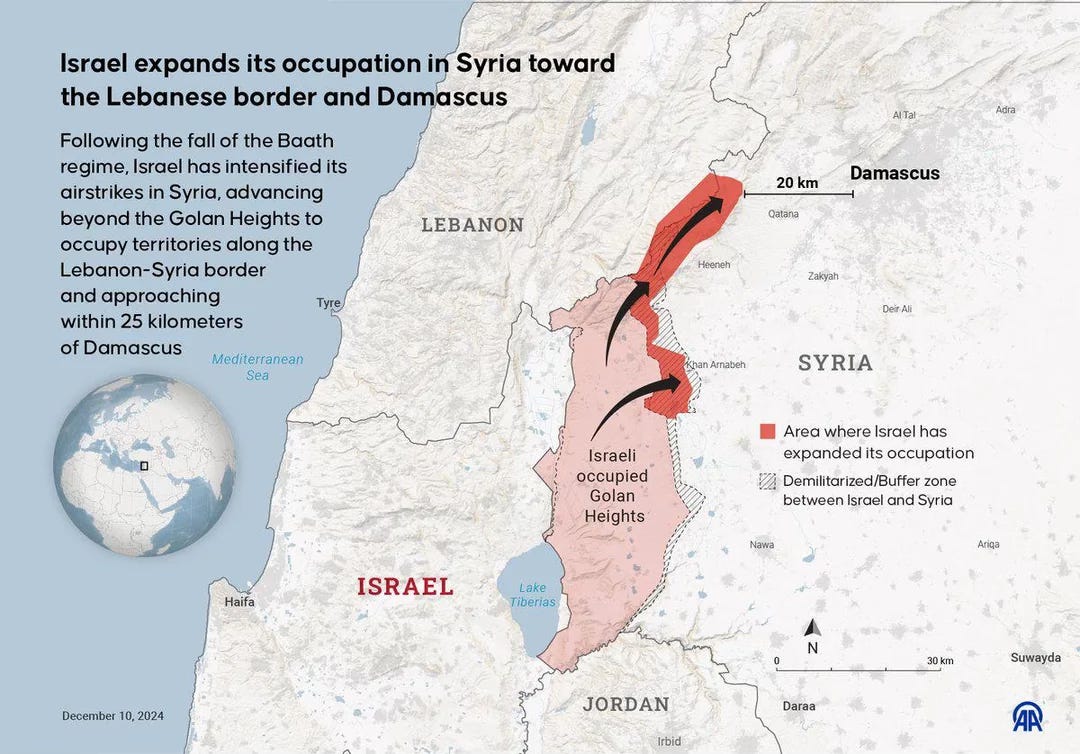
Another vital issue, of course, is America’s seemingly permanent state of war and its slavish support of Israel in its ongoing demolition of Gaza. As expected, that genocidal act is beginning to spin out of control as it appears Israel is preparing to strike Hezbollah in Lebanon in the aftermath of a deadly missile strike on the Israeli-occupied Golan Heights.

When will the madness of war in the Middle East end? And is it the intent of the U.S. government to continue to provide all the weapons Israel needs to continue its campaign of mass killing? (Always done in the name of “defense” and “security,” naturally.)

In his recent address to America, President Biden declared that under him U.S. troops weren’t at war for the first time this century. His exact words were: “I’m the first president in this century to report to the American people that the United States is not at war anywhere in the world.” This boast came as U.S. forces were bombing Yemen in support of Israel’s operations in Gaza. Meanwhile, America leads the world in selling weapons and spends more on its military than the next ten countries combined, most of those being U.S. allies.

When does the U.S. get to become a normal country in normal times, rather than a nation permanently at war and forever preparing for it, even for nuclear Armageddon? Why are we spending possibly as much as $2 trillion on “modernizing” a nuclear triad that, if used, could easily destroy life on earth as well as several other earth-sized planets? When are we going to end this insanity?

We need to challenge Democrats and Republicans as well as the media to cover real issues, issues of life and death, rather than writing puff pieces about Kamalove and MAGA.

*Thanks to John R. Moffett for the CON acronym.