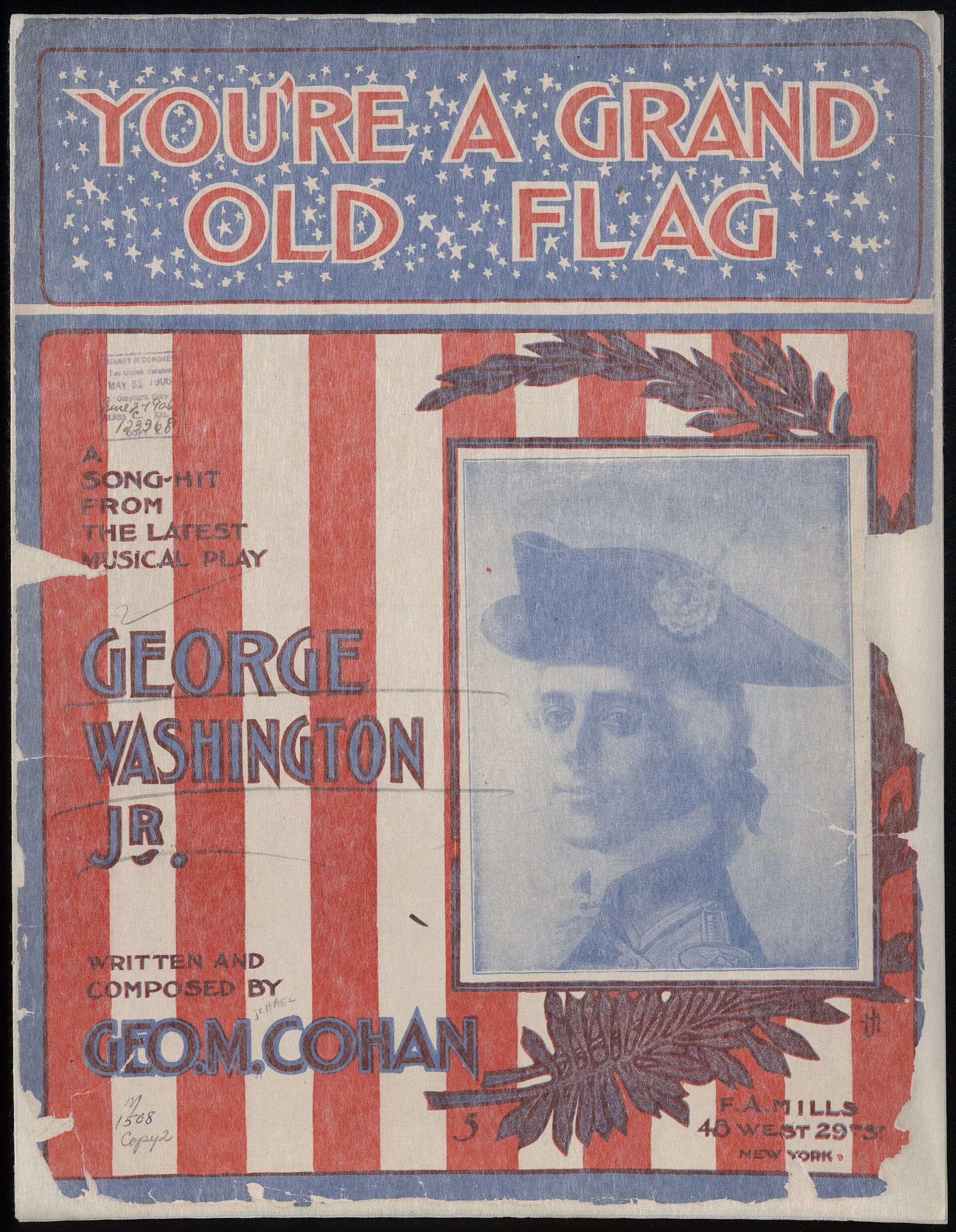
A patriotic song I was taught in my youth was “You’re A Grand Old Flag,” written by George M. Cohan in 1906. It’s been a long time since I’ve heard it, but it flashed into my mind the other day because of its lyrics, especially the refrain:
You’re a grand old flag, You’re a high-flying flag, And forever in peace may you wave. You’re the emblem of the land I love, The home of the free and the brave. Ev’ry heart beats true ‘Neath the Red, White and Blue, Where there’s never a boast or brag. But should auld acquaintance be forgot, Keep your eye on the grand old flag.
Forever in peace? I second that sentiment, except America is constantly at war or preparing for war. An America that doesn’t boast or brag? Amen to that, except presidents from Bush to Obama to Biden to Trump boast and brag about America having the world’s best and strongest military, with Obama adding that America has the best military in all human history. How’s that for a boast?
Cohan’s song, of course, is nakedly patriotic, with its references to marches and pride. Yet even this stanza is more resonant of democracy than America’s actions today:
Here’s a land with a million soldiers, That’s if we should need ’em, We’ll fight for freedom!
The song speaks of U.S. military potential (“a million soldiers”) but adds only if we should need them, in which case they’ll fight for freedom.
When was the last time the U.S. military truly fought for freedom? World War II, I reckon.
This song’s references to peace, to humility, and to fighting only if we should need to in the defense of freedom, mark it as a true museum piece. How do we recover that version of America?
I read the news today, oh boy. About a lucky man named Elon Musk. But he lost out on one thing: he didn’t get a top secret briefing on Pentagon war plans for China. And the news people breathed a sigh of relief.
With apologies to John Lennon and The Beatles, a day in the life is getting increasingly tough to take here in the land of the free. I’m meant to be reassured that Musk didn’t get to see America’s top-secret plans for — yes! — going to war with China, even as I’m meant to ignore the constant drumbeat of propaganda, the incessant military marches that form America’s background music, conveying the message that America must have war plans for China, that indeed war in or around China is possible, even probable, in the next decade. Maybe in 2027?
My fellow Americans, we should be far more alarmed by such secret U.S. war plans, along with those “pivots” to Asia and the Indo-Pacific, and the military base-building efforts in the Philippines, than reassured by the “good news” that Comrade Billionaire Musk was denied access to the war room, meaning (for Dr. Strangelove fans) he didn’t get to see “the big board.”
It’s war, war, everywhere in America. We do indeed have a strange love for it. I’ve been writing for TomDispatch for 18 years now — this is my 111th essay (the other 110 are in a new book of mine) — most of them focusing on militarism in this country, as well as our disastrous wars in Iraq, Afghanistan, and elsewhere, the ruinous weapons systems we continue to fund (including new apocalyptic nuclear weapons), and the war song that seems to remain ever the same.
A few recent examples of what I mean: President Trump has already bombed Yemen more than once. He’s already threatening Iran. He’s sending Israel all the explosives, all the weaponry it needs to annihilate the Palestinians in Gaza (so too, of course, did Joe Biden). He’s boasting of building new weapons systems like the Air Force’s much-hyped F-47 fighter jet, the “47” designation being an apparent homage by its builder, Boeing, to Trump himself, the 47th president. He and his “defense” secretary, Pete Hegseth, continually boast of “peace through strength,” an Orwellian construction that differs little from “war is peace.” And I could, of course, go on and on and on and on…
Occasionally, Trump sounds a different note. When Tulsi Gabbard became the director of national intelligence, he sang a dissonant note about a “warmongering military-industrial complex.” And however haphazardly, he does seem to be working for some form of peace with respect to the Russia-Ukraine War. He also talks about his fear of a cataclysmic nuclear war. Yet, if you judge him by deeds rather than words, he’s just another U.S. commander-in-chief enamored of the military and military force (whatever the cost, human or financial).
Consider here the much-hyped Department of Government Efficiency (DOGE) led by that lucky man Elon Musk. Even as it dismantles various government agencies like the Department of Education and USAID, it has — no surprise here! — barely touched the Pentagon and its vast, nearly trillion-dollar budget. In fact, if a Republican-controlled Congress has any say in the matter, the Pentagon budget will likely be boosted significantly for Fiscal Year 2026 and thereafter. As inefficient as the Pentagon may be (and we really don’t know just how inefficient it is, since the bean counters there keep failing audit after audit, seven yearsrunning), targeted DOGE Pentagon cuts have been tiny. That means there’s little incentive for the generals to change, streamline their operations, or even rethink in any significant fashion. It’s just spend, spend, spend until the money runs out, which I suppose it will eventually, as the national debt soars toward $37 trillion and climbing.
Even grimmer than that, possibly, is America’s state of mind, our collective zeitgeist, the spirit of this country. That spirit is one in which a constant state of war (and preparations for more of the same) is accepted as normal. War, to put it bluntly, is our default state. It’s been that way since 9/11, if not before then. As a military historian, I’m well aware that the United States is, in a sense, a country made by war. It’s just that today we seem even more accepting of that reality, or resigned to it, than we’ve ever been. What gives?
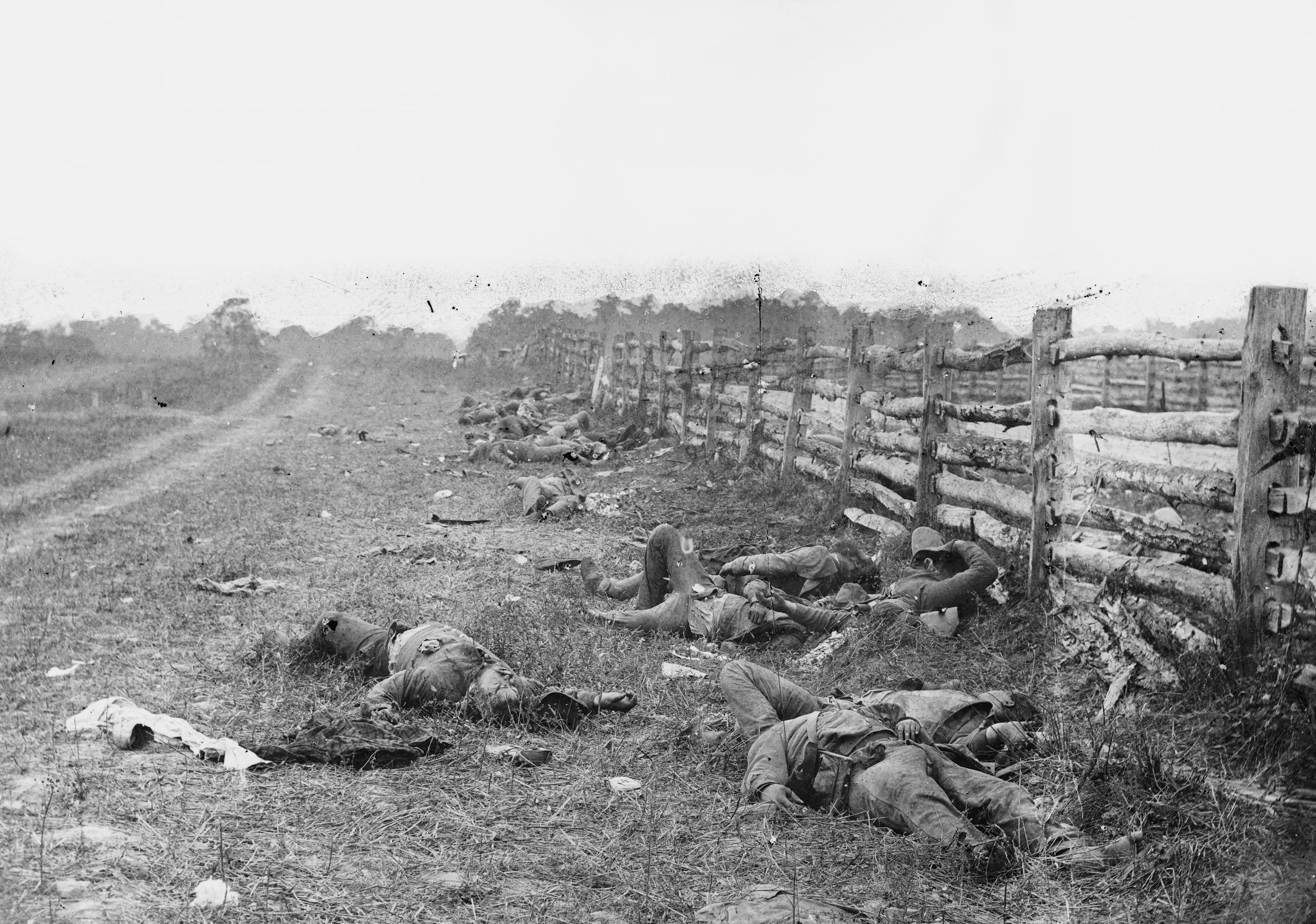
The Face of War: Confederate Dead at Antietam (Matthew Brady)
Remember when, in 1963, Alabama Governor George Wallace said, “Segregation now, segregation tomorrow, and segregation forever”? Fortunately, after much struggle and bloodshed, he was proven wrong. So, can we change the essential American refrain of war now, war tomorrow, and war forever? Can we render that obsolete? Or is that too much to hope for or ask of America’s “exceptional” democracy?
Taking on the MICIMATT(SH)
Former CIA analyst Ray McGovern did America a great service when he came up with the acronym MICIMATT, or the Military-Industrial-Congressional-Intelligence-Media-Academia-Think-Tank complex, an extension of President Dwight D. Eisenhower’s military-industrial complex, or MIC (from his farewell speech in 1961). Along with the military and industry (weapons makers like Boeing and Lockheed Martin), the MICIMATT adds Congress (which Eisenhower had in his original draft speech but deleted in the interest of comity), the intelligence “community” (18 different agencies), the media (generally highly supportive of wars and weapons spending), academia (which profits greatly from federal contracts, especially research and development efforts for yet more destructive weaponry), and think tanks (which happily lap up Pentagon dollars to tell us the “smart” position is always to prepare for yet more war).
You’ll note, however, that I’ve added a parenthetical SH to McGovern’s telling acronym. The S is for America’s sporting world, which eternally gushes about how it supports and honors America’s military, and Hollywood, which happily sells war as entertainment (perhaps the best known and most recent film being Tom Cruise’s Top Gun: Maverick, in which an unnamed country that everyone knows is Iran gets its nuclear ambitions spanked by a plucky team of U.S. Naval pilots). A macho catchphrase from the original Top Gun was “I feel the need — the need for speed!” It may as well have been: I feel the need — the need for pro-war propaganda!
Yes, MICIMATT(SH) is an awkward acronym, yet it has the virtue of capturing some of the still-growing power, reach, and cultural penetration of Ike’s old MIC. It should remind us that it’s not just the military and the weapons-makers who are deeply invested in war and — yes! — militarism. It’s Congress; the CIA; related intel “community” members; the mainstream media (which often relies on retired generals and admirals for “unbiased” pro-war commentary); academia (consider how quickly institutions like Columbia University have bent the knee to Trump); and think tanks — in fact, all those “best and brightest” who advocate for war with China, the never-ending war on terror, war everywhere.
But perhaps the “soft power” of the sporting world and Hollywood is even more effective at selling war than the hard power of bombs and bullets. National Football League coaches patrol the sidelines wearing camouflage, allegedly to salute the troops. Military flyovers at games celebrate America’s latest death-dealing machinery. Hollywood movies are made with U.S. military cooperation and that military often has veto power over scripts. To cite only one example, the war movie 12 Strong (2018) turned the disastrous Afghan War that lasted two horrendous decades into a stunningly quick American victory, all too literally won by U.S. troops riding horses. (If only the famed cowboy actor John Wayne had still been alive to star in it!)
The MICIMATT(SH), employing millions of Americans, consuming trillions of dollars, and churning through tens of thousands of body bags for U.S. troops over the years, while killing millions of people abroad, is an almost irresistible force. And right now, it seems like there’s no unmovable object to blunt it.
Believe me, I’ve tried. I’ve written dozens of “Tomgrams” suggesting steps America could take to reverse militarism and warmongering. As I look over those essays, I see what still seem to me sensible ideas, but they die quick deaths in the face of, if not withering fire from the MICIMATT(SH), then being completely ignored by those who matter.
And while this country has a department of war (disguised as a department of defense), it has no department of peace. There’s no budget anywhere for making peace, either. We do have a colossal Pentagon that houses 30,000 workers, feverishly making war plans they won’t let Elon Musk (or any of us) see. It’s for their eyes only, not yours, though they may well ask you or your kids to serve in the military, because the best-laid plans of those war-men do need lots of warm bodies, even if those very plans almost invariably (Vietnam, Afghanistan, Iraq, etc.) go astray.
So, to repeat myself, how do you take on the MICIMATT(SH)? The short answer: It’s not easy, but I know of a few people who had some inspirational ideas.
On Listening to Ike, JFK, MLK, and, Yes, Madison, Too
Militarism isn’t exactly a new problem in America. Consider Randolph Bourne’s 1918 critique of war as “the health of the state,” or General Smedley Butler’s confession in the 1930s that “war is a racket” run by the “gangsters of capitalism.” In fact, many Americans have, over the years, spoken out eloquently against war and militarism. Many beautiful and moving songs have asked us to smile on your brother and “love one another right now.” War, as Edwin Starr sang so powerfully once upon a time, is good for “absolutely nothin’,” though obviously a lot of people disagree and indeed are making a living by killing and preparing for yet more of it.
And that is indeed the problem. Too many people are making too much money off of war. As Smedley Butler wrote so long ago: “Capital won’t permit the taking of the profit out of war until the people — those who do the suffering and still pay the price — make up their minds that those they elect to office shall do their bidding, and not that of the profiteers.” Pretty simple, right? Until you realize that those whom we elect are largely obedient to the moneyed class because the highest court in our land has declared that money is speech. Again, I didn’t say it was going to be easy. Nor did Butler.
As a retired lieutenant colonel in the U.S. Air Force, I want to end my 111th piece at TomDispatch by focusing on the words of Ike, John F. Kennedy (JFK), Martin Luther King, Jr. (MLK), and James Madison. And I want to redefine what words like duty, honor, country, and patriotism should mean. Those powerful words and sentiments should be centered on peace, on the preservation and enrichment of life, on tapping “the better angels of our nature,” as Abraham Lincoln wrote so long ago in his First Inaugural Address.
Why do we serve? What does our oath of office really mean? For it’s not just military members who take that oath but also members of Congress and indeed the president himself. We raise our right hands and swear to support and defend the U.S. Constitution against all enemies, foreign and domestic, to bear true faith and allegiance to the same.
There’s nothing in that oath about warriors and warfighters, but there is a compelling call for all of us, as citizens, to be supporters and defenders of representative democracy, while promoting the general welfare (not warfare), and all the noble sentiments contained in that Constitution. If we’re not seeking a better and more peaceful future, one in which freedom may expand and thrive, we’re betraying our oath.
If so, we have met the enemy — and he is us.
Ike told us in 1953 that constant warfare is no way of life at all, that it is (as he put it), humanity crucifying itself on a cross of iron. In 1961, he told us democracy was threatened by an emerging military-industrial complex and that we, as citizens, had to be both alert and knowledgeable enough to bring it to heel. Two years later, JFK told us that peace — even at the height of the Cold War — was possible, not just peace in our time, but peace for all time. However, it would, he assured us, require sacrifice, wisdom, and commitment.
How, in fact, can I improve on these words that JFK uttered in 1963, just a few months before he was assassinated?
What kind of peace do we seek? Not a Pax Americana enforced on the world by American weapons of war. Not the peace of the grave or the security of the slave. I am talking about genuine peace, the kind of peace that makes life on earth worth living…
I speak of peace because of the new face of war. Total war makes no sense in an age… when the deadly poisons produced by a nuclear exchange would be carried by wind and water and soil and seed to the far corners of the globe and to generations yet unborn… surely the acquisition of such idle [nuclear] stockpiles — which can only destroy and never create — is not the only, much less the most efficient, means of assuring peace.
I speak of peace, therefore, as the necessary rational end of rational men. I realize that the pursuit of peace is not as dramatic as the pursuit of war — and frequently the words of the pursuer fall on deaf ears. But we have no more urgent task.
Are we ready to be urgently rational, America? Are we ready to be blessed as peacemakers? Or are we going to continue to suffer from what MLK described in 1967 as our very own “spiritual death” due to the embrace of militarism, war, empire, and racism?
Of course, MLK wasn’t perfect, nor for that matter was JFK, who was far too enamored of the Green Berets and too wedded to a new strategy of “flexible response” to make a clean break in Vietnam before he was killed. Yet those men bravely and outspokenly promoted peace, something uncommonly rare in their time — and even more so in ours.
More than 200 years ago, James Madison warned us that continual warfare is the single most corrosive force to the integrity of representative democracy. No other practice, no other societal force is more favorable to the rise of authoritarianism and the rule of tyrants than pernicious war. Wage war long and it’s likely you can kiss your democracy, your rights, and just maybe your ass goodbye.
America, from visionaries and prophets like MLK, we have our marching orders. They are not to invest yet more in preparations for war, whether with China or any other country. Rather, they are to gather in the streets and otherwise raise our voices against the scourge of war. If we are ever to beat our swords into plowshares and our spears into pruning hooks and make war no more, something must be done.
Let’s put an end to militarism in America. Let’s be urgently rational. To cite John Lennon yet again: You may say I’m a dreamer, but I’m not the only one. Together, let’s imagine and create a better world.
Meanwhile, Institute of War Is Going Full Throttle
Surprise! America’s Institute of Peace (USIP), admittedly a think tank that is neither that peaceful nor successful, is being shut down by the Trump administration. Meanwhile, the Institute of and for War, otherwise known as the Pentagon, is going full throttle and likely getting even more money to crank up conflict around the globe.
The symbolism here is almost too obvious for words. The budget for the Peace Institute is roughly $55 million. The budget for the War Institute (Pentagon) is roughly $900 billion. That means America spends 16,000 times as much money preparing for war than it does thinking about peace. That might be one reason why we always get war—we get what we pay for.
For the yearly budget of the USIP, we could buy roughly one-half of an F-35 fighter jet. Now there’s some meaningful cost savings.
A Reminder: My new book, American Militarism on Steroids, goes live on Amazon Kindle tomorrow. It gathers all the essays I’ve written for TomDispatch, which amazingly add up to over 230,000 words. Prolix? Prolific? Profane? It must be profane if it criticizes our beloved Institute of War. Available for downloading for $7.50 at this link. Thank you.
The U.S. Empire, Thrashing and Lashing Out as It Declines
President Donald Trump has promised to bomb Yemen for a “long time.” Trump is a real president now. Presidents become “real” when they bomb something. Remember how Trump was praised by the U.S. mainstream media when he launched missiles against Syria in 2017?
Back in 2017, I wrote this: The launch of 59 expensive cruise missiles against a Syrian airfield did little to change the actions of the Assad government. Nor did it knockout the airfield. Yet it was spun by Trump as a remarkable victory. In his words, “We’ve just fired 59 missiles, all of which hit, by the way, unbelievable, from, you know, hundreds of miles away, all of which hit, amazing. It’s so incredible. It’s brilliant. It’s genius. Our technology, our equipment, is better than anybody by a factor of five. I mean look, we have, in terms of technology, nobody can even come close to competing.”
“Only we can bomb it” should replace “In God we trust” as the U.S. national motto.
America’s best and brightest (who were never quite that) have become the worst and dimmest. And that’s true whether the president is blue or red, Biden or Trump. The problem is our “leaders” have no moral principles. No integrity. No sense of right and wrong. They’re all about power and sending “messages” through bombing. Or sending tons and tons of bombs to Israel so that the Zionists can send “messages” to the Palestinians. The main message: begone or be dead.
Even as our “leaders” do this, they seek to solidify a mythic history of the U.S. (see video above) where America is exceptional in its rightness and where they (the leaders) are the ones who grant us our rights (such as freedom of speech) when these rights are inalienable. Indeed, rather than protecting our rights, they want to control them, limit them, and make them obedient and subservient to power.
Rulers’ ideas rule. And our rulers’ ideas are increasingly toxic.
With democracy already deeply compromised in America, we’re witnessing and experiencing the thrashing and lashing out of a declining American empire, not only externally but in the “homeland.”
The so-called SignalGate scandal centered on the bombing of Yemen is highly revelatory. First, some resources. CNN has a useful annotated account of the chats exchanged at the highest levels of the Trump administration. At their respective Substacks, Lenny Broytman and Caitlin Johnstone have telling dissections of these chats as well. At Jacobin, Branko Marcetic has an important article that reminds us of the illegality of the attacks. As the article’s subheading puts it: The press [mainstream media] is mostly framing the Yemen group chat scandal as a story of incompetence. There’s little attention being paid to the deadliness, illegality, and ineffectiveness of the strikes themselves.
To me, among the most telling “chats” came from Secretary of Defense Pete Hegseth. It highlights the “exceptional” nature of America:
*****
Pete Hegseth to Vice President JD Vance: I fully share your loathing of European free-loading. It’s PATHETIC.
But Mike [Waltz, the National Security Adviser] is correct, we are the only ones on the planet (on our side of the ledger) who can do this. Nobody else even close. Question is timing…
*****
This is precisely the problem for America since the Vietnam War, if not before then. We’ve created a monster military, a “global strike” force, that is capable of destroying any target anywhere around the globe. “Nobody else even close,” SecDef Hegseth correctly says. And because we can do it, because we are exceptional in military force, our leaders believe we should do it, even if it’s only to send a “message” to the world how tough we are, how committed we are to killing others.
Other countries—like those “free-loading” European ones—are PATHETIC because they don’t have America’s military might. Only we can smite evildoers around the globe, only we can do so while also arming Israel to the teeth and covering its flanks while it continues its annihilation of Gaza, and this is something we are immensely proud of.
My fellow Americans, this is not something to be proud of. Consider if America’s military in the 1960s had lacked the ability to deploy over half a million troops to Vietnam while also facing down the Warsaw Pact in Europe. Consider if America’s military had lacked the ability to invade Iraq in 2003 while also waging war in Afghanistan and garrisoning the globe with roughly 800 military bases. Consider how much blood would not have been spilled, and treasure wasted, if the U.S. military was smaller, focused on defense, and led by people who didn’t put muscle and flame emojis in their chats to celebrate U.S. military prowess at killing people in Yemen.
That U.S. military forces are the only ones who can kill globally with such comparative ease, that “nobody else even close,” is exactly what is wrong with our government. We place far too much faith and pride in military prowess, so much so that the Pentagon becomes the Pentagod, something we worship, something we make immense sacrifices to, as in budgets that approach $1 trillion yearly.
Not for nothing did President Dwight D. Eisenhower say in 1953 that this is no way of life at all—that we are crucifying ourselves on a cross of iron. Tell me again, who are the pathetic ones?
We must end our intoxication with military power before it ends us.
I’ve been reading John Ketwig’s memoir “…and a hard rain fell: A GI’s true story of the War in Vietnam,” and it’s reminding me just how plain dumb, destructive, and duplicitous America’s wars have been since World War II.
America’s wars are always dressed up with a necessary, even allegedly noble, cause. In Vietnam, we had to stop communism and all those dominoes from falling. In Iraq, it was about WMD and stopping Saddam Hussein, “the next Hitler.” In Afghanistan, it was about vengeance for 9/11, then creating democracy and even helping women. (How about helping women in America? Never mind.)
Vietnam is nominally communist today—and a big trading partner of the U.S. and an ally of sorts against China. No dominoes fell. Iraq didn’t have WMD and Saddam wasn’t the next Hitler; he was merely a regional strongman and a former U.S. ally who got a little too big for his britches, especially for Israel. Afghanistan was a war in search of a clear mission and attainable goals. After twenty years of effort and roughly $2 trillion in expenditures, the U.S. replaced the Taliban with—the Taliban. (I heard Norman Finkelstein say this first.)
We’re always told versions of the same lie: We need to fight them over there so that we don’t have to fight them here. Communism had to be rolled back in Vietnam else commies would be landing in Manhattan. Iraq had to be pummeled and Saddam overthrown before WMD landed in Boston. Afghanistan had to be pacified and modernized before the Taliban enforced conservative Sharia law in Biloxi.
None of this was true. The United States would have been perfectly safe without committing any troops to Vietnam, Iraq, and Afghanistan. In fact, the U.S. would have been far better off if those wars had never been fought. Certainly Vietnam, Iraq, and Afghanistan would have been far better off if they’d never become free-fire zones for American munitions (including the poisonous Agent Orange in Vietnam and, more recently, depleted uranium and other poisons in Iraq and Afghanistan).
Now we’re hearing about a possible U.S. war with Iran, allegedly to stop that country from acquiring an atomic bomb. It’s OK for the U.S. to have more than 5000 nuclear warheads and for Israel to have 200 or so, but it’s not OK for Iran to have even one, because reasons.
The U.S. military, vast as it is, with a vision of global dominance, always needs enemies. Of course, it’s not simply the military but the whole military-industrial complex, the MICIMATT,* which needs war and conflict to sustain itself.
I recently read “American War,” a powerful novel by Omar El Akkad. It imagines a second U.S. civil war starting roughly 50 years from now. It’s a fascinating book, well worth reading because it captures the horror of war, with all its atrocities, its massacres, its war crimes, and the deep wounds war leaves behind even among the most resolute survivors. John Ketwig’s book does the same as he recounts the fears and horrors of his year in Vietnam and the personal struggles he endured in coming to terms with what he’d seen and endured.
So, count me among those who are already against the next war, whether against Iran, China, or for that matter any other country. Sure, I think America needs to defend itself; I don’t think peace is going to break out spontaneously around the world; but I know for a fact that fighting constant wars is not a way toward greater peace and prosperity. Quite the opposite.
If you want to know what desperate and profoundly wounded war survivors are capable of, read “American War.” If you want to know what desperate and profoundly confused troops are capable of, read “…and a hard rain fell.” And ponder the continued propaganda here of the “good war,” the wonders of warriors and warfighters, and the repetition of slogans like “peace through strength,” a specific form of strength measured in kilotons and megatons of explosives, in massive body counts and military production figures.
Ask yourself: Is that “strength”? Are constant wars truly the path toward peace? How can we possibly be so dumb as to believe this?
MICIMATT: military-industrial-congressional-intelligence-media-academe-think-tank complex. It employs millions of people and spends more than a trillion dollars a year. It’s not easily confronted. Nor is it easily contained, let alone curtailed.
Yesterday, I awoke to grim news that Israel is bombing Gaza yet again, killing a few hundred people, even as the U.S. targets Yemen with “precision” bombs and strikes, apparently to intimidate Iran as well—and perhaps to provoke a war, as Israeli jets escort U.S. B-52 bombers in “exercises.”
War is in the news, incessantly, with Congress sidelined and feckless as usual.
The constant drumbeat of war—the never-ending concussion of bombs in the Middle East—put me to mind of Orwell’s 1984. Nothing favors authoritarian states more than a constant state of war. If you truly want to weaken the Trump administration, reject their “warrior” and “war fighting” rhetoric and their selling of “peace through strength,” by which they mean peace through bombing and killing. Some “peace,” right? They may as well go full Orwell and declare that “war is peace” while making the Pentagon the “Ministry of Peace.”
Speaking of Orwell, and needing a break from death and mayhem, I remembered this piece that I wrote in 2018. Citizens, you had best police not only your words and actions, but the faces you make as well, especially when our Dear Leader is talking.
Written in September 2018
Facecrime!
W.J. Astore
We’re truly living in Orwellian times. A 17-year-old high school student, now known as #plaidshirtguy due to his choice of wardrobe, was removed from a Trump rally in Montana because of the faces he was making as Trump spoke. You can read all about here, and watch an interview with him at CNN.
Not surprisingly, people who stand behind Trump are selected ahead of time and told to clap and cheer. This young man did that, but he also chose to look quizzical, skeptical, and bemused at times. This is not allowed! A Trump staffer eventually intervened to remove him from the audience due to his “face crime.” To make matters worse, he was then held by the Secret Service for ten minutes, after which he was asked to leave the event.
Leave the event? For making skeptical and quizzical facial expressions?
You may recall from George Orwell’s “1984” that “Facecrime” existed. Anyone making skeptical or otherwise unacceptable faces when the Party announced bogus victories, production figures, and so forth opened himself or herself up to serious punishment.
Thanks to plaid shirt guy, we now know that facecrime has come to America. Just remember, fellow citizens, always to smile and cheer in the presence of Our Dear Leader. Unless you want to be detained and sent away — perhaps next time to the cornfield.
*From my copy of “1984”: “In any case, to wear an improper expression on your face (to look incredulous when a victory was announced, for example) was itself a punishable offense. There was even a word for it in Newspeak: facecrime, it was called.” (From the end of Chapter 5.)
As a retired U.S. military officer, I’m appalled at the notion of “peace through strength.” You may as well say “war is peace.” Peace is achieved through dialogue. Diplomacy. Engagement. A spirit of good will. It isn’t achieved by brandishing weapons while selling the same around the globe. (The U.S. dominates the global arms trade, accounting for nearly half of it.)
I’m also outraged by the ongoing militarism of this moment, whether it’s Kamala Harris celebrating military lethality and embracing the Cheneys in 2024 or the Trump crowd that embraces “warriors” and “warfighters.” The solemn tradition of the citizen-soldier has long been abandoned in the U.S., replaced as it has been by a mercenary mindset that sees war as permanent and therefore “normal,” even admirable.
Even as we’re essentially being told and sold “war is peace,” we’re also being told and sold that ethnic cleansing in Gaza is urban renewal, a prelude to a new Riviera, a new playground for the rich, even if it’s erected on the bones of millions of Palestinians. Obviously, this cleansing of genocide using the imagery of crass and vulgar tourism must be condemned in no uncertain terms.
Put colloquially, I often wonder, Dude, where’s my country?
Explore Gaza, by Mr. Fish (at Chris Hedges’ Substack)
America’s Revival Will Begin When It Finally Embraces Peace
Arguably the biggest problem in America today is that the government remains on a wartime footing. The possibility of America being a normal country in normal times, at peace, is simply never mentioned. In current politics and in the mainstream media, there is no vision of America being at peace with the world. Ever.
There is always an enemy, usually plural. Russia. China. Iran. North Korea. The inchoate threat of terror and terrorists. Islamist extremism. All these and more are cited by the “experts” in the “national security state” as requiring a military response. If some kind of peace deal is orchestrated for the Russia-Ukraine War, America and its war machine will immediately pivot to Asia. Or the Middle East. Or perhaps Africa. Or all three.
I’m amazed when friends tell me they’re concerned about U.S. isolationism. Usually this concern is couched in America’s alleged withdrawal from (or even betrayal of) Europe in light of the Russia-Ukraine War. Their message to me is simple: America must keep sending weapons and intel to Ukraine until Russia and Putin are defeated, “as long as it takes.” The “it” is left undefined, but apparently “it” refers to an unqualified Ukrainian victory over Russia, followed by Ukraine’s eventual admission into NATO. Whether that “it” is even possible—whether that “it” could well lead to a nuclear exchange—doesn’t seem to matter because “We’re at war.”
I don’t know how anyone can think America will return to isolationism when the U.S. has 800 military bases globally and a vision of global reach, global power, and total dominance everywhere. And when America spends more on its military than the next ten countries combined (and most of those are U.S. allies). Dominating the globe isn’t exactly consistent with isolationism.
The problem with all the war rhetoric, the war narrative, the war framing, the warrior and lethality talk, is what it enables and facilitates, which is atrocity. Waste. Destruction. War is no way of life at all. As Ike said, the persistence of war is humanity crucifying itself on a cross of iron.
War is immensely corrosive to democracy. It is the enemy of freedom. Just listen to James Madison:
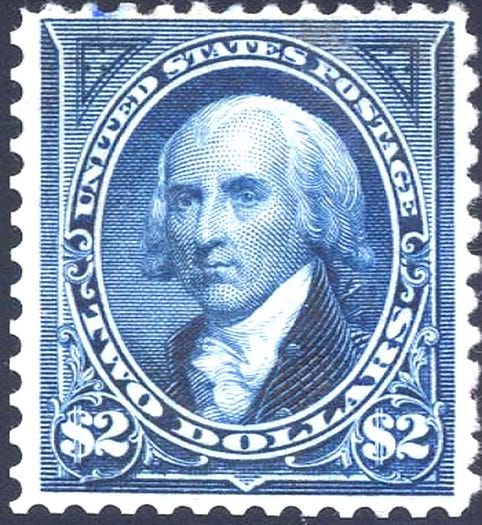
James Madison
Of all the enemies of true liberty, war is, perhaps, the most to be dreaded, because it comprises and develops the germ of every other. War is the parent of armies; from these proceed debt and taxes; and armies, and debts, and taxes are the known instruments for bringing the many under the domination of the few. In war, too, the discretionary power of the Executive is extended; its influence in dealing out offices, honors and emoluments is multiplied; and all the means of seducing the minds, are added to those of subduing the force, of the people. The same malignant aspect in republicanism may be traced in the inequality of fortunes, and the opportunities of fraud, growing out of a state of war, and in the degeneracy of manner and of morals, engendered in both. No nation can preserve its freedom in the midst of continual warfare …
*****
If you’re concerned about authoritarianism, if you’re concerned about maintaining and strengthening freedom, if you’re concerned about combatting corruption and waste, if you’re concerned about America’s huge deficits, stopping war should be your number one concern.
War is a terrible thing, and a state of war enables all kinds of butchery. Just ask the indigenous peoples of America, or the peoples of Palestine today. Even genocide can be disguised as a wartime exigency, a wartime necessity. How many times throughout history has the declaration, “We’re at war!” been used to justify the most heinous crimes against humanity? Even the Nazis hid behind wartime exigency to justify the mass euthanasia of the old, the mentally ill, and other forms of “life unworthy of life” as part of the T4 program (which anticipated the Holocaust).
The true revival of America will begin when this country declares itself to be at peace with the world. Until then, precipitous decline will continue for as long as our government remains at (and continues to celebrate) war.
I recently ordered a few items from Amazon. Random stuff like a shower caddy, an iPhone case, and lamp sockets. It won’t surprise you to learn they were all “Made in China.”
I ordered some clothes from a fancy online retailer. The clothes said “Designed in California” but they were, of course, Made in China.
What is America making? What are we sending overseas? Bombs and bulldozers for the devastation and dismantlement of Gaza and other Palestinian Territories. Consider this article from Ken Klippenstein (excerpt follows), which details roughly $10 billion in “foreign aid” to Israel.
Here’s what Klippenstein had to say:
*****
While the entire news media is focused on Trump’s suspension of arms for Ukraine, the administration is arming Israel to the teeth. The nature of the bombs being sold indicates Israel’s military is preparing to continue its bombing campaigns in Gaza, Lebanon, Syria, and Yemen; as well as preparing for possible war with Iran.
Included in the sales are tens of thousands of controversial 2,000 lb. bombs so heavily criticized during the Gaza war for their destructive capacity, and thousands of “Hellfire” missiles that are used for targeted killings.
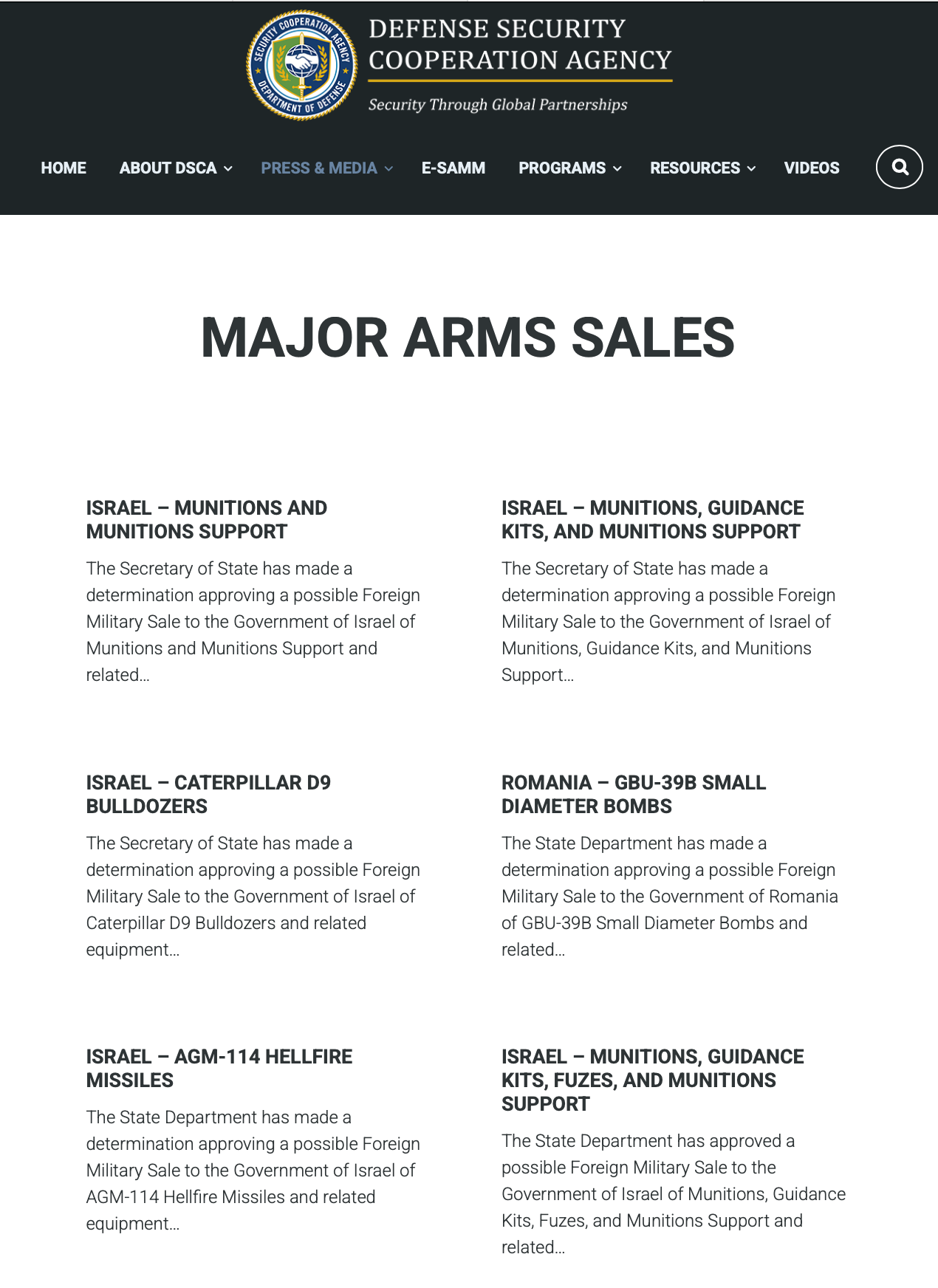
When I visited the Defense Security Cooperation Agency website’s section for major arms sales to see a breakdown of the weapons, I was immediately struck by the fact that five of the last six sales were to Israel.
Screenshot of DSCA’’s “Major Arms Sales” landing page
The U.S. bombs and missiles being sent to Israel, almost all made by Boeing, are included in:
2,166 GBU-39/B 250-pound Small Diameter Bombs (SDB) Increment 1.
2,800 MK 82 General Purpose, 500-pound bomb bomb bodies.
13,000 KMU-556 JDAM Guidance Kits to attach to MK-84 (2,000-pound) bomb bodies.
3,475 KMU-557 JDAM Guidance Kits to attach to BLU-109 (2,000-pound) bomb bodies.
1,004 KMU JDAM Guidance Kits to attach to 500-pound GBU-38v1 bomb bodies.
17,475 FMU-152A/B multi-function fuzes for bombs.
*****
Holy shit! Nearly thirty-six thousand 2000-pound bombs! That is 36 kilotons, roughly the equivalent of the two atomic bombs dropped on Hiroshima and Nagasaki in 1945. And that’s not including the assorted 1000- and 500-pound bombs tossed into the mix.
This is an astonishing amount of ordnance for Israel to continue its ethnic cleansing campaign in Gaza and the West Bank.
President Trump, of course, has the full support of most Democrats in sending this stockpile of destruction to Israel. Call it bipartisan genocidal enablement.
America sure is an “exceptional” nation. No nation is better at bombing others—or supplying the bombs for others like Israel to do so—then flattening what remains with “Made in USA” bulldozers.
Honestly, I wish my country made shower caddies, iPhone cases, and lamp sockets instead of bombs and bulldozers. Don’t you?








 Bracing Views