U.S. media outlets have been consumed by the story today that President Trump improperly or unwisely shared classified material on ISIS with the Russians, material that apparently came from Israel. For its part, the Trump administration denies the charge that information was improperly or unwisely shared.
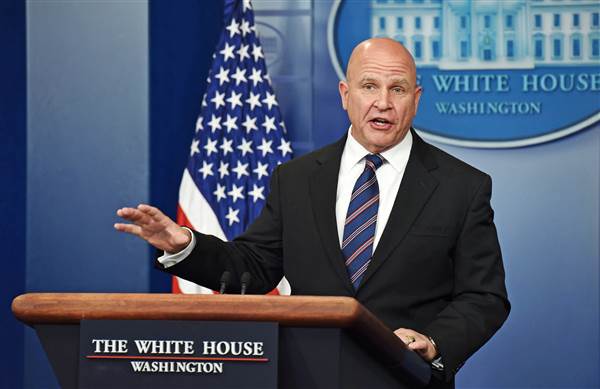
Today, National Security Adviser H.R. McMaster defends Trump’s decision to share classified information with the Russians
A couple of comments. First, the president has broad powers of declassification and the discretion to share sensitive secrets with others. Sharing classified information with the Russians, an ally of a sort in the struggle against ISIS, is not necessarily a bad idea. Trump seems to have decided it was a way to strengthen relations and build trust at high levels with the Russian government, a defensible position, in my view.
Second, I’ll repeat here what I said about classification and the Hillary Clinton email scandal: Far too much information is classified by the U.S. government. Classification is vastly overused by our government to conceal many sins, blunders, nefarious designs, and who knows what else. There’s nothing sacred about secrecy; indeed, a democracy should prefer transparency, rather than stamping everything “secret” or “top secret” and thereby keeping nearly all Americans in the dark.
Obviously, I’m not privy to the exact nature of the intelligence shared, the sensitivity and vulnerability of the source(s) and collection methods, and so on. I’m not an intelligence trade-craft expert. So far, Israeli operatives seem unconcerned, but whether their blase attitude is feigned or not is unknown.
Americans elected Trump because he promised to do things differently. He campaigned on the idea of being unorthodox; indeed, he is unorthodox. Surely no one should be surprised when he decides to speak in the clear to Russian government officials on matters concerning ISIS and terrorism.
Repeat after me, America: Secrecy is not sacred. Transparency is desirable. So too is building trust with rivals as well as friends. Trump has his faults, major ones I believe, but this current controversy is a tempest in a teapot.
Memories of War: So powerful yet often so fragmentary
W.J. Astore
Memories of war are powerful and fragmentary. At a national level, we do best at remembering our own war dead while scarcely recognizing the damage to others. This is one cost of nationalism. Nationalism is violent, bigoted, and discriminatory. It elevates a few at the expense of the many. It fails fully to recognize common human experience, even one as shattering as war.
One example. I’ve visited the Vietnam War Memorial in Washington, D.C. In seeing all those names of American dead on the wall, I was moved to tears. It’s a remarkable memorial, but what it fails to capture is any sense of the magnitude of death from that war visited upon Vietnam, Laos, and Cambodia. As I wrote for Alternet, to visualize the extent of death from America’s war in Southeast Asia, the Vietnamese would need a wall that would be roughly 20 to 50 times as long as ours.
Think about that for a moment. A wall perhaps 50 times as long as our Vietnam memorial wall. It’s a staggering mental image. Sadly, today in America the only wall garnering much media interest is Trump’s wall along our border with Mexico, yet another manifestation of nationalist bigotry and bias.
John Dower challenges us to think differently. To explore our common humanity. To remember the war dead of other nations and peoples, and to record the true cost of America’s wars, both to others and to ourselves. His latest article at TomDispatch.com explores how Americans both remember and forget their wars. Here’s an excerpt:
While it is natural for people and nations to focus on their own sacrifice and suffering rather than the death and destruction they themselves inflict, in the case of the United States such cognitive astigmatism is backlighted by the country’s abiding sense of being exceptional, not just in power but also in virtue. In paeans to “American exceptionalism,” it is an article of faith that the highest values of Western and Judeo-Christian civilization guide the nation’s conduct — to which Americans add their country’s purportedly unique embrace of democracy, respect for each and every individual, and stalwart defense of a “rules-based” international order.
Such self-congratulation requires and reinforces selective memory. “Terror,” for instance, has become a word applied to others, never to oneself. And yet during World War II, U.S. and British strategic-bombing planners explicitly regarded their firebombing of enemy cities as terror bombing, and identified destroying the morale of noncombatants in enemy territory as necessary and morally acceptable. Shortly after the Allied devastation of the German city of Dresden in February 1945, Winston Churchill, whose bust circulates in and out of the presidential Oval Office in Washington (it is currently in), referred to the “bombing of German cities simply for the sake of increasing the terror, though under other pretexts.”
Too often, Americans believe they’re waging a war on terror, forgetting that war itself is terror. That war itself is evil. That doesn’t mean that war is never justified, as it was, I believe, in the struggle against Nazi tyranny in World War II. Even in justifiable wars, however, we need to recognize that war breeds corruption; that war, in essence, is corruption, a corruption of the human spirit, of a humanity which should be held in common and nourished, but which during war is degraded if not destroyed.
John Dower recognizes this. It’s a theme he explores in his new book, The Violent American Century: War and Terror Since World War Two. Consider it a primer on war’s many corruptions, and a precis of America’s tendency toward a nationalism of callous indifference when it comes to the damages we inflict on others. It’s not happy reading, but then again wars shouldn’t be a subject for happiness.
A remarkable primer and meditation on America’s endless wars
Wars and rumors of war seem always to be with us. Some would say they’re an inevitable part of the human condition. Our historical record seems to support that grim conclusion. Yet there is another way, a more pacific path, a path toward peace. But to walk that path, we must first fully recognize the tangled undergrowth of war that imperils our every footstep. Dower’s latest book helps us to do just that.
Today, I saw another article on why America is losing its wars in places like Iraq, Afghanistan, and elsewhere. The gist of this and similar articles is that America’s wars are winnable. That is, if we bomb more, or send more troops, or change our strategy, or alter our ROE (rules of engagement), or give more latitude to the generals, or use all the weapons at our disposal (to include nukes?), and so on, these wars will prove tractable and even winnable. This jibes with President Trump’s promises about America winning again, everywhere, especially in wars.
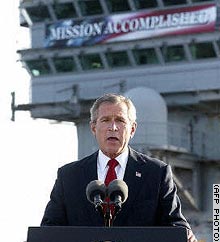
Sorry: The Missions Are Never Going to be “Accomplished”
Nonsense. The U.S. military hasn’t won these wars since the wars themselves are unwinnable by U.S. military action. Indeed, U.S. military action only makes them worse.
Consider Iraq. Our invasion in 2003 and our toppling of Saddam kicked off a regional, religious, ethnic, and otherwise complicated civil war that is simply unwinnable by American troops. Indeed, the presence of (and blunders made by) American troops in Iraq helped to produce ISIS, much-hyped as the current bane of American existence.
Consider Afghanistan. Our invasion in 2001 toppled the Taliban, at least for a moment, but did not produce peace as various Afghan factions and tribes jostled for power. Over time, the U.S. and NATO presence in the country produced instability rather than stability even as the Taliban proved both resilient and resurgent. U.S. and NATO forces have simply become yet another faction in the Afghan power game, but unless we want to stay there permanently, we are not going to “win” by any reasonable definition of that word.
You could say the same of the U.S. military’s involvement in similar conflicts like Yemen or Syria (look at the mess we made of Libya). We can kill a lot of “terrorists” and drop a lot of bombs, spreading our share of chaos, but we aren’t going to win, not in the sense of these wars ending on terms that enhance U.S. national security.
This hard reality is one that the U.S. military explains away by using jargon. Military men talk of generational wars, of long wars, of fourth generation warfare, of gray zones, of military operations other than war (which has its own acronym, MOOTW), and so on. A friend of mine, an Air Force captain, once quipped: “You study long, you study wrong.” You can say something similar of war: “You wage war for long, you wage it wrong.” This is especially true for a democracy.
America’s wars today are unwinnable. They are unwinnable not only because they are not ours to win: they aren’t even ours. We refuse to take ownership of them. At the most fundamental level, we recognize they are not vital to us, since we don’t bother to unify as a country to declare war and to wage it. Most Americans ignore them because we can ignore them. The Afghans, the Iraqis, the Syrians, and so on don’t have the luxury of ignoring them.
Trump, with all his talk of winning, isn’t going to change this. The more he expands the U.S. military, the more he leans on “his” generals for advice, the more he’s going to fail. Our new commander-in-chief needs to learn one lesson: The only way to win America’s wars is to end them.
As the end of Trump’s first 100 days in office approaches, we can already see the novice commander-in-chief’s approach to military action. The approach is to empower “his” generals. And the results? A triumph of image over substance. “Spin it to win it” is the byword for Trump’s military “strategy.”
A few examples:
The disastrous raid on Yemen that led to the death of a Navy SEAL as well as many civilians, including children, was spun by the Trump administration as a great success. At the same time, Trump pinned the death of the SEAL on his generals, saying “they” lost him.
The launch of 59 expensive cruise missiles against a Syrian airfield did little to change the actions of the Assad government. Nor did it knockout the airfield. Yet it was spun by Trump as a remarkable victory. In his words, “We’ve just fired 59 missiles, all of which hit, by the way, unbelievable, from, you know, hundreds of miles away, all of which hit, amazing. It’s so incredible. It’s brilliant. It’s genius. Our technology, our equipment, is better than anybody by a factor of five. I mean look, we have, in terms of technology, nobody can even come close to competing.”
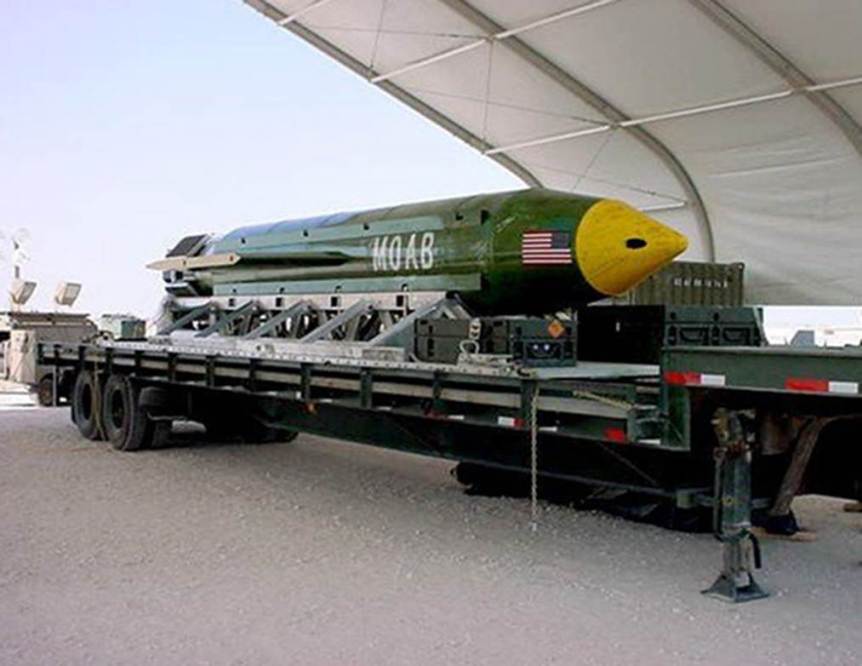
The use of the “mother of all bombs” (MOAB) in Afghanistan was seized upon by Trump as an example of his toughness and decisiveness vis-à-vis the Obama administration’s use of force. Yet Trump didn’t even know about the bomb until after it was used. Nevertheless, he boasted “If you look at what’s happened over the last eight weeks [of my administration] and compare that really to what’s happened over the past eight years, you’ll see there’s a tremendous difference, tremendous difference.” Dropping MOAB, Trump claimed on scant evidence, “was another very, very successful mission.”
The Trump administration lost track of an aircraft carrier battle group, saying it was on its way as a show of force against North Korea even as it was headed in the opposite direction. This blunder was chalked up to a miscommunication between the White House and Pentagon, even as allies such as South Korea and Japan expressed concern about the credibility of U.S. support at a time of rising tensions.
As Tom Engelhardt notes in his latest must-read piece at TomDispatch.com:
President Trump did one thing decisively. He empowered a set of generals or retired generals — James “Mad Dog” Mattis as secretary of defense, H.R. McMaster as national security adviser, and John Kelly as secretary of homeland security — men already deeply implicated in America’s failing wars across the Greater Middle East. Not being a details guy himself, he’s then left them to do their damnedest. “What I do is I authorize my military,” he told reporters recently. “We have given them total authorization and that’s what they’re doing and, frankly, that’s why they’ve been so successful lately.”
Have the generals really been “so successful lately,” President Trump? The facts suggest otherwise. Meanwhile, Trump has not yet learned that generals always want more – they believe they can win if they just get more troops, more money, more weaponry. They’ll support Trump as long as he keeps funneling more of everything their way – and as long as he keeps spinning their blunders and missteps as victories.
Is this the face of “success” in Yemen? A little girl dead?
For the moment, Trump’s generals may love him for his “spin it to win it” boosterism and his blank checks of support. But beware, men wearing stars. Trump has already shown he prefers to delegate responsibility as well as authority when things go bad (recall the failed raid on Yemen and the dead SEAL).
Trump may not be a micro-manager, but that’s because he doesn’t know anything. He just wants to spin military action as a win – for Trump. If the generals keep losing, Trump will turn on them. The question is, will they turn on him?
More disturbing still: When failed military actions are spun as alt-fact “victories,” the violence isn’t done simply to facts: it’s done to innocent people around the world. It’s no game when innocent children die in the false name of “winning.”
In my latest article for TomDispatch.com, I investigate what an “America first” foreign policy actually means in practice. What follows is an extract from the article in which I consider whether the U.S. military has morphed from a deterrent force (at least in its own eyes) to a doomsday machine. This idea is inspired in part by an article that Dennis Showalter, a fine historian and an even better friend, wrote back in 2000 about the German military prior to World War I. Excerpt follows:
Deterring Our Way to Doomsday
Who put America’s oil under all those Middle Eastern deserts? That was the question antiwar demonstrators asked with a certain grim humor before the invasion of Iraq. In Trump’s oft-stated opinion, the U.S. should indeed have just taken Iraq’s oil after the 2003 invasion. If nothing else, he said plainly what many Americans believed, and what various multinational oil companies were essentially seeking to do.
Consider here the plight of President Jimmy Carter.Nearly 40 years ago, Carter urged Americans to scale back their appetites, start conserving energy, and free themselves from a crippling dependency on foreign oil and the unbridled consumption of material goods. After critics termed it his “malaise” speech, Carter did an about-face, boosting military spending and establishing the Carter Doctrine to protect Persian Gulf oil as a vital U.S. national interest. The American people responded by electing Ronald Reagan anyway. As Americans continue to enjoy a consumption-driven lifestyle that gobbles up roughly 25% of the world’s production of fossil fuels (while representing only 3% of the world’s population), the smart money in the White House is working feverishly to open ever more fuel taps globally. Trillions of dollars are at stake.
Small wonder that, on becoming president, Trump acted quickly to speed the building of new pipelines delayed or nixed by President Obama while ripping up environmental protections related to fossil fuel production. Accelerated domestic production, along with cooperation from the Saudis — Trump’s recent Muslim bans carefully skipped targeting the one country that provided 15 of the 19 terrorists in the 9/11 attacks — should keep fuel flowing, profits growing, and world sea levels rising.
One data point here: The U.S. military alone guzzles more fossil fuel than the entire country of Sweden. When it comes to energy consumption, our armed forces are truly second to none.
With its massive oil reserves, the Middle East remains a hotbed in the world’s ongoing resource wars, as well as its religious and ethnic conflicts, exacerbated by terrorism and the destabilizing attacks of the U.S. military. Under the circumstances, when it comes to future global disaster, it’s not that hard to imagine that today’s Middle East could serve as the equivalent of the Balkans of World War I infamy.
If Gavrilo Princip, a Serbian “Black Hand” terrorist operating in a war-torn and much-disputed region, could set the world aflame in 1914, why not an ISIS terrorist just over a century later? Consider the many fault lines today in that region and the forces involved, including Russia, Turkey, Iran, Israel, Saudi Arabia, and the United States, all ostensibly working together to combat terrorism even as they position themselves to maximize their own advantage and take down one another. Under such circumstances, a political temblor followed by a geo-political earthquake seems unbearably possible. And if not an ISIS temblor followed by major quake in the Middle East, there’s no shortage of other possible global fault lines in an increasingly edgy world — from saber-rattling contests with North Korea to jousting over Chinese-built artificial islands in the South China Sea.
As an historian, I’ve spent much time studying the twentieth-century German military. In the years leading up to World War I, Germany was emerging as the superpower of its day, yet paradoxically it imagined itself as increasingly hemmed in by enemies, a nation surrounded and oppressed. Its leaders especially feared a surging Russia. This fear drove them to launch a preemptive war against that country. (Admittedly, they attacked France first in 1914, but that’s another story.) That incredibly risky and costly war, sparked in the Balkans, failed disastrously and yet it would only be repeated on an even more horrific level 25 years later. The result: tens of millions of dead across the planet and a total defeat that finally put an end to German designs for global dominance. The German military, praised as the “world’s best” by its leaders and sold to its people as a deterrent force, morphed during those two world wars into a doomsday machine that bled the country white, while ensuring the destruction of significant swaths of the planet.
Today, the U.S. military similarly praises itself as the “world’s best,” even as it imagines itself surrounded by powerful threats (China, Russia, a nuclear North Korea, and global terrorism, to start a list). Sold to the American people during the Cold War as a deterrent force, a pillar of stability against communist domino-tippers, that military has by now morphed into a potential tipping force all its own.
Recall here that the Trump administration has reaffirmed America’s quest for overwhelming nuclear supremacy. It has called for a “new approach” to North Korea and its nuclear weapons program. (Whatever that may mean, it’s not a reference to diplomacy.) Even as nuclear buildups and brinksmanship loom, Washington continues to spread weaponry — it’s the greatest arms merchant of the twenty-first century by a wide mark — and chaos around the planet, spinning its efforts as a “war on terror” and selling them as the only way to “win.”
In May 1945, when the curtain fell on Germany’s last gasp for global dominance, the world was fortunately still innocent of nuclear weapons. It’s different now. Today’s planet is, if anything, over-endowed with potential doomsday machines — from those nukes to the greenhouse gas emissions that cause global warming.
That’s why it’s vitally important to recognize that President Trump’s “America-first” policies are anything but isolationist in the old twentieth century meaning of the term; that his talk of finally winning again is a recipe for prolonging wars guaranteed to create more chaos and more failed states in the Greater Middle East and possibly beyond; and that an already dangerous Cold War policy of “deterrence,” whether against conventional or nuclear attacks, may now have become a machine for perpetual war that could, given Trump’s bellicosity, explode into some version of doomsday.
Or, to put the matter another way, consider this question: Is North Korea’s Kim Jong-un the only unstable leader with unhinged nuclear ambitions currently at work on the world stage?
General Joseph Votel, U.S. Centcom commander, testified to the House Armed Services Committee this week that the greatest destabilizing force in the Middle East is Iran, and that the U.S. must be prepared to use “military means” to confront and defeat the Iranian threat to the region.
No doubt Iran is a pest to U.S. designs in the Middle East. No doubt Iran has its own agenda. No doubt Iran is no friend to Israel. But the greatest destabilizing force in the Greater Middle East? That’s the USA. We’re the ones who toppled Iraq in 2003, along with the legitimate government of Iran 50 years earlier.
Iran/Persia has lived in, and sometimes dominated, the Greater Middle East for 2500 years. By comparison, the USA is a newcomer on the block. Yet it’s the Iranians who are the destabilizers, the ones operating in a nefarious “grey zone” between peace and war, at least according to U.S. generals.
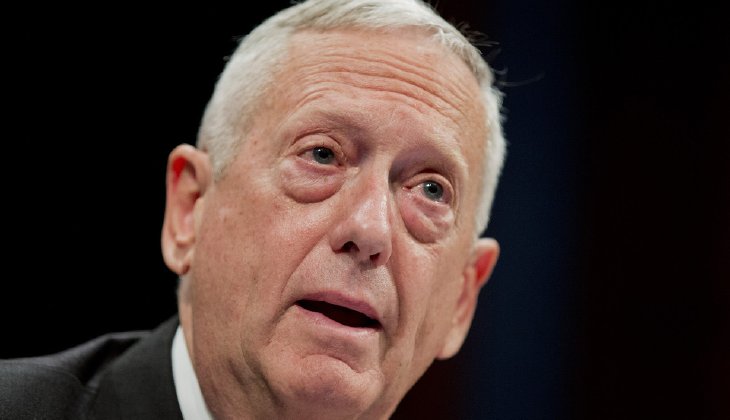
According to General Mattis, the Iranians are the greatest threat to stability and peace in the Middle East. The U.S., with its massive military and extensive weapons sales, only safeguards peace and stability.
Besides the disastrous U.S. invasion of Iraq in 2003, which accidentally helped Iran, the U.S. continues to sell massive amounts of weaponry to Iran’s rivals, most especially Saudi Arabia. U.S. military operations in Yemen, Syria, Iraq, and elsewhere in the Middle East have both destabilized the region and created marketplaces for U.S. weaponry and opportunities for economic exploitation by multinational corporations.
I’m no fan of Iran and its leaders, but can one blame them for resisting U.S. military and economic incursions into their sphere of influence? Recall how we reacted when the Russians put missiles into Cuba. Look at all the hostile rhetoric directed today against Mexico and its allegedly unfair trade practices vis-a-vis the U.S.
Let’s not forget that for 25 years (1953-78), the Shah of Iran was an American ally. The U.S. military loved to sell him our most advanced weaponry, which at that time included F-14 Tomcat fighters and HAWK missile systems. That cozy relationship died with the Iranian Revolution (1979); ally turned to enemy as the U.S. supported Saddam Hussein and Iraq during the bloody Iran-Iraq War of the 1980s.
Yet, despite all this history, despite all the U.S. meddling, all the weapons sales, all the invasions and sanctions, somehow it’s the Iranians who are the destabilizing force, the ones deserving of more “disruptive” U.S. military action.
As America’s designs are frustrated in the Middle East, American generals never look in the mirror to see their own faults and failings. Instead, they cast about for new countries to blame — and to attack. Iran is seemingly next on the list, a country that General Mattis, America’s Secretary of Defense, said is “the single most enduring threat to stability and peace in the Middle East.”
Anyone for war with Iran? U.S. generals are ready.
President Donald Trump is incurious, ignorant, and ill-informed. He hides this with rudeness, bluster, and lies. As an anonymous German Foreign Ministry official said during Chancellor Merkel’s visit, Trump “uses rudeness to compensate for his weakness.”
Trump couldn’t hold his own with a brilliant woman of substance like Angela Merkel, so he changed the narrative. He accused Germany of not paying up with NATO; he said Obama wiretapped Merkel, just like he tapped Trump tower; he whined about unfair trade with Germany. In public, Trump showed little substance and no sophistication.
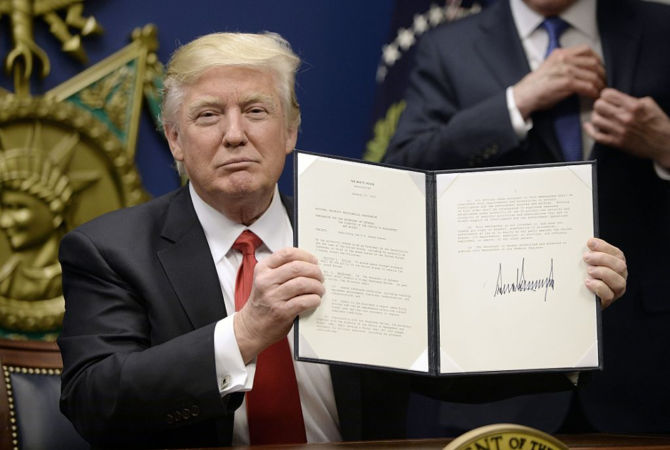
It’s not that Trump can’t learn; he doesn’t want to. He’s happy watching Fox News or movies like “Finding Dory,” golfing at his expensive resorts, signing executive orders and holding them aloft like a proud second-grader (Look Ma! I can sign my name!), and holding rabble-rousing rallies (“Lock her up!”) and basking in applause.
Trump operates in the shallows. His experience is in high-priced real-estate and media. He’s best at hyping a certain image of himself. He’s a bull-shitter, and he’s had lots of practice.
A big part of the presidency is ceremonial: the U.S. president is king and prime minister all in one. Trump is failing at both jobs. As a symbol of America, he’s boorish, boastful, and bullying. As a prime minister, he’s incurious, ignorant, and vain.
Five examples: Candidate Trump knew nothing about America’s nuclear triad. He didn’t know it consists of SLBMs (on Trident submarines), ICBMs (land-based), and “air-breathing” bombers. All he “knew” is that allegedly the U.S. nuclear arsenal is obsolete and inferior to the Russian arsenal. But actually the U.S. arsenal is more accurate, more survivable, and far superior to that of any other country, including Russia.
Second example. According to Trump, before he came along, nobody knew how complicated health care could be. We owe that stunning insight to Trump. Third example. According to Trump, Germany owes vast sums of money to the U.S. for defense costs, a false claim rejected by the Germans.
Fourth example: Based on a false Fox News report, Trump accused the previous president of committing a felony by tapping his phones during the campaign season, a charge for which there is no evidence whatsoever. Yet Trump refuses to rescind the charge, despite its repudiation by the FBI, NSA, British intelligence, and his own party.
Fifth example: Trump refuses to admit his Muslim ban is, well, a Muslim ban. Yet the ban refuses to target the one country that supplied 15 out of the 19 hijackers on 9/11: Saudi Arabia. Most experts agree that Trump’s ban is unconstitutional and counterproductive in the war on terror.
Being Trump means never having to say you’re sorry. In his unapologetic blustering, Trump echoes the foreign leader he seems to admire most: Vladimir Putin. In Putin’s Russia, with its history of Tsars and other strong leaders, uncompromising firmness and unyielding certitude are expected if not always applauded. In democratic America, an ability to compromise and a willingness to yield on matters of fact are generally seen as signs of adult leadership by statesmen who serve the people rather than themselves.
Trump’s behavior is better suited to that of Tsars and other anti-democratic strongmen. Trump the incurious has surrounded himself with loyalists, family members like his daughter Ivanka and her husband Jared Kushner, and commissars who watch over his cabinet appointees to ensure their loyalty. Pettiness, paranoia, and score-settling characterize the Executive branch.
Trump often harkens back to World War II and the likes of Generals Patton and MacArthur. How does he compare to the president back then? Franklin D. Roosevelt had a global view of the world while exhibiting a mastery of detail. (So too did Winston Churchill.) Self-confident, FDR looked for no-men, not yes-men. He and his administration took pains to be inclusive and bipartisan. And FDR, with help from Allies like Churchill and Stalin, won World War II.
By comparison, Trump has a parochial view of the world and can’t even master himself (witness those temper-driven tweets). He hires yes-men and demonizes Democrats and indeed anyone he sees as against him. Alienating allies like Britain, Australia, and Germany, Trump seems least critical of Russia.
Some leaders surprise: they grow in office. But Trump’s smugness, his unwillingness to admit when he’s wrong, his showboating to hide uncomfortable truths, are stunting him. Effective at selling himself and entertaining as a blowhard on (un)reality TV, Trump is failing as a statesman.
Rather than grow, it’s likely Trump will wither in office. The problem is he won’t be alone in his decline and fall.
Update: To state the obvious, Trumpcare is not a health care plan: it’s a massive tax cut for the rich combined with a cut in services for the working classes and poor. Under this “plan,” the CBO estimates that 14 million will initially lose coverage, rising by another 10 million in the next decade. How is this a health care plan? Add cynicism and broken promises to Trump’s qualities.
Update (3/25): As Heather Digby Parton puts it, Trump “truly believes that he’s never ever been wrong about anything and when he lies he’s actually telling the future. He said it over and over again in that astonishing interview [for Time Magazine].”
Matt Taibbi, in his inimitable style, captured Trump during the election season: “On the primary trail we had never seen anything like him: impulsive, lewd, grandiose, disgusting, horrible, narcissistic and dangerous, but also usually unscripted and 10 seconds ahead of the news cycle … maybe he was on the level, birthing a weird new rightist/populist movement, a cross of Huey Long, Pinochet and David Hasselhoff. He was probably a monster, but whatever he was, he was original.” (Insane Clown President, pg. 221)
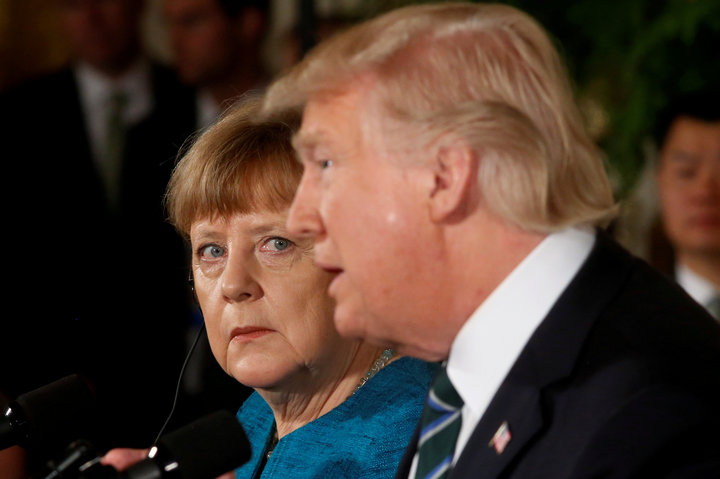
Yesterday’s Trump-Merkel Press Conference was disturbing on several levels. Worst of all was the scene of a German Chancellor listening to an American president boast about how strong his military is, and how much stronger it soon will be. Not that long ago in historical terms, Germany was a country that stressed military dominance. Two lost world wars cured Germany of its militarism. American militarism has taken its place.
As Trump responded to questions, again and again he returned to the U.S. military, vowing that he’s going to strengthen it from its “depleted” condition, perhaps to a level of power that “we’ve never seen before.”
America as a country is “very strong, very strong,” said Trump, a “very powerful company/country,” and soon the U.S. military would be “stronger,” and “perhaps far stronger than ever before.” Naturally, the president added that he hoped he wouldn’t have to use that “far stronger” military, even as the U.S. military garrisons the globe at more than 700 bases while launching ongoing attacks against “radical Islamic terrorism” (Trump loves enunciating those three words) in places like Yemen.
She’s right to be worried …
This coming year, Trump is enlarging the military with a fresh influx of $54 billion. “My generals,” as Trump likes to refer to James Mattis and John Kelly and Company, support him in part because he’s boosting military spending. But will they continue to support Trump and his advisers like Steve Bannon when the President uses that “much stronger” military in unwise ways?
When you forge a bigger hammer, you tend not to leave it unused in the tool shed. No — you look for bigger nails to strike. As Trump noted at the press conference, he’s not an isolationist. “Fake news,” he said.
That Trump, with his “far stronger” military, is not an isolationist is disturbing “real” news indeed. Small wonder that the German Chancellor looked discomfited; her country has seen it all before.
What price military dominance? Perhaps Chancellor Merkel could explain that to President Trump, if only he’d listen.
Last week, I wrote an article for TomDispatch.com on the Afghan war. You can read the entire article here, but I wanted to share some excerpts and some afterthoughts.
Some Excerpts
America’s war in Afghanistan is now in its 16th year, the longest foreign war in our history. The phrase “no end in sight” barely covers the situation. Prospects of victory — if victory is defined as eliminating that country as a haven for Islamist terrorists while creating a representative government in Kabul — are arguably more tenuous today than at any point since the U.S. military invaded in 2001 and routed the Taliban. Such “progress” has, over the years, invariably proven “fragile” and “reversible,” to use the weasel words of General David Petraeus who oversaw the Afghan “surge” of 2010-2011 under President Obama. To cite just one recent data point: the Taliban now controls 15% more territory than it did in 2015…
Afghanistan, U.S. military theorists claim, is a different kind of war, a fourth-generation war fought in a “gray zone”; a mish-mash, that is, of low-intensity and asymmetric conflicts, involving non-state actors, worsened by the meddling of foreign powers like Pakistan, Iran, and Russia — all mentioned in General Nicholson’s [recent] testimony [before the Senate Armed Services Committee]. (It goes without saying that the U.S. doesn’t see its military presence there as foreign.) A skeptic might be excused for concluding that, to the U.S. military, fourth-generation warfare really means a conflict that will last four generations…
Asked by Senator Lindsey Graham whether he could do the job in Afghanistan with 50,000 troops, which would quadruple coalition forces there, [General] Nicholson answered with a “yes”; when asked about 30,000 U.S. and other NATO troops, he was less sure. With that 50,000 number now out there in Washington, does anyone doubt that Nicholson or his successor(s) will sooner or later press the president to launch the next Afghan surge? How else to counter all those terrorist strands in that petri dish? (This, of course, represents déjà vu all over again, given the Obama surge [in 2009-10] that added 30,000 troops to 70,000 already in Afghanistan and yet failed to yield sustainable results.)
That a few thousand [additional] troops [requested by General Nicholson, the overall commander in Afghanistan] could somehow reverse the present situation and ensure progress toward victory is obviously a fantasy of the first order, one that barely papers over the reality of these last years: that Washington has been losing the war in Afghanistan and will continue to do so, no matter how it fiddles with troop levels.
Whether Soviet or American, whether touting communism or democracy, outside troops to Afghan eyes are certainly just that: outsiders, foreigners. They represent an invasive presence. For many Afghans, the “terrorist strands” in the petri dish [a metaphor General Nicholson used to describe the AfPak theater] are not only the Taliban or other Islamist sects; they are us. We are among those who must be avoided or placated in the struggle to stay alive — along with government forces, seen by some Afghans as collaborators to the occupiers (that’s us again). In short, we and our putative Afghan allies are in that same petri dish, thrashing about and causing harm, driving the very convergence of terrorist forces we say we are seeking to avoid.
In sum, I argued that the biggest foe the U.S. faces in Afghanistan is our own self-deception. Rarely do we see ourselves as foreigners, and rarely do we perceive how pushy we are, even as we remain stubbornly ignorant or highly myopic when it comes to Afghan culture and priorities.
After I wrote my article for TomDispatch, I jotted down the following, somewhat disorganized, thoughts about ourselves and our wars.
Some Afterthoughts
There’s a form of war fatigue, a lack of interest, in the U.S. We treat our wars as if they’re happening off stage, or even in another universe. And I suppose for most Americans this is indeed the case. The wars matter little to us. Why? Because they are largely invisible and without effect (until blowback).
There’s no narrative thread to our wars (Afghan/Iraq), unless it’s “déjà vu all over again.” Lines don’t move on maps. Enemies aren’t truly defeated. Meanwhile, a war on terror is a contradiction in terms, because war is terror. So you have “terror on terror,” which can only propagate more war. And with President Trump throwing more money at the Pentagon, and hiring more generals and bellicose civilians, the dynamic created is as predictable as it is unstoppable: more and more war.
Trump seems to think that expanding the military will make us so strong that no one will dare attack us. But that just raises the stakes for the underdogs. More than ever, they’ll want to humble Goliath.
Here’s the thing. I’m not an expert on Afghanistan. I’ve never been there. I’ve talked to soldiers and others who’ve been there, I’ve read lots of articles and books, but Afghanistan remains an intellectual/historical construct to me. My own conceit that I can write about it with authority is my country’s conceit. Afghanistan would be better without my advice, and without our country’s military intervention.
What I do know is my own country and my own military. I know our forms of deception, our apologetics, our ways of thinking reductively about other peoples as problems to be solved with a judicious application of money or “surgical” military power.
As I write about Afghanistan, I’m really writing about my country and how it views Afghanistan. We Americans see Afghanistan through a glass darkly; even worse, U.S. generals see it through a glass bloody — forever bloodstained and blackened by war.
America’s wars overseas are solipsistic wars. When we do think about them, they’re all about us. They’re not about Afghans or Iraqis or whomever. They are mirrors in which we see favorable reflections of ourselves, flat surfaces that flatter us. We prefer that to portals or revolving doors that we (and especially they) could walk through, that would expose us to hazards as well as to harsh truths.
Concluding Thought
Afghanistan is not a war for us to win, nor is it a country for us to make in our image. It’s a very different culture, a very different world, one that will resist American (and other foreign) efforts to remake it, as it has for centuries and centuries.
Isn’t it time to let Afghanistan be Afghanistan? To let its peoples find their own path?
Steve Bannon, self-professed student of the Art of War (Getty Images)
W.J. Astore
A favorite book of Steve Bannon’s is Sun Tzu’s The Art of War. A classic of military strategy, The Art of War was compiled during the Warring States period (403-221 BCE) in ancient Chinese history. It was a time of intense civil warfare in China, a time when a cessation in fighting was merely a pause between the next round of battles among warlords. It’s still widely read today for its insights into war, its clever stratagems and tactics, and its lessons into human nature and behavior.
Bannon, who served in the U.S. Navy, is an armchair strategist with an affinity for military history books. He appears to believe in inevitable conflict between the Judeo-Christian West, which he favors due to its “enlightened” values, and the World of Islam, which he sees as retrograde and barbaric when compared to the West. He sees the world as already being in a “warring states” period writ large, a realm of conflict marked by “holy war” to be mastered by warrior/scholars like himself.
Joining him in this belief is Donald Trump, who took great pains to recite the phrase “radical Islamic terrorism” in his speech before Congress, as if using these words were a mark of personal courage on his part. Trump has boasted about winning the “next” war, as if war during his presidency is inevitable. And I suppose it is, with Trump at the helm and advisers like Bannon, Sebastian Gorka, and Stephen Miller pursuing a bellicose hardline against Islam.
Be careful what you wish for, Trump and cronies, and be especially careful about declaring victory in wars before you’ve even fought them. Here Sun Tzu has much to teach our “warriors” in the White House.
For one thing, Sun Tzu writes that a battle is best won without fighting at all. Said Sun Tzu: “Fighting and winning a hundred wars is not the greatest good. Winning without having to fight is.” In other words, you set the stage so carefully that the enemy must surrender or face obliteration before the curtain is even raised on war.
Secondly, Sun Tzu warns about the folly of protracted wars, how they deplete the national budget and weaken a state, especially when support among the people is tepid. Warfare, notes Sun Tzu, must be treated with the greatest caution, even as it is waged with great cunning. Best of all is to outsmart the enemy; next best is to form alliances, to build a much bigger army than the enemy, which may force them to capitulate. Worst of all is to get bogged down in long wars, especially in cities, which require expensive sieges that wear on both sides (just ask the Germans at Stalingrad about this).
Ultimately, Sun Tzu writes that by understanding oneself and one’s enemy, a skilled leader can engage in a hundred battles without ever being in serious danger. But an unskilled leader who does not truly know his own nature or that of his enemies is one who is fated always to lose. Trump, who fancies himself a great leader and who is ignorant of foreign nations and peoples, does not inspire confidence here, even as he promises the American people that we’re going to win so much, we’ll get bored with winning.
Sun Tzu puts great emphasis on careful planning and sober deliberation before launching attacks. If the recent Yemen raid is any indicator, Trump is neither a careful planner nor a sober deliberator. Indeed, Trump’s personal qualities expose him to being manipulated by a cunning enemy. In listing the personal traits that are dangerous in a commander, Sun Tzu mentions “quick to anger” as well as “self-consciousness” or vanity. One who’s quick to anger can be goaded by insults into making poor decisions; one who’s vain and self-conscious can be humiliated or manipulated into rash action.
Trump promises an American military that is so big and so strong that no country will dare attack us. Yet Trump himself, surrounded by his “warrior” advisers, isn’t content to build a huge military while not using it. Indeed, Trump is already using it, notably in Yemen, pursuing policies that are fated to perpetuate warfare around the globe. And it’s hardly encouraging that, after the failed Yemen raid, Trump shifted the blame to his generals rather than taking it himself.
Remember what Sun Tzu warned about vanity as well as perpetual warfare, especially when your own people are increasingly divided? Something tells me this lesson is lost on Trump, Bannon, and crew. Embracing the stratagems of The Art of War, its emphasis on surprise, subterfuge, deception, and quick strikes, is not enough. You must seek the wisdom at its core, which is very much against war except as a last resort.
Know thyself, said Sun Tzu, echoing the Greek philosopher Socrates. Face yourself squarely, recognize your flaws, your vanity (“All is vanity,” say the Christian Bible, a book Trump professes to treasure), and be careful indeed in unleashing war.
Do Trump, Bannon, and company know themselves, admit to their flaws and vanities, and recognize that war, in all its perils and costs, should be a course of last resort? So far, evidence is wanting.
Update (8/12/17): Bannon has said his concern about a civilizational conflict with Islam dates from his time in the Navy and a visit to Pakistan. Apparently, however, his ship visited Hong Kong rather than Pakistan. Bannon also recalls specific details of Iran — its resemblance to a “primeval” wasteland — that he apparently was not privy to. All this is revealed in an article at The Intercept. Either Bannon’s memory is faulty or he is an esteemed member of the “alternative fact” club, where you just make things up to fit your preconceived notions.
As Peter Maass at The Intercept notes: “It turns out that Bannon, who has drawn a large amount of criticism for his exclusionary stances on race, religion, and immigration, has also inaccurately described his military service, simultaneously creating an erroneous narrative of how he came to an incendiary anti-Muslim worldview that helps shape White House policy.”







 Bracing Views