America’s Disastrous 60-Year War

W.J. Astore

In my latest for TomDispatch.com, I tackle America’s disastrous 60-year war (1961-2021), which began with Ike’s warning of the pernicious threat to democracy of the military-industrial complex and ended with last year’s humiliating retreat from Afghanistan. Has America learned anything? Based on recent events with Russia and Ukraine, together with bellicose acts toward China, it doesn’t seem so.

Here’s an excerpt from my article; you can read it in its entirety at TomDispatch.com.

Three Generations of Conspicuous Destruction by the Military-Industrial Complex

BY WILLIAM ASTORE

In my lifetime of nearly 60 years, America has waged five major wars, winning one decisively, then throwing that victory away, while losing the other four disastrously. Vietnam, Afghanistan, and Iraq, as well as the Global War on Terror, were the losses, of course; the Cold War being the solitary win that must now be counted as a loss because its promise was so quickly discarded.

America’s war in Vietnam was waged during the Cold War in the context of what was then known as the domino theory and the idea of “containing” communism. Iraq and Afghanistan were part of the Global War on Terror, a post-Cold War event in which “radical Islamic terrorism” became the substitute for communism. Even so, those wars should be treated as a single strand of history, a 60-year war, if you will, for one reason alone: the explanatory power of such a concept.

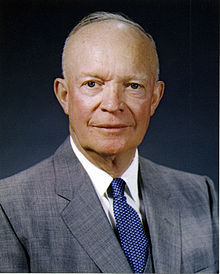
For me, because of President Dwight D. Eisenhower’s farewell address to the nation in January 1961, that year is the obvious starting point for what retired Army colonel and historian Andrew Bacevich recently termed America’s Very Long War (VLW). In that televised speech, Ike warned of the emergence of a military-industrial complex of immense strength that could someday threaten American democracy itself. I’ve chosen 2021 as the VLW’s terminus point because of the disastrous end of this country’s Afghan War, which even in its last years cost $45 billion annually to prosecute, and because of one curious reality that goes with it. In the wake of the crashing and burning of that 20-year war effort, the Pentagon budget leaped even higher with the support of almost every congressional representative of both parties as Washington’s armed attention turned to China and Russia.

At the end of two decades of globally disastrous war-making, that funding increase should tell us just how right Eisenhower was about the perils of the military-industrial complex. By failing to heed him all these years, democracy may indeed be in the process of meeting its demise.

The Prosperity of Losing Wars

Several things define America’s disastrous 60-year war. These would include profligacy and ferocity in the use of weaponry against peoples who could not respond in kind; enormous profiteering by the military-industrial complex; incessant lying by the U.S. government (the evidence in the Pentagon Papers for Vietnam, the missing WMDfor the invasion of Iraq, and the recent Afghan War papers); accountability-free defeats, with prominent government or military officials essentially never held responsible; and the consistent practice of a militarized Keynesianism that provided jobs and wealth to a relative few at the expense of a great many. In sum, America’s 60-year war has featured conspicuous destruction globally, even as wartime production in the U.S. failed to better the lives of the working and middle classes as a whole.

Let’s take a closer look. Militarily speaking, throwing almost everything the U.S. military had (nuclear arms excepted) at opponents who had next to nothing should be considered the defining feature of the VLW. During those six decades of war-making, the U.S. military raged with white hot anger against enemies who refused to submit to its ever more powerful, technologically advanced, and destructive toys.

Please read the rest of my article here.

Many Decades of the Condor

W.J. Astore

I recently rewatched “Three Days of the Condor” (1975) featuring Robert Redford and Faye Dunaway. It’s a smart and understated spy thriller that takes on the Central Intelligence Agency (CIA) and the deadly games the agency plays in its pursuit of global dominance. In the aftermath of the Vietnam War and the backlash from Richard Nixon and Watergate, not to mention America’s role in overthrowing the Allende government in Chile in 1973, it became acceptable in Hollywood to make films that portrayed the U.S. government as sometimes less than noble in all its pursuits. Condor, the codename for Redford’s character, stumbles across a plot within the CIA to overthrow governments in the Middle East so that U.S. corporations could dominate the oil market, and for that he and his colleagues in the special branch where he works must die. The movie follows his efforts to stay alive among people who will execute their own for the greater good of The Company (the CIA).

At the end (spoiler alert), Redford goes to the New York Times as a whistleblower in an effort both to stay alive and to reveal the nefarious machinations of the CIA. A CIA senior official, played by Cliff Robertson, confronts Redford and asks him a question that is deadly in its implications: Will they print it? Redford is confident the newspaper will, but Robertson, in asking Redford how he can be sure that they will, reminds us that there’s no certainty the “liberal” New York Times will go against the wishes of the CIA.

Robert Redford and Cliff Robertson in “Three Days of the Condor”

This was on my mind today as news broke once again that the CIA is collecting “bulk data” on Americans without Congressional authorization and outside of normal oversight. Well, as some of my students used to say, if you’ve done nothing wrong, you have nothing to fear from the diligent and honest agents of the CIA, right?

There’s a little scene in the movie where Condor laughs at the conceit of the CIA in referring to themselves as the intelligence “community.” A community of powerful and ultra-secretive intelligence agencies — I’m sure we have nothing to fear from such an Orwellian concoction.

Anyway, if you haven’t seen “Three Days of the Condor,” I recommend it. As a bonus, it has one of the most powerful yet understated romantic relationships caught on film, with Redford and Dunaway both superb in portraying two people on the edge who are desperately looking for connection.

A Few Thoughts About NATO and Russia

W.J. Astore

NATO, the North Atlantic Treaty Organization, dates from 1949. From its very name, the alliance focused on North Atlantic countries and Western Europe, and stated its intent was to deter the Soviet Union from attacking European countries like Germany, France, and Italy.

Interestingly, Dwight D. Eisenhower was NATO’s first SACEUR, or Supreme Allied Commander in Europe, and he favored the complete withdrawal of U.S. troops when Europeans were back on their feet from World War II and capable of defending themselves. Since U.S. troops are still stationed in Europe nearly 75 years after the founding of NATO, one must assume Europe is still not ready.

All kidding aside, getting the U.S. to commit troops to NATO was in part a European ploy against a repeat of American isolationism, which had manifested itself in the aftermath of World War I. There was indeed a time when Americans wanted nothing to do with European intrigue and folly, and in the 1930s the U.S. Senate even attacked European arms manufacturers as warmongering “merchants of death.” Imagine that!

Nowadays, of course, it’s the USA that dominates the world’s arms market, and our merchants of death truly dominate the world. Our weapons merchants now deliver weapons to places like Ukraine in the name of “freedom” and “protecting democracy,” though I have yet to see a freedom or democracy bomb. (Interestingly, the names we choose for weapons systems are far more honest, like Hellfire missiles and Predator and Reaper drones. Talk about peddling death!)

When the Soviet Union collapsed in 1991, NATO’s reason for being collapsed along with it, but reason not the need, as King Lear said. NATO was not about to disband itself; lucrative and powerful bureaucracies rarely do. So NATO’s mission began to change to “out of area” operations, working in concert with the UN in places like Bosnia and Kosovo. Speaking of “out of area,” NATO countries also got involved in the War on Terror, including U.S. folly in Afghanistan, which provided political cover for the U.S. in the sense that American officials could claim to be working as part of a coalition to help the Afghan people.

But the biggest money maker of all for NATO and for today’s merchants of death has been expansion. Recall that the Soviet Union collapsed in 1991. Recall that NATO was created to deter a Soviet attack on Western Europe. If NATO was going to continue to exist, it needed to morph into something else, but most of all it needed to grow. And so it did.

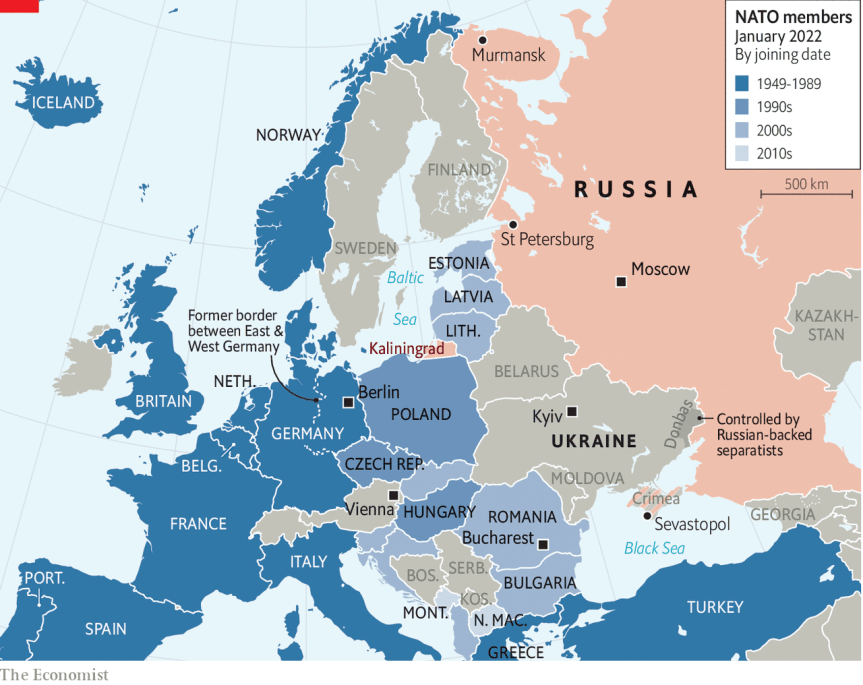
In 1999, former Warsaw Pact countries like Poland, Hungary, and the Czech Republic joined. Five years later, Bulgaria, Romania, Slovakia, Slovenia, and the three Baltic States (Latvia, Lithuania, and Estonia) joined as well. In short, what began as a defensive alliance focused on Western Europe has grown into an alliance that includes just about all of Eastern Europe. And the new NATO members have been eager customers for NATO-compatible weaponry, much of it made in the USA.

The caption from the Economist suggested this map showed how Russia was menacing Ukraine! And that NATO was unlikely to retreat

If I were Russian, I think I’d look at the dramatic eastern expansion of NATO as worrisome. If not aggressive, it is most certainly constrictive. And with former Soviet republics like Georgia and Ukraine mentioned as future NATO members, this constriction would seem more like strangulation if I occupied the Kremlin. And I’m not an ex-KGB agent like Vladimir Putin.

I remember a military history symposium in 1998 I attended in which the future of NATO was bandied about. Russian concerns about NATO expansion were discussed by four senior generals. One of them, General Sir Anthony Farrar-Hockley, basically argued that NATO should tell the Russians to go pound sand. In the notes I took from the discussion, Farrar-Hockley said that to forego NATO expansion because of Russian concerns would be to grant Russia a continuing fiefdom in Eastern Europe. Besides, Russia had nothing to fear from an expanded NATO, he added. The three other generals expressed some concern that Russia could see expansion as encirclement, and given Russia’s history of being invaded and devastated by countries to its west, any expansion would have to be done carefully, with plenty of dialogue.

We’re not witnessing much dialogue, are we? Instead, NATO expansion is seen by the U.S. as uncontroversial, and indeed as desirable, and certainly as non-threatening. Surely the Russians have nothing to fear from such a vast alliance creeping up to its very door step! It’s not like Russia wasn’t devastated by Napoleon in 1812, or by Germany and its various allies in World Wars I and II. I’m sure that will never happen again. Right, comrade?

Here’s an idea. Perhaps NATO expansion would be less problematic for the Russians if the U.S. withdrew all its troops from Europe, harkening back to Eisenhower’s initial vision. Shouldn’t European countries be able to defend themselves after almost 75 years of U.S. aid? Maybe Donald Trump wasn’t so crazy after all in asking whether NATO was really worth the candle.

When In Doubt, Send Troops

W.J. Astore

On that proverbial table in Washington D.C. where all options are allegedly kept, the one option that’s always used is military escalation. First, the U.S. sent more weaponry to Ukraine. Now, America’s commander-in-chief is sending more troops, according to this news update today from the Boston Globe:

President Biden is sending about 2,000 troops from Fort Bragg, North Carolina, to Poland and Germany this week and sending part of an infantry Stryker squadron of roughly 1,000 troops based in Germany to Romania, a senior administration official said Wednesday.

The military moves come amid stalled talks with Russia over its military buildup at Ukraine’s borders. And they underscore growing fears across Europe that Russian President Vladimir Putin is poised to invade Ukraine — and smaller NATO countries on the eastern flank worry they could be next.

Has Russia given any sign of invading “smaller NATO countries on the eastern flank”? No matter. The solution is obviously to send small contingents of U.S. troops as a sign of resolve. A couple thousand troops split between Poland and Romania will show Vladimir Putin that America means business. (War business, that is.)

Such small troop contingents have negligible military value, so their real significance is in domestic politics. Biden, a typical Democratic president, is forever on guard against accusations of “weakness” vis-a-vis Russia or China or Iran or you-name-it. To minimize such accusations, while keeping the military-industrial complex happy, the go-to option on the table is to send in the weapons and the troops. Who cares about the risk of military escalation and a wider war between major nuclear powers?

One could imagine a different president, a savvier one, winning major international points by offering to defuse tensions between Ukraine and Russia through negotiation. But that option, farfetched as it would be, is never on that table of options kept in Washington. And why Russia would trust the U.S. is beyond me.

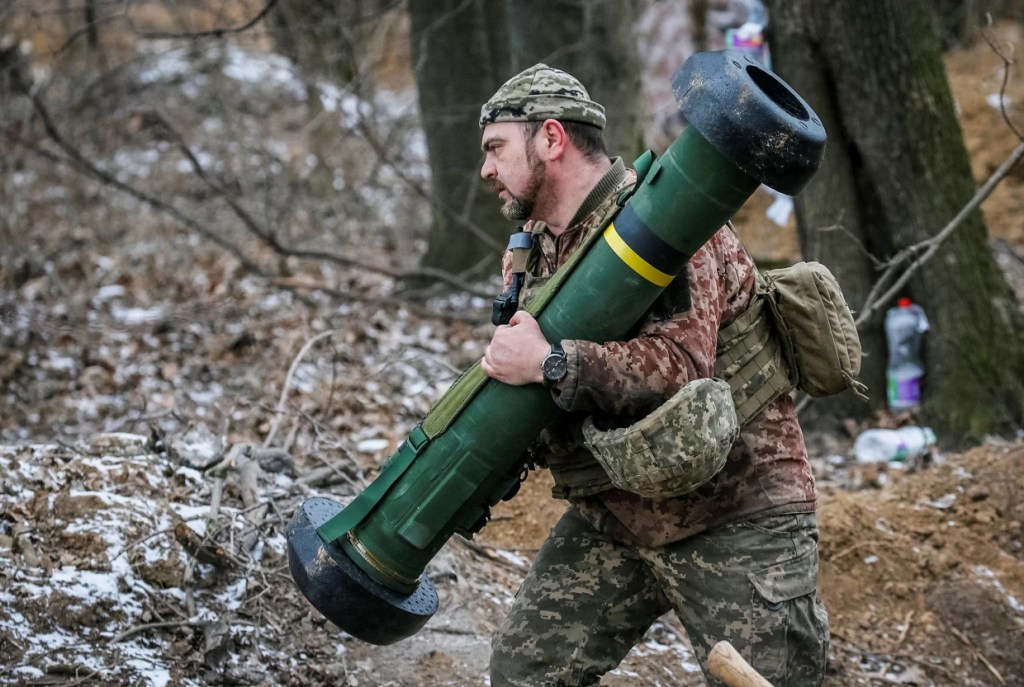
Kyiv (Kiev) in Ukraine is roughly 5500 miles from me by airplane. That’s a very long way indeed from what I consider to be my “eastern flank.” Maybe America should practice a new foreign policy in which we learn to mind our own business, or, if you prefer, stay in our own backyard?

A Ukrainian soldier. One imagines he’s hoping for a peaceful solution. But this is not what I think of as America’s (or NATO’s) eastern flank

Why It’s So Hard to Give Peace A Chance in America

W.J. Astore

It sure is hard to give peace a chance in America, as recent events with Russia and Ukraine show. The Washington consensus is all about weapons and more weapons, of economic sanctions, i.e. economic warfare, of not being seen as a pitiful helpless giant, as Richard Nixon once said during the Vietnam War. America can never stand on the sidelines, even when its national security interests aren’t even threatened. Something must be done, something forceful, something involving troops and weapons and ultimatums that could very well escalate into disaster.

Revealingly, Washington insiders always talk of “all options” being on a metaphorical table, meaning the most violent ones, including war, for the president to choose from. They lie. Because the one option that’s never on that imaginary table is peace.

Peacemakers might be the children of God, but perhaps America is more godless than it knows. Or maybe it just worships the god of war, a Pentagod. It’s discouraging to face the obstacles to peace in America, because these obstacles are not going to be removed just by singing songs and writing articles or even by protesting. What is truly needed is a mass movement against war, as we saw during the Vietnam War years, but even that mass movement took years to have an impact. And it was motivated as well by resistance to the draft, which no longer exists.

A short list of the obstacles to peace is sobering indeed:

  • The power of the military-industrial-congressional complex. It doesn’t want to get smaller or less powerful. It thrives off weaponry and wars. It has no interest in peace.
  • The mainstream media. It’s owned by major corporations and advances corporate agendas. It smears antiwar voices as naive (at best) and often as traitorous and/or weak. Antiwar voices simply aren’t heard on the MSM. Instead, retired colonels and generals, as well as senior ex-CIA officials, are put forward as unbiased voices of reason as they promote the most hawkish lines.
  • The absence of a draft. Let’s face it: the youth of America are much more likely to resist war if they have to risk their lives. But America has an “all volunteer force,” and if these volunteers are sent off to war, that’s what they signed up for. Right?
  • American culture in general is suffused with violence and misinformed about the world, especially America’s imperial role in it. Myths about American exceptionalism and beliefs about the troops as freedom-fighters serve to inhibit antiwar criticism and protests.
  • The difficulty of launching any kind of sustained protest nowadays. Ready to gather in the streets to march against war? Sorry, do you have a permit? Covid restrictions may prevent you from gathering. And maybe we’ll move you to a special “free speech” zone, which I assure you will be far away from media cameras. What good is protesting if you gain no traction because few people see you and the media ignores you?

Don’t get me wrong. I’m not saying it’s impossible to give peace a chance. Just that it’s very difficult, given the power structures of our society and our collective national ethos. It’s mind-boggling that America has so many agencies for “defense” and “intelligence.” We have the Pentagon, the Department of Homeland Security (a domestic mini-Pentagon), something like 17 intelligence agencies like the CIA and NSA, the list goes on. State and local police forces are now heavily militarized and generally unsympathetic to your right to assemble and to protest vigorously. Get a job, commie peacenik!

Meanwhile, society’s heroes are U.S. military troops, or the “thin blue line” of police that “protect and serve.” Those who are committed to peace are generally not viewed as heroes, at least not by society at large. Again, Christ may have seen peacemakers as God’s children, but in the U.S. there’s a preference (judging by gun sales) for Colt Peacemakers.

How to overcome these obstacles to truly give peace a chance is perhaps the most pressing issue of our age, given the risk of war going nuclear and ending most life on our planet. Readers, I don’t have easy answers, but I’d begin with Ike’s warning about the military-industrial complex in 1961, JFK’s peace speech in 1963, MLK’s speech against the Vietnam War on April 4th, 1967, perhaps even John Lennon’s song “Imagine.”

How do we imagine — and then create — a new reality that favors peace instead of war? How do we pursue a just and lasting peace with ourselves and with all nations that Abraham Lincoln spoke of near the end of the U.S. Civil War?

The words are there. The vision is there. Tapping the nobility of Lincoln, Ike, JFK, and MLK and their antiwar messages is possible. Isn’t it?

As JFK said in his “peace speech,” to believe that war is inevitable is a “dangerous defeatist belief.” I’m with JFK.

The antiwar movement helped to stop the disastrous Vietnam War, but it sure wasn’t easy

Russia, Ukraine, and the USA

W.J. Astore

The situation along the border of Russia and Ukraine is volatile. War is possible. Given this volatility and the possibility of war, does it make any sense to send more weaponry to Ukraine?

From this CNN report, that is exactly what the USA is doing: sending more arms and ammunition to Ukraine:

“The second bird in Kyiv! More than 80 tons of weapons to strengthen Ukraine’s defense capabilities from our friends in the USA! And this is not the end,” Ukrainian Defense Minister Oleksii Reznikov said in a tweet Sunday. The first shipment of security assistance from the US had arrived in Ukraine on Friday. That shipment included “close to 200,000 pounds of lethal aid, including ammunition for the front line defenders of Ukraine,” the US Embassy in Kyiv tweeted Friday night. The shipments come as the US has sought to convince Moscow to de-escalate the situation at the Ukrainian border, where Russia has amassed more than 100,000 troops. Earlier Sunday, Secretary of State Antony Blinken amplified his warning against a Russian invasion of Ukraine, saying “a single additional Russian force” entering Ukraine “in an aggressive way” would result in a severe response by the US and its allies. “If a single additional Russian force goes into Ukraine in an aggressive way, as I said, that would trigger a swift, a severe and a united response from us and from Europe,” Blinken told CNN’s Dana Bash on “State of the Union.”

Let me get this straight: weapons and ammo are “security assistance,” or “lethal aid,” a construction that should win a prize for best oxymoron of the year. Hi! I’m here to help you. How about some “lethal” aid? Meanwhile, even as the US escalates the situation with “lethal aid” and threats, the US State Department insists it’s the Russians who need to “de-escalate the situation.” No contradiction here, right?

Consider here the words of Antony Blinken, he of the “swift” and “severe” and “united” response if only a “single” Russian force should enter Ukraine “in an aggressive way.” This naked bombast directly contradicts President Joe Biden’s words at last week’s press conference. Biden, who occasionally has “senior moments” of inadvertent truth, explained that NATO wasn’t united and that a minor incursion by Russian forces probably wouldn’t trigger a swift and severe response. It’s reassuring to know we have such skilled and consistent leaders as Biden and Blinken in charge here.

US meddling in Ukraine is complex, but let’s just say America’s leaders are part of the problem, not the solution. As usual, the US response to almost any situation is to send troops and weapons while telling the other side to “de-escalate.”

Worst of all, though, from an American perspective, is the lack of skilled and smart leadership in the White House. Biden appears confused and his vice president is hapless. Blinken is a neo-con tool who won’t be confused with Bismarck, let alone Henry Kissinger. He thinks American diplomacy is most effective when it’s backed by brazen military threats. No speaking softly with a big stick held prudently in reserve; Blinken prefers to shout loudly while openly brandishing the big stick of the US military.

It doesn’t bode well, does it?

Kamala Harris and Joe Biden with Antony Blinken on the far right. Not exactly the A-Team.

Stop the MADness

W.J. Astore

Mutually Assured Destruction (MAD) is making a comeback as the Pentagon hypes a new Cold War with China and Russia. Threat inflation is a big part of this “new” war, just as it was in the old one. So too is greed. There’s much money to be made (a trillion or more dollars, perhaps) in building new nuclear missiles and bombers, even though these weapons represent incipient holocausts.

We need to stop this MADness. There is no need for a new Cold War, and there is no need for new nuclear weapons, weapons that could very well destroy human civilization and most of life on our planet.

This is the subject of my latest article at TomDispatch.com. What follows is an excerpt. I encourage you to read the article in its entirety here.

Stop the MADness. Seriously.

Only Fools Replay Doomsday

In the early 1960s, at the height of America’s original Cold War with the Soviet Union, my old service branch, the Air Force, sought to build 10,000 land-based nuclear missiles. These were intended to augment the hundreds of nuclear bombers it already had, like the B-52s featured so memorably in the movie Dr. Strangelove. Predictably, massive future overkill was justified in the name of “deterrence,” though the nuclear war plan in force back then was more about obliteration. It featured a devastating attack on the Soviet Union and communist China that would kill an estimated 600 million people in six months (the equivalent of 100 Holocausts, notes Daniel Ellsberg in his book, The Doomsday Machine). Slightly saner heads finally prevailed — in the sense that the Air Force eventually got “only” 1,000 of those Minuteman nuclear missiles.

Despite the strategic arms limitation talks between the U.S. and the Soviet Union, the dire threat of nuclear Armageddon persisted, reaching a fresh peak in the 1980s during Ronald Reagan’s presidency. At the time, he memorably declared the Soviet Union to be an “evil empire,” while nuclear-capable Pershing II and ground-launched cruise missiles were rushed to Europe. At that same moment, more than a few Europeans, joined by some Americans, took to the streets, calling for a nuclear freeze— an end to new nuclear weapons and the destabilizing deployment of the ones that already existed. If only…

It was in this heady environment that, in uniform, I found myself working in the ultimate nuclear redoubt of the Cold War. I was under 2,000 feet of solid granite in a North American Aerospace Defense (NORAD) command post built into Cheyenne Mountain at the southern end of the Colorado front range that includes Pikes Peak. When off-duty, I used to hike up a trail that put me roughly level with the top of Cheyenne Mountain. There, I saw it from a fresh perspective, with all its antennas blinking, ready to receive and relay warnings and commands that could have ended in my annihilation in a Soviet first strike or retaliatory counterstrike.

Yet, to be honest, I didn’t give much thought to the possibility of Armageddon. As a young Air Force lieutenant, I was caught up in the minuscule role I was playing in an unimaginably powerful military machine. And as a hiker out of uniform, I would always do my best to enjoy the bracing air, the bright sunshine, and the deep blue skies as I climbed near the timberline in those Colorado mountains. Surrounded by such natural grandeur, I chose not to give more than a moment’s thought to the nightmarish idea that I might be standing at ground zero of the opening act of World War III.  Because there was one thing I knew with certainty: if the next war went nuclear, whether I was on-duty under the mountain or off-duty hiking nearby, I was certainly going to be dead.

Then came 1991 and the collapse of the Soviet Union. The Cold War was over! America had won! Rather than nightmares of the Red Storm Rising sort that novelist Tom Clancy had imagined or Hollywood’s Red Dawn in which there was an actual communist invasion of this country, we could now dream of “peace dividends,” of America becoming a normal country in normal times.

It was, as the phrase went, “morning again in America” — or, at least, it could have been. Yet here I sit, 30 years later, at sea level rather than near the timberline, stunned by the resurgence of a twenty-first-century version of anticommunist hysteria and at the idea of a new cold war with Russia, the rump version of the Soviet Union of my younger days, joined by an emerging China, both still ostensibly conspiring to endanger our national security, or so experts in and out of the Pentagon tell us.

Excuse me while my youthful 28-year-old self asks my cranky 58-year-old self a few questions: What the hell happened? Dammit, we won the Cold War three decades ago. Decisively so! How, then, could we have allowed a new one to emerge? Why would any sane nation want to refight a war that it had already won at enormous cost? Who in their right mind would want to hit the “replay” button on such a costly, potentially cataclysmic strategic paradigm as deterrence through MAD, or mutually assured destruction?

Please read the rest of my article here.

The Prince of Peace

W.J. Astore

As Christmas approaches, peace is on my mind. Christ, after all, was known as the Prince of Peace. I say “was” because we hear so infrequently of peace in the United States today. In fact, peace in the U.S. seems to be contingent on enormous military budgets dedicated to weapons and warfare. It reminds me of Strategic Air Command (SAC) in the Air Force, which was prepared utterly to destroy the Soviet Union and China in the 1960s but whose motto was “peace is our profession.” Paraphrasing Tacitus, one might say that SAC was prepared to make the world an irradiated hellscape and call it “peace.”

If Christmas is to have any religious meaning, one would think it would be centered on the arrival of the Prince of Peace in the world. As a Catholic, I can’t count the number of times I recited the prayer that begins, Glory to God in the highest/and peace to His people on earth, the Gloria in adoration of Christ as a bringer of peace. By way of contrast, Easter is about the fulfillment of Christ’s mission; His death and resurrection “takes away the sins of the world,” even as we continue to implore Him to “grant us peace.”

Now that I reflect upon it, the Christian mass must be one of the few places in American culture today where we routinely hear about peace, where the idea is not mocked as fallacious or faulty or insane.

To be honest, I’m not in close contact with Christian culture today. What little I know of it confuses me and disappoints me. I can’t square the so-called Prosperity Gospel with Christ’s teachings against the corruption of earthly riches. I can’t square the evangelical emphasis on personal salvation by being born again with Christ’s command to focus on helping others in place of celebrating oneself. (OK, you’re saved; now get over yourself.) It’s so terribly easy to lose sight of the great commandments of Christianity, which boil down to loving God and loving thy neighbor.

So many Americans seem to believe they live in an exceptional nation, literally holier than other nations because of shared Judeo-Christian traditions as well as God’s special favor allegedly showered upon this “city on a hill.”

Is it OK if I say that current events (and past ones too) suggest otherwise? Garrisons across the globe bristling with weapons are not the same as a shining city on a hill. There is nothing angelic about a Predator or Reaper drone, nor is salvation to be found at any end of a Hellfire missile.

What part of “love thy neighbor” is reflected in a gargantuan war and weapons budget that officially sits just under $800 billion, and which in its total cost routinely exceeds a trillion dollars annually? Not to be presumptuous, but something tells me the Prince of Peace isn’t too happy about this.

Yes, I am stunned that there isn’t more Christian opposition to America’s war machine. I am stunned that America’s churches and ministers have made their peace, so to speak, with nuclear weapons that can destroy all of God’s creation. I am stunned that on Christmas Day, when Christians are supposed to adore Christ and to recall the miracle of His birth, that we collectively give so little thought to making peace happen, to dedicating ourselves to it in His name.

Still, I must say this about my Catholic Church and my memories of it: At least we reached out to each other to offer a sign of peace. We reached across the pews to shake hands, to share smiles, to make human contact.

Let us offer each other the sign of peace: Should this not be our gift to each other, not just this Christmas but on each and every day? What better way to adore the Prince of Peace than to spread peace?

Bombing Kills Lots of Innocents: Who Knew?

W.J. Astore

Extensive U.S. bombing overseas kills lots of innocent people: who knew?

So this blinding statement of the obvious popped up in my email today from the New York Times:

A five-year Times investigation found that the U.S. air wars in Iraq, Syria and Afghanistan led to thousands of civilian deaths.
Hidden Pentagon records show a pattern of failures in U.S. airstrikes — a sharp contrast to the American government’s image of war waged by all-seeing drones and precision bombs.
The military’s own confidential assessments of over 1,300 reports of civilian casualties since 2014, obtained by The Times, lays bare how the air war has been marked by deeply flawed intelligence, rushed and often imprecise targeting and the deaths of thousands of civilians, many of them children. None of these failures resulted in a finding of wrongdoing. We are making these Pentagon records public.
This is the first of a two-part investigation. Here are the key takeaways.

Finally, at the end of 2021, the Times is willing to speak up against America’s murderous regimen of bombing overseas. I wrote about this myself at this site in 2016 and 2017, and I’m hardly the only person to have pointed this out. At TomDispatch.com, Tom Engelhardt has been reporting for years and years on wedding parties being wiped out by U.S. bombing missions based on “faulty intelligence.” The mainstream media have largely played down these atrocities until now, when the war in Afghanistan is finally (mostly) over, at least for the U.S.

As I wrote in 2013 for TomDispatch.com, airpower is neither cheap nor surgical nor decisive. Indeed, because it provides an illusion of effectiveness, and because America dominates the “high ground” of the air, all of this “precision” bombing serves to keep America in wars for far longer than is tenable on tactical grounds. Imagine how long the Iraq and Afghan wars would have lasted if America didn’t dominate the air, if the U.S. military had to rely exclusively on ground troops, and thus had suffered much higher casualties in ground combat. My guess is that these wars would have ended earlier, but “progress” could always be faked with all those statistics of bombs dropped and alleged “high value targets” eliminated.

I suppose it’s good to see the “liberal” New York Times cover this issue of murderous bombing after 20 years of the global war on terror. The question remains: why did it take them two decades to cover this issue in depth?

Presidents become “presidential” when they bomb other countries. Meanwhile, Julian Assange rots in prison. Maybe he needs to bomb a few countries?

Update (12/21/21)

More notes on U.S. bombing and the Times report, courtesy of ReThink Round Up:

“Not a single file [from the military about the bombings] includes a finding of wrongdoing. An effort within the military to find lessons learned to prevent future civilian harm was suppressed. An analyst who captures strike imagery even told the Times that superior officers would often “tell the cameras to look somewhere else” because “they knew if they’d just hit a bad target.”

Responding to the report, a Pentagon spokesperson acknowledged that preventing civilian deaths is not just a “moral imperative” but a strategic issue because civilian casualties can fuel recruiting for extremist groups. [New York Times/ Azmat Khan]”

*****

Again, to state the obvious here:

1. There’s no accountability in the system. Murderous mistakes are covered up and no one is held responsible (“tell the cameras to look somewhere else”).

2. The bombing attacks were counterproductive. Guess what? Killing innocents creates more “terrorists.” Who knew?

Murderous inaccuracy, making matters worse, with no accountability: WTF? So much for America’s “awesome” military, as Andrew Bacevich writes about today at TomDispatch.com.

How Awesome Is “Awesome”?

Fox News and The New York Times Agree: America is Weak!

W.J. Astore

Did you know that the world’s lone surviving military superpower, the one that spends more than a trillion dollars yearly on all things military, is weak?

Fox News would have you think that. And so too would the New York Times (NYT).

Over at Fox News, the headline suggests Biden’s weakness is inviting “the next Pearl Harbor,” even as the article focuses mainly on alleged weakness vis-a-vis Russia-Ukraine and China-Taiwan. Meanwhile, my daily summary from the NYT agrees that “U.S. weakness emboldens Moscow and Beijing.” So what does the NYT suggest America should do to show strength?

With respect to Russia and Ukraine, this is the sage advice of the New York Times:

On its own, Ukraine’s military seems outmatched by Russia’s. And a full-scale U.S. military response seems doubtful, given a weariness of foreign wars that Biden and many American voters share.
But Biden still has options. The U.S. can increase its military support to Ukraine, which could make a potential invasion look bloodier and more costly for Russia. (The U.S. is pursuing a related strategy in Taiwan.)
Biden can also threaten sanctions on Russia, as he did on the call with Putin yesterday, according to Jake Sullivan, the president’s national security adviser. “He told President Putin directly that if Russia further invades Ukraine, the United States and our European allies would respond with strong economic measures,” Sullivan told reporters. If Russia does attack Ukraine, Biden said that the U.S. would react more strongly than it did to the 2014 takeover of the Crimean Peninsula.
But sanctions might not be enough to deter Putin.

In sum, here’s the tough-minded advice of the “liberal” New York Times: Sell more expensive weaponry to Ukraine (as well as Taiwan). Threaten the most violent economic warfare possible. And, since sanctions “might not be enough” to deter Russia or China, there’s more than a hint that America may need to go to war, despite “weariness” of wars allegedly shared by Biden and “many American voters.”

A show of hands here: How many Americans think it’s wise to risk nuclear war if Russia attacks Ukraine or China attacks Taiwan?

Even if the risk of nuclear war is discounted (which it shouldn’t be), how many Americans think it’s wise for the U.S. military to get involved in a land war in Asia or against Russia in Ukraine?

Maybe patient diplomacy is the answer here? After all, what does the “defense” of Ukraine or Taiwan by U.S. forces have to do with defending our country and our constitution?

America doesn’t lack toughness — it lacks smarts. Selling more weapons to Ukraine or Taiwan isn’t the answer. Nor are constant threats.

Sun Tzu taught that the best way to win is when you can achieve your objectives without even having to fight. Guile is not weakness, nor is restraint. But Fox News, joined by the New York Times, would have us think that toughness is mostly about weaponry and a willingness to wage war. Because, you know, it’s worked so well for America in Vietnam, Afghanistan, Iraq, and so many other places around the globe.