When Trump Shows More Empathy, You Know You’re In Trouble
The train derailment in East Palestine, Ohio on February 3rd that led to a “controlled” explosion of toxic chemicals that’s now causing sickness among residents there was preventable. Both the Obama and Trump administrations made compromises driven by rail industry lobbyists that contributed to the disaster, which isn’t surprising, given the corporate capture of the U.S. government. The disaster represents a bipartisan failure, yet somehow it’s the Democrats who’ve emerged as the party most out of touch with the suffering of the people of East Palestine.
Nothing to see here, no reason to visit. A “controlled” chemical explosion after the derailment in East Palestine, Ohio
This week, former President Donald Trump visited East Palestine, handing out water bottles emblazoned with the Trump name, looking like a natural as he visited the local fire department and McDonald’s. Alleged billionaire Donald Trump: man of the people! Meanwhile, President Joe Biden announced he has no plans to visit East Palestine. Instead, after Trump had already stolen the spotlight, Pete Buttigieg, Secretary of Transportation, was sent in the next day, robotically trying to show concern when it was obvious he had little to show.
Trump visits East Palestine. Senator J.D. Vance stands to Trump’s right and Trent Conaway, mayor of East Palestine (purple shirt) stands to Trump’s left
It’s been a corporate-made disaster for East Palestine residents who have to live with the aftermath of this toxic chemical spill and explosion: let’s not lose sight of that. But it’s also been a total public relations disaster for Joe Biden, “Mayor Pete,” and the Democratic Party, showcasing an obtuseness that borders on obliviousness.
What should have happened? Buttigieg, as Transportation Secretary, should have been on the ground in Ohio within days of the accident. The government should have clearly announced that the rail company would be held responsible, that government aid would be provided, and that Ohioans would be given all the help they need to recover from this disaster. If Biden was unavailable, Kamala Harris should have joined Buttigieg, because that’s what Vice Presidents are for.
Buttigieg and Harris could have seized control of the narrative. They could have admitted that members of both parties, Democrats and Republicans, were responsible, but that the Trump administration was arguably most responsible in its relaxation of rules regarding safety brakes. They could have admitted as well that Ohioans had legitimate concerns about the safety of their air and water, and that the federal government would do everything in its power to assist state government authorities with the cleanup and the investigation.
Pete Buttigieg (far left) finally visits East Palestine. He looks more than a little out of place
Instead, the Democrats have allowed Trump and the Republicans to appear to be more concerned about, more in touch with, the plight of ordinary Americans.
Recently, Trump has released videos in which he’s warned of World War III, advocated for peace and a negotiated end to the Russia-Ukraine War, while promoting the idea (yet again) of putting Americans first. If he stays with this message, and if Democrats allow Trump to pose as the champion of peace as well as the champion of regular guys and gals (and all gender pronouns in between), there’s a good chance we’ll be looking at four more years of Trump beginning in 2025.
If so, Trump’s victory will be the ultimate proof of how oblivious Democrats have become.
This week, I was truly honored to talk with Robert Scheer about a subject that should be on our minds: nuclear war. I remember reading Scheer’s book, “With Enough Shovels: Reagan, Bush, and Nuclear War” when I was in college in the early 1980s. Back then, at least some of the “experts” surrounding Ronald Reagan and George H.W. Bush believed a nuclear war was “winnable” against the Soviet Union. Those were the days of the nuclear freeze movement and of deep concern about the possibility of a cataclysmic nuclear war. (Of course, any nuclear war would be cataclysmic.)
Today, few people seem that concerned about nuclear war even as the Doomsday Clock creeps ever closer to midnight. Why is this? Scheer and I talk about this as well as other subjects related to nuclear weapons and the military-industrial complex.
In my eclectic reading, I came across a couple of references to ChatGPT, an experiment in artificial intelligence (AI). You ask the AI bot a question, or give it a task, and it spits out an answer, and I must say a pretty good one judging from the task I gave it.
My task to the AI bot: “Write a critical essay on the military-industrial complex.” Here’s what it generated:
The military-industrial complex refers to the relationship between a country’s military and the defense industry that supplies it, seen together as a vested interest which influences public policy. This relationship has been a source of concern for many people, who argue that it can lead to an unnecessary expansion of military budgets and an over-reliance on military solutions to problems.
One of the main criticisms of the military-industrial complex is that it can result in the waste of taxpayer money. Military contracts are often given to a select group of companies, which can result in overcharging for goods and services. Additionally, the military often purchases weapons and equipment that are unnecessary or not well-suited for the tasks at hand. This can lead to a tremendous amount of waste and inefficiency, as resources are poured into projects that do not provide much value.
Another concern is that the military-industrial complex can distort foreign policy decision-making. Countries with a strong military-industrial complex may be more likely to engage in military action, even when diplomatic solutions would be more appropriate. This can lead to an escalation of conflicts and an increased risk of war.
The military-industrial complex can also have negative impacts on domestic policy. It can divert resources away from other important priorities, such as education and healthcare. Additionally, the influence of the defense industry on policy decisions can lead to the prioritization of the needs of military contractors over the needs of the general public.
Some have argued that the military-industrial complex represents a threat to democracy, as it can give undue influence to a small group of powerful interests. This can lead to a lack of transparency and accountability in decision-making, as well as a distorted political process.
In conclusion, the military-industrial complex is a complex and multifaceted issue that has the potential to have negative impacts on both domestic and foreign policy. It is important for citizens to be aware of the potential dangers of this relationship and to hold their elected officials accountable for ensuring that military spending is responsible and transparent.
Not bad! Firstly, I’m glad I’m no longer a professor actively teaching and grading papers. Something tells me more than a few students might be reaching for help from the AI bot on their assignments. Often, I was able to catch plagiarism (the giveaway was an essay written too well with too many “big words” used correctly) by searching for certain phrases or sentences that struck me as more than odd or much too advanced, but now with these AI programs I’m guessing it’s going to be a lot harder to ensure students do their own work.
Anyhow, the AI bot essay on the military-industrial complex makes some good points, don’t you think? Though there’s still room for a human here (at least I hope so).
So what does this human intelligence (that’s me) have to say?
“Unnecessary expansion of military budgets”: that’s for sure! The latest Pentagon budget is $858 billion, and that doesn’t count roughly $45 billion in aid (mostly military) to Ukraine. It also leaves out much spending related to homeland security, policing, and the like. By some estimates, 2/3rds of the federal discretionary budget is devoted to military, security, and policing.
“Over-reliance on military solutions”: bingo! Afghanistan, Iraq, Libya, Syria, Somalia, Yemen, the whole “war on terror” was and is driven by the idea that America’s singular military strength can solve everything.
A “vested interest” that “influences public policy”: I think the AI bot has read Eisenhower’s warning about the undue influence of the MIC and the danger it poses to freedom and democracy.
A “tremendous amount of waste and inefficiency”: Looks like the AI bot has heard that the Pentagon is missing trillions of dollars and has failed five audits in a row. It’s probably heard about wasteful weapons like the F-35 and B-21 as well. (Coincidence: as I was typing “wasteful,” the computer corrected my initial misspelling to “hateful.” Yes, I suppose a nuclear bomber that can kill millions could be described as “hateful”).
“Escalation of conflicts” and “an increased risk of war”: Well, I’m glad our leaders have the Ukraine situation firmly in hand and are seeking a well-considered diplomatic solution. (Yes, that’s sarcasm. Match that, AI bot!)
“Negative impacts on domestic policy”: Well, I’m glad Americans have excellent and affordable health care, virtually no debt due to educational costs, and that John Q. Public is heard as much as Boeing and Raytheon in the halls of power. (More sarcasm from the human!)
“Lack of transparency and accountability”: Boy, this AI bot is smart! When’s the last time you heard of a U.S. general or admiral being cashiered for losing a war?
“Important for citizens to be aware of the potential dangers” of the MIC: Hooray for the AI bot! If only we still had citizens in America who were kept informed about the dangers of the MIC. We’ve all been reduced to passive consumers and occasional voters who are told by the mainstream media to cheer for war and to revel in the beauty of our missiles.
I think you’ll agree, dear reader, that the AI bot is less sarcastic and more dispassionate than I am. It also speaks with much greater probity of the dangers of the MIC than people like Biden or Trump or Pelosi or DeSantis. So I say “three cheers!” for our new robot master. ChatGPT for President in 2024!
The Madness of Nuclear Warfare, Alive and Well in America
W.J. Astore
(Here’s my latest for TomDispatch.com; If you haven’t subscribed, you should!)
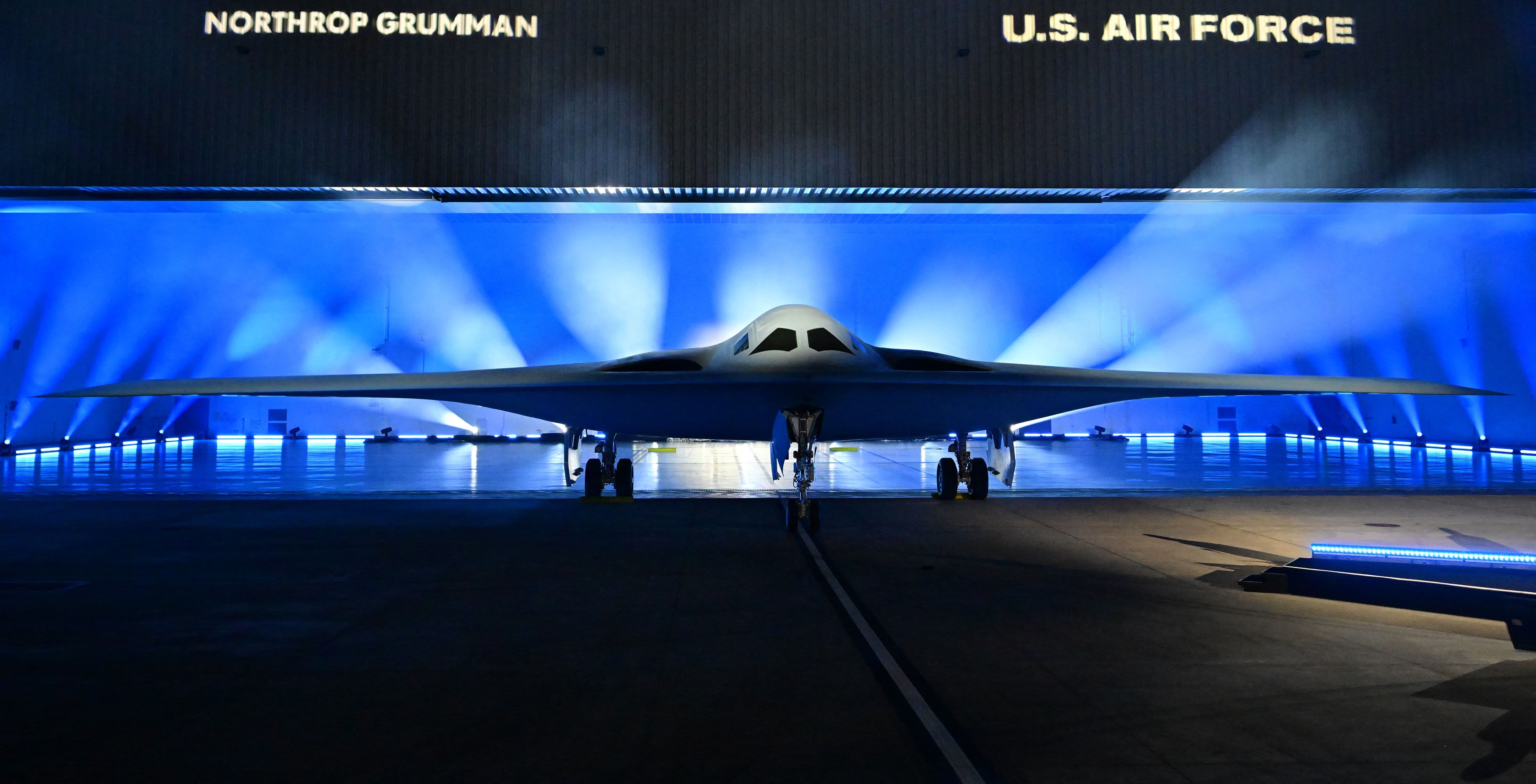
Hey, cheer up because it truly is a beauty! I’m talking about this country’s latest “stealth bomber,” the B-21 Raider, just revealed by Northrop Grumman, the company that makes it, in all its glory. With its striking bat-winged shape and its ability to deliver a very big bang (as in nuclear weapons), it’s our very own “bomber of the future.” As Secretary of Defense Lloyd Austin put it at its explosive debut, it will “fortify America’s ability to deter aggression, today and into the future.” Now, that truly makes me proud to be an American.
And while you’re at it, on this MAD (as in mutually assured destruction) world of ours, let that scene, that peculiar form of madness, involving the potential end of everything on Planet Earth, sink in. As a retired Air Force officer, it reminded me all too vividly of my former service and brought to mind the old motto of the Strategic Air Command(SAC), “Peace Is Our Profession.” Headed in its proudest years by the notorious General Curtis LeMay, it promised “peace” via the threat of the total nuclear annihilation of America’s enemies.
SAC long controlled two “legs” of this country’s nuclear triad: its land-based bombers and intercontinental ballistic missiles, or ICBMs. During the Cold War, those Titans, Minutemen, and MX “Peacekeepers” were kept on constant alert, ready to pulverize much of the planet at a moment’s notice. It didn’t matter that this country was likely to be pulverized, too, in any war with the Soviet Union. What mattered was remaining atop the nuclear pile. A concomitant benefit was keeping conventional wars from spinning out of control by threatening the nuclear option or, as was said at the time, “going nuclear.” (In the age of Biden, it’s “Armageddon.”)
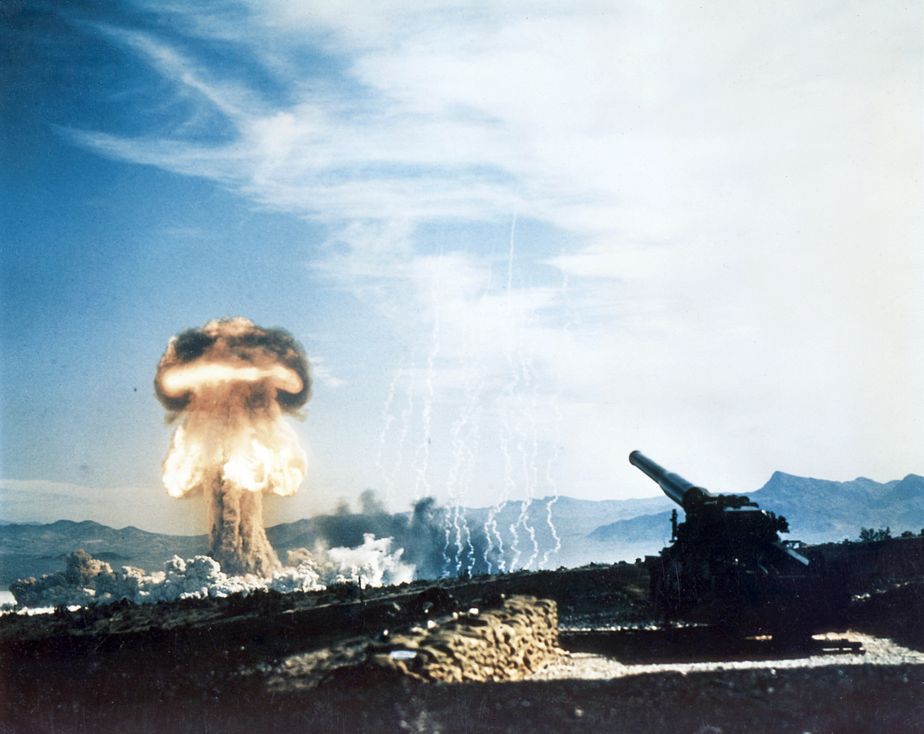
Luckily, since the atomic destruction of Hiroshima and Nagasaki in 1945, the world hasn’t gone nuclear again and yet this country’s military continues, with the help of weapons makers like Northrop Grumman, to hustle down that very path to Armageddon. Once upon a time, the absurdity of all this was captured by Stanley Kubrick’s masterpiece, the satirical 1964 film Dr. Strangelove, which featured a “war room” in which there was no fighting, even as its occupants oversaw a nuclear doomsday. Sadly enough, that movie still seems eerily relevant nearly 60 years later in a world lacking the Soviet Union, where the threat of nuclear war nonetheless looms ever larger. What gives?
The short answer is that America’s leaders, like their counterparts in Russia and China, seem to have a collective death wish, a shared willingness to embrace the most violent and catastrophic weapons in the name of peace.
Nuclear Bombers and ICBMs Return!
There’s nothing magical about the nuclear triad. It’s not the Holy “Trinity,” as a congressman from Florida said long ago. Even so, it’s worshipped by the U.S. military in its own all-too-expensive fashion. America’s triad consists of bombers capable of carrying nuclear weapons (B-52s, B-1s, B-2s, and someday B-21s), those land-based ICBMs, and that most survivable “leg,” the U.S. Navy’s Trident-missile-firing submarines. No other country has a triad quite as impressive (if that’s the word for it), nor is any other country planning to spend up to $2 trillion over the next three decades “modernizing” it. The Air Force, of course, controls the first two legs of that triad and isn’t about to give them up just because they’re redundant to America’s “defense” (given those submarines), while constituting a threat to life on this planet.
Recently, when the Air Force unveiled that B-21 Raider, its latest nuclear-capable bomber, we learned that it looks much like its predecessor, the B-2 Spirit, with its bat-like shape (known as a “flying wing” design) driven by stealth or the avoidance of radar detection. The Air Force plans to buy “at least” 100 of those planes at a projected cost of roughly $750 million each. Count on one thing, though: with the inevitable delays and cost overruns associated with any high-tech military project these days, the flyaway cost will likely exceed $1 billion per plane, or at least $100 billion of your taxpayer dollars (and possibly even $200 billion).
Four years ago, when I first wrote about the B-21, its estimated cost was $550 million per plane, but you know the story, right? The F-35 was supposed to be a low-cost, multi-role fighter jet. A generation later, by the Air Force’s own admission, it’s now a staggeringly expensive “Ferrari” of a plane, sexy in appearance but laden with flaws. Naturally, the B-21 is advertised as a multi-role bomber that can carry “conventional” or non-nuclear munitions as well as thermonuclear ones, but its main reason for being is its alleged ability to put nuclear bombs on target, even without Slim Pickens (“Major Kong” in Kubrick’s Dr. Strangelove) riding down on one of them.
The main arguments for expensive nuclear bombers are that they can be launched as a show of resolve but also, unlike missiles, recalled, if necessary. (Or so we hope anyway.) They have a “man in the loop” for greater targeting flexibility and so complicate the enemy’s defensive planning. Such arguments may have made some sense in the 1950s and early 1960s, before ICBMs and their sub-launched equivalents were fully mature technologies, but they’re stuff and nonsense today. If nuclear-capable nations like Russia and China aren’t already deterred by the hundreds of missiles with thousands of highly accurate nuclear warheads in America’s possession, they’re not about to be deterred by a few dozen, or even 100, new B-21 stealth bombers, no matter the recent Hollywood-style hype about them.
Yet logic couldn’t matter less here. What matters is that the Air Force has had nuclear-capable bombers since those first modified B-29s that dropped Little Boy and Fat Man on Hiroshima and Nagasaki, and the generals are simply not about to give them up — ever. Meanwhile, building any sophisticated weapons system like the B-21 is sure to employ tens of thousands of workers. (There are already 400 parts suppliersfor the B-21 scattered across 40 states to ensure the undying love of the most congressional representatives imaginable.) It’s also a boondoggle for America’s many merchants of death, especially the lead contractor, Northrop Grumman.
A reader at my Bracing Views Substack, a Vietnam veteran, nailed it when he described his own reaction to the B-21’s unveiling:
“What struck me in my heart (fortunately, I have a great pacemaker) was the self-assured, almost condescending demeanor of the Secretary [of Defense], the Hollywood staging and lighting, and the complete absence of consideration of what cognitive/emotional/moral injuries might be inflicted on the viewer, never mind experiencing exposure to the actual bomber and its payload — add in the incredible cost and use of taxpayer money for a machine and support system that can never actually be used, or if used, would produce incalculable destruction of people and planet; again, never mind how all that could have been used to start making America into a functioning social democracy instead of a declining, tottering empire.”
Social democracy? Perish the thought. The U.S. economy is propped up by a militarized Keynesianism tightly embraced by Congress and whatever administration is in the White House. So, no matter how unnecessary those bombers may be, no matter how their costs spiral ever upwards, they’re likely to endure. Look for them flying over a sports stadium near you, perhaps in 2030 — if, that is, we’re still alive as a species.
As the Air Force buys new stealth bombers with your tax dollars, they also plan to purchase a new generation of ICBMs, or a “ground-based strategic deterrent” in Newspeak, to plant in missile silos in garden spots like rural Montana, Nebraska, North Dakota, and Wyoming. The Air Force has had ICBMs since the 1960s. Roughly 1,000 of them (though that service initially requested 10,000) were kept on high alert well into the 1980s. Today’s ICBM force is smaller, but ever more expensive to maintain due to its age. It’s also redundant, thanks to the Navy’s more elusive and survivable nuclear deterrent. But, again, logic doesn’t matter here. Whether needed or not, the Air Force wants those new land-based missiles just like those stealth bombers and Congress is all too willing to fund them in your name.
Ka-ching! But hopefully not ka-boom!
Just as the purchase price for the B-21 project is expected to start at $100 billion (but will likely far exceed that), the new ICBMs, known as Sentinels, are also estimated to cost $100 billion. It brings to mind an old saying (slightly updated): a hundred billion here, a hundred billion there, and pretty soon you’re talking real money. In a case of egregious double-dipping, Northrop Grumman is once again the lead contractor, having recently opened a $1.4 billion facility to design the new missile in Colorado Springs, conveniently close to the Air Force Academy and various other Air and Space Force facilities. Location, location, location!
Why such nuclear folly? The usual reasons, of course. Building genocidal missiles creates jobs. It’s a boon and a half for the industrial part of the military-industrial-congressional complex. It’s considered “healthy” for the communities where those missiles will be located, rural areas that would suffer economically if the Air Force bases there were instead dismantled or decommissioned. For that service, shiny new ICBMs are a budget bonanza, while helping to ensure that the real “enemy” — and yes, I have the U.S. Navy in mind — won’t end up with a monopoly on world-ending weaponry.
In the coming decades, expect those “Sentinels” to be planted in fields far from where most Americans live under the guiding principle that, if we keep them out of sight, they’ll be out of mind as well. Yet I can’t help but think that this country’s military is out of its mind in “planting” them there when the only harvest can be of mass death.
It’s a MAD Old World
As MAD magazine’s Alfred E. Neuman would undoubtedly have said, “What, me worry?”
Oh, MAD old world that has such nukes in it! Color me astonished, in fact, that America’s nuclear weapons mix hasn’t changed much since the 1960s. That sort of world-ending persistence should tell us something, but what exactly? For one thing, that not enough of us can imagine a brave new world without genocidal nuclear weapons in it.
In 1986, President Ronald Reagan and Soviet leader Mikhail Gorbachev actually did so. They came close, in fact, to reaching a deal to eliminate nuclear weapons. Sadly, Reagan proved reluctant to abandon his dream of a nuclear space shield, then popularly known as “Star Wars” or, more formally, as the Strategic Defense Initiative. Since Reagan, sadly enough, U.S. presidents have stayed the course on nukes. Most disappointingly, the Nobel Prize-winning Barack Obama spoke of eliminating them, supported by former Cold War stalwarts like Henry Kissinger and George Schultz, only to abandon that goal, partly to solidify support in the Senate for a nuclear deal with Iran that, no less sadly, is itself pretty much dead and buried today.
If saintly Reagan and saintly Obama couldn’t do it, what hope do ordinary Americans have of ending our nuclear MADness? Well, to quote a real saint, Catholic peace activist Dorothy Day, “Our problems stem from our acceptance of this filthy, rotten system.” It’s hard to think of a system more filthy or rotten than one that threatens to destroy most life on our planet, so that this country could in some fashion “win” World War III.
Win what, exactly? A burnt cinder of a planet?
Look, I’ve known airmen who’ve piloted nuclear bombers. I’ve known missileersresponsible for warheads that could kill millions (if ever launched). My brother guarded ICBM silos when he was a security policeman in SAC. I sat in the Air Force’s missile-warning center at Cheyenne Mountain under 2,000 feet of solid granite as we ran computerized war games that ended in… yep, mutually assured destruction. We were, at least individually, not insane. We were doing our duty, following orders, preparing for the worst, while (most of us, anyway) hoping for the best.
A word of advice: don’t look for those within this nightmarish system to change it, not when our elected representatives are part of the very military-industrial complex that sustains this MADness. Only an alert and knowledgeable citizenry, with real freedom, could act to do so for the benefit of humanity. But will we ever do that?
“We’re going backwards as a country,” my wife reminds me — and I fear that she’s right. She summarized the hoopla at the B-21’s recent unveiling this way: “Let’s go gaga over a mass-murder machine.”
Collectively, it seems that we may be on the verge of returning to a nightmarish past, where we lived in fear of a nuclear war that would kill us all, the tall and the small, and especially the smallest among us, our children, who really are our future.
My fear: that we’ve already become comfortably numb to it and no longer can take on that culture of mass death. I say this with great sadness, as an American citizen and a human being.
No matter. At least a few of us will have profited from building new ultra-expensive stealth bombers and shiny new missiles, while ensuring that mushroom clouds remain somewhere in our collective future. Isn’t that what life is truly all about?
There’s more to military history than decisive battles, great captains, and sexy weapons
We sure could use honest and critical teaching about military history and war in America.
I don’t mean celebratory BS. I don’t mean potted histories of the American Revolution and its freedom fighters, the Civil War and its freeing of the slaves, World War II and America’s greatest generation and so on. I mean history that highlights the importance of war together with its bloody awfulness.
Two books (and book titles) come to mind: “War is a force that gives us meaning,” by Chris Hedges, and “A country made by war,” by Geoffrey Perret. Hedges is right to argue that war often provides meaning to our lives: meaning that we often don’t scrutinize closely enough, if at all. And Perret is right to argue that America was (and is), in very important ways, made by war, brutally so in fact.
Why study war? Shouldn’t we affirm that we ain’t gonna study war no more? Well, as Leon Trotsky is rumored to have said: You may not be interested in war, but war is interested in you. Among other reasons, students of history should study war as a way of demystifying it, of reducing its allure, of debunking its alleged glories. War is always a bad choice, though there may be times when war is the least bad in a series of bad choices. (U.S. involvement in World War II was, I believe, less bad than alternatives like pursuing isolationism.)
How are we to make sense and reach sound decisions about war if we refuse to study and understand it? A colleague sent along an interesting article (from 2016) that argues there’s not enough military history being taught in U.S. colleges and universities, especially at elite private schools. Here’s the link: https://aeon.co/ideas/the-us-military-is-everywhere-except-history-books
Visit your local bookstore and you’ll probably see lots of military history — it’s very popular in America! — but critical military history within college settings is much less common. This is so for a few reasons, I think:
1. Many professors don’t like the “stench” of military history. When I was at Oxford in the early 1990s, I had a professor who basically apologized for spending so much time talking about mercenary-captains and war in early modern Europe. Yet war and controlling it was a key reason for the growth of strong, centralized nation-states in Europe in the 17th and 18th centuries.
2. Many professors simply have no exposure to the military — they’re ignorant of it, almost proudly so. Having taught college myself for fifteen years, including survey subjects like world history, I know the difficulty of teaching topics and subjects where your knowledge is shallow or dodgy. Far easier to stand on firm ground and teach what you know and ignore what you don’t know — or don’t like. But the easier road isn’t always the best one.
3. Critical military history suggests lack of patriotism. I taught college as a civilian professor for nine years, and I was once told to “watch my back” because I wrote articles that were critical of the U.S. military’s wars in Iraq and Afghanistan. And I’m a retired Air Force officer!
So, with history professors often preferring to ignore or elide military subjects, military history is left to buffs and enthusiasts who focus on great captains, exciting battles, and famous weapons (often featured in glossy coffee-table books) like Tiger tanks and Spitfire fighters. Such books often sell well and make for exciting reads. What they don’t do is to make us think critically about the costs of war and how disastrous wars often prove.
My own book on Paul von Hindenburg is a critical account of his life, including his complicity in the “stab in the back” myth and the rise of Adolf Hitler to power
A subject I taught at the USAF Academy was technology and warfare, and one of my concerns was (and remains) America’s blind faith in technology and the enormous sums of money dedicated to the same. The Pentagon will spend untold billions on the latest deadly gadgets (actually, as much as $1.7 trillion alone on the F-35 jet fighterthroughout its lifespan) but academia won’t spend millions to think and teach more critically about war.
As an aside, weapons alone don’t make an effective military. It’s not the gladius sword that made Rome dominant but the citizen-soldier wielding it, empowered by republican ideals, iron discipline, and a proven system of leadership by example.
When the principled citizen-soldier ideal died in Rome, a warrior ideal consistent with a hegemonic empire replaced it. There’s much for Americans to learn here, as its own military today identifies as warriors and finds itself in the service of a global empire.
There’s more to military history than drums and trumpets — or bullets and bombs. For better or for worse, and usually for worse, we as a people are made and defined by war. We would all do well to study and understand it better.
(If you’d like to comment, please visit Bracing Views on Substack.)
With Russia issuing warnings about using all weapons at its disposal to protect its position in Ukraine, it’s a good time to talk about the distinction between “tactical” and “strategic” nuclear weapons.
Put bluntly, there’s no real distinction. All nuclear weapons, regardless of size and yield, are devastating and potentially escalatory to a full-scale nuclear war. Were Russia to use “tactical” nuclear weapons, the U.S. and NATO would likely respond in kind. Even if a major nuclear war could be avoided, resulting political disruptions would likely aggravate ongoing economic dislocation, triggering a serious global recession, even a Great Depression, further feeding the growth of fascism and authoritarianism.
When you build weapons, there’s a temptation to use them. Weapons don’t exist in a vacuum. Within the military, people are trained to use them. Doctrine is developed along with contingency plans. Exercises are run to prepare for deployment and use in wartime, “just in case.” In short, we can’t count on sane heads to prevail here, not when some people seem to think you can use a “little” nuke to send a message.
Fortunately for the world, nuclear weapons haven’t been used in war since Hiroshima and Nagasaki in 1945. But they are used daily in the sense of intimidating other countries. Currently, Russia is using its nuclear forces to try to contain US/NATO aid to Ukraine and involvement in the Russia-Ukraine War. Russia is drawing a nuclear red line, and I doubt it’s a bluff.
It’s hypocritical of both the US and Russia to accuse the other of nuclear brinksmanship since both countries have contingency plans to use nukes. Hopefully, it’s obvious to both countries how devastating it would be if a nuclear exchange, even a “limited” or “tactical” one, were to occur.
Even as bluffs, nuclear threats are reckless, since there’s always some fool who may seek to call the bluff. Let’s hope the US/NATO collective doesn’t play the fool. We have enough problems in the world without tossing nuclear warheads of whatever size or yield at each other.
Even as gas and diesel prices soar along with global temperatures, American vehicles continue to get bigger. In my first Air Force job in 1985, I had a friend who drove a classic Ford Bronco. It was a little bigger than a jeep and truly meant for off-road adventures in Colorado where four-wheel drive is a necessity. Nowadays, Ford trucks and SUVs are much more likely to resemble military vehicles like Humvees or even MRAPs. Bigger is better, especially for the truck makers and fossil fuel companies, who profit much more by selling and fueling steroidal trucks than Ford Escorts or hybrids.
But there’s a darker side to these steroidal, quasi-military vehicles on America’s roads, notes Stan Cox today at TomDispatch.com. They’re being used to intimidate, to bully, even to injure and kill people that the drivers of these vehicles don’t like. Typical targets are protesters for the BLM movement or women trying to protect abortion rights. When Dodge named their Ram pickup, I really don’t think they meant you should use it as a battering ram, but that seems to be crude animus motivating more than a few white male drivers today.
This phenomenon isn’t just limited to flyover states like Kansas, where Stan Cox lives. Here in Blue Massachusetts, I recently saw a pickup that was proudly flying a “Fuck Joe Biden” flag, modeled after Trump MAGA flags. Heck, I don’t much like Joe Biden, but I don’t feel the need to mount a giant flag on my vehicle to that effect. I guess I’m just too humble or shy — or sane.
Steroidal trucks are nothing new in America, and I’ve seen plenty with stickers that say “No Fear” or even “Fear This.” (You learn quickly to give these idiots on wheels a wide berth.) But using these trucks to hurt people is truly cowardly. What kind of young men are we producing?
The wars are coming home again, America. Just look around at all the mini-tanks in America’s parking lots and driveways.
A final caution: Beware of bully boys with bull bars, coming soon (though I hope not) to a protest near you. If you stand your ground, they might just run you over — and in some states you’ll be to blame for blocking their way.
So use common sense and get out of their way. You’re not the coward: they are.
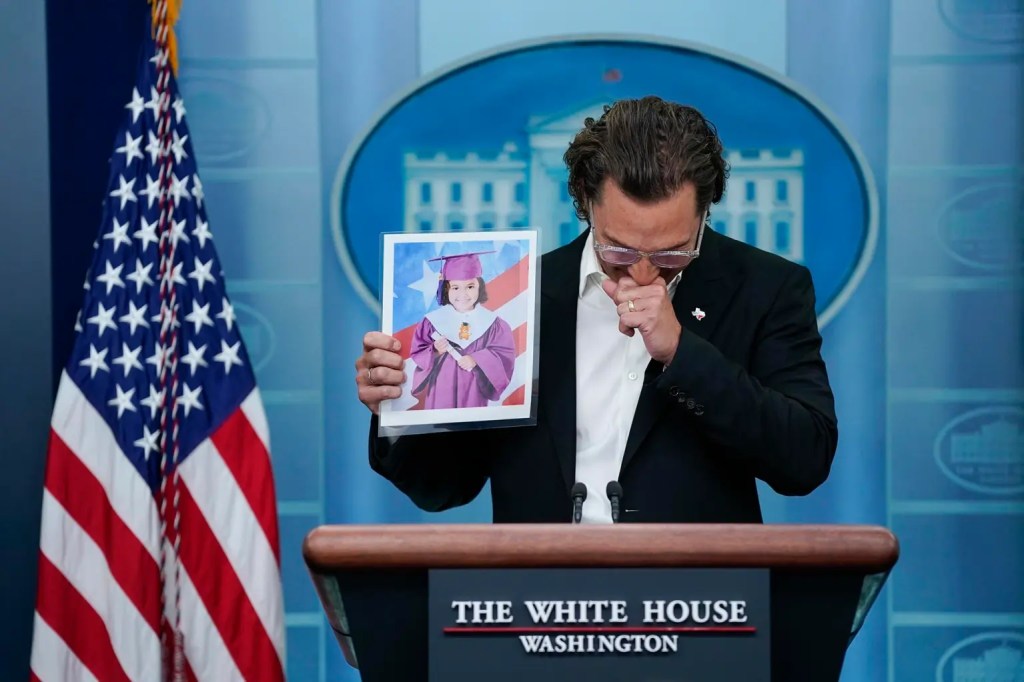
Matthew McConaughey holds a photo of Alithia Ramirez, 10, killed in the Uvalde mass shooting
W.J. Astore
The bottom line on gun laws in the USA is, surprise, profit. What matters most is not banning any guns, including military-style assault weapons. There are already more than 20 million AR-15-type assault weapons in the hands of Americans, with more being sold legally every day. They and their related gear (ammo, ammo magazines, and so on) are a big source of profit to American gun makers and gun sellers, so you can be sure that those guns will be protected, unlike the victims of them.
To illustrate this, two stories popped up in my email today. The first, from CNN, is a quick summary of where we stand on gun control measures in Congress:
The current changes to gun laws under consideration include hardening school security, providing more funding for mental health care and ensuring that juvenile records can be considered when a person between the ages of 18 and 21 wants to buy a semi-automatic weapon. Federal incentives for states to pass so-called red flag laws are also being discussed. However, despite the ongoing talks, it remains unclear whether there will be enough Republican support to push the legislation forward.
Note that Orwellian term: the “hardening” of school security. Schools are now being talked about in military terms as “soft” targets for mass shooters. Naturally, the solution isn’t to deny shooters their assault weapons. No: let’s turn every school into a “hardened” fortress, with more fences, cameras, locking doors, and armed guards (perhaps with AR-15s?). How long before our schools are indistinguishable from our prisons?
You’ll note, of course, that none of the “new” gun laws being considered by Congress will reduce the number of guns in circulation. Gun sales will continue to soar. When you think about it, guns now have more rights in America than people do.
The second story involves a Hollywood celebrity, Matthew McConaughey, who was born in Uvalde, Texas, and who’s been working with the Biden administration in the cause of “responsible” gun control. He’s called for “universal background checks, raising the minimum age for purchasing an AR-15 to 21, a waiting period for purchasing AR-15s and the implementation of red flag laws.” These steps are better than nothing, but again they will not impact the profit margins of gun makers/sellers. Even so, they are likely to be judged too radical by Republicans in Congress.
President Biden has called for a ban on new assault weapons, but it’s simply empty words. He knows a ban stands no chance of getting through Congress. If the Democrats really wanted to accomplish something, they’d get rid of the filibuster in the Senate, but they’re not about to do that, especially since they’re likely to lose control of the Senate after the November elections.
Speaking of Joe Biden, I saw this hilarious headline at NBC News today: “Biden’s gaffes might actually be his selling point.” The gist of the op-ed is that Biden often misspeaks and sounds both angry and confused, but these qualities make him “authentic” to voters, therefore “let Biden be Biden” and don’t try to handle or edit him.
That’s where we’re at as a country. Guns have more rights than people and our president is to be embraced for all the gaffes he makes. What a country!
Americans have a remarkable faith in weapons as “gamechangers,” as simple panaceas to complex problems.
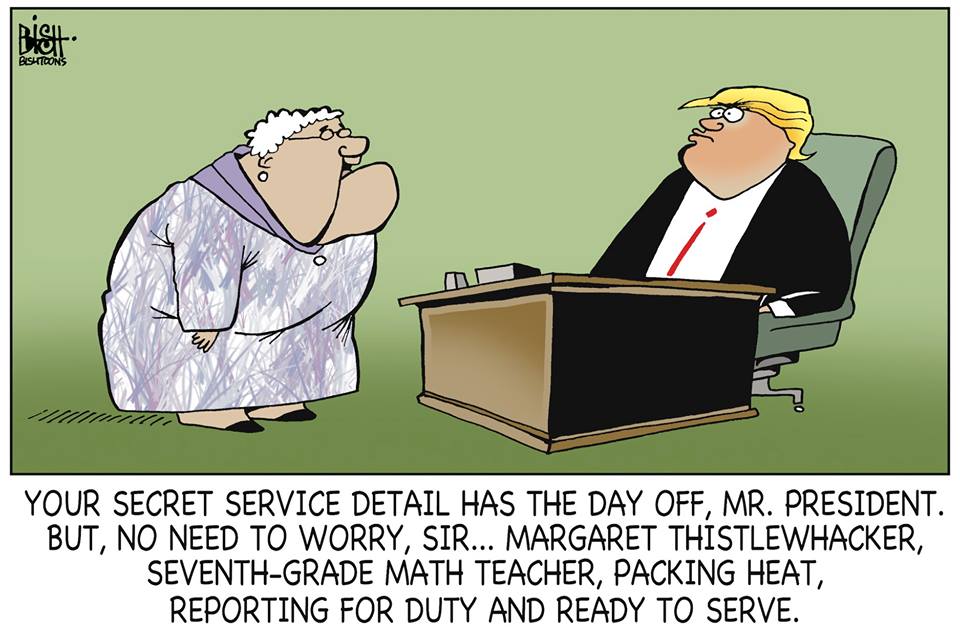
Yesterday, Donald Trump addressed the NRA convention in Houston, offering guns as a panacea to mass shootings. Once again, Trump said that “highly trained” teachers should be allowed to carry concealed guns in the classroom. Apparently, teachers should now be the equivalent of Special Forces warriors, ready to confront shooters with assault weapons at a moment’s notice. When he was president, Trump suggested these warrior-teachers might even see a small bump in pay for their willingness to carry guns and to serve as quasi-SWAT team members at schools. What generosity!
Just as many Americans see more guns as the answer to domestic violence like mass shootings, yet bigger guns and missiles are seen as “game changers” for complex foreign issues like the Russia-Ukraine War. According to CNN, the U.S. government is considering sending the MLRS (multiple launch rocket system) to Ukraine, which has a range of up to 300 miles, to counter Russian troops. One Congressman in particular thinks it’s a dandy idea:
Democratic Rep. Jason Crow of Colorado, who was part of a congressional delegation trip to Kyiv earlier this month, told CNN he believes the systems could help Ukraine gain significant momentum against Russia.
“I think it could be a gamechanger, to be honest with you,” Crow said, not only for offensive attacks but also for defense. He explained that Russian conventional artillery, which has a range of about 50km, “would not get close” to Ukrainian urban centers if MLRS systems were positioned there. “So it would take away their siege tactics,” he said of the Russians.
Where to begin? Are Ukrainian troops trained on such a system? How do you get the system into Ukraine to begin with? What if the system is used to strike targets inside of Russian territory? What about Russian warnings that such a system could lead to reprisals against European or American assets? What if less-than-well-trained Ukrainian troops fire a bunch of missiles that end up killing dozens, even hundreds, of innocent people?
No matter. The “answer” is always more guns, more howitzers, more missiles. They’re “gamechangers”!
Indeed, they just may be. Just not in the way that Trump imagines, or Congressman Crow.
Finally, that word: “gamechanger.” It’s a common practice in America to talk about war as if it’s a sport, a game. Call it the triumph of dumbass thinking. War is neither sport nor game, and you’re not going to “game-change” the Russia-Ukraine War, as in turning the tide so Ukraine wins, just by sending the MLRS, just as you’re not going to decrease mass shootings in schools by arming teachers with guns.
Guns are the only innocents in America. To be clear, I’m being sarcastic.
Whenever there’s a school shooting, you can count on the shooter being denounced as evil, as monstrous, as out of his mind. But the guns the shooter uses? There are always people who tell us not to blame the guns. Guns aren’t evil. Guns aren’t monstrous. Guns are, in a word, innocent.
It’s all very strange. I think of the children killed in Texas, along with their teachers, as being innocent. I wish we’d have kept them safe. I wish their rights to life, liberty, and the pursuit of happiness hadn’t been cut down by bullets. But wish in one hand …
We hear a lot of talk about gun rights and gun safety, almost as if guns indeed had rights, almost as if America’s true goal was to keep guns safe.
America is indeed a country where guns are safe, secure, and free to roam. We have more than 400 million of them, including more than 20 million military-style assault weapons. Congress is not seriously acting to put meaningful restrictions on guns. We’re lucky if we’ll see a “red-flag” law (allowing the confiscation of guns from a person who makes deadly threats before he decides to go on a murderous rampage), or possibly universal background checks. Of course, neither of these will curtail gun purchases and availability, and neither would have stopped the latest shooter in Texas, who purchased his guns legally and apparently showed no clear “red flag” before he attacked a school and killed 19 innocent children.
And there’s that word again. Innocent. We need to focus on child rights and child safety, not gun rights and gun safety. Don’t you think?
I’ve been a gun owner and have shot everything from a pellet rifle and .22 pistol to a .44 magnum Model 29 Smith & Wesson, made famous by Clint Eastwood in “Dirty Harry.”
Model 29 Smith & Wesson .44 Magnum.
I’ve felt the powerful allure of guns. I also have no problem with hunters, target shooters, and all the responsible gun owners we have in America. But when guns are responsible for 45,000 deaths a year in America (data from 2020), and when mass shootings become almost forgettable in their repetition (except in the most heinous cases, like the latest mass murder event in Texas), it’s time to admit that guns are not the innocents here. They are part of the problem, and restrictions to their ownership is part of the solution.









 Bracing Views