Genocide Is Apparently OK in Gaza

Lesson from the LA Holocaust Museum

BILL ASTORE

SEP 09, 2025

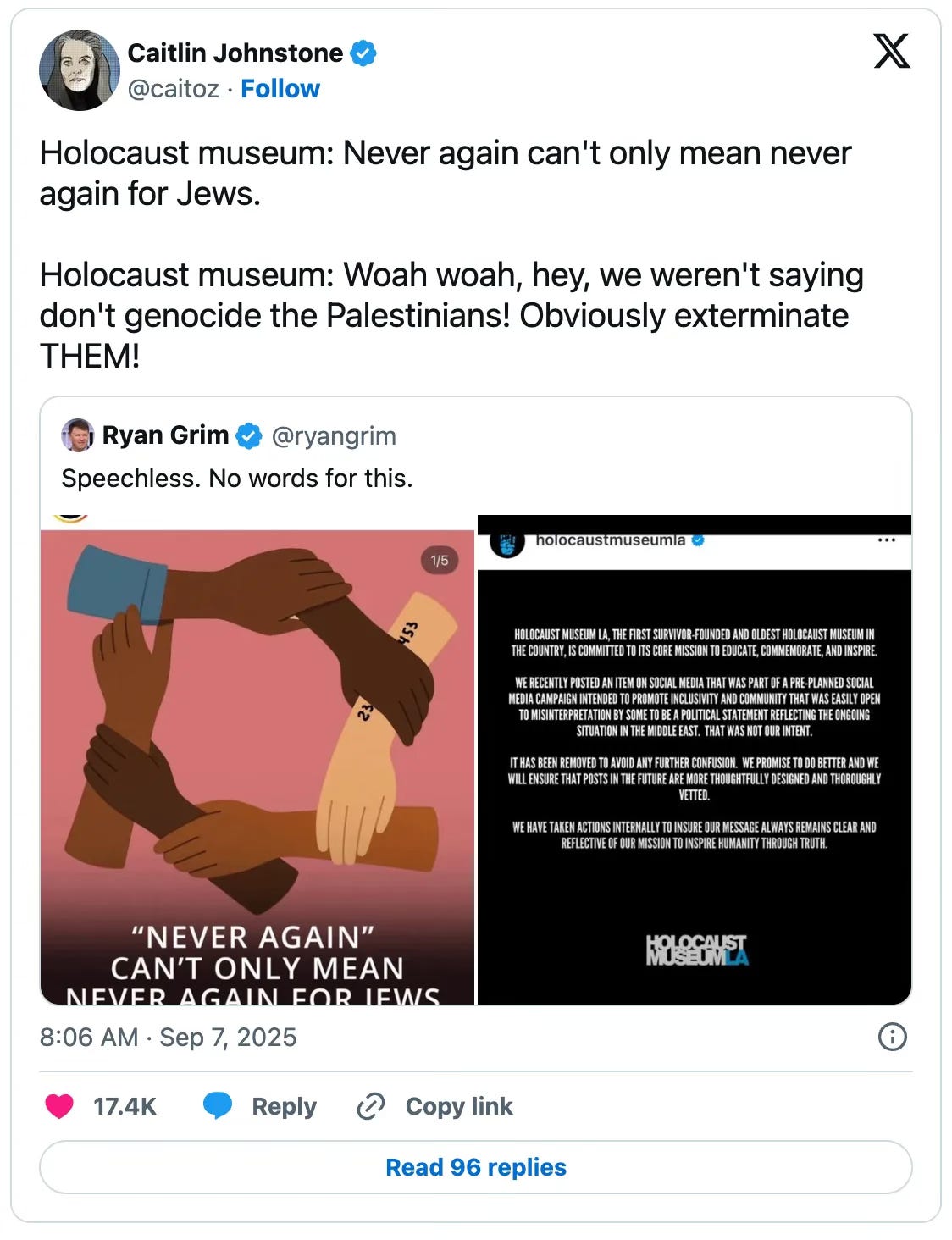
The LA Holocaust Museum recently suggested that “Never Again” is a fundamental lesson of the Holocaust. Then they took it back. Here’s the (almost) inconceivable story from Caitlin Johnstone:

Israel supporters are so crazy and evil that the Los Angeles Holocaust Museum recently retracted a statement saying “Never again can’t only mean never again for Jews” after objections from Zionists.

The museum issued a statement saying, “We recently posted an item on social media that was part of a pre-planned social media campaign intended to promote inclusivity and community that was easily open to misinterpretation by some to be a political statement reflecting the ongoing situation in the Middle East. That was not our intent. It has been removed to avoid any further confusion.”

Think about how gross your position has to be for you to be all hey, let’s say no genocide for ANYBODY, and then immediately have to come back and clarify that you definitely weren’t saying no genocide for the Palestinians.

I’m glad that’s clear! Talk about a profile in cowardice.

Then there are those who get testy about applying the word “genocide” to events in Gaza. Their distorted mouth noises sound something like this: Israel is at war with terrorists (Hamas) and *only* 70,000 or so Palestinians are dead so it’s not really a genocide, is it? Plus it’s all their fault because of October 7th, end of story.

For what it’s worth, I taught the Holocaust as a professor of history after attending a seminar at the US Holocaust Memorial Museum. Also, if it means anything, I’m Catholic, retired military, with no particular axe to grind.

Yes, it’s a genocide in Gaza. A holocaust in slow motion. Heck, Israeli leaders have freely confessed their goal is a final solution to the Gaza question, mainly by killing many Palestinians while forcing the rest to leave. (Whether they’ll have any place to go remains to be seen.)

There is no one model of genocide, and definitions also vary. But if what’s happening in Gaza isn’t a genocide, I don’t know what other word applies. Mass murder, perhaps? Extermination, but slowly? Ethnic cleansing and mass death followed by mass expulsion? That is genocide, plain and simple.

Sports and the Military

An Unholy Alliance

BILL ASTORE

SEP 07, 2025

There’s a full slate of NFL football games today, meaning there’ll be a full slate of military flyovers and similar ceremonies to “support” our troops. The militarization of sports in America is something to behold, and a new report that tackles the issue is available from a series on “Consuming War” at Brown University. Here’s the link.

It put me to mind of an article I wrote for Huff Post back in 2011. Fourteen years later, the unholy alliance between sports and the military has only deepened.

Here’s what I wrote in 2011. What do you think, readers? Will we ever learn to play ball again without all the military trappings?

America!

The Militarization of Sports — And the Sportiness of Military Service

The co-joining of corporate-owned sports teams and events with the military strikes me as more than disturbing. We’ve created a dangerous dynamic in this country: one in which sporting events are exploited to sell military service for some while providing cheap grace for all.

William Astore

By William Astore, Contributor

Writer, History Professor, Retired Lieutenant Colonel (USAF)

Jul 28, 2011, 01:19 PM EDT

Updated Sep 27, 2011

Connecting sports to military service and vice versa has a venerable history. The Battle of Waterloo (1815) was won on the playing fields of Eton, Wellington allegedly said. Going over the top at the Battle of the Somme (1916), a few British soldiers kicked soccer balls in the general direction of the German lines. American service academies have historically placed a high value on sports (especially football) for their ability to generate and instill leadership, teamwork and toughness under pressure.

But in today’s America, we are witnessing an unprecedented militarization of sports, and a concomitant emphasis on the sportiness of military service. With respect to the latter, take a close look at recent Army recruitment ads (which I happen to see while watching baseball). These ads show soldiers lifting weights, playing volleyball, climbing mountains and similar sporty activities. The voice-over stresses that army service promotes teamwork and toughness (“There’s strong. Then there’s armystrong.”) There are, of course, no shots of soldiers under direct fire, of wounded soldiers crying for help, of disabled veterans. Army service in these ads is celebrated as (and reduced to) an action-filled sequence of sporting events.

Today’s militarization of sports is even more blatant. Consider this excellent article by U.S. Army Colonel (retired) Andrew Bacevich, which highlights the “cheap grace” available to crowds at major sporting events. For-profit sports corporations and the Pentagon join hands to orchestrate pageants that encourage (manipulate?) us to cheer and celebrate our flag, our troops and our sports and military heroes, as the obligatory fighter jets roar overhead.

Now, I’m sure there are well-meaning people who see such pageantry as an uncontroversial celebration of love of country, as well as a gesture of generosity and thanks to our military. And this retired veteran admits to feeling my heart swell when I see our flag flying proudly and our troops marching smartly. But the co-joining of corporate-owned sports teams and events (which are ultimately about entertainment and making a buck) with the military (which is ultimately in the deadly business of winning wars) strikes me as more than disturbing.

To cite only one example: The San Diego Padres baseball team takes “tremendous pride” in being “the first team in professional sports to have a dedicated military affairs department,” according to a team press release quoting Tom Garfinkel, the Padres president and chief operating officer. But is it truly “tremendous” for sports teams to be creating “military affairs” departments? As our sporting “heroes” celebrate our military ones, does not a dangerous blurring take place, especially in the minds of America’s youth?

War is not a sport; it’s not entertainment; it’s not fun. And blurring the lines between sport and war is not in the best interests of our youth, who should not be sold on military service based on stadium pageantry or team marketing, however well-intentioned it may be.

We’ve created a dangerous dynamic in this country: one in which sporting events are exploited to sell military service for some while providing cheap grace for all, even as military service is sold as providing the thrill of (sporting) victory while elevating our troops to the status of “heroes” (a status too often assigned by our society to well-paid professional athletes).

Which brings me to a humble request: At our sporting events, is it too much to ask that we simply “Play Ball?” In our appeals for military recruits, is it too much for us to tell them that war is not a sport?

Think of these questions the next time those military warplanes roar over the coliseum of your corporate-owned team.

“There is no America, there is no democracy”

Thoughts on Gaza and the Profitability of Genocide

BILL ASTORE

JUL 10, 2025

I sent this somewhat despairing note to a friend this morning:

It remains unclear to me whether the U.S. government kowtows to Israel (for all the reasons we know, like AIPAC), or whether Israel is a sort of cat’s paw for U.S. imperial and corporate interests. Maybe it’s not about nations and borders, as the famous speech from “Network” put it, but rather resources and profit, whether oil, water, weapons, and the like. The people of Gaza are simply in the way and entirely expendable to these larger interests. Naturally, propaganda is skillfully used to portray just about every Palestinian as a Hamas terrorist. Then, as you noted, there’s a media blackout on Gaza in most U.S. mainstream media sources.

Short of revolution, I don’t see any changes coming. The Democrats, of course, are just as happy to serve Israel and corporate interests.

This is the famous scene from “Network” featuring a brilliant performance by Ned Beatty:

If the world is a “college of corporations” (heck, even Harvard is a corporation) and if business and money is the universal lubricant, the Palestinians in Gaza are both good and bad for business. They are “good” in the sense that money can be made from killing them, concentrating them, monitoring them, expelling them, and so on. Speaking and documenting this horrendous truth got Francesca Albanese, the UN Special Rapporteur for Palestine, sanctioned by the U.S. government, as Lisa Savage noted here.

They are “bad” for business with respect to the gas fields off Gaza. Those marine gas reserves are likely worth $5 billion or more, money that would have done much to alleviate poverty in Gaza. Of course, Israel wasn’t about to allow Palestinians in Gaza to share in this bounty. Getting rid of Palestinians is a means to the end of completely dominating future trade in gas and other commodities in the Levant Basin.

I’ve been wondering why Great Britain is at great pains to help the Netanyahu government—then I noted that British Petroleum is one of the giant corporations that Israel granted a license to for future gas exploration. Coincidence?

Now, unlike Ned Beatty above, I’m not saying everything is explained by money and currency flows as “the primal forces of nature.” But it’s always a good idea to follow the money. It’s a ghastly business indeed when genocide makes money, but there you have it. A large part of the Holocaust in World War II was Germans and their fellow travelers taking everything from the Jews before they killed them. Profit from death factories—a grim truth I care not to contemplate, but it happened. Mass death can be a huge money-maker, and those pulling the strings couldn’t care less about body counts. Quarterly profits—now those they care about.

This suggests a strategy for activism—except efforts at BDS (boycott, divestment, sanctions) are heavily resisted by the powers that be. Surprise! You can find out more about the BDS movement here.

When protests are bad for business, that’s when the powerful pay attention. Powerful people already know the truth—they do everything in their power to determine what is “true”—so they’re not interested in right or wrong. What’s “right” is what makes money and what’s wrong, very wrong, loses money. You can’t appeal to their collective conscience (Good luck with that!), but you can possibly appeal to or cut into their collective profits.

Too cynical? What say you, readers?

Catastrophic Flooding in Texas

Just Don’t Mention Global Warming or Climate Change

BILL ASTORE

JUL 07, 2025

More than 100 people are already dead from catastrophic flooding in Texas. The “blame game” has started, with the Trump administration taking heat for flash flood warnings that came too late to save those in the path of surging rivers fed by thunderstorms dumping too much rain in too short a time.

Camp Mystic in Texas was especially hard hit by flooding, losing 27 children and camp counselors

The White House, naturally, says it’s not their fault. If you want to blame someone, blame God. A quick summary from NBC:

White House Press Secretary Karoline Leavitt pushed back against questions as to why flood alerts were issued “while people were likely sleeping” and what the administration is doing to ensure alerts go out earlier.

Leavitt noted that the National Weather Service issued escalating warnings Thursday regarding the weather forecasts as information came in. She said there were “timely flash flood alerts” including a flood watch in the afternoon, evening, and “timely flash flood alerts” at night.

“So people were sleeping in the middle of the night when this flood came — that was an act of God,” Leavitt said. “It’s not the administration’s fault that the flood hit when it did, but there were early and consistent warnings.”

“An act of God” — Divine wrath? Judgment? What, exactly?

Why do we use this expression, “an act of God,” as if God or gods are just waiting to smite people with hurricanes, floods, locusts, tornados, and (Lord?) knows what else.

Wasn’t it really an act of nature? Too much heat, too much humidity, and wind patterns combining somewhat predictably to cause dangerous flash flooding. An act of nature we can guard against. An act of God implies caprice, violence, and forces that can neither be predicted nor prevented.

We know about acts of nature. That’s why we have science and scientists, or in this case meteorologists, radar, supercomputers, and the like. We fund a national weather service of experts so that we can predict and perhaps ameliorate some of these acts of nature.

But we know as well nature is becoming more extreme. Nature’s acts are becoming more violent as the earth slowly warms and as climate patterns become more violent and hence often less predictable—as well as more punishing.

Let’s not talk about acts of God, whether as a way to shift blame or even as a form of comfort. (Speaking for myself, I wouldn’t be comforted if someone told me God had swept my loved one away in a flash flood He sent.) Let’s talk about acts of nature, and how they’re growing more violent, and the steps we can take to understand them, predict them better, and lessen their impact.

Again, “act of God” gets us nowhere. But I know man is acting, with drill, baby, drill consistency, and man’s acts are something we do have control over.

With sympathy to all those who’ve lost loved ones in the terrifying flash flooding in Texas. Nature can be brutal—it’s why we must respect it, study it, and understand it.

Remember When the Balanced Budget Amendment Was A Thing?

$37 Trillion in Debt and Counting

BILL ASTORE

JUN 30, 2025

With the U.S. national debt sitting at $37 trillion, it’s hard to imagine a time when Congress argued for a balanced budget amendment to the Constitution. Remember when Republicans had a reputation for fiscal conservatism?

According to the non-partisan CBO, President Trump’s big beautiful bill will add another $3.3 trillion in debt over the next decade. At the same time, the bill cuts health care to poor people. This from the New York Times:

G.O.P. Bill Has $1.1 Trillion in Health Cuts and 11.8 Million Losing Care, C.B.O. Says

Analysis from the nonpartisan Congressional Budget Office found that Republicans’ new version of the legislation would make far deeper cuts and lead to more people becoming uninsured than previous proposals.

Who needs health insurance, am I right?

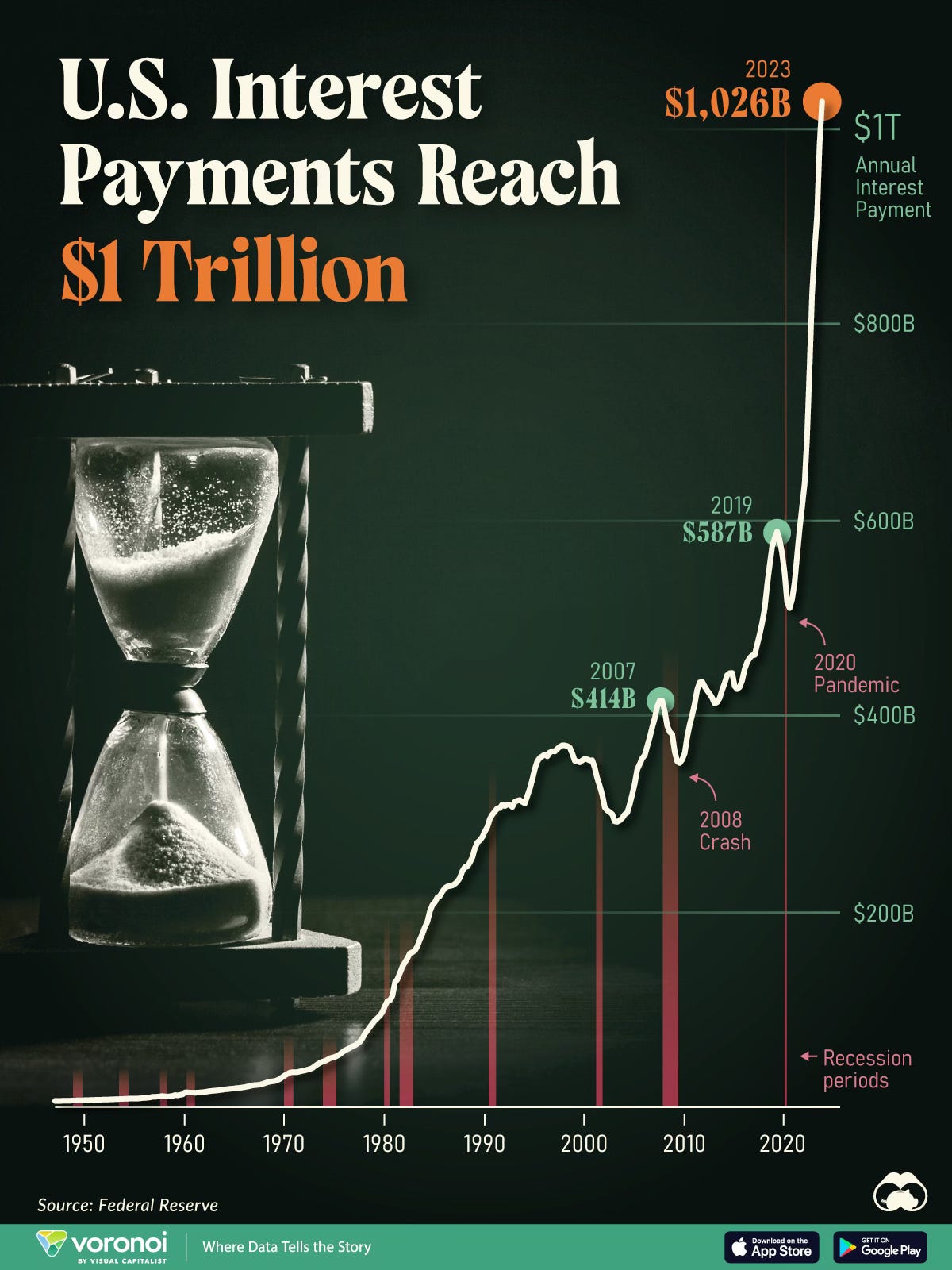
Yearly interest on the national debt is now higher than the Pentagon budget, which is truly saying (and spending) a lot.

Where is all the money going? Leaving aside the cost of servicing the national debt, most of discretionary spending goes to the Pentagon, Homeland Security, and similar forces of aggression and repression. New nuclear weapons, for example, may cost $2 trillion over the next 30 years. A misnamed “golden dome” (leaky sieve is more accurate) allegedly to protect America against nuclear missile attacks may cost $500 billion or more over the next decade or two. And nothing costs as much as foreign wars, as we learned from the disastrous Iraq and Afghan Wars, which may end up adding $8 trillion to the national debt when all the bills come due.

While achieving a balanced budget isn’t easy, there are two easy ways to come closer:

  1. Tax the rich.
  2. Stop making war, downsize the empire, and focus the U.S. military on national defense and defense alone.

Option (1) is out since the rich own the government. (Welcome to Plutocracy USA.) Option (2) is also out since the military-industrial-congressional complex is the fourth branch of government and arguably the most powerful. All presidents appease it, whether their names are Bush or Biden, Obama or Trump.

So, Congress and the President do what they always do: Serve the rich and kowtow to the MICC, the National (In)Security State. Any “balancing” to be done with the federal budget will be done on the tired backs of the poor and disadvantaged. They have no lobbies, no money, no say.

Can the working classes pull America up by their collective bootstraps? America’s workers have achieved miracles before, but this is too big of an ask even for them.

Donald Trump, Insulter-in-Chief

Teenage Boys Playing “Risk” Lead America!

BILL ASTORE

JUN 27, 2025

When I was in high school, my friends and I would get together and play “Risk,” the game of world domination. It was an excuse to hang out, to have fun, and especially to trade insults as we rolled the dice and moved our “armies” around the board to vanquish one another.

Trump understands this mentality—the mentality of adolescent teens trading insults for fun, bonding over shared putdowns. Never did I or my friends think, however, that juvenile and puerile insults should become the foundation of politics and governance in America. That was Trump’s peculiar “genius”: he has become America’s Insulter-in-Chief. 

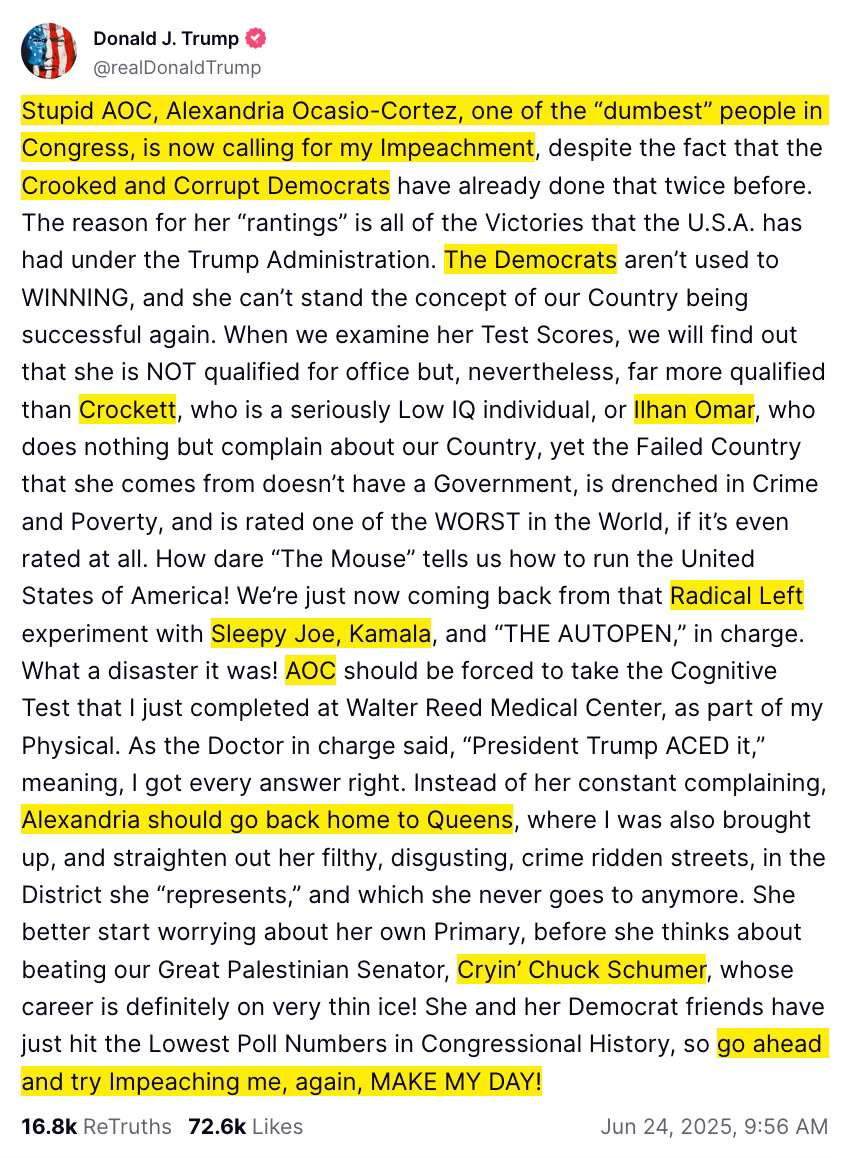
Consider this recent post from Trump’s Truth Social account:

Now, my teenage self is smiling or laughing even as I read these insults. Of course they’re outrageous, deceptive, irresponsible, juvenile, inaccurate, add your own descriptors here. Yet Trump recognizes that they work, especially with his followers, whose main objective often appears to be “owning the libs.”

To Trump, all of this is par for the course. His “genius” in 2015-16, when he first ran, was recognizing that his Republican challengers were, as we say in the military, whiskey deltas, often deserving of insults and contempt. He recognizes too in 2025 that the Democrats similarly are weak, are corrupt, and therefore targets of opportunity for the most withering insults, no matter how exaggerated.

Predictably, more than a few of his insults are patently absurd. Israel has no bigger champion than Chuck Schumer, yet Trump labels him as a “Great Palestinian Senator.” Absurd as that is, it’s a reminder to Chuck to get back in line, to continue kowtowing to Israel, which, of course, he doesn’t need much reminding to do.

Best of all, perhaps, is Trump’s reference to Dirty Harry’s “Make My Day!” tagline, which Ronald Reagan also employed. Again, we as teenagers were fond of quoting our favorite lines from various Clint Eastwood movies, and I can still recite many from memory. (“Do I feel lucky? Well, do ya, punk?”)

Trump’s insults resonate in part because America’s so-called best and brightest have so often failed or betrayed the working classes or sold themselves out to the highest bidder. And most everyone deserves to be taken down a peg or two now and again. But, to state the obvious, there should be something more to our political scene than insults and name-calling.

Too often, U.S. politics and foreign affairs today resemble a bunch of 16-year-olds ragging on and insulting each other while hatching plots for world dominance. It might make for a fun “Risk” game, but it doesn’t make for a healthy world.

America’s Unrepresentative Government

How can ordinary Americans regain political agency?

BILL ASTORE

JUN 06, 2025

When you have an unrepresentative government, or, put differently, a government that represents oligarchic interests and corporations, as well as being heavily influenced by lobbyists, domestic and foreign (AIPAC), you get Trump and Congress conspiring to decrease Medicaid, to cut food support for the poor, while funneling more money upward to the very richest Americans.

American workers essentially have no agency, no ability to act in meaningful ways in the political realm. Along with no agency, Americans also have fewer liberties, especially if you should choose to criticize U.S./Israeli policies and otherwise challenge the imperatives of the powerful.

Be careful shouting “Give me liberty or give me death!” in these times. Death may be far easier to achieve.

Hannah Arendt

What is the answer to regaining our agency? In “Between Past and Future,” the political philosopher Hannah Arendt wrote how French resisters to the Nazis during World War II discovered themselves—their true nature—in and through action. In resisting the Nazis, they seized control over their own agency by exercising it in the face of danger. They chose risk, they fought to effect change, they took stands that often meant life or death.

Through action, these resisters lifted themselves out of “normal” time, Arendt argued, entering instead a realm between past and future, a realm of true existence, a present of dynamism, of possibilities, of clarity of commitment.

Political agency is not going to be given back to the people. If we regain it, it will only be by seizing it ourselves, through action, through commitment, through risk-taking, and perhaps most of all through large-scale organized resistance.

Hopefully, that resistance can remain non-violent. I prefer reformation or restoration to revolution, recalling the words of Aleksandr Solzhenitsyn that revolutions unleash the most elemental barbarism.

Trump’s “Big Beautiful Bill” Robs the Poor and Rewards the Rich

More Walls, A “Golden” Dome, More Weapons, Higher Deficits, Make this a Petty Ugly Bill

BILL ASTORE

MAY 23, 2025

The “Big Beautiful Bill” passed recently by the House is petty and ugly. A sham. A reverse Robin Hood. It cuts SNAP benefits (food stamps) to the poor. It cuts Medicaid. Because who needs food and medical care, amirite? Meanwhile, it cuts taxes for the richest Americans and funds various weapons follies (a foolish and wasteful missile shield known as “Golden Dome,” more nuclear weapons, yet more billions for the wall on America’s border with Mexico). And it adds significantly to the national debt.

Remember when Republicans were once known as fiscal conservatives? Remember calls for a balanced budget? Those days are long gone. The “Big Beautiful Bill” is a fever dream, or a night terror if you prefer, of wanton and wasteful spending that rewards the already well-heeled and hurts the most vulnerable of Americans.

Trump, who is truly an expert at the craft of the con, concocts the most outrageous names to sell his BS. Thus a missile shield that may end up wasting $500 billion is a “golden dome.” Heck, the whole bill, which is contempuous toward the poor and punishing to workers organizing for higher wages, is sold as “big” and “beautiful.”

When Trump describes things as “golden” and “big” and “beautiful,” you should know to hold tightly to your wallets and purses, America, because you’re about to get scammed.

At his site, Stephen Semler has a superb chart that breaks down the petty ugly bill the House just passed. Here’s an excerpt. Read it and weep, America.

The bottom line: More money for the already affluent and for the Pentagon; less money and benefits for the poor. The rich get richer, the poor poorer, as America reinforces its turn to weapons, walls, police, domes, and warriors.

Speaking Truth to Power Is A Great Way to Learn

Truth Is Costly When It Contradicts the Lies of the Powerful

BILL ASTORE

Though the sentiment has been wrongly attributed to George Orwell, it makes sense to say that in an age of universal deceit, telling the truth is a revolutionary act.

Two graduating college students recently decided to tell the truth about Israel’s genocide in Gaza. The first student, Logan Rozos, said he’d searched his heart, a search which led him to condemn mass murder in Palestine.

New York University responded by denouncing his statement and withholding his diploma.

At George Washington University, another student-speaker, Cecilia Culver, used her speech to denounce Israel’s genocide in Gaza and U.S. complicity in the same. I haven’t heard as yet how she will be punished.

It’s truly hard to be a “prestigious university” when you have no moral spine.

It’s nice to think that speaking truth to power works, except that the powerful already know the truth, indeed they work hard to define what is “truth” and what isn’t, and they will indeed punish those who pose a threat to manufactured notions of truth.

I commend these students for speaking boldly and honestly, as democracy withers when it’s defined and dominated by lies. They truly earned their diplomas, even if the powerful conspire to take them away.

These students have learned a valuable lesson that really can’t be taught in classrooms: that doing the right thing, when it’s contrary to the dictates and interests of powerful entities, is risky and will often lead to severe repercussions. Just ask truth-tellers like Edward Snowden, Julian Assange, and Daniel Hale.

Zuckerberg Tells a Truth

W.J. Astore

Ready for Your AI “Friends”?

I caught this snippet from Mark Zuckerberg, guru of Facebook:

There’s this stat that I always think is crazy. The average American, I think has, I think it’s fewer than three friends, three people that they’d consider friends and the average person has demand for meaningfully more. I think it’s like 15 friends or something.

If you’re familiar with Facebook, every personal contact you make on there is categorized as a “friend.” When you want to add someone to your Facebook page, you “friend” them. Alternatively, when you want to get rid of someone, you “unfriend” them.

Now, the typical Facebook user has roughly 200-300 “friends.” What Zuckerberg is unintentionally revealing in that snippet above is that Facebook “friends” aren’t real friends. They’re mostly acquaintances. People we’ve met once or twice, maybe even people we’ve never met. They’re not close friends, intimate friends, “real” friends. 

So why call them “friends,” Facebook? For obvious reasons. Just about anyone would like more friends, and indeed I know people with over 2000 “friends” on Facebook. But, again, how many close or intimate friends can you really have?

That’s where Zuckerberg comes in, yet again, riding to the rescue with AI “friends.” Yes, he’s suggesting that the solution to loneliness in America, our lack of intimacy, is AI programs that will be your “friend,” a little bit like the movie “Her” with Joaquin Phoenix and Scarlett Johansson.

So, I suppose you’ll soon be able to buy AI “friends” from Mark Zuckerberg or someone like him. Or perhaps they’ll be offered for “free,” as Facebook is, with your most intimate data being sold to the highest bidder.

I really don’t want AI “friends.” I have a few real friends, people I’ve known for decades, people I do feel close to, and I’m lucky to have them. Two quick lessons come to mind. First, of course, friends aren’t perfect. They can be annoying, frustrating, maddening. (Guess what? I can be too.) Part of being a friend and keeping one is tolerance, acceptance, patience. The second lesson: To have a friend you have to be a friend. If you want people to be there when you need them, it’s a good idea to be there when they need you.

Sorry, Zuckerberg: I don’t think AI “friends” are the answer here. But thanks for debunking the whole idea of “friends” on Facebook.