Binary logic is common in America. Us versus them. Republican versus Democrat. BLM versus BLM (that’s Black lives versus blue lives). Love it or leave it.
I remember as a teenager reading a coda to that saying: Or change it. If you don’t “love” America, you shouldn’t have to leave it. Indeed, if you truly “love” America, you’d want to change it to make it even better.
This idea was on my mind as a I watched a couple of videos on YouTube by Americans who’ve been living overseas for many years, only to return recently and reflect on how life in America seemed to them after being away for so long. Here are a few notes I jotted down:
Features of America: Consumerism. Materialism. Advertising everywhere, especially for prescription drugs. Fast pace of life and a stress on competition. A mainstream media that’s propagandistic — and that pushes fear and outrage. Only two major political parties that stifle debate and change. Constant divisiveness.
Features of Americans: Stress on individualism and ethnocentrism. Empathy and our common humanity is downplayed. Sense of entitlement. Lack of curiosity about the wider world. A lack of purpose in the sense of living a life of meaning. Lack of integrity, especially at the higher levels of government and the corporate world.
These observations reminded me of Michael Moore’s “Where to Invade Next” (2015). Moore goes to various countries (Germany, France, Italy, and so on), looking for ideas Americans can steal as they “invade.” I recall German workers who only had to work one job to make ends meet (roughly 37 hours a week, if memory serves), and also German workers who served by law on the board of major companies like Mercedes; I recall school lunches made for French kids by chefs using local ingredients (the contrast with American school lunches was stomach-turning); I recall Italian workers with six weeks of paid vacation per year, as opposed to American workers who are lucky to get two weeks. Why can’t America change to be more worker- and kid-and family-friendly?
The female leaders of Iceland, if memory serves, put it well near the end of Moore’s excursions. They said America is a me-me-me society, whereas Iceland prefers “we” to “me.”
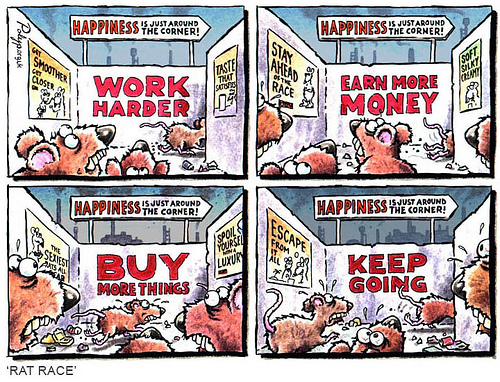
I’ve written before about how Americans are kept divided, distracted, and downtrodden as a way of preventing meaningful, organized, societal change. Another “d” word related to this is discontent. Americans are often discontented in ways that inhibit change. It’s something Tana French touched on in her novel, “The Likeness,” from 2008. Here’s an excerpt:
Our entire society’s based on discontent: people wanting more and more and more, being constantly dissatisfied with their homes, their bodies, their décor, their clothes, everything. Taking it for granted that that’s the whole point of life, never to be satisfied. If you’re perfectly happy with what you’ve got—specially if what you’ve got isn’t even all that spectacular—then you’re dangerous. You’re breaking all the rules, you’re undermining the sacred economy, you’re challenging every assumption that society’s built on. By being content, you become a subversive. A traitor.
To which another character replies: “I think you’ve got something there. Not jealousy, after all: fear… Throughout history—even a hundred years ago, even fifty—it was discontent that was considered the threat to society, the defiance of natural law, the danger that had to be exterminated at all costs. Now it’s contentment.”
There’s a potential paradox here. Won’t the discontented favor positive change, whereas the contented will favor the status quo?
But French’s insight suggests otherwise. The discontented are so busy trying to become contented, most often through a me-first consumerism and materialism, that they can’t come together and mobilize for change. Fear drives them to pursue what their “betters” have, and to admire those people as well. It’s the contented who are dangerous, the ones who’ve left consumerism and materialism behind, the ones with the confidence, time, and independence of thought to contemplate a changed world, a better world. Perhaps even a better America.
The Senate Trial of Donald Trump begins today, though the outcome seems clear: Trump will be exonerated for his alleged role in inciting the Capitol riot.
Democrats will do their best to put all the blame for this riot on Trump. They would be better advised to focus on why Americans stormed the Capitol to begin with, and why 74 million voters chose Trump — despite all his flaws — as their champion back in November.
Trump voters shouldn’t be shoved en masse into a basket of deplorables. Nor should they be dismissed as being beyond redemption, as Hillary Clinton did in 2016. That an incompetent buffoon like Trump could win so many votes says as much about the (lack of) appeal of the Democratic Party as it says about the grifter skills of Trump.
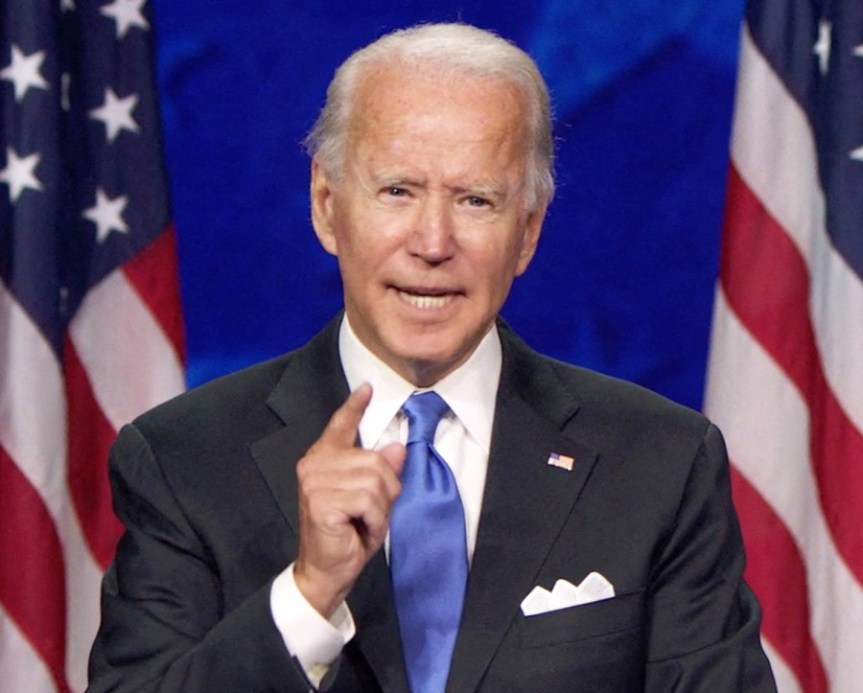
If Democrats want to continue winning elections while actually doing their jobs as public servants, they’d advance policies that would help ordinary Americans. So far, signs that the Democrats understand this are few. Joe Biden has already said the Covid relief package may not advance the policy of a $15 minimum wage. Covid relief checks, promised at $2000 and pronto, are already reduced and delayed until March at the earliest. Medicare for all is dead; so too is a single-payer option. Biden and Pelosi have promised only extra funds for people to buy high-priced private health care coverage in Obamacare markets.
Americans support Medicare for all. Americans support a higher minimum wage. Americans desperately need Covid relief now. And so far Biden and his establishment Democrats are failing on all of these. This isn’t a bug or glitch in the Democratic matrix, it’s a feature. “Nothing will fundamentally change,” Biden said before his election, and that’s the one promise he may well keep.
Joe Bageant knew the score. A self-confessed “Appalachian native who grew up dirt-eating poor,” Bageant explained how he’d “managed to live a couple of decades in the middle class as a news reporter, magazine editor, and publishing executive.” He also knew to keep his eyes and ears open, writing in September 2008 that “the liberal middle class is condescending to working-class redneck culture–which is insulting, but not a crime. The real crime is the way corporate conservatives lie to my people, screw us blind, kill us in wars, and keep us in economic serfdom.”
If you read “corporate conservatives” as Republicans, you’d be only half-right. As a term, “corporate conservatives” includes Joe Biden, Kamala Harris, and most of the people around them inside the Washington Beltway. That doesn’t bode well for “redneck culture”–and it most certainly doesn’t bode well for the country.
Americans are tired of being lied to and disrespected and mistreated. They are also in many cases desperate for help. Angry and desperate people do not make for normalcy. Nor are they an obliging audience for the tepid and often phony acts of corporate politicians, whether Democrat or Republican.
Reading an article by historian Dennis Showalter*, a friend and mentor, reminded me of how the Nazis mobilized “the petty spite and everyday resentment” of “frustrated little men and good Germans” of the early 1930s. About these people Showalter wrote: “They wanted help. They wanted to voice grievances. They wanted to be heard. They turned to the Nazis because the Nazis expressed sympathy for their problems and implied the possibility of solutions in the framework of a new order.”
Trump’s appeal, of course, was to an old order (Make America Great Again). But it wasn’t entirely retrograde or racist. Trump succeeded in showing sympathy for ordinary Americans, e.g. their loss of jobs due to trade deals that favored the richest of Americans, and he did promise solutions even as he failed to deliver on them. Even after all his debacles and disasters, 74 million Americans still voted for him instead of the Democrats.
A few days ago, I was watching an interview of Ralph Nader as he described the powerbrokers of the Democratic Party. A few of his choice words about them: arrogant, bureaucratic, decrepit, exclusive, and indentured (to corporations and special interests). I don’t think Nader is wrong here.
So, as the Democratic Party postures and sputters against Trump this week, they’d best remember that the real issue is helping ordinary Americans, including those in “redneck culture.” People want to be heard, and if Democrats are unwilling to hear them, others will.
* Showalter, “Letters to Der Sturmer: The Mobilization of Hostility in the Weimar Republic,” Modern Judaism, 3 (May 1983), 173-87.
P.S. If you liked this article, perhaps you’ll consider chipping in $12 as a donation. The PayPal button in the sidebar makes it easy. Thank you.
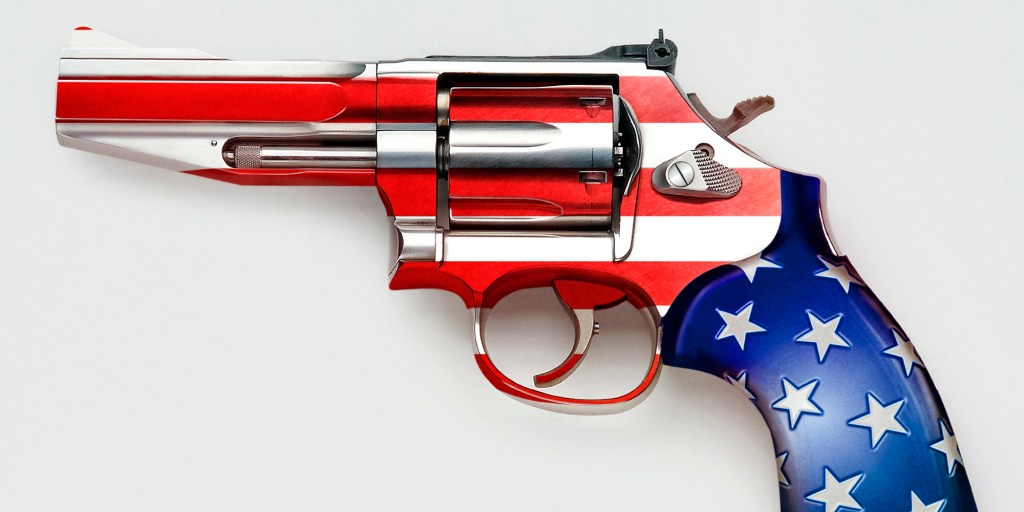
Today, I was reading some stats about guns in America in The Nation. Did you know gun sales went up 40% in 2020 when compared to 2019? Did you know 3.9 million guns were sold in America in a single month (June 2020), at the height of the BLM protests? Did you know that, according to the trade association for the U.S. firearms industry, Americans own roughly 434 million guns, including 20 million AR-15s and its variants? Did you know that roughly 43% of U.S. households have one or more guns, and that the U.S. has “the most heavily armed civilian population in the world”?
An old joke says that lots of guns make for a polite society, but I haven’t seen much politeness lately. I’ve seen plenty of guns, though.
Even as America dominates the world in gun ownership, we continue to have the world’s largest and potentially cataclysmic array of nuclear weapons. Nuclear deterrence allegedly requires more than five thousand (5000!) nuclear warheads in the U.S. military’s inventory. (It’s quite possible that a mere fifty nuclear explosions could be enough to trigger a global nuclear winter.)
America is indeed exceptional: exceptional in its pursuit of overkill.
I know some might ask: What do guns have to do with nuclear warheads? I’d say that the gun has become the nuclear option in the home. Dead men tell no tales, whether shot or nuked.
Why do Americans feel so safe with so many guns? Why do they feel so safe with so many nuclear warheads? Why do we continue to buy more and more?
It’s a uniquely American form of madness. Or MADness, as in mutually assured destruction.
Look, before the 2nd Amendment crowd comes, packing heat, I’ve owned guns myself and have no objection to anyone who’s a hunter, or anyone who truly needs a gun and gets properly trained in its use. But what we’ve witnessed with the proliferation of guns in America over the last two decades is inexplicable in terms of sport hunting or any real need.
It’s been said we can’t allow the smoking gun to become a mushroom cloud. What if there is, in essence, no difference? Dead is dead, whether shot or nuked, and 434 million guns have a “throw weight” and a “fallout” of their own.
Isn’t it time that Americans found a way to destroy their own weapons of mass destruction? At least we won’t have far to look for them.
I’d like to say I don’t see race or color or ethnicity and so on, but of course I do. We all do, once we’re alerted to it. Racism exists in our society, and in fact I’ve been an instrument of racism myself.
At my first job, when I was about seventeen, a Black man came into the shop where I worked. He was looking for an apartment to rent (there were rental apartments above the shop). He asked me to check on a listing he’d seen. I left the counter and asked the boss in back. The boss peeked out and saw who it was — that is, the color he was — and told me to tell him the apartment had been rented. I did so, and the Black guy looked at me and said, “I just called a few minutes ago and was told you had an apartment.”
I felt ashamed and used; the boss later told me he’d rented apartments to “them” before and had had trouble. The Black guy I’d talked to was the epitome of class; he just shook his head at me and walked out. I think he understood, from my apology (“Sorry — my boss told me it’s been rented”), that I was merely a messenger boy, an instrument of another person’s racism.
Three other small episodes from my high school years. I recall a race riot in my high school (there were about 6000 students at my school), and I remember one of my white friends told me he’d talked to one of his Black friends who’d said, “I’m not your friend today,” during the riot. Second, I recall a friend (white) who got into a fight with a Black kid in school, after which he told me one of the white teachers had complimented him. (Imagine a teacher complimenting a student for fighting simply because the student had punched a Black kid.) Finally, I remember taking a school bus that I didn’t normally take. I tried to sit next to a Black kid and he told me I couldn’t sit there. This was repeated again until a Black girl told me to come sit next to her.
The shock of being told I couldn’t sit next to another student because of the color of my skin stayed with me. I have no resentment against the kids who said it; indeed, it made me realize, in a small way, the prejudice these kids faced every day from white America. I gained a little empathy that day.
All this is on my mind due to this remarkable interview between Daryl Davis and Jimmy Dore, which is frank and moving in its discussion of racism and some of the ways we can fight against it and overcome it in America. I welcome your thoughts and comments on this.
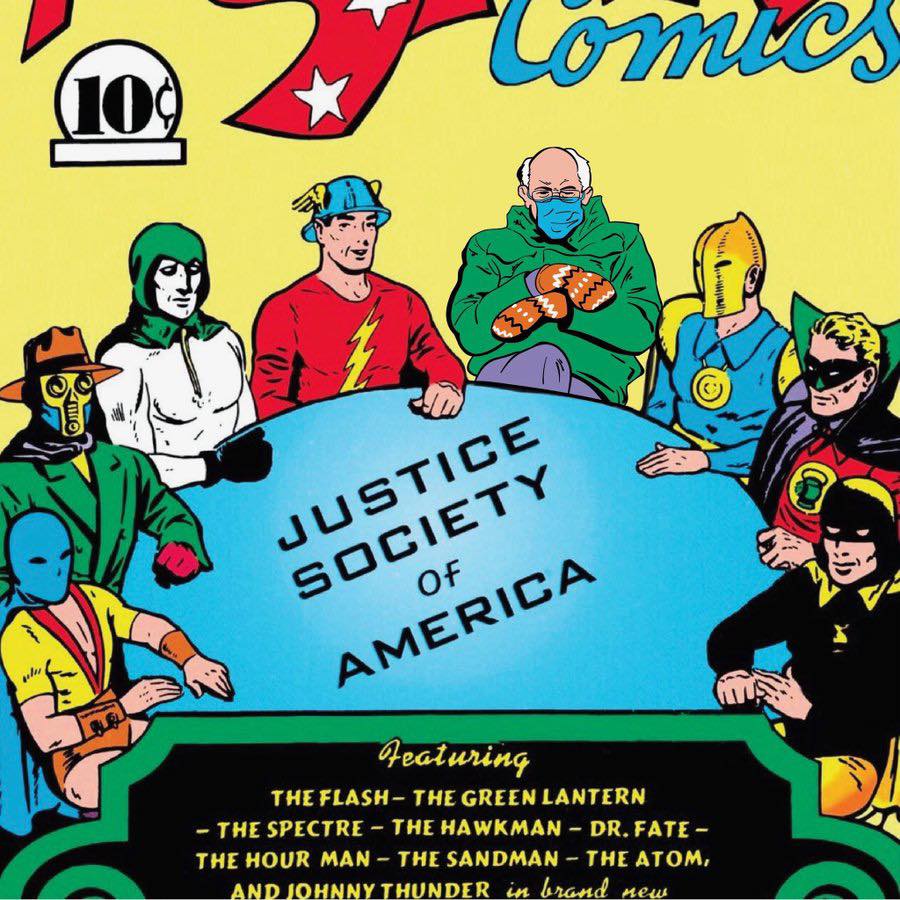
The Bernie Sanders meme has been good fun over the last few days. At an inauguration ceremony where everyone was dressed to the nines, like the rulers of the Capitol in “Hunger Games,” Bernie looked like one of the downtrodden from the districts. He looked like one of us. A no-frills man of the people. And so the photo of him with his practical coat and handmade mittens has caught on exactly because it was real. As Caitlin Johnstone put it,
“This is why something as simple as Bernie Sanders turning up in mittens captured everyone’s hearts and imaginations. It was such a glitch in the whole phony performance and such a nice break from being lied to all the fucking time. We need to give people that experience way more.”
Special Guest Star: Mitten Man
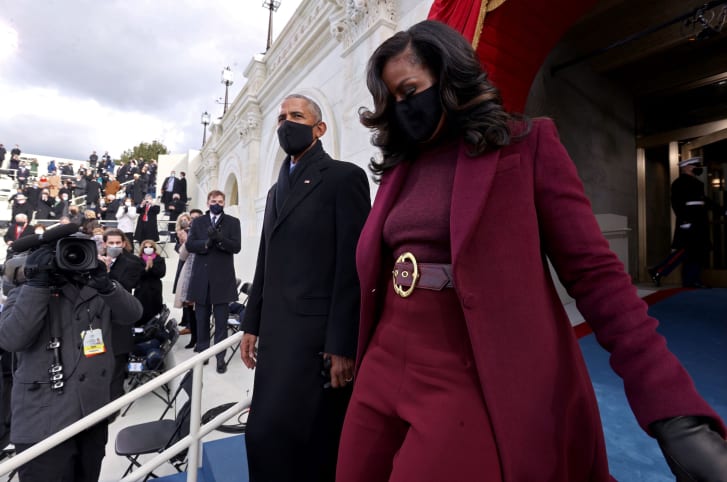
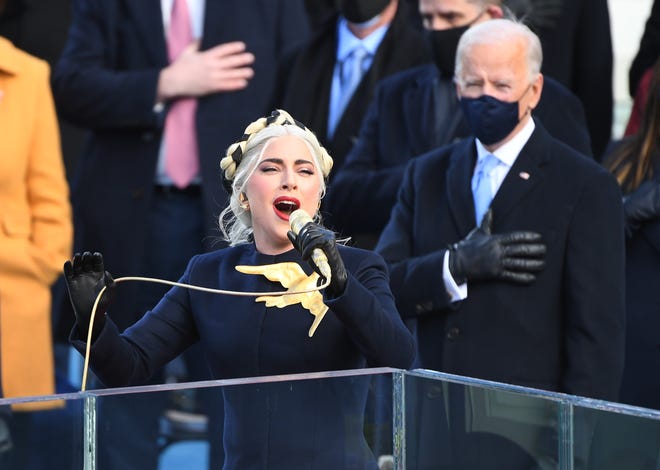
Bernie has already been pushing and pressuring the Biden administration to be more aggressive in helping people suffering in the districts, to use “Hunger Games” terminology. (We’d say “flyover country.”) Meanwhile, back in the Capitol, people were gushing over Michelle Obama’s fashion sense, or Lady Gaga’s inaugural outfit, with its huge golden bird that truly echoed the privileged getups of Capitol denizens (credit to Ron Placone for the Gaga/Hunger Games reference).
CNN was gushing over the splendor of Michelle Obama’s outfitA full-throated Lady Gaga. If only that golden bird had been a mockingjay.
“In this moment of unprecedented crises, Congress and the Biden administration must respond through unprecedented action. No more business as usual. No more same old, same old.
Democrats, who will now control the White House, the Senate and the House, must summon the courage to demonstrate to the American people that government can effectively and rapidly respond to their pain and anxiety. As the incoming chairman of the Senate budget committee that is exactly what I intend to do.”
Good luck, Mitten Man. We need you now more than ever.
A shining example of awesome splendor and timeless exceptionalism
W.J. Astore
A Few Heretical Thoughts as America Celebrates Itself
Back in the days of the Cold War with the Soviet Union, most Americans took pride in not being like the USSR, or our image of the USSR. We, the USA, were not a militaristic empire. We, the USA, didn’t have state propaganda. We, the USA, took in Soviet dissidents who spoke out against state abuses of power and for personal freedoms. We, the USA, didn’t have old sclerotic leaders who were simply figureheads for elites. We, the USA, didn’t have military forces in the streets to maintain order. And so forth.
I was thinking about this today because Trump didn’t pardon Edward Snowden, whose only sanctuary is Russia. I was thinking about this today because some of the more interesting shows with critical coverage of the USA are on RT, a Russia-owned network. (I’m thinking here of shows hosted by Jesse Ventura and Chris Hedges. Their outspoken criticism and honesty is rarely heard on America’s mainstream media networks.) I was thinking today of a mainstream media that’s celebrating the inauguration of an aging man, Joe Biden, who’s visibly in decline and who is a tool for the establishment. I was thinking today of the nation’s capital that resembles an armed and fortified camp for a “peaceful” transference of power.
These are uncomfortable thoughts, I know.
Similarly, my wife and I were joking this morning about what the Washington Football Team should call itself, now that the “Redskins” has finally been rejected as impolitic and inappropriate. An innocuous name like the Washington Monuments came to mind. But if we wanted to be more honest, how about the Washington Lobbyists? The Washington Bullies? Or the Washington Awesome Splendor of Timeless Exceptionalism (WASTE)?
The idea for the latter name came from a recent statement the Trump administration released in support of a “Garden of American Heroes.” Here’s a sample of the rhetoric:
The garden’s purpose is “to reflect the awesome splendor of our country’s timeless exceptionalism.”
The garden of heroes “is America’s answer to [a] reckless attempt to erase our heroes, values and entire way of life. On its grounds, the devastation and discord of the moment will be overcome with abiding love of country and lasting patriotism. This is the American way.”
A garden of heroes is a perfect antidote to “a dangerous anti-American extremism that seeks to dismantle our country’s history, institutions and very identity.”
So, what Trump was saying is that America’s main enemy is “a dangerous anti-American extremism” that’s seeking to destroy our very identity. Meanwhile, anti-Trump forces are similarly arguing that Trump and his minions represent a dangerous anti-American extremism that’s out to destroy our way of life. Not much room for compromise and unity here, is there?
The Soviet Union collapsed in part due to internal tensions and disorder, massive military spending, and lost wars. A sclerotic leadership was incapable of changing course, and by the time the empire attempted to change course with Gorbachev, it was too late for restructuring and openness.
Is it already too late for the USA? Or does today’s pomp and ceremony promise a new beginning? Readers, what do you think?
I’ve heard a lot of words and historical analogies applied to the Capitol riots. Was it a coup, an insurrection, a putsch? Was it like Hitler’s failed Beer Hall Putsch in 1923? Or was it much more American, an exercise in White supremacy, more like a lynch mob, perhaps? M. Davout asks us to think more deeply about the past, as the Founders did, and turn to the Roman Republic and its own issues with mobs. Read on! W.J. Astore
Friends, Romans, Countrymen…Rioters?
M. Davout
In the days since the Capitol riot on January 6, pundits, politicians, and journalists have been underlining the shocking nature of the events of that day by comparing them to the sacking and burning of the Capitol by British troops during the War of 1812. Perhaps it is too big a stretch to compare the outcome of a military raid by a hostile foreign power to an attempt by a mob of US citizens to overturn a presidential election. A different historical precedent was suggested by Senator Michael Bennet of Colorado (D) in the hours after the Senate reconvened to finish its work of certifying the 2020 Electoral College vote. (The entirety of his remarks can be found between time signatures 27:49 and 33:15 here.)
A visibly shaken Bennet, who at one point in his remarks notes that, “there is a tendency around this place …to always believe that we’re the first people to confront something,” starts off by suggesting that when the Founders wrote the Constitution they were thinking about “what happened to the Roman Republic when armed gangs, doing the work of politicians, prevented [Roman citizens] from casting their ballots for consuls, for praetors, for senators. These were the offices in Rome and those armed gangs ran through the streets of Rome keeping elections from being started, keeping elections from even being called, and in the end because of that the Roman Republic fell and a dictator took its place. And that was the end of the Roman Republic or any republic until this beautiful Constitution was written in the United States of America.”
Putting aside some historical inaccuracies (e.g., Roman senators were not popularly elected), Bennet’s point about the importance of Roman precedent for the drafters of the Constitution and their concern about the destabilizing effects of popular mobs is largely right.
However, the lesson that Roman mobs would teach us in our contemporary moment is more complicated than warning of the threat mobs can pose to a constitutional order.
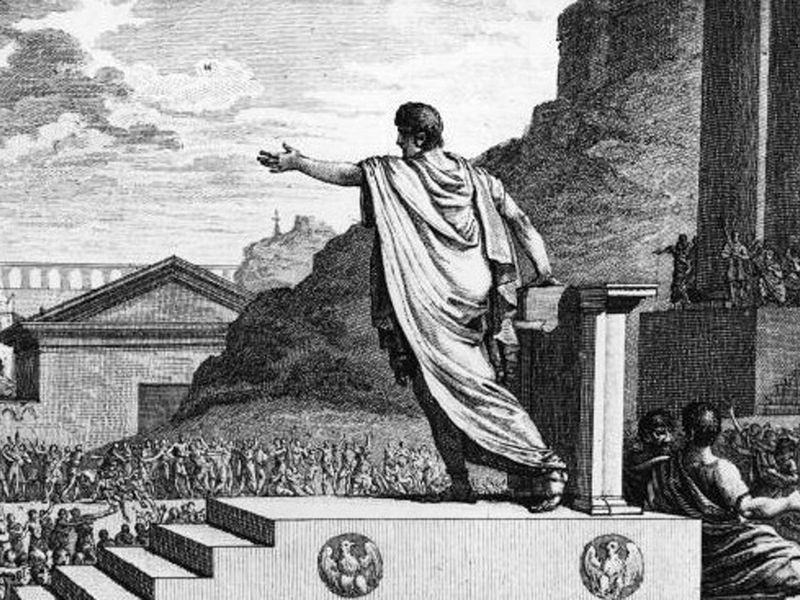
In the late Roman Republic, mobs were indeed politically mobilized against the constitutional order but oftentimes in pursuit of opening that constitutional order to the interests of the common people. Noted ancient historian Moses Finley wrote that, “it would not be far from the truth to say that the Roman populus exercised influence not through participation in the formal machinery of government, through its voting power, but by taking to the streets, by agitation, demonstrations and riots…” It is no small irony that the most (in)famous example of mob action in the Roman Republic was arguably in defense of the constitutional order when the populist tribunes Tiberius Gracchus and then his brother, Gaius, were defeated and killed by mob violence carried out at the instigation of Roman senators who felt their economic interests threatened.
Gaius Gracchus died at the hands of the Senate and mob violence
When the histories of this time are written, will the attack on the Capitol be considered completely sui generis, unique and incomparable to other recent episodes of populist uprising? To be sure, the rioters in the Capitol were motivated by an unhinged demagogue telling a lie, unlike the BLM protesters against an unjust criminal justice system of last summer, or even the 2011-2012 Occupy Wall Street protestors against accelerating levels of politically dangerous social inequality. However wrong and pernicious the rightwing paranoia about the presidential election results was and is, it may become clear from an historical distance that the current instability of our constitutional system has as much, if not more, to do with the corruption of our political representatives by economic elites content to pile up obscene levels of wealth at the expense of the well-being of the rest of us.
Under the continuation of such a corrupted constitutional order, we can expect more popular uprisings, whether rationally motivated and aimed at reforming that order, or cynically incited and aimed at its overthrow. Only time will tell whether such protests, uprisings, and mobs will be in service of the Republic or of elites whose interests are contrary to those of the people.
M. Davout, an at-large contributor to Bracing Views, teaches political science in the Deep South.
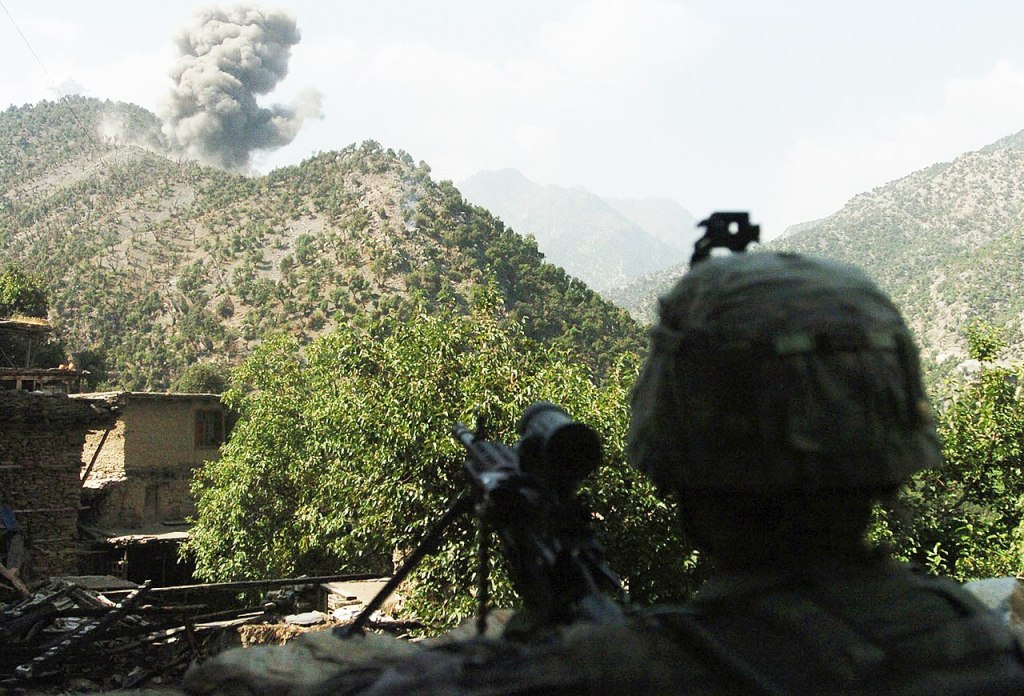
There I wasn’t: The Korengal Valley, Afghanistan, August 2009 (Wikipedia)
W.J. Astore
Combat myths matter to more than just military members. So do their ramifications.
I don’t have any personal war stories to tell. In my twenty years in the U.S. Air Force, I never saw combat. I started as a developmental engineer, working mainly on computer software, and morphed into a historian of science and technology who taught for six years at the USAF Academy. I worked on software projects that helped pilots plan their missions and helped the world to keep track of objects in Earth orbit. I taught military cadets who did see combat and served as the dean of students at the Defense Language Institute at the Presidio of Monterey, where I saw plenty of young troops cross the graduation stage with language skills in Arabic and Pashto and other languages as they prepared to deploy to Iraq, Afghanistan, and elsewhere. But no combat for me.
I got lucky. As one friend, an Army colonel, told me: any day you’re not being shot at is a good day in the Army. The result, however, is that I can’t tell exciting war stories that begin: “There I was” in Baghdad, or Kandahar, or Fallujah, or the Korengal Valley.
But I was involved in computer simulations (“war games”) at Cheyenne Mountain in Colorado near the end of the Cold War. The one I remember most vividly ended with a Soviet nuclear missile strike on the United States. As I watched the (simulated) missile tracks emerge from Soviet territory, cross the Arctic circle, and terminate in American cities, I had a momentary glimpse of nuclear terror. What if I ‘d just witnessed the death of millions of Americans on a monochrome computer screen? That’s a “war story” that’s stayed with me, and so I’m a firm supporter of eliminating all nuclear weapons everywhere.
That’s my “there I sorta was” story. Yet, whether you’ve served in the military or not, all Americans tell themselves war stories, or rather stories about America’s wars. The basic story most tell themselves goes something like this:
America is a good and decent country, our troops are heroes, that we wage wars reluctantly and for noble causes, and that our wars are almost exclusively defensive or preventive. We tell ourselves we don’t want to be bombing and killing in Afghanistan and Iraq and Somalia and Yemen and elsewhere, but we have to be. Bad people are doing bad things, and we need to fight them over there else we’ll have to fight them right here.
Yet what if the stories we tell ourselves are all wrong? What if we are the bad people, or at least the ones doing much of the bad things? And, even if those stories aren’t always wrong and we aren’t always bad, what are the costs of permanent war – all those “bad things” associated with war – to our democracy, what’s left of it, that is?
A book I return to is Every Man in this Village is a Liar: An Education in War, by Megan Stack. Stack was a war correspondent who witnessed the effects of war in places like Iraq and Afghanistan. She focuses not on strategy or tactics or weaponry or combat but on the impact of war on people. And in her chapter on “Terrorism and Other Stories,” she reaches this powerful conclusion:
It matters, what you do at war. It matters more than you ever want to know. Because countries, like people, have collective consciences and memories and souls, and the violence we deliver in the name of our nation is pooled like sickly tar at the bottom of who we are. The soldiers who don’t die for us come home again. They bring with them the killers they became on our national behalf…
We may wish it were not so, but action amounts to identity. We become what we do. You can tell yourself all the stories you want, but you can’t leave your actions over there … All of that poison seeps back into our soil.
Nothing has changed since Stack’s book was published a decade ago. U.S. forces remain in Iraq and Afghanistan, still fighting that word, terrorism, even as there’s renewed talk within the Pentagon of a new cold war against Russia and China. A reboot of that Cold War I thought I’d witnessed the end of thirty years ago. (I even got a certificate signed by President George H.W. Bush thanking me for helping to win that war.) Could it be that real enemy doesn’t reside in Moscow or Beijing, but in us? As Stack continued:
And it makes us lie to ourselves, precisely because we want to believe that we are good … we Americans tell ourselves that we are fighting tyranny and toppling dictators. And we say this word, terrorism, because it has become the best excuse of all. We push into other lands, we chase the ghosts of a concept, because it is too hard to admit that evil is already in our own hearts and blood is on our hands.
As Americans we need to stop telling ourselves self-serving war stories and start telling much tougher ones about working for peace. We need to stop telling (and selling) stories about a new cold war and stop “investing” a trillion dollars in new nuclear bombers, missiles, and submarines. I’ve seen those simulated nuclear missile tracks crossing the pole and ending in American cities; that was scary enough. The real thing would be unimaginably terrifying and would likely end life on our planet.
What mad story can we possibly tell ourselves to justify the continued building of more ecocidal and genocidal weapons?
We humans are great storytellers but we’re not smart ones. Perhaps it’s the power of our stories that has led us to be the dominant and most destructive species on this planet. The problem is that we still tell far too many war stories and value them far too highly. Peace, meanwhile, if mentioned at all, is dismissed as fantasy, a tale to be told to children alongside stories of unicorns and fairies—which, to the first generation of voting age adults never to have known it, it sort of is.
Unless we smarten up and grow as a species, our collective war stories will likely be the death of us.
William Astore, a retired lieutenant colonel (USAF) and history professor, is a senior fellow at the Eisenhower Media Network (EMN), an organization of critical veteran military and national security professionals.
I started writing for TomDispatch.com in 2007. I really thought I had one article to write, focusing on the disastrous Iraq War and the way in which the Bush/Cheney administration was hiding its worst results behind the bemedaled chest of General David Petraeus. Here we are, in 2020, and my latest article is my 75th contribution to the site, which truly amazes me. Special thanks to Tom Engelhardt for publishing my first piece back in 2007 and for setting a stellar example of what alternative freethinking media can be.
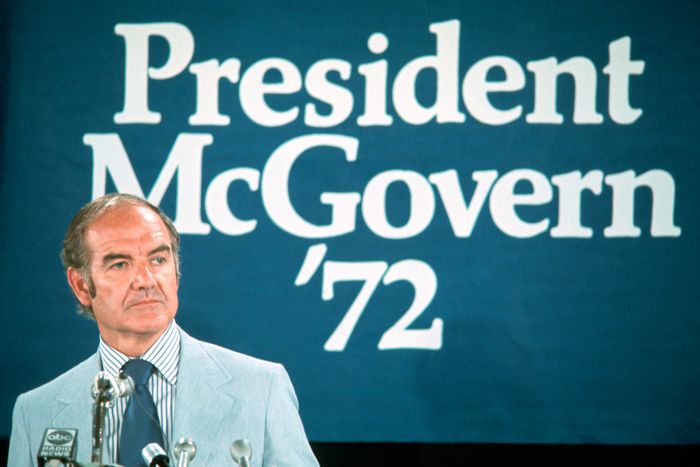
We Could Use A Leader Like George McGovern Again By William J. Astore
As I lived through the nightmare of the election campaign just past, I often found myself dreaming of another American world entirely. Anything but this one.
In that spirit, I also found myself looking at a photo of my fourth-grade class, vintage 1972. Tacked to the wall behind our heads was a collage, a tapestry of sorts that I could make out fairly clearly. It evoked the promise and the chaos of a turbulent year so long ago. The promise lay in a segment that read “peace” and included a green ecology flag, a black baseball player (Brooklyn Dodgers second baseman Jackie Robinson, who had died that year), and a clenched fist inside the outline of the symbol for female (standing in for the new feminism of that moment and the push for equal rights for women).
Representing the chaos of that era were images of B-52s dropping bombs in Vietnam (a war that was still ongoing) and a demonstration for racist Alabama governor and presidential candidate George Wallace (probably because he had been shot and wounded in an assassination attempt that May). A rocket labeled “USA” reminded me that this country was then still launching triumphant Apollo missions to the moon.
How far we’ve come in not quite half a century! In 2020, “peace” isn’t even a word in the American political dictionary; despite Greta Thunberg, a growing climate-change movement, and Joe Biden’s two-trillion-dollar climate plan, ecology was largely a foreign concept in the election just past as both political parties embraced fracking and fossil fuels (even if Biden’s embrace was less tight); Major League Baseball has actually suffered a decline in African-American players in recent years; and the quest for women’s equality remains distinctly unfulfilled.
Bombing continues, of course, though those bombs and missiles are now aimed mostly at various Islamist insurgencies rather than communist ones, and it’s often done by drones, not B-52s, although those venerable planes are still used to threaten Moscow and Beijing with nuclear carnage. George Wallace has, of course, been replaced by Donald Trump, a racist who turned President Richard Nixon’s southern strategy of my grade school years into a national presidential victory in 2016 and who, as president, regularly nodded in the direction ofwhite supremacists.
Progress, anyone? Indeed, that class photo of mine even featured the flag of China, a reminder that Nixon had broken new ground that very year by traveling to Beijing to meet with Chinese Communist leader Mao Zedong and de-escalate the Cold War tensions of the era. Nowadays, Americans only hear that China is a military and economic threat; that Joe Biden and some Democrats are allegedly far too China-friendly (they aren’t); and that Covid-19 (aka the “Wuhan Flu” or “Kung Flu”) was — at least to Donald Trump and his followers — a plague sent by the Chinese to kill us.
Another symbol from that tapestry, a chess piece, reminded me that in 1972 we witnessed the famous Cold War meeting between the youthful, brilliant, if mercurial Bobby Fischer and Soviet chess champion Boris Spassky in a match that evoked all the hysteria and paranoia of the Cold War. Inspired by Fischer, I started playing the game myself and became a card-carrying member of the U.S. Chess Federation until I realized my talent was limited indeed.
The year 1972 ended with Republican Richard Nixon’s landslide victory over Democratic Senator George McGovern, who carried only my home state of Massachusetts. After Nixon’s landslide victory, I remember bumper stickers that said: “Don’t blame me for Nixon, I’m from Massachusetts.”
Eighteen years later, in 1990, I would briefly meet the former senator. He was attending a history symposium on the Vietnam War at the U.S. Air Force Academy and, as a young Air Force captain, I chased down a book for him in the Academy’s library. I don’t think I knew then of McGovern’s stellar combat record in World War II. A skilled pilot, he had flown 35 combat missions in a B-24 bomber, winning the Distinguished Flying Cross for, at one point, successfully landing a plane heavily damaged by enemy fire and saving his crew. Nixon, who had served in the Navy during that war, never saw combat. But he did see lots of time at the poker table, winning a tidy sum of money, which he would funnel into his first political campaign.
Like so many combat veterans of the “greatest generation,” McGovern never bragged about his wartime exploits. Over the years, however, that sensible, honorable, courageous American patriot became far too strongly associated with peace, love, and understanding. A staunch defender of civil rights, a believer in progressive government, a committed opponent of the Vietnam War, he would find himself smeared by Republicans as weak, almost cowardly, on military matters and an anti-capitalist (the rough equivalent today of democratic-socialist Bernie Sanders).
Apparently, this country couldn’t then and still can’t accept any major-party candidate who doesn’t believe in a colossal military establishment and a government that serves business and industry first and foremost or else our choice in 2020 wouldn’t have been Trump-Pence versus Biden-Harris.
Channeling Lloyd Bentsen
As I began writing this piece in late October, I didn’t yet know that Joe Biden would indeed win the most embattled election of our lifetime. What I did know was that the country that once produced (and then rejected) thoughtful patriots like George McGovern was in serious decline. Most Americans desperately want change, so the pollsters tell us, whether we call ourselves Republicans or Democrats, conservatives, liberals, or socialists. Both election campaigns, however, essentially promised us little but their own versions of the status quo, however bizarre Donald Trump’s may have been.
In truth, Trump didn’t even bother to present a plan for anything, including bringing the pandemic under control. He just promised four more years of Keeping America Trumpish Again with yet another capital gains tax cut thrown in. Biden ran on a revival of Barack Obama’s legacy with the “hope and change” idealism largely left out. Faced with such a choice in an increasingly desperate country, with spiking Covid-19 cases in state after state and hospitals increasingly overwhelmed, too many of us sought relief in opioids or gun purchases, bad habits like fatty foods and lack of exercise, and wanton carelessness with regard to the most obvious pandemic safety measures.
Since the presidencies of Richard Nixon and Ronald Reagan, and especially since September 11, 2001, it’s amazing what Americans have come to accept as normal. Forget about peace, love, and understanding. What we now see on America’s streets aren’t antiwar protesters or even beat cops, but Robocops armed to the teeth with military-style weaponry committing indefensible acts of violence. Extremist “militias” like the Proud Boys are celebrated (by some) as “patriots.” Ludicrous QAnon conspiracy theories are taken all too seriously with political candidates on the Republican side of the aisle lining up to endorse them.
Even six-figure death tolls from a raging pandemic were normalized as President Trump barnstormed the country, applauding himself to maskless crowds at super-spreader rallies for keeping Covid-19 deaths under the mythical figure of 2.2 million. Meanwhile, the rest of us found nothing to celebrate in what — in Vietnam terms — could be thought of as a new body count, this time right here in the homeland.
And speaking of potential future body counts, consider again the Proud Boys whom our president in that first presidential debate asked to “stand back and stand by.” Obviously not a militia, they might better be described as a gang. Close your eyes and imagine that all the Proud Boys were black. What would they be called then by those on the right? A menace, to say the least, and probably far worse.
A real militia would, of course, be under local, state, or federal authority with a chain of command and a code of discipline, not just a bunch of alienated guys playing at military dress-up and spoiling for a fight. Yet too many Americans see them through a militarized lens, applauding those “boys” as they wave blue-line pro-police flags and shout “all lives matter.” Whatever flags they may wrap themselves in, they are, in truth, nothing more than nationalist bully boys.
Groups like the Proud Boys are only the most extreme example of the “patriotic” poseurs, parades, and pageantry in the U.S.A. of 2020. And collectively all of it, including our lost and embattled president, add up to a red-white-and-blue distraction (and what a distraction it’s been!) from an essential reality: that America is in serious trouble — and you can take that “America” to mean ordinary people working hard to make a living (or not working at all right now), desperate to maintain roofs over their heads and feed their kids.
It’s a distraction as well from the reality that America hasn’t decisively won a war since the time George McGovern flew all those combat missions in a B-24. It’s a distraction from some ordinary Americans like George Floyd, Breonna Taylor, and Jacob Blake being not just manipulated and exploited, but murdered, hence the need for a Black Lives Matter movement to begin with. It’s a distraction from the fact that we don’t even debate gargantuan national security budgets that now swell annually above a trillion dollars, while no one in a position of power blinks.
Today’s never-ending wars and rumors of more to come remind me that George McGovern was not only against the Vietnam conflict, but the ones in Afghanistan and Iraq, too. Joe Biden, meanwhile, voted for the Iraq War, which Donald Trump also spoke in favor of, then, only to campaign on ending this country’s wars in 2016, even if by 2020 he hadn’t done so — though he had set up a new military service, the Space Force. Feeling the need to sharpen his own pro-war bona fides, Biden recently said he’d raise “defense” spending over and above what even Trump wanted.
If you’ll indulge my fantasy self for a moment, I’d like to channel Lloyd Bentsen, the 1988 Democratic vice presidential nominee who, in a debate with his Republican opposite Dan Quayle, dismissed him as “no Jack Kennedy.” In that same spirit, I’d like to say this to both Trump and Biden in the wake of the recent Covid-19 nightmare of a campaign: “I met George McGovern. George McGovern, in a different reality, could have been my friend. You, Joe and Donald, are no George McGovern.”
Prior military service is not essential to being president and commander-in-chief, but whose finger would you rather have on America’s nuclear button: that of Trump, who dodged the draft with heel spurs; Biden, who dodged the draft with asthma; or a leader like McGovern, who served heroically in combat, a leader who was willing to look for peaceful paths because he knew so intimately the blood-spattered ones of war?
A Historical Tapestry for Fourth Graders as 2020 Ends
What about a class photo for fourth graders today? What collage of images would be behind their heads to represent the promise and chaos of our days? Surely, Covid-19 would be represented, perhaps by a mountain of body bags in portable morgues. Surely, a “Blue Lives Matter” flag would be there canceling out a Black Lives Matter flag. Surely, a drone launching Hellfire missiles, perhaps in Somalia or Yemen or some other distant front in America’s endless war of (not on) terror, would make an appearance.
And here are some others: surely, the flag of China, this time representing the growing tensions, not rapprochement, between the two great powers; surely, a Trump super-spreader rally filled with the unmasked expressing what I like to think of as the all-too-American “ideal” of “live free and die”; surely, a vast firenado rising from California and the West, joined perhaps by a hurricane flag to represent another record-breaking year of such storms, especially on the Gulf Coast; surely, some peaceful protesters being maced or tased or assaulted by heavily armed and unidentified federal agents just because they cared about the lives of George Floyd and Breonna Taylor, among others.
And I suppose we could add something about sports into that collage, maybe an image of football players in empty stadiums, kneeling as one for racial equality. Look, sports used to unite us across race and class lines, but in his woebegone presidency, Donald Trump, among others, used sports only to divide us. Complex racial relations and legacies have been reduced to slogans, Black Lives Matter versus blue lives matter, but what’s ended up being black and blue is America. We’ve beaten ourselves to a pulp and it’s the fight promoters, Donald Trump above all, who have profited most. If we are to make any racial progress in America, that kind of self-inflicted bludgeoning has to end.
And what would be missing from the 2020 collage that was in my 1972 one? Notably, clear references to peace, ecology, and equal rights for women. Assuming that, on January 20th, Joe Biden really does take his place in the Oval Office, despite the angriest and most vengeful man in the world sitting there now, those three issues would be an ideal place for him to start in his first 100 days as president (along, of course, with creating a genuine plan to curb Covid-19): (1) seek peace in Afghanistan and elsewhere by ending America’s disastrous wars; (2) put the planet first and act to abate climate change and preserve all living things; (3) revive the Equal Rights Amendment and treat women with dignity, respect, and justice.
One final image from my fourth-grade collage: an elephant is shown on top of a somewhat flattened donkey. It was meant, of course, to capture Richard Nixon’s resounding victory over George McGovern in 1972. Yet, even with Joe Biden’s victory last week, can we say with any confidence that the donkey is now on top? Certainly not the one of McGovern’s day, given that Biden has already been talking about austerity at home and even higher military spending.
Sadly, it’s long past time to reclaim American idealism and take a stand for a lot less war and a lot more help for the most vulnerable among us, including the very planet itself. How sad that we don’t have a leader like George McGovern in the White House as a daunting new year looms.
William Astore, a retired lieutenant colonel (USAF) and professor of history, is a TomDispatch regular. His personal blog is Bracing Views.
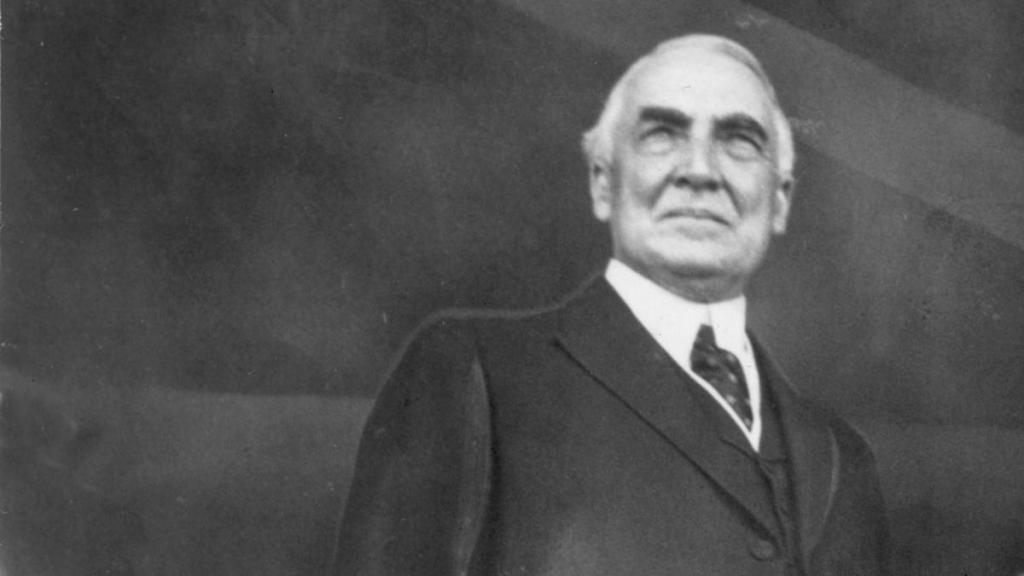
A century ago, Warren Harding bloviated about normalcy.
W.J. Astore
About forty years ago, I took undergraduate courses in U.S. History, where I first learned about “normalcy.” Normalcy came from the (successful) presidential campaign of Warren G. Harding in 1920. After World War I’s devastation and Woodrow Wilson’s attempt at internationalism, what Americans wanted most of all, according to Harding, was a “return to normalcy.” Harding, running against Wilson’s record though not Wilson himself, won the presidency.
Wilson himself favored a sort of high-minded preaching when he addressed Americans; in his own way, he may have been as narcissistic as Trump, and probably more racist. Again, while Harding didn’t run against Wilson, he did run against his legacy, and to many Americans he seemed like a good and decent man and was considered handsome to boot.
Another word associated with Harding’s campaign a century ago was “bloviate,” which basically means BS. A quick Google search confirms that bloviation is “a style of empty, pompous, political speech which originated in Ohio and was used by US President Warren G. Harding.” I guess I did learn something in those history classes.
I mention these two words, normalcy and bloviate, because in many ways they sum up Joe Biden’s strategy in 2020. He’s promised a return to normalcy, i.e. a return to the Obama/Biden years, and this does hold some appeal to Americans who are sick and tired of Trump’s lies and incompetence. But Biden himself has told us little about what he hopes to achieve, preferring to bloviate, which suggests he won’t be doing much to improve the lives of ordinary working Americans, assuming he wins.
The presidency of Warren G. Harding was an ill-starred one. He surrounded himself with corrupt cronies and was humiliated by the Teapot Dome Scandal. Harding died at the comparatively young age of 57 in 1923; his vice president, Calvin Coolidge, took over and led the country until 1928. Interestingly, Coolidge had made his reputation putting down the Boston police strike in the name of preserving “law and order” during the Red Scare of 1919. Perhaps his most famous sentiment as president was the idea that the business of the American people is business. It seemed to make sense during the Roaring Twenties until the Wall Street Crash of 1929.
History, as they say, doesn’t repeat itself but it does echo. Biden/Harris in 2020 is a little like Harding/Coolidge in 1920. Biden is the normalcy guy who bloviates; Harris is the VP who may well have to step in as president, but who as a “top cop” in California was no friend of labor but very much pro-business. Naturally, judging by our history, whether in 1920 or 2020, you can forget about any progressive policies unless and until we experience a cosmic crunch like the Great Depression of 1929. Even then, FDR and the New Deal didn’t come along until 1933.
History can be a depressing subject to take — a record of crimes, follies, and disasters of the past. We’re supposed to learn from it so as to avoid repeating the same. Assuming Biden/Harris win this week, we shall see if there’s any substance to them, or whether it’s just normalcy, bloviation, scandal, and business-friendly policies all over again.



 Bracing Views