I’m a Mutt-American

Enough of the “Heritage America” BS

BILL ASTORE

DEC 11, 2025

I’m a Mutt-American. I’m half Italian, 3/8th English, and 1/8th Swedish. But I’ve never thought of myself as other than 100% American.

Ancestors on my mother’s side go back to the 1630s when they came across the Atlantic to the Massachusetts Bay Colony. Surnames like Wilder, Bird, and Hayward. I’ve been able to trace them back to England and to specific regions, even to ship’s names that they took in emigrating to the New World. At least one of my mother’s ancestors fought in the American Revolutionary War. Take that, J.D. Vance.

Another ancestor on my mother’s side, surname of Johnson, came from Sweden in the 19th century. He was a janitor. Other ancestors were reverends, clockmakers, and tanners, among other occupations. Again, typically American.

On my father’s side, his parents came from Italy in 1902 and 1913, so in that sense my American pedigree is more recent. That said, my father and his two brothers all served in World War II, my dad staying stateside as his two brothers served overseas, one in Europe, the other in the Pacific.

I think my family background is about as typical, as unexceptional, about as “normal” as they come. Unless you are of Native American ancestry, your roots here in America are fairly shallow, relatively speaking. A few centuries at best—not much on the cosmic timescale.

I mention all this because of the Trump administration’s vilification of immigrants, notably so-called illegals. Yes, I think people should immigrate legally to this country, but I don’t think anyone should be demonized.

Ilhan Omar, American (official portrait, 2019)

Trump in particular likes to attack Congresswoman Ilhan Omar, who is a Somali-American. His harsh rhetoric against her is dangerously irresponsible as well as hateful. I see Omar as akin to my Italian grandmother, who proudly became a naturalized U.S. citizen in 1945. 

Trump is a remarkably puny man—a man who thinks he can puff himself up by belittling others. It’s shameful behavior. He should be impeached by Congress and removed for his un-American attacks that endanger other lawmakers—that demean others, that sow discord.

So many immigrants came (and come) to this country seeking a better life, a fresh start, a land where you really could be judged by the content of your character. In its attacks on immigrants, the Trump administration has shown itself to be characterless and wanting of the true American spirit.

Unless you’re Cheyenne or Pawnee or Iroquois or some other kinship group drawn from indigenous peoples, you’re a recent American, and probably a Mutt-American like me. As Americans, we’re all in this together—all equal under the law, all striving to form a more perfect union.

Well, except for Trump and his tribe of dividers. It’s high time they left America. Perhaps Elon Musk has a few rockets ready to send them to the Moon and beyond.

America the Sick and Anxious

And so too are our kids

BILL ASTORE

NOV 25, 2025

“America’s children are unwell.” From the New York Times this morning:

Nearly one in four 17-year-old boys in the United States has attention deficit hyperactivity disorder. In the early 1980s, a diagnosis of autism was delivered to one child in 2,500. That figure is now one in 31. Almost 32 percent of adolescents have at some point been given a diagnosis of anxiety. More than one in 10 have experienced a major depressive disorder, my colleague Jia Lynn Yang reports.

And the number of mental health conditions is expanding. A child might be tagged with oppositional defiance disorder or pathological avoidance disorder. “The track has become narrower and narrower, so a greater range of people don’t fit that track anymore,” an academic who studies children and education told Jia Lynn. “And the result is, we want to call it a disorder.”

Why did this happen? A lot of reasons. Kids spend hours on screens, cutting into their sleep, exercise and socializing — activities that can ward off anxiety and depression. Mental health screenings have improved.

And then there’s school itself: a cause of stress for many children and the very place that sends them toward a diagnosis.

I can’t read the main article since it’s behind a paywall. The gist of the article is that American schooling is hyper competitive, constricting, perhaps too demanding, and therefore a big part of the problem.

Maybe. Schools are also chronically underfunded. Teaching remains an underpaid profession. Classrooms can be overcrowded. Standards vary widely. And parents are stressed as they try to get their kids into the “right” schools. It’s not hard to see how that educational ecosystem might amplify distress.

But the explosion in ADHD diagnoses, autism, and anxiety is surely also driven by Big Pharma.* “We’ve got a drug for that” should be the motto of these companies. Americans are bombarded every day with drug ads promising to change our lives. I’m not a parent myself, but if my kid had trouble focusing or otherwise had behavioral issues, I’d explore medication as an option. I’m guessing it’s easier to get a prescription for Adderall or Ritalin than for kids to get wise treatment and sustained counseling from a psychiatrist or other mental health specialist.

Not just “mother’s little helper”

Some parents may even feel that particular diagnoses confer a kind of status— confirmation that their child is not merely struggling but exceptional in some “high-functioning” or creatively gifted way. That, too, reflects broader cultural forces.(“Annie is autistic and really too intelligent/creative/artistic/sensitive for this world.”)

But beyond parental dysfunction, omnipresent screens, school pressures, and pharmaceutical marketing, there’s a deeper question: Are our kids simply mirroring the broader dysfunction of American society? We live in a culture marked by relentless competition, materialism, polarization, and chronic stress. There’s little about our adult world that could be described as calm or balanced. If our society itself is unwell, why would we expect our kids to feel—or behave—otherwise?

I know it’s not easy, but surely kids need to unplug more (especially from social media, with all its pressures). They need to get outside more. They need to play more—they need more unstructured time. They probably need less stimulation—and arguably more time to be, in a word, bored. To find their own way to play, their own hobbies and interests to pursue, their own path in life.

A dysfunctional society produces dysfunctional kids. If that’s true, how do we make a society that better serves everyone? If American society and culture is uniquely disorienting and destabilizing, can’t we change that? Can’t we make a better saner world for our kids?

Grim factoid: In 2008, Americans consumed 80% of the world’s opioid supply. Though that percentage has dropped to roughly 40% today, what is it about American life that is so painful? Why are we so addicted to (legal and illegal) drugs? And now our kids too?

Readers, what do you make of all this?

*By no means am I dismissing mental illness; my brother Stevie had his first schizophrenic episode when he was sixteen in 1973 and never fully recovered from it. I have friends with a daughter with severe Asperger’s syndrome. My concern here is the vast increase in ADHD, autism, and similar diagnoses and the potential reasons for this.

250 Years of America

What’s It All Mean?

BILL ASTORE

NOV 14, 2025

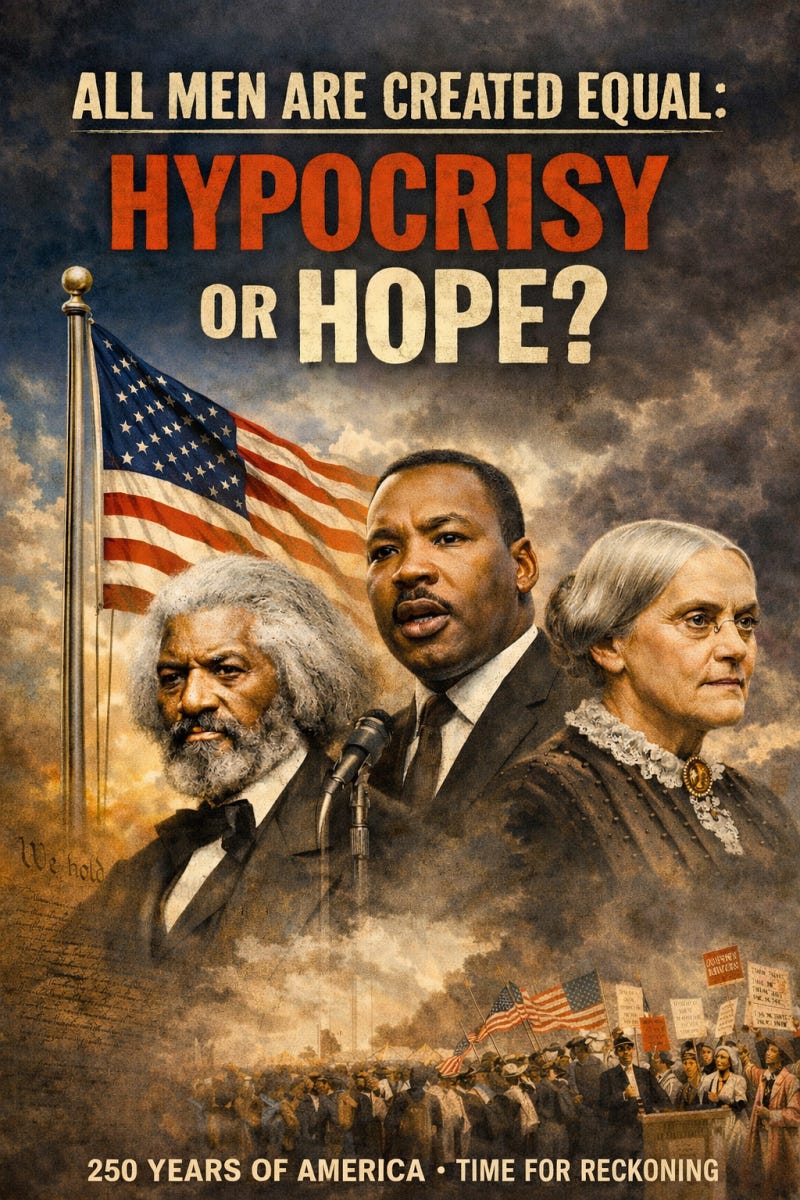
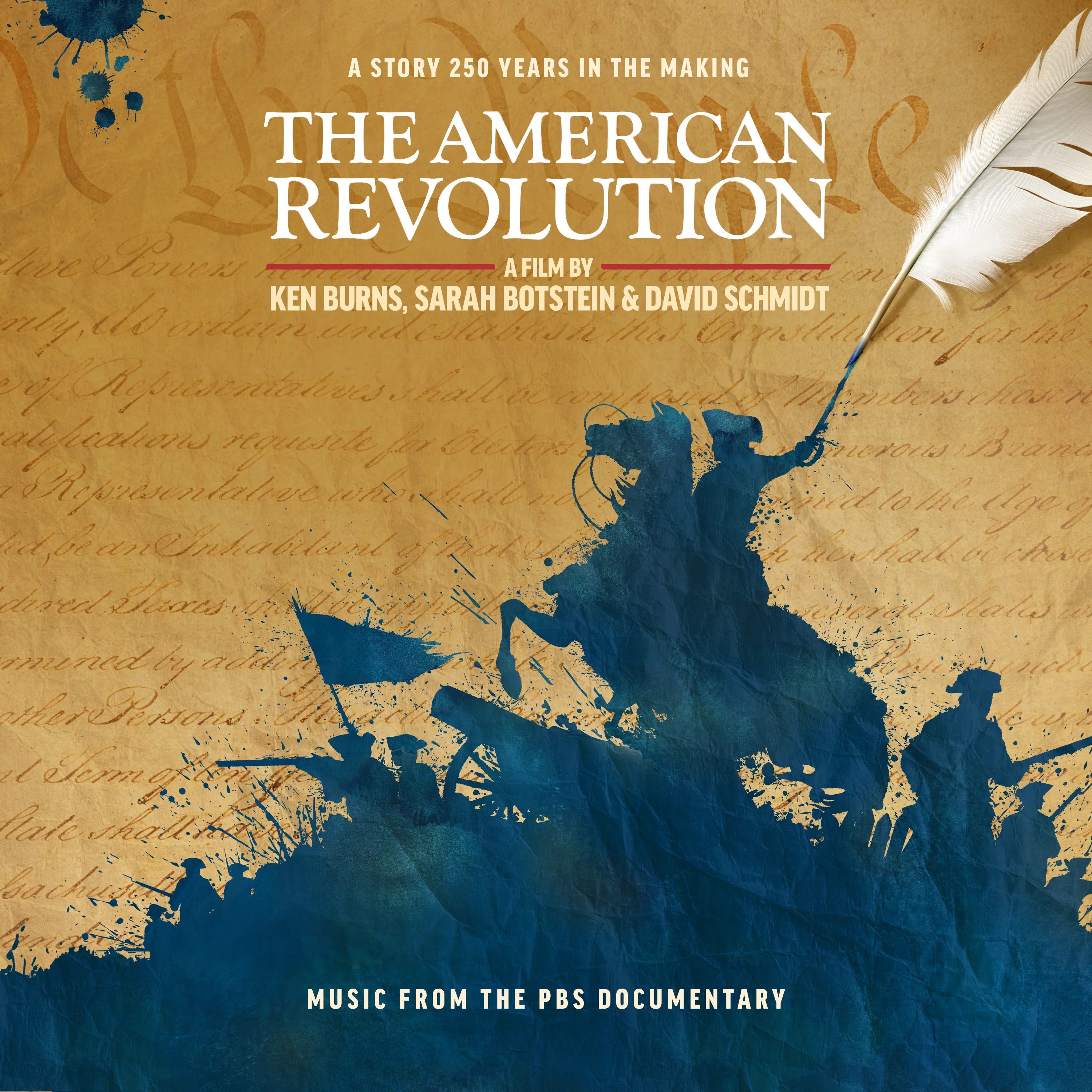
Next year we celebrate the 250th anniversary of America’s founding. There’s going to be the usual fight over what that anniversary should mean to Americans, and what lessons we should draw. For example, the Ken Burns series on “The American Revolution” starts this Sunday night on PBS. I’ll be watching it. If it comes close to his series on the U.S. Civil War, it should be interesting and informative.

There are so many lessons we could take from the American revolution (or war of independence). Speaking as a retired military officer, I might stress the citizen-soldier tradition, the ideal of the Minuteman, the rejection of tyranny, the suspicion of large standing armies, the desire for independence and liberty, the courage to affix one’s name to a declaration that could end with your head swinging in the air.

I don’t know what lessons Trump & Crew will be selling, but something tells me they won’t be salutary. Lots of flag-waving, of course, along with American exceptionalism.

We know America was founded as an imperfect union. Life, liberty, and the pursuit of happiness wasn’t granted to slaves. Or indigenous peoples. Or women for that matter. (Let’s not forget women couldn’t vote for president until 1920.) The founders were mostly white men of property, with some holding “property” in slaves. For African-Americans, the “revolution of 1776” certainly didn’t prove revolutionary for them.

I would stress the idea of striving toward a more perfect union, recognizing the early republic was, in so many ways, imperfect. And that’s putting it gently. I’d stress as well what Benjamin Franklin said. As a form of government, a representative republic is better than most but also difficult to keep. And there’s the rub: today our representatives, our public servants, serve the owners and donors, the power brokers, rather than the people. A revival of the republic isn’t going to come from either major political party—they’re both beholden to money.

So how can we end this “tyranny” without a bloody revolution? Is a national revival possible without years and years of domestic conflict and strife? Meanwhile, can America reject its embrace of militarism and imperialism? Can it advance the rule of law as represented by the U.S. Constitution? Can we be touched, as Abraham Lincoln wrote, by the better angels of our nature?

1776-2026. 250 years of glorious imperfection. We can be better. We can do better. Let’s strive to live up to the promise of America.

Sports and the Military Again

Salute to Service Returns!

BILL ASTORE

NOV 03, 2025

As I watched NFL football yesterday, I noticed coaches on the sidelines wearing “salute to service” fatigue-like hoodies. The NFL does this every year to celebrate the military and to “support our troops.” It’s popular and lucrative to boot, since you can buy this gear on nflshop.com (a hoody will set you back a cool $115).

For $115, you too can own a team hoodie in military olive drab. Hooah!

Sports, especially NFL football, are incredibly powerful and influential within American society.

Back in 2018, I was briefly involved in discussions, associated with the 9/11 Memorial & Museum in New York City, about the role sports played in the aftermath of the attacks in 2001. The general subject was how sports brought the nation together after those attacks. I shared the following comments below with two likeminded colleagues who were involved in the initial discussions, after which I never heard anything from the museum.

I think sports did help to bring the nation together after 9/11. The return of the games showed a return to normalcy. They were a chance for patriotic display and also an opportunity to forget, perhaps for just a moment, the losses America suffered in those attacks.

But they arguably set a precedent. In the aftermath of 9/11, patriotic displays took on a military flavor that has only grown more powerful over the years. My memory is of spontaneous displays that, over time, grew increasingly organized, exaggerated, and linked to corporate and commercial agendas, while retaining a strong military presence.

Anti-war demonstrations failed as the nation mobilized for war against Iraq in 2003. That war proved disastrous. The Bush/Cheney administration hid the costs of war from us (not even allowing us to see flag-draped caskets) and suppressed criticism of a disastrous war by telling us we needed to “support our troops.”

Not to be cynical, but how much of this sports/military/patriotism blending is done, not just for recruiting purposes, but to inhibit any kind of serious (and populist) movement against the “forever” wars we’re waging?

In other words, the post-9/11 sports/military nexus, while it may have soothed the country in the aftermath of 9/11, came with a high price tag: the lack of any serious questions about why we were attacked, and also the discouragement of anti-war protests as both divisive and disrespectful.

To me the high price is reflected in the life of Pat Tillman. He patriotically sacrificed a lucrative NFL career to fight the war on terror. It appears he came to question that war. He was killed by friendly fire [in 2004], which the Army hushed up, giving him a false narrative and a Silver Star under false pretenses. One man’s selfless patriotic act became twisted into a feel-good heroic moment that betrayed the ideals of the Army and of the country (and devastated his family as well).

Does the 9/11 museum really want to tackle tough issues like this? The appropriation of patriotism by the powerful as a way of silencing dissent? The betrayal of ideals we hold dear?

I added the following comment on “camouflage” sports uniforms being marketed around Independence Day in 2018:

I was talking with my wife yesterday. She, like me, hates the camouflage swag that’s been incorporated into sports uniforms. This is not “military appreciation.” It’s more military indoctrination and idolization.

We wear camouflage when we’re in deadly combat. It’s totally inappropriate for games that are supposed to be entertaining and fun, not a matter of life-and-death.

The Romans used gladiatorial games to accustom the mob to violence; to inure them to murder and killing; to train them to support the worst of Rome’s imperial policies. Are we using our games to accustom Americans to incessant warfare and surging military budgets and the “wonders” of our own empire?

I wrote something about this here: As America’s games are becoming more militarized, America’s wars are becoming more game-like, a form of infotainment, at least in the way they’re packaged and sold by the media:

After which I sent another email about the so-called “feminization” of American society:

One more thought, gents: there’s a narrative afoot that America is being feminized. I saw this recently in an article by William Lind. Here’s a quote: “A feminized society indulges in a culture of emotion, of pathos, of weakness.” https://fabiusmaximus.com/2018/07/10/william-lind-a-crying-child-shows-how-america-has-changed/

So I think some of this macho militarism is being promoted as a counter to this “feminized society.” Trump tapped this sentiment, calling for protesters to be punched, for the NFL to allow more violent hits, etc.

We’re all supposed to be “real men” again: sort of like the Reagan years. Remember the book, “Real Men Don’t Eat Quiche”? Now it’s real men punch protesters, wear camouflage, and …

I didn’t finish my list of “real men” activities in 2018. Today, we hear even more about “warrior ethos” and the like, about the need to show toughness, e.g. by summarily murdering people on speedboats in the Caribbean who may, or may not, be drug-runners, or by dragging young teenagers off the streets and shipping them hundreds of miles to detention centers because their papers aren’t in order, and so on.

So, as the NFL persists in wearing pseudo-military gear, perhaps they might consider a new rule that would make every player a member of the reserves or national guard, subject to military recall and service from the months of March to August. If they want to salute military service so vigorously, why not just serve in uniform?

The Vanishing Ideal of Public Service

Of Sharks and Chum

BILL ASTORE

OCT 27, 2025

Remember when politicians had some notion of public service? That ideal now feels positively antediluvian.

What I’d really like to see is a genuine commitment to public service—especially from the most powerful figures in our government. That should begin with a reaffirmation of their oath to the U.S. Constitution as the supreme law of the land, and with a renewed dedication to transparency. Citizens have a right to privacy; the government, by contrast, should not. Yet today we have an unaccountable government that routinely hides behind “that’s classified” or the dark humor of “we could tell you, but then we’d have to shoot you.”

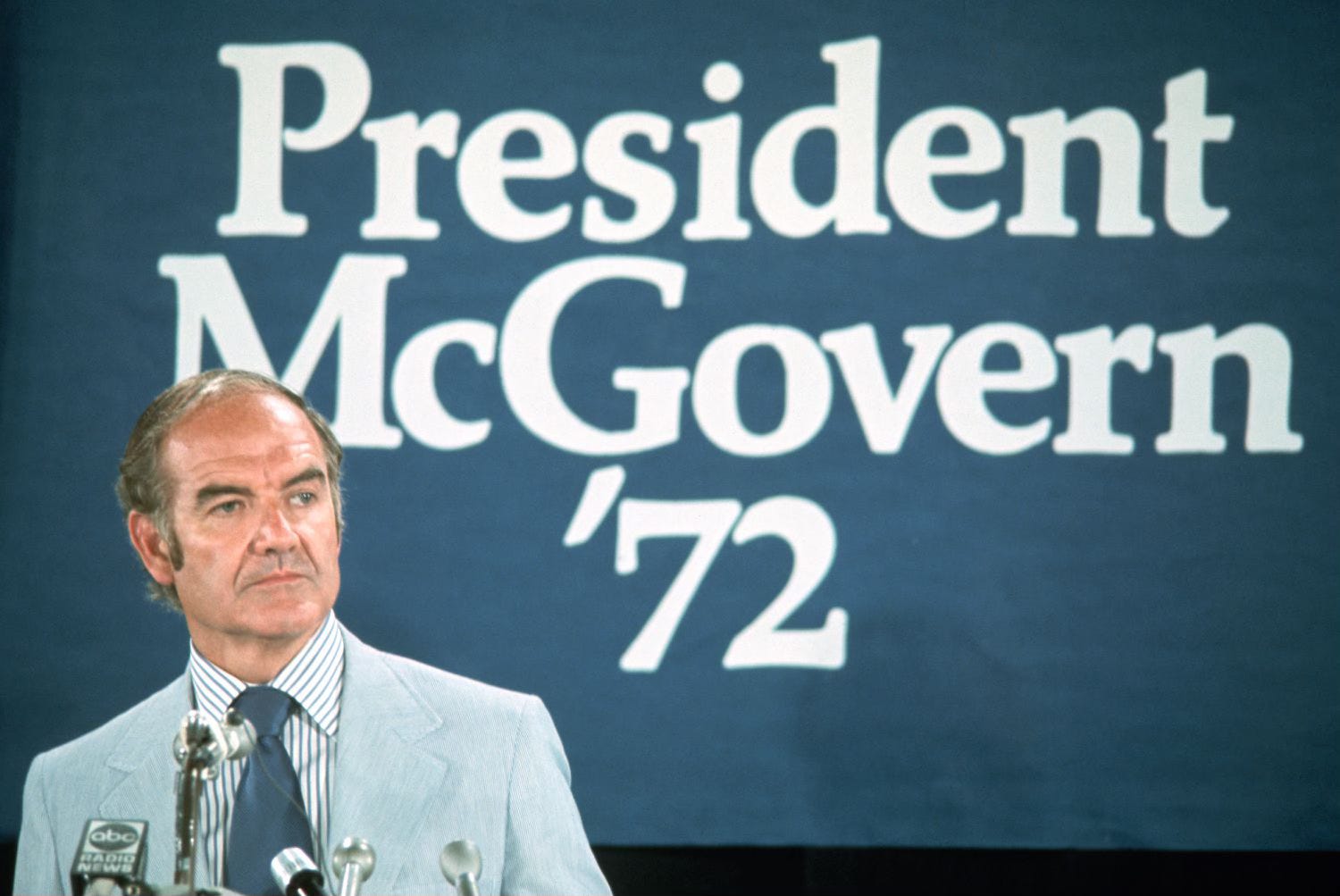
George McGovern, a true public servant

True public service also means not profiting from one’s position. I’d gladly support higher salaries for members of Congress if they swore off investing in sectors where they hold influence or privileged information. (Nancy Pelosi comes to mind, though she’s hardly alone in benefiting through dubious if technically “legal” means.) When, exactly, did public service turn into a “get rich quick” scheme?

It would also be refreshing if members of Congress, retired generals and admirals, and other officials were barred from becoming corporate lobbyists for at least ten years after leaving office. The revolving door between government, industry, and the military breeds conflicts of interest that corrode the public trust.

Once, public service was seen as sacrificial—and therefore honorable. Today, it’s often self-serving, self-enriching, and self-glorifying. Those in power increasingly see themselves as big fish—if not outright sharks—while the rest of us are left as so many minnows, or worse, chum.

It’s hard to imagine America becoming “great again” when the very notion of public service has come to be regarded as something only a sap would believe in.

The Enemy Within

America’s Overseas Wars Have Come Home

BILL ASTORE

OCT 20, 2025

America’s overseas wars, with all their capricious and vicious violence, have indeed come home. For decades, our leaders projected power abroad under the banner of fighting evil — whether Communism, terrorism, or tyranny. Yet in doing so, they helped cultivate an authoritarian mindset that has now turned inward. The “enemy” is no longer some distant foe in a foreign land; it is “the enemy within.” For Donald Trump, that means the mythical “radical left,” a variation of the 1950s fantasy that a Communist was hiding under every bed. The irony, of course, is that the real danger then, as now, comes not from a phantom leftist menace but from a radical right-wing movement willing to strip Americans of their rights in the false name of security, safety, and patriotism.

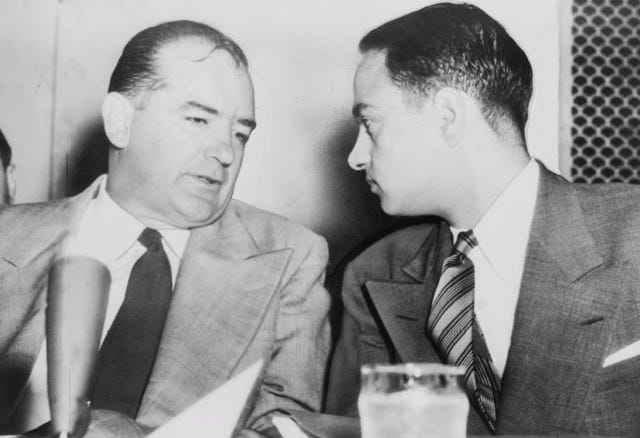
Joe McCarthy (L) with Roy Cohn

Today’s moment is more perilous than the McCarthy era. In the 1950s, Senator Joe McCarthy could destroy reputations and careers, but he was still just one senator. Today, we face a president who channels McCarthy’s demagoguery from the Oval Office, using the full power of the executive branch to punish dissent and reward loyalty. He is surrounded by a coterie of opportunists, lackeys, and lickspittles who feed his vanity, echo his grievances, and amplify his baseless conspiracy theories. The machinery of government — the same machinery once used to surveil and target foreign “enemies” — is now being aimed at our fellow citizens.

The global war on terror, it seems, has finally gone global in the truest sense — extending to America’s own streets, courthouses, and universities. Trump and his allies portray Democratic cities and progressive movements as breeding grounds of chaos and sedition. In his mind, anyone who resists his will — even through the most lawful and constitutional means — is an “insurrectionist.” He has long shown contempt for the Constitution he swore to uphold. Trump is often exactly what he appears to be: a dangerous blowhard with a vindictive streak, ignorant of the limits and responsibilities of his office. Yet others in his orbit, people like Stephen Miller, harbor more deliberate and insidious designs on American democracy.

What is to be done? Congress is paralyzed, fragmented, and largely disempowered. The Supreme Court is dominated by ideologues nursing grievances and eager to reshape the nation along reactionary lines. Who, then, will check a president determined to rule rather than govern?

The American experiment in self-government has endured many crises but rarely has it seemed so fragile. As journalist Nick Turse recently wrote in TomDispatch, the United States now stands on the precipice of authoritarian rule. Many Trump loyalists appear eager to leap — to wage an internal war against their fellow citizens under the guise of saving the nation.

Never has Dwight D. Eisenhower’s warning, “Only Americans can hurt America,” been more prescient or more tragic. The enemy within is not a phantom of the left or right — it is the creeping authoritarianism that grows when fear conquers freedom.

As Master Po reminded us in Kung Fu, “fear is the only darkness.” My fellow Americans, we are in a very dark place.

A Letter to the Catholic Church

With Some Follow-on Thoughts

BILL ASTORE

OCT 14, 2025

Back in June of 2023, I wrote a letter to my archdiocese in response to a request for money. (I am a lapsed Catholic who has in the past given money to the Church.) Here is the letter I wrote, with some follow-on thoughts:

*****

June 2023

Most Reverend ***

Archdiocese of Boston

Dear Reverend ***

I received your Catholic Appeal funding letter dated June 1st. I won’t be contributing…

[Well into the 1990s,] I took my Catholic faith seriously; in fact, my master’s thesis at Johns Hopkins, which examined Catholic responses to science in the mid-19th century, especially Darwinism, geology, and polygenism, was published in the Catholic Historical Review. But scandals involving the Church drove me to question my commitment to Catholicism and especially its patriarchal hierarchy, which was so intimately involved in the coverups of crimes committed against innocents.

I grew up in Brockton, Mass., where the archdiocese assigned a predatory priest to our church of St. Patrick’s. His name was Robert F. Daly. He abused minors and was eventually defrocked by the Church, but far too late. (See the Boston Globe, 6/14/11.)

When I attended St. Patrick’s in the 1970s, Father Daly was teaching CCD. A sexual predator was attempting to teach young people the meaning of Christian love. He had a decent definition for love, something like “giving, without expecting anything in return.” Selfless love, I suppose. Tragically, he obviously failed catastrophically to practice what he preached.

Fortunately, I was never abused. I was supposed to have one meeting with him, alone, that was cancelled at the last minute. I’d like to imagine God was looking out for me on that day, but that’s absurd. Why wasn’t God looking out for all those children abused by Catholic clergy like Father Daly?

To be blunt, I am thoroughly disgusted by the moral cowardice of the archdiocese in confronting fully its painful legacy of failing to protect vulnerable children against predatory priests like Father Daly. Shame on the Church.

The Bible says that all sins may be forgiven except those against the Holy Spirit. This is supposed to refer to a stubborn form of blasphemy. Yet I truly can’t think of a worse sin committed by the Church than to allow innocent children to suffer at the hands of predators disguised as “fathers.”

I sincerely hope you are doing something to change the Church, to reform it, to save it. I fear the Church has not fully confessed its sins, and in that sense it truly does not deserve absolution from the laity. Far too often, the Church has placed its own survival ahead of Truth, ahead of Christ as the Way and the Truth, and thus the Church has washed its hands of its crimes, as Pontius Pilate did.

I am staggered by this betrayal.

Perhaps you have truly fought to reform the Church. If you have not yet done so, perhaps you will soon find the moral courage. I pass no judgment on you. Judge not, lest you be judged. But I do find the Church to be wanting.

Recalling scripture, if the Church does not abide in Christ, should it not be cast into the fire and be consumed?

I am sorry to share such a bleak message with you. I find the Church’s decline to be truly tragic because we need high moral standards now more than ever. Yet the Church is adrift, consumed by petty concerns and obedience to power. Just one example: The U.S. Church cannot even clearly condemn the moral depravity of genocidal nuclear weapons!

I realize I am seriously out of step with today’s Catholic church. I believe priests should be able to marry if they so choose. I believe women who have a calling should be ordained as priests. I believe the Church’s position on abortion is absolutist and wrong. More than anything, I believe the Church is too concerned with itself and its own survival and therefore is alienated from the true spirit of Christ, a spirit of compassion and love.

Unlike you, I cannot in good conscience claim to be “devotedly yours in Christ.” But I am sincere in wishing you the moral courage you will need to manifest your devotion in directions that will help the least of those among us the most. For I well recall the song we sang in our youth: Whatsoever you do for the least of my brothers, that you do unto Me.

Sincerely yours

*****

I’m happy to say I get a thoughtful response from a local bishop, who assured me the Church was serious about reform, was doing all that it could to eliminate pedophilia and to punish those who were guilty of it, and that therefore the Church no longer needed outside policing.

It was the last statement that puzzled me. The Church disgraced itself precisely because it had swept decades of crimes under the rug. Hadn’t the Church learned that earnest attempts at reform by insiders were necessary but not sufficient?

So I wrote back these comments to the bishop:

I will say this as well: I don’t think the Church can police itself from within. That’s what produced the scandals to begin with. It’s like asking the Pentagon to police itself, or police forces with their “internal affairs” departments.

The Church has to open itself to being accountable to the laity, not just to reformers like yourself. Thus the Church has to cede power and a certain measure of autonomy, and institutions are loath to do this, for obvious reasons. Meanwhile, the Church is being weakened by lawsuits, as people seek compensation (and perhaps a measure of vengeance) for sins of the past.

Skeptics would reply that it took a huge scandal with major financial implications to force the Church to do the right thing.

For too long, the Church tolerated these crimes. The Church is hardly unique here. Think of sexual assaults within the military (notably during basic training), or think of the Sandusky scandal at Penn State, where Joe Paterno clearly knew of (some) of Sandusky’s abuse, yet chose not to take adequate action. (I was at Penn College when that scandal broke.)

The challenge, as you know, is that the Church is supposed to be a role model, an exemplar of virtue. Priests hold a special place of trust within communities and are therefore held in especially high regard.

Image courtesy of the Mormon (LDS) Church

As my older brother-in-law explained to me, if a young boy or girl accused a priest of assault in the 1950s or 1960s, few if any people would have believed them. Indeed, the youngster was likely to be slapped by a parent for defaming a priest. That moral authority, that respect, was earned by so many priests who had done the right thing, set the right example. It was ruined by a minority of priests who became predators and a Church hierarchy that largely looked the other way, swept it under the rug, or otherwise failed to act quickly and decisively.

As you say, the Church has learned. It is now better at policing itself. The shame of it all is that it took so much suffering by innocents, and the revelations of the same and the moral outrage that followed, to get the Church to change.

*****

Friends of mine who are still firm believers tell me, correctly, that the Church is much more than the hierarchy. It certainly shouldn’t be defined by the grievous sins of a few. Still, I can’t bring myself to rejoin a Church that so grievously failed the most innocent among us.

There’s a passage in the New Testament where Christ says: “Suffer little children to come unto me.” As in, let the children come, I will bless them, for they in their innocence and humility are examples to us all. He didn’t teach, let the children suffer, molest them and exploit them, then cover it all up. 

I still have respect for priests who exhibit the true fruits of their calling. I still find the teachings of Christ to be foundational to my moral outlook. But I find the Church itself to be unnecessary to the practice of my faith, such as it is. I do hope the Church truly embraces transparency and service; I hope it recalls as well its need to preach life and love and peace, as we need these now more than ever.

Some Qualities of Good Leadership

Does Donald Trump Exhibit Any?

BILL ASTORE

SEP 29, 2025

Recently, I jotted down some qualities of good leadership. Of course, the importance of specific traits depends on context—a leader who is overly cautious may be a liability in a crisis requiring quick action, though less so in a college faculty meeting. That said, here are thirteen attributes I consider essential, in no particular order:

· Decisiveness balanced with care: the ability to decide informed by experience and consultation.

· Integrity and character.

· Bringing people together–motivating and inspiring them.

· Calmness under pressure.

· Leading by example, or “walking the walk.”

· Honor and trustworthiness.

· A commitment to fairness. Setting high standards that apply equally to all.

· Selflessness. A belief in service.

· Compassion. A hard-ass shouldn’t have a hard heart.

· Open-mindedness. A willingness to listen.

· Humility. A willingness to admit no one knows everything or always gets it right.

· Experience (again). While people want to know a leader cares, they also expect competence. Confidence erodes quickly if a leader doesn’t grasp the fundamentals of the job and mission.

· A commitment to ethics, or “doing the right thing.

That’s my baker’s dozen. Sadly, when I measure Donald Trump against these qualities, I don’t see him embodying any of them with consistency. Yet his supporters insist he is not only effective but “great.” In Trump’s case, does he have the integrity to support and defend the U.S. Constitution? Does he realize that no man is above the law? Is the example he sets a selfless one? Does he bring people together for the greater good?

In business and the military, leadership is often judged narrowly by results—profits earned, battles won. But that standard can elevate sociopaths, people who care only about themselves and about producing results at any cost. Such leaders may achieve short-term gains, like higher profits, but at immense costs to those beneath them. Ultimately, a self-absorbed, “results-at-any-cost” leader drives organizations into the ground.

Leadership can be lonely, in the sense of “uneasy lies the head that wears a crown.” True leaders must sometimes accept unpopularity, stand firm, and take responsibility—“the buck stops here.” Leadership is both privilege and burden, which is why many shy away from it. Sociopaths, by contrast, don’t hesitate; they feel no weight from the consequences of their actions.

So, America, are we doing our best to identify the right—truly qualified—leaders? Evidence suggests we are not.

A final thought. I was once asked, as a young lieutenant competing for “Company Grade Office of the Quarter,” to explain the difference between management and leadership. For management, I said something about teamwork, smarts, effectiveness—taking on a project and bringing it to fruition. For leadership, I remember saying something like the ability to make good things happen. Here I was inspired by Chief Dan George in “Little Big Man” when he asks the Great Spirit “to grant me my old power—to make things happen.” And I remember a friend of mine, another lieutenant, saying the selection board loved short snappy answers. Maybe it was true—I won the award for that quarter.

Competitive Consumption as America’s Pastime

The Real American Way

BILL ASTORE

SEP 24, 2025

Competition can be a good thing. Think of sports, for example. Would victory have any meaning without competition? If we just randomly selected a winner each year of the Super Bowl or the World Series, who would care?

Competing is completing—a way to motivate oneself, to better oneself. That said, “victory” is more than just lifting a trophy in triumph. How you got there—how you treated your fellow competitors along the way—matters too. 

I remember a saying—If you’re not enough before the gold medal, you won’t be enough with it. Competing honorably, giving your very best, is really what it’s about, not just shiny medals and trophies. If your soul is empty, if your heart is cold, the glow from even the highest accolade will fade—and quickly.

Too often in our society, competition is embraced for the sake of dominance. For some, winning has no meaning unless others suffer by losing. A real winner, however, lifts up others even as she or he is competing to be the very best.

This is a lengthy prelude to an article I thought I would write about Americans competing for everything. Cooperation? Fuhgeddaboudit! Competition for everything, always, calls to mind a cutthroat world in which only the fittest—or the most ruthless, the nastiest—survive and thrive. 

Far too often, competition in America is further expressed through materialism, buying, and display. Competitive consumption, if you will. Over-the-top displays of dominance: having the biggest yacht, the loudest stereo system, the largest truck, the most expensive SUV, the most exotic pets, you name it.

America, let us say, is not a country known for its restraint. But as I thought about consumption as a national pastime, I recalled the great monologue on America by comedian George Carlin, who in less than eleven minutes dissected the American way with more power and wit than just about anyone else I’ve heard. His lessons were grim, but Carlin spoke from his heart and warned us we were losing our way in mindless consumption.

Every now and then, I rewatch the 11-minute clip below to give myself a cold slap of reality. Believe me, there’s a lot in his monologue to digest. And a lot of profanity as well—consider yourself warned.

The End Game for Gaza

Using Old Tools of War

BILL ASTORE

SEP 12, 2025

I’ve taught military history “from Plato to Nato,” as we used to joke, but my expertise focused on technology and warfare. Along with “revolutions” and “transformations” in weaponry, I probably spent too much time focusing on “decisive battles” and “great captains” in history. When you look at the course of military history, most deaths from war didn’t come in battle. They came from hunger and disease, from famine and pestilence. Sometimes, mass starvation and pandemics were unintentional byproducts of chaos and societal disruption caused by war, and sometimes starvation and disease were intentional weapons and products of war.

And behold a pale horse, and his name that sat on him was Death

You might call this apocalyptic war, from the Bible and the Four Horsemen of the Apocalypse, which included famine and pestilence among the death riders.

An apocalyptic fate seemingly awaits Palestinians in Gaza. I’ve written about Gaza as a genocide, the mass bombing by Israel, the mass killing, with the apparent goal of forcing Palestinians out of Gaza, but I haven’t given enough thought to the use of mass starvation and diseases as weapons in this genocide.

A reader, Dan White, brought this lesson home to me, and I’d like to quote his message to me at length:

I can’t think of a better word than the etiology of starvation. It hasn’t been adequately addressed by the snoozemedia. Starvation death rates have a funny shaped curve. During the first stages of starvation–can’t give any figures on a time period for this or any other part of the process/curve, due to there being varying levels of food deprivation–there are few deaths, generally (but not always) those persons with compromised health/preexisting health problems that make them more susceptible to death than others in the population. After some (varying length) period of starvation, people start to die in larger numbers, and then all of a sudden, everyone is dying, and then everyone is dead. This period of death is fairly short compared to the period of starvation. Again, due to varying levels of starvation and varying levels of preexisting health and varying levels of surplus consumable body tissue in the starved group, this period has no fixed length, but it happens all of a sudden, and it doesn’t take long for everyone to die once it starts–couple of weeks seems common.

The starving residents of Gaza haven’t reached the mass-death stage of starvation, but it could well start happening tomorrow. I can’t say because I don’t know the food reserves preexisting, the food delivery figures since the ‘war’ started, and nobody in the news biz has bothered to look for them, either. There really should have been some government or multistate agency who has looked for them and published them, but nobody has.

When the mass-death stage hits, people in Gaza will be dying by the tens of thousands a week. Stopping the mass-death by all of a sudden providing food isn’t going to work very well, on account of logistical delivery problems and the medical problems of alleviating starvation at this advanced stage–folks’ digestive tracts may well not work well enough even if they get food. That will be the real genocide, and I’d bet money it happens, and bet more money that this is the real objective of Israel’s ‘war’ in Gaza. The notion of Israel’s war objective is displacement of Gazans is an absurdity–you want someone to leave, well they have to be able to walk, right? And they have to have a place to go. Israel is counting on the rest of the world to all of a sudden do a mass-evacuation of Gazans combined with a mass feeding and mass medical intervention all at the same time in order to prevent this mass death of Gazans from occurring? NFW–Israel’s leaders have accepted mass killing as an official state policy, and have commenced doing it, and do it as we speak. And Israeli hasbara [propaganda] will blame us for it, and a whole lot of whored-out American and European politicians, as well as Israel-worshipping American Jews, will go along with it.

What Dan White posits here is horrifying—and increasingly likely. Of course, as people are weakened through starvation, they become more susceptible to various diseases associated with famine and unsanitary conditions.

These “old” weapons of war—starvation and disease—will serve as the grimmest of reapers among the Palestinians in Gaza.

The “mass-death stage” of starvation is nearing, unless the U.S. and other countries intervene to force Israel to allow adequate food and medical supplies into Gaza. A failure to act will only spur the pale horse on whose back Death sits.