As Russia Weakens, Why Is Pentagon Spending Set to Soar?

W.J. Astore

Overall, the Russian invasion of Ukraine isn’t going well for Russia. If reports are correct, the Russian military hasn’t distinguished itself. Poor logistics, bad intelligence, lack of effective air support, and an increasing reliance on brute strength appear to be features of this campaign. Meanwhile, Russia is suffering from debilitating economic sanctions imposed by the West. In sum, Russia is weaker today than it was three weeks ago before the invasion. So why is Pentagon spending set to soar in the coming fiscal years?

A friend sent an article along from the New York Times that sums up this insane moment in Washington. He suggested that I re-post it here and make some comments on it. Here goes (my comments in italics):

War in Ukraine rallies support in Congress for more military spending

Catie Edmondson

The New York Times

WASHINGTON — From his perch as chairman of the Armed Services Committee, Rep. Adam Smith, D-Wash., has long lamented what he sees as a Pentagon budget bloated by inefficient spending. When hawkish lawmakers led a successful charge last year to pour nearly $24 billion more into the military’s coffers, he opposed the move.

But last week, as Russian forces continued their assault on Ukraine and he pondered the size of the coming year’s military budget, Mr. Smith sounded a different tone.

“I haven’t picked a number yet,” he said, “but without question, it’s going to have to be bigger than we thought.”

Yes, the Pentagon budget is “bloated” and “inefficient.” You don’t solve that by giving the Pentagon yet more billions!

He added: “The Russian invasion of Ukraine fundamentally altered what our national security posture and what our defense posture needs to be. It made it more complicated, and it made it more expensive.”

No, the invasion hasn’t “fundamentally altered” America’s “defense posture.” If anything, a weakening Russia means we can spend less money on defense, not more.

His shift signals a stark new reality facing President Joe Biden on Capitol Hill, where Democrats had already shown they had little appetite for controlling the defense budget, even as Mr. Biden declared an end to the era of ground wars and indicated he wanted to reimagine the use of American power abroad.

How interesting. I thought “American power” was about “defense.” Why does this have to be “reimagined”?

Now, facing a military onslaught by President Vladimir Putin in Ukraine, and rising fears of a protracted war in Europe and an emboldened China, lawmakers in both parties — including some who had resisted in the past — are pressing for vast increases in military spending to address a changed security landscape.

Why are more weapons and more wars always the answer to a “changed security landscape”? What is the sense of “vast increases”?

As images pour out of Ukrainian cities devastated by a relentless and indiscriminate volley of Russian missiles, Democrats and Republicans who have struggled to coalesce behind meaningful legislation to aid the Ukrainian cause are rallying around one of the few substantive tools available to them: sending money and weapons.

The House this week is poised to approve $10 billion in emergency funds to Ukraine, including $4.8 billion to cover the costs of weapons already sent to Ukraine and eastern flank allies, as well as the deployment of U.S. troops. But already on Monday, Sen. Chuck Schumer, D-N.Y., the Senate majority leader, suggested lawmakers could approve a $12 billion package, in a sign of how eager lawmakers were to send more aid to Kyiv. The United States alone has deployed more than 15,000 troops to Europe, while committing an additional 12,000 to NATO’s response force if necessary.

$10 billion in “emergency funds” is now more than $13 billion for Ukraine. How come America’s poor and neediest can’t get that level of aid, and that quickly?

Beyond funding immediate needs, the consensus around more generous Pentagon spending previews a dynamic that is likely to drive negotiations around next year’s defense budget, potentially locking in the kind of large increases that Mr. Biden and many Democrats had hoped to end.

This is false. Biden ran for president promising increases in Pentagon spending over and above what Trump had proposed.

“I think people are sort of waking up out of this haze that we were living somehow in a secure world,” said Rep. Elaine Luria, D-Va., who sits on the Armed Services Committee.

WTF? We live in an insecure world because of wanton spending by the military-industrial-congressional complex.

Ms. Luria added: “I was not satisfied with the budget that came over last year from the White House, especially in regards to China, especially in regards to the Navy or shipbuilding, and I’ll be very disappointed, in light of the new world situation, if they come up with a budget like that again.”

The rapid shift in thinking is a setback for progressives who had hoped that unified Democratic control of the House, the Senate and the White House would translate into a smaller Pentagon budget and a reduced footprint of American troops around the world.

Democrats, as a party, never wanted a smaller Pentagon budget.

Rep. Ilhan Omar, D-Minn., said in a brief interview that she believed it was crucial that the United States provide Ukrainians with some defensive weapons, but added: “Do I think that there is a point where it becomes too much? Yes.”

Ms. Omar said she was particularly worried about the prospect of arming an insurgency, especially as civilians from around the world have flocked to Ukraine to help push back against the Russian army.

“We’ve seen what the result of that was in Afghanistan, when we armed so many people to fight against the Russians,” said Ms. Omar, who was born in Somalia. “Many of those people went back to their own countries and caused a lot of havoc, including the one I come from.”

A little bit of sense by Rep. Omar, but she has no support here.

Mr. Biden last weekend authorized a $350 million package of weapons that included Javelin anti-tank missiles and Stinger anti-aircraft missiles as well as small arms and munitions, a shipment that represented the largest single authorized transfer of arms from U.S. military warehouses to another country.

Weapons bought for U.S. troops are being sent for free to Ukraine to be used (in some cases) by neo-Nazi forces. I’m sure nothing bad will come from this.

Many lawmakers want to go further. Several Republican senators have endorsed setting up a separate fund to support the Ukrainian resistance, signaling an appetite to continue arming those in Ukraine willing to fight for an extended period of time, even in the event their government falls.

“I want to see more Javelins,” said Sen. Jim Risch, of Idaho, the top Republican on the Armed Services Committee. “I want to see more Stingers.”

Missiles are the answer! More Russian and Ukrainian dead! Hooah!

An emotional virtual meeting on Saturday in which President Volodymyr Zelenskyy, of Ukraine, who has been defiant in the face of continuing Russian attacks, pleaded with senators for additional weapons rallied more support for his cause.

Sen. Ted Cruz, R-Texas, called for Congress to pass an additional military aid emergency spending bill. And Rep. Tom Malinowski, D-N.J., suggested that Congress quickly approve funding to reimburse Eastern European allies if they provide Ukraine with planes or surface-to-air missiles.

“We should be signaling to the Poles and Romanians and others that this is something we would want to help them do,” Mr. Malinowski said.

Lawmakers are eyeing long-term solutions, too, in Europe and beyond. At an Armed Services Committee hearing last week, both Republicans and Democrats endorsed increasing the U.S. military presence in the Baltics.

Rep. Elissa Slotkin, D-Mich., who is a former Pentagon official, called Mr. Putin’s invasion “a sea change” for “how both the Defense Department and the State Department should think about our presence in Europe.”

“I couldn’t agree more with my colleagues who have talked about putting more force in right now,” Ms. Slotkin said, adding later, “We have to completely re-evaluate deterrence and how we re-establish it.”

What we’re witnessing is the U.S. Congress foaming at the mouth to send more weapons to Ukraine to kill more Russians (and doubtless Ukrainians too), while boosting Pentagon spending against a Russian threat that will be considerably lower, assuming this war doesn’t spiral out of control because of ill-judged and incendiary responses by the U.S.

Readers, what do you think of all this?
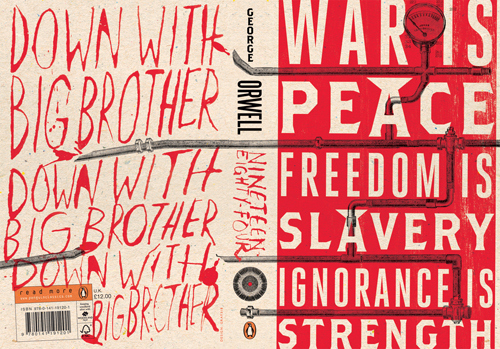
Orwell’s “1984” Holds Many Lessons for the New Cold War

Jeffrey G. Moebus

Anybody attempting to understand what is unfolding in Ukraine and over in the South China Sea and Taiwan should read George Orwell’s 1984. When you do, you will recognize and realize the following.

To use Orwell’s terms:  What we have here and now is a Eurasia with its Putin and an Eastasia with its Xi. All that is lacking is an Oceania with its Big Brother. And we have a whole gaggle of folks on the American political landscape ~ on the Left and on the Right ~ who would love to have the chance to fill that slot.

America’s twenty year “Forever War” after 9/11 was, is, and ever will be a half-time show designed to keep the troops occupied, the defense contractors profitable, and the American people comfortably numb to protracted conflicts in places many of them cannot find on a map of the world.

For now, Russia has recovered from the disintegration of European Communism and the USSR ~ and China has recovered from the madness of Mao ~ sufficiently for either [or especially both] to present viable, credible “threats” to America’s 30-year reign of global, unipolar hegemony since the end of Cold War I in December, 1991.

For now looms Cold War II, with Ukraine, the South China Sea, and/or Taiwan set to kick it off in fine fashion.

And to understand what is happening in Ukraine, in particular, one must also be familiar with the history of Russia’s interaction with Western Europe over the past 200 years.  Napoleon and Hitler both tried to bring the “blessings” of the West to Mother Russia, and failed at terrible cost, particularly to the Land, Country, Nation, and People that was ~ and still is ~ Russia.  

NATO is hard on all of Russia’s borders except in Ukraine; and, given that history spanning over two centuries, it is not at all difficult to understand why Russia wants to keep it that way.  This in no way justifies, excuses, or exonerates Putin and his illegal, immoral, and quite insane invasion of Ukraine.  It merely speculates on a very real possible motive. 

And beyond all that is the fact that a major force at work here in the United States is the possibility of a War, and the effect that that can have on the Citizens of a nation already hammered by a failed national response to a pandemic, inflation kicking in big time, a national Debt that just broached $30 trillion, a crumbling infrastructure increasingly vulnerable to disruptions by weather, cyber attack, and social unrest, and the disintegration of anything even close to a national consensus on virtually every hot-button issue: from vaccine and mask mandates, voting rights, and critical race theory, to gun control, police violence, and crimes against persons and property, to drug overdoses, suicides, and vehicular deaths, abortion, wokeness and cancel culture, “domestic terrorism,” and so forth.   

So that’s the “long answer” to what’s up in Ukraine and East Asia.    

The short, bottom-line, bullet-hits-the bone answer is that it is a very convenient distraction for Putin, Xi, and Biden [ie, his owners, operators, and script writers, America’s Ruling Elite] as they each attempt to deal with very serious economic and social problems within their own kingdoms. 

While the wings haven’t fallen off quite yet, rivets are popping loose and hydraulic fluid is streaming back across the wing tops.  And the folks up in the cockpit are very aware that it is increasingly visible to the other folks back in 1st, Business, and especially Tourist Class. 

Add all that to the fact that this is an election year in the US, and this is shaping up to be a very interesting Chinese “Year of the Black Water Tiger,” indeed.

Note:  One of the biggest differences between 1984 and today is that we all carry our very own portable, personal telescreen around with us. Certainly makes the job of the Thought Police a whole lot easier, eh?

Jeffrey Moebus, a retired U.S. Army Master Sergeant, spent two years in Vietnam in the 1960s and two years in the pre-Operation Desert Storm Middle East in the 1980s.  He lives in Sitka, Alaska on the sailboat he brought up from San Francisco Bay ten years ago this summer, and is the POC for Veterans Against War [Sitka Platoon] at vaw.sitka@gmail.com.

The Keyboard Commandos

W.J. Astore

As war in Ukraine drags on, the possibility for dangerous escalation increases. The goal should be the quickest possible ceasefire and a diplomatic solution that puts an end to hostilities. Or, to cite Vera Brittain in “Testament of Youth” again: “No to killing. No to war.”

An obstacle to this are all the keyboard commandos in the West who are recklessly calling for dangerous escalations against Russia. These include a “no-fly” zone above the city of Kyiv enforced in part by the U.S. Air Force, and direct attacks by European air forces against Russian armored columns on their way to Kyiv. Such calls for military action are indeed reckless since Vladimir Putin has issued a none-too-veiled threat of a nuclear response to them. Is he bluffing? I for one do not want to find out.

The West is already providing advanced weaponry to Ukraine such as Stinger anti-aircraft missiles and Javelin anti-tank missiles. EU countries even talked of sending fighter aircraft to Ukraine, but that deal seems to be falling apart. Such weaponry may increase the costs of war to Russia, but weapons alone are not likely to prove decisive in any way.

For all those keyboard commandos out there, safely tweeting about attacks on Russian forces in the cause of “helping” Ukraine, I have a challenge for you. Come out from behind your keyboards, book a flight to Ukraine, grab a Kalashnikov or perhaps even a Stinger, and show how determined you really are to defend Ukraine. Barring that, and assuming you’re of military age and that you’re American, why not take this opportunity to enlist in the U.S. military, as NFL star Pat Tillman famously did in the aftermath of 9/11. Show us how tough you really are; show us how much you truly care.

Because, if you’re not willing to put up, it really is better (and also much more honest) if you shut up.

Testament of Youth

W.J. Astore

Perhaps the most powerful antiwar film that I’ve seen is “Testament of Youth” (2014), based on Vera Brittain’s memoir of the same title. I watched it soon after it first came out, and I rewatched it this past week after Russia invaded Ukraine. The film rips your heart out with its depiction of the costs of war: battered and bloodied bodies, blasted and shattered nature. It’s set during World War I and recounts Brittain’s heartrending loss of her fiancé, her brother, and other close friends. Brittain is played brilliantly by Alicia Vikander, who pours her heart and soul into every scene.

Especially powerful is the scene near the end, where Brittain passionately denounces war and the way it demonizes and dehumanizes the enemy, even as “patriots” (including her younger self) send young men off to fight and die in the name of honor. Even if you haven’t seen all that leads up to this scene, it retains its power (you may need to click and watch on YouTube):

“No to killing. No to war.”

Near the end of Brittain’s memoir, she passionately asks us to find another way, a better way, than the murderous one of war. She seeks to “rescue mankind from that domination by the irrational which leads to war,” to lead an “exultant fight” against war that would enlarge the soul of humanity.

Earlier in her memoir, she quoted from the war diary she kept that “It is impossible to find any satisfaction in the thought of 25,000 slaughtered Germans, left to mutilation and decay; the destruction of men as though beasts, whether they be English, French, German or anything else, seems a crime to the whole march of civilization.” How right she was, and remains.

One aspect of this film I truly appreciate is that it shows the costs of war without glorifying battle. In fact, there are no spectacular battle scenes; no rousing music; nothing to distract us from war’s many horrors. The movie does not romanticize war in any way, which makes it that much more effective.

I’m astonished this movie isn’t better known. It is worth 100 “Avatars” and “Titanics” and Marvel/DC superhero movies. Then again, I suppose I shouldn’t be shocked; antiwar films are rarely that popular, no matter how powerful, no matter how well-crafted, no matter how true.

If you haven’t seen it, watch it. Think about its message. We need to ask ourselves, again and again, why we as humans simply can’t say no to war.

Alicia Vikander as Vera Brittain in “Testament of Youth”

Condemning War

W.J. Astore

And so the dogs of war are off and running again, this time unleashed by Putin’s Russia against Ukraine. What is Putin up to? Is it a punitive raid against Ukraine, or a general invasion followed by an occupation, or something in between? Time will tell, but wars are unpredictable. Just look at America’s wars. Vietnam was supposed to be over with quickly after the U.S. committed large numbers of troops there in 1965. Afghanistan started as a punitive raid in 2001, then morphed into a wider invasion and occupation that persisted for two decades. Iraq was supposed to be over and done with in a few weeks in 2003, but that general invasion also morphed into an occupation that persisted for nearly a decade.

At their best, wars are controlled chaos, and that contradiction in terms is intended. My best guess is that Putin sees this as an extended punitive raid to send a message to Ukraine and to NATO that Russia won’t tolerate NATO expansion into Ukraine. Put bluntly, NATO, led by the USA, got into Putin’s grill on Ukraine, and Putin calculated that drawing his saber was a better choice than simply rattling it. Whether he who lives by the sword will die by it remains to be seen.

In the meantime, I took a quick look at how the mainstream media is covering the Russian invasion. I noted that NBC spoke of Russia’s “terrifying might,” while CBS spoke of “dozens reported dead” in Ukraine. CNN simply said that “Russia invades Ukraine” and that “Ukraine vows defiance.” I have nothing against these headlines, but I wonder if the same coverage would apply to the U.S. military. Would NBC speak of the “terrifying might” of U.S. military attacks? Would our mainstream media mouthpieces report on the deaths of foreigners from those attacks? Did we see terse headlines that read, simply, “U.S. invades Iraq” or “U.S. invades Afghanistan” or “U.S. invades Vietnam”? I can’t remember seeing them, since we like to think of the U.S. military as “liberating” or “assisting” other countries, or, even better, bringing democracy to them with our “freedom” bombs and “liberty” missiles.

U.S. leaders like Antony Blinken and Nancy Pelosi have shown their toughness. Blinken said Putin will “pay for a long, long time” for his actions, and Pelosi said the Russian invasion is an “attack on democracy.” Did Ukraine truly have a functional democracy? For that matter, does the United States have one?

I’m with Ike: I hate war with a passion. Most often it’s the innocent and the most vulnerable who end up dead. Whatever Putin is up to, it’s wrong and he should be condemned. But while condemning Putin for his invasion, we shouldn’t forget America’s wars. Indeed, in condemning Putin for his invasion, it offers us a fresh chance to condemn war in general — even, or especially, America’s own versions.

The U.S. Mainstream Media and War

W.J. Astore

When it comes to war, mainstream media voices in the U.S. are almost always for it, even when it could conceivably escalate to a nuclear exchange.

That’s a disturbing lesson reinforced by recent U.S. media coverage of the Russia-Ukraine crisis. The basic narrative is that Putin’s Russia is the aggressor, the U.S. is the defender of democracy, and that U.S. actions are high-minded even when they involve weapons sales, troop deployments, and draconian economic sanctions.

You don’t get more mainstream than David Brooks and Jonathan Capehart on PBS, so I tuned in to watch their “debate” (2/18) on the issue. Both men expressed their approval of Democrats and Republicans coming together to support the Biden administration’s hardline against Russia. Bipartisan unity is to be celebrated when it comes to warmongering, I suppose. Especially revealing was David Brooks’s quick dismissal of left/right critics of the administration’s policies:

There will be some people who worry on the left that this is part of American imperialism to get involved in Europe. There are some people on the right who like Vladimir Putin. They see him as a manly, socially conservative, authoritarian kind of guy who they kind of like. So, I’m sure, on either end, there will be some [critics]. But, among the mainstream of both parties, I think, right now, there’s strong unity. The Biden administration has done an excellent job of rallying the Western alliance. It’s been a demonstration of why the world needs America to be a leader of the free world.

So, leftist critics are knee-jerk anti-imperialists; rightists critics are authoritarian Putin-lovers. But real Americans in the mainstream support Joe Biden and America as the “leader of the free world.”

What’s amazing about the “mainstream” in America is how narrow that stream is allowed to be. Of course, as Noam Chomsky famously wrote, it’s all about manufacturing consent. But imagine if true diversity of opinion was allowed on PBS. Imagine if someone like Jonathan Capehart said the following:

“The U.S. betrayed its promise not to expand NATO to the borders of Russia. Even worse, the U.S. meddled in Ukrainian politics in 2014, driving a coup and empowering neo-Nazi forces there. Sending weapons to Ukraine is making a bad situation worse, and constant threats are ratcheting up tensions that could lead to war. In war, mistakes are always possible, even common, which could lead to a wider and disastrous war between the world’s two leading nuclear powers. Measured diplomacy is what we need, even as the U.S. should take a step back in a region of the world that is not directly related to our national defense.”

Imagine that statement as a counter-narrative to the idea the U.S. is always in the right (as well as blameless), that more troops and weapons are always the answer, and that Russia has no national defense issues of its own, because NATO obviously poses no military threat to anyone. (Imagine, for one second, seeing the expansion of NATO and U.S. meddling in Ukraine from a Russian perspective, which we should be willing to do because you should always plumb the mindset of your rival or enemy.)

Truly, the lack of diversity of opinion on foreign relations and war is startling in U.S. media. It’s almost as if we have an official state media, isn’t it, comrade? I still remember Tass and Pravda from the days of the Soviet Union; who knew that today the U.S. would have its very own versions of them, while still applauding itself as the unbesmirched leader of the “free” world?

A Few Thoughts About NATO and Russia

W.J. Astore

NATO, the North Atlantic Treaty Organization, dates from 1949. From its very name, the alliance focused on North Atlantic countries and Western Europe, and stated its intent was to deter the Soviet Union from attacking European countries like Germany, France, and Italy.

Interestingly, Dwight D. Eisenhower was NATO’s first SACEUR, or Supreme Allied Commander in Europe, and he favored the complete withdrawal of U.S. troops when Europeans were back on their feet from World War II and capable of defending themselves. Since U.S. troops are still stationed in Europe nearly 75 years after the founding of NATO, one must assume Europe is still not ready.

All kidding aside, getting the U.S. to commit troops to NATO was in part a European ploy against a repeat of American isolationism, which had manifested itself in the aftermath of World War I. There was indeed a time when Americans wanted nothing to do with European intrigue and folly, and in the 1930s the U.S. Senate even attacked European arms manufacturers as warmongering “merchants of death.” Imagine that!

Nowadays, of course, it’s the USA that dominates the world’s arms market, and our merchants of death truly dominate the world. Our weapons merchants now deliver weapons to places like Ukraine in the name of “freedom” and “protecting democracy,” though I have yet to see a freedom or democracy bomb. (Interestingly, the names we choose for weapons systems are far more honest, like Hellfire missiles and Predator and Reaper drones. Talk about peddling death!)

When the Soviet Union collapsed in 1991, NATO’s reason for being collapsed along with it, but reason not the need, as King Lear said. NATO was not about to disband itself; lucrative and powerful bureaucracies rarely do. So NATO’s mission began to change to “out of area” operations, working in concert with the UN in places like Bosnia and Kosovo. Speaking of “out of area,” NATO countries also got involved in the War on Terror, including U.S. folly in Afghanistan, which provided political cover for the U.S. in the sense that American officials could claim to be working as part of a coalition to help the Afghan people.

But the biggest money maker of all for NATO and for today’s merchants of death has been expansion. Recall that the Soviet Union collapsed in 1991. Recall that NATO was created to deter a Soviet attack on Western Europe. If NATO was going to continue to exist, it needed to morph into something else, but most of all it needed to grow. And so it did.

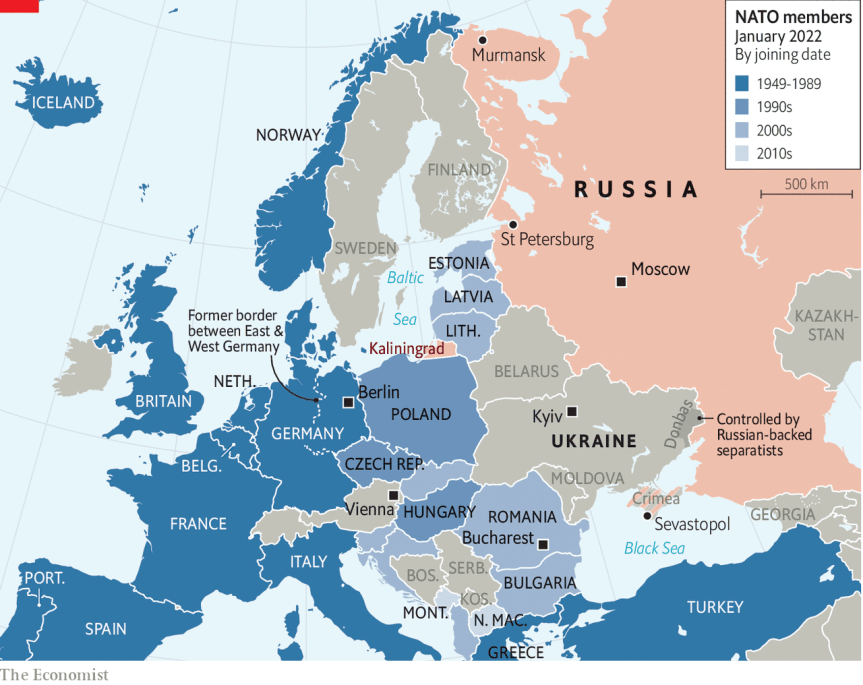
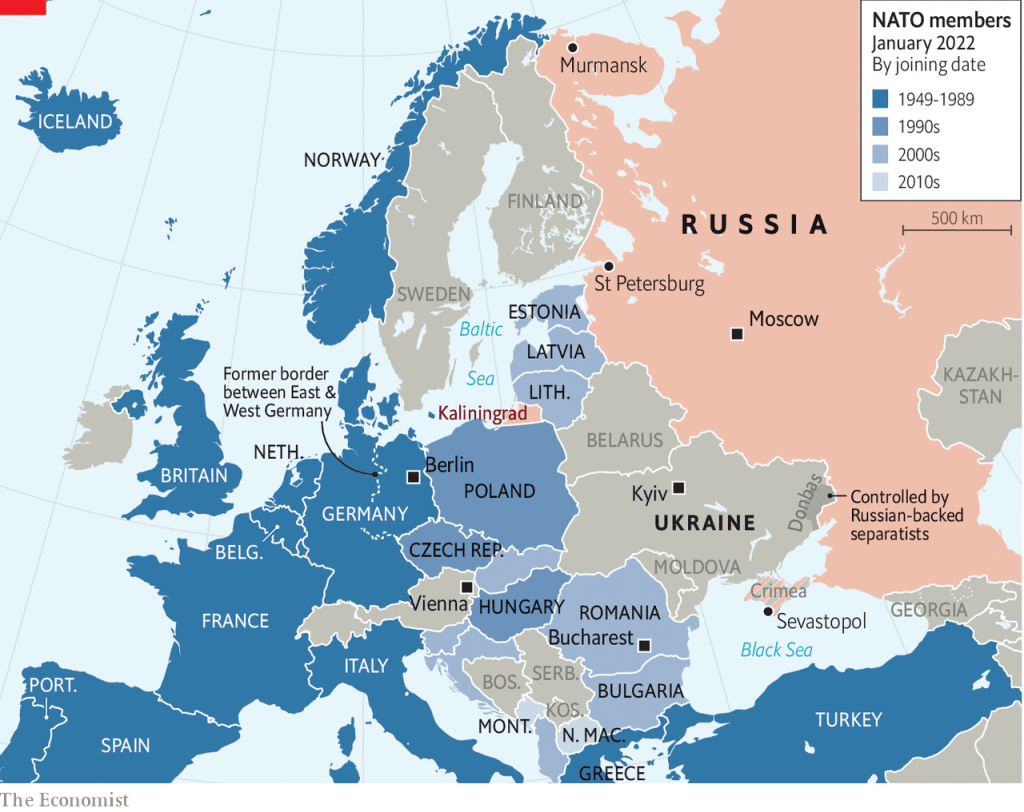
In 1999, former Warsaw Pact countries like Poland, Hungary, and the Czech Republic joined. Five years later, Bulgaria, Romania, Slovakia, Slovenia, and the three Baltic States (Latvia, Lithuania, and Estonia) joined as well. In short, what began as a defensive alliance focused on Western Europe has grown into an alliance that includes just about all of Eastern Europe. And the new NATO members have been eager customers for NATO-compatible weaponry, much of it made in the USA.

The caption from the Economist suggested this map showed how Russia was menacing Ukraine! And that NATO was unlikely to retreat

If I were Russian, I think I’d look at the dramatic eastern expansion of NATO as worrisome. If not aggressive, it is most certainly constrictive. And with former Soviet republics like Georgia and Ukraine mentioned as future NATO members, this constriction would seem more like strangulation if I occupied the Kremlin. And I’m not an ex-KGB agent like Vladimir Putin.

I remember a military history symposium in 1998 I attended in which the future of NATO was bandied about. Russian concerns about NATO expansion were discussed by four senior generals. One of them, General Sir Anthony Farrar-Hockley, basically argued that NATO should tell the Russians to go pound sand. In the notes I took from the discussion, Farrar-Hockley said that to forego NATO expansion because of Russian concerns would be to grant Russia a continuing fiefdom in Eastern Europe. Besides, Russia had nothing to fear from an expanded NATO, he added. The three other generals expressed some concern that Russia could see expansion as encirclement, and given Russia’s history of being invaded and devastated by countries to its west, any expansion would have to be done carefully, with plenty of dialogue.

We’re not witnessing much dialogue, are we? Instead, NATO expansion is seen by the U.S. as uncontroversial, and indeed as desirable, and certainly as non-threatening. Surely the Russians have nothing to fear from such a vast alliance creeping up to its very door step! It’s not like Russia wasn’t devastated by Napoleon in 1812, or by Germany and its various allies in World Wars I and II. I’m sure that will never happen again. Right, comrade?

Here’s an idea. Perhaps NATO expansion would be less problematic for the Russians if the U.S. withdrew all its troops from Europe, harkening back to Eisenhower’s initial vision. Shouldn’t European countries be able to defend themselves after almost 75 years of U.S. aid? Maybe Donald Trump wasn’t so crazy after all in asking whether NATO was really worth the candle.

When In Doubt, Send Troops

W.J. Astore

On that proverbial table in Washington D.C. where all options are allegedly kept, the one option that’s always used is military escalation. First, the U.S. sent more weaponry to Ukraine. Now, America’s commander-in-chief is sending more troops, according to this news update today from the Boston Globe:

President Biden is sending about 2,000 troops from Fort Bragg, North Carolina, to Poland and Germany this week and sending part of an infantry Stryker squadron of roughly 1,000 troops based in Germany to Romania, a senior administration official said Wednesday.

The military moves come amid stalled talks with Russia over its military buildup at Ukraine’s borders. And they underscore growing fears across Europe that Russian President Vladimir Putin is poised to invade Ukraine — and smaller NATO countries on the eastern flank worry they could be next.

Has Russia given any sign of invading “smaller NATO countries on the eastern flank”? No matter. The solution is obviously to send small contingents of U.S. troops as a sign of resolve. A couple thousand troops split between Poland and Romania will show Vladimir Putin that America means business. (War business, that is.)

Such small troop contingents have negligible military value, so their real significance is in domestic politics. Biden, a typical Democratic president, is forever on guard against accusations of “weakness” vis-a-vis Russia or China or Iran or you-name-it. To minimize such accusations, while keeping the military-industrial complex happy, the go-to option on the table is to send in the weapons and the troops. Who cares about the risk of military escalation and a wider war between major nuclear powers?

One could imagine a different president, a savvier one, winning major international points by offering to defuse tensions between Ukraine and Russia through negotiation. But that option, farfetched as it would be, is never on that table of options kept in Washington. And why Russia would trust the U.S. is beyond me.

Kyiv (Kiev) in Ukraine is roughly 5500 miles from me by airplane. That’s a very long way indeed from what I consider to be my “eastern flank.” Maybe America should practice a new foreign policy in which we learn to mind our own business, or, if you prefer, stay in our own backyard?

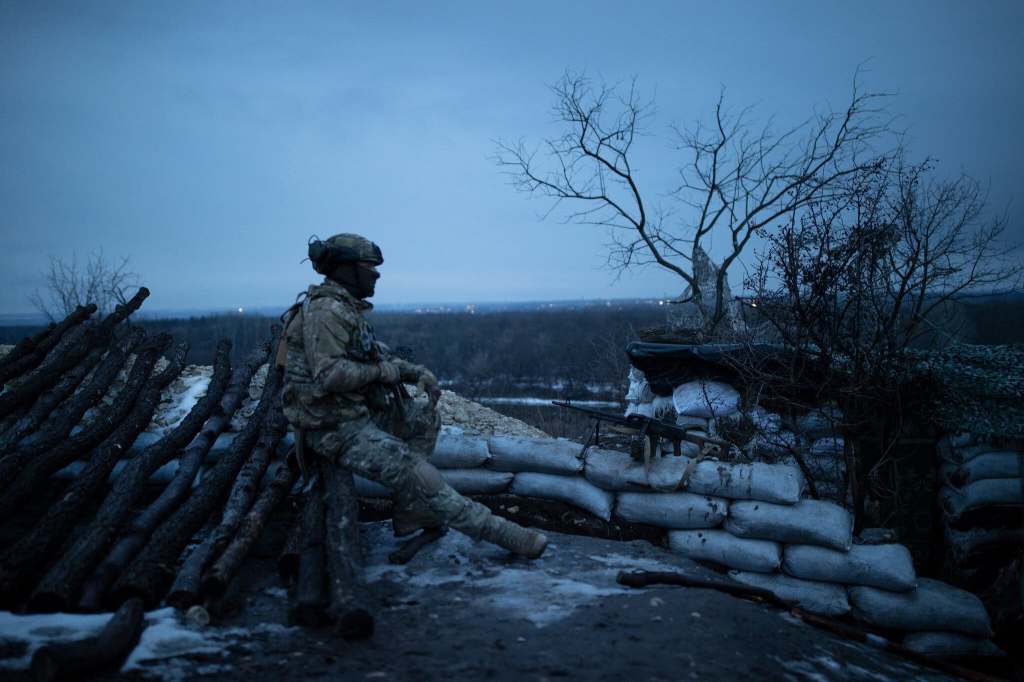
A Ukrainian soldier. One imagines he’s hoping for a peaceful solution. But this is not what I think of as America’s (or NATO’s) eastern flank

Russia, Ukraine, and the USA

W.J. Astore

The situation along the border of Russia and Ukraine is volatile. War is possible. Given this volatility and the possibility of war, does it make any sense to send more weaponry to Ukraine?

From this CNN report, that is exactly what the USA is doing: sending more arms and ammunition to Ukraine:

“The second bird in Kyiv! More than 80 tons of weapons to strengthen Ukraine’s defense capabilities from our friends in the USA! And this is not the end,” Ukrainian Defense Minister Oleksii Reznikov said in a tweet Sunday. The first shipment of security assistance from the US had arrived in Ukraine on Friday. That shipment included “close to 200,000 pounds of lethal aid, including ammunition for the front line defenders of Ukraine,” the US Embassy in Kyiv tweeted Friday night. The shipments come as the US has sought to convince Moscow to de-escalate the situation at the Ukrainian border, where Russia has amassed more than 100,000 troops. Earlier Sunday, Secretary of State Antony Blinken amplified his warning against a Russian invasion of Ukraine, saying “a single additional Russian force” entering Ukraine “in an aggressive way” would result in a severe response by the US and its allies. “If a single additional Russian force goes into Ukraine in an aggressive way, as I said, that would trigger a swift, a severe and a united response from us and from Europe,” Blinken told CNN’s Dana Bash on “State of the Union.”

Let me get this straight: weapons and ammo are “security assistance,” or “lethal aid,” a construction that should win a prize for best oxymoron of the year. Hi! I’m here to help you. How about some “lethal” aid? Meanwhile, even as the US escalates the situation with “lethal aid” and threats, the US State Department insists it’s the Russians who need to “de-escalate the situation.” No contradiction here, right?

Consider here the words of Antony Blinken, he of the “swift” and “severe” and “united” response if only a “single” Russian force should enter Ukraine “in an aggressive way.” This naked bombast directly contradicts President Joe Biden’s words at last week’s press conference. Biden, who occasionally has “senior moments” of inadvertent truth, explained that NATO wasn’t united and that a minor incursion by Russian forces probably wouldn’t trigger a swift and severe response. It’s reassuring to know we have such skilled and consistent leaders as Biden and Blinken in charge here.

US meddling in Ukraine is complex, but let’s just say America’s leaders are part of the problem, not the solution. As usual, the US response to almost any situation is to send troops and weapons while telling the other side to “de-escalate.”

Worst of all, though, from an American perspective, is the lack of skilled and smart leadership in the White House. Biden appears confused and his vice president is hapless. Blinken is a neo-con tool who won’t be confused with Bismarck, let alone Henry Kissinger. He thinks American diplomacy is most effective when it’s backed by brazen military threats. No speaking softly with a big stick held prudently in reserve; Blinken prefers to shout loudly while openly brandishing the big stick of the US military.

It doesn’t bode well, does it?

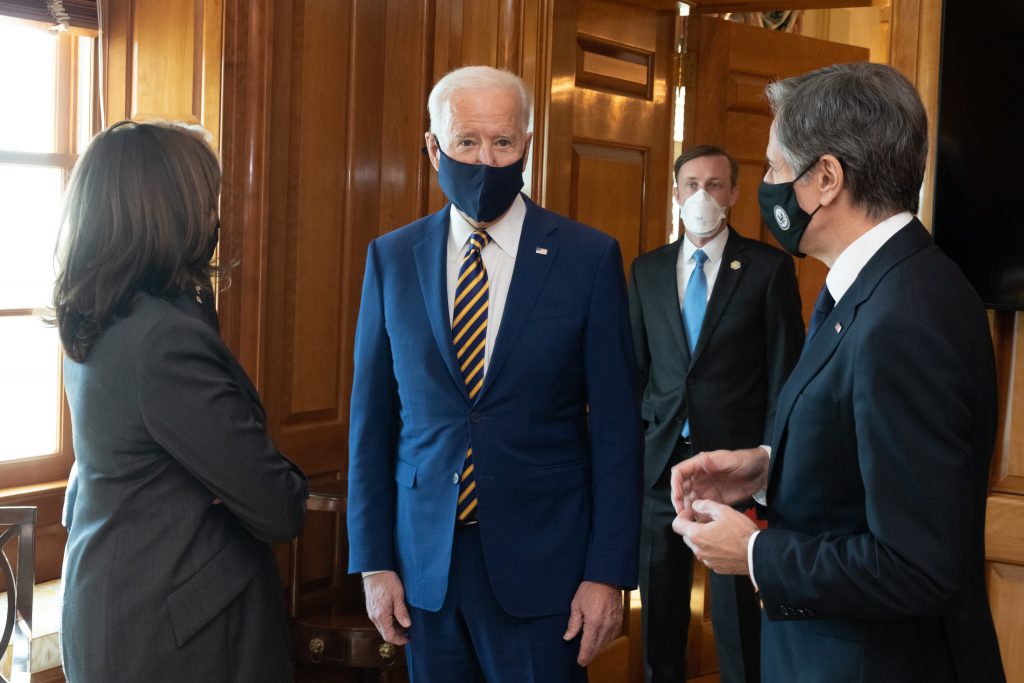
Kamala Harris and Joe Biden with Antony Blinken on the far right. Not exactly the A-Team.

Fox News and The New York Times Agree: America is Weak!

W.J. Astore

Did you know that the world’s lone surviving military superpower, the one that spends more than a trillion dollars yearly on all things military, is weak?

Fox News would have you think that. And so too would the New York Times (NYT).

Over at Fox News, the headline suggests Biden’s weakness is inviting “the next Pearl Harbor,” even as the article focuses mainly on alleged weakness vis-a-vis Russia-Ukraine and China-Taiwan. Meanwhile, my daily summary from the NYT agrees that “U.S. weakness emboldens Moscow and Beijing.” So what does the NYT suggest America should do to show strength?

With respect to Russia and Ukraine, this is the sage advice of the New York Times:

On its own, Ukraine’s military seems outmatched by Russia’s. And a full-scale U.S. military response seems doubtful, given a weariness of foreign wars that Biden and many American voters share.
But Biden still has options. The U.S. can increase its military support to Ukraine, which could make a potential invasion look bloodier and more costly for Russia. (The U.S. is pursuing a related strategy in Taiwan.)
Biden can also threaten sanctions on Russia, as he did on the call with Putin yesterday, according to Jake Sullivan, the president’s national security adviser. “He told President Putin directly that if Russia further invades Ukraine, the United States and our European allies would respond with strong economic measures,” Sullivan told reporters. If Russia does attack Ukraine, Biden said that the U.S. would react more strongly than it did to the 2014 takeover of the Crimean Peninsula.
But sanctions might not be enough to deter Putin.

In sum, here’s the tough-minded advice of the “liberal” New York Times: Sell more expensive weaponry to Ukraine (as well as Taiwan). Threaten the most violent economic warfare possible. And, since sanctions “might not be enough” to deter Russia or China, there’s more than a hint that America may need to go to war, despite “weariness” of wars allegedly shared by Biden and “many American voters.”

A show of hands here: How many Americans think it’s wise to risk nuclear war if Russia attacks Ukraine or China attacks Taiwan?

Even if the risk of nuclear war is discounted (which it shouldn’t be), how many Americans think it’s wise for the U.S. military to get involved in a land war in Asia or against Russia in Ukraine?

Maybe patient diplomacy is the answer here? After all, what does the “defense” of Ukraine or Taiwan by U.S. forces have to do with defending our country and our constitution?

America doesn’t lack toughness — it lacks smarts. Selling more weapons to Ukraine or Taiwan isn’t the answer. Nor are constant threats.

Sun Tzu taught that the best way to win is when you can achieve your objectives without even having to fight. Guile is not weakness, nor is restraint. But Fox News, joined by the New York Times, would have us think that toughness is mostly about weaponry and a willingness to wage war. Because, you know, it’s worked so well for America in Vietnam, Afghanistan, Iraq, and so many other places around the globe.