Thoughts on War in Gaza and Ukraine

W.J. Astore

America as the Essential Nation for Trigger Treats

Some thoughts — more or less connected — on war in Gaza and Ukraine:

Israel is engaged in a “traditional” war of conquest. Like the Romans destroyed Carthage, Israel is essentially destroying Gaza using American-provided weaponry, together with hoary approaches like famine and disease.

What surprises so many is that ruthless wars of conquest aren’t supposed to happen. It’s 2023! We’re civilized people! Only dictators like Putin are ruthless! But, as many people have noted, Israel has already killed more children in two months than Russia has killed in nearly two years of war in Ukraine.

No — Israel and the USA are not civilized. The so-called rules-based order is might makes right. Thucydides defined Israel/USA policy 2400 years ago: The strong do what they will; the weak suffer what they must.

The Palestinians are being killed, starved, and shoved off their land because Israel wants it. The Hamas attacks provided the excuse for the final solution to the Gaza question.

But let’s be clear here: Wars of conquest are a feature of humanity throughout history. Look at the history of the United States and its conquest of Native Americans or its war of “manifest destiny” against Mexico. It’s a land grab.

Gaza isn’t primarily a religious war of Jews versus Muslims. There may be some Jews who believe it’s “their” land because the Torah says so, but many other Jews are against this brazen war of conquest. Religion isn’t the main cause here. The causes are greed and power, land lust and the pursuit of black gold (fossil fuels off Gaza). And vengeance.

The Biden administration refuses to place any conditions on massive weapons shipments to Israel. So much for “leverage.”

*****

Judging by the U.S. federal budget, America’s leaders are most addicted to violence and war, whether manifested against our fellow humans or against nature and the planet. Dangerously, in violence people often find a sense of purpose and belonging as well as scapegoats even as they embrace and empower leaders who promise them blood-soaked redemption.

It’s quite possible the historical Jesus was betrayed and killed because he rejected redemptive violence.  Jesus seems to have taught redemptive peace, and that was an unpopular message among Jewish people 2000 years ago, who apparently were looking for liberation through military victory over the Romans, not salvation through the grace offered them by a peace-preaching prophet and rabbi who took the side of the marginalized and oppressed.

*****

The average age of Ukrainian troops is now 43.  Young women are being actively recruited into the ranks. Men as old as 60 are being pressed into service. “Body snatchers” are illegally grabbing men off the streets and forcing them to the front. Does this sound like a winnable war for the “imperfect democracy” of Ukraine?

I continue to see a stalemated situation with little chance of a decisive military victory for Ukraine.  Assuming the war continues, Ukraine will continue to be hollowed out.

Meanwhile, Russia has most certainly been weakened militarily by this war, and perhaps economically as well with the destruction of the Nordstream pipelines.  Russia is less of a threat to NATO than it was two years ago, meaning that NATO has even less to fear from an alleged expansionist Putin.  Given the quagmire faced by Russia in Ukraine, I doubt very much that Putin is contemplating an invasion of any NATO country.

Suffice to say I am against another $62+ billion for Ukraine and I am for diplomatic efforts to foster a ceasefire and settlement.  Indeed, I think that if the U.S. stops military aid to Ukraine, Zelensky and Putin would likely find a way to end this war and all its killing and destruction.

Yet, the Biden administration is persisting in its plans to send scores of billions in more weaponry to Ukraine, with Senator Lindsey Graham still boasting Ukraine will fight and die to the last man (and woman?). If Biden’s war package is approved, U.S. aid (mainly military) to Ukraine will approach $200 billion in two years. That’s roughly $8 billion a month, double the monthly cost of the Afghan War. Yet Americans are told this is the price of freedom: massive shipments of weapons and other forms of aid so that Ukraine can kill Russians.

The Biden administration has embraced war in Ukraine as well as war in Gaza, essentially placing no conditions on massive shipments of U.S. weaponry to fuel these conflicts. Someone please tell me what is “progressive” and humane about Joe Biden’s policies.

I know freedom isn’t free; I had no idea freedom came at so high a cost in deadly military weaponry and dead bodies. I guess it’s true, then: America is the freest country in the world because we dominate the world’s trade in life-takers and widow-makers. Exceptional we are in our belief in war and weapons; essential we are to any country looking to add “trigger treats” to their arsenals of democracy.

It’s a wonderful life in Pottersville USA.

Was Bedford Falls the illusion?

Is the Russia-Ukraine War Sputtering to an End?

W.J. Astore

Let the killing stop and the healing begin

A report from Sy Hersh today (12/1/23) suggests that the Russia-Ukraine War may finally be sputtering to a diplomatic conclusion. The senior generals on both sides seem to be the main actors, but who really cares as long as the killing stops and the healing begins?

Remember when we were told that all Ukraine needed was a few good Western tanks to turn the tide in its favor?

Conflicts and wars often exhibit a horrifying form of logic. Military hardliners, convinced of their own righteousness, claim that victory will come only on the battlefield when the enemy is totally defeated by force of arms. Armchair warriors at home and abroad glom on to this, cheering for their side and calling for no compromises, no negotiations, just more killing.  Think here of “bomb’em back to the stone age” slogans heard in America during the Vietnam War, or expressions of apocalyptic destruction like “make the rubble bounce.”

Call it a total war fixation, the idea that victory can only be achieved by erecting one’s flag on a mountain of skulls. Here, anyone arguing for ceasefires or peace must be an agent or sympathizer for the bad people, in this case a “Putin puppet.”

To armchair warriors, the idea that people might simply prefer peace to war seems unfathomable. This is often true of wars everywhere. Those furthest from danger, those from whom no sacrifice is required or even asked, are those most likely to bray the loudest for more killing and more war. To the warmongers, they are the tough ones, the hardheaded realists, and those who disagree with them are disreputable and weak.

Here in the USA, there’s another element to this: the fact that the U.S. government, in the people’s name, has provided massive amounts of weaponry to Ukraine in a pursuit of decisive victory. Many still favor a Ukrainian fight to the death against Russia, though America in general is showing growing reluctance to pay for it all.

Is Ukraine’s senior general naive in supporting a ceasefire and negotiations? Allegedly, evil Putin will take advantage of any ceasefire to rearm and prepare yet more devastating attacks. Yet this “logic” of war could be applied to any conflict at any time in history. At some point, all wars come to an end.

After almost two years of fighting and hundreds of thousands of casualties, it’s high time to give peace a chance in Ukraine. War, as we can see from current events in Gaza, has no lack of chances to thrive in this world.

15,000 Bombs Equivalent to Two Hiroshimas

W.J. Astore

The Israeli Annihilation of Gaza

After dropping 6000 bombs in six days, the Israeli Air Force has now reached the staggering sum of at least 15,000 bombs dropped on densely populated areas of Gaza. The bomb tonnage is already equivalent to two Hiroshimas, notes Joshua Frank at TomDispatch. As he puts it:

[W]ell over 25,000 tons of bombs had already been dropped on Gaza by early November, the equivalent of two Hiroshima-style nukes (without the radiation). Under such circumstances, a nuclear-capable Israel that blatantly flouts international law could prove a clear and present danger, not only to defenseless Palestinians but to a world already in ever more danger and disarray.

Israel is the only power in the Middle East with nuclear weapons; it’s not beyond the realm of possibility that the right-wing government of Netanyahu would choose to use one or more if cornered.

Netanyahu’s goal seems clear: make Gaza uninhabitable to Palestinians through a combination of massive bombing, blockades (water, food, medical supplies, and other essentials), and invasion and occupation. Palestinians are to be “pushed” into the Sinai Desert, with Gaza absorbed into Israel. All this is being justified in the name of neutralizing Hamas, a terrorist organization that has no ability to hurt Israel in a major way. (The brutal attacks of October 7th were a one-off made more brutal by Israeli helicopter gunships whose counterattacks killed friendlies as well as the Hamas attackers.)

In the name of destroying Hamas, Israel is ethnically cleansing Gaza so it can be absorbed into Israel. Apparently, there are enormous gas reserves off Gaza, possibly worth $500 billion, which were to be shared between Israel and the Palestinians in Gaza. With the Palestinians either dead, severely wounded, or evicted from Gaza, Israel will likely claim total ownership over those gas fields. Israel may yet become a major gas supplier to Europe, replacing much of the gas lost when Putin blew up his own gas pipelines to Germany. (Just kidding: America did that, as President Biden promised he would.)

Meanwhile, Joe Biden penned an op-ed to the Washington Post equating Hamas with Putin as “pure, unadulterated evil.” Hamas is allegedly trying to wipe Israel off the map with its “ideology of destruction,” but of course Hamas has no military ability to do this, whereas Israel does indeed have the power to wipe Gaza off the map. So where does Biden see the future heading? Consider this passage:

There must be no forcible displacement of Palestinians from Gaza, no reoccupation, no siege or blockade, and no reduction in territory. And after this war is over, the voices of Palestinian people and their aspirations must be at the center of post-crisis governance in Gaza.

As we strive for peace, Gaza and the West Bank should be reunited under a single governance structure, ultimately under a revitalized Palestinian Authority, as we all work toward a two-state solution.

He may as well wish for puppies and unicorns for everyone. Israel doesn’t want a two-state solution with a thriving Palestinian state. Netanyahu’s goal, to repeat myself, is clear: Gaza absorbed into Israel, with Palestinians displaced in another Nakba, along with the West Bank slowly absorbed into Israel as illegal Jewish settlements are extended.

This is, essentially, what Thucydides meant when he said: the strong do what they will; the weak suffer what they must.

What Biden’s op-ed was really about was justifying his $105 billion package in giveaways, mainly for Ukraine and Israel, with more than half that money flowing to U.S. weapons makers, the merchants of death or, as Biden calls them, job creators. In short, Biden celebrates the creation of a few jobs in America in the name of killing tens of thousands of Russians and Palestinians with American-made weaponry paid for by U.S. taxpayers.

Biden calls that “democracy” in action, the work of the world’s “essential nation” in contrast to the “murderous nihilism” of Hamas.

“Murderous nihilism”? Well, as we used to say as kids, it takes one to know one.

Speaking of murderous nihilism …

When Is a Stalemate Not a Stalemate?

W.J. Astore

When Zelensky Says So

The Russia-Ukraine War is stalemated. Even Ukraine’s top commander concedes this point, as the New York Times reported here:

World

Ukraine’s Top Commander Says War Has Hit a ‘Stalemate’

Ukraine’s Top Commander Says War Has Hit a ‘Stalemate’

By Constant Méheut and Andrew E. Kramer

In a candid assessment, Gen. Valery Zaluzhny said no “beautiful breakthrough” was imminent and that breaking the deadlock could require advances in technological warfare.

*************

(As an aside, I should note that back in July we saw articles in the New York Times and Wall Street Journal using that dreaded word, “stalemate,” as I wrote about here:) 

The Russia-Ukraine War and the Management of Expectations

BILL ASTORE

JUL 25

The Russia-Ukraine War and the Management of Expectations

It can’t be coincidence. In the past few days, I’ve seen articles at mainstream media outlets like the New York Times and Wall Street Journal that the much-hyped and much-delayed Ukrainian “spring” counteroffensive has stalled, and at high cost to Ukrainian troops. Here’s a quick online headline from the NYT on Monday:

Read full story

Nice to know Ukrainian officials are finally being “candid.” Yet Zelensky is having none of it. In my CNN feed this morning, I saw this response from Ukraine’s leader: “People are tired. Everyone is tired … But this is not a stalemate.”

Truth is that Russia-Ukraine War will enter its third year in February of next year, even as the U.S. government has provided more than $130 billion in weaponry and other forms of aid to a Ukrainian government that’s known for its corruption. Meanwhile, the Biden administration wants to send another $60 billion in weaponry and aid to Ukraine. Many Republicans, notably new House Speaker Mike Johnson, are on record as being against scores of billions to perpetuate a stalemated war, though their motivation seems less “America first” than “Biden sucks.”

Things are so bad with the war that I now see articles at NBC News arguing for diplomacy! When NBC News, a reliable mouthpiece for Neo-con Democrats, suggests negotiations and the possibility of Ukraine making territorial concessions to end its war with Russia, you know the situation on the ground in Ukraine is likely worse than we’re being told.

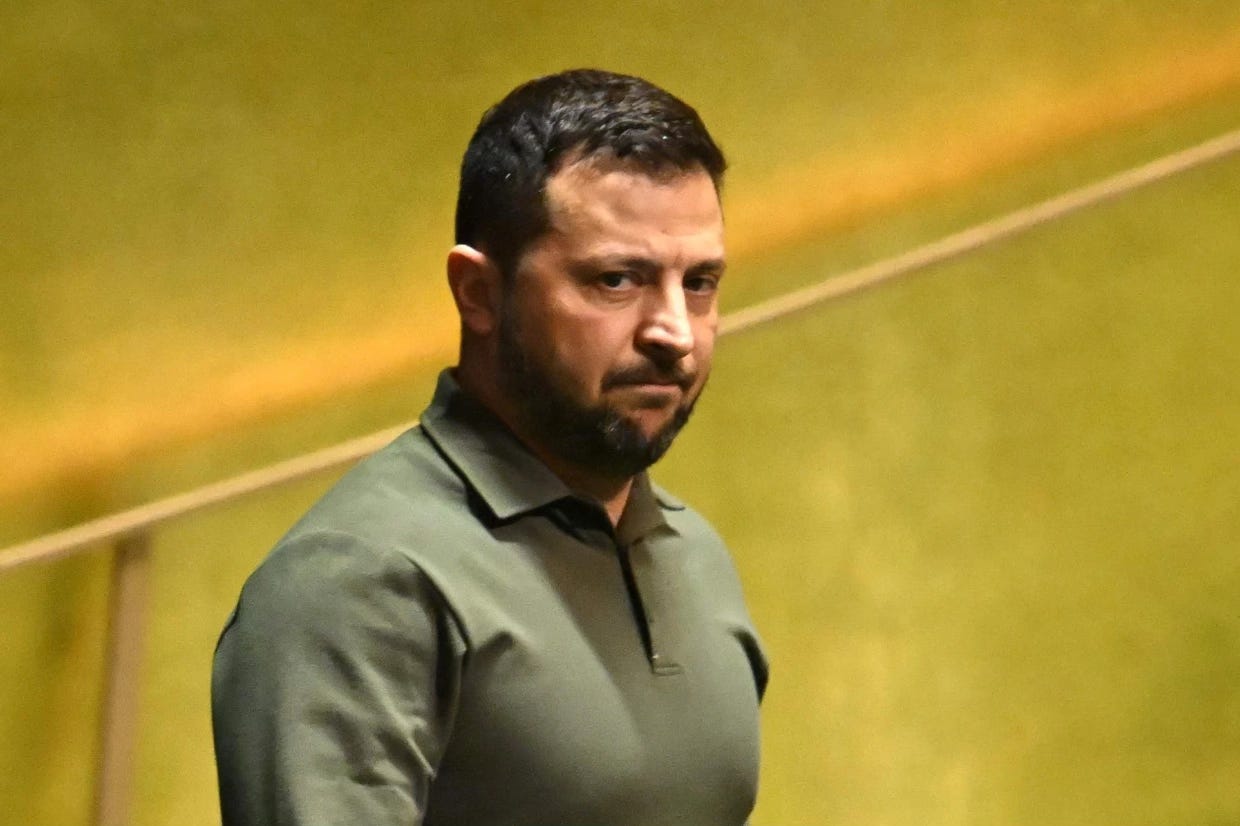
Interestingly, this photo of a grim Zelensky accompanied the NBC article. No more hero-worship from the mainstream media? (Timothy Clary, AFP-Getty Images)

The U.S. government, obviously distracted by the crisis in Gaza and the potential for a much wider war in the Middle East, may be near the point of cutting its losses in Ukraine, though obviously the military-industry-congressional complex (MICC) wants to keep sending weaponry until the final bullet and cluster munition is fired. After which Ukraine will have to “rebuild” its military, so you can count on more military “aid” going to Kyiv.

Yet, for the MICC there are bigger fish to fry now. Republicans in particular are obsessed with China. Democrats and Republicans are obsessed with Israel. Ukraine has become something of a distraction. Sure, you may continue to fly blue-and-yellow Ukrainian flags, but it’s time to back Israel unconditionally while threatening Iran with the full might of the U.S. military. Looming in the background is the alleged threat of “near-peer” competitor, China. After all, you can’t justify a massive U.S. war budget that’s approaching $900 billion with a stalemated war in Ukraine.

If nothing else, perhaps the U.S. warmonger obsession with empowering Israel and encircling China may provide an opportunity for diplomacy between Ukraine and Russia. With Ukraine apparently no longer enjoying a blank check of support (that’s now reserved for Israel), a grim-faced Zelensky may come to conclude that jaw-jaw is better than war-war.

War as an “Investment”

W.J. Astore

The Bizarre Business-Speak of Mass Killing

Did you know the Russia-Ukraine War is a great “investment” for the United States? A terrific opportunity to kill lots of Russians and to destroy lots of their military equipment at a relatively cheap cost to us? (Just don’t mention the price paid by Ukraine.) It gives new meaning to the expression “making a killing” on the “market.”

To Gordon Gekko’s infamous “greed is good” speech we must now add “war is good.” That war is “right.” That it “works”—at least for America, allegedly. 

War as an “investment” truly symbolizes the moral bankruptcy of conventional discourse in the U.S. political mainstream. Instead of war being a calamity, a catastrophe, a realm of death and destruction, dare I say even a mortal sin of grievous evil, we’re told that instead it’s an investment that’s paying dividends, especially in that growth stock known as Ukraine.

We can’t let MAGA Republicans stop the Ukraine “investment,” can we? Not when it’s paying such great dividends

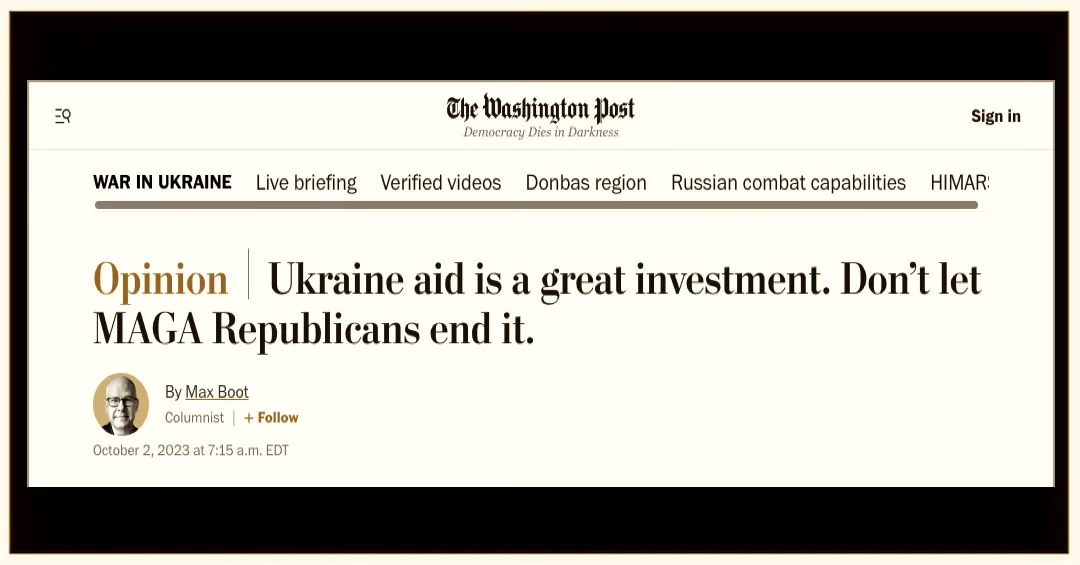
Even body counts and truck counts from the Vietnam War era are being brought back to show what a great “investment” the Ukraine War has been for the U.S. In her latest, Caitlin Johnstone cites war-lover Max Boot for his advocacy of the Russia-Ukraine War as a continuing investment opportunity for the U.S., including the use of body and truck counts as a measure of progress:

“Russia has lost an estimated 120,000 soldiers and 170,000 to 180,000 have been injured,” [Max] Boot writes [in a Washington Post op-ed]. “Russia has also lost an estimated 2,329 tanks, 2,817 infantry fighting vehicles, 2,868 trucks and jeeps, 354 armored personnel carriers, 538 self-propelled artillery vehicles, 310 towed artillery pieces, 92 fixed-wing aircraft and 106 helicopters.”

“The Russian armed forces have been devastated, thereby reducing the risk to front-line NATO states such as Poland and the Baltic republics that the United States is treaty-bound to protect,” Boot continues. “And all of that has been accomplished without having to put a single U.S. soldier at risk on the front lines.”

“That’s an incredible investment,” gloats Boot.

At no time in his masturbatory gushing about how many Russians this war has helped kill does Boot make any mention of the immense toll this deliberately provoked and completely unnecessary war has taken on Ukrainian lives. Their deaths and dismemberments and displacement are the largest price being paid into this “investment” by far, but Boot doesn’t deem them worthy of even a footnote.

We’ve been seeing this “investment” line being promoted with increasing frequency by US empire managers and their apologists. In an article published in the Connecticut Post last month, Senator Richard Blumenthal assured Americans that “we’re getting our money’s worth on our Ukraine investment.” A few days prior to that Senator Mitt Romney had described the proxy war as “the best national defense spending I think we’ve ever done,” because “We’re diminishing and devastating the Russian military for a very small amount of money… a weakened Russia is a good thing.” In December Senate Minority Leader Mitch McConnell said that funding the proxy war is “a direct investment in reducing Vladimir Putin’s future capabilities to menace America, threaten our allies and contest our core interests.” Last November the imperial war machine-funded think tank Center for European Policy Analysis published a report arguing that “US spending of 5.6% of its defense budget to destroy nearly half of Russia’s conventional military capability seems like an absolutely incredible investment.”

Imagine the vacuity, the bankruptcy, the venality, the sinfulness of writing about war and killing as “an absolutely incredible investment.” And what is our ROI, our return on investment? A lot of dead and wounded Russians and Ukrainians, a devastated and poisoned landscape, millions of war refugees, and an increasing likelihood of a wider war that could possibly go nuclear. ROI, indeed.

War is many things, but it is not an “investment.” People who talk and write like this have no moral center. They are soulless. They are automatons of war.

Come On, Ukraine, Learn from the U.S. Military

W.J. Astore

American experts have all the answers for Ukraine

In today’s New York Times send out, I saw the following story:

Ukraine’s Forces and Firepower Are Misallocated, U.S. Officials Say

American strategists say Ukraine’s troops are too spread out and need to concentrate along the counteroffensive’s main front in the south.

Listen to the U.S. military, Ukraine! Don’t be casualty-averse! Concentrate your forces. Take the fight to the Russian enemy. Use all those cluster munitions we’ve sent you. Commit your armored reserve and punch a hole in the Russian lines. Break through, break out, and drive toward Crimea. You know: just like Americans would do in your place.

One might forgive Ukrainians if they asked, When was the last war you “experts” won for America? Afghanistan? Iraq? Vietnam? Korea? What about ongoing military commitments to Syria and Somalia? If you’re so good at winning wars, how come the U.S. military didn’t win in Afghanistan, Iraq, and Vietnam where you had overwhelming materiel and firepower superiority?

With respect to why Ukraine has its forces “too spread out”: perhaps Ukraine needs to garrison its lines so that it can fend off Russian counterattacks? If Ukraine concentrates its strategic reserve and uses it in a big counteroffensive that stalls, what’s to stop Russia from a decisive riposte? Think of Kursk for Nazi Germany in 1943. Once that huge offensive failed for Germany, using up its strategic reserve, the Red Army seized the initiative on the eastern front and never lost it.

At Kursk in 1943, the Germans committed their reserves in a desperate gamble to seize the initiative from the Soviet Union. When the offensive failed, the Red Army counterattacked and proved unstoppable.

Headlines like the one posted above from the New York Times are intended to be exculpatory for the U.S. If the war turns worse for Ukraine, U.S. “experts” can point to articles like this, casting blame on the Ukrainians for not following sage American advice.

If “we” win in Ukraine, it will be because of generous U.S. aid and especially vaunted U.S. and NATO weaponry; but if they (the Ukrainians) lose, it’s all their fault for not following the advice of America’s master strategists. And, obviously, even if Ukraine loses, plenty of weapons manufacturers in the U.S. are winning and will continue to win. Indeed, a Russian victory could be just the thing to propel even more weapons spending by NATO countries as well as even larger and more monstrous Pentagon budgets.

The False Comfort of Illusions

W.J. Astore

In the Russia-Ukraine War, what is the truth?

When others asked the truth of me, I was convinced it was not the truth they wanted, but an illusion they could bear to live with. — Anaïs Nin

War, among other things, is a place of illusion. With the Russia-Ukraine War, the illusions are many. For the mainstream media in America, the illusion promoted is this: Ukraine, a quasi-democratic country, is enduring an unprovoked invasion by authoritarian Russia, now in its 18th month. The freedom-fighters of Ukraine have been greatly assisted by benevolent military and economic aid freely offered and given by the Biden administration and NATO countries. Ukraine fights for a noble cause that the U.S. should and must support, since allowing Russia to prevail would lead to further unprovoked Russian invasions of other freedom-loving peoples in Europe.

It’s an illusion that’s comforting for Americans to live with, since it flatters us while vilifying an old enemy, the former Soviet Union and now Russia. It’s flattering to the Biden administration, which can pose as a stalwart defender of Ukraine, and certainly flattering to U.S. weapons makers, who can pose collectively as the new arsenal of democracy. It’s an illusion, moreover, that elides or disguises any economic motives the U.S. might have in supporting Ukraine so generously since the war began.

Even something as simple as smoke contains great complexity, as I recall from my fluid dynamics classes

The best illusions, the most seductive ones, have elements of truth to them. Yes, Russia did invade Ukraine; yes, Russia is authoritarian; yes, Ukraine has defied the odds and stymied Vladimir Putin’s designs; yes, NATO and U.S. weaponry has been important to Ukraine’s endurance. But partial facts are generally not impartial.

Briefly put, NATO expansion eastwards since the collapse of the Soviet Union is seen by Russia as provocative, constricting, and aggressive. Ukraine itself is very much an imperfect democracy, rating “high” on government corruption indices. U.S. meddling in Ukraine, especially in 2014, is most certainly problematic. The destruction of the Nordstream pipelines and subsequent profits by U.S.-based energy companies can’t be ignored. And, not surprisingly, U.S. weapons manufacturers are enjoying boom times. Not only does Ukraine need weaponry and ammunition, but U.S. and NATO stocks of the same must be replenished as arms and ammo are gifted to Ukrainian fighters. Nor is Ukraine completely free of neo-Nazi influences, which is to say that the situation is muddier and more complex than the comfortable illusion that’s so often sold by the mainstream media. 

Which brings me to CNN’s report today, that showed up in my morning email: 

President Joe Biden is asking Congress for more than $24 billion in aid for Ukraine and other international needs as he works to sustain support for the war amid signs of softening support among Americans. The request — which includes more than $13 billion in security assistance and $7 billion for economic and humanitarian assistance for Ukraine — sets up a potential battle with Republicans in Congress. Biden has promised support will last “as long as it takes,” but an increasingly skeptical Republican Party has cast doubt on US involvement going forward. This comes after a CNN poll released last week found 55% of Americans believe Congress should not authorize additional funding to support Ukraine. 

As the Russia-Ukraine War drags on with neither side apparently having a quick victory in sight, questions accelerate. How much are Americans prepared to pay to Ukraine? Is an open-ended, “as long as it takes” commitment truly wise? What happens if the war escalates even further? And, perish the thought: What happens if someone uses a nuclear weapon or another form of WMD?

Many Americans today are in dire straits. Credit card debt for Americans recently exceeded $1 trillion and rising. The Biden administration has failed to provide promised and significant student debt relief; a public option for health care; a $15 federal minimum wage; while acting to break a railroad strike and promoting more fossil fuel drilling on fragile federal lands as well as offshore.

Americans are not stupid to wonder about the priorities of the Biden administration and why Ukraine gets a blank check as Americans continue to suffer. Illusions may be comfortable, but they don’t put food on the table or pay health care bills. And the price they come at may be high indeed, which is one reason, I think, a majority of Americans are none too comfortable with this illusion.

The Russia-Ukraine War and the Management of Expectations

W.J. Astore

The U.S. Mainstream Media Finally Admits to a Costly Stalemate

It can’t be coincidence. In the past few days, I’ve seen articles at mainstream media outlets like the New York Times and Wall Street Journal that the much-hyped and much-delayed Ukrainian “spring” counteroffensive has stalled, and at high cost to Ukrainian troops. Here’s a quick online headline from the NYT on Monday:

The war is approaching a violent stalemate. Ukraine has made only marginal progress lately and is deploying less experienced soldiers after heavy casualties.

And here’s what the WSJ had to say (intro here from an article by Caitlin Johnstone):

In a new article titled “Ukraine’s Lack of Weaponry and Training Risks Stalemate in Fight With Russia,” the Wall Street Journal’s Daniel Michaels reports that western officials knew Ukrainian forces didn’t have the weapons and training necessary to succeed in their highly touted counteroffensive which was launched last month.

Michaels writes:

“When Ukraine launched its big counteroffensive this spring, Western military officials knew Kyiv didn’t have all the training or weapons — from shells to warplanes — that it needed to dislodge Russian forces. But they hoped Ukrainian courage and resourcefulness would carry the day.

“They haven’t. Deep and deadly minefields, extensive fortifications and Russian air power have combined to largely block significant advances by Ukrainian troops. Instead, the campaign risks descending into a stalemate with the potential to burn through lives and equipment without a major shift in momentum.”

So: We have both the NYT and WSJ admitting the war is likely to be stuck in a destructive stasis for the foreseeable future.  This isn’t that surprising.  Russia is deploying “defense in depth” tactics with minefields and other traps.  Ukrainian forces try bravely to advance, they get stuck, and Russia replies with withering artillery fire.

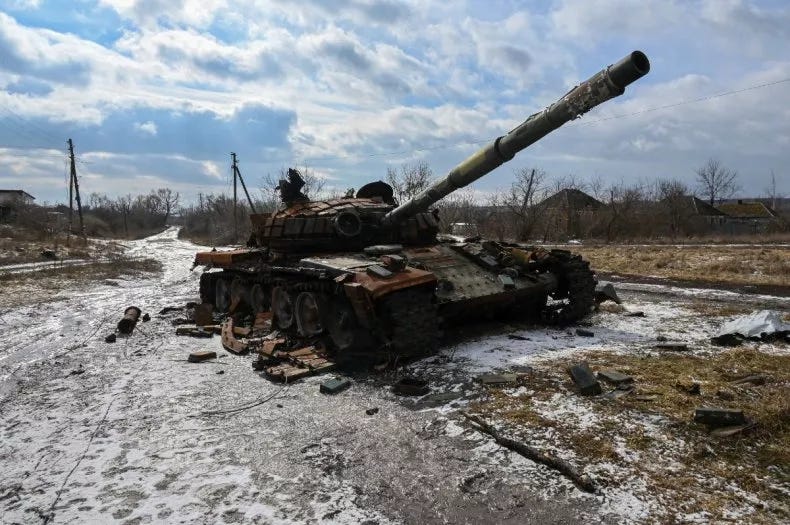
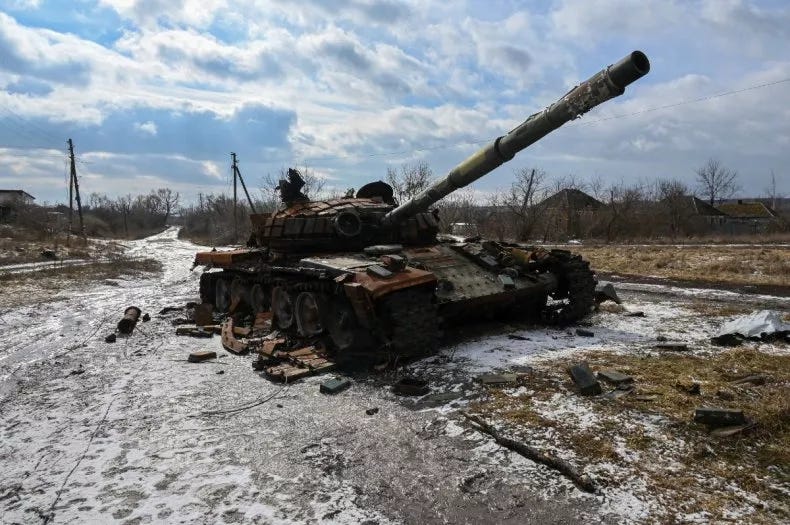
A destroyed Russian tank from March 2023, part of the poisonous detritus of war

There’s much of World War I here.  WWI only ended when Germany collapsed from exhaustion after four terribly long and incredibly costly years of war.

I don’t know if Russia or Ukraine will collapse first.  Certainly, Ukraine would collapse quickly without massive infusions of U.S./NATO aid.

What’s striking to me is how the MSM hyped the “decisive” spring counteroffensive, and how that narrative is now largely forgotten as a new narrative is rolled out, one where the course must be stayed until all those new U.S. weapons turn the tide, like M-1 tanks and F-16 jets.

Only time — and lots more dead — will tell. Supporters of Ukraine allege that progress is being made, that Russia is suffering more dearly, and that U.S./NATO aid must continue at the highest possible level to ensure that the forces of democracy will prevail against those of authoritarianism. These same supporters reject calls for diplomacy as misguided at best and at worst treasonous to Ukraine and appeasement to Putin. As long as Ukraine is apparently willing to fight to the last Ukrainian, the U.S./NATO should help them to do so.

I confess I don’t support this idea, which I hope doesn’t imply I’m a Putin puppet. Sorry, I don’t want to see Ukraine destroyed in a lengthy, murderous, and destructive war fought on their turf. Assuming this war is truly stalemated or otherwise bogged down, what better time for both sides to come together for a truce and some wheeling and dealing? The worst that could happen if talks bore no fruit, i.e. more killing, more war, is already happening and will continue to do so.

And indeed there are much worse things than a costly stalemate here: an expanded war that goes nuclear.

Interestingly, so far the mainstream sources I’ve read may be admitting to a stalemate but they’re not suggesting diplomacy in earnest. When they start doing that, I suppose that’ll mean things have truly gone bad for the embattled people of Ukraine.

The Circus Tiger Bit Back

W.J. Astore

Thoughts on the Ongoing Russia-Ukraine War

In 1998, as an Air Force major, I attended a military history symposium on coalition warfare that discussed the future of NATO.  One senior officer present, General Sir Anthony Farrar-Hockley, spoke bluntly in favor of NATO expansion.  From my notes taken in 1998:

Farrar-Hockley took the position that to forego expansion because of Russian concerns would be to grant Russia a continuing fiefdom in Eastern Europe.  Russia has nothing to fear from NATO, and besides, it can do nothing to prevent expansion.  If the Soviet Union was an anemic tiger, Russia is more like a circus tiger that may growl but won’t bite.

That sums up the Western position vis-a-vis NATO expansion and Russia: too bad.  You lost the Cold War. There’s nothing you can do.

Until the “circus tiger” finally bit back. 

The U.S. and NATO calculated that Russia, now led by Vladimir Putin, wouldn’t bite back.  It did so in 2022.

Even circus tigers may do more than growl

Now, you might argue it’s the tiger’s fault for biting; you might say Ukraine didn’t deserve to be bitten.  But I don’t think you can say that U.S. and NATO actions were entirely guiltless or blameless in provoking the tiger.  At the very least, the actions were misjudged (assuming there wasn’t a plot to provoke Putin and Russia into attacking).

Ukraine is central to Russia’s concerns.  Both countries share a long common border and an even longer history.  By comparison, Ukraine, I think, is peripheral to U.S. concerns, just as Afghanistan and Vietnam ultimately proved peripheral.  Here I recall the critique of political scientist Hannah Arendt that, with respect to America, the Vietnam War was a case of using “excessive means to achieve minor aims in a region of marginal interest.”  Whether in Vietnam or more recently in Afghanistan, the U.S. could always afford to accept defeat, if only tacitly, by withdrawing (even though die-hard types at the Pentagon always want to keep fighting).

All this is to say Russia’s will to prevail may prove more resilient than the current U.S. commitment to Ukraine of “blank check” support.

Ukraine resistance to Russia has indeed been strong, backed up as it has been by bountiful weapons and aid from the U.S. and NATO.  Faced by an invasion, they are defending their country.  But a clear victory for Ukraine is unlikely in the short term, and in the long term will likely prove pyrrhic if it is achieved.

No one in the U.S. thought that a punitive raid against the Taliban in 2001 would produce an Afghan War that would last for 20 years.  When the U.S. committed troops in big numbers to Vietnam beginning in 1965, most at the Pentagon thought the war would be over in a matter of months. How long is the U.S. and NATO truly prepared to support Ukraine in its war against Russia?

In the 17 months or so since the Russian invasion, the U.S. has already committed somewhere between $115-$200 billion to Ukraine and the war.  Should that commitment remain open-ended at that level until Ukraine “wins”?  What of legitimate fears of regional escalation or nightmare scenarios of nuclear exchanges?

Long wars usually don’t end with a healthier democracy.  Indeed, wars most often generate censorship, authoritarianism, suppression of dissent, and many other negative aspects.  Think of the enormous burden on Russia and Ukraine due to all the wounded survivors, the grieving families, the horrendous damage to the environment.  The longer the war lasts, the deeper the wounds to society.

Scorched by decades of war, areas of Afghanistan are wastelands.  Vietnam, Laos, and Cambodia are still recovering from America’s orgy of violence there.  What will Ukraine have to recover from, assuming it’s fortunate enough to “win”?

I don’t see a quick victory for either side in the immediate weeks and months ahead.  Channeling John F. Kennedy’s famous “peace” speech of June 10, 1963, I do believe that peace need not be impractical, and war need not be inevitable.  As JFK also cautioned, forcing a nuclear power into a humiliating retreat while offering no other option is dangerous indeed.

Recent attention has focused on the Biden administration’s decision to provide cluster munitions to Ukraine.  Russia can, and likely will, match Ukraine’s use of U.S.-provided cluster munitions.  Earlier, the U.S. claimed Russia was guilty of war crimes for using these munitions.  Now it’s all OK since Ukraine needs them.  When they kill Russians, they’re “good” bombs?

I also hear U.S. commentators speaking of “terror bombing campaigns” by Russia.  Perhaps so, but when U.S. commentators use that expression, they should fully acknowledge what the U.S. did in Japan, North Korea, Vietnam, Laos, Cambodia, Iraq, Afghanistan, and elsewhere.  No country in the world comes close to the number and amount of bombs, defoliants, cluster munitions, DU shells, and napalm that the U.S. has used in various wars in the last 80 years.  When it comes to terror bombing, the U.S. is truly the exceptional nation.

But can the U.S. be exceptional at peace?  The U.S. should and must wage diplomacy with the kind of fervor that it usually reserves for war.

Praise the Lord and Pass the Cluster Munitions

W.J. Astore

Let the Freedom Bomblets Ring!

A popular song of defiance that came soon after the Pearl Harbor attack on December 7, 1941 was “Praise the Lord and Pass the Ammunition.” Today, that song title must be amended: Praise the Lord and pass the cluster munitions.

From its stockpiles, the U.S. is providing cluster munitions to Ukraine, munitions that have been banned by more than 100 countries. It appears that Russia has already used cluster munitions in the war, which Biden administration spokesperson Jen Psaki denounced as a potential war crime. Ukraine, of course, will only use cluster munitions in a godly way, so no worries there. It’s a crime when Russia does it but they are freedom munitions when Ukraine uses them.

They’ll free you of your legs, your arms, and maybe your life

Naturally, Putin and the Russians have promised to respond with more of their own cluster munitions, assuming Ukraine uses its American-made bombs and bomblets. Basically, the Biden administration is sending cluster munitions as a stopgap since the U.S./NATO is running short of conventional high explosive (HE) artillery shells. HE shells are more effective against fixed fortifications and trenches than cluster shells (the latter is a higher-tech variant of shrapnel shells). But in the absence of HE shells, cluster munitions will have to do, even though the “dud” bomblets will persist in the environment for years, if not decades, killing and maiming anyone unlucky enough to come across them.

Supporters of sending cluster munitions to Ukraine, including most members of Congress, are essentially saying that just about any weapon of any brutality is OK if it theoretically helps Ukraine.  Short of poison gas and nuclear weapons, I’m not sure there are any weapons they wouldn’t send to Ukraine in the name of “democracy.”

With respect to progress in this war, I’ve read conflicting reports that say that Russia is winning by grinding up Ukrainian forces and vice-versa. I’ve read where Ukraine will soon reach a “tipping point” and breakthrough Russian defense lines, driving toward Crimea, but such optimism isn’t shared by some U.S. experts. For example, John Kirchhofer of the U.S. Defense Intelligence Agency recently said the war is “at a bit of a stalemate” and that “magical” weapons like Leopard and Challenger tanks are not “the holy grail that Ukraine is looking for” and that a breakthrough in the near-term is unlikely.

So, “praise the Lord and pass the cluster munitions” is likely to be a very long funereal dirge rather than an exultant victory anthem.