Last week, I talked to Judge Napolitano about the Russia-Ukraine War, the Trump administration’s designs on Venezuela, and the rule of law in America.
A point I could have made more clearly involves casualty figures in the Russia-Ukraine War. There are no official figures that are trustworthy; each side is exaggerating the casualties of the other, which is unsurprising, since the first casualty of war is truth.
Figures that I’ve seen suggest that Ukraine has suffered over 100,000 killed and another 400,000 wounded/missing/captured. Russian figures may be double those of Ukraine but I honestly don’t know. My guess is that Russian casualty figures are higher because they have been on the offensive more and Ukrainian defenses have generally been robust and the troops increasingly skilled. Added to these battlefield casualties are the more than 30,000 Ukrainian citizens killed in the war, plus another six to seven million Ukrainians who have fled the country.
My point here isn’t to celebrate one side as “winning” or “losing.” To my mind, both sides are losing as they wage this devastating war, a war that will enter its fourth year next February. While some commentators see this war as a necessary one for Ukraine, a war for high ideals like democracy and freedom, I see a country that has lost roughly 20% of its territory, a country that suffers because the war is being fought largely on Ukrainian land, a country where roughly 7 in 10 people seek an end to this costly struggle.
A common narrative in the West is that Putin must not be allowed to profit from war, and if he does, the Russian military will next be on the march against NATO countries. This narrative suggests war and more war until either Putin is defeated or Ukraine collapses under the strain.
I would prefer to see negotiations to end the killing, the suffering, and the destruction, allowing Ukraine to recover, even if Ukraine must give up its desire to join NATO. I remain concerned that this war could expand further, as lengthy wars tend to do, becoming a wider regional war that could conceivably escalate toward nuclear weapons.
Since the last time (July 19th) I wrote about the Russia-Ukraine War, perhaps the biggest change has been to President Trump’s rhetoric. After being frustrated in his efforts to end the war (and perhaps win a Nobel Peace Prize to boot), Trump effectively washed his hands of the conflict. A Truth Social post was especially surprising, as the BBC reported on 9/24:
US President Donald Trump has said Kyiv can “win all of Ukraine back in its original form”, marking a major shift in his position on the war with Russia.
In a post on his Truth Social platform, he said Ukraine could get back “the original borders from where this war started” with the support of Europe and Nato, due to pressures on Russia’s economy …
Trump has repeatedly expressed his desire to end the war, but has previously warned that process would likely involve Ukraine giving up some territory, an outcome Zelensky hasconsistently rejected.
In his post, Trump added Ukraine could “maybe even go further than that”, but did not specify what he was referring to.
Exactly how Ukraine is going to win back all the land captured by Russia is unclear. Also less than clear is the role of the EU and NATO in this. Trump appears to have said it’s up to the EU and NATO to support Ukraine (as if NATO is not commanded and controlled by America), with the U.S. more than willing to sell weapons to EU and NATO countries to support Ukraine’s efforts.
Trump’s gambit is this: If Ukraine wins, he takes credit for continuing to supply weaponry and for his new vote of confidence. If Ukraine loses, Trump shifts the blame to the EU and possibly to Ukraine and Zelensky too.
It’s a cynical policy—but these are cynical times.
An undeniable truth is that the war grinds on with no end in sight. U.S. aid to Ukraine will soon reach $200 billion. Meanwhile, front lines have stagnated, counteroffensives have stalled, and Ukrainians themselves have grown increasingly weary of war.
Observers in the West point to a weakening Russian economy and high battlefield losses as signs Russia itself may be nearing a tipping point that could lead to collapse and defeat. Both a heavily damaged Ukraine and a destabilized Russia might be the fruits of “victory,” leading to chaos and possible nuclear escalation.
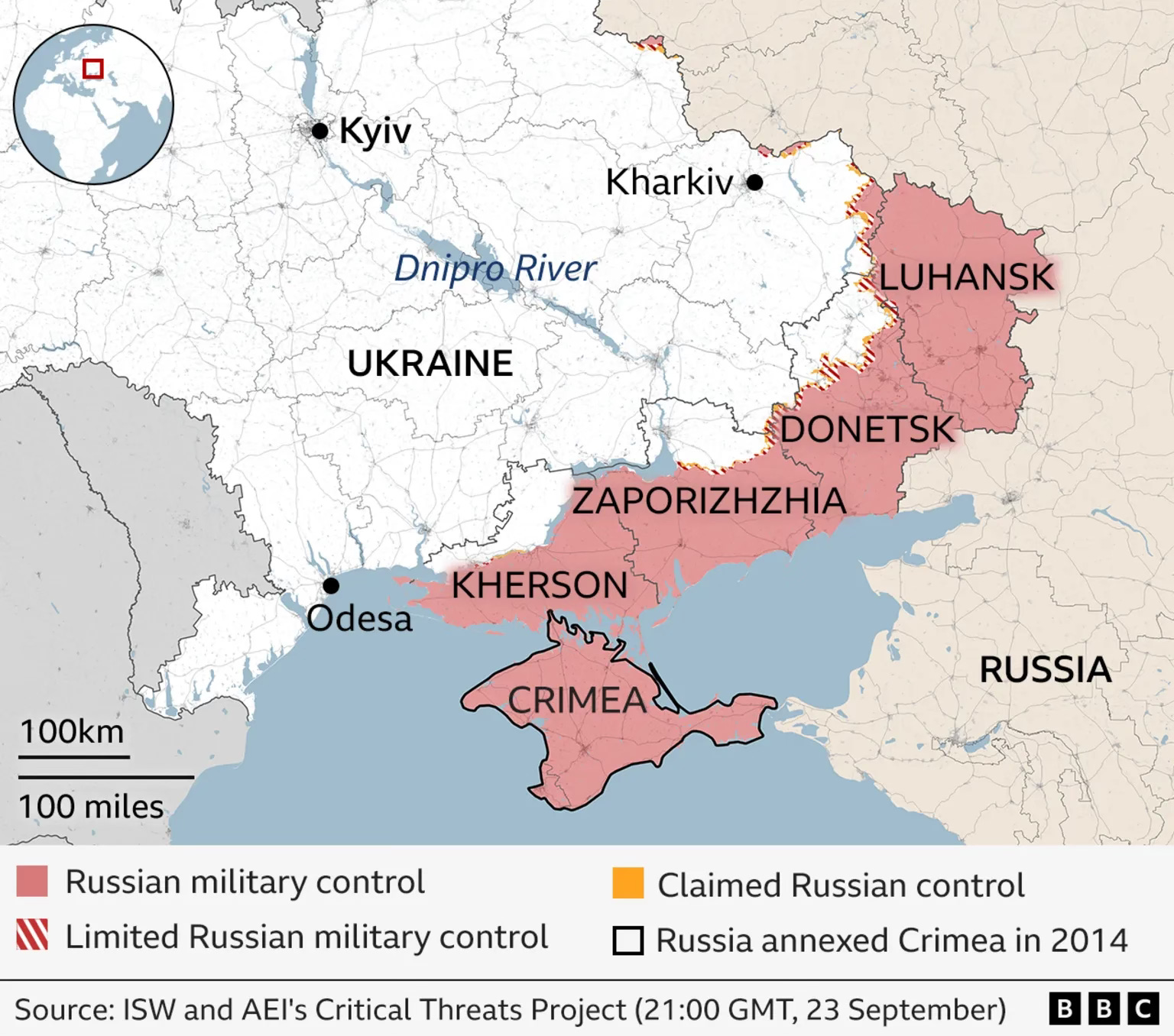
Again, no matter what Trump says, a total victory for Ukraine looks remote. Russia controls about 20 percent of Ukrainian territory, including the industrial Donbas and much of the south. Ukraine’s economy is weakened (as is Russia’s), its army is depleted, and its demographics are unfavorable to success (millions of Ukrainians have sought sanctuary abroad).
The Media’s Role in Perpetuating Illusion
The mainstream media in the U.S. has been partisan since day one. The MSM framed the conflict as a morality play: a heroic democracy versus an evil autocrat.
Meanwhile, the MSM overhyped U.S. weapons as “decisive” and Ukrainian counteroffensives in 2023 as “war-winning.” Media hype distorted expectations and contributed to public fatigue.
Most strikingly, the press has consistently downplayed the risks of escalation with a nuclear power. Ukraine’s use of long-range Western missiles to strike inside Russia carries serious dangers. That Putin will tolerate further provocations without escalating himself is a dangerous bet.
The Case for Diplomacy
Ukraine, no matter Trump’s new faith, cannot win this war in the maximalist sense of regaining all occupied territories and forcing Russia’s surrender. The longer the war continues, the more Ukraine will suffer—physically, economically, and politically.
Wars feed autocracy. Already, Ukraine has postponed elections, banned several opposition parties, and restricted media outlets. These measures may be understandable in wartime, but they belie the notion that Ukraine is a flourishing democracy.
A negotiated settlement is not capitulation. It is recognition of limits. The alternative is indefinite conflict—one that may bleed Ukraine dry even as it edges the world closer to catastrophe.
Dangerous Assumptions
Some policymakers argue a prolonged war will weaken Russia to the point of collapse. But a weakened Russia is not necessarily a safer one. If the Russian state disintegrates, who controls its nuclear arsenal? What if chaos in Moscow produces a more radical, vengeful leader? What if a desperate Kremlin lashes out, or if fighting spills into a NATO country like Poland?
Conversely, what if Ukraine, drained by endless war and reliant on foreign arms, slides toward authoritarianism? Wars have a way of transforming republics into garrison states. The longer the conflict lasts, the greater the risk that Ukraine’s democracy will become a casualty of its own “great patriotic war.”
The Limits of Analogy
Too often, the war is discussed through lazy historical analogies. Putin is Hitler; Zelensky is Churchill; negotiations are “another Munich.” Such framing flatters Western moral vanity but obscures strategic reality. This is not 1938. Putin is not on the verge of conquering Europe, and diplomats are not appeasing him by seeking peace.
Putin may be ruthless, but he is not suicidal. He knows that attacking a NATO member would invite his own destruction. Nuclear deterrence remains real. To suggest otherwise is to indulge in a fever-dream of perpetual conflict, one that justifies limitless military spending and forecloses diplomacy.
The American Connection
For most Americans, the Russia–Ukraine War remains distant and impersonal. We are not threatened by Russian artillery; the war is thousands of miles away. Yet we are paying for it—literally. Every artillery shell, every tank, every missile financed through our taxes contributes to death and destruction abroad. Some justify this as moral duty: helping Ukraine defend freedom. But morality also demands an accounting of consequences.
How many Americans know that 69 percent of Ukrainians report being weary of the war, or that their own government has suspended elections? How many realize that each dollar spent on war is a dollar not spent on schools, infrastructure, or healthcare at home?
We are told the U.S. can afford virtually limitless weapons for Ukraine, but when it comes to social programs, we always hear the same question: How are you going to pay for that? Apparently, there’s always money for war, never for peaceful pursuits.
A Broader Reckoning
The Russia–Ukraine War has become a mirror reflecting America’s own pathologies: our addiction to militarism, our aversion to diplomacy, our willingness to spend without scrutiny when the cause is war, and our moral complacency about the human cost of conflict.
We have turned foreign policy into a morality play, where compromise is dismissed as cowardice and negotiation is treated as akin to sin. Yet history teaches the opposite: the greatest statesmen are not those who glorify war but those who end it.
The Russia–Ukraine War continues, and so does the silence around the most basic of questions: What is America’s endgame? If the answer is “as long as it takes,” we should ask: takes for what? For Ukraine’s victory—or for its ruin? For democracy’s defense—or for another endless war?
It is time to demand accountability, restraint, and above all, diplomacy. Supporting Ukraine should not mean subsidizing endless cycles of death and destruction. How many more must die before this war is finally ended?
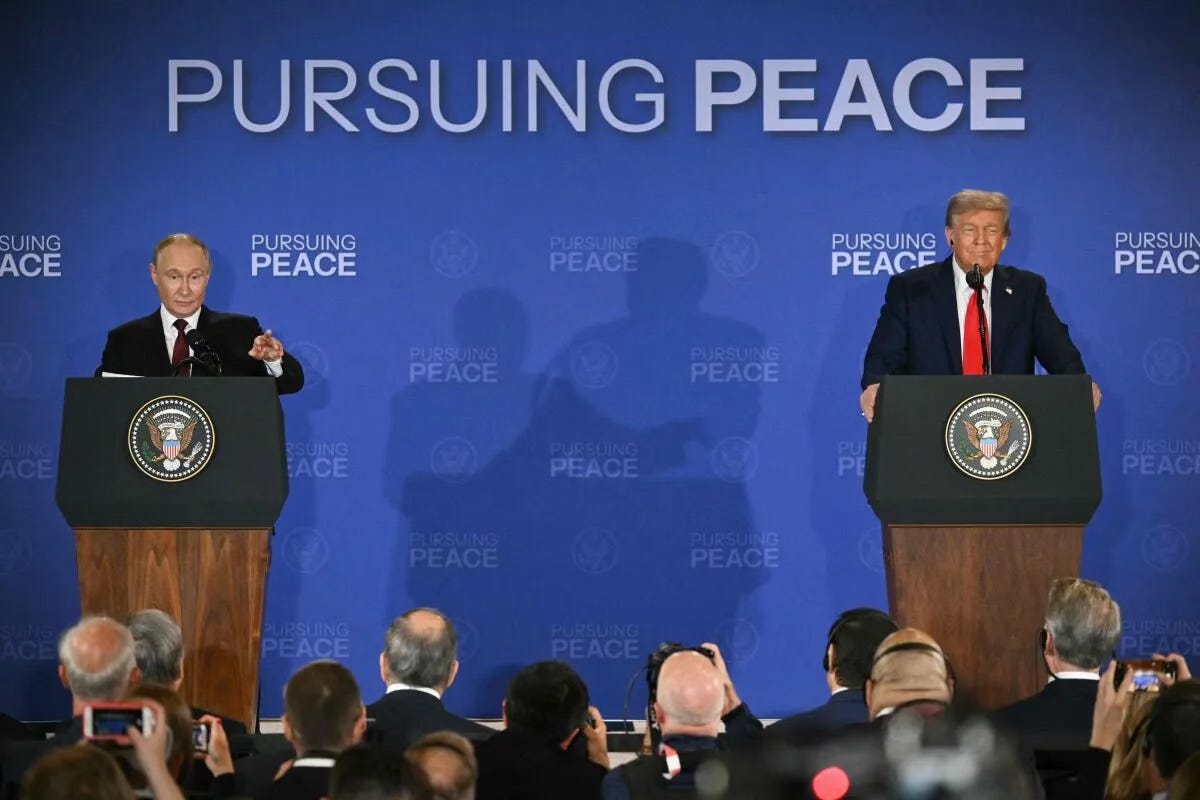
I’m glad President Donald Trump met with his Russian counterpart, Vladimir Putin, in Alaska. No country possesses more nuclear warheads than Russia, so dialogue is essential. As Churchill once allegedly observed, “jaw-jaw” is better than “war-war,” especially when nuclear weapons and humanity’s fate are at stake.
Unsurprisingly, the two leaders announced no breakthrough on ending the Russia-Ukraine War. Still, the fact they were talking matters. They even floated the idea of a second meeting in Moscow. Putin quipped about it; Trump replied that he might “take some heat” for visiting the Kremlin. Innocuous banter, yes—but I’ll take that over nuclear threats any day.
Pursuing peace—but not yet finding it.
The transcript of their closing remarks made for revealing reading. Putin spoke first, striking an amicable and measured tone. He invoked the U.S.-Soviet alliance of World War II, when both nations fought a common enemy. His words were thoughtful, cautious, above all diplomatic. He repeatedly emphasized the “businesslike” nature of the meeting, framing his approach as pragmatic and respectful—an approach likely to resonate with Trump, the self-proclaimed master of “the art of the deal.” Putin’s message, in essence, was: I’m someone you can do business with.
Trump’s remarks, by contrast, were more improvisational, filled with his trademark superlatives. Putin’s words, he said, were “very profound,” the meeting itself “very productive,” and the progress “great.” He even declared his relationship with Putin “fantastic.” That may be fantasy, but better that than animosity and hostility.
One passage from Trump’s comments stood out as both peculiar and revealing:
I would like to thank President Putin and his entire team—faces I know in many cases, faces I see all the time in the newspapers. You’re almost as famous as the boss—especially this one right over here. But we have had good, productive meetings over the years, and I hope to have more in the future.
That offhand line about Putin’s advisers being “almost as famous as the boss,” and about seeing their faces “all the time in the newspapers,” points to Trump’s obsession with fame. For Trump, people seem to matter only if they are celebrities. Recall his boasts about his own face appearing on the cover of Time magazine. His ego and craving for recognition make him vulnerable to manipulation. Unless you’re “famous”—someone whose picture appears regularly in the media—you scarcely exist in his world.
Trump’s deep need to be respected by other famous figures serves as a way to affirm his own worth. The danger, of course, is where that need might lead him—and the country.
Roughly three and a half years have passed since Russia’s invasion of Ukraine in February 2022 and the war shows little sign of ending. President Trump has gone from boasting he could end the war in a day to following the policy of the Biden administration in providing weapons and aid to Ukraine. To most Americans, the war has become background noise, barely perceptible. Most Ukrainian flags have been put away or deleted from Facebook and similar social media sites.
If you’re looking for a primer on the war that’s both critical and balanced, check out Medea Benjamin and Nicolas J.S. Davies’ book, “War in Ukraine: Making Sense of a Senseless Conflict,” now available in a revised and expanded second edition. ($20 paperback; $10 ebook, from OR Books.)
Benjamin and Davies recognize the war didn’t erupt out of nowhere in February 2022 nor was it completely “unprovoked.” As much as they deplore and denounce Vladimir Putin’s decision to invade, they recognize Putin had his reasons. Putin is more rational actor than a power-hungry dictator, and he’s arguably driven more by securing Russia’s position (and regional dominance) than recreating a Tsarist Russian or Soviet empire. Unlike most American commentators, Benjamin and Davies favor a diplomatic solution that would end mass killing on both sides. Not surprisingly, their views have gained little traction in the pro-war, anti-Putin mainstream media.
Speaking of the U.S. mainstream media, NBC News posted an article yesterday citing Condoleezza Rice, former Secretary of State under President George W. Bush. An unrepentant neocon, Rice is happy that Trump is sending more weapons to Ukraine while threatening more sanctions as well. In short, Trump is following a traditional neocon script while also keeping weapons factories in the U.S. going full blast. Rice approves!
What I found most staggering from Rice was this claim cited by NBC:
Rice also criticized the Biden administration for, in her view, having taken its time to get desperately needed weapons to Ukraine from the outset. “If you had given them everything at the beginning of the war,” she said, when “the Russians were on their back foot, [Ukraine] could’ve won this war outright.”
Excuse me, but WTF? What does giving Ukraine “everything” at the beginning of the war in 2022 mean? Fighter jets, main battle tanks, long-range missiles, nuclear weapons? Ukraine wasn’t even an ally of the U.S., nor was it ever a part of NATO. And would Ukraine really have won the war against Russia with “everything”? What about the risk that Russia would have escalated as well, perhaps calling on its arsenal of 6000 or so nuclear weapons?
Rice’s call for more smoking guns to have been sent to Ukraine early in 2022 almost certainly would have ended in a mushroom cloud or two. But I suppose that’s OK with her as long as the mushroom clouds were limited to Ukraine.
Remember 2023 and the failure of the much-hyped Ukrainian counteroffensive? I do. Remember all the hype about U.S., German, and British wonder weapons like Abrams, Leopard, and Challenger tanks? I do.
Let’s hope that Trump’s gambit to push Putin to some kind of compromise settlement bears fruit. No war should go on forever. Haven’t enough people died on both sides?
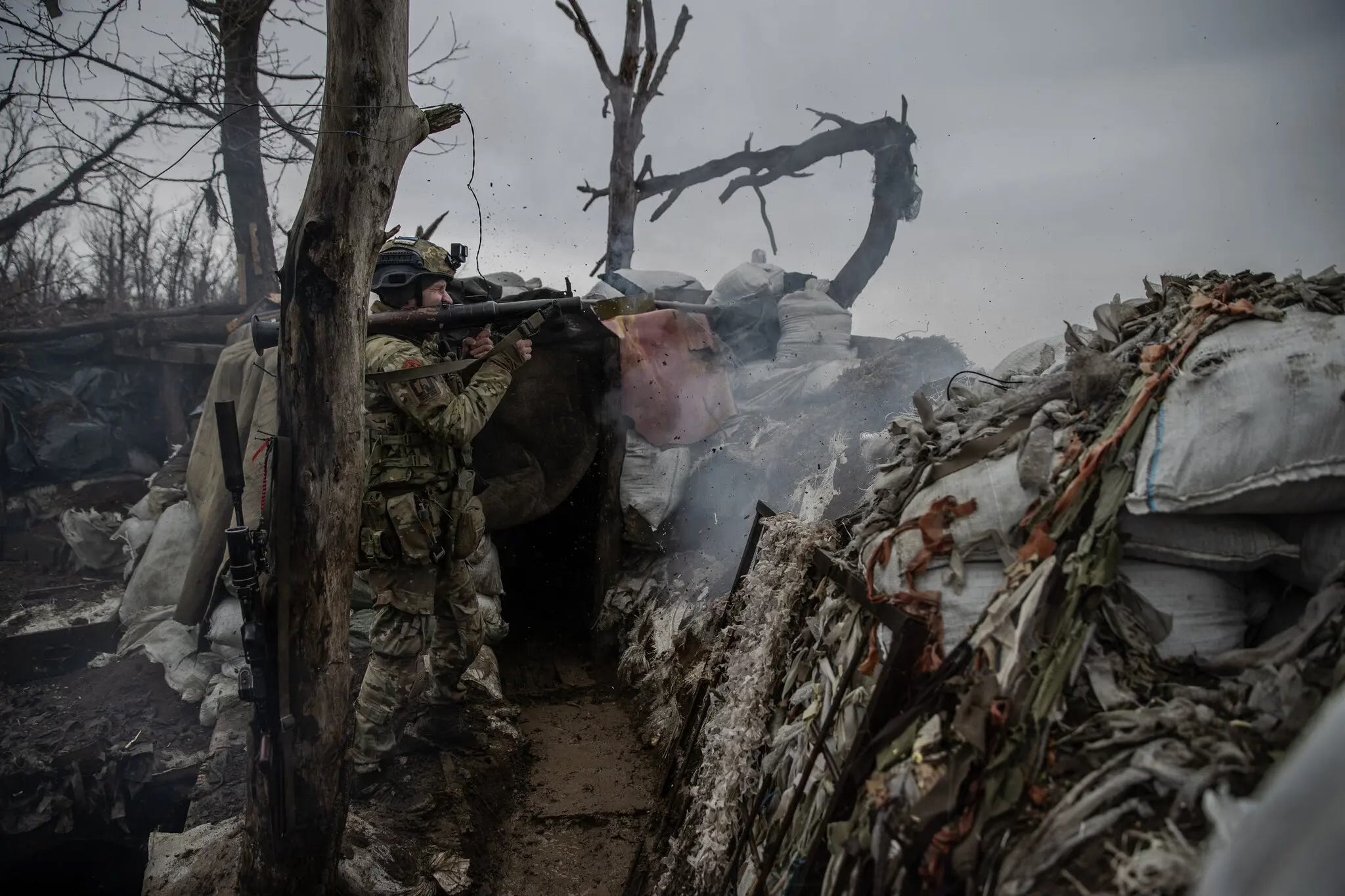
I recently read the book, “Generals Die in Bed,” a classic account of World War I. In terms of combat between Ukraine and Russia, there are serious echoes of WW1 with trench warfare and needless death on a massive scale.
There are few things dumber and more wasteful than trench warfare (Ukraine, from the New York Times)
Far too often, war is glorified when it is really colossal waste. As Dwight D. Eisenhower said, war is to be hated. So, short of abject capitulation to a tyrant, I support efforts to end wars. Stop the waste. Stop the hate. Find a way to live together in peace. The alternative, perpetual war, is too terrible to contemplate.
Diplomacy can be pursued without abandoning Ukraine or betraying NATO. Certainly, Ukraine should be a party to the negotiations. The war is being fought on their turf. They have bled, as has Russia.
But: All wars must end. The trick is ending them in a way that doesn’t generate future wars. That was the greatest tragedy of World War I: that its ending and the botched settlement led almost inexorably to World War II and an even greater bloodletting.
Here’s the rub: Ever since 9/11, indeed ever since World War II, almost without exception, America has ALWAYS been at war. And it hasn’t gone well, has it? (Except for the arms makers and the Cheney neocon crowd.) Isn’t it time we worked for peace?
Far too often, America’s worst enemy hasn’t been Putin or China or some other bogeyman. It’s been the enemy within. And I don’t mean the “red menace” or the “woke” crowd. I mean the enemy that is threat inflation. The enemy that is incessant warfare in unnecessary wars of choice, which drives deficit spending, and which is reinforced by lies.
How many times have we heard of bomber gaps, missile gaps, falling dominoes in Asia, WMD in Iraq, etc., that turned out not to be true, but which were used to justify massive military spending and (especially in Southeast Asia) drove horrendous casualties? Yes, the MICIMATT is powerful, but why are Americans so easy to scare? Why are we so fearful when this country’s geographic position is so enviably strong and defensible? It’s not like Putin’s on our northern border: friendly Canadians are there! (Even if they boo our National Anthem at hockey games.)
The world is becoming multipolar again, which doesn’t mean it has to be a scarier place. A multipolar world could be a more stable one if U.S. leaders could just back off on their goal of dominating everything everywhere all at once.
The idea of full-spectrum dominance and America as a global hegemon at any price must give way to an irenic and ecumenical view of the world. The American religion of violent militarism and prideful exceptionalism is simply too expensive to sustain.
When the ship of state is slowly slipping under the waves, it’s not wise to steer closer to more icebergs. Let’s work to save our ship of state first.
What is the point of playing Russian roulette—with Russia?
As the Biden administration fades into oblivion, among its last decisions has been to allow Ukraine to strike deep into Russia with U.S.-made ATACMS, a missile with a range of 300 kilometers (190 miles). Ukraine’s recent use of these missiles brought a worrisome response from Russia: hypersonic intermediate-range missiles. If Ukraine persists in striking deeper into Russia with U.S., British, and French missiles, the Russian response will be proportionately greater, and possibly escalatory against NATO.
Here’s the thing: These missiles are too few in number to have a decisive impact on the course of the war. Ukraine isn’t going to “win” by launching ATACMS and similar tactical missiles. Yes, they can inflict more pain on Russia, hitting targets like ammunition dumps, military bases, and the like. But nobody is pretending these are war-winning weapons. All they promise is more dead bodies on both sides.
In World War I, new weapons were often introduced because it was believed they would prove decisive on the battlefield, weapons such as poison gas (1915) and tanks (1916). Of course, the other side adapted fairly quickly and the war dragged on, but at least there was a sincere belief that new weapons might break the awful stalemate of trench warfare.
There is no such sincere belief today. The main objective seems to be to complicate matters for the incoming Trump administration and its stated goal to end the Russia-Ukraine War. To that end, the Biden administration is using all means at its disposal to send the remaining $6 billion or so in weapons and related aid to Ukraine before Trump’s inauguration in January. Even anti-personnel mines are included in the mix.
Here’s how Antony Blinken put it:
President Biden is committed to making sure that every dollar we have at our disposal will be pushed out the door between now and January 20.
We’re making sure that Ukraine has the air defenses it needs, that it has the artillery it needs, that it has the armored vehicles it needs.
If only the Biden administration had been so committed to helping Americans in need.
In playing Russian roulette with Russia, Biden and Blinken have demonstrated unconscionable levels of recklessness and stupidity.
In my morning news feed from the New York Times came this article on Tulsi Gabbard:
How Tulsi Gabbard Became a Favorite of Russia’s State Media
President-elect Donald J. Trump’s pick to be the director of national intelligence has raised alarms among national security officials.
Here’s the key paragraph from the article, which, of course, is delayed until the sixth paragraph:
No evidence has emerged that she has ever collaborated in any way with Russia’s intelligence agencies. Instead, according to analysts and former officials, Ms. Gabbard seems to simply share the Kremlin’s geopolitical views, especially when it comes to the exercise of American military power. [Emphasis added]
Did you get that? NO EVIDENCE. Tulsi has never collaborated with Russia in any way. The problem is that she’s a critic of unnecessary and disastrous wars like Iraq and Afghanistan. She’s a critic of massive U.S. military aid to Ukraine. And since those criticisms are vaguely useful to Russia, she must therefore be a “Russian asset,” a dupe of Putin, according to Hillary Clinton and now the New York Times.
Within the so-called intelligence community (IC), you are allowed to be a cheerleader, a booster, even a selective critic in the sense that you may call for more money for the IC because of certain limitations or oversights, but you are not allowed to question America’s disastrously wasteful imperial foreign policy.
No matter how poorly the IC performs (consider the colossal failure of 9/11, or the total obliviousness about the impending collapse of the Soviet Union in the late 1980s, or recent disastrous wars in Afghanistan, Iraq, and Libya), no one is ever held accountable, even as the IC gets more money and authority.
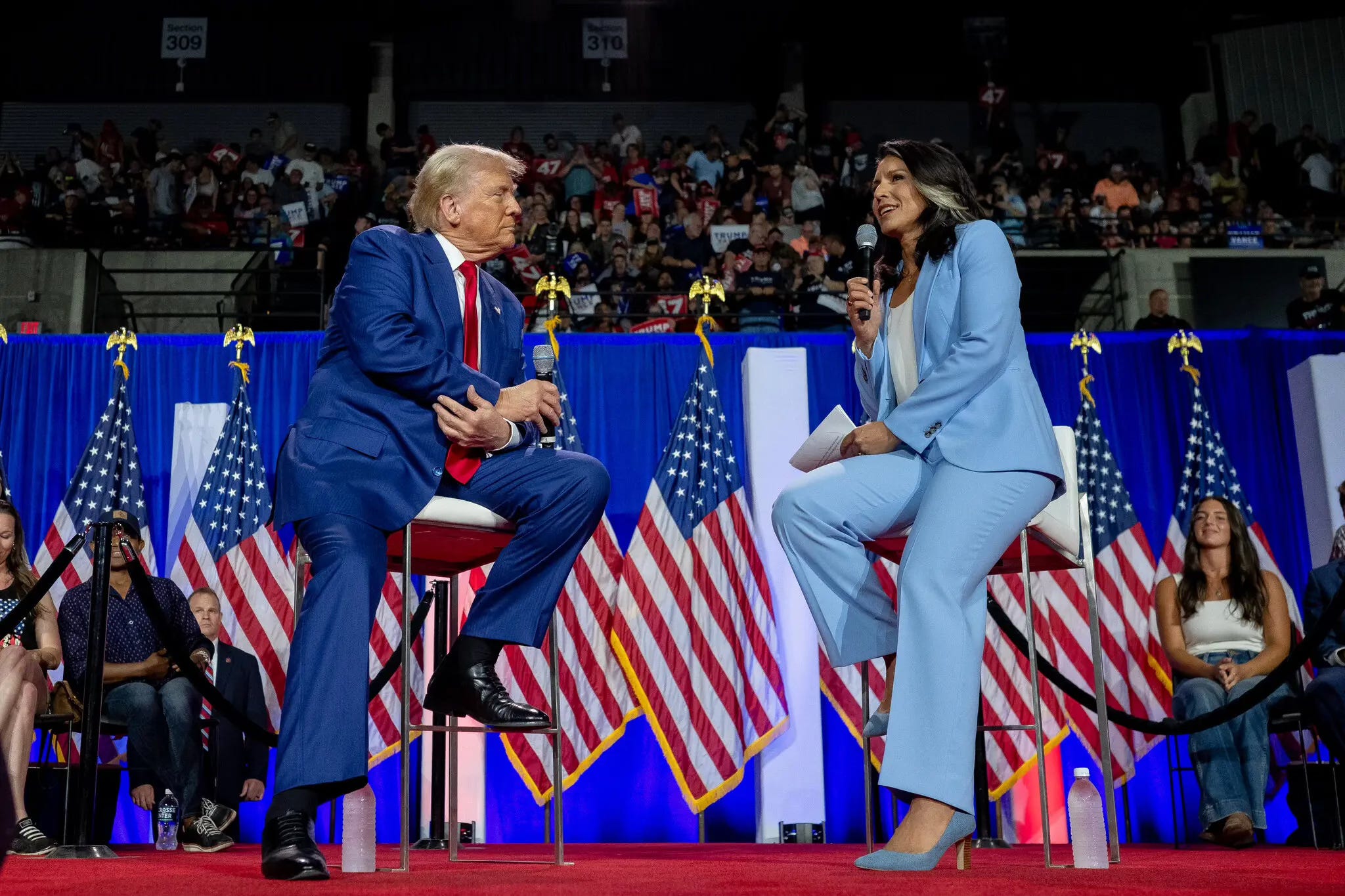
Tulsi Gabbard with President-elect Trump. (Jim Vondruska for the NYT)
Tulsi Gabbard promises to be a game-changer. Skeptical of the blatant misuse of American military power, she’s been an articulate critic of forever wars. She is especially sensitive to deploying U.S. troops in harm’s way for purposes other than the defense of the United States.
The “liberal” New York Times is having none of that. Consider this remarkable paragraph:
“Nominating Gabbard for director of national intelligence is the way to Putin’s heart, and it tells the world that America under Trump will be the Kremlin’s ally rather than an adversary,” Ruth Ben-Ghiat, a professor of history at New York University and the author of “Strongmen,” a 2020 book about authoritarian leaders, wrote on Friday. “And so we would have a national security official who would potentially compromise our national security.” [Emphasis added]
Who knew that “Putin’s heart” could be won so easily? And note the weasel wording that Tulsi could “potentially compromise” U.S. national security. Again, no evidence is presented.
Well, we certainly don’t want the U.S. to have a rapprochement with Putin. He must always be our adversary, am I right? How dare that Trump and Gabbard might, just might, pursue a policy that is less antagonistic toward the Kremlin? Don’t you enjoy teetering on the brink of a world-ending nuclear exchange? I much prefer that to listening and negotiation.
In making enemies of Hillary Clinton and now the New York Times, Tulsi Gabbard has demonstrated she has what it takes to serve as director of national intelligence.
That’s a headline that proves once again that America is led by the best and brightest. (Sarcasm alert.)
Vladimir Putin has already said that long-range weapons striking targets in Russia means war between Russia and NATO. I don’t think he’s bluffing. And, lest we forget, Russia has nearly 6000 nuclear warheads in its inventory.
Why is the U.S. and NATO allowing Ukraine to use missiles that can strike targets deep into Russian territory? The short answer is that Ukraine is losing the war. But any escalation by Ukraine can be matched (and over-matched) by Russia. The most likely scenario is an even more devastated Ukraine. The worst-case scenario is World War III.
Wars are made by fools with stars on their shoulders and produce more fools, especially in government circles. Ukraine isn’t going to win the war by launching Storm Shadow missiles 150 miles into Russia. More attacks on Russia are likely to reinforce Putin’s rule than to weaken it.
Meanwhile, Ukraine continues to lose more territory to Russian forces in the east, as this map (courtesy of the NYT) shows.
In a war that’s now lasted more than two and a half years, we’ve been told repeatedly that new “magical” weapons will make all the difference for Ukraine, whether Leopard and Challenger and Abrams tanks or F-16 fighter jets or ATACMS or what-have-you. Yet the Russia-Ukraine War is largely an old-fashioned infantry and artillery war, a land war, an attritional war, in which Ukraine is slowly being worn down.
Long-range missiles launched into Russia aren’t going to turn the tide in Ukraine’s favor. But they may provoke a devastating response from Russia that could provoke a far wider conflict. And for what, exactly?
Killing Russians and Palestinians–A Growth Industry for America
To sell the Biden administration’s $95 billion arms package (the big pieces are $60 billion to Ukraine and $14 billion to Israel), Democrats and Republicans alike are celebrating the fact that genocide in Gaza and more war in Ukraine will create jobs for Americans.
The honest (not used) slogan: Wars and genocide create jobs in America!
Of course, they don’t couch it quite this way. The $14 billion to Israel is touted as “defending Israel’s right to exist” and the $60 billion to Ukraine is sold as defending democracy in that country while thwarting evil Putin, a dictator “worse than Hitler.”
Yet, as an article in Politico put it back in October, as quoted in The Nation: “The White House has been quietly urging lawmakers in both parties to sell the war efforts abroad as a potential economic boom at home. Aides have been distributing talking points to Democrats and Republicans who have been supportive of continued efforts to fund Ukraine’s resistance to make the case that doing so is good for American jobs.”
Talk about a win-win! Creating jobs by killing and wounding Russians and Palestinians in large numbers. I’m finally proud to be an American, where at least I know I can profit prodigiously from other people’s pain and anguish.
Death—it’s a jobs program.
Sullivan and Blinken, more than willing to sell genocide and war as jobs programs
Selling this “jobs program” are diplomats and civilians like Secretary of State Antony Blinken and National Security Adviser Jake Sullivan. I wrote about these two paragons of non-virtue soon after Joe Biden was elected president in November 2020. Here’s what I wrote then (citing some sharp-eyed critics):
At TomDispatch.com, Danny Sjursen gives a sharp-eyed summary of the typical Biden operative in the realm of military and foreign affairs. Here’s what Sjursen has to say:
In fact, the national security bio of the archetypal Biden bro (or sis) would go something like this: she (he) sprang from an Ivy League school, became a congressional staffer, got appointed to a mid-tier role on Barack Obama’s national security council, consulted for WestExec Advisors (an Obama alumni-founded outfit linking tech firms and the Department of Defense), was a fellow at the Center for New American Security (CNAS), had some defense contractor ties, and married someone who’s also in the game.
It helps as well to follow the money. In other words, how did the Biden bunch make it and who pays the outfits that have been paying them in the Trump years? None of this is a secret: their two most common think-tank homes — CNAS and the Center for Strategic and International Studies (CSIS) — are the second- and sixth-highest recipients, respectively, of U.S. government and defense-contractor funding. The top donors to CNAS are Northrop Grumman, Boeing, and the Department of Defense. Most CSIS largesse comes from Northrop Grumman, Lockheed Martin, Boeing, and Raytheon.
With the news that Tony Blinken will be Biden’s Secretary of State, Caitlin Johnstone makes the following salient point:
Blinken is a liberal interventionist who has supported all of the most disgusting acts of US mass military slaughter this millennium, including the Iraq invasion which killed over a million people and ushered in an unprecedented era of military expansionism in the Middle East. So needless to say he will fly through the confirmation process.
Meanwhile, Julia Rock and Andrew Perez note the incestuous nature of this process, or how the national security revolving door keeps spinning:
On Sunday, Bloomberg reported that Biden has chosen his longtime aide, Tony Blinken, to serve as Secretary of State and will name Jake Sullivan, his senior advisor and a former Hillary Clinton aide, national security adviser. Former Obama Defense Department official Michèle Flournoy is considered the favorite to be Secretary of Defense.
After leaving the Obama administration, Blinken and Flournoy founded WestExec Advisors, a secretive consulting firm whose motto has been: “Bringing the Situation Room to the board room.” Flournoy and Sullivan have both held roles at think tanks raking in money from defense contractors and U.S. government intelligence and defense agencies.
Biden has been facing calls [Ha! Ha!] from Democratic lawmakers and progressive advocacy groups to end the revolving door between government and the defense industry. One-third of the members of Biden transition’s Department of Defense agency review team were most recently employed by “organizations, think tanks or companies that either directly receive money from the weapons industry, or are part of this industry,” according to reporting from In These Times.
Meanwhile, defense executives have been boasting about their close relationship with Biden and expressing confidence that there will not be much change in Pentagon policy.
Please forgive the “Ha! Ha!” parenthetical, but all this was predictable based on Biden’s record and his statement that nothing would fundamentally change in his administration …
Progressives have essentially no power in the Democratic Party. Look at who the Speaker of the House is! Nancy Pelosi, once again, the ultimate swamp creature.
Expect no new ideas from this bunch, meaning grim times are ahead…
My prediction in November 2020 that “grim times are ahead” was hardly a moment of psychic power. Sure, we didn’t know we’d have an ongoing genocide in Gaza and a godawful war of attrition in Ukraine, but we knew some bad decisions were going to be made by the likes of Biden, Blinken, and Sullivan. And so they have been made.
The Russia-Ukraine War Enters Its Third Year with No End in Sight
Russia launched its “special military operation” against Ukraine on February 24th, 2022. Russia and Ukraine had been feuding since 2014, with U.S. meddling in Ukraine exacerbating the tensions. NATO expansion to Russia and Ukraine’s borders, along with calls to incorporate Ukraine into NATO at some future date, also led to increased tensions with Russia. The result has been a costly and enduring war in which Ukraine has lost roughly 20% of its territory in the east; both sides have suffered high casualties in horrendous conditions that recall the trench warfare of World War I.
At the moment, Russia appears to have the edge. Ukraine recently lost the city of Avdiivka. Manpower in Ukraine is stretched thin. The average age of troops at the front for Ukraine is 43 even as I’ve seen stories touting the recruitment of young women for the front as well as 17-year-old teenagers. Artillery ammunition is in short supply; $60 billion in weapons, munitions, and other military aid from the United States is frozen in Congress. A path to military victory for Ukraine is unclear.
Nevertheless, the Biden/Harris administration is fully behind the Ukraine war effort. I take the title of this article from Vice President Kamala Harris and her recent vow that the U.S. will support Ukraine for “as long as it takes.” The word “it” apparently refers to a complete victory by Ukraine over Russia by force of arms, i.e. the expulsion or withdrawal of all Russian troops from Ukrainian territory. Since it is unlikely Vladimir Putin will withdraw his troops voluntarily, the U.S. government has signed up to support Ukraine until it is able to defeat Russian forces on the battlefield, whether that takes one year, five years, or forever and a day.
Zelensky and Harris recently in Munich, together for “as long as it takes”
Such an open-ended commitment by the U.S. requires some explanation. The conventional narrative goes something like this: Putin is a bully and a thug. He is the next Hitler, or even worse. If he’s allowed to win in Ukraine, he will be emboldened to strike at NATO countries in Europe. Meanwhile, other authoritarian dictators around the world will see Russia’s victory as permission to strike at U.S. interests globally, undermining democracy and the “rules-based order.” Supporting Ukraine with vast sums and amounts of weaponry and munitions, therefore, is necessary to stop worldwide aggression by Putin and those who would emulate him. This is, in essence, the narrative of the Biden administration.
I believe this narrative is wrong. I see no evidence that Putin has plans to invade NATO countries; indeed, his invasion of Ukraine has strengthened NATO and led to its expansion. Russia is bogged down in a costly war in Ukraine, and while its forces have generally performed better recently than they did two years ago when they first invaded, the outcome of this war remains unclear. The Russian economy isn’t strong; an enduring war in Ukraine isn’t beneficial to Putin or the Russian people.
So far, “diplomacy” seems to be the hardest word in this conflict. Negotiation seems to be seen as capitulation. There’s evidence to suggest the U.S. and Great Britain have discouraged—even sabotaged—talk of ceasefires and settlements. To my knowledge, there are no efforts by the U.S. to seek a truce or some kind of armistice or other agreement that would end the war with all its suffering and devastation. The war must go on, full stop.
More than a stated fear of Putin as the new Hitler is involved here. Domestic politics are critical. In the U.S., Democrats are using Republican opposition to $60 billion in more aid to Ukraine to accuse GOP members of favoring Russia and of sabotaging Ukraine’s noble and heroic war effort. If the Republican-controlled House doesn’t approve the $60 billion aid package and Ukraine suffers a serious setback this year, Democrats will accuse Republicans of having “lost” Ukraine, of having become Putin-appeasers. Facing this possibility, it’ll be interesting to see if Republicans eventually cave and provide the $60 billion in aid.
Meanwhile, the military-industrial-congressional complex continues to profit from this war. The U.S. State Department recently boasted of a 56% increase in foreign arms sales in 2023, much of that going to Ukraine. More and more, the State Department is simply a tiny branch of the Pentagon, “negotiating” through arms sales and shipments and boasting of profits from the same.
War may be the health of the state of the self-styled “arsenal of democracy,” but it’s very unhealthy for the people of Ukraine and Russia and indeed for the planet. The New York Times, consistently on the side of Ukraine and more war, recently referred to the heavy troop losses of both sides and the “relentless devastation” of a war being fought on Ukrainian territory. Recent articles in publications like Reuters and The New Yorker pose the question, “Can Ukraine Still Win?” Their conclusion seems to be “possibly,” but not in 2024, and not without massive aid from the U.S., and even then, “victory” by feat of arms is increasingly unlikely.
Meanwhile, I keep seeing articles that favor more offensive and destructive weaponry for Ukraine, most recently long-range missiles to strike at Russia. Recall that U.S./NATO aid to Ukraine first focused on defensive weapons such as Stinger and Javelin missiles. Very quickly, aid escalated to armored vehicles, including main battle tanks (Challenger, Leopard, and Abrams), heavy artillery, rockets, and now F-16 fighter jets. Tank ammunition included depleted uranium shells; artillery rounds included cluster munitions. All these weapons have increased the deadliness of the battlefield, ensuring a blasted, dangerous, and toxic environment for generations to come without delivering decision on the battlefield for Ukraine.
The outlook for 2024 seems dire. Ukraine, outgunned and outmanned, is facing another bleak year of war. Optimism about a decisive Ukrainian counteroffensive (that was supposed to come in 2023) is long gone, with U.S. advisors having pointed fingers at Ukrainian leaders for their alleged hesitancy in absorbing large casualties on the offensive. An increasing number of American voters are questioning whether a war costing them roughly $180 billion in two years (assuming the Biden aid package is approved) is truly in their national interest, even as Members of Congress tell them that much of that money provides good-paying jobs to Americans making bullets and bombs to kill Russians.
Is America an arsenal of democracy, or just an arsenal?
Having served in the U.S. military for 20 years during the end of the Cold War, I remember a time when U.S. leaders talked to their Soviet counterparts. Kennedy talked to Khrushchev, Nixon talked to Brezhnev, Reagan talked to Gorbachev. Agreements were reached; crises were deescalated; wars were avoided. Courage and resoluteness aren’t shown through more weapons and war; they’re shown by reducing weapons and putting an end to war. Why can’t Biden talk to Putin?
“Blessed are the peacemakers” is a sentiment that shouldn’t be limited to the New Testament. If only this nation’s leaders would work to pursue peace “for as long as it takes.” Sadly, war always finds a way, especially when it’s sold as stopping the next Hitler.







 Bracing Views