Quick Thoughts on Hillary and Trump before the Debate

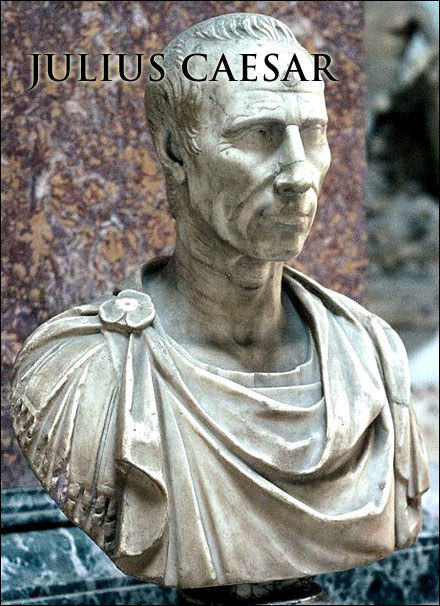
julius-caesar3
Hail Caesar!

W.J. Astore

Sorry, I have no special insight into tonight’s debate.  I’m guessing Hillary will win based on points, but that Trump will also win by being present on the same stage.  More celebrity than politician, more showman than man of substance, Trump knows how to control his own image. Hillary will command the facts; Trump will command the audience’s attention.  It’s a win-win for them but a lose-lose for America.

I had a strange dream last night.  I dreamed that Trump arrived at the debate, riding a chariot and posing as Caesar.  And the audience applauded.  I was desperate to ask a question (yes, I was in the audience, don’t ask me how), and got the chance.  I said something like this: “I was in the military for 20 years, serving my country, yet you, Donald Trump, dodged the draft during the Vietnam War.  You claim to be on the side of veterans, but you arrive here dressed as Caesar, as a conquering hero, even though you yourself never served.  Have you no sense of decency, sir?  Have you no shame?”

I swear: I rarely remember my dreams, and those that I do remember have nothing whatsoever to do with presidential politics.  In my waking hours, I don’t think of Trump as Caesar.  He’s more of a Nero, a deeply flawed narcissist who will fiddle while America burns.

Hillary raises different issues.  I keep seeing, both in print and on TV, the argument that Hillary is imperfect, secretive, compromised by special interests, a person of questionable judgment, but that we must vote for her simply because SHE’S NOT TRUMP.  Trump is so bad, such a hazard to democracy, the argument goes, that we must swallow the jagged big pill that is Hillary, no matter how painful that pill may prove, simply because the alternative is too terrible to contemplate.

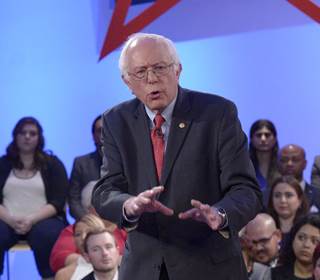
It’s sad indeed that some people’s best (only?) argument for Hillary is that SHE’S NOT TRUMP. For me, I can’t get past the Democratic Party’s efforts to rig the primary process in her favor against a true populist with integrity, Bernie Sanders.  It’s Bernie, not Hillary, who should be running against Trump, but the Democratic Party establishment determined from the beginning that Hillary, not Bernie, would be its nominee.

Of course, both parties, Republican and Democrat, want to keep alternatives from us.  The shameful part of tonight’s debate is that Gary Johnson (Libertarian) and Jill Stein (Green) are excluded.  In short, there will be no “debate” tonight in any meaningful sense of that word. Instead, we will get a narrow discussion of establishment views with considerable jousting and posturing (and perhaps some mugging from Trump), generating some heat but precious little light.

Yes, I will watch the debate.  I just hope some version of my dream of Caesar’s rapturous appearance doesn’t come to pass.

Which Hypocritical Billionaire Should Rule America?

Clinton_Paskova_0191471569795
She might meet with you — if the price is right

W.J. Astore

News about the Clinton Foundation and its finances shows the truth of that old adage, “You get what you pay for.”  In this case, giving money to the Clinton Foundation often bought access to Hillary Clinton (or her closest aides), the odds-on favorite to be America’s next president, and sometimes it helped with favors as well.  These revelations illustrate perfectly the “pay to play” nature of the American political scene: the usual influence peddling, the usual FOBH, Friends of Bill and Hillary, coming together to pull the strings while being paid handsomely for the performance.

Here’s what the Washington Post had to say about it:

A sports executive who was a major donor to the Clinton Foundation and whose firm paid Bill Clinton millions of dollars in consulting fees wanted help getting a visa for a British soccer player with a criminal past.

The crown prince of Bahrain, whose government gave more than $50,000 to the Clintons’ charity and who participated in its glitzy annual conference, wanted a last-minute meeting with Secretary of State Hillary Clinton.

U2 rocker and philanthropist Bono, also a regular at foundation events, wanted high-level help broadcasting a live link to the International Space Station during concerts.

In each case, according to emails released Monday from Hillary Clinton’s time as secretary of state, the requests were directed to Clinton’s deputy chief of staff and confidante, Huma Abedin, who engaged with other top aides and sometimes Clinton herself about how to respond.

The emails show that, in these and similar cases, the donors did not always get what they wanted, particularly when they sought anything more than a meeting.

But the exchanges, among 725 pages of correspondence from Abedin disclosed as part of a lawsuit by the conservative group Judicial Watch, illustrate the way the Clintons’ international network of friends and donors was able to get access to Hillary Clinton and her inner circle during her tenure running the State Department.

Yes, money sure does matter.  If asked why they took more the fifty grand from the prince of Bahrain, among other donors with deep pockets, I suppose Hillary and Bill might just say, “Because that’s what they offered.”  Money is the universal solvent of politics, and Hillary and Bill know this better than most.

Of course, Hillary is trying to position herself as the champion of ordinary people, even as she and her husband have amassed a foundation and position worth roughly $2 billion. Who knows?  Given the nebulous and chaotic nature of Trump’s finances, the Clintons may be richer than him.

Which brings me to this question: Which hypocritical billionaire do you want to rule America?

Update (8/24/16): The Washington Post has another story on how Hillary Clinton is raising big money through various fundraisers.  All you need is $25K or $50K and some good connections and you too might be able to meet Hillary in a semi-private setting.  You might even net a bonus like seeing Cher (in Provincetown) or hearing Aretha Franklin sing (in Birmingham, Michigan).

Remember how Bernie Sanders energized a movement, raising millions by relying on individual donations that averaged (and this is an amount he made famous) $27 per donation?

Those days are gone.  Establishment Hillary is back, and she’s raising buckets of money from the deep pockets of heavy-hitters.

But never fear!  She’s all about helping “everyday people” — a phrase her campaign used until someone noticed it was slightly condescending.

If we’re “everyday people,” who are the Clintons?  Well, I can tell you how they think of themselves by how they act: They are the higher life forms, to borrow a phrase from a friend, a retired Army major who remembers M-48 tanks because he served in one.

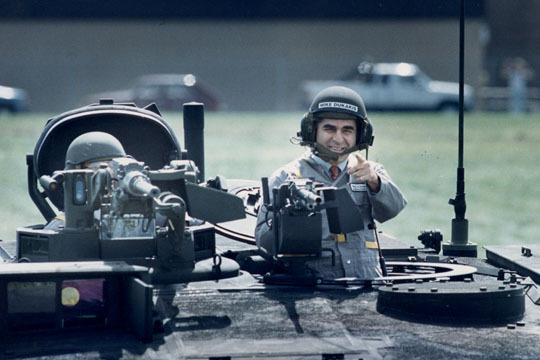
That’s one place we won’t see Hillary: in an Army tank.  But if we ever did, I think she’d pull it off better than Michael Dukakis did.

***Photographer
Beware of posing with tanks


Hillary’s Clinching of the Nomination

Yet another selfie
Yet another selfie

W.J. Astore

Well, she’s won.  Hillary Clinton’s victories in last night’s presidential primaries have clearly put her over the top, clinching the Democratic nomination. Facing the loudmouthed bigotry and ignorant blustering of Donald Trump this fall, Hillary has an excellent chance of being elected as America’s first female president.

I’ve already written a lot of articles at this site on why I find both Hillary and The Donald to be poor choices as president. I won’t repeat those arguments here.  But I do want to talk about Hillary’s campaign, and what it says about her candidacy.

I remember the first commercial Hillary made, the announcement of her candidacy.  A tedious spot, it focused on her grandmotherly qualities.  It had no vision, no bite, and little hope.  It was about trying to make us feel comfortable with Hillary.  Hey, she’s a mom and a grandma!  Other women like her!  She’s just like us!

It went downhill from there.  Hillary’s campaign has been carefully scripted and modulated, the opposite of impassioned.  Vapidness replaced vision.  That’s why a democratic socialist Jew from Vermont via Brooklyn gave her a run for her money, because she had no passion or vision and he did (and does).

For me, the defining moment of their debates came when Bernie argued strongly for a $15.00 minimum wage for workers and Hillary was content with offering workers a $12.00 wage. (More than enough, peasants!)  Combine that moment with her infamous statement about the gobs of money she made in three speeches to Goldman Sachs (“Well, that’s what they offered”) and you get a clear sense of who she is and what she’s about.

A quick note: A nursing aide making Hillary’s generous $12.00 hourly wage at 40 hours a week would take 28 years to earn the $675,000 that Clinton “earned” in a few short hours giving those speeches.

Her campaign claims she’s “fighting for us.”  But I see Hillary as fighting for herself — and her circle of privileged cronies.  There’s nothing new about this in American politics, of course.  It’s just terribly disappointing for America that two narcissists, two voices of the privileged, will be vying for the presidency this fall.

One thing I would like to see (and it won’t happen): I’d like to see Trump and Hillary debate with Green and Libertarian candidates.  I’d like to hear some real alternative views and how the “major” candidates respond to them.  But even though the media found room for up to seventeen Republican primary candidates on the stage, you can bet the house that Trump and Hillary will share a stage alone together.

Alone together — get ready for gratuitous insults and sound bites, America. One thing is certain: neither candidate is fighting for us, and both are not about making America great again.

D-Day Thoughts on Strength versus Weakness

330px-York
Sergeant Alvin C. York, reluctant hero

W.J. Astore

On this 72nd anniversary of D-Day, the Allied invasion at Normandy in France during World War II, it’s high time we thought about what is truly weakness versus strength in U.S. foreign policy.

There’s no doubt that in World War II American leaders demonstrated strength.  Nazi Germany and Imperial Japan had to be defeated, and the means had to be military.  Our leaders mobilized the nation and the deed was done by men and women of my parent’s generation.

What about today?  Is our nation truly mobilized for war?  Are threats like ISIS truly the equivalent of militarized nation-states like Nazi Germany and Imperial Japan?  Are we truly engaged in wars of necessity, in wars of self-defense, or are our wars those of choice?  The lack of any Congressional declarations of war, of any effort at national mobilization or shared sacrifice, suggests the latter.  Our leaders choose to wage them – a choice that showcases weakness rather than strength.

How so?  “Strength” is shown not by committing troops to quagmires; not by escalating wars; not by buying, sending or selling more weaponry; not by more and more bombing; not by drone assassinations.  Indeed, weakness is shown in embracing these steps as providing “solutions.”

How “tough” do you really have to be to commit other people’s sons and daughters to war?  How tough do you have to be to bomb foreigners without risk to yourself, to buy and sell weapons at healthy profits, to send in the B-52s or the drones or the privatized militaries?  For Washington today, these are the easy steps to take, the expected ones, the expedient ones, the predictable ones.  They are not evidence of “toughness” — rather the reverse.

So, what is really “tough” for today’s DC crowd?  Patient diplomacy, quiet resolve, a willingness to withdraw from unwinnable wars, the resolve to retrench and rethink militarized positions.  Being a peacemaker instead of a war-bringer – that is what is really tough in today’s hyper-violent America.  But in “exceptional” America, war means never having to say you’re sorry.

The corporate media also has its categories of “weakness” and “strength” exactly backwards, hence the praise of Hillary Clinton for her toughness.  Her embrace of Henry Kissinger is generally applauded, and if Henry wasn’t so old, one could imagine the media applauding her if she made him her VP.  Donald Trump, of course, is riding a wave of (trumped up) toughness.  He’s presented as a “Go ahead—make my day” kind of guy, as if attacking marginalized groups for political advantage is the height of manly courage.  In polarized America, how tough do you have to be to criticize Muslims, immigrants of color, and other victimized or vulnerable groups? Trump would be truly tough if he took on racism, if he fought for justice, if he adopted positions based on democratic principles rather than his own biases and resentments.

The ass backwards nature of “strength” versus “weakness” is mirrored in America’s movies and TV shows.  In my dad’s day (the 1930s and 1940s), America’s good guys didn’t obsess about weapons.  Generally, it was gangsters who relied on them.  Men of weak character played with guns.  Truly tough men duked it out with fists when they weren’t otherwise facing each other down.  Think Humphrey Bogart, unarmed, facing down the gangster Johnny Rocco and his gun-toting stiffs in “Key Largo” (1948).

Think too of Gary Cooper in “High Noon” (1952).  He’s not spoiling for a fight, but he’s ready to endure one if it’s unavoidable.  His main “weapon” is his decency, his nerve, his courage, his character.  Today’s “heroes” in movies and TV are all about kinetic action, amped-up violence, and big guns.  Violence and mayhem dominate, just as in America’s overseas wars of choice.  Art imitates life while reinforcing it.  As a result, Americans don’t even blink when they hear about the latest drone assassination in Where–is-it-stan.  It’s happening off-stage, so who cares?

Even our war movies aren’t what they used to be.  Think Gary Cooper (again) playing Sergeant Alvin C. York, the World War I hero who was a conscientious objector due to his religious views.  Nowadays, our war movies celebrate gung-ho “American snipers” for their kill totals.

What is truly weakness and what is truly strength?  And why are America’s leaders, leaders of the sole superpower with the self-avowed “best” military ever, so very, very afraid of being perceived as “weak”?

Mister, we could use a man like Alvin York again.

Obama’s Foreign Policy: Image over Substance

Obama address
Actions speak louder than spin

W.J. Astore

At Salon.com, Patrick Smith has a telling article on the Obama administration’s foreign policy.  He details the way in which style has triumphed over substance, and how tightly the Obama administration controls the narrative in the mainstream media.  Essentially, Smith provides more evidence of the way in which reporters and journalists serve as stenographers to the powerful.

Many journalists, notes Smith, are twenty-somethings who attempt to provide coverage of foreign affairs from inside the Washington Beltway. Under such conditions, even a diligent reporter has to rely far too heavily on official mouthpieces at the Pentagon, State Department, and similar governmental agencies. Those reporters who buck the system risk losing access; in short, they risk losing their privileges — and their jobs. Most end up conforming.

This is nothing new to anyone familiar with Stephen Colbert’s famous take-down of insider journalists at the Washington Correspondents’ Dinner in 2006.  As Colbert said a decade ago:

But, listen, let’s review the rules. Here’s how it works. The President makes decisions. He’s the decider. The press secretary announces those decisions, and you people of the press type those decisions down. Make, announce, type. Just put ’em through a spell check and go home. Get to know your family again. Make love to your wife. Write that novel you got kicking around in your head. You know, the one about the intrepid Washington reporter with the courage to stand up to the administration? You know, fiction!

Along with that critique, Smith is excellent on critiquing the fundamental unoriginality, the militarized banality, of much of Obama’s foreign policy.  As Smith notes:

There can be no radical shift in American conduct abroad, of course, until goals and purposes are addressed very forthrightly. This means taking on, in explicit fashion, our inherited tropes—our claims to exceptionalism and universalism—as well as the hegemonic ambitions the Pentagon shares with American corporations. It is a question, as noted in a previous column, of techne and telos, two words from ancient Greek. You can change the former—your method, your means—all you like, but it will matter little until you alter your telos, your aims, the ideal you strive for …

What is the new [Obama administration] narrative, then? May we know, please? I address the question to Ben Rhodes, David Samuels and Samuels’ editors at the Times Magazine. All this palaver about a brilliant foreign policy innovator and not one word about his masterstroke innovation, a reimagined frame for American conduct abroad?

The lapse is a symptom of the above-noted problem: style without substance, form without content. We cannot count even the openings to Iran and Cuba as any great departures, given Washington’s behavior since. There is no new narrative, only a new way of telling the old narrative.

Just so.  Consider recent events.  More U.S. “advisers” (troops) to Iraq.  More foreign weapons sales.  The commitment of ABM missiles to Romania.  Sending B-52s (a symbol of the Cold War) to strike at ISIS.  More talk of the dangers of a resurgent Russia.  And (of course) more talk of enlarging the Pentagon and feeding it more money.

Yes, the Obama administration has been more reluctant than Bush/Cheney to commit big battalions of the regular army to overseas invasions and wars, but otherwise the foreign policy song has remained pretty much the same.  Obama just prefers a smaller stage presence or “footprint,” as defined by Washington as drones and special ops, together with privatized militaries and extensive weapons sales, rather than big battalions.

That’s hardly a new narrative in U.S. foreign policy — precisely the point of Smith’s telling critique.


The “Liberal” Media Narrative on Bernie Sanders

Bernie
Keep fighting, Bernie

W.J. Astore

Bernie Sanders has won yet another primary against Hillary Clinton, this time in West Virginia.  He’s likely to win more, perhaps even California in June.  Yet what is the headline at the “liberal” New York Times?

Top News
Senator Bernie Sanders of Vermont campaigning Tuesday in Salem, Ore. His victory in West Virginia's Democratic primary on Tuesday was less about policy differences with Hillary Clinton than about the state's demographics.

Bernie Sanders Wins West Virginia, Prolonging Race With Hillary Clinton

By TRIP GABRIEL

The primary victory by the senator from Vermont will force his Democratic rival to continue a distracting nominating fight.

Can you believe the nerve of that man?  Bernie Sanders is “forcing” his rival, Hillary Clinton, “to continue a distracting nominating fight.”

I suppose Democrats should just hand the nomination to Hillary, uncontested. Now that’s true democracy in action.

Without the “superdelegates,” i.e. without the support of the establishment within the Democratic Party, Hillary and Bernie would be running neck-and-neck.  You’d think the media would love a close horse race like this.  But no: the media is slavering for a Trump versus Hillary race.  Bernie is already an afterthought, even as he keeps winning.

Bernie’s victories highlight Hillary’s weaknesses.  Progressives don’t trust her. Independents are not impressed.  Young people are turned off (her politics as usual is uninspiring, to say the least).  Working-class whites find little of appeal in her message and record.

Yet the media, even the so-called liberal media, has already declared victory for Hillary, looking ahead to the joys of months of mud-slinging between Hillary and Trump.

Please stay in the race, Bernie. You have nothing to lose — and the country has much to gain.

This Modern and Dystopic World

orwell 006
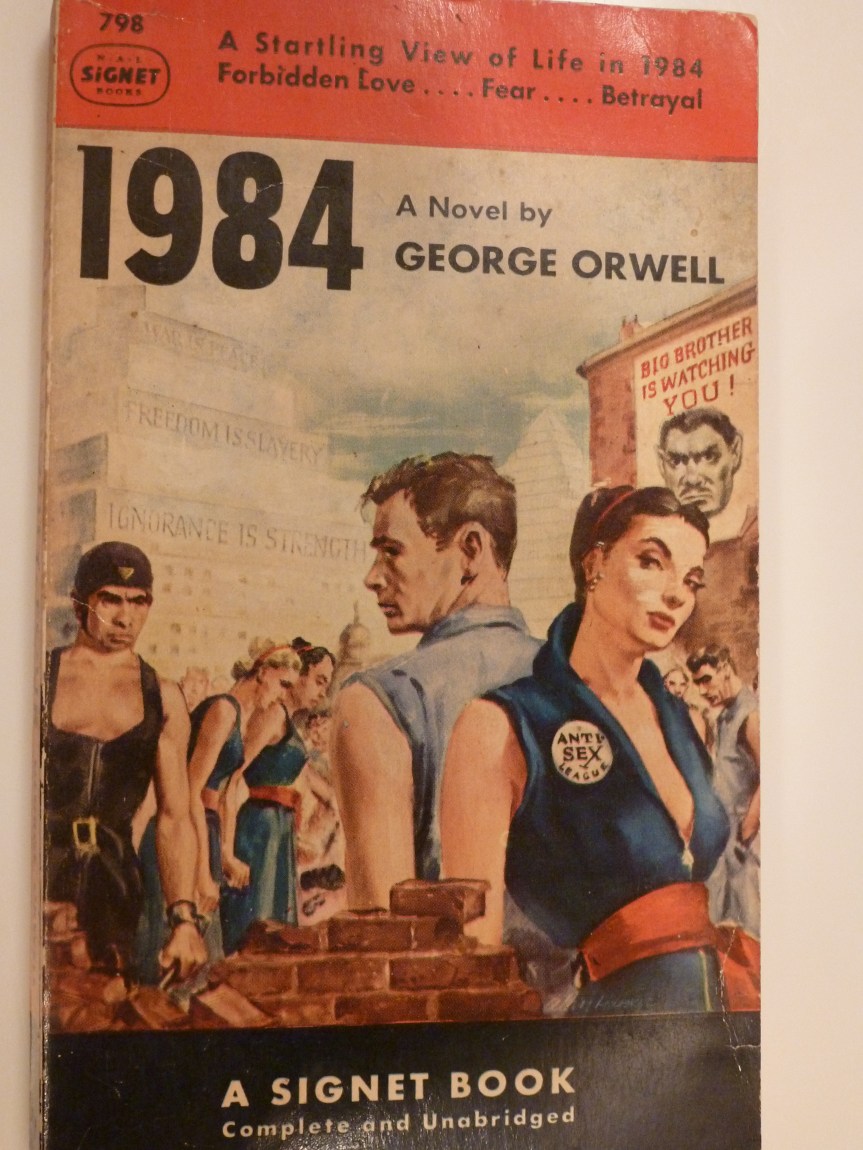
My copy of Orwell’s 1984

W.J. Astore

The modern world is a kluge of Ray Bradbury’s Fahrenheit 451 with screens everywhere in which people submerge themselves, Aldous Huxley’s Brave New World with “soma” of all sorts to keep us drugged and happy, and of course George Orwell’s 1984 with constant surveillance and the “two minutes of hate,” directed mainly at “the enemy,” especially the enemy within, known in 1984 as Goldstein (for some Americans today, “Goldstein” is Donald Trump; for others, it’s Hillary Clinton; for a few, it’s Ted Cruz or perhaps all of the above).

Dystopic elements characterize our American moment, hence the appropriateness of dystopic science fiction novels.  Bradbury was especially good at poking holes in the idea technology was in essence a liberating force.  He captured the way people might submerge their identities within screens, neglecting the real people around them, even those closest to them, for the “virtual reality” of infotainment.  Huxley was keen to debunk mass production as a liberating force, but his invention of “soma,” a mood-enhancing drug that leads to detachment and inaction, captured our overly medicated ways.  (I can’t watch network news without being bombarded by drug ads that promise me release from pain or acne or other nuisances and hence a better life, as long as I take this pill or use this inhaler.)  Finally, Orwell captured the total surveillance state, one driven by fear, obsessed by enemies created by the state to cow the masses.  Perhaps the darkest of the three, Orwell left little hope for the “little man” oppressed under the jackboot of a militaristic and totalitarian state.

The times are not quite that dark in America today, but these three classic novels offer warnings we’d do well to heed.  An aspect of these dystopias we most definitely see in America today is the degeneration of news, of information, of knowledge.  As a society, America is arguably less fact-based today than at any point in its history.  Even as we’re immersed in information via the Internet, the news itself has become shallower, or trivial, or frivolous, when it’s not out-and-out propaganda.

I grew up watching the news.  Before going to school, I used to watch the “Today” show in the morning in the 1970s.  It was a decent show.  Some real and serious news made the cut.  Now it’s largely a laugh-fest featuring celebrities making sales-pitches.  The news as soap opera; the news as vanity.

To state the obvious: The network “news” has been dumbed down.  Image is nearly everything.  Stories are far shorter and without context.  Designed for people with limited attention spans, they’re also designed to keep people watching, so they feature sensationalism and “quick hits” — nothing too taxing or disturbing.

Of course, the real news is still out there, as Tom Engelhardt notes in his latest probing article at TomDispatch.com.  It’s just much harder to find on the network “news”:

What’s left out?  Well, more or less everything that truly matters much of the time: any large, generally unphotogenic process, for instance, like the crumbling of America’s infrastructure (unless cameras can fortuitously zoom in on a bridge collapsing or a natural gas pipeline in the process of blowing up in a neighborhood — all so much more likely in an age in which no imaginable situation lacks its amateur video); poverty (who the hell cares?); the growing inequality gap locally or globally (a no-interest barrier the WikiLeaks-style Panama Papers recently managed to break through); almost anything that happens in the places where most of the people on this planet actually live (Asia and Africa); the rise of the national security state and of militarism in an era of permanent war and permanent (in)security in the “homeland”; and don’t even get me started on climate change…

Coming to grips with the real news would require thought and necessitate action – changes, radical ones, to the status quo.  And what powerbroker wants that?

Focus instead, America, on your screens.  Take your soma.  Hate your Goldstein.  That’s the method driving our madness.  Dystopia, anyone?


The Vietnam War, the Pentagon Papers, and Lying

Arendt
Hannah Arendt (Arendt Center at Bard College)

W.J. Astore

In November 1971, the political philosopher Hannah Arendt published “Lying in Politics: Reflections on the Pentagon Papers” in the New York Review of Books.  Earlier that year, Daniel Ellsberg had shared those highly classified government papers with the U.S. media.  They revealed a persistent and systematic pattern of lying and deception by the government about U.S. progress in the Vietnam War.  By undermining the people’s trust in government, lies and deception were destabilizing democracy in America, Arendt said.  Furthermore, America was witnessing two new and related categories of lying.  The first was lying as public relations, the creation and distribution of images substituting for facts and premised in human manipulability (a Madison Avenue approach to war and foreign policy).  The second was lying tied to a country’s reputation as embraced by professional “problem-solvers” as the basis for political action.  Both categories of lying constituted a crisis to the republic.

Widespread lying during the Vietnam War, Arendt explained, had not been aimed at the enemy, as lies often are in war.  Rather, governmental lying had targeted Americans.  The enemy could hardly be fooled, but most Americans could – at least for a time.  Throughout the war, Arendt noted, senior U.S. government and military officials made decisions about Vietnam with the firm knowledge they could not be carried out, a form of self-deception facilitated by constant goal-shifting.  As goals changed and chaos mounted, U.S. officials then became driven by concerns about saving face.  Image-making and image-saving took precedence over reality. The truth about Vietnam – that the U.S. was losing the war – hurt, therefore it was denied, especially in public discourse.

Official lies can fool even the officials themselves, a fact Pulitzer prize-winning reporter David Halberstam noted in his prescient book, “The Making of a Quagmire,” published in 1965.  With respect to the Kennedy Administration’s support of the corrupt Diem/Nhu government of South Vietnam, Halberstam wrote that:

Having failed to get [the Diem/Nhu regime to make needed] reforms, our officials said that these reforms were taking place; having failed to improve the demoralized state of the [South] Vietnamese Army, the Americans talked about a new enthusiasm in the Army; having failed to change the tactics of the [South Vietnamese] military, they talked about bold new tactics which were allegedly driving the Communists back.  For the essence of our policy was: There is no place else to go.

When reporters began to file stories which tended to show that the [U.S.] policy was not working, its authors, President Kennedy and General [Maxwell] Taylor, clung to it stubbornly.  At least part of the explanation for this apparent blindness is that although they knew things were going wrong, they felt that the alternatives were worse.

This “blindness,” a sustained willingness to deny harsh truths about the Vietnam War, persisted throughout the Kennedy, Johnson and Nixon administrations.  U.S. leaders continued to package and sell a losing effort as a winning product. It helped, in Arendt’s words, that U.S. officials had “a truly amazing and entirely honest ignorance of the historically pertinent background” when it came to Vietnam.  Their ignorance was “honest” in the sense they did not believe facts were all that important to success.  What was needed, U.S. officials concluded, were not incontestable facts but the right premises, hypotheses, and theories (such as the infamous Domino Theory) to fit Vietnam within prevailing Cold War orthodoxies.  Overwhelming applications of U.S. military power would serve to actuate these premises, facts be damned.

Upon taking power in 1969, the Nixon Administration, which had promised a quick and honorable end to the war, continued the lies of previous administrations.  Even as Nixon and Henry Kissinger spoke publicly of peace with honor, they talked privately of a lost war.  To shift the blame for defeat, they cast about for scapegoats (as corroborated recently in the HBO documentary, “Nixon by Nixon: In His Own Words”).  Kissinger settled on South Vietnamese “incompetence” as the primary scapegoat.  He reassured Nixon that, after a “decent interval” between U.S. withdrawal and the inevitable South Vietnamese collapse, most Americans would come to see Vietnam as a regrettable (and forgettable) “backwater.”  Naturally, harsh facts such as these were ones Nixon and Kissinger refused to share with the American people.

For Hannah Arendt, truth as represented by verifiable facts is the chief stabilizing factor in politics.  Lacking truths held in common, action is compromised, judgment is flawed, reality is denied.  Deception feeds self-deception until politics is poisoned and collective action for the common good is disrupted.  Yet lies cannot be eliminated simply by moral outrage, Arendt noted.  Rather, truth must be fought for even as humility before truth must be cultivated.

The American people must fight for the truth: that is the lesson of Arendt’s essay.

Next Week: Part II: More Lies and Deception in the Iraq War of 2003

The Bizarre and Scary World of Republicans

11TRANSCRIPTweb-master675
There they go again

W.J. Astore

I watched last night’s Republican debate from Florida (transcript here) and then checked this morning’s coverage from major networks such as NBC and CBS.  The focus of media coverage was the “civility” of this debate compared to previous ones, combined with typical horse race speculations about which candidate won and which lost.

Well, I can’t tell you who won, but I can tell you who lost: the American people lost.

Several lowlights from the debate that stick in my mind:

1. Marco Rubio was asked about climate change and whether human action, such as the emission of greenhouse gases, contributed to it.  Rubio essentially denied that human action had any significant impact on global warming.  The essence of his answer: the climate is changing because the climate always changes.  And the U.S. government can take no action to reduce it.

2.  Donald Trump held to his position on torture.  He believes waterboarding should be used, that laws should be changed to allow harsher means of torture, apparently because the enemy (ISIS) beheads its opponents or drowns them in cages.  He was not challenged on how he would change international laws against torture, nor was he challenged on consistent evidence that torture does not work in efforts to gain accurate intelligence.  Nor were any questions raised about the morality of torture and its proposed expansion if he wins the presidency.

3.  All of the candidates expressed support for sending U.S. ground troops, perhaps 20,000 to 30,000, to combat ISIS in the Middle East.  The situation was presented as a civil war within Islam between radical Sunni and Shia forces, but no candidate explained how U.S. combat forces could win someone else’s civil war, a war driven by fierce ideological differences.  Somehow, magically, the reappearance of big battalions of U.S. troops and massive displays of air power would “shock and awe” radical jihadists into collapse and capitulation.

4.  For the candidates, nothing Obama has done in the last seven years is worthy of the slightest praise.  Obamacare must be repealed.  The Iran nuclear deal is a disaster.  His forthcoming trip to Cuba represents a capitulation to communism.  His executive actions are illegal; all of them must be reversed.

5.  Each candidate tried to best the other on who is more pro-Israel.  According to Trump, “there’s nobody on this stage that’s more pro-Israel than I am.”  Apparently Israel is the only U.S. ally that is worthy of total support and unconditional love by Republican candidates.

6.  Trump refused to qualify his statement that there is “tremendous hate” in the Islamic world directed against the United States.  However, there was no reason given for this hate, and no sense that U.S. military actions overseas, to include invasions, drone strikes, and special ops raids, contribute in any way to Islamic animosity.  The candidates were simply not asked why some, most, or nearly all Muslims “hate” America.

7.  Finally, topics that weren’t discussed at this debate but which are commonly discussed at Democratic debates: racism, shootings by police against Blacks, prison and justice reform, raising the minimum wage, the rising gap between the richest 1% and everyone else, reducing the cost of college education, and efforts to guarantee affordable health care for all.  Nor were women’s issues, such as equal pay for equal work, mentioned.  Indeed, with the exception of Trump’s comment about women being mistreated by the Muslim world, women’s issues simply didn’t exist, not in this debate and not in most of the others.  Indeed, my wife turned to me during a previous Republican debate and said, “Not one of these guys cares one whit about women’s issues — they’re offering us nothing.”

And on that sad yet telling note, I’ll end.


Hillary to Bernie: You Smear Me When You Tell the Truth

bernie

W.J. Astore

I watched yet another Democratic debate last night, this one moderated by MSNBC in a more traditional format instead of the previous version’s “town hall.”  Much was repeated: Bernie Sanders wants a “revolution” to overthrow a rigged economy and to enact campaign finance reform, Hillary Clinton says she’s a progressive who can get things done and who will build on the legacy of President Obama.

For me, the big moment came when Hillary tried to change the narrative on her taking millions of dollars from banks, investment houses, and Wall Street in the form of speaking fees and money from Super PACs.  She accused Bernie of a “smear” campaign when he “insinuated” she might be influenced by all this money.  She said other progressives (she cited Obama, for example) took money from Wall Street yet still allegedly held the big money boys to account.

Another moment, not as big but also telling, was when Bernie painted Hillary as an “establishment” candidate.  Talk about stating the obvious!  But Hillary rejected this by playing the gender card.  How can I be an establishment candidate for president, Hillary asked, when if elected I’d be the first woman president?  This is total nonsense, of course. She is an establishment candidate who just happens to be a woman.  But I suppose she and her team had no other response to the truth Bernie was bringing.

Speaking of the establishment, after claiming she wasn’t part of it, Hillary cited Henry Kissinger’s praise of her, saying Kissinger had applauded her for running a tight ship at the State Department.  Praise from Caesar …

But back to the “smear” campaign.  Obviously, Hillary and her team are hoping the media will focus on the smoke and mirrors generated by that loaded term, while neglecting the reality of Bernie’s truth-telling.  Given the craven nature of the mainstream media, her cynical gambit may even work.

When the big money boys give millions to candidates, any candidate, they’re not usually so blatant (or stupid) as to be buying votes.  They’re not going to get caught telling a candidate, vote yes on this, no on that.  What they’re buying is access.  They’re gaining the candidate’s ear. They want to be the last “person” to whisper in the candidate’s ear before she or he makes a decision.

I’m sure Hillary believes she’s her own woman.  But she knows how the system works, and so does Bernie.  If you accept big money, you know it always comes with strings attached.  The more big money you accept, the more strings, until no matter how much you resist, you end up dancing like a puppet on those strings.  That’s basically Bernie’s point, and it’s not a smear. It’s the truth.

An interesting question came up about whether Hillary would be willing to share transcripts of all her speeches before the big money boys.  She said she’d look into it.  If she’s the “progressive” she claims to be, she should be willing to share those transcripts immediately as a matter of public record.  Something tells me we either won’t see these transcripts, or they’ll be released months from now, after the primary race is decided.