Creator of Bracing Views. Contributor to TomDispatch, Truthout, HNN, Alternet, Huffington Post, Antiwar, and other sites. Retired AF lieutenant colonel and professor of history. Senior fellow, Eisenhower Media Network
The scary part is that the official death toll of 76,134 is an undercount. So many bodies remain under rubble or just plain obliterated by bombs.
Of course, the so-called cease fire in Gaza is anything but as Israel continues its policy of not-so-selective killing and slow strangulation. If you suggest genocide is wrong, the predictable response from the Israeli-U.S. government is that you’re a Hamas terrorist sympathizer and probably an anti-Semite as well (the latter is true even if you’re Jewish).
Coincidentally, I just took a drink after typing that and started choking. OK, maybe that wasn’t a coincidence.
I remember during Catholic service we’d sing the hymn: “Whatsoever you do to the least my brothers, that you do unto me.” I guess they’re just empty words to all those avowed Christians in the government.
I’m a Mutt-American. I’m half Italian, 3/8th English, and 1/8th Swedish. But I’ve never thought of myself as other than 100% American.
Ancestors on my mother’s side go back to the 1630s when they came across the Atlantic to the Massachusetts Bay Colony. Surnames like Wilder, Bird, and Hayward. I’ve been able to trace them back to England and to specific regions, even to ship’s names that they took in emigrating to the New World. At least one of my mother’s ancestors fought in the American Revolutionary War. Take that, J.D. Vance.
Another ancestor on my mother’s side, surname of Johnson, came from Sweden in the 19th century. He was a janitor. Other ancestors were reverends, clockmakers, and tanners, among other occupations. Again, typically American.
On my father’s side, his parents came from Italy in 1902 and 1913, so in that sense my American pedigree is more recent. That said, my father and his two brothers all served in World War II, my dad staying stateside as his two brothers served overseas, one in Europe, the other in the Pacific.
I think my family background is about as typical, as unexceptional, about as “normal” as they come. Unless you are of Native American ancestry, your roots here in America are fairly shallow, relatively speaking. A few centuries at best—not much on the cosmic timescale.
I mention all this because of the Trump administration’s vilification of immigrants, notably so-called illegals. Yes, I think people should immigrate legally to this country, but I don’t think anyone should be demonized.
Ilhan Omar, American (official portrait, 2019)
Trump in particular likes to attack Congresswoman Ilhan Omar, who is a Somali-American. His harsh rhetoric against her is dangerously irresponsible as well as hateful. I see Omar as akin to my Italian grandmother, who proudly became a naturalized U.S. citizen in 1945.
Trump is a remarkably puny man—a man who thinks he can puff himself up by belittling others. It’s shameful behavior. He should be impeached by Congress and removed for his un-American attacks that endanger other lawmakers—that demean others, that sow discord.
So many immigrants came (and come) to this country seeking a better life, a fresh start, a land where you really could be judged by the content of your character. In its attacks on immigrants, the Trump administration has shown itself to be characterless and wanting of the true American spirit.
Unless you’re Cheyenne or Pawnee or Iroquois or some other kinship group drawn from indigenous peoples, you’re a recent American, and probably a Mutt-American like me. As Americans, we’re all in this together—all equal under the law, all striving to form a more perfect union.
Well, except for Trump and his tribe of dividers. It’s high time they left America. Perhaps Elon Musk has a few rockets ready to send them to the Moon and beyond.
Hello Everyone: In 2007, I was fed up with the lies of the Bush/Cheney administration and the way civilian leadership was using the bemedaled chest of David Petraeus to deflect blame for that disastrous war. I knew then the “success” of the surge was an illusion, or, as Petraeus put it back then, “fragile” and “reversible” (and so it proved to be). I wrote an op-ed about how we the people had to save the military from itself and its own self-serving illusions. No one was interested in what I had to say; no one, that is, except Tom Engelhardt at TomDispatch. And so that led to my first “tomgram.”
Eighteen years later, I’ve reached the unlikely number of 115 essays for TomDispatch, something neither Tom nor I ever expected. And just about all those essays have been introduced by a mini-essay by Tom himself. It’s been a remarkable partnership—it’s what got my career as a writer and essayist (rather than a traditional historian) started.
This piece, my 115th, returns again to Cheyenne Mountain and nuclear war. I first wrote about my time “in the mountain” in 2008; seventeen years later, I’m even more dismayed at (and disgusted by) my country’s newfound enthusiasm for nuclear weapons and their “recapitalization.” Read on!
*****
It’s been 20 years since I retired from the Air Force and 40 years since I first entered Cheyenne Mountain, America’s nuclear redoubt at the southern end of the Front Range that includes Pikes Peak in Colorado. So it was with some nostalgia that I read a recent memo from General Kenneth Wilsbach, the new Chief of Staff of the Air Force (CSAF). Along with the usual warrior talk, the CSAF vowed to “relentlessly advocate” for the new Sentinel ICBM (intercontinental ballistic missile) and the B-21 Raider stealth bomber. While the Air Force often speaks of “investing” in new nukes, this time the CSAF opted for “recapitalization,” a remarkably bloodless term for the creation of a whole new generation of genocidal thermonuclear weapons and their delivery systems.
(Take a moment to think about that word, “creation,” applied to weapons of mass destruction. Raised Catholic, I learned that God created the universe out of nothing. By comparison, nuclear creators aren’t gods, they’re devils, for their “creation” may end with the destruction of everything. Small wonder J. Robert Oppenheimer musedthat he’d become death, the destroyer of worlds, after the first successful atomic blast in 1945.)
In my Cheyenne Mountain days, circa 1985, the new “must have” bomber was the B-1 Lancer and the new “must have” ICBM was the MX Peacekeeper. If you go back 20 to 30 years earlier than that, it was the B-52 and the Minuteman. And mind you, my old service “owns” two legs of America’s nuclear triad. (The Navy has the third with its nuclear submarines armed with Trident II missiles.) And count on one thing: it will never willingly give them up. It will always “relentlessly advocate” for the latest ICBM and nuclear-capable bomber, irrespective of need, price, strategy, or above all else their murderous, indeed apocalyptic, capabilities.
At this moment, Donald Trump’s America has more than 5,000 nuclear warheads and bombs of various sorts, while Vladimir Putin’s Russia has roughly 5,500 of the same. Together, they represent overkill of an enormity that should be considered essentially unfathomable. Any sane person would minimally argue for serious reductions in nuclear weaponry on this planet. The literal salvation of humanity may depend on it. But don’t tell that to the generals and admirals, or to the weapons-producing corporations that get rich building such weaponry, or to members of Congress who have factories producing such weaponry and bases housing them in their districts.
So, here we are in a world in which the Pentagon plans to spend another $1.7 trillion(and no, that is not a typo!) “recapitalizing” its nuclear triad, and so in a world that is guaranteed to remain haunted forever by a possible future doomsday, the specter of nuclear mushroom clouds, and a true “end-times” catastrophe.
I Join AF Space Command Only to Find Myself Under 2,000 Feet of Granite
My first military assignment in 1985 was at Peterson Air Force Base in Colorado with Air Force Space Command. That put me in America’s nuclear command post during the last few years of the Cold War. I also worked in the Space Surveillance Center and on a battle staff that brought me into the Missile Warning Center. So, I was exposed, in a relatively modest way (if anything having to do with nuclear weapons can ever be considered “modest”), to what nuclear war would actually be like and forced to think about it in a way most Americans don’t.
Each time I journeyed into Cheyenne Mountain, I walked or rode through a long tunnel carved out of granite. The buildings inside were mounted on gigantic springs (yes, springs!) that were supposed to absorb the shock of any nearby hydrogen bomb blast in a future war with the Soviet Union. Massive blast doors that looked like they belonged on the largest bank vault in the universe were supposed to keep us safe, though in a nuclear war they might only have ensured our entombment. They were mostly kept open, but every now and then they were closed for a military exercise.
The author (right) with Tom Engelhardt
I was a “space systems test analyst.” The Space Surveillance Center ran on a certain software program that needed periodic testing and evaluation and I helped test the computer software that kept track of all objects orbiting the Earth. Back then, there were just over 5,000 of them. (Now, that number’s more like 45,000 and space is a lot more crowded — perhaps too crowded.)
Anyhow, what I remember most vividly were military exercises where we’d run through different potentially world-ending scenarios. (Think of the movie War Gameswith Matthew Broderick.) One exercise simulated a nuclear attack on the United States. No, it wasn’t like some Hollywood production. We just had monochrome computer displays with primitive graphics, but you could certainly see missile tracks emerging from the Soviet Union, crossing the North Pole, and ending at American cities.
Even though there were no fancy (fake) explosions and no other special effects, simply realizing what was possible and how we would visualize it if it were actually to happen was, as I’m sure you can imagine, a distinctly sobering experience and not one I’ve ever forgotten.
That “war game” should have shaken me up more than it did, however. At the time, we had a certain amount of fatalism about the possibility of nuclear war, something captured in the posters of the era that told you what to do in case of a nuclear attack. The final step was basically to bend over and kiss your ass goodbye. That was indeed my attitude.
Rather than obsess about Armageddon, I submerged myself in routine. There was a certain job to be done, procedures to be carried out, discipline to adhere to. Remember, of course, that this was also the era of the rise of the nuclear freeze protest movement that was demanding the U.S. and the Soviet Union reach an agreement to halt further testing, production, and deployment of nuclear weapons. (If only, of course!) In addition, this was the time of the hit film The Day After, which tried to portray the aftermath of a nuclear war in the United States. In fact, on a midnight shift in Cheyenne Mountain, I even read Tom Clancy’s Red Storm Rising, which envisioned the Cold War gone hot, a Third World War gone nuclear.
Of course, if we had thought about nuclear war every minute of every day, we might indeed have been cowering under our sheets. Unfortunately, as a society, except in rare moments like the nuclear freeze movement one, we neither considered nor generally grasped what nuclear war was all about (even though nine countries now possess such weaponry and the likelihood of such a war only grows). Unfortunately, that lack of comprehension (and so protest) is one big reason why nuclear war remains so chillingly possible.
If anything, such a war has been eerily normalized in our collective consciousness and we’ve become remarkably numb to and fatalistic about it. One characteristic of that reality was the anesthetizing language that we used then (and still use) when it came to nuclear matters. We in the military spoke in acronyms or jargon about “flexible response,” “deterrence,” and what was then known as “mutually assured destruction” (or the wiping out of everything). In fact, we had a whole vocabulary of different words and euphemisms we could use so as not to think too deeply about the unthinkable or our possible role in making it happen.
My Date With Trinity
After leaving Cheyenne Mountain and getting a master’s degree, I co-taught a course on the making and use of the atomic bomb at the Air Force Academy. That was in 1992, and we actually took the cadets on a field trip to Los Alamos where the first nuclear weapon had largely been developed. Then we went on to the Trinity test sitein Alamogordo, New Mexico, where, of course, that first atomic device was tested and that, believe me, was an unforgettable experience. We walked around and saw what was left of the tower where Robert Oppenheimer and crew suspended the “gadget” (nice euphemism!) for testing that bomb on July 16, 1945, less than a month before two atomic bombs would be dropped on the Japanese cities of Hiroshima and Nagasaki, destroying both of them and killing perhaps 200,000 people. Basically (I’m sure you won’t be surprised to learn), nothing’s left of that tower except for its concrete base and a couple of twisted pieces of metal. It certainly does make you reflect on the sheer power of such weaponry. It was then and remains a distinctly haunted landscape and walking around it a truly sobering experience.
And when I toured the Los Alamos lab right after the collapse of the other great superpower of that moment, the Soviet Union, it was curious how glum the people I met there were. The mood of the scientists was like: hey, maybe I’m going to have to find another job because we’re not going to be building all these nuclear weapons anymore, not with the Soviet Union gone. It was so obviously time for America to cash in its “peace dividends” and the scientists’ mood reflected that.
Now, just imagine that 33 years after I took those cadets there, Los Alamos is once again going gangbusters, as our nation plans to “invest” another $1.7 trillion in a “modernized” nuclear triad (imagine what that means in terms of ultimate destruction!) that we (and the rest of the world) absolutely don’t need. To be blunt, today that outrages me. It angers me that all of us, whether those like me who served in uniform or your average American taxpayer, have sacrificed so much to create genocidal weaponry and a distinctly world-ending arsenal. Worse yet, when the Soviet Union collapsed in 1991, we didn’t even try to change course. And now the message is: Let’s spend staggering amounts of our tax dollars on even more apocalyptic weaponry. It’s insanity and, no question about it, it’s also morally obscene.
The Glitter of Nuclear Weapons
That ongoing obsession with total destruction, ultimate annihilation, reflects the fact that the United States is led by moral midgets. During the Vietnam War years, the infamous phrase of the time was that the U.S. military had to “destroy the town to save it” (from communism, of course). And for 70 years now, America’s leaders have tacitly threatened to order the destruction of the world to save it from a rival power like Russia or China. Indeed, nuclear war plans in the early 1960s already envisioned a massive strike against Russia and China, with estimates of the dead put at 600 million, or “100 Holocausts,” as Daniel Ellsberg of Vietnam War fame so memorably put it.
Take it from this retired officer: you simply can’t trust the U.S. military with that sort of destructive power. Indeed, you can’t trust anyone with that much power at their fingertips. Consider nuclear weapons akin to the One Ring of Power in J.R.R. Tolkien’sThe Lord of the Rings. Anyone who puts that ring on is inevitably twisted and corrupted.
Freeman Dyson, a physicist of considerable probity, put it well to documentarian Jon Else in his film The Day After Trinity. Dyson confessed to his own “ring of power” moment:
“I felt it myself. The glitter of nuclear weapons. It is irresistible if you come to them as a scientist. To feel it’s there in your hands, to release this energy that fuels the stars, to let it do your bidding. To perform these miracles, to lift a million tons of rock into the sky. It is something that gives people an illusion of illimitable power, and it is, in some ways, responsible for all our troubles — this, what you might call technical arrogance, that overcomes people when they see what they can do with their minds.”
I’ve felt something akin to that as well. When I wore a military uniform, I was in some sense a captive to power. The military both captures and captivates. There’s an allure of power in the military, since you have a lot of destructive power at your disposal.
Of course, I wasn’t a B-1 bomber pilot or a missile-launch officer for ICBMs, but even so, when you’re part of something that’s so immensely, even world-destructively powerful, believe me, it does have an allure to it. And I don’t think we’re usually fully aware of how captivating that can be and how much you can want to be a part of that.
Even after their service, many veterans still want to go up in a warplane again or take a tour of a submarine, a battleship, or an aircraft carrier for nostalgic reasons, of course, but also because you want to regain that captivating feeling of being so close to immense — even world-ending — power.
The saying that “power corrupts, and absolute power corrupts absolutely” may never be truer than when it comes to nuclear war. We even have expressions like “use them or lose them” to express how ICBMs should be “launched on warning” of a nuclear attack before they can be destroyed by an incoming enemy strike. So many years later, in other words, the world remains on even more of a nuclear hair-trigger, the pistol loaded and cocked to our collective heads, just waiting for news that will push us over the edge, that will make those trigger fingers of ours too itchy to resist the urge to put too much pressure on that nuclear trigger.
No matter how many bunkers we build, no matter that the world’s biggest bunker tunneled out of a mountain, the one I was once in, still exists, nothing will save us if we allow the glitter of nuclear weapons to flash into preternatural thermonuclear brightness.
“America’s children are unwell.” From the New York Times this morning:
Nearly one in four 17-year-old boys in the United States has attention deficit hyperactivity disorder. In the early 1980s, a diagnosis of autism was delivered to one child in 2,500. That figure is now one in 31. Almost 32 percent of adolescents have at some point been given a diagnosis of anxiety. More than one in 10 have experienced a major depressive disorder, my colleague Jia Lynn Yang reports.
And the number of mental health conditions is expanding. A child might be tagged with oppositional defiance disorder or pathological avoidance disorder. “The track has become narrower and narrower, so a greater range of people don’t fit that track anymore,” an academic who studies children and education told Jia Lynn. “And the result is, we want to call it a disorder.”
Why did this happen? A lot of reasons. Kids spend hours on screens, cutting into their sleep, exercise and socializing — activities that can ward off anxiety and depression. Mental health screenings have improved.
And then there’s school itself: a cause of stress for many children and the very place that sends them toward a diagnosis.
I can’t read the main article since it’s behind a paywall. The gist of the article is that American schooling is hyper competitive, constricting, perhaps too demanding, and therefore a big part of the problem.
Maybe. Schools are also chronically underfunded. Teaching remains an underpaid profession. Classrooms can be overcrowded. Standards vary widely. And parents are stressed as they try to get their kids into the “right” schools. It’s not hard to see how that educational ecosystem might amplify distress.
But the explosion in ADHD diagnoses, autism, and anxiety is surely also driven by Big Pharma.* “We’ve got a drug for that” should be the motto of these companies. Americans are bombarded every day with drug ads promising to change our lives. I’m not a parent myself, but if my kid had trouble focusing or otherwise had behavioral issues, I’d explore medication as an option. I’m guessing it’s easier to get a prescription for Adderall or Ritalin than for kids to get wise treatment and sustained counseling from a psychiatrist or other mental health specialist.
Not just “mother’s little helper”
Some parents may even feel that particular diagnoses confer a kind of status— confirmation that their child is not merely struggling but exceptional in some “high-functioning” or creatively gifted way. That, too, reflects broader cultural forces.(“Annie is autistic and really too intelligent/creative/artistic/sensitive for this world.”)
But beyond parental dysfunction, omnipresent screens, school pressures, and pharmaceutical marketing, there’s a deeper question: Are our kids simply mirroring the broader dysfunction of American society? We live in a culture marked by relentless competition, materialism, polarization, and chronic stress. There’s little about our adult world that could be described as calm or balanced. If our society itself is unwell, why would we expect our kids to feel—or behave—otherwise?
I know it’s not easy, but surely kids need to unplug more (especially from social media, with all its pressures). They need to get outside more. They need to play more—they need more unstructured time. They probably need less stimulation—and arguably more time to be, in a word, bored. To find their own way to play, their own hobbies and interests to pursue, their own path in life.
A dysfunctional society produces dysfunctional kids. If that’s true, how do we make a society that better serves everyone? If American society and culture is uniquely disorienting and destabilizing, can’t we change that? Can’t we make a better saner world for our kids?
Grim factoid: In 2008, Americans consumed 80% of the world’s opioid supply. Though that percentage has dropped to roughly 40% today, what is it about American life that is so painful? Why are we so addicted to (legal and illegal) drugs? And now our kids too?
Readers, what do you make of all this?
*By no means am I dismissing mental illness; my brother Stevie had his first schizophrenic episode when he was sixteen in 1973 and never fully recovered from it. I have friends with a daughter with severe Asperger’s syndrome. My concern here is the vast increase in ADHD, autism, and similar diagnoses and the potential reasons for this.
It’s been a busy week of news. Here are four items that stood out.
A group of Democratic members of Congress released a short video addressed to the U.S. military, reminding service members that they may refuse unlawful orders. President Trump denounced the video as “seditious behavior” and said such behavior was “punishable by death,” even resharing posts calling for the lawmakers to be hanged. The Democratic message itself was partisan and thin on specifics, but Trump’s response was far more troubling. U.S. troops already know they can and should refuse unlawful orders—though determining what is lawful in practice is rarely simple. What struck me most was the timing: Democrats issued this warning to the troops in response to Trump, but I don’t recall a similar concern when President Biden continued military support to Israel amid mounting accusations from human-rights bodies of grave—indeed, genocidal—violations in Gaza.
In sum, Congress should confront questionable executive actions directly rather than shifting responsibility to Lieutenant Smith or Corporal Jones.
The Trump administration has floated a 28-point plan to end the Russia-Ukraine War. Reports indicate the plan involved Russian input but did not include Ukraine or key European partners. Unsurprisingly, many provisions cross Ukraine’s stated red lines. Diplomacy is still preferable to endless war—jaw-jaw over war-war is a sound motto—but it’s hard to see this plan gaining real traction, especially when it seems designed more to satisfy Washington and Moscow than Kyiv.
One thing is certain: Ukraine is learning that when you dance with elephants, you’re likely to get trampled.
Marjorie Taylor Greene has announced her resignation from Congress, effective January 5, 2026. This surprised me. I read her resignation letter and, despite disagreeing with much of her politics, I respected her consistent opposition to regime-change wars and her outspoken criticism of Israel’s genocidal effort in Gaza and of the undue influence of AIPAC and similar lobbies. She is also right to highlight how far our government has drifted from serving America’s working and middle classes.
MTG, as unlikely as it sounds, is a viable candidate for the Republican nomination for President in 2028, assuming Trump obeys the Constitution and steps aside.
The UN Security Council has approved a U.S.-sponsored Gaza resolution, with Russia and China abstaining. Their decision not to veto suggests a calculation: let Washington bear responsibility for the consequences of its own neocolonial proposal. The plan itself looks like a thinly veiled endorsement of a murderous status quo—one that provides political cover as Gaza remains strangled and devastated. If the United States is now the guarantor of this “peace,” then it also owns the moral and political fallout. If anything, this “peace” plan will only provide cover for Israel’s ongoing genocide in slow motion.
Which brings me back to unlawful orders. Any U.S. service member asked to support actions that clearly violate international law has a duty to refuse. Yet the Democrats who admonished troops about unlawful orders seemed focused only on hypothetical abuses under Trump, not on real-world concerns about U.S. support for Israel’s genocidal operations in Gaza. For too many in Washington, unwavering support for Israel overrides legal, moral, and humanitarian considerations.
Readers, what did you make of this week’s events? One thing seems certain: we continue to live in “interesting times.”
Just when you thought the assault on the English language couldn’t be more severe, I came across a new abomination in a recent memo (11/3/25) signed by the Chief of Staff of the Air Force (CSAF).
The CSAF expressed his commitment to nuclear force “recapitalization,” meaning that he fully supports the B-21 Raider and the Sentinel ICBM, which will cost more than $500 billion over the next two decades. He vowed he’d “relentlessly advocate” for them.
“Recapitalization”: What a word to describe more genocidal nuclear weapons!
Typically, the Air Force refers to “modernization” or “investment” when it comes to new nukes. This latest euphemism is an even more extreme example of bureaucratese and business-speak.
We’re just “recapitalizing” our nuclear forces, folks. Nothing to see here, move along.
One thing is certain. The new CSAF, with his talk of “recapitalization,” will make the smoothest of transitions to industry once he retires from the military.
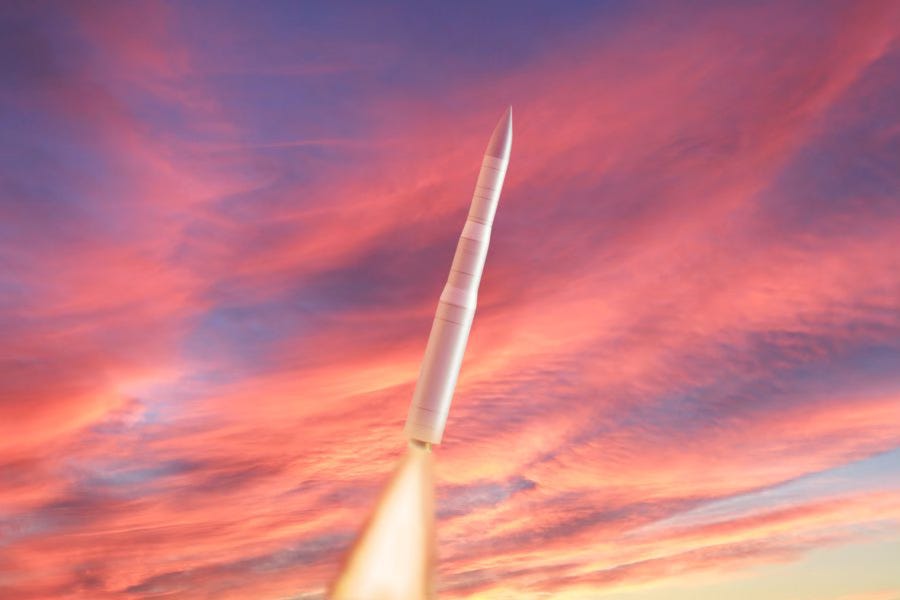
It’s time for recapitalization! (Red sky in morning, America take warning.)
Above is an idealized illustration of a Sentinel ICBM soon after launch. Don’t think about the aftermath of thermonuclear war. As NBC Pitchman Brian Williams once said, it’s important to be guided by the beauty of our weapons.
Next year we celebrate the 250th anniversary of America’s founding. There’s going to be the usual fight over what that anniversary should mean to Americans, and what lessons we should draw. For example, the Ken Burns series on “The American Revolution” starts this Sunday night on PBS. I’ll be watching it. If it comes close to his series on the U.S. Civil War, it should be interesting and informative.
There are so many lessons we could take from the American revolution (or war of independence). Speaking as a retired military officer, I might stress the citizen-soldier tradition, the ideal of the Minuteman, the rejection of tyranny, the suspicion of large standing armies, the desire for independence and liberty, the courage to affix one’s name to a declaration that could end with your head swinging in the air.
I don’t know what lessons Trump & Crew will be selling, but something tells me they won’t be salutary. Lots of flag-waving, of course, along with American exceptionalism.
We know America was founded as an imperfect union. Life, liberty, and the pursuit of happiness wasn’t granted to slaves. Or indigenous peoples. Or women for that matter. (Let’s not forget women couldn’t vote for president until 1920.) The founders were mostly white men of property, with some holding “property” in slaves. For African-Americans, the “revolution of 1776” certainly didn’t prove revolutionary for them.
I would stress the idea of striving toward a more perfect union, recognizing the early republic was, in so many ways, imperfect. And that’s putting it gently. I’d stress as well what Benjamin Franklin said. As a form of government, a representative republic is better than most but also difficult to keep. And there’s the rub: today our representatives, our public servants, serve the owners and donors, the power brokers, rather than the people. A revival of the republic isn’t going to come from either major political party—they’re both beholden to money.
So how can we end this “tyranny” without a bloody revolution? Is a national revival possible without years and years of domestic conflict and strife? Meanwhile, can America reject its embrace of militarism and imperialism? Can it advance the rule of law as represented by the U.S. Constitution? Can we be touched, as Abraham Lincoln wrote, by the better angels of our nature?
1776-2026. 250 years of glorious imperfection. We can be better. We can do better. Let’s strive to live up to the promise of America.
Today is Veterans Day, though of course November 11th was originally Armistice Day to mark the end of World War I on the 11th hour of the 11th day in 1918. Back then, it was hoped that the World War would inaugurate an era of lasting peace. Tragically, instead it inaugurated a state of more or less permanent war.
When I think of Veterans Day, I recall a grizzled veteran who spoke to me and a group of other young men (we didn’t want to be called “boys”) at Boys State in Massachusetts in 1980. I told the story 16 years ago at Huff Post, and I think it bears repeating today in 2025.
One Grizzled Veteran’s Dream
On this Veterans Day [in 2009], what if we began to measure our national success and power not by our military arsenal or number of recruits, but rather by the very opposite of that?
Writer, History Professor, Retired Lieutenant Colonel (USAF)
Thirty years ago [Now, 45 years ago], I attended Boys State. Run by the American Legion, Boys State introduces high school students to civics and government in a climate that bears a passing resemblance to military basic training. Arranged in “companies,” we students did our share of hurrying up, lining up, and waiting (sound preparation, in fact, for my career in the military). I recall that one morning a “company” of students got to eat first because they launched into a lusty rendition of the Marine Corps hymn. I wasn’t angry at them: I was angry at myself for not thinking of the ruse first.
Today, most of my Boys State experience is a blur, but one event looms large: the remarks made by a grizzled veteran to us assembled boys. Standing humbly before us, he confessed that he hoped organizations like the American Legion and Veterans of Foreign Wars would soon wither away. And he said that he hoped none of us would ever become a member of his post.
At first, we didn’t get it. Didn’t he like us? Weren’t we tough enough? (Indeed, I recall that one of our adolescent complaints was that the name “Boys State” didn’t seem manly enough.)
Then it dawned on us what the withering away of organizations like the American Legion and the VFW would mean. That in our future young Americans would no longer be fighting and dying in foreign wars. That our world would be both saner and safer, and only members of an “old guard” like this unnamed veteran would be able to swap true war stories. Our role would simply be to listen with unmeasured awe and undisguised thanks, grateful that our own sons and daughters no longer had to risk life or limb to enemy bullets and bombs.
It pains me that we as a country have allowed this veteran’s dream to die. We as a country continue to enlarge our military, expand our foreign commitments, and fight seemingly endless wars, whether in Iraq, Afghanistan, or in other far-off realms of less-than-vital interest to us.
As a result of these wars, we continue to churn out so many new veterans, including so many wounded veterans, not forgetting those who never made it back.
Collectively, we Americans tend to suppress whatever doubts we have about the wisdom of our wars with unequivocal statements of support for our troops. And on days like Veterans Day, we honor those who served, and especially those who paid the ultimate price on the battlefield.
Yet, wouldn’t the best support for our troops be the achievement of the dream of that grizzled vet who cut through a young man’s fog thirty years ago? Shouldn’t we be working to achieve a new age in which the rosters of our local VFWs and Legion posts are no longer renewed with the broken bodies and shattered minds of American combat veterans?
Veteran’s grave, Williamsport, PA (Author’s photo)
Sadly, as we raise more troops and fight more wars, we seem committed to the opposite. Our military just enjoyed its best recruiting class in years. This “success” is not entirely surprising. It’s no longer that difficult to fill our military’s expanding ranks because many of our young men and women simply have little choice but to enlist, whether for economic opportunity, money for college, or benefits like free health care.
Many of course enlist for patriotic reasons as well. Yet the ease of expanding our military ranks during a shooting war is also a painful reminder of the impoverishment of opportunities for young, able-bodied Americans – the bitter fruit of manufacturing jobs sent overseas, of farming jobs eliminated by our own version of corporate collectivization, of a real national unemployment rate that is approaching twenty percent.
On this Veterans Day, what if we began to measure our national success and power, not by our military arsenal or by the number of new recruits in the ranks, but rather by the gradual shrinking of our military ranks, the decline of our spending on defense, perhaps even by the growing quiet of our legion posts and VFW halls?
Wouldn’t that be a truer measure of national success: fewer American combat veterans?
Wouldn’t that give us something to celebrate this Veterans Day?
I know one old grizzled veteran who would quietly nod his agreement.
“Star Wars’“ fans will recall the Imperial Death Star, a ship the size of a small moon that was powerful enough to obliterate planets.
Who needs the Death Star when we humans are doing such a bang-up job of obliterating our planet?
This thought came to mind as a friend queried me about nuclear accidents. I recalled a piece I wrote in 2017 about various accidents we’ve had involving nuclear weapons. We’re incredibly lucky not to have nuked ourselves with megatons of thermonuclear explosive power and radiation.
Maybe we should echo Voltaire and cultivate our gardens while we’re still alive.
Anyhow, here’s my article from 2017, timely as ever as the Trump administration embraces new nukes and a “golden dome,” both representing yet another golden fleecing of American taxpayers.
The Threat of Nuclear Weapons to America
W.J. Astore (posted in April 2017)
Did you know the U.S. has built nearly 70,000 nuclear weapons since 1945? Did you know the U.S. Air Force lost a B-52 and two hydrogen bombs in an accident over North Carolina in 1961, and that one of those H-bombs was a single safety-switch away from exploding with a blast equivalent to three or four million tons of TNT (roughly 200 Hiroshima-type bombs)? Did you know a U.S. nuclear missile exploded in its silo in Arkansas in 1980, throwing its thermonuclear warhead into the countryside?
On more the one occasion, the U.S. has come close to nuking itself
That last accident is the subject of a PBS American Experiencedocumentary that I watched last night, “Command and Control.” I highly recommend it to all Americans, not just for what it reveals about nuclear accidents and the lack of safety, but for what it reveals about the U.S. military.
Here are a few things I learned about U.S. nuclear weapons and the military from the documentary:
During the silo accident, the Strategic Air Command (SAC) general in charge of nuclear missiles was a pilot with no experience in missiles. His order to activate a venting fan during a fuel leak led to the explosion that destroyed the missile and killed an airman. (Experts from Martin Marietta, the military contractor that built the Titan II missile, advised against such action.)
Airmen who courageously tried against long odds to mitigate the accident, and who were wounded in the explosion, were subsequently punished by the Air Force.
The Air Force refused to provide timely and reliable knowledge to local law enforcement as well as to the Arkansas governor (then Bill Clinton) and senators. Even Vice President Walter Mondale was denied a full and honest accounting of the accident.
Nuclear safety experts concluded that “luck” played a role in the fact that the Titan’s warhead didn’t explode. It was ejected from the silo without its power source, but if that power source had accompanied the warhead as it flew out of the silo, an explosion equivalent to two or three megatons could conceivably have happened.
Finally, the number of accidents involving U.S. nuclear weapons is far greater than the military has previously reported. Indeed, even the nation’s foremost expert in nuclear weapons development was not privy to all the data from these accidents.
In short, the U.S. has been very fortunate not to have nuked itself with multiple hydrogen bombs over the last 70 years. Talk today of a threat from North Korea pales in comparison to the threat posed to the U.S. by its own nuclear weapons programs and their hair-raising record of serious accidents and safety violations.
Despite this record, President Obama and now President Trump have asked for nearly a trillion dollars over the next generation to modernize and improve U.S. nuclear forces. Talk about rewarding failure!
Threatening genocidal murder is what passes for “deterrence,” then and now. This madness will continue as long as people acquiesce to the idea the government knows best and can be trusted with nuclear weapons that can destroy vast areas of our own country, along with most of the world.
To end the insanity, we must commit to eliminating nuclear weapons. Ronald Reagan saw the wisdom of total nuclear disarmament. So should we all.
An Addendum: In my Air Force career, I knew many missileers who worked in silos. They were dedicated professionals. But accidents happen, and complex weapons systems fail often in complex and unpredictable ways. Again, it’s nuclear experts themselves who say that luck has played a significant role in the fact that America hasn’t yet nuked itself. (Of course, we performed a lot of above-ground nuclear testing in places like Nevada, making them “no-go” places to this day due to radiation.)
Update (4/27/17): I’d heard of Air Force plans to base nuclear weapons on the moon, but today I learned that a nuclear test was contemplated on or near the moon as a way of showcasing American might during the Cold War. As the New York Timesreported, “Dr. [Leonard] Reiffel revealed that the Air Force had been interested in staging a surprise lunar explosion, and that its goal was propaganda. ‘The foremost intent was to impress the world with the prowess of the United States.’ It was a P.R. device, without question, in the minds of the people from the Air Force.” Dr. Reiffel further noted that, “The cost to science of destroying the pristine lunar environment did not seem of concern to our sponsors [the U.S. military] — but it certainly was to us, as I made clear at the time.”
The U.S. military wasn’t just content to pollute the earth with nuclear radiation: they wanted to pollute space and the moon as well. All in the name of “deterrence.”
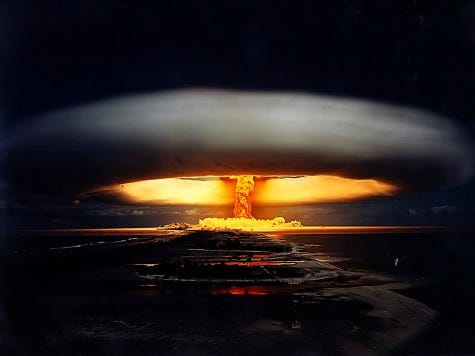
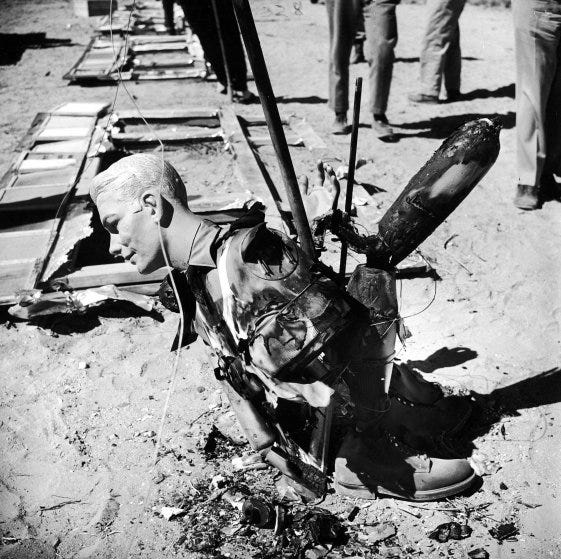
Two pictures of above-ground nuclear testing in Nevada in 1955
Here’s a tip, ladies: Wear light-colored dresses during a nuclear war. They absorb less heat
Lately, there’s a “Talking Heads” lyric that’s been popping up in my brain: Our president’s crazy/Did you hear what he said?
A few days ago, President Trump threatened war against Nigeria. He vowed that U.S. military action against Nigeria would be “fast, vicious, and sweet.”
Sweet? What kind of president describes warfare as “sweet”? Truly this is militarism run amuck.
What is wrong with our country? Must we wage war on everyone?
Speaking of “sweet,” J. Robert Oppenheimer described the development of the atomic bomb as a “technically sweet” challenge for the scientists and engineers who worked on it. I suppose it was, but the results were bitter indeed.
America, all is not sweetness here.
Wars and threats of war: It’s how Americans learn geography











 Bracing Views