Kamala Harris and Donald Trump have something in common. They both embrace colossal Pentagon budgets and both celebrate the “lethality” of the U.S. military, which, they agree, must be the strongest, bestest, in the world. They also agree on giving a blank check to Israel and its leaders to do whatever they want in Gaza to the Palestinians and will continue to provide whatever weapons Israel desires to kill massive numbers of Palestinians while flattening and destroying the Gaza Strip.
With respect to Iran, Harris appears to be even more hawkish than Trump, and indeed criticized him for not being aggressive enough with Iran’s leaders. Harris is also a strong supporter of Ukraine, seeing war as its best option to defeat Russia, whereas Trump is more skeptical of war and more open to diplomacy with Putin and Russia.
This isn’t surprising. Mainstream Democrats in DC are basically warmongering neo-conservatives on foreign policy, so a vote for Harris/Walz is a vote, as the “liberal” New York Times reported, for “muscular patriotism” (or, to paraphrase my wife, febrile and unapologetic nationalism). This is Washington Beltway conformity at its finest, as organs such as the National Interest write unironic articles about cheerleading the wonders of the military-industrial complex (MIC).
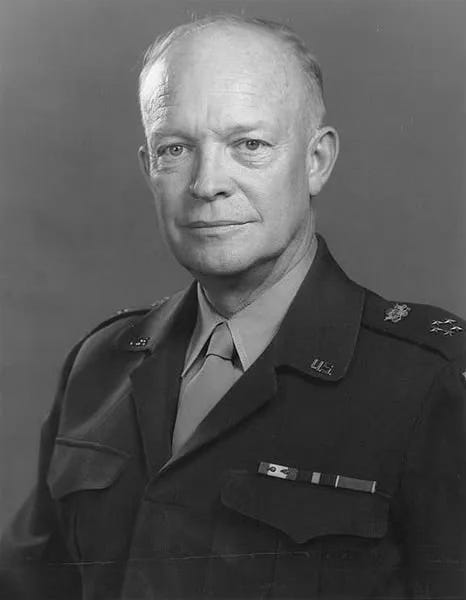
Ike got it all wrong. Embrace the MIC! Cheer for it!
See, President Dwight D. Eisenhower got it all wrong. We shouldn’t be wary of the MIC; we shouldn’t worry that its unchecked power threatens democracy and our very freedoms. No, we should embrace the MIC, celebrate it, enrich it with even more of our taxpayer dollars.
At Responsible Statecraft, Bill Hartung wrote a thoughtful response to the recent National interest piece. To me, it all depends on what vision of America you want to advance. If you want to advance America as the world’s hegemon, the empire of global reach, power, and dominance, the empire of constant warfare, then, heck, three cheers for the MIC.
But, if you want to advance America as a republic that leads “by the power of its example,” one that focuses on national defense and defense alone, then “three cheers for the MIC” guarantees the death of that republic and the corruption of its moral authority as an exemplar of democracy.
Of course, whether you choose to support Harris or Trump, we are witnessing exactly that latter fate. When you embrace the MIC, war, and empire, you set in motion the death of Democracy.
Whether America’s politicians put an “R” after their names or a “D,” it doesn’t alter the fundamental reality that the power of America’s example is very much driven and determined by examples of its military power. That is not about to change whether Harris or Trump prevails.
Last night was Obama night at the DNC as both Barack and Michelle Obama spoke to endorse Kamala Harris while denouncing Donald Trump. Perusing my various media streams this AM suggests they did a bang up job of it. Perhaps a few sobering reminders are in order:
Obama promised in 2007 he’d codify Roe v. Wade into law as his top priority. Once he won the election, he did nothing; in fact, he said it wasn’t among his top priorities.
Obama himself admitted that his administration, politically speaking, could best be described as moderate Republican. Here he was honest, for Obama was pro-corporate, pro-banks, pro-war, pro-Big Pharma, and pro-Wall Street.
Obama gave us a corporate-friendly health care plan without a single payer option. Thus, Americans continue to pay more than double what people in countries like Germany and France pay for their health care.
Obama “surged” in Afghanistan with military forces, prolonging a lost war in that country.
Obama, with Hillary Clinton by his side, overthrew Libya, leaving that a country a wreck. Open slave markets, anyone?
Obama, by his own admission, became very good at killing people, especially via drone assassinations.
Obama, after winning a Nobel Peace Prize for not being George W. Bush, promised a muscular U.S. foreign policy supported by military operations to protect vital U.S. (corporate) interests.
Obama bailed out the banks while allowing them to foreclose on millions of homeowners.
Obama admitted “We tortured some folks” and then held no one accountable except for the brave whistleblower, John Kiriakou, who helped to expose the torture regimen (and regime).
Obama said we had to look forward, not backward, so no one was held accountable for the disastrous Iraq War.
That’s just ten reminders, off the top of my head, so I wouldn’t get too excited by soaring rhetoric from the Obamas about saving democracy.
The main point here isn’t to bash the Democrats or to rain on their parade. It’s to realize where the corporate-aligned Democratic Party really stands on issues like war and economic fairness, to take that knowledge in fully, and then to use it to change the Party.
And the time to do that is now, when Harris/Walz need your vote. It’s too late to wait until after the election, which Harris just may win (a big reason why, I think, is Trump fatigue, as Americans ponder what another four years of the Trump circus may be like).
A Sign You Didn’t See Inside the Convention Hall
Democrats tell me not to attack or criticize Harris because when I do I’m helping Trump. But not to criticize politicians, not to make demands of them, is tantamount to surrendering to authoritarianism even before it’s taken hold. No one is helped in America by surrendering to a politics of joy or for that matter the MAGA crowd.
For I guarantee you, the corporate Democrats will tell you the time is NEVER right to challenge their power and agendas. The time is wrong now because of Trump. The time will be wrong in 2025 because Harris/Walz deserve a honeymoon. The time will be wrong in 2026 because of Congressional midterms. The time will be wrong in 2027-28 because of the threat of a “new” Trump (Ron DeSantis? Tom Cotton?).
One example from the Obama years. My friend and colleague, Matt Hoh, resigned from the State Department to protest the Afghan War surge. He came to Congress and spoke to Democrats. He persuaded many to take action. And then House Speaker Nancy Pelosi stood up. Literally. She said Democrats had to support Obama’s expansion of the war because of a bigger fight, Obama’s fight for the Affordable Care Act.
That’s right: the time was wrong to save American and Afghan lives in a lost war because Pelosi said Obama couldn’t afford dissension within the ranks as he “fought” for the corporate-friendly ACA, most commonly known as Obamacare.
The corporate Democrats will persist in telling you the TIME IS ALWAYS WRONG to challenge them because of Trump, new Trump, some legislative priority, perhaps a foreign leader like Putin, etc. It’s total BS. The best and only time you can push them is when you have real leverage, and that’s now, before you give them your money and votes.
After all, if you don’t speak up, it’s guaranteed no one will hear you. Dare to speak up, Democrats, for what you believe in. For that is what Democracy truly is about.
I remember watching The Phil Donahue Show with my dad. Informative and willing to tackle controversial issues, the show proved remarkably popular, a tribute to its host, Phil Donahue, who recently died at the age of 88. The show was briefly revived in 2002 on MSNBC, where it was the network’s highest-rated offering until it was cancelled.
Here’s what the Boston Globe had to say yesterday about Phil Donahue’s show in 2002 and why MSNBC cancelled it:
Donahue returned briefly to television in 2002, hosting another “Donahue” show on MSNBC. The station canceled it after six months, citing low ratings.
OK, the suits at MSNBC may have cited “low ratings,” but the real reason was that Phil Donahue was asking uncomfortable questions in the run up to the Iraq War. His show was perceived as anti-war and therefore unprofitable and “unpatriotic” to those suits. And so he was cancelled.
As Donahue says above, his show wasn’t “good for business,” and the business in America was (and is) war.
At Common Dreams, Jeff Cohen further explained why Donahue’s show was axed by MSNBC:
I was a senior producer on Phil’s short-lived MSNBCprimetime show in 2002 and 2003. It was frustrating for us to have to deal with the men Phil called “the suits”—NBCand MSNBC executives who were intimidated by the Bush administration, and resisted any efforts by NBC/MSNBC to practice journalism and ask tough questions of Washington before our young people were sent to Iraq to kill or be killed. Ultimately, Phil was fired because—as theleaked internal memo said—Donahue represented “a difficult public face for NBC at a time of war.”
But before we were terminated, we put guests on the screen who were not commonly on mainstream TV. We offered a full hour with Barbara Ehrenreich on Labor Day 2002, a full hour with Studs Terkel, congressmembers Bernie Sanders and Dennis Kucinich, columnist Molly Ivins, experts like Phyllis Bennis and Laura Flanders, Palestinian advocates including Hanan Ashrawi.
No one on US TV cross-examined Israeli leaders like Phil did when he interviewed then-Israeli Foreign Minister Shimon Peres, and later, former Prime Minister Ehud Barak. They seemed stunned—never having faced such questioning from a US journalist.
Phil Donahue (right) with Michael Moore—three right-wingers for balance not pictured.
But “the suits” ruined our show when they took control and actually mandated a quota system favoring the right wing: If we had booked one guest who was antiwar, we needed to book two that were pro-war. If we had two guests on the left, we needed three on the right. When a producer suggested booking Michael Moore—known to oppose the pending Iraq War—she was told she’d need to book three right-wingers for political balance.
Three weeks before the Iraq war started, and after some of the biggest antiwar mobilizations the world had ever seen (which were barely covered on mainstream TV), the suits at NBC/MSNBC terminated our show.
Keep this in mind if you watch MSNBC today, currently airing glowing coverage of the Democrats and the war machine. In fact, keep this in mind if you watch any corporate-owned news (CON) network.
It’s convention week for the Democrats, which brings me to concerns expressed by a couple of loyal readers. They tell me I’m being too hard on Kamala Harris and the Democrats. They say I’m missing a much bigger picture when I criticize them. That bigger picture is the threat of another Donald Trump victory, which very well could end elections in America, or at the very least produce a much more conservative and reactionary judiciary than the one we already have. They point to Project 2025 and challenge me to write about it and denounce it.
Together with this is one reader’s optimism for a Harris presidency. She may not be the best choice, this reader admits, but she’s shown some progressive chops. And strong support for her within the party has grown organically as she’s raised over $200 million from mostly smaller donors, money that could help her to move away from corporate agendas and in progressive directions.
And that’s all OK with me. I’m willing to hear criticism of my positions and priorities. Indeed, that’s a big reason why I started Bracing Views, not only to air my thoughts but to hear responses from others.
As I thought about this feedback, I saw this headline and story at the New York Timesthis morning:
Harris’s Muscular Patriotism: At her first rally with Tim Walz, Kamala Harris delivered a riff about their quintessentially American backgrounds. She grew up in Oakland, Calif., raised by a working mother, while he grew up on the Nebraska plains, she explained. They were “two middle-class kids,” she said, now trying to make it to the White House together.
“Only in America,” Harris said, as the Philadelphia crowd burst into a chant of “U.S.A.! U.S.A.!”
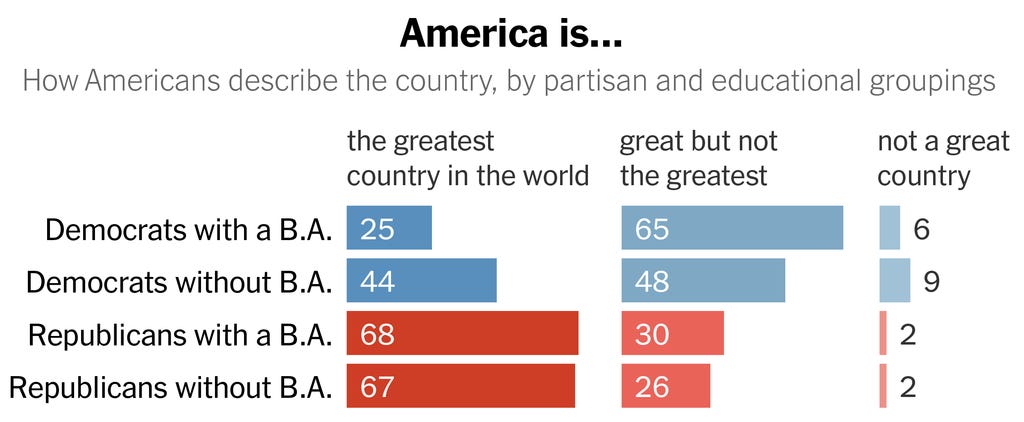
This sort of unabashed patriotism doesn’t always come naturally to today’s Democratic Party. But it has been central to Harris’s presidential campaign. In her ads and speeches, she portrays herself as a tough, populist, progressive patriot.
Source: New York Times/Siena College poll, Sept. 2022 | By The New York Times
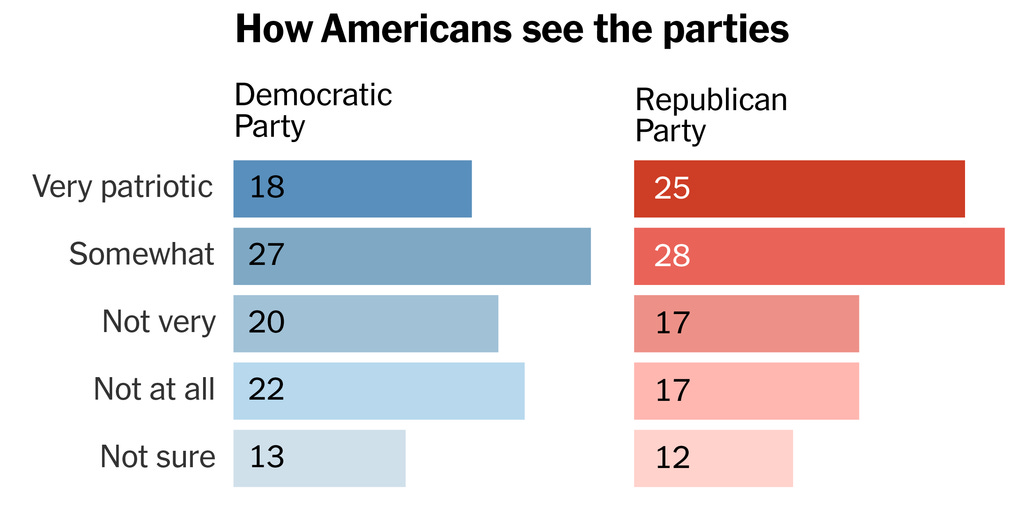
Given all this, it’s not surprising that most voters consider the Republican Party to be the more patriotic one:
Source: YouGov April 2024 poll | By The New York Times
The far left plays a role here. Parts of it — think of Noam Chomsky— can be disdainful of the U.S., describing it as a fundamentally oppressive country. Liberals, not conservatives, tend to argue that immigrants are forced to move here because of the consequences of American imperialism. Liberals are more likely to have qualms about national institutions like Thanksgiving, the military or the flag.
The most prominent left-wing movement of the past year — the Gaza protests — is a case study. The movement has not merely called attention to the high civilian death toll in Gaza; it sometimes portrays the war as an extension of U.S. immorality. Protesters have pulled down American flags and defaced a statue of George Washington with the word “genocidal.”
The America-skeptical left isn’t the Democratic Party, of course. But the left does exacerbate many swing voters’ concerns about the party — namely, that it isn’t cleareyed about a dangerous world. These same swing voters generally don’t like Trump, but they do appreciate his apparent toughness on trade, immigration, crime and more.
Harris combines patriotism with muscular promises to defend the interests of ordinary Americans. “Being president is about who you fight for, and she’s fighting for people like you,” the narrator in a campaign ad says. Her ads explain that as a prosecutor, she took on murderers, child abusers, drug cartels, big banks and big drug companies.
Harris’s flip-flop on immigration embodies both the toughness and patriotism themes. As a presidential candidate in 2019 — when the left was more influential in the Democratic Party — she favored decriminalizing border crossings. Today, she promises to protect Americans from gangs and fentanyl flowing across the border, and she criticizes Trump for blocking a border-security bill.
The image that accompanied this story showed a person wearing a Kamala Harris t-shirt in which she’s depicted as Captain America.
Given this article and many others like it, I don’t think my two readers have to worry about Kamala Harris being treated unfairly by the corporate-owned news (the CON)!
According to the New York Times, Harris is going to outmuscle Trump for who can be tougher on crime, drugs, and illegal immigrants. As Captain America, she’s going to be even more muscularly patriotic (or blindly nationalistic, my wife quipped) than Trump. The only concern is killjoys on the “far left,” who think mass destruction and genocide in Gaza is wrong. They don’t think America is the greatest, goodest, bestest country in the world. But Kamala does!
Sadly, Bracing Views doesn’t have quite the same market penetration as the New York Times, so my critique of Harris and the Democrats will hardly make a dent in all the partying and enthusiasm for Kamala this week. It does seem to me, however, that the tactics being used here are yet another case of the Democrats faking left and running right.
Anyhow, here’s a reply I sent to a loyal reader and friend about my approach to Kamala and the Democrats:
I’m not anti-Harris per se. She has such a thin record that who knows how she’d make decisions.
I am against how Harris is being shoved down our throats as an almost savior-like figure. I am against the Democratic party, which is why I left it and am now an independent.
I am also against Trump and the MAGA crowd. I wrote article after article denouncing them from 2016 to 2021. Do I have to repeat all that again so that I can be “fair and balanced”?
I get that you see Trump and MAGA as major threats, much more so than the Democrats. I see a different threat, I suppose, a uniparty that embraces empire, militarism, colossal spending on wars and weapons, and a foreign policy agenda that may yet produce World War III, whether the figurehead at the top is Trump or Harris.
I was hoping the Democrats would offer a REAL alternative to Trump with respect to the issues I cited above, but Harris is a lightweight in foreign policy whose description of the Russia-Ukraine War should really scare you for its ignorance and vapidness. She, like Trump, will spend $2 trillion on new nukes. She, like Trump, will brag that the U.S. military is the finest in the world, thus the Pentagon budget will continue to soar toward $1 trillion as the Pentagon continues to flunk audit after audit. She, like Trump, will keep the weapons flowing to Israel so that Gaza can be made Palestinian-free, giving more living space to Israel and Bibi.
Will Harris be more populist at home? I guess. Will she be friendlier to LGBTQ+ and pro-choice movements? Definitely. Is that enough to vote for her? That’s up to the voters to decide.
Harris is basically trying to play from the Obama book, “Yes, we Kam,” supported by big-money donors who expect a big return on their “investments.” Again, maybe she won’t be as bad as Trump domestically, but, as they say, the lesser of two evils is still evil. How long must we wait for a non-evil candidate?
If we don’t push the Democratic party to offer something other than corporate tools, we’ll keep getting corporate tools like I believe Harris to be.
I stand by that response. For many Americans, the Kamala/Walz ticket is attractive, but I will continue to criticize it, as I will Trump and the MAGA crowd. For I think neither party, and certainly neither candidate, is the last best hope of America.
Readers, what do you think? Should we be enthused by the Harris/Walz ticket? Is it time to embrace the politics of joy? Should we not criticize the Democrats because the MAGA Republicans are worse? Should I write more articles that are critical of Trump, because there are not enough of those already in the CON? Fire away!
I’m old enough to remember when New Coke was introduced in 1985. Coke had been losing market share to Pepsi (you might remember all the “taste tests” back then that Coke was allegedly losing to Pepsi). So the execs made New Coke, a sweeter, blander, version of “old” Coke, and hired Bill Cosby (yes, that Bill Cosby, before we knew he was a sexual predator) to sell it to the world as the new and very much improved version.
It flopped.
I remember trying it soon after it came out. No matter what Bill Cosby said, few people liked it. They wanted the “old” Coke back, so Coca Cola had to save face by reintroducing it, rebranding it as “Classic Coke.”
I know it’s not a perfect analogy, but the New Kamala I’m being sold by the DNC (and many, many, others) reminds me of the New Coke sold to me by Bill Cosby back in 1985. A lot of hype, many millions thrown at advertising, but in the end I’m left with a bad taste in my mouth.
Coincidentally, I just saw this in my New York Times news feed this morning:
See what I mean? In the past, she’s been “uneven” and “prone to missteps” but now there’s a New Kamala who’s “found her footing.” How so?
To my knowledge, Kamala has yet to hold an unscripted press conference and has yet to sit for an extended interview. Yet she’s “found her footing” because she can attend political rallies and read from a teleprompter. Oh, and she’s brat!
She’s also good at telling genocide protesters to shut up, warning them that Trump will win if they continue to protest mass murder and atrocity in Gaza.
Kamala is being sold like a new and improved commodity by cynical sales people who’d make Bill Cosby look slightly less menacing and predatory.
Standard Disclaimer: This is in no way a promotion for another overhyped, oversold, and dangerous product, one commonly known as Trump.
Governor Tim Walz, the Democratic nominee for Vice President, has come under fire about his military record. Leading the charge has been another Vice President nominee, J.D. Vance of the Republican Party, who served in the Marines and deployed to Iraq.
A young Tim Walz. Little did that young man know how this photo and his military service would become yet another battleground in American politics, generating plenty of heat but very little light
Let’s use the Army acronym of BLUF (bottom line up front); in other words, let’s cut to the chase:
Tim Walz has said he retired as a command sergeant major (CSM) after 24 years of service in the Army National Guard. While he did serve as CSM for his battalion, he didn’t attend the Sergeants Major Academy and therefore he retired a step down as a master sergeant (MSG).
When Tim Walz retired in 2005, he was preparing to run for Congress. His unit was also preparing to deploy to Iraq, which it eventually did in March of 2006. Walz was well within his rights as a soldier to retire when he did. Whether he did so to avoid war service in Iraq is known only to Walz. He claims he’d made his decision to retire before his unit was notified of its overseas deployment to Iraq.
Tim Walz has talked loosely about using weapons of war “that he carried in war,” implying he’d seen combat service when he hadn’t. I don’t see this as a case of “stolen valor.” He wasn’t boasting about being some kind of badass hero in war. Obviously, in 24 years of service in the Army National Guard, he’d carried weapons of war and trained with them under simulated combat conditions “down range.” He should have simply said: “I’ve trained extensively with weapons of war.” Period.
Does any of this matter? Not to me. Tim Walz, by all accounts, served honorably, reaching the senior enlisted ranks. If the Army had wanted him to stay instead of retiring, he could have been stop-lossed or his retirement request could have been denied. He moved on to Congress, winning his election in 2006. He seems to be a person motivated by public service.
The issues that really matter here aren’t mentioned by the Republicans or the corporate-owned news (the CON). Here are those issues:
Tim Walz is a strong supporter of Israel and its ongoing genocide in Gaza.
Tim Walz is a strong supporter of massive military aid to Ukraine.
To my knowledge, Tim Walz has not criticized the military-industrial-congressional complex (MICC) in meaningful ways, though he has spoken out against the idea of China being an inevitable U.S. enemy.
Tim Walz, in short, is a typical pro-Israel, pro-Ukraine, generally pro-MICC, Democrat.
The most important issue of all is the whole idea that one must go to war—to serve in places like Afghanistan and Iraq and, more likely than not, to kill other human beings, to prove one’s “valor” in uniform. Why is carrying and using a gun in war such a great and glorious thing? Especially wars like those in Afghanistan and Iraq that were based on lies? Would we respect Tim Walz more if he’d gone to Iraq in 2006 and shot up some Iraqis in the cause of “freedom”?
As a candidate for the presidency in 2016, Donald Trump famously denounced the Iraq War, using words like “stupid,” “dumb,” a “total disaster.” and a “big fat mistake.” The war was based on a lie, Trump said, about weapons of mass destruction that didn’t exist. Even worse, the Bush/Cheney administration was behind the lie, leading to a war that destabilized the Middle East, costing the U.S. military thousands of lives and U.S. taxpayers $2 trillion, Trump concluded.
Under that bright blaze of honesty from Trump (yes, you read that right), we might question anyone who wants to trumpet service in Iraq as praiseworthy in the sense of “bringing freedom” or “spreading democracy.”
Kamala Harris is officially the Democratic nominee for the presidency. As Lee Fang has noted, it’s not wise to underestimate her, as she’s savvy at “messaging” and positioning herself among party elites. In this interview between Fang and Glenn Greenwald, it’s almost conclusively shown that Kamala doesn’t have a progressive bone in her body. What she is most of all, perhaps, is an opportunist.
It’s interesting to see how my local paper, The Boston Globe, announced her nomination:
Vice President Kamala Harris, a daughter of immigrants who rose through the California political and law enforcement ranks to become the first female vice president in US history, formally secured the Democratic presidential nomination on Monday — becoming the first woman of color to lead a major party ticket.
A lot of boxes are being checked there. She’s “a daughter of immigrants.” She rose through the ranks, with an emphasis on law enforcement. She’s the first female VP and now the first “woman of color to lead a major party ticket.”
Her positions on most of the leading policies and topics of the day, however, are largely unknown. Meanwhile, rank-and-file Democrats didn’t have a chance to vote for her or against her in the primaries. She’s been selected by party insiders, not elected by party voters.
All this brings to mind a snippet of conversation I overheard at a coffee shop this weekend. Three young women were ahead of me in line, talking about some offerings at the shop, and one said: “I don’t even know what that is, but I like it.”
You could say something similar of Kamala: “I don’t even know who she is or what she believes, but I like her.” It’s the ultimate triumph of image over substance.
So, for example, you might ask Kamala why the Biden/Harris administration is complicit in genocide in Gaza, and the answer might be: “She’s a daughter of immigrants!”
Or you might ask her to support single-payer health care and a higher federal minimum wage, and the answer might be: “She’s BIPOC!”
Kamala isn’t going to cut off the flow of weapons and money to Israel no matter how atrociously the Israeli government acts. She isn’t going to fight for affordable single-payer health care or for a higher federal minimum wage. She’s savvy, i.e. a cynical instrument of power, and she knows what to do and what to say to raise money and secure the support of the powerful.
Kamala wouldn’t have been selected (again, she wasn’t elected) by powerful corporate interests if she wasn’t sympathetic and obedient to them. In fact, the DNC has shown how it treats true progressives like Bernie Sanders and Dennis Kucinich. Kamala is on top because she’s willing to afflict the powerless for the powerful, and that’s not a formula that promises any change in a progressive direction.
Whether you believe the corporate-owned Democratic Party is less bad than the Trump-dominated Republican Party is a separate question, but let’s not kid ourselves about what Kamala represents.
Update: Minnesota Governor Tim Walz is Kamala’s VP choice! I thought Walter Kirn’s description of Walz was telling. Kirn, talking to Matt Taibbi, described Walz as a “county fair huckster,” a sort of “white hick” who balances the urban BIPOC Harris. Kirn and Taibbi speculated that Democrats are trying to outflank the Republicans and their choice of J.D. Vance, i.e. Walz is even more of a flannel-wearing Midwesterner, and he has more military experience to boot.
VP choices often don’t matter that much, until they do. Just look at Kamala. She basically didn’t matter until she did.
As Walter Kirn also noted, Democrats are now spectators in their own party. You don’t get to choose your president or VP candidates; you have no say; yet you’re expected to cheer those candidates selected for you by the DNC and big donors.
Hooray, Harris/Walz! We didn’t get to vote for you, we had no say in your nomination, but we love you anyway!
During his one debate with Joe Biden, Donald Trump made the audacious claim that if reelected in November he would end the Russia-Ukraine War before his inauguration in January. While it’s doubtful he could do that, the boast certainly disturbed self-styled supporters of Ukraine like Senator Lindsey Graham.
Graham recently made an appearance to highlight strategic minerals in Ukraine. He said Ukraine is sitting on $10-$12 trillion in various “critical” minerals and metals and that Putin must not be allowed to seize, mine, sell, or otherwise share them with China.
Mr. President, we cannot allow a strategic minerals gap!
Trump, in general, has been skeptical of providing an almost open-ended commitment to Ukraine, to the tune of roughly $200 billion in aid since Russia launched its “special military operation.” This new emphasis on Ukraine as a business partner sitting on a “gold mine,” a mine that could be stolen by Putin, seems tailor-made to convince Trump, a businessman with an affinity for gold, to keep funneling weapons and money to Ukraine if he does indeed win reelection in November.
A trillion here, a trillion there, pretty soon you’re talking real money.
*****
This week in U.S. militarism: I was scrolling through my CNN email feed this morning and noticed this headline:
Army officer wins Miss USA Michigan’s Alma Cooper was crowned the new Miss USA on Sunday, capping a tumultuous year of pageant controversy.
A U.S. Army officer is Miss USA. At least she’s used to obeying orders.
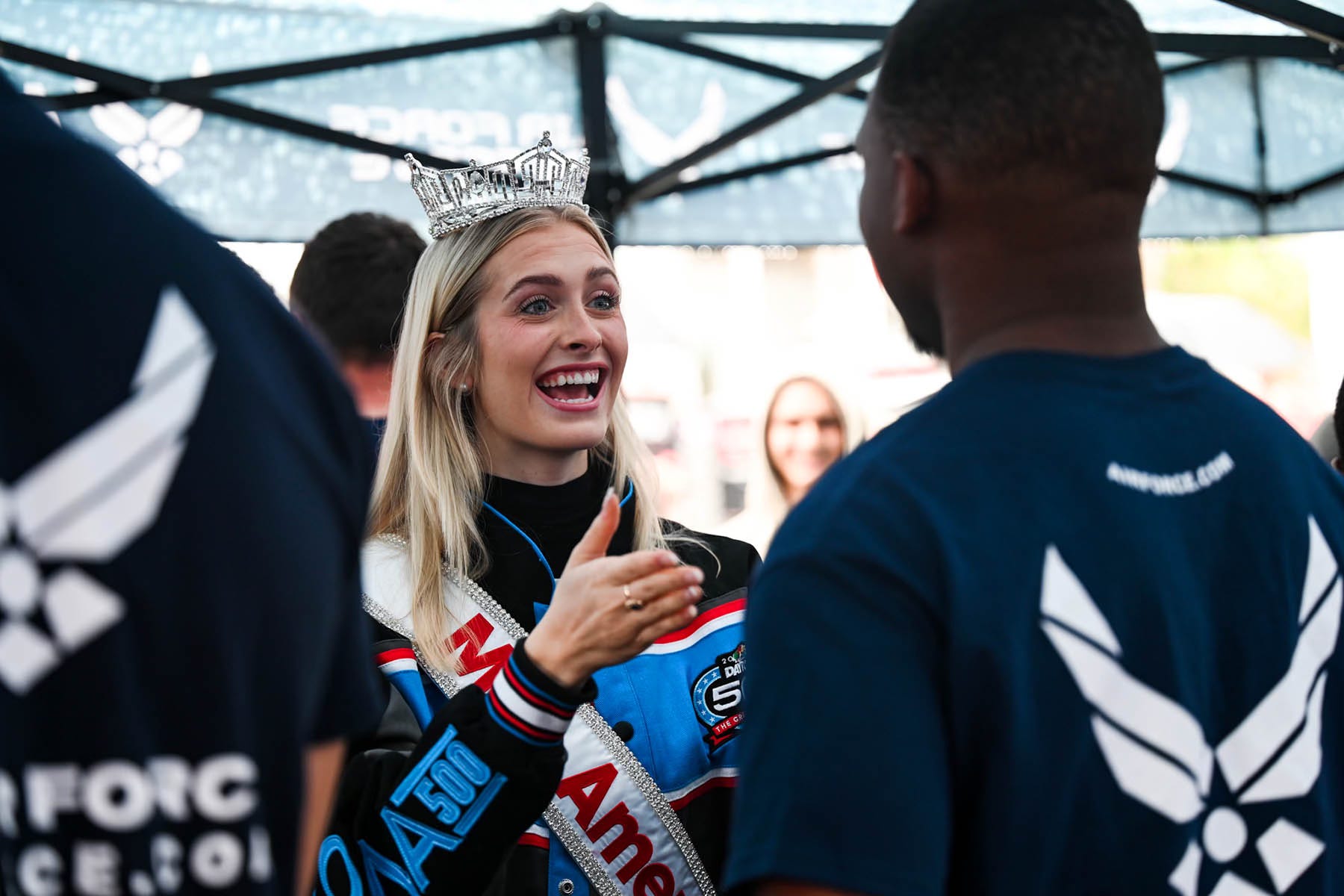
Back in January at CNN, I noted this headline: US Air Force officer crowned as 2024 Miss America.
Miss America, 2Lt Madison Marsh (from the AF Website). Taken at the Daytona 500 Speedway, where she was engaged in recruitment and PR
This truly must be a first. Both Miss USA and Miss America are serving U.S. military officers. My only question is this: What’s wrong with the Navy? How come the Army and the Air Force are dominating the beauty pageants?
In all seriousness, public relations teams for the U.S. military must think this is a major coup, but it seems so strange to me to mix beauty pageants with military service. I recently caught Miss America on NESN (New England Sports Network) doing an on-air interview wearing mufti and a tiara. She attended the Air Force Academy, where I taught for six years. She’s smart, ambitious, accomplished, and obviously pretty.
She may yet fulfill her dream of becoming an Air Force pilot. Will she then launch missiles and drop bombs, perhaps on whatever country is threatening Israel in the Middle East? At least those on the receiving end of those missiles and bombs can say they were killed by a former Miss America.
Empty Boasts of Having the “World’s Best” Military Hide Rot, Waste, and Stupidity
Sixteen years ago, I made a plea to my fellow citizens to banish the word “warfighter” from our vocabulary. I asked that we stop referring to the U.S. military as the “world’s best,” an empty boast then and, after twin disasters in Iraq and Afghanistan, an emptier one today. (If something can indeed be “emptier,” it’s certainly bellicose boasts of alleged military brilliance.) Today’s military is overstretched, busy guaranteeing Israel’s security as the Israeli Defense Forces demolish and depopulate Gaza. Facing recruiting shortfalls, open-ended imperial commitments across the globe, and fears of hostilities with Russia, China, Iran, or an almost unimaginable and certainly unbeatable combination of the three, the U.S. military faces grim times. If leaders like President Biden truly want to protect “our” troops, they should look not to God but in the mirror. They should pursue peace through diplomacy while downsizing an unsustainable empire. Isn’t it finally time for “Generation Warfighter” to come to an end before the U.S. military is utterly hollowed out — and America with it?
Having the “Best Military” Is Not Always a Good Thing Reclaiming Our Citizen-Soldier Heritage By William J. Astore
[Originally posted at TomDispatch in July of 2008]
When did American troops become “warfighters” — members of “Generation Kill” — instead of citizen-soldiers? And when did we become so proud of declaring our military to be “the world’s best”? These are neither frivolous nor rhetorical questions. Open up any national defense publication today and you can’t miss the ads from defense contractors, all eagerly touting the ways they “serve” America’s “warfighters.” Listen to the politicians, and you’ll hear the obligatory incantation about our military being “the world’s best.”
All this is, by now, so often repeated — so eagerly accepted — that few of us seem to recall how against the American grain it really is. If anything — and I saw this in studying German military history — it’s far more in keeping with the bellicose traditions and bumptious rhetoric of Imperial Germany under Kaiser Wilhelm II than of an American republic that began its march to independence with patriotic Minutemen in revolt against King George.
So consider this a modest proposal from a retired citizen-airman: A small but meaningful act against the creeping militarism of the Bush years would be to collectively repudiate our “world’s best warfighter” rhetoric and re-embrace instead a tradition of reluctant but resolute citizen-soldiers.
Becoming Warfighters
I first noticed the term “warfighter” in 2002. Like many a field-grade staff officer, I spent a lot of time crafting PowerPoint briefings, trying to sell senior officers and the Pentagon on my particular unit’s importance to the President’s new Global War on Terrorism. The more briefings I saw, the more often I came across references to “serving the warfighter.” It was, I suppose, an obvious selling point, once we were at war in Afghanistan and gearing up for “regime-change” in Iraq. And I was probably typical in that I, too, grabbed the term for my briefings. After all, who wants to be left behind when it comes to supporting the troops “at the pointy end of the spear” (to borrow another military trope)?
But I wasn’t comfortable with the term then, and today it tastes bitter in my mouth. Until recent times, the American military was justly proud of being a force of citizen-soldiers. It didn’t matter whether you were talking about those famed Revolutionary War Minutemen, courageous Civil War volunteers, or the “Greatest Generation” conscripts of World War II. After all, Americans had a long tradition of being distrustful of the very idea of a large, permanent army, as well as of giving potentially disruptive authority to generals.
Our tradition of citizen-soldiery was (and could still be) one of the great strengths of this country. Let me give you two examples of such citizen-soldiers, well known within military circles because they wrote especially powerful memoirs. Eugene B. Sledge served in the U.S. Marines during World War II, surviving two unimaginably brutal campaigns on the islands of Peleliu and Okinawa. His memoir With the Old Breed is arguably the best account of ground warfare in the Pacific. After three years of selfless, heroic service to his country, Sledge gladly returned to civilian life, eventually becoming a professor of biology. His conclusion — that “war is brutish, inglorious, and a terrible waste” — is one seconded by many a combat veteran.
Richard (Dick) Winters is better known because his exploits were captured in the HBO series Band of Brothers. He rose from platoon commander to battalion commander, serving in the elite 101st Airborne Division during World War II. A hero beloved by his men, Winters wanted nothing more than to quit the military and return to the civilian world. After the war, he lived a quiet life as a businessman in Pennsylvania, rarely mentioning his service and refusing to use his military rank for personal gratification. In Beyond Band of Brothers, he recounts both his service and his ideas on leadership. It’s a book to put in the hands of any young American who wishes to understand the noble ideas of service and sacrifice.
Sledge and Winters were regular guys who answered their country’s call. What comes across in their memoirs, as well as in the many letters I’ve read from World War II soldiers, was the desire of the average dogface to win the war, return home, hang up the uniform, and never again fire a shot in anger. These men were war-enders, not warfighters. Indeed, they would’ve been sickened by the very idea of being “warfighters.”
The term “warfighter” — a combination, I suppose, of “warrior” and “war fighting” — suggests a person who lives for war, who spoils for a fight. Certainly, the United States has fought its share of ruthless wars. But traditionally our soldiers have thought of themselves as civilians first, soldiers second. Equally as important, the American people thought of their troops that way.
Why are we now, with so little debate, casting aside an ethos that served us well for two centuries for one that straightforwardly embraces war and killing? Possibly because we’ve invented a distinctly American product: sanitized militarism. I bumped into it last week at a most unlikely place.
Visiting Gettysburg
Last week, I finally made it to Gettysburg, site of the great three-day battle between Union and Confederate forces in July 1863 that ended with the defeat of General Robert E. Lee’s army. Walking the battlefield was a sobering experience. I found myself on Little Round Topat 5:00 PM, just about the time of day that Union generals rushed men to reinforce the hill against a determined Confederate assault at the close of the battle’s second day. Earlier, I was at the Angle, just when, almost a century and a half ago, Pickett’s Charge failed to pierce the Union center, sealing Lee’s fate on the third day.
The Devil’s Den at Gettysburg
As these events played through my mind, I marveled that I had the battlefield largely to myself. Not that I was alone, mind you. Tour buses circled; cars, trucks, and SUVs whizzed about, but many, perhaps most, Americans who visit Gettysburg get surprisingly little tactile or sensory experience of its difficult topography. Yes, a few kids (and fewer adults) joined me in clambering about the huge, claustrophobically placed boulders of Devil’s Den, and I did spy a couple of guided tour groups on foot. But at the site of a bloodcurdling, distinctly septic nineteenth century battle, most visitors were clearly having a distinctly bloodless, even antiseptic, twenty-first century experience.
That day, I learned a lot about Gettysburg the battle — and maybe a little about us as well. As surely as my fellow tourists were staying in their cars and buses, we, as a people, are distancing ourselves from the realities of war. As we seal ourselves away from war’s horrors, we’re correspondingly finding it easier to speak of “warfighters” and to boast of having the world’s best military.
As we catch a glimpse, from the comfort of our living rooms, of a suicide bombing in Iraq or an American outpost attacked, then abandoned, in Afghanistan, are we not like those tourists in buses at Gettysburg, listening to sanitized recordings telling us what to see and think about the (expurgated) reality in front of us? And who dares challenge the “expert” commentary? Who dares turn off the canned talking heads and stare into the face of war?
But if we are to end our militaristic, yet curiously sanitized, “warfighter” moment, if we are ever to return to our citizen-soldier ethos and heritage, this is just what we must do.
After all, it’s later than you think. Our military now relies not only on a volunteer (if, at times, “stop-lossed”) Army, but increasingly on tens of thousands of hired guns, consultants, interrogators, interpreters, and other paramilitary camp followers. Private, for-profit “security contractors” — companies like Blackwater and Triple Canopy — give a disturbing new meaning to our “warfighter” terminology and the rhetoric that marches in step with it. As even casual students of history will recall, a clear sign of the Roman Empire’s decline was its shift from citizen-soldiers motivated by duty to mercenaries motivated by profit.
Replacing “warfighters” with true citizen-soldiers in the mold of Sledge and Winters would hardly be a solve-all solution at this late date, but it might be a step in the right direction — however unlikely it is to happen. For when we look at our troops, if we don’t see ourselves, then we see aliens or, worse yet, superiors (“warfighters”) in need of “support.” And that’s a clear sign of trouble for the republic.
Want to Be in the “World’s Best Military”? Ask German Veterans
It may come as a shock to some, but the American army wasn’t the best in the field in World War I, or World War II either. And thank heavens for that.
The distinction falls to the Kaiser Wilhelm’s army in 1914, and to Hitler’s Wehrmacht in 1941. Even toward the end of World War II, the American army was still often outmaneuvered and outclassed by its German foe. Because victory has a way of papering over faults and altering memories, few but professional historians today recall the many shortcomings of our military in both world wars.
But that’s precisely the point: The American military made mistakes because it was often ill-trained, rushed into combat too quickly, and handled by officers lacking in experience. Put simply, in both World Wars it lacked the tactical virtuosity of its German counterpart.
But here’s the question to ponder: At what price virtuosity? In World War I and World War II, the Germans were the best soldiers because they had trained and fought the most, because their societies were geared, mentally and in most other ways, for war, because they celebrated and valued feats of arms above all other contributions one could make to society and culture.
Being “the best soldiers” meant that senior German leaders — whether the Kaiser, Field Marshal Paul von Hindenburg, that Teutonic titan of World War I, or Hitler — always expected them to prevail. The mentality was: “We’re number one. How can we possibly lose unless we quit — or those [fill in your civilian quislings of choice] stab us in the back?”
If this mentality sounds increasingly familiar, it’s because it’s the one we ourselves have internalized in these last years. German warfighters and their leaders knew no limitations until it was too late for them to recover from ceaseless combat, imperial overstretch, and economic collapse.
Today, the U.S. military, and by extension American culture, is caught in a similar bind. After all, if we truly believe ours to be “the world’s best military” (and, judging by how often the claim is repeated in the echo chamber of our media, we evidently do), how can we possibly be losing in Iraq or Afghanistan? And, if the “impossible” somehow happens, how can our military be to blame? If our “warfighters” are indeed “the best,” someone else must have betrayed them — appeasing politicians, lily-livered liberals, duplicitous and weak-willed allies like the increasingly recalcitrant Iraqis, you name it.
Today, our military is arguably the world’s best. Certainly, it’s the world’s most powerful in its advanced armaments and its ability to destroy. But what does it say about our leaders that they are so taken with this form of power? And why exactly is it so good to be the “best” at this? Just ask a German military veteran — among the few who survived, that is — in a warrior-state that went berserk in a febrile quest for “full spectrum dominance.”
Fighting to End Wars
Words matter. Let’s start by banishing the word “warfighter,” and, while we’re at it, let’s toss out that “world’s best” boast as well. Boasting about military prowess is more Spartan than Athenian, more Second and Third Reich Germany than republican and democratic America.
Indeed, imagine, for a moment, a world in which the U.S. is no longer “number one” in military might (and, at the same time, no longer fighting endless wars in the Middle East and Central Asia). Would we then be weak and vulnerable? Or would we become stronger precisely because we stopped boasting about our ability as “warfighters” to dominate far from our shores and instead redirected our resources to developing alternative energy, bolstering our education system, reviving American industry, and focusing on other “soft power” alternatives to weapons and warriors? In other words, alternatives we can actually boast about with the pride of accomplishment.
Think about it: Must our military forever remain “second to none” for you to feel safe? Our national traditions suggest otherwise. In fact, if we no longer had the world’s strongest military, perhaps we would be more reluctant to tap its strength — and more hesitant to send our citizen-soldiers into harm’s way. And while we’re at it, perhaps we’d also learn to boast about a new kind of “warfighter” — not one who fights our wars, but one who fights against them.








 Bracing Views