W.J. Astore
Two weeks ago, I did an interview with TheoFantastique on the military in science fiction. I’d like to thank John Morehead, the site’s creator, for inviting me to answer a few questions on a subject near and dear to my heart.
TheoFantastique: Bill, thanks for making a little time to respond to a few questions related to the subject matter of your article. What are some general observations you have made about the shift in science fiction film depictions of the American military from the post-World War II period to the present?
 Bill Astore: Thanks for inviting me, John. I grew up in the late 1960s and 1970s, in the immediate aftermath of the Vietnam War and Watergate. Films of that era were generally critical of the establishment, including sci-fi films. I fondly recall Planet of the Apes with its anti-nuclear message. Also Soylent Green with its warning about over-population, but even more dire was the way in which the authorities hid from the people the true nature of their new food source. Think also of Capricorn One, hardly a great film, but one which exposed a government conspiracy at the heart of the first manned mission to Mars. And Silent Running with Bruce Dern. The basic message was how humans were destroying planet earth, often due to nuclear war or environmental destruction, or both. Finally, Logan’s Run was a favorite of mine, but again the message was how the government of that world hid from the people the true nature of life outside of the bubble.
I remember seeing Alien in the theater and being blown away by the alien “birth” scene. But again the theme of that film was you can’t trust the authorities, who wanted the “alien” at any cost, i.e. the crew was expendable. Think of Outland as well with Sean Connery: yet more corruption among the establishment, this time involving drugs and production quotas in space mining. Here the workers were expendable.
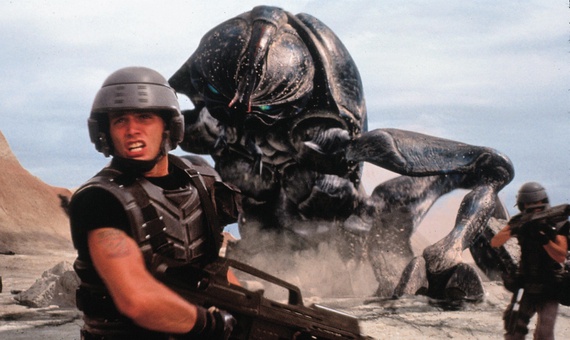
I know I’m digressing from your question, but my general point is this: Sci-Fi films (and stories) are generally questioning (or questing, perhaps). They are usually not pro-military or pro-authority. Put differently, for every Starship Troopers there’s a Bill the Galactic Hero as a counterweight.
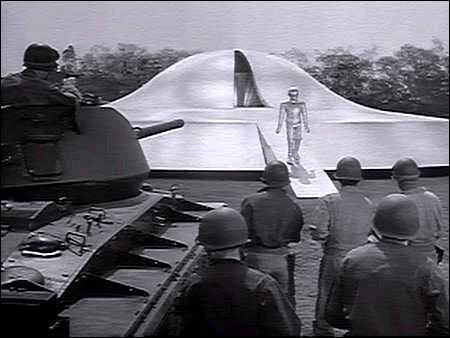
Think of one of my all-time favorite films, The Day the Earth Stood Still. The military is completely ineffectual in that film. Worse: the military contributes to the problem. Similarly, in the 1950s lots of films were made about the dangers of nuclear war and radiation. The military usually didn’t emerge in a favorable light in those films, if I recall correctly.
I think this began to change with films like Star Wars and Close Encounters of the Third Kind. Star Wars could be read as apolitical (“a long time ago, in a galaxy far, far away”), even if that wasn’t George Lucas’s intent. In Close Encounters, a terrific film that I saw in the theater, the authorities actually know what they’re doing. They greet the alien mothership peacefully, and communicate with music and light instead of guns and nukes. Again, I don’t think Spielberg was making a pro-authority or pro-military film, but I believe he didn’t want to make a political film, a film like The Day the Earth Stood Still.
 After these two films, Hollywood embraced space operas and feel-good movies. There were exceptions, of course. One of my favorite movies is Starman with Jeff Bridges. Again, the authorities only want the alien for the powers he brings with him. Think too of The Man Who Fell to Earth and the way in which his life is corrupted by human excess. Doesn’t he get addicted to television?
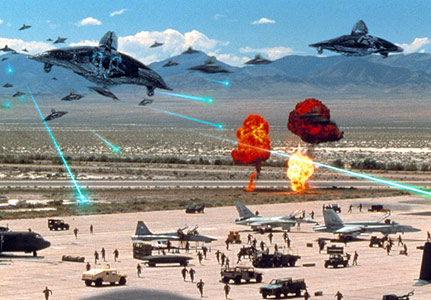
The movie that really changed it all was Independence Day, a perfect film in the aftermath of Desert Storm (the expulsion of Iraq from Kuwait). Here, of course, the militaries of various countries come together to defeat the aliens, led by an American president who climbs into the cockpit to lead the charge himself. This proved so popular that it’s no surprise George W. Bush tried to replicate the scene in the aftermath of the U.S. invasion of Iraq in 2003 (his infamous landing on an aircraft carrier, followed by his “Mission Accomplished” victory speech).
TheoFantastique: What represents much of the portrayal of the U.S. and its military, and what does this say back to us by way of reflection on American militarism around the world?
Bill Astore: I think many, if not most, Americans now want to see the U.S. military portrayed in a positive light in films. Since the 1980s, and especially since the 1990s, Americans have been told to “support our troops.” After 9/11, ordinary Americans were taught and told we live in a dangerous world filled with “alien” terrorists, and that we had to submit to authority to combat and defeat those “aliens.”
 Some recent sci-fi films, I believe, have come to celebrate the military, its weaponry, and its can-do spirit of “warriors.” They’ve played it safe, in other words. In some cases, film makers may have curried favor with the Pentagon as a way of securing military cooperation in filming. For example, to secure access to bases, to advanced technologies such as the F-22 and F-35 jet fighters, and so on. It makes their films “sexier” to have such access.
I’m sure some would say, So what? What’s wrong with a summer blockbuster that portrays military action in a favorable light? To that I’d say: reel war is nothing like real war. The best science fiction films — or the memorable ones — inspire us to dream of bettering ourselves as individuals and as a species. And I think the best films still seek to challenge us to be more noble, more benevolent, more compassionate.
TheoFantastique: How do you feel as a retired Air Force officer about current science fiction’s perspective on the U.S. military?
Bill Astore: I have mixed feelings. On the one hand, I’m glad that films are not universally anti-military. On the other hand, I’m upset that many films tend to glorify battle and war. War often looks very sexy and exciting in today’s crop of sci-fi action flicks. We need to remember that war is bloody awful, and that lasers and light sabers would not make it any less awful.
Check out TheoFantastisque, a meeting place for myth, imagination, and mystery in pop culture.



 Too many troops have died in the name of big boy pants
 Bracing Views