
The Nuclear Fleecing of America

W.J. Astore

The Stupidity of the Sentinel ICBM and the B-21 Raider Bomber

My fellow Americans, your government wants to spend nearly $2 trillion over the next 30 years to “modernize” its nuclear arsenal. Modernization, of course, is a euphemism. And the Pentagon actually uses the word “invest” rather than “spend.” The dividends on this “investment” go to the weapons makers, obviously, not to the American people.

Let’s first consider the Sentinel ICBM; the military wants to buy 400+ of these and stuff them in fixed silos in places like Wyoming and North Dakota. Land-based ICBMs were (among other things) obsolete by the 1970s; that’s why the MX was developed as a mobile system under President Jimmy Carter. Fortunately, the shell-game idea of moving nuclear missiles around by truck or rail was too dear and dumb even for the government. You don’t “modernize” that which is obsolete and redundant (and escalatory due to its inherent vulnerability). The smart move here is to eliminate land-based ICBMs.

Speaking as a retired Air Force officer, my old service will always want more of everything, including that which is obsolete. It’s all about budgetary share. No enemy is more to be dominated than the other services, who are also competing for money.
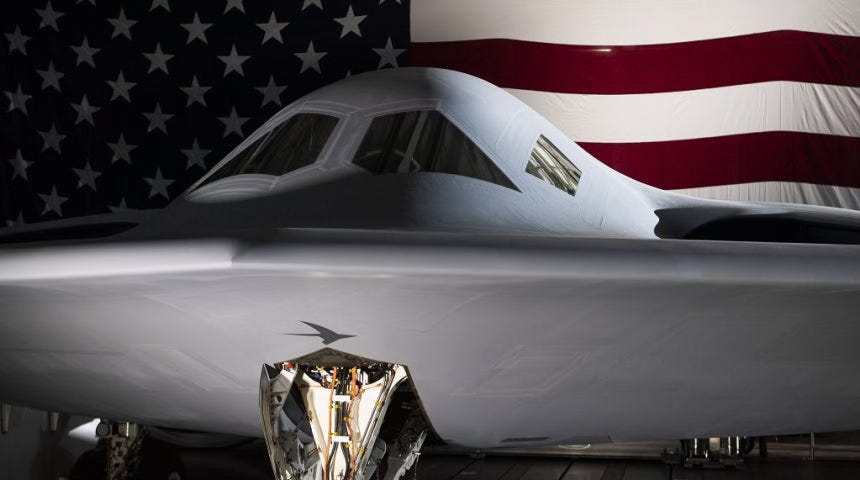
The B-21 Raider, with American flag (Northrop Grumman photo)

Similarly, strategic bombers to drop nuclear bombs (or even to launch cruise missiles) are not needed for nuclear deterrence. The whole idea of “penetrating” strategic bombers was obsolete by the late 1970s, which is why President Carter cancelled the B-1 bomber (it was revived by Ronald Reagan). We simply don’t need more strategic nuclear bombers–but the AF will always want them. If pilots can fly it (even if they have to do it remotely, as with drones), the AF wants it. Who cares if the B-21 will cost roughly $1 billion per plane when it’s finally fielded?

There is no need for the Sentinel or Raider. But the Air Force will fight until doomsday to protect its budgetary authority and the pilot and command billets that come with nuke missile fields and planes.

Let’s never forget the power of the industrial side of the military-industrial complex as well. There are hundreds—even thousands— of billions of dollars at stake here, so of course industry will fight to the end (of all of us) for the money. Weapons makers will spend millions on lobbyists, and millions more to buy politicians, to make billions in return. The profit margin here is better than crypto or most anything, actually.

They say alchemists were wrong that lead could be turned into gold, but every day the lead of bullets is sold, earning gold for the weapons makers, so alchemy is real after all. Now America’s weapons makers are turning radioactive uranium and plutonium into nearly $2 trillion in gold (or paper money, at least), the ultimate alchemical trick.

Don’t let them do it, America.

The Best Air Raid Ever

vonnegut

W.J. Astore

I finally had a chance to read Kurt Vonnegut’s classic book, Slaughter-House Five, based upon his experiences in World War II as a POW who survived the firebombing of Dresden in 1945.

I grew up on war stories featuring air raids by the German Luftwaffe as well as the Allied combined bombing offensive of World War II. Favorite paperbacks that I read include Cajus Bekker’s The Luftwaffe War Diaries, Adolf Galland’s The First and the Last, and Big Week by Bill Yenne (about the week in February 1944 when the Allies turned the tide of the air campaign against the Luftwaffe in the skies over Germany).  All of these books had one thing in common: they were written from the perspective of the air crews, not from the perspective of those on the receiving end of bombs and bullets and fire.  As such, they read like adventure stories, at least to my excitable teenage mind.

Kurt Vonnegut gave us a different perspective in Slaughter-House Five: at the ground level, during and after the firestorm that destroyed Dresden in February 1945, one year after the Allies had allegedly turned the tide and “won” the air battle during Big Week.  The moon scape that Vonnegut encountered after leaving his shelter was evidence of the perfect firestorm the Allies had created in their bombing raids over Dresden, which combined area bombing at night by Britain’s Royal Air Force (using a mix of high explosive and incendiary bombs) with daylight “precision” bombing by U.S. bomber forces.

But I don’t want to speak about the horrors of that raid.  No need to repeat Vonnegut’s account.  What struck me in reading his book was an imaginary air raid, an air raid that runs backwards.  In Vonnegut’s words:

American planes, full of holes and wounded men and corpses took off backwards from an airfield in England. Over France, a few German fighter planes flew at them backwards, sucked bullets and shell fragments from some of the planes and crewmen. They did the same for wrecked American bombers on the ground, and those planes flew backwards to join the formation.

The formation flew backwards over a German city that was in flames. The bombers opened their bomb bay doors, exerted a miraculous magnetism which shrunk the fires, gathered them into cylindrical steel containers, and lifted the containers into the bellies of the planes. The containers were stored neatly in racks. The Germans below had miraculous devices of their own, which were long steel tubes. They used them to suck more fragments from the crewmen and planes. But there were still a few wounded Americans, though, and some of the bombers were in bad repair. Over France, though, German fighters came up again, made everything and everybody as good as new.

When the bombers got back to their base, the steel cylinders were taken from the racks and shipped back to the United States of America, where factories were operating night and day, dismantling the cylinders, separating the dangerous contents into minerals. Touchingly, it was mainly women who did this work. The minerals were then shipped to specialists in remote areas. It was their business to put them into the ground, to hide them cleverly, so they would never hurt anybody ever again.

There you have it: the best air raid ever, brought to you via the imagination of a great writer who survived one of the worst air raids ever.

I’m not sure Vonnegut’s words would have resonated with my teenage mind, caught as it was in dramatic and deadly duels in the skies over Europe.  As Vonnegut knew, there’s an endless supply of dumb teenagers fantasizing about war.  So it goes.