

W.J. Astore
Honoring the wisdom of an anti-war hero
I woke this morning to the sad news that Daniel Ellsberg has pancreatic cancer and has been given only a few months to live. Ellsberg has lived a long and heroic life; he famously leaked the Pentagon papers, risking lifelong imprisonment to put a stop to America’s calamitous and atrocious war against Vietnam.
Five years ago, I read Ellsberg’s book on his years as a nuclear war theorist for the U.S. government. I was so impressed (and so alarmed) that I immediately wrote my own review of it, which I’m reposting today in Ellsberg’s honor.
Ellsberg is one of the giants of recent American history. He has lived a life of great value. Perhaps the best way to honor him is to read him, listen to him, and act to put a stop to our collective nuclear madness.
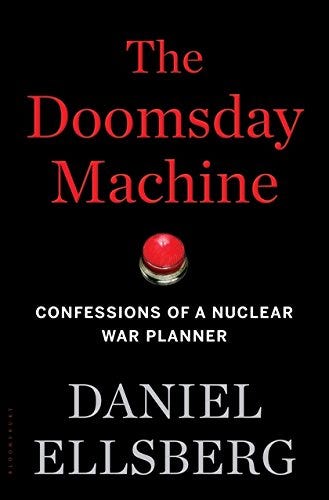
The Doomsday Machine: The Madness of America’s Nuclear Weapons
(Originally posted 12/28/17)
I just finished Daniel Ellsberg’s new book, The Doomsday Machine: Confessions of a Nuclear War Planner. Talk about hair-raising! Ellsberg, of course, is famous for leaking the Pentagon papers, which helped to end the Vietnam war and the presidency of Richard Nixon as well. But before Ellsberg worked as a senior adviser on the Vietnam war, he helped to formulate U.S. nuclear policy in the late 1950s and early 1960s. His book is a shattering portrayal of the genocidal nature of U.S. nuclear planning during the Cold War — and that threat of worldwide genocide (or omnicide, a word Ellsberg uses to describe the death of nearly everything from a nuclear exchange that would generate disastrous cooling due to nuclear winter) persists to this day.
Rather than writing a traditional book review, I want to list some memorable facts and lessons I took from the book, lessons that should lead us to question the very sanity of America’s leaders. To wit:
- U.S. nuclear war plans circa 1960 envisioned a simultaneous attack on the USSR and China that would generate 600 million deaths after six months. As Ellsberg notes, that is 100 Holocausts. This plan was to be used even if China hadn’t directly attacked the U.S., i.e. the USSR and China were lumped together as communist bad guys who had to be eliminated together in a general nuclear war. Only one U.S. general present at the briefing objected to this idea: David M. Shoup, a Marine general and Medal of Honor winner, who also later objected to the Vietnam War.
- The U.S. military consistently overestimated the Soviet nuclear threat, envisioning missile and bomber gaps that didn’t exist. In the nuclear arms race, the U.S. was often racing itself in the fielding of more and more nuclear weapons.
- General Curtis LeMay, the famous commander of Strategic Air Command (SAC) and later AF Chief of Staff, said that once war started, politicians like the president had no role to play in decision-making.
- When the atomic bomb was first tested in 1945, there were fears among the scientists involved that the atmosphere could be ignited, ending all life on earth. The chance was considered remote (perhaps 3 in a million), so the scientists pressed ahead.
- The Cuban Missile Crisis of 1962 came much closer to nuclear war than most people recognize. Soviet submarines in the area, attacked by mock U.S. depth charges, were prepared to launch nuclear torpedoes against U.S. ships. Fidel Castro’s air defenses were also preparing to shoot down American planes, which may have ended in U.S. air attacks and an invasion in which Soviet troops on Cuba may have used nuclear weapons to defend themselves.
- The U.S. military was (and probably still is) extremely reluctant to reveal nuclear secrets to senior American civilian leaders, including even the President himself. Ellsberg, possessing the highest security clearances and acting with presidential authority, had to pry answers from military officers who refused to provide detailed and complete information.
- The U.S. has always refused, and continues to refuse, to pledge to a “no first use” policy for nuclear weapons.
- The U.S. remains the only country to have used nuclear weapons (Hiroshima and Nagasaki). Yet, as Ellsberg notes, the U.S. uses nuclear weapons all the time — by threatening their use, as President Eisenhower did during the Korean War, as President Nixon did during the Vietnam War, and as President Trump is doing today, promising “fire and fury” against North Korea. The U.S. uses nuclear weapons like a loaded gun — holding it to an enemy’s head and threatening to pull the trigger, Ellsberg notes. In short, there’s nothing exceptional about Trump and his nuclear threats. All U.S. presidents have refused to take nuclear attacks “off the table” of options for U.S. action.
- Interservice rivalry has always been a driver of U.S. nuclear force structure and strategy. The Navy (with its nuclear submarine programs, Polaris followed by Trident) and especially the Air Force (with its ICBMs and bombers) jealously guard their nuclear forces and the prestige/power/budgetary authority they convey.
- President Eisenhower’s emphasis on massive retaliation (as represented by SAC and its war plan, the SIOP) was a way for him to limit the power of the military-industrial complex (MIC). But once Ike was gone, so too was the idea of using the nuclear deterrent as a way of restricting U.S. expenditures on conventional weaponry and U.S. adventurism in foreign wars, e.g. Vietnam. (It should be said that Ike’s exercise at limiting the MIC in America held the world as a nuclear hostage.)
- Ellsberg shows convincingly that control over U.S. nuclear weapons was decentralized and delegated to much lower levels than most Americans know. It’s not the case that only the president can launch a nuclear war. Especially in the late 1950s and early 1960s, Ellsberg shows how it was possible that field-grade officers (majors and colonels) could have made decisions in the heat of battle to release nuclear weapons without direct orders from the president.
- Most Americans, Ellsberg notes, still don’t understand the huge quantitative and qualitative differences between atomic bombs and hydrogen (thermonuclear) weapons. Hydrogen bombs are measured in megatons in equivalent TNT yield; atomic bombs are in kilotons. In short, hydrogen bombs are a thousand times more destructive than atomic ones. And this is just their explosive yield. Radioactive fallout and massive fires are even bigger threats to life on earth.
- Most Americans still don’t understand that even a smallish nuclear exchange involving a few dozen hydrogen bombs could very well lead to nuclear winter and the deaths of billions of people on the earth (due to the widespread death of crops and resulting famine and disease).
- Despite the genocidal threat of nuclear weapons, the U.S. is persisting in plans to modernize its arsenal over the next 30 years at a cost of $1 trillion.
Ellsberg sees this all as a form of collective madness, and it’s hard to disagree. He quotes Nietzsche to the effect that madness in individuals is rare, but that it’s common among bureaucracies and nations. The tremendous overkill inherent to U.S. nuclear weapons — its threat of worldwide destruction — is truly a form of madness. For how do you protect a nation or uphold its ideals by launching a nuclear war that would kill nearly everyone on earth? How does that make any sense? How is that not mad?
Ellsberg ends his “confessions” with many sane proposals for downsizing nuclear arsenals across the world. But is anyone in power listening? Certainly not U.S. presidents like Trump or Obama, who both signed on to that trillion dollar modernization program for U.S. nuclear weapons.
Ellsberg shows us there have been many chair-bound paper-pushers in the U.S. government who’ve drawn up plans to murder hundreds of millions of people — to unleash doomsday — all in the name of protecting America. He also shows how close they’ve come to doing just that, especially during the Cuban Missile Crisis, but during other crises as well.
Nuclear brinksmanship, threats of nuclear war, and similar uses of nuclear weapons to intimidate hold the potential for catastrophe. Miscalculations, mishaps, mistakes, are more than possible in an atmosphere of mistrust, when words and actions can be misinterpreted.
Ellsberg’s recommendations for changes point the way to a better world, a world where the threat of nuclear doomsday could be much reduced, perhaps eliminated completely. The question remains: Is anyone in power listening?
 Bracing Views