

W.J. Astore
Coming to Hate Those You Kill
After attending a seminar at the U.S. Holocaust Memorial Museum with Henry Friedlander, I taught my first course on the Holocaust just over two decades ago. I then continued to teach courses on the Holocaust until I retired as a professor of history in 2014. Having read dozens of books on the Holocaust, seen dozens of moviesand documentaries on it, and having talked to Jewish survivors of the Holocaust, including Henry Friedlander, I learned a few things about how and why such a colossal crime against humanity happened.
When I took his seminar, Friedlander, who as a teenager survived Auschwitz, taught us that “You don’t kill the people you hate—you hate the people you kill.” It may seem paradoxical, but this insight is powerful. Normal human beings don’t want to be or become killers. Thankfully, killing isn’t easy, even at a remove. (Drone operators are known to suffer adverse symptoms from witnessing death at a distance.)
Yet, if you’re taught and told that you must kill, the moral, mental, physical, and other burdens of killing may drive you to hate those you are killing. “Look at what you made me do!” the killer thinks. You made me do this—and I hate you for it. Doesn’t matter that you’re a guiltless child, I still hate you.
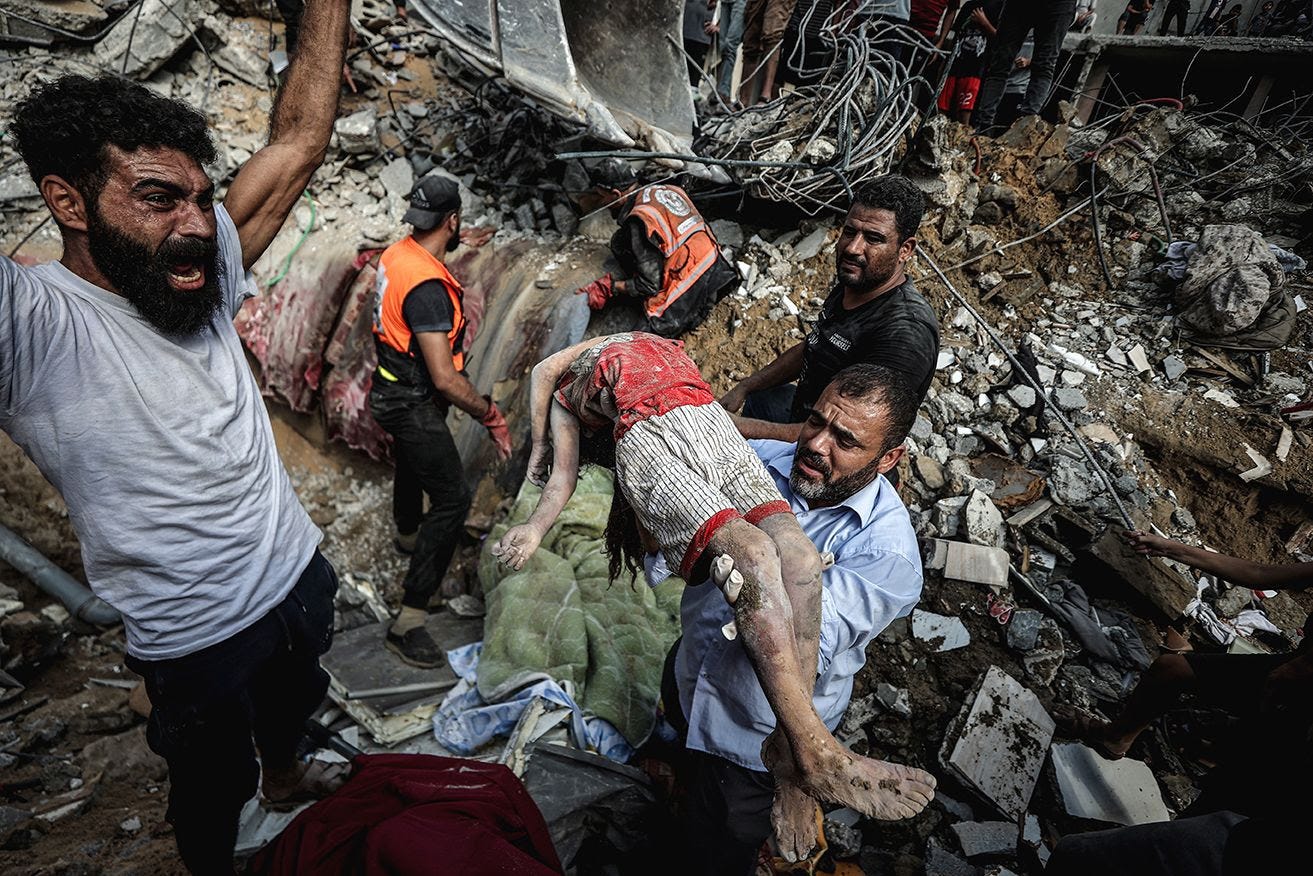
I wonder about Israeli officials today, those who are in control of the demolition of Gaza. A few must truly hate Hamas, but there are many more, I think, who’d prefer not to be put in the position of ordering (or carrying out) massive bombing raids and ground invasions that result in the deaths of tens of thousands of innocent Palestinians.
How many in Israel, notably in the Israeli Defense Forces, will come to hate those that they kill? How many will succumb to hate as a matter of survival, a sort of mental coping mechanism?
Honestly, I don’t pretend to understand it all. Catchphrases like “man’s inhumanity to man” or “the banality of evil” seem too easy. I remember reading an interview with Primo Levi, another Holocaust survivor, who related an anecdote about his experience communicating with an unrepentant Nazi in Germany well after World War II. This man wrote to Levi to defend himself; unbeknownst to him, his wife snuck a note into the letter that read:
“When the devil is loose in the village, a few people try to resist and are overcome, many bow their heads, and the majority follow him with enthusiasm.”*
Whether you prefer “devil” or “evil” or “racist extremist” or some other term, history shows how humans readily unleash the most elemental barbarism when they believe they are threatened, especially when the “threat” is dehumanized.
Do we kill those we hate, or do we come to hate those we kill? Regardless of the causality here, the common words “hate” and “kill” tell us that to stop the hating and killing, we must simply stop. Stop killing. Stop hating. Find another way, a better way, a way that is life-affirming.
In teaching the Holocaust, I came across a multi-volume encyclopedia devoted to humanity’s genocides throughout history. Imagine that! An encyclopedia is needed just to document the almost countless times humans have engaged in mass murder against other humans.
Will Gaza (2023) become the latest entry in this devilish encyclopedia?
*Ferdinando Camon, Conversations with Primo Levi, The Marlboro Press, 1989, p. 37.
 Bracing Views