In America, Health Care Is Wealth Care

W.J. Astore

Private health insurers make money denying care–not providing it

Luigi Mangione, the young man who shot and killed a senior health insurance executive, is emerging as a folk hero of sorts in America. This requires some explanation for people outside of America.

Luigi Mangione

Most peer countries to the United States have national health care systems. Countries like Britain, Germany, France, Japan, New Zealand, and the like. These national health care systems, run by the government, are not perfect, but overall they are cheaper and produce better results for patients than the American system, where health care is basically wealth care for the rich and privileged.

America primarily has a privatized health care system where profit is the prime directive. (Programs like Medicare* and Medicaid are a public-private partnership and are government-funded; the former focuses on people 65 and older, the latter on the poorest of Americans.) Most Americans get their private health insurance with their job, else they’re required to buy private health insurance on their own nickel. These health insurance plans are expensive and often come with high deductibles and co-pays.

So, for example, when you visit a doctor for a routine appointment, your co-pay is likely between $50 and $100 per visit. If you get seriously sick, break a bone, etc., your health insurance provider may not start paying your bills until a certain yearly deductible is met, which may sit between $5000 and $10,000. Not surprisingly with these deductibles, co-pays, and the like, Americans often declare bankruptcy due to medical bills even when they have health insurance and are in theory “covered.”

A quick Google search reveals that an unsubsidized private health care plan for a family of four in America cost an average of $24,000 a year in 2023. Other figures suggest a cost of roughly $18,000 a year, but it depends on what state you live in as well as your age. The various plans that you can buy are quite complicated and include the aforementioned deductibles, co-pays, and other complexities. Employer-based plans cost less; perhaps in the neighborhood of $6000 to $8000 per year.

Again, health insurers’ #1 priority isn’t to provide health care. It’s to make money for shareholders—and for the senior executives in the industry. So their profit-driven approach to claims is the now infamous “deny, delay, depose (or defend)” strategy. As often as possible, they seek to deny claims outright, forcing sick and desperate people to fight an incomprehensible bureaucracy shrouded in fine-print legalese. Or they seek to delay payment on claims. Or they take Americans to court (“defend and depose”), forcing people to hire lawyers (quite expensive) while aiming for the quickest and cheapest settlement.

For the insurers, this strategy makes all the sense in the world. They are in this business to maximize profits and earnings, not to provide generous health care benefits.

Efforts to create a fairer and more just system for Americans have failed due to political corruption at the highest levels as well as propaganda (remember those rumored “death panels” if the government ran health care). The idea of a national non-profit healthcare system is nothing new; the Truman administration advocated for it after World War II, and various other proposals were floated by LBJ in the 1960s, the Clintons in the 1990s, and even tepidly by the ultimate sellout Barack Obama with his Affordable Care Act, which is unaffordable for many and less than generous with its care. These and similar efforts have failed as Big Pharma, the AMA, health insurers, and other forces have combined to exert tremendous pressure so as to prevent meaningful reforms that would cut into their profits, salaries, and market share.

Basically, the U.S. health wealth care system costs roughly double that of comparable countries with worse outcomes for patients. Again, this isn’t a surprising result, since the health and well-being of patients isn’t the guiding priority. It never has been. The U.S. system is all about producing the highest possible salaries and profits for Big Pharma, for health insurers, for privileged doctors (specialists often make yearly salaries in the high six-figures), and for all the other stakeholders (and shareholders) in the current system.

Here in America, the Hippocratic oath of “first do no harm” in medicine doesn’t apply. Our oath is the Gordon Gekko one of “Greed is good.” It doesn’t matter if people go bankrupt or die as a result. It’s wealth care, not health care, silly!

It’s unlikely the Trump administration will do anything to change this. Its top priority seems to be the expulsion of immigrants. Members of Congress are completely in the pocket of Big Pharma, the health insurers, and powerful medical lobbies, so don’t look for meaningful change there.

That’s why so many Americans, deeply frustrated with an exploitative system of healthwealth care, where costs rise year by year as benefits shrink, sympathize with Luigi Mangione, even if they disagree with his murderous method of expressing his anger and disgust.

Put bleakly, America’s health wealth care system is another way of enriching the few while impoverishing the rest. It is also a form of social control. (Act out, protest—lose your job, your health care, maybe your life.) Only the most revolutionary acts are likely to change this system. That is exactly why the government, the mainstream media, and corporate elites are acting to suppress sympathy for Mangione.

Consider this article by Ken Klippenstein about a mom who, frustrated with her health insurer, repeated “deny-delay-depose” while saying “you people are next” on the phone; she quickly apologized, but not before the police and FBI were called in and charged her with threatening “an act of terrorism.”

Know your place, Americans. Stay supine and obedient or they’ll take away your health insurance. Better yet, they’ll finally give you affordable health care—in prison.

*More on Medicare, courtesy of the Center for Medicare Advocacy

Most people think Medicare is a government program. That’s only partly true. While Congress created Medicare, and continues to develop Medicare coverage and appeal rules, decisions to pay claims are actually made by private companies. The government does not make those decisions. This was one of the compromises made in order to pass Medicare in 1965 – and the public-private partnership continues to date.

Indeed, the entities granting or denying coverage, and those deciding whether or not to pay claims, are mostly private insurance companies. For example, Anthem is the parent company of “National Government Services,” one of the major Medicare claims administrators. Another Medicare administrative contractor, “MAXIMUS,” is a for-profit company that helps state, federal and foreign governments administer programs.

In addition, about 30% of Medicare beneficiaries are enrolled in private “Medicare Advantage” plans. These plans are also run by private companies, mostly within the insurance industry, and they make Medicare initial coverage decisions for their enrollees.

We know that when Medicare is working right and covering necessary care, everyone is content. But, if coverage is denied unfairly… don’t blame the government. It’s probably not “Medicare” that made the decision; it’s most likely a private insurance company that’s paid by Medicare to make coverage decisions.

Thanks to a reader, Sally Moore, for pointing out the public-private nature of Medicare. It’s more complicated than I thought—I should have known better.

Update: A classic cartoon from Tom Tomorrow seems appropriate here:

America Is Weak!

W.J. Astore

Spend More on the Military! Says the New York Times

As the U.S. deploys more troops to the Middle East (now nearing 50,000 and rising), as Israel expands its war into Lebanon by killing nearly 500 people there, as Palestinians continue to die in Gaza and the West Bank as Israel steals their land, the “liberal” New York Times is running features on how “weak” the U.S. military is.

This is from yesterday’s New York Times send-out, citing a recent (and typical) bipartisan study:

*******

American weaknesses

The report cited several major U.S. weaknesses, including:

A failure to remain ahead of China in some aspects of military power. “China is outpacing the United States and has largely negated the U.S. military advantage in the Western Pacific through two decades of focused military investment,” the report concluded.

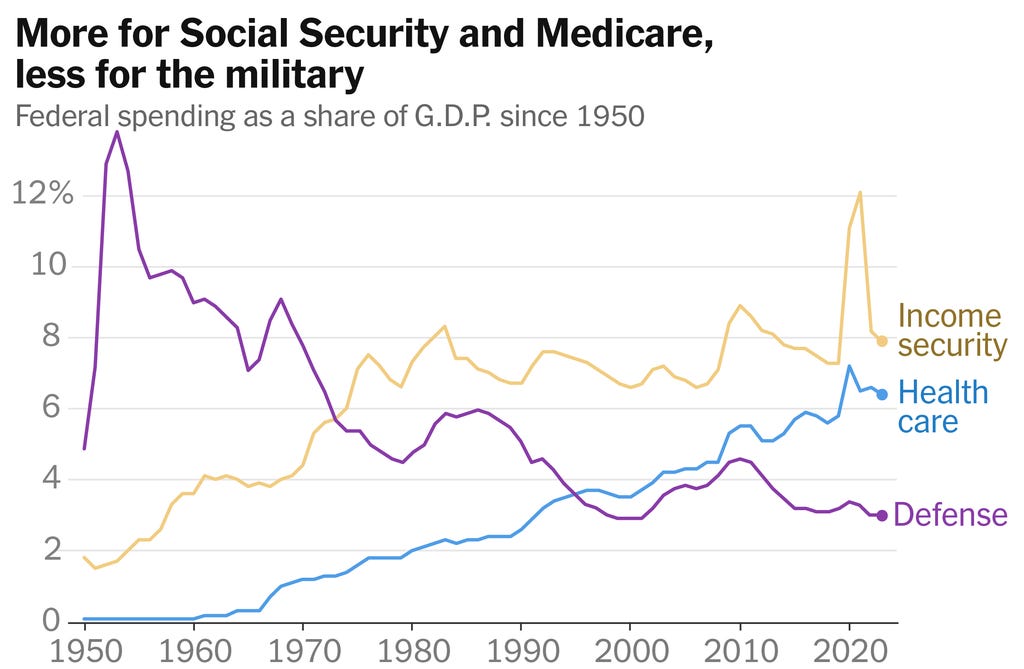
One reason is the decline in the share of U.S. resources devoted to the military. This Times chart, which may surprise some readers, tells the story:

Three lines track federal spending on health care, social security and defense. Total budget allocated to defense has fallen since 1950, while money spent on health care and income security has risen.

Source: Congressional Budget Office | By The New York Times

The report recommended increasing military spending, partly by making changes to Medicare and Social Security (which is sure to upset many liberals) and partly by increasing taxes, including on corporations (which is sure to upset many conservatives). The report also called for more spending on diplomacy and praised the Biden administration for strengthening alliances in Europe and Asia.

A Pentagon bureaucracy that’s too deferential to military suppliers. The report criticized consolidation among defense contractors, which has raised costs and hampered innovation. The future increasingly lies with drones and A.I., not the decades-old equipment that the Pentagon now uses.

A U.S. manufacturing sector that isn’t strong enough to produce what the military needs. A lack of production capacity has already hurt the country’s efforts to aid Ukraine, as The Times has documented. “Putin’s invasion has demonstrated how weak our industrial base is,” David Grannis, the commission’s executive director, said. If the Pentagon and the innovative U.S. technology sector collaborated more, they could address this problem, Grannis added.

A polarized political atmosphere that undermines national unity. A lack of patriotism is one reason that the military has failed to meet its recent recruitment goals. Perhaps more worrisome, many Americans are angry at one another rather than paying attention to external threats.

*******

Where to begin with such nonsense?

  1. So-called “defense” spending currently sits at or above $1 trillion, representing roughly 60% of federal discretionary spending. It continues to rise. Showing it as declining vis-a-vis the GDP is lying through statistics.
  2. Even if military spending was truly declining, which it isn’t, that would be a “good news” story. As President Eisenhower explained in 1953, military spending represents a theft from those who hunger, those who need shelter, those who need better schools and hospitals.
  3. Social Security: Yes, the government is going to keep trying to cut benefits while handing the savings to military contractors. Ditto for Medicare.
  4. Notice who’s mainly to blame for the alleged need for higher military spending: Putin and China.
  5. The Pentagon has misspent funds and misunderstands war. The solution: give the Pentagon more money as a reward.
  6. Americans are allegedly so angry with each other we’re not sufficiently hating Russians, Chinese, Iranians, and other alleged “external threats.”
  7. America lacks patriotism!

All this is reported with a straight face and the utmost seriousness by your “liberal” friends at the New York Times

So, when your Social Security benefits are reduced, when your Medicare bills go up, as you struggle even more mightily to make ends meet, just know your money is going to the Pentagon and the weapons makers.

Got a problem with that? The real problem just might be your lack of patriotism.

You can make a lot of money off sick people

W.J. Astore

America’s true national health care plan

When I was teaching college in Pennsylvania, I had a colleague whose car sported a telling bumper sticker: “Our national health care plan: Don’t get sick.” As true as that is, I think America’s real health care plan can be summed up by a corporate motto of my own coining: You can make a lot of money off sick people.

This came to mind today as my wife returned from a routine medical appointment. She overheard a lady complaining to a clerk that she didn’t understand her health insurance and why her latest procedure hadn’t been covered. Meanwhile, my wife noticed a sign about Medicare at the office, something about a new requirement that medical professionals were apologizing for in advance. And so it goes in the land of the free …

If you’re an American and 100% pleased with your medical care, you are a rare bird indeed. It’s an incredibly complex “system” with its own logic driven by the need to make money, whether off drugs or surgical procedures or whatever. I’ve talked to doctors and they tell me they’re typically allotted fifteen minutes per patient. They have to see a certain number of patients per hour, creating billable actions in the computer tablets they increasingly carry around with them, to fulfill quotas and to stay in business.

A heart specialist I was seeing, a truly sympathetic and knowledgable doctor, got fed up with all the emphasis on billing and money and took another position at a different hospital where he could do more research. At his practice, I noted new computer monitors in the examination rooms featuring videos that advertised drugs to lower cholesterol, improve blood pressure, and the like, along with pamphlets featuring shiny happy people taking various drugs related to heart and blood care. Honestly, I felt good for my doctor that he was going to a better job for him even as I felt bad for all his patients, myself included.

A big reason I supported Bernie Sanders was his seemingly empathetic and principled call for affordable health care for all, some kind of national plan that would deemphasize the profit motive, ending the tragic reality that some Americans have to choose between their own health and bankruptcy. Naturally, the Democratic Party, in league with big Pharma, health insurers (they should be called health deniers for their business model that seeks to deny claims whenever possible), and other corporate forces, threw their considerable financial support behind corporate tools like Hillary Clinton and Joe Biden.

He promised a public option. I guess he forgot about it.

Speaking of Biden, he of course promised a public (government) option on the campaign trail, only to renege on that promise once he became president. Biden, a tired corporate hack, will never go to bat for affordable health care, which is no endorsement of his Republican opponents. Their “plan” consists of encouraging bake sales and go-fund-me appeals along with vague hints of Scrooge-like notions: If you can’t afford your health care, you had best die to decrease the surplus population.

Are there no prisons, no workhouses?

The health of our society, in a sense, is the aggregate of the health of 333 million of us. Americans are increasingly sick, obese, depressed, tense, even suicidal. And it seems the first question some “providers” ask here is: How can I make money off this?

P.S. I kid you not. I just got an email from Amazon saying that “Your new pharmacy is here.” I feel happier and healthier already!