
Silencing Voices for Peace

W.J. Astore

The U.S. Mainstream Media Is Almost Always Pro-War

In the “liberal” New York Times today, I saw an article on “Putin’s forever war” that has the following short synopsis: “Vladimir Putin wants to lead Russians into a civilizational conflict with the West far larger than Ukraine. Will they follow him?”

Is this true?  Does Putin truly seek a “civilizational conflict” with the West?  One that’s “far larger” than the Ukraine war?  It doesn’t seem likely.  Russian forces have struggled in Ukraine.  Already embroiled in a destructive regional war that’s become somewhat of a quagmire, why would Putin seek to widen it?  Is Putin always the aggressor, the bad guy, and the West always the aggrieved party, the good guys, holding back a “red storm rising”?  I thought the West won the Cold War more than 30 years ago.

It’s remarkable how easy it is to get alarmist articles about Russia or China published in the U.S. mainstream media (MSM).  Wars and rumors of war dominate.  The West is always portrayed as the defender of democracy; other countries such as China and Russia are portrayed as threats to civilization and its “rules-based order.”  Strictly speaking, this is simplistic, one-sided, propaganda.

Back in 2017, I wrote about how difficult it is in the MSM to read honest accounts of war.  In the runup to the Iraq War in 2003, critical voices were actively suppressed and punished.  Back then, I focused my article on MSNBC, which like the New York Times is allegedly “liberal.”  At “liberal” newspapers and networks, shouldn’t America expect at least a few critical critiques of war narratives?  The answer here is “no,” as I wrote here:

Jesse Ventura, former governor of Minnesota (1999-2003), was a hot media commodity as the Bush/Cheney administration was preparing for its invasion of Iraq in 2003. Ventura, a U.S. Navy veteran who gained notoriety as a professional wrestler before he entered politics, was both popular and outspoken. MSNBC won the bidding war for his services in 2003, signing him to a lucrative three-year contract to create his own show – until, that is, the network learned he was against the Iraq war. Ventura’s show quickly went away, even as the network paid him for three years to do nothing.

I heard this revealing story from a new podcast, the TARFU Report, hosted by Matt Taibbi and Alex Pareene. By his own account, Jesse Ventura was bought off by the network, which back then was owned by General Electric, a major defense contractor that was due to make billions of dollars off the war.

Of course, Ventura was hardly the only war critic to run afoul of GE/NBC. Phil Donahue, the famous talk show host, saw his highly rated show cancelled when he gave dissenters and anti-war voices a fair hearing. Ashleigh Banfield, a reporter who covered the Iraq war, gave a speech in late April 2003 that criticized the antiseptic coverage of the war (extracts to follow below). For her perceptiveness and her honesty, she was reassigned and marginalized, demoted and silenced.

So much for freedom of speech, as well as the press.

As Phil Donahue said, his show “wasn’t good for business.” NBC didn’t want to lose ratings by being associated with “unpatriotic” elements when the other networks were waving the flag in support of the Iraq war. In sidelining Ventura and Donahue, NBC acted to squelch any serious dissent from the push for war, and punished Ashleigh Banfield in the immediate aftermath of the war for her honesty in criticizing the coverage shown (and constructed) by the mainstream media, coverage that was facilitated by the U.S. military and rubber-stamped by corporate ownership.

Speaking of Banfield’s critique, here are some excerpts from her speech on Iraq war coverage in April 2003. Note that her critique remains telling for all U.S. media war coverage since then:

That said, what didn’t you see [in U.S. media coverage of the Iraq war]? You didn’t see where those bullets landed. You didn’t see what happened when the mortar landed. A puff of smoke is not what a mortar looks like when it explodes, believe me. There are horrors that were completely left out of this war. So was this journalism or was this coverage? There is a grand difference between journalism and coverage, and getting access does not mean you’re getting the story, it just means you’re getting one more arm or leg of the story. And that’s what we got, and it was a glorious, wonderful picture that had a lot of people watching and a lot of advertisers excited about cable news. But it wasn’t journalism, because I’m not so sure that we in America are hesitant to do this again, to fight another war, because it looked like a glorious and courageous and so successful terrific endeavor, and we got rid of a horrible leader: We got rid of a dictator, we got rid of a monster, but we didn’t see what it took to do that.

With admirable honesty, Banfield spoke of the horrific face of war at Kansas State Univ. in 2003. Soon after her speech, she was demoted (Image courtesy of KSU)

I can’t tell you how bad the civilian casualties were. I saw a couple of pictures. I saw French television pictures, I saw a few things here and there, but to truly understand what war is all about you’ve got to be on both sides…

Some of the soldiers, according to our embeds had never seen a dead body throughout the entire three-week campaign. It was like Game Boy. I think that’s amazing in two different ways. It makes you a far more successful warrior because you can just barrel right along but it takes away a lot of what war is all about, which is what I mentioned earlier. The TV technology took that away too. We couldn’t see where the bullets landed. Nobody could see the horrors of this so that we seriously revisit the concept of warfare the next time we have to deal with it.

I think there were a lot of dissenting voices before this war about the horrors of war, but I’m very concerned about this three-week TV show and how it may have changed people’s opinions. It was very sanitized.

This TV show [Iraq invasion coverage] that we just gave you was extraordinarily entertaining, and I really hope that the legacy that it leaves behind is not one that shows war as glorious, because there’s nothing more dangerous than a democracy that thinks this is a glorious thing to do.

War is ugly and it’s dangerous, and in this world the way we are discussed on the Arab street, it feeds and fuels their hatred and their desire to kill themselves to take out Americans. It’s a dangerous thing to propagate…

I’m hoping that I will have a future in news in cable, but not the way some cable news operators wrap themselves in the American flag and patriotism and go after a certain target demographic, which is very lucrative. You can already see the effects, you can already see the big hires on other networks, right wing hires to chase after this effect, and you can already see that flag waving in the corners of those cable news stations where they have exciting American music to go along with their war coverage.

Nothing has changed since Banfield’s powerful critique. Indeed, the networks have only hired more retired generals and admirals to give “unbiased” coverage of America’s military actions. And reporters and “journalists” like Brian Williams have learned too. Recall how Williams cheered the “beautiful” U.S. Tomahawk cruise missiles as they were launched against Syria earlier this year [2017].

It’s not just that U.S. media coverage actively suppresses dissent of America’s wars: it passively does so as well, which is arguably more insidious. Any young journalist with smarts recognizes the way to get ahead is to be a cheerleader for U.S. military action, a stenographer to the powerful. Being a critic leads to getting fired (like Donahue); demoted and exiled (like Banfield); and, in Ventura’s case, if you can’t be fired or demoted or otherwise punished, you can simply be denied air time.

When you consider that billions and billions of dollars are at stake, whether in weapons sales or in advertising revenue tied to ratings, none of this is that surprising. What’s surprising is that so few Americans know about how pro-authority and uncritical U.S. media coverage of war and its makers is. If anything, the narrative is often that the U.S. media is too critical of the military to the detriment of the generals. Talk about false narratives and alternative facts!

America’s greed-wars persist for many reasons, but certainly a big one is the lack of critical voices in the mainstream media. Today’s journalists, thinking about their career prospects and their salaries (and who is ultimately their boss at corporate HQ), learn to censor themselves, assuming they have any radical thoughts to begin with. Some, like Brian Williams, even learn how to stop worrying and love the beautiful bombs.

[After I wrote this in 2017, I added this comment at the site.]

One thing that troubles me is the mindset that criticism of America’s wars undermines the troops. That it could even be a form of betrayal. This mindset is very dangerous. It not only protects the decisions and actions of those at the highest levels of the military and government. It acts to prolong wars and to endanger the lives of the troops (and of their “enemies” as well).

During the Iraq war, I recall instances of U.S. troops speaking clearly and frankly against the war. Their voices were heard, yet their advice was not taken. Instead, generals like David Petraeus were trotted out to assure the American people that the war was being won, even if the gains were characterized by weasel words like “fragile” and “reversible.” And so those gains have proved — even so, Petraeus remains in demand, and is still trotted out, now in mufti, to explain how we must stay the course and continue to defer to the military.

There’s a powerful book to be written here, and it should focus in part on the silencing or marginalization of anti-war voices (even those that wear or wore the uniform), even as pro-war elements are given the main stage as the voices of probity and sanity.
The Mainstream Media and the U.S. Military

W.J. Astore

How do we stop the next war built on lies from being waged?

(I prepared these notes for a talk I gave on “Truth-killers: The Corporate Media and the Military-Industrial Complex,” sponsored by Massachusetts Peace Action.  David Swanson also spoke.)

I served in the U.S. military for 20 years, and for the last 15 years I’ve been writing articles that are generally critical of that military and our nation’s drift into militarism and endless warfare.  Here are two lessons I’ve learned:

1.     I agree with I.F. Stone that all governments lie.

2.     As a historian who’s read and studied military history for most of my life, I agree that the first casualty of war is truth.

Because all governments lie and because lies are especially common during war, a healthy democracy must have an outspoken and independent media that challenges and questions authority while informing the public.

But the mainstream media (MSM) in America is neither outspoken nor independent.  The MSM in America serves as stenographers to the powerful.  Far too often, the U.S. military/government lies and leaks, the MSM believes and repeats. 

The result is clear: disastrous wars (Vietnam, Afghanistan, Iraq) from which little is ever learned, enabled by a media culture that is deeply compromised by, or openly in league with, President Dwight D. Eisenhower’s military-industrial-congressional complex (MICC).

Here’s the fundamental issue: We need a skeptical and powerful media to deter the MICC from wars, war profiteering, and folly.  The MSM should, and must, serve as a check on the MICC while holding it accountable when it fails.  By doing neither, it serves various “big lies,” enabling future abuses of power by the national security state.  There is no accountability for failure, so failure is neither punished now nor is it curtailed in the future.

Even when the MICC fails, and since the Vietnam War it has failed frequently, it gets more money. Consider the FY2023 Pentagon budget, which sits at $858 billion, a nearly inconceivable sum and which is roughly $45 billion more than the Biden administration asked for. 

The challenge, as I see it: How do we stop the next war built on lies from being waged?

Something to ponder: Could a more critical, more courageous, truly independent media have shortened or stopped the Vietnam War? Iraq? Afghanistan?

In his famous speech warning Americans about the MICC in 1961, Eisenhower (Ike) said that only an alert and knowledgeable citizenry could guard against the acquisition of power by the MICC.  This may indeed be why most citizens are not kept informed or are misinformed about the U.S. military and its wars.  It’s hard to act when you’re kept ignorant.  You’ll also be reluctant to act when you’re told to defer to the “experts” in the MSM, most of whom are deeply compromised, often by conflicts of interest that are kept hidden from you. 

Military Mendacity

Put simply, the U.S. military, in its upper ranks, lacks honor.  What matters most is reputation and budgetary authority.  Sharing negative news with the media is the absolute last thing the military wants to do.  Surprisingly, most in the MSM are willing to look the other way, assuming they even know of military mendacity and malfeasance.

What this means, essentially, is that the MICC is unaccountable to the people–the very antithesis of democracy.

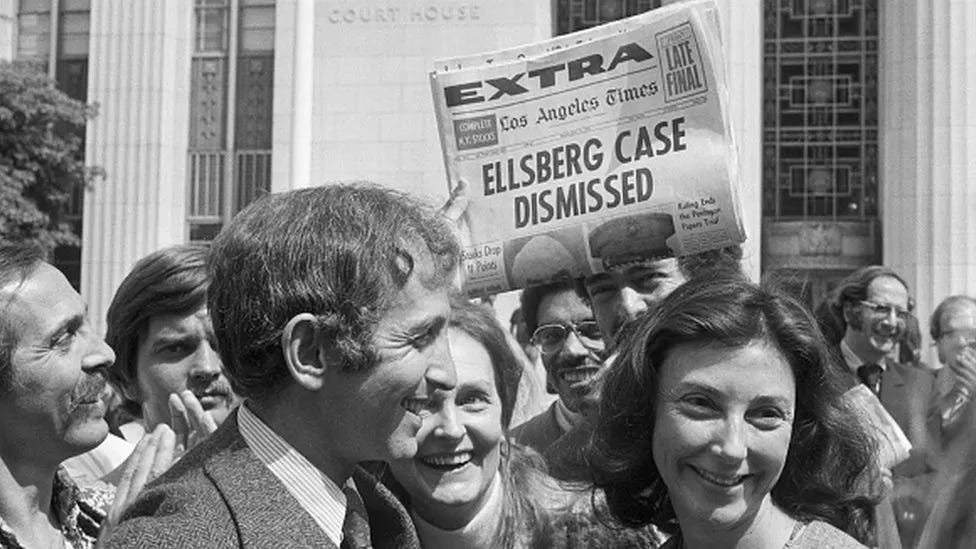
Three big examples of MICC mendacity: The Pentagon Papers revealed by Daniel Ellsberg during the Vietnam War; the Iraq War and lies about WMD (weapons of mass destruction); and the Afghan War Papers.  Even as the U.S. military was losing these three wars, military commanders and government officials spoke publicly and confidently of lights at the end of tunnels, of corners being turned toward victory.  (Privately, however, they talked of serious problems and lack of progress.)

With “The Pentagon Papers,” Daniel Ellsberg revealed the lies that helped fuel the Vietnam War

The MSM (with notable exceptions) largely repeated the happy-talk lies.  Since 9/11, this is unsurprising, since the MSM leans heavily on senior retired military officers, CIA officials, and the like to “interpret” events in places like Iraq and Afghanistan.  As journalist David Barstow showed, these “interpreters” were and are fed talking points by the Pentagon.  Whatever this is, it’s not honest reporting.  It’s not journalism.  It’s state propaganda. 

It’s not that the American people can’t handle the truth about “their” military.  It’s that the MICC prefers to keep a lid on the truth, because the truth is often unfavorable to their positions, power, prestige, and profits. 

There are many ways the MICC works with a complicit media (and a compliant Congress) to keep the truth from us.

1.     Bad news is not reported.  Or it’s classified or otherwise hushed up.  Consider the My Lai Massacre in Vietnam or the “collateral murder” video from the Iraq War revealed by Chelsea Manning and Wikileaks.

2.     Critical information is omitted.  Coverage is edited.  Consider the ban on showing flag-draped coffins by the Bush/Cheney administration, or official reports about drone strikes that omitted the true number of civilian/non-combatant casualties.

3.     The military has its own PAOs (public affairs offices and officers) who feed news of “progress” and similar “good news” stories to the media.  This is also true of the State Department. (See Peter Van Buren’s account, “We Meant Well,” of his Potemkin Village-like experience in Iraq.)

4.     Ever-present appeals to patriotism and warnings that critical information will give aid and comfort to the enemy.  Even worse, portraying critics as pro-Putin, as possible traitors, as in the NBC smear campaign against Congresswoman Tulsi Gabbard, abetted also by Hillary Clinton.

5.     Run-of-the-mill propaganda.  Consider, for example, how almost all U.S. sporting events include glowing coverage of the military and veterans.  If all military members are “heroes,” how dare we question them!  Instead, you’re encouraged to salute smartly and remain silent.

Media Complicity

Why is the MSM so hobbled and often so complicit with the MICC?

1.     Intimidation.  Critics are punished.  Examples include Ashleigh Banfield, Phil Donahue, and Chris Hedges in the early days of the Iraq War.  Think of Julian Assange today.  Edward Snowden.  Daniel Hale.  Smart journalists know (or learn) that critics and whistleblowers are punished; cheerleaders are promoted, e.g. Brian Williams, demoted for stolen valor but redeemed for declaring his awe at “the beauty” of U.S. missiles.

2.     Ratings/Economics.  Recall that MSNBC fired Phil Donahue over concerns that his critical coverage of the Iraq War was turning off viewers, i.e. that the network wasn’t being seen as “patriotic” as rivals like CNN or Fox News, thereby losing market share and money.

3.     Embedding Process.  Reporters who want to cover war are often embedded with U.S. military units.  They come to identify with “their” troops, who, after all, are protecting them from harm.  The embedding process forges a sense of dependency and camaraderie that interferes with disinterested and balanced reporting.

4.     Reliance on deeply conflicted experts from the MICC instead of independent journalists.  Whatever else they are, retired generals and CIA directors are not reporters or journalists.

5.     Corporate advertising dollars.  Why air a report critical of Boeing or Northrop Grumman when that company is a major advertiser on your network?  Why bite the hand that feeds you?

You don’t need a top secret “Mockingbird” project by the CIA to infiltrate and influence the MSM, as we witnessed during the Cold War and Vietnam.  Today, the MSM and its owners acquiesce in their own infiltration, hiring retired CIA agents and similar senior government officials to give/sell their “unbiased” opinions.

Again, military contractors pay for ads and sponsor shows on TV. The media is not about to challenge or criticize a big revenue stream. And it’s not always a weapons maker like Boeing or Raytheon. Think of ExxonMobil.  Their thirstiest customer is the U.S. military; ExxonMobil is unlikely to support media reports that criticize its biggest customer.

Meanwhile, there are precious few reporters and journalists willing to risk their careers to challenge the MICC.  With so-called access journalism, if you reveal uncomfortable facts, you’ll likely lose access to the powerful, alienate your bosses, and probably lose your job.

Food for Thought: Journalists are selected and groomed for compliance to mainstream militarized agendas. They’ve learned and internalized what is acceptable and what isn’t.  If they refuse to play along, they’re fired or shunted aside. (See Noam Chomsky and the manufacturing of consent.)

For the U.S. military, full-spectrum dominance includes information and the control of the same, including most especially in America.

A final shocking truth: The U.S. military lost in Vietnam, Iraq, Afghanistan, and elsewhere while avoiding responsibility. Indeed, its cultural authority and its command over the media have only grown stronger.  Worse, the military promulgates, or goes along with, various stab-in-the-back myths that exculpate itself while mendaciously blaming the few good media outlets for accurate reporting about the MICC’s failings.

A crucial step in preventing future disastrous wars is a media culture that sees the MICC for what it is: a danger to democracy and liberty, as Ike warned us in 1961 in his farewell address.  How we get there is a crucial issue; the failures above suggest remedies.

One remedy I wrote about in 2008: the major networks need to develop their own, independent, journalists who are experts on the military, rather than relying largely on retired military officers and other senior government officials.

We are told that America has independent media rather than state media like China or Russia.  Yet, if America had official state media, would its coverage differ from today’s content?  The MSM supports state and corporate agendas because that’s how it makes money even as it claims it’s “independent.”

A Couple of Anecdotes

A journalist colleague told me of his experience teaching students at one of America’s universities.  His sense: most students today don’t want to be Bob Woodward and Carl Bernstein.  They aspire to be on-air personalities who make six-figure salaries while being invited to all the right parties.  They don’t want to afflict the comfortable while comforting the afflicted; they want to be among the most comfortable.  Crusading for truth isn’t what they’re about.  They seek to be insiders.

From the Robert Redford movie, “Three Days of the Condor.”  If a whistleblower goes to the MSM (in the movie, it’s The New York Times), will the truth ever see the light of day?  More to the point, if the American people do see it, will they even care?

What we’re witnessing in America, according to Matt Taibbi, is an “elaborate, systematized method of censorship and opinion control.”  Taibbi mentions agencies like Homeland Security and Justice/FBI and their focus on “collecting domestic intelligence on a grand scale … seeking to distort the public’s perception of reality through mass moderation, via programs we’ve been told little to nothing about.”

While Taibbi, in his latest investigation, focused on social media and especially Twitter, the reality is that the MSM (and social media as well) is complicit with the government/military, collaborating on what “truths” are fed to the people while suppressing facts that are deemed dangerous, embarrassing, inconvenient, and otherwise not in the interest of the MICC.

With so many Americans now getting their news from social media sites rather than the MSM, that the government serves as a powerful content-moderator for what counts as “reliable” news on social media should disturb us all.

Again, it’s hard for Americans to serve as Ike’s “alert and knowledgeable” citizenry when they are fed lies, disinformation, and propaganda by the government and MSM. 

Even more fundamentally, when corporations are elevated and protected as super-capable “citizens” and when citizens themselves are reduced to passive consumers—when corporations own the MSM while profiting greatly from war and militarism—there’s little hope of fostering freedom and of ever escaping from a state of permanent warfare.

This is where we are today.

Our Pro-War Media

Cheerleaders may support our troops, but media cheerleaders are bad at covering our wars

W.J. Astore

Five years ago, I wrote an article for Nieman Watchdog with the title, “Networks Should Replace Pentagon Cheerleaders with Independent Military Analysts.”  Major media networks rely on retired colonels, generals, and admirals to give “unbiased” and “disinterested” commentary on military matters to the wider public.  At the same time, many of these same retired military talking heads serve on boards for major defense contractors, a clear conflict of interest, as revealed most tellingly by David Barstow.  I argued that media outlets need to develop their own, independent, commentators, ones that are not embedded with (or in bed with) the military and companies that profit from war.

In five years, I’ve witnessed no change to military coverage on TV and cable news.  It’s wave-the-flag boosterism, pure and simple.  The main problem with such uncritical coverage is that it keeps us in untenable (and unwinnable) wars.  Consider the latest announcement from Afghanistan that American troops will remain in that country for another decade.  Such an announcement is greeted with collective yawns by the U.S. media, even though a majority of Americans want U.S. troops out of Afghanistan now.  After a dozen years of death and waste and corruption, who can blame them?

Critical documentaries have been made about the U.S. military and its wars, but they are consigned largely to leftist fringes and seen by audiences that need little convincing about the peril of war.  To name just three, consider watching The Ground Truth (veterans’ perspectives from Iraq), Dirty Wars (based on the Jeremy Scahill book by the same title), and Unmanned: America’s Drone Wars (currently streaming for free online).  These documentaries give the lie to the idea that America’s wars are heroic and clean and necessary.

Nevertheless, a pervasive myth is the belief that the U.S. media is “liberal” and “anti-military.”  In “Stop Blaming the Press,” journalist David Danelo (in the U.S. Naval Institute’s Proceedings from January 2008) recalled a comment made by the Commandant of the Marine Corps, General James Conway, in September 2006.  Lauding Marine reporters, General Conway barked, “Maybe if we could get the rest of the media to do the job like you folks, we might have a chance of winning the war [in Iraq].”  Stormy applause greeted this comment.

To his credit, Danelo defended the fairness of most U.S. media coverage, which drew strong dissents in the February 2008 issue of Proceedings.  A Navy officer complained that Danelo failed “to level criticism at reporters for not doing their part to ensure victory.”  Today’s press, this officer implied, neither supported American troops nor wanted America to succeed in its wars.  Another officer, a retired Marine, wrote that “just one negative story” from an American journalist “bolsters our enemies’ confidence and resolve while equally destroying support from the public at home, thus eroding our servicemen’s and women’s resolve on the battlefield.”  Refusing to suffer such journalistic “fools,” whose “stories could not have been more harmful than if al Qaeda had written them,” this officer demanded immediate military censorship of media working in-theater.  Those journalists who refused to cooperate “would operate at their own risk and without military protection,” this retired Marine concluded ominously.

The idea that critical media coverage provides aid and comfort to the enemy is a commonplace.  It serves to muzzle U.S. media watchdogs, ensuring that America will continue to unleash its dogs of wars across the world.

Sadly, the saying “The first casualty in war is truth” has never been more true.  When our media coverage of wars is compromised, so too are our wars.  And when our wars are fought for ill-conceived notions, so too will our media coverage be ill-conceived and notional.

As long as our nation keeps lying to itself in its wave-the-flag media coverage of war, our nation’s wars will persist.