
Trust the Government!

W.J. Astore

Well, Maybe Not

One of my favorite bumper stickers has this message: If you think you can trust the government, ask an Indian (Native American). It’s a good reminder.

Lately, the mainstream media has warned us against conspiracy theorists. Against distrusting government and media narratives. And yet recently (and finally!) the Wall Street Journal came clean in an article that probed President Biden’s declining stamina and mental health. The article is recounted here with venomous humor by Jimmy Dore.

I wrote in 2019 that Biden’s debate performance then, with his rambling about turning on record players and the like, suggested a diminishing capacity to serve as president. Many people shared those concerns, but the Democrats carefully stage-managed Biden, keeping him largely in Covid lockdown as he ran for the presidency and won. Over the last four years, we’ve witnessed many, many episodes of Biden’s continuing decline, most clearly during his debate earlier this year with President-elect Trump. Yet, until that debate, and even after in some cases, we were told not to believe our lying eyes about Biden’s sorry performance.

Now, with lame duck Biden slowly making his way out the door (assuming he doesn’t lose his way), we’re finally being told by the Wall Street Journal that he really wasn’t up to the job for the last four years.

I wonder why people don’t trust the government?

Another example: Recently, the government “discovered” the U.S. military had 2000 troops in Syria, not the 900 or so that Pentagon spokespeople had been telling us about for the last couple of years. What happened? Where did these extra 1100 troops come from? Not only can’t the Pentagon pass a financial audit (seven straight years of failures!), it can’t even count its troops.

Of course, the Pentagon knew all along that it had 2000 or so troops in Syria. They simply lied to us, full stop.

Will anyone be called on the carpet and punished for this lie? Of course not. When you lie for the government, you get promoted. When you reveal truth to the American people (Edward Snowden, for example), you get punished.

So, while not everything is a conspiracy, it’s always a good idea to question authority. Incredibly, whether led ostensibly by Biden or Trump, the federal government is something less than trustworthy. And if you don’t believe me, it wouldn’t be a bad idea to explore the white man’s many broken promises to Native Americans.
On Censorship and Disinformation

W.J. Astore

The best way to combat disinformation is with more and better information.  Censorship isn’t the answer.

The Biden administration has reached a different conclusion, creating a “Disinformation Governance Board” under the Department of Homeland Security. This “board” is headed by Nina Jankowicz, an unelected official and an apparent partisan hack. One example: she dismissed the infamous Hunter Biden laptop story as a “fairy tale” involving a “laptop repair shop”; it’s now been confirmed that Hunter’s laptop was real, and so too was that repair shop.

Democrats, of course, don’t have exclusive rights to censorship. Republicans always seem to be calling for books to be banned or education to be policed. But the real problem is much larger than partisan hackery and bickering. Efforts at censorship are all around us, couched as a way of protecting us from harmful lies and other forms of disinformation. Yet, as the comedian Jimmy Dore points out, the government isn’t that concerned about protecting you from lies; it is, however, deeply concerned with denying you access to certain truths, truths that undermine governmental authority and the dominant narrative.

As a retired U.S. military officer and as a historian, the most insidious lies and disinformation I’ve encountered have come from the government. Consider the lies revealed by Daniel Ellsberg and his leak of the Pentagon Papers. Consider the war crimes revealed by Chelsea Manning, aided by Julian Assange and Wikileaks. Consider the lies revealed in the recent Afghan War Papers. Consider the lies about the presence of WMD in Iraq, lies that were used to justify the disastrous Iraq War. The government, in short, is a center of lies and disinformation, which is precisely why we need an adversarial media, one that is willing to ferret out truth. Instead, we’re being offered a governmental Ministry of Truth in the form of a “Disinformation Governance Board.”

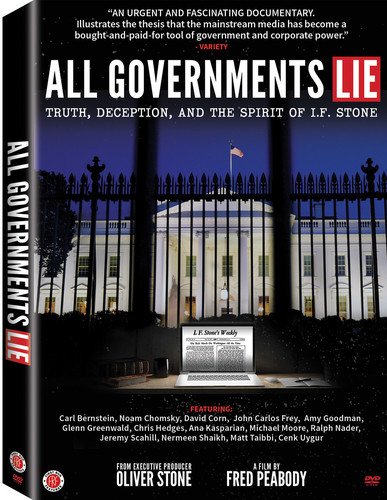
All things being equal, a democratic society thrives best when speech is as free as possible, trusting in the people to sort fact from fiction, and sound theories from blatant propaganda. And there’s the rub: trusting in the people. Because the government doesn’t trust us (remember Hillary Clinton’s comment about all those irredeemable deplorables), even as the government is often at pains to mislead and misinform us. As maverick journalist I.F. “Izzy” Stone said, all governments lie. It’s truly nonsensical, then, to allow the government to police what is true and what is “disinformation.”

But don’t we need some censorship in the name of safety or security or mental health or whatever? Sorry: censorship is rarely about safety, and it most certainly doesn’t serve the needs of the vulnerable. Instead, it serves the needs of the powerful, those who already possess the loudest megaphones in the public square.

But doesn’t someone like Donald Trump deserve to be censored because he spreads disinformation? Which is the bigger problem: Trump or censorship? I happen to think Trump is a divisive con man, but it was a bad precedent for Twitter to have banned him from tweeting. The bigger problem wasn’t Trump’s tweets but the media’s obsessive coverage of them in pursuit of ratings. The way to combat a blowhard like Trump is to ignore him, and to correct him when needed. To combat his lies with the truth. We don’t need a governmental Ministry of Truth to police the tweets of a former president. Not when the government is often the biggest liar.

The solution isn’t censorship but an active, engaged, and informed citizenry, assisted by a fourth estate, the press, that is truly independent and adversarial to power. But the weakening of education in America, combined with a fourth estate that is deeply compromised by the powerful and often in bed with the government, means that these democratic checks on power are less and less effective. Hence calls for quick yet dangerous “solutions” like censorship, where the censors (governmental boards, private corporations) are opaque and almost completely unaccountable to the people.

Unless your goal is to give the already powerful a monopoly on speech, censorship is not the answer.